Introduction
The European apple sawfly Hoplocampa testudinea (Klug) (Hymenoptera: Tenthredinidae) is an established invasive species in Canada and the United States of America. Native to Western Europe, it was introduced to North America in the 1930s. Since then it has spread throughout the western United States of America and into British Columbia, Canada apple orchards as well as moving from the northeastern United States of America into Québec, Canada and the Maritimes (Pyenson Reference Pyenson1943; Paradis Reference Paradis1980; Weires Reference Weires1991; Vincent et al. Reference Vincent, Babendreier and Kuhlmann2002; Vincent Reference Vincent2011). Adults of both sexes are active mainly during the bloom stage and females lay their eggs in the receptacle. Because apple trees require obligatory entomopollination, sprays with adulticidal insecticides are proscribed during bloom stage. Alternative control measures such as host resistance or biological control need to be explored.
Hoplocampa testudinea larvae leave the fruitlet, drop to the ground, and overwinter as pupae in the soil. Adult female H. testudinea emerge from pupation in early-mid May (Boevé Reference Boevé1996) and mature within 4–10 days (Miles Reference Miles1932; Downes Reference Downes1944; Weires Reference Weires1991; Ontario Ministry of Agriculture, Food and Rural Affairs 2011; Tamošiūnas and Valiuškaitė Reference Tamošiūnas and Valiuškaitė2013). After mating, female H. testudinea lay an egg at the base of the apple blossom (Weires Reference Weires1991; Boevé Reference Boevé1996; Ontario Ministry of Agriculture, Food and Rural Affairs 2011). Eggs take one to two weeks to develop (Miles Reference Miles1932; Weires Reference Weires1991) and after hatching, the larvae burrow into the fruitlet. As larvae grow, they invade nearby fruitlets, consuming one fruitlet per instar (Weires Reference Weires1991; Hull et al. Reference Hull, Pfeiffer and Biddinger1995). Consumed fruitlets will fail to develop and drop from the tree. Should the larvae fail to survive past the first instar, the apple will continue to develop and exhibit a characteristic c-scar at harvest (Alford Reference Alford1973).
Insects can exhibit cultivar preferences based on gustatory, environmental and/or chemical cues (Boevé et al. Reference Boevé, Lengweiller, Tollsten, Dorn and Turlings1996; Hogmire and Miller Reference Hogmire and Miller2005). Chemical cues include volatile semiochemicals emitted by the plant (Boevé et al. Reference Boevé, Lengweiller, Tollsten, Dorn and Turlings1996), where variation in the chemical profile can occur during its life cycle, or resulting from infestation by insects or pathogens. Cultivar preference has been documented for numerous insect species (Boevé et al. Reference Boevé, Lengweiller, Tollsten, Dorn and Turlings1996; Hogmire and Miller Reference Hogmire and Miller2005). Apple cultivars vary in their damage by H. testudinea at harvest (Briggs and Alston Reference Briggs and Alston1969; Alford Reference Alford1973; Hogmire and Miller Reference Hogmire and Miller2005), suggesting that cultivar may influence larval development. Mature apples with a c-scar are indicative that a sawfly larva failed to survive. High frequency of c-scars at harvest may indicate the ability of the cultivar to tolerate or resist loss from H. testudinea, rather than indicate preference as suggested by Briggs and Alston (Reference Briggs and Alston1969) and Alford (Reference Alford1973). Adult preference and damage of the fruitlets across cultivars has been suggested but not fully documented in H. testudinea (Miles Reference Miles1932; Alford Reference Alford1973). Further, these studies examined cultivars common for the time and region of study. Hoplocampa testudinea was found to use visual cues to discriminate between host cultivars (Chaboussou Reference Chaboussou1961) while other sawfly families use olfaction and tactile cues in cultivar choice and host plant selection (Bartelt et al. Reference Bartelt, Jones and Kulman1982; Cosse et al. Reference Cosse, Bartelt, Weaver and Zilkowski2002; Piesik et al. Reference Piesik, Weaver, Runyon, Buteler, Peck and Morill2008; Weaver et al. Reference Weaver, Buteler, Hofland, Runyon, Nansen and Talbert2009). A cultivar preference in H. testudinea to new cultivars in Nova Scotia, Canada has been reported anecdotally but not documented. Further, it was speculated that host volatiles emitted during bloom may play a role in the attraction of H. testudinea to its host.
The objectives of this work were to: (1) determine if H. testudinea exhibits a cultivar preference in apple cultivars within the Annapolis Valley, Nova Scotia; (2) examine larval performance across cultivars; and (3) determine whether host volatiles are involved in the attraction of H. testudinea females to preferred cultivars using laboratory bioassays and electroantennography.
Materials and methods
Field site
All field research was conducted at the Atlantic Food and Horticultural Research Centre (AFHRC) in Kentville, Nova Scotia, Canada (45°04′08″N, 64°28′41″W). Entomological research apple orchards B137 and B138 were selected for study, containing 16–17-year-old experimental and commercial cultivars. The orchards were treated with fungicides to control apple scab, but not with any insecticidal sprays during the study. Cultivars were grafted onto commercially available Malling-9 rootstock (B137) and Budagovski-9 rootstock (B138) and established in 1999 and 2000, B137 and B138, respectively. There were no overlapping cultivars between these two blocks. Each block comprised two rows of trees with the cultivars randomised within the block and allocated equally to each row. Distance between the blocks was ~30 m with the B137 block located north of the B138 block. Rows were in line between the blocks. There were five trees of “Ambrosia”, “COOP 39”, “Jubilee Fuji”, “Pinova”, and “Zestar!”, and four of “Rogers McIntosh” in orchard B137. In B138, there were eight trees of “8S-27-43”, “Royal Gala”, “s23-06-153”, and “Summer McIntosh” and seven “Silken” trees. Trees were topped at 3.5 m in height. In 2012 and 2013 field surveys occurred during late spring and early summer, from May until July, when H. testudinea were active.
Field observations
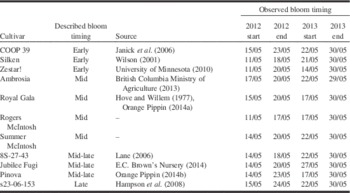
During 2012 and 2013, adult visitation on the surveyed cultivars occurred from 8 to 27 May and 5 May to 3 June, respectively (Table 1). Surveys occurred at least twice each week (i.e., every three to four days) with every tree surveyed each time. Surveys were conducted between 9:00 a.m. and 2:00 p.m. Larval infestation was surveyed from 4 June to 10 July 2012 and 6 June to 4 July 2013. Observations involved completing a circuit around each tree at 1.0–1.5 m from the trunk and visually identifying all adult H. testudinea visiting blossoms or infested fruitlets viewable by an observer on the ground. All adult H. testudinea visible while completing this circuit were recorded; all fruitlets were visible from the ground. Infested fruitlets were identified based on distinctive scarring and frass-filled holes created by larval H. testudinea. Numbers of infested fruitlets per tree per cultivar were used to quantify larval H. testudinea infestation. Percentages of infested fruitlets per tree were calculated using 10, 25, 50, or 100 randomly selected fruitlets. An original goal of 50–100 randomly selected fruitlets sampled per tree was intended. Variation in actual fruitlets sampled was based upon the productivity of each tree as some trees produced <50 fruitlets. Trees producing few fruitlets had a correspondingly smaller sample size. This was done to ensure that the same fruitlets were not sampled on consecutive surveys. At harvest, 27 apples/tree/cultivar were collected and examined for damage. Apples with the characteristic c-scar were counted as evidence of larval failure and used as an indicator of larval performance.
Average bloom periods for apples used in a Nova Scotian study of Hoplocampa testudinea cultivar preference.

Notes: Start of observed bloom is based upon sighting of first H. testudinea at each cultivar. End of bloom is based upon end of sightings at each cultivar. Dates given in day/month format.
Volatile collection
Host plant volatiles were collected in 2012 during bloom using a dynamic headspace system as described in Casado et al. (Reference Casado, Gemeno, Avilla and Riba2006). Collection times were concurrent with active periods of adult H. testudinea. A single-tree limb from each cultivar of interest was covered with oven bags measuring 45×56 cm (Extra Packaging, Boca Raton, Florida, United States of America). Samples of volatile chemicals emitted by each tree were collected within the bags by passing charcoal-scrubbed air (flow rate of 1 L/minute) across the bagged limb for two hours onto a Porapak-Q trap made from disposable glass pipettes, cotton, and 35 mg of PorapakTM Porous Polymer Adsorbents (mesh 50–80) (Sigma-Aldrich, Oakville, Ontario, Canada). All Porapak Q traps were conditioned by rinsing with pentane and heating to 150 °C under vacuum for four hours. Samples from three trees per cultivar were pooled for use in bioassays. Each bag had a capacity of 8 L. The amount of leaf material varied by tree, but was standardised to four to five blossom clusters (20–24 blossoms) per tree. Three trees from each cultivar were sampled at the same time. Porapak-Q traps were eluted with 2 mL 95:5 pentane: diethyl ether and concentrated under a slow stream of N2. Samples were concentrated to a total volume of 200 μL and stored at −20 °C until use. Each microlitre of volatile extract was equivalent to material produced from 1.2 blossoms/minute. Extracts from all trees within a cultivar were pooled for bioassay purposes.
Y-tube bioassays and electrophysiology
In 2013, live adult H. testudinea were collected using an aspirator and placed in a growth chamber at 15 °C, 80% relative humidity, and 16:8 light:dark photoperiod until experimentation. Y-tube bioassays were carried out to evaluate the role of host volatiles in cultivar preference. Only female H. testudinea were selected as it is ovipositional preference in host plants that leads to larval infestation and damage (Weires Reference Weires1991). The Y-tube assembly used humidified and charcoal-filtered air with 1.5 L/minute airflow. The Y-tube was 45 cm in length with a 23 cm central tube and two 22 cm junction arms. The tubes were 2.5 cm in diameter and composed of glass 2.5 mm thick. Temperature and humidity in the room were consistent at 21 °C and 60–80% relative humidity. Light levels in the room were measured at the arms and center of the Y-tube assembly. Illumination was consistent between each site at ~500 lx. Light levels were measured using a Sper Scientific Advanced Light Meter 840022 (Sper Scientific®, Scottsdale, Arizona, United States of America). A live H. testudinea adult was placed in the central tube of the assembly and monitored for seven minutes which is consistent for time used in other bioassays with sawflies (e.g., yellowheaded spruce sawflies, Pikonema alaskensis (Rohwer) (Hymenoptera: Tenthredinidae) in Bartelt et al. (Reference Bartelt, Jones and Kulman1982) and wheat stem sawfly, Cephus cinctus (Norton) (Hymenoptera: Tenthredinidae) in Piesik et al. (Reference Piesik, Weaver, Runyon, Buteler, Peck and Morill2008)). Due to low numbers of available sawflies, each female was used no more than twice each day.
Extracts from four cultivars were selected for testing. The four cultivars (two preferred and two non-preferred) were selected based on the preferences indicated by H. testudinea in the 2012 field season. The two “preferred” cultivars, “Zestar!”, and “Pinova”, were compared against two “less preferred” cultivars, “8S-27-43”, and “Ambrosia”. These cultivars were chosen from available samples to represent more preferred and less preferred responses in the field and to compare responses observed in the field versus a laboratory setting. Pentane was used as a control. Odour sources were 0.5×3 cm filter paper strips with 2 μL of volatile or the pentane control micro-pipetted to their surface. After each test, the Y-tube assembly was washed with 70% ethanol to remove any trace odours, wiped with KimTech Science* Delicate Task Kimwipes® (Kimberly-Clarkson International, Roswell, Georgia, United States of America) and air-dried. Fresh filter papers were used after each insect was tested. The position of the filter papers in each junction arm was switched after each trial.
Electroantennography
Olfactory responses from H. testudinea of both sexes to volatile blends were tested via electroantennography using a Syntech IDAC-4 system (Syntech®, Kirchzarten, Germany) between 17 May and 5 June 2013. Male H. testudinea were tested in addition to female to evaluate sex-based variation in olfactory responses. Extracts from three “preferred” (“Pinova”, “Royal Gala”, and “Zestar!”), and three “non-preferred” (“8S-27-43”, “Ambrosia”, and “COOP 39”) cultivars were used in the electroantennography (EAG) bioassays. The pentane control standardised any stimulation of antennal mechanoreception caused by airflow versus olfactory stimulation by selected blends.
Adult H. testudinea (five males and 11 females) were immobilised by being placed in a freezer at −20 °C for five minutes. Whole-body mounts were made by inserting the insect into a cut plastic 100-μL micropipette tip, which exposed the head and antennae but restrained bodily movement. The head of the insect was secured in place with dental wax and the distal tip of the right antenna was severed with surgical forceps to provide optimal contact between the recording electrode and the exposed lumen of the antenna. The ground electrode was inserted into the eye of the insect. Signals were amplified, digitally acquired, recorded and measured on a computer using AutoSpike® software (Syntech®).
Pulled glass electrodes made from 1 mm×6" Borosilicate 51 Exp glass capillaries (World Precision Instruments, Sarasota, Florida, United States of America) were used. Each capillary was nicked with a diamond cutter blade and used to create two electrodes using a Model P-97 Flame/Brown Micropipette Puller (Sutter Instrument, California, United States of America). After being pulled, the glass electrodes were broken at each tip and filled with saline. Electrodes were coated with a thin layer of Parker’s Signa gel® (electrode gel, Parker Laboratories, Fairfield, New Jersey, United States of America) to improve conductivity. Odour sources were prepared as described in Syntech (2004). Ten μL of each odour blend was applied on a 0.5×3 cm strip of filter paper. Each strip was inserted into a 5 3/4' disposable Pasteur pipette (13-678-6 G, Allied Fisher-Scientific, Washington, District of Columbia, United States of America), which was then connected to the air supply and inserted into the mixing tube 5–10 seconds before each stimulus puff. Difference in response by each sex to the odour of each cultivar was measured. Insects were subjected to a 0.5 second puff of odour, delivered by a stimulus controller and timed by the EAG software. For each recording, three seconds pre-stimulus and seven seconds post-stimulus were recorded. Time between puffs was between 30 seconds to one minute to prevent adaptation and habituation (Judd et al. Reference Judd, Gardiner, DeLury and Karg2005).
Data analysis
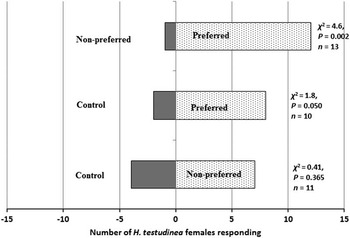
Adult visitation, larval infestation, and larval performance were evaluated for cultivar preference in Hoplocampa testudinea. Mean number of adult H. testudinea observed on blossoms, percentage of fruitlets infested by larvae, and percentage of apples displaying c-scars were analysed by unbalanced analysis of variance (ANOVA) tests at α=0.05 in R (R Core Team 2015). Count data were transformed using sin−1(sqrt(x+0.5)) and percentages transformed using sin−1(x) as required to ensure homogeneity of variance. Comparisons between cultivars were evaluated using Tukey’s honestly significantly different tests. Correlation between visitation and infestation, infestation, and damage at harvest and visitation and damage at harvest was evaluated in Excel (Microsoft, Redmond, Washington, United States of America). Correlation analysis was chosen over regression as the nature of these relationships is unknown and correlation represents a less constrained means to examine these relationships. Statistical evaluation of H. testudinea responses during Y-tube bioassays was performed using a χ2 analyses at α=0.05. Trials in which the insect did not respond to either odour were excluded from the analysis. Due to low numbers of adults available (five to seven for each comparison) results from individual cultivar trials were pooled into “preferred” and “non-preferred” categories. This resulted in three comparisons: preferred versus non-preferred, preferred versus control, and non-preferred versus control with 13, 10, and 11 female sawflies responding for each comparison. Electroantennogram responses were analysed using one-way ANOVA at α=0.05.
Results
Adult visitation
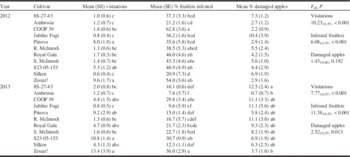
Analysis of adult visitations from 2012 and 2013 indicated that cultivars were not equally attractive to Hoplocampa testudinea and that populations were significantly different between years (cultivar: F 10,114=15.99, P<0.001, year: F 10,114=15.97, P=1.150×10⁻⁴, cultivar×year: F 10,114=1.273, P=0.254) (Table 2). Based on these results, three levels of preference can be inferred: more-preferred and less-preferred cultivars, in which levels of visitation are significantly different from each other and cultivars of intermediate preference, which are not significantly different from either preceding group. More-preferred cultivars, “Pinova”, “Zestar!”, and “s23-06-153”, had greater H. testudinea visitations compared with less preferred cultivars in each year. Intermediate and less preferred cultivars were similar between years as well, with one exception. “Silken” was of intermediate preference in 2013 and less preferred in 2012. In 2012, “Zestar!” was among the more preferred cultivars with a mean of 9.6 H. testudinea visits per tree. “Pinova” and “s23-06-153” had 8.00 and 5.25 mean visits (Table 2). In 2013, “Zestar!” was again a more preferred cultivar, as were “s23-06-153” and “Pinova”. Though not statistically different, “Royal Gala’s” higher mean visitations in 2013 than “COOP 39” may be a result of the later bloom of the latter (Table 1).
Mean number (SE) of Hoplocampa testudinea adults observed during bloom, mean (SE) percentage of fruitlets affected by H. testudinea larvae and mean percentage (SE) of fruit showing c-scar damage at harvest by cultivar during 2012 and 2013

Note: Letters following means within each column and year denote significance at α=0.05.
The variation in mean visitations and difference in ranking among cultivars may be a result of the bloom period intensity in each year. In 2012, all cultivars blossomed within six days of each other, providing a range of choice for H. testudinea. In 2013, the start of bloom was more staggered among cultivars, occurring over more than a week, thus providing fewer options for emergent adult H. testudinea.
Larval infestation
Larval infestation of fruitlets will indicate not only the pattern of insect choice but also the success of the larvae within a cultivar. Infestation rates were significantly different between cultivars in each year and between years, with no significant cultivar×year interactions (F 10,114=12.85, P<0.001; F 10,114=142.44, P<0.001; F 10,114=1.42, P=0.179, cultivar, year, and cultivar×year, respectively). In 2012 and 2013, “Zestar!”, “s23-06-153”, and “COOP 39” had a higher proportion of fruitlets infested, while “Silken” and “Ambrosia” consistently had low proportions infested (Table 2). In 2012, “COOP 39” had a mean of 28.3% infested fruitlets, compared with 26.7% for “Zestar!”. “Silken” and “Ambrosia” showed low levels of fruitlet infestation, 5.8% and 7.7%, respectively, with similar results observed in 2013 (Table 2).
Larval performance
Percentage of apples showing the characteristic c-scar were significant across cultivar and year with no significant cultivar×year interactions when the model included both years of data (F 10,117=2.98, P=2.240×10⁻³; F 10,117=8.47, P=0.004; F 10,117=1.04, P=0.416, cultivar, year, and cultivar×year, respectively). When the years were analysed separately however, cultivar did not show significance in 2012 but was significant in 2013 (F 10,60=1.43, P=0.192; F 10,53=2.52, P=0.013, 2012 and 2013, respectively). Percentage damaged apples ranged from 2.9% to 10.4% during 2012 and 0.74% to 12.5% during 2013. “8S-27-43” and “Jubilee Fugi” exhibited high levels of damage while “Zestar!” and “Ambrosia” showed low levels of damage in both years.
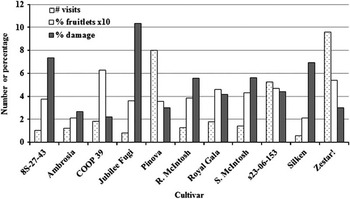
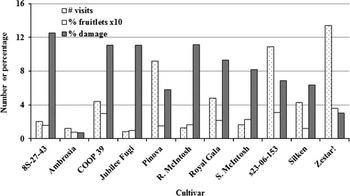
Comparison of visitation, fruitlet infestation, and damage at harvest by cultivar in 2012 (Fig. 1) and in 2013 (Fig. 2) clearly show the variation in larval performance. Cultivars with high visitation rates did not necessarily also have high levels of fruitlet infestation, e.g., “Zestar!” and “Pinova”. Likewise, cultivars with low visitation rates could have low to moderate levels of fruitlet infestation and then high levels of damage at harvest, e.g., “Jubilee Fugi” and “8S-27-43”. Correlation between mean visitation and mean infestations rate by cultivar were both positive; stronger in 2013 than 2012, 0.69 and 0.36, respectively. The relationship between mean infestation and mean damage at harvest was variable over the two years of this study (−0.61 and 0.44, 2012 and 2013, respectively). Finally the relationship between mean visitation and mean damage at harvest was negative for both 2012 and 2013 (−0.49 and −0.41, 2012 and 2013, respectively). Correlation analysis was chosen over regression as the nature of these relationships is unknown and correlation represents a less constrained means to examine these relationships.
Mean (±SE) of adult Hoplocampa testudinea visiting blossoms, percentage of fruitlets (×10) infested with H. testudinea larvae and percentage of apples showing damage from failed H. testudinea larval development in apple cultivars in 2012.

Mean (±SE) of adult Hoplocampa testudinea visiting blossoms, percentage of fruitlets (×10) infested with H. testudinea larvae and percentage of apples showing damage from failed H. testudinea larval development in apple cultivars in 2013.

Y-tube bioassays
Hoplocampa testudinea responded in the Y-tube bioassay with preferred host volatiles showing significantly greater attraction than non-preferred host volatiles (P=2.00×10⁻³) or the control (P=0.050) (Fig. 3). Females did not exhibit a preference for host volatiles over the control (P=0.365), however this may reflect the small sample size, rather than the absence of a preference.
Number of Hoplocampa testudinea females responding to host volatile blends from preferred or non-preferred cultivars in Y-tube bioassays. Responses to individual cultivars were pooled due to low numbers of available females.

Electroantennography
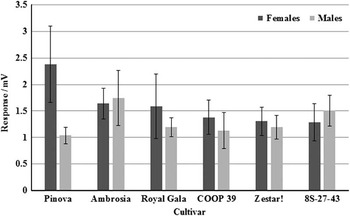
Electroantennographic responses to cultivar from either sex were not statistically significant (F 6,70=0.09, P=0.997; F 6,14=0.57, P=0.745, females and males, respectively, Fig. 4). Females gave a significantly stronger response F 6,84=18.71, P=4.160×10⁻⁵ than males. Electroantennographic results suggest a preference for “Pinova” as observed in the field (Fig. 1), but further study is required to validate these results. Other preferred cultivars, “Zestar!” and “COOP 39”, did not elicit a significantly stronger or weaker EAG response than the less preferred cultivars.
Mean electroantennographic response of female (n=11) and male (n=5) Hoplocampa testudinea adults to volatile extracts from different apple cultivars. Response was standardised to the response to the pentane control before analysis.

Discussion
Cultivar was a significant factor influencing Hoplocampa testudinea adult visitation and larval infestation of the fruitlets. Results from behavioural bioassays and electrophysiological tests suggest that volatile chemical cues may play a role in this preference, but that other factors or cues are likely involved. Field preference observed during bloom could have been influenced by the timing of bloom (Table 1). Although earlier blossoming varieties harboured more adults in the beginning of the survey period, once later blossoming cultivars opened, these were equally visited. “Zestar!” bloomed the earliest of the cultivars studied and was visited throughout the entire survey period. “Jubilee Fugi” bloomed relatively early (Table 1) but was less preferred (Table 2). Later-blooming cultivars such as “Pinova” (Orange Pippin 2014b) and “s23-06-153” (Hampson et al. Reference Hampson, McNew, Cline, Embree, Zandstra and Wilson2008) were the three more preferred cultivars visited by H. testudinea while other early-blossoming cultivars such as “Silken” or “Jubilee Fugi” were intermediate or less-preferred (Table 2). These observations are consistent with Miles (Reference Miles1932), who suggested that while timing of apple bloom could influence visitation rate, it was less important in determining cultivar attractiveness to H. testudinea than other cues. Results from the visitation surveys indicate that H. testudinea exhibits a consistent preference towards specific apple cultivars, but will visit less preferred cultivars if few options are available. A similar shift in visitation and infestation rates in mixed orchards was observed by Downes (Reference Downes1944).
Cultivars selected by H. testudinea for visitation also showed suitability of the cultivar for larval development as measured by infestation rate (Table 2). However, visitation preferences did not translate strongly into infestation levels or damage observed at harvest (Figs. 1–2). “Summer McIntosh” demonstrated suitability for H. testudinea infestation, but was less preferred during bloom (Figs. 1–2). Conversely, “Silken” had low levels of infestation in both field seasons, despite an increased interest by adults during 2013 (Figs. 1–2). “COOP 39” had an intermediate level of visitation, and showed a high rate of infestation by H. testudinea (Figs. 1–2). Correlations between mean visitation and mean infestations rate, between mean visitation and mean damage at harvest and between mean infestation and mean damage at harvest were all moderate (range of 0.36–0.69). That these correlations are not very strong suggests that cultivar may influence oviposition or larval survival. The specific attributes of these cultivars that translate into preference for oviposition or suitability for survival are largely unknown. Selection of fruitlets is vital to the survival of H. testudinea, as the larvae can suffer high mortality after hatching (Miles Reference Miles1932). Cultivars that are suitable as food sources for adult H. testudinea may not produce fruitlets that are suitable for survival of larvae, possibly due to traits associated with the fruitlets such as flesh firmness or chemical composition. Because H. testudinea oviposit a single egg on each blossom (Weires Reference Weires1991) and females produce epideictic pheromones after oviposition to deter conspecifics (Roitberg and Prokopy Reference Roitberg and Prokopy1984), high levels of infestation within a single tree and/or cultivar may induce ovipositing H. testudinea to seek alternate host sites, potentially leading to increases in infestation levels among cultivars that would otherwise be less preferred for visitation. This combination of factors may explain the differences in H. testudinea preferences between visitation and infestation. Fruitlets infested by H. testudinea larvae produce a strong odour (Vincent et al. Reference Vincent, Babendreier and Kuhlmann2002) with a higher concentration of terpenoids than healthy fruitlets (Boevé et al. Reference Boevé, Lengweiller, Tollsten, Dorn and Turlings1996; Boevé Reference Boevé1999), which may deter subsequent oviposition and infestation within the same tree. The stem galling sawfly, Euura lasiolepis (Smith) (Hymenoptera: Tenthredinidae), avoids ovipositing on arroyo willow shoots with natural or artificial oviposition scars (Craig et al. Reference Craig, Itami and Price1988). Roitberg and Prokopy (Reference Roitberg and Prokopy1984) determined that adult H. testudinea showed lower rates of oviposition on blossoms that were previously infested or artificially scarred to simulate oviposition. H. testudinea larvae showed a preference for uninfested fruitlets when given the option between uninfested fruitlets and those with living/dead conspecific larvae inside. The cues larvae use in differentiating between host fruitlets is unknown (Roitberg and Prokopy Reference Roitberg and Prokopy1984). Further, those cultivars with the highest susceptibility for sawfly may be those exhibiting the lowest damage at harvest as the damaged fruit is aborted and fails to mature.
Bioassay and electroantennography results suggest that H. testudinea will respond to host volatiles. The effect of olfactory cues on host plant preference has been noted in other sawfly families such as Cephidae (Hymenoptera) with the wheat stem sawfly C. cinctus (Piesik et al. Reference Piesik, Weaver, Runyon, Buteler, Peck and Morill2008; Weaver et al. Reference Weaver, Buteler, Hofland, Runyon, Nansen and Talbert2009) and in other Tenthredinidae sawflies, such as the yellowheaded spruce sawfly, P. alaskensis (Bartelt et al. Reference Bartelt, Jones and Kulman1982; Cosse et al. Reference Cosse, Bartelt, Weaver and Zilkowski2002). Cultivar selection in these species is influenced by volatile chemicals emitted from the host plant and conspecifics (Bartelt et al. Reference Bartelt, Jones and Kulman1982; Cosse et al. Reference Cosse, Bartelt, Weaver and Zilkowski2002; Piesik et al. Reference Piesik, Weaver, Runyon, Buteler, Peck and Morill2008). Female H. testudinea demonstrate avoidance to host plants with signs of previous oviposition/infestation, although the mechanism by which H. testudinea adults determine the suitability of host plants is unknown (Roitberg and Prokopy Reference Roitberg and Prokopy1984). In the bioassay studies presented here, individual cultivar pairings suffered from low replication. Pooling the cultivars into “preferred” or “non-preferred” categories yielded significant indication that H. testudinea adult females can distinguish preferred hosts using volatile cues. For further clarification, each female was tested against multiple stimuli pairings, usually only once but occasionally twice on the same day. In total there were 24 female H. testudinea used in the Y-tube bioassays with five or six being used on any given day and bioassays occurring over a three-week period. As these were wild caught adults, it is highly likely they had previous exposure to these cultivars in the field; adults are excellent fliers and can readily move between cultivars within the orchard. Despite this, it is possible that testing females more than once on the same day could have influenced results in the second trial, possibly creating a bias if initial exposure resulted in the same result when exposed a second time on the same day. Examination of the same-day trials did not disclose this trend, insects were equally likely to choose the first choice, the alternate choice or make no choice when tested on the same day. This result provided confidence that enough time between trials had passed for these to be considered independent responses.
Hoplocampa testudinea adults showed a preference during bloom for certain cultivars and there is some evidence that host volatile cues may play a role in their host choice. Once a host is chosen for oviposition, there are several factors that could influence subsequent survival of the larvae. The connection between visitation rate and oviposition was not examined here, but could lead to further understanding of the role of cultivar on larval survival and subsequent damage. Once inside a fruitlet, the developing larvae may encounter an environment not conducive to survival. It is wholly plausible that cultivars exhibiting low levels of sawfly damage at harvest are aborting higher levels of fruitlets and are actually more susceptible to sawfly attack. Cultivars with high levels of sawfly damage at harvest may be able to tolerate or resist fruitlet loss. Deeper examination of these areas is warranted to fully understand the extent of crop loss and nature of the relationship between H. testudinea and its host.
Acknowledgements
This work was supported with funding from Agriculture and AgriFood Canada Agriflex programme to S.B., Acadia University Acadia Graduate Assistantship to C.B., the Natural Science and Engineering Research Council through a Discovery grant (356109) to N.K.H., Canada Foundation for Innovation Funding (22087) to N.K.H., and Atlantic Canada Opportunities Agency – Atlantic Innovation Fund (197853) to N.K.H.