INTRODUCTION
Considerable evidence now suggests that employees’ feedback-seeking behavior, defined as the effort to ask others for information concerning work behavior and work performance (Ashford, Reference Ashford1986; Ashford, Blatt, & VandeWalle, Reference Ashford, Blatt and VandeWalle2003; Chen, Lam, & Zhong, Reference Chen, Lam and Zhong2007), can help employees to know themselves better in the work context, set job-related goals, and substantially contribute to performance enhancement and goal attainment (Ilgen, Fisher, & Taylor, Reference Ilgen, Fisher and Taylor1979; Ashford, Blatt, & VandeWalle, Reference Ashford, Blatt and VandeWalle2003; Chen, Lam, & Zhong, Reference Chen, Lam and Zhong2007; Crommelinck & Anseel, Reference Crommelinck and Anseel2013). Given the potential significance of employees’ feedback-seeking behavior, it is not surprising that scholars and practitioners alike have sought to identify ways to promote employee feedback seeking (e.g., VandeWalle & Cummings, Reference VandeWalle and Cummings1997; Wanberg & Kammeyer-Mueller, Reference Wanberg and Kammeyer-Mueller2000; Janssen & Prins, Reference Janssen and Prins2007). The resulting efforts by such investigators have suggested that feedback seeking is influenced by feedback seekers’ individual differences, such as personality, goal orientation, and feedback orientation (e.g., VandeWalle & Cummings, Reference VandeWalle and Cummings1997; Wanberg & Kammeyer-Mueller, Reference Wanberg and Kammeyer-Mueller2000; Janssen & Prins, Reference Janssen and Prins2007), and/or feedback-seeking contexts such as the supervisors’ leadership behaviors when they serve as feedback sources and the norms in the workplace (e.g., Ashford & Northcraft, Reference Ashford and Northcraft1992; Fedor, Rensvold, & Adams, Reference Fedor, Rensvold and Adams1992; VandeWalle & Cummings, Reference VandeWalle and Cummings1997; Callister, Kramer, & Turban, Reference Callister, Kramer and Turban1999; Williams, Miller, Steelman, & Levy, Reference Williams, Miller, Steelman and Levy1999; Steelman, Levy, & Snell, Reference Steelman, Levy and Snell2004).
Future time orientation is defined as the degree to which an individual values future-oriented behaviors, such as planning and delaying gratification (Strathman, Gleicher, Boninger, & Edwards, Reference Strathman, Gleicher, Boninger and Edwards1994; House, Hanges, Javidan, Dorfman, & Gupta, Reference House, Hanges, Javidan, Dorfman and Gupta2004). Studies have shown that individual differences in future time orientation are highly relevant to the work setting (Zimbardo & Boyd, Reference Zimbardo and Boyd2008), and play an important role in both how employees perceive their work and how they behave at work (Zimbardo & Boyd, Reference Zimbardo and Boyd1999, Reference Zimbardo and Boyd2008; Boniwell & Zimbardo, Reference Boniwell and Zimbardo2004). High future orientation is believed as essential if an employee is to be motivated to conduct activities that could generate long-term rather than immediate gain, and which may involve risk (Zimbardo & Boyd, Reference Zimbardo and Boyd2008). Given that feedback seeking requires the employee to slow down and seek input (Ashford, Blatt, & VandeWalle, Reference Ashford, Blatt and VandeWalle2003), it is surprising that little is known about the impact of future time orientation on employees’ feedback-seeking behavior. As such, drawing upon psychological ownership theory and construal-level theory (CLT), the first contribution our study makes is to extend the knowledge of the extant literature of feedback seeking by identifying future time orientation as an antecedent of employee feedback-seeking behavior.
Second, the majority of empirical studies have chosen immediate supervisors as the dominant source for employee feedback seeking (e.g., VandeWalle et al., 2000; Chen, Lam, & Zhong, Reference Chen, Lam and Zhong2007; Qian, Lin, & Chen, Reference Qian, Lin and Chen2012), but few studies have examined what influences an employee’s decision to seek feedback from co-workers. Given that co-workers play an important role in a person’s work life and the lateral relationships one forms with co-workers serve as informative feedback channels (Whitaker, Dahling, & Levy, Reference Whitaker, Dahling and Levy2007; Chiaburu & Harrison, Reference Chiaburu and Harrison2008), we suggest an examination of both immediate supervisors and co-workers as sources for employee feedback seeking. Therefore, the second contribution of our study is to examine the influences of employees’ future time orientation on feedback seeking from both supervisors and co-workers.
Third, we investigate how and why future time orientation influences feedback seeking. When explaining how and why antecedents could influence one’s feedback seeking, most studies have applied a cost–value framework (e.g., Ashford, Reference Ashford1986; VandeWalle & Cummings, Reference VandeWalle and Cummings1997; VandeWalle et al., 2000; Qian, Lin, & Chen, Reference Qian, Lin and Chen2012). This framework suggests that the cost and value analysis of feedback seeking determines one’s feedback-seeking behavior. Antecedents that enhance the perceived value of feedback seeking (i.e., satisfy the instrumental motive) and/or reduce perceived cost of feedback seeking (i.e., serve the motive of protecting one’s image and ego) will promote feedback-seeking behavior. However, a recent meta-analysis of the literature on feedback seeking (Anseel, Beatty, Shen, Lievens, & Reference Anseel, Beatty, Shen, Lievens and SackettSackett, 2015) has shown that the cost and value perceptions of feedback-seeking behavior only captures part of an individual’s decision to seek feedback (e.g., Ashford & Black, Reference Ashford and Black1996; Anseel & Lievens, Reference Anseel and Lievens2007). This review calls for more studies that not only focus on the behavior analysis itself, but which draw attention to the source of such behavior – that is, the job and the self (see Anseel et al., 2015). As such, in the present study we draw upon psychological ownership theory and CLT to propose that, future time orientation, a relatively broad individual differences, is activated in the work context through developing ownership feelings toward one’s job. In this way, future-oriented employees view their jobs as extensions of the self, thus are motivated to seek feedback.
Employing job-based psychological ownership as a motive to explain how future time orientation could be positively related to feedback seeking also addressed Ashford, Blatt, and VandeWalle’s (Reference Ashford, Blatt and VandeWalle2003) call to shift the tone of feedback seeking from the somewhat reluctant tone of filling the information gap and tailoring oneself to the views held by others, to a more positive tone that emphasizes the need for information from the employee himself/herself, and setting and achieving goals of meaning and excellence. Indeed, the application of a reluctant tone to fill the information gap has been challenged. For example, the meta-analytic review of 30 years of feedback-seeking research found that the relationship between uncertainty and feedback seeking was negative. In the present study, we argued that when an employee considers the job to be his or her own, the motivation to seek feedback comes from within. As suggested by psychological ownership theory (Pierce, Kostova, & Dirks, Reference Pierce, Kostova and Dirks2001, Reference Pierce, Kostova and Dirks2003), a job is a hub of multiple goals, and feedback seeking has been used as a self-regulation strategy to set and achieve these goals (Chen, Lam, & Zhong, Reference Chen, Lam and Zhong2007; De Stobbeleir, Ashford, & Buyens, Reference De Stobbeleir, Ashford and Buyens2011). The psychological state where employees feel as though their job is ‘theirs’ (Pierce, Kostova, & Dirks, Reference Pierce, Kostova and Dirks2003) captures how much the goals involved in their jobs mean to them. This could affect the amount of effort that employees are willing to put into the goal-directed self-regulation strategy of feedback seeking from various sources at work (in this study, supervisors and co-workers). Therefore, the present study makes a third contribution by hypothesizing job-based psychological ownership as a newly identified motive of employee feedback seeking and employing it as a mediating mechanism through which future orientation is made present and personal, and is bridged into feedback seeking from supervisors and co-workers.
THEORETICAL BACKGROUND AND HYPOTHESES
Future time orientation
Stemming from the psychology of time introduced by Lewin’s (Reference Lewin1951) and Fraisse’s (Reference Fraisse1963) seminal work, future time orientation is an emerging construct in the motivation literature and has been related to a host of psychological and behavioral constructs (e.g., Keough, Zimbardo, & Boyd, Reference Keough, Zimbardo and Boyd1999; Adams, Reference Adams2009). It is learned at an early age through culture, religion, social interactions, and family influences (Zaleski, Reference Zaleski1994, Reference Zaleski1996) and can be developed throughout one’s lifetime (Zimbardo & Boyd, Reference Zimbardo and Boyd2008). Moreover, this process, when set in the workplace, is considered as pleasant and meaningful (Zimbardo & Boyd, Reference Zimbardo and Boyd2008). This is because employees with high future orientation are empowered to be engaged in goal setting and goal attainment and they consider their future to be controllable, and are thus more willing to sacrifice present pleasure for future obligations.
Psychological ownership
The construct of psychological ownership can be traced back to the early work of Furby (Reference Furby1978), Dittmar (Reference Dittmar1992), Litwinski (Reference Litwinski1947), and Belk (Reference Belk1988). Pierce, Kostova, and Dirks define psychological ownership as ‘that state where an individual feels as though the target of ownership or a piece of that target is “theirs”’ (2003: 86). In the following elaboration of this construct, they suggest that people can develop ownership feelings toward a range of material (e.g., a house, bike, or toy) and immaterial (e.g., ideas, plans, and songs) objects. In the present study, the focus is placed on the psychological ownership that employees have toward their jobs, which in this context is defined as a psychological state an employee feels when the job is thought of as ‘his/hers.’
The psychological ownership theory proposed by Pierce, Kostova, and Dirks (Reference Pierce, Kostova and Dirks2001, Reference Pierce, Kostova and Dirks2003) represents a motivation model that identifies the routes through which psychological ownership emerges while evaluating its motivational potential. Three routes have been identified: controlling the target, coming to intimately know the target, and investing the self in the target. Meanwhile, the feelings of ownership can potentially lead to strong psychological and behavioral effects. Several outcomes have been proposed. For example, the willingness to make personal sacrifices on behalf of the target is an outcome of psychological ownership, whereas the assumption and experience of responsibility is another important outcome. Drawing upon the theory of psychological ownership, we posited that job-based psychological ownership is a powerful driving force that could lead to employee feedback seeking, and constitutes an underlying mechanism through which future time orientation relates to such seeking.
Future time orientation and feedback seeking
Research relating future time orientation and feedback seeking is surprisingly rare, yet there appear to be natural links between the two constructs. Future time orientation describes the extent to which individuals value future-oriented behaviors, such as planning and delaying gratification (Strathman et al., Reference Strathman, Gleicher, Boninger and Edwards1994; House et al., Reference House, Hanges, Javidan, Dorfman and Gupta2004). People who hold a future time perspective tend to be willing and able to challenge the current status, have the desire to make reasonable judgments about their current status quo, set a desired future state, and make subsequent plans to achieve it. In the workplace, employees who have a strong future time perspective may have a greater need for a broader range and depth of knowledge about their current work status in terms of work behaviors and performance, as well as the potential for improving or changing the status quo. Those employees are therefore more willing to seek feedback at work. In addition, research suggests that feedback seeking involves slowing down to seek input (Ashford, Blatt, & VandeWalle, Reference Ashford, Blatt and VandeWalle2003), which requires employees to turn away from the comforts of the present and to deny the impetus for fast action that is desired in the business world. Indeed, Zimbardo and Boyd note that future-oriented individuals have a strong will to achieve goals through exerting effort, and an understanding that ‘discipline and sometimes righteous suffering are necessary for getting from here to where they want to be’ (2008: 152). They further suggest that beliefs and expectations of the future could lead future-oriented employee to exert an effort in the behaviors that are more likely to persevere and endure.
Furthermore, recent research on CLT posits that how events are construed can influence both cognitive processing style and decision making (Liberman, Sagristano, & Trope, Reference Liberman, Sagristano and Trope2002; Trope & Liberman, Reference Trope and Liberman2003; Liberman, Trope, & Wakslak, Reference Liberman, Trope and Wakslak2007). Events construed at a high level are associated with schematic qualities and long-term goals, whereas events construed at a low level are associated with concrete qualities and immediate pleasure or pain (Usunier & Valette-Florence, Reference Usunier and Valette-Florence2007). Milkman, Rogers, & Bazerman (Reference Milkman, Rogers and Bazerman2008) argue that should choices (i.e., choices that benefit future goals, but which have immediate and detail-focussed costs) are more appealing to individuals when construed at a high level. Feedback seeking takes into account both long-term instrumental benefits and possible immediate costs that may hurt one’s image or ego (e.g., Ashford, Blatt, & VandeWalle, Reference Ashford, Blatt and VandeWalle2003; Qian, Lin, & Chen, Reference Qian, Lin and Chen2012). For this reason, we argue that future-oriented employees favor high-level construals. They tend to focus on the meaning of their jobs and on the self-regulation processes involved in the pursuit of long-term job-related goals (Zimbardo & Boyd, Reference Zimbardo and Boyd1999); these tendencies can lead them to perceive the should choice of feedback seeking as more attractive. Therefore, future-oriented employees are more likely to seek feedback at work.
Research has suggested that there is a range of feedback source options, such as immediate supervisors, immediate co-workers, and people from other departments or other organizations (e.g., Ashford & Tsui, Reference Ashford and Tsui1991; Miller & Jablin, Reference Miller and Jablin1991; Morrison, Reference Morrison1993; Vancouver & Morrison, Reference Vancouver and Morrison1995), though the majority of empirical studies have chosen immediate supervisors as a dominant source for employee feedback seeking (e.g., VandeWalle et al., 2000; Chen, Lam, & Zhong, Reference Chen, Lam and Zhong2007; Qian, Lin, & Chen, Reference Qian, Lin and Chen2012). In the present study, we focus on immediate supervisors and co-workers as primary sources for employee feedback seeking instead of being limited to supervisors as a dominant source. Accordingly:
Hypothesis 1a: Future time orientation is positively related to feedback seeking from supervisors.
Hypothesis 1b: Future time orientation is positively related to feedback seeking from co-workers.
Future time orientation, psychological ownership, and feedback seeking
Drawing upon psychological ownership theory and CLT, we contend that employees with stronger future time orientation are more likely to develop job-based psychological ownership, which in turn motivates them to seek feedback at work. Employees with high future orientation favor high-level construals – they can see beyond their day-to-day activities to the big picture, increasing psychological distance regarding their job. Rim, Hansen, and Trope (Reference Rim, Hansen and Trope2013) argue that increased psychological distance from events can help individuals to focus on underlying causes, as opposed to specific consequences. When future-oriented employees apply high-level construals to their job, they focus more on deeper causes and meaning; they make sense of their jobs by knowing them passionately, exercising control over, and investing in their work (Pierce, Kostova, & Dirks, Reference Pierce, Kostova and Dirks2001, Reference Pierce, Kostova and Dirks2003). Through building strong and long-term connections with their jobs, they come to view them as parts of their extended selves, cultivating feelings of psychological ownership.
Psychological ownership theory posits that there is ‘a varying likelihood of the development of feelings of ownership across individuals’ (Pierce, Kostova, & Dirks, Reference Pierce, Kostova and Dirks2003: 95), and it suggests that there will be individual differences in the development of job-based psychological ownership (Pierce, Kostova, & Dirks, Reference Pierce, Kostova and Dirks2001, Reference Pierce, Kostova and Dirks2003). Psychological ownership theory identified three routes through which psychological ownership emerges: becoming familiar with the target, the exercise of control over the target and an investment of the self into the target (Pierce, Kostova, & Dirks, Reference Pierce, Kostova and Dirks2001, Reference Pierce, Kostova and Dirks2003). Employees who are more future oriented are more willing to know the job passionately and intimately due to their need to be familiar with their current status in order to make plans and perform for the future. The set of rich knowledge about one’s job signals a living and deep relationship between the employee and the job, hence a strong feeling of ownership toward it (Beaglehole, Reference Beaglehole1932; Weil, Reference Weil1952). Furthermore, employees with high future orientation consider the consequences of their current job practice on their future well-being. They create or take advantage of opportunities to exert influence on their future and maximize their control, thus increasing the likelihood of developing feelings of ownership toward their jobs (Pierce, Kostova, & Dirks, Reference Pierce, Kostova and Dirks2003). In addition, in order to make sequential plans about the near future and direct current activities toward future objectives, future-oriented employees tend to invest their time, energy, skills, and emotion in their jobs, and are more likely to form and maintain ownership feelings toward them (Epel, Bandura, & Zimbardo, Reference Epel, Bandura and Zimbardo1999; Zimbardo & Boyd, Reference Zimbardo and Boyd2008).
A person with high job-based psychological ownership may seek more feedback because they set and internalize their job-related goals by considering them as their own, and are thus entitled to engage in self-regulatory processes to exert responsibility while applying the self-regulatory strategy of feedback seeking. When a person considers the goals as their own, they will try harder to achieve them and persist in that effort longer (Pierce, Kostova, & Dirks, Reference Pierce, Kostova and Dirks2003), meaning that employees with ownership feelings toward their jobs are more likely to continuously engage in the self-regulation process and seek feedback more frequently to help with this. Indeed, Formanek (Reference Formanek1991) suggests an uplifting effect of psychological ownership – when ownership feelings grow, individuals have stronger desires to bring it to the next level and exert a personal effort. Therefore, these employees will emphasize the degree to which the feedback is informative or helpful for their job. Furthermore, psychological ownership theory also suggests that someone with ownership feelings toward their job is more willing to make sacrifices. This line of thinking yields a change in attitude and shapes how the employee responds to the difficulties of the feedback-seeking process. Employees with higher job-based psychological ownership perceive less cost when seeking feedback and will be less likely to be hurt by the negative feedback. Thus, we suggest here that employees with job-based psychological ownership are more likely to seek feedback from supervisors and co-workers more frequently. Based on these arguments and evidence, we conceptualize job-based psychological ownership as a mediator through which future time orientation leads to feedback seeking from supervisors and co-workers. Accordingly:
Hypothesis 2: Future time orientation is positively related to job-based psychological ownership.
Hypothesis 3: Psychological ownership mediates the relationships between future time orientation and feedback seeking from supervisors and co-workers.
METHOD
Research setting, sample, and procedures
We collected data in person from a hotel group located in a major city in China. Two types of survey questionnaires were designed and collected. The supervisor questionnaires were distributed to 59 supervisors at a company meeting held for supervisors. This was one of the four meetings during that month, all of which were designed for training purpose to limit the size of each meeting. The participants for each meeting were randomly selected by the human resource management by computer. In each supervisor’s team, there were 7–24 subordinates. Of all 885 subordinates under the 59 supervisors, 68% were male at an average age of 35.2 with an average organizational tenure of 5.43 years. The 59 supervisors were instructed to rate the feedback seeking of five subordinates and distribute the subordinate questionnaires to them. The five rated subordinates were randomly selected by the human resource management by computer. Each questionnaire was assigned an identification number so the responses of the subordinates could be matched with the evaluations of their immediate supervisors. Respondents were informed that the survey aimed to investigate individual differences and proactive behavior and were assured of the confidentiality of their responses. To ensure confidentiality, the respondents were instructed to complete the questionnaires, seal them in the return envelope, and deliver them at a company meeting for all employees (both supervisory and non-supervisory) 2 weeks later. SMS messages were sent to the participants the day before the meeting and they were instructed to put the finished questionnaires in a designated box located at the front of the meeting venue.
Of the 59 supervisor and 290 subordinate questionnaires distributed, 56 supervisor and 228 subordinate questionnaires were returned, representing response rates of 94.91 and 78.62%, respectively. The average number in each workgroup was 4.07. Subordinate respondents were predominantly male (62.7%), reported an average age of 30.14 years (SD=5.5), an average organizational tenure of 6.31 years (SD=3.99), and an average of 13.82 years of formal education (SD=2.88). The subordinate participants came from different levels of the companies although the majority of them (95.2%) were non-supervisory employees, whereas the rest consisted of first-line supervisors (3.9%) and middle managers (0.9%). Of the supervisor participants, 68.3% were male, the average reported age was 31.3 years (SD=4.81), the average reported organizational tenure was 8.12 years (SD=4.53), and the average reported education was 14.3 years (SD=5.46). In terms of levels of management, 89.2% were lower-level managers, 9.6% were middle-level managers, and 1.2% were senior managers.
Measures
The translation and back-translation method (Brislin, Reference Brislin1990) was applied to verify the questionnaire in Chinese. According to Behling and Law (Reference Behling and Law2000), this technique is necessary as creating a translation from one language to another that maintains the conceptual equivalence is very difficult owing to cultural differences.
Future time perspective
This was measured with the 13-item future time perspective scale from the Zimbardo Time Perspective Inventory (Zimbardo & Boyd, Reference Zimbardo and Boyd1999). Respondents were asked to answer the question: ‘How characteristic is this of you?’ Sample items include ‘I am able to resist temptations when I know that there is work to be done’ and ‘I complete projects on time by making steady progress.’ Response options ranges from 1=‘very uncharacteristic,’ to 5=‘very characteristic.’ The α reliability for this scale was 0.97.
Job-based psychological ownership
This was measured with the 5-item scale from VanDyne and Pierce (Reference VanDyne and Pierce2004). Sample items include ‘I feel a very high degree of personal ownership for my job’ and ‘I sense that this job is my job.’ Response options range from 1=‘strongly disagree,’ to 5=‘strongly agree.’ The α reliability for this scale was 0.91.
Feedback seeking from supervisors
The immediate supervisors’ perceptions of their subordinates’ feedback-seeking inquiry frequency were measured with a 5-item scale validated by VandeWalle et al. (2000). Each supervisor was asked to provide his or her own ratings of how frequently each of the five aspects of feedback (i.e., the inadequacies of overall job performance, technical aspects of the job, values and attitudes of the firm, role expectations, and social behaviors) were asked by the rated subordinate. Response options ranged from 1=‘never,’ to 7=‘always.’ The α reliability for the scale was 0.72.
Feedback seeking from co-workers
Measured with a 5-item scale validated by VandeWalle et al. (2000), each employee participant provided his or her own ratings of how frequently they asked their co-workers for each of the five aspects of feedback (i.e., the inadequacies of overall job performance, technical aspects of the job, values and attitudes of the firm, role expectations, and social behaviors). Their scores were averaged to rate feedback seeking from immediate co-workers. Response options ranged from 1=‘never,’ to 7=‘always.’ The α reliability for the scale was 0.87.
Control variables
In keeping with other feedback-seeking research (e.g., Ashford, Reference Ashford1986; Gupta, Govindarajan, & Malhotra, Reference Gupta, Govindarajan and Malhotra1999; VandeWalle et al., 2000), we controlled the participants’ age, gender, education, position, and company tenure. Age, education, and company tenure were measured by number of years. Gender was coded 0 for ‘female’ and 1 for ‘male.’ The nominal variable of the employee position was coded 1 for ‘non-supervisory employees,’ 2 for ‘first-level supervisor/manager,’ and 3 for ‘middle-level manager.’
Data analytic strategy
First, although the variables included in the current study are theoretically distinctive, we conducted a confirmatory factor analysis using AMOS 17.0 to empirically demonstrate the distinctiveness of future orientation, psychological ownership, feedback seeking from supervisors, and feedback seeking from co-workers. Mediation models were tested using an SPSS INDIRECT macro for bootstrapping methods, described by Preacher and Hayes (Reference Preacher and Hayes2008) for estimating direct and indirect effects. These analytic methods are considered advantageous for testing mediation, as it focussed on the presence and size of the indirect effects without the designation of the full or partial mediation that is over sensitive to sample size (Rucker, Preacher, Tormala, & Perry, Reference Rucker, Preacher, Tormala and Petty2011). Statistically, the presence of a significant correlation between future time orientation and psychological ownership is no longer a requirement for testing of mediation (Rucker et al., Reference Rucker, Preacher, Tormala and Petty2011). However, as discussed previously in the hypothesis section, we argued for a significant correlation between future time orientation and psychological ownership owing to theoretical consideration.
Second, as each supervisor rated the feedback-seeking score for more than one subordinate in the present study, we computed the intraclass correlation coefficient to assess whether non-independence of supervisor ratings of subordinate’s feedback seeking was a concern in this study. Non-independence has little impact on statistical results when the intraclass correlation coefficient and the number of subordinates assigned to a rater are relatively small (Kenny, Kashy, & Bolger, Reference Kenny, Kashy and Bolger1998; Bliese, Reference Bliese2000). In the current study, the average number of subordinates per supervisor in this sample was 4.07 and the intraclass correlation coefficient was 0.03. Hence, the issue of non-independence was not consequential in this study.
RESULTS
Confirmatory factor analysis
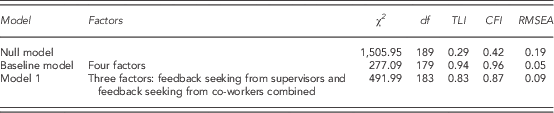
To examine the distinctiveness of the variables studied, we conducted confirmatory factor analyses using AMOS 17.0. Procedures used by previous researchers that reduce the number of items by creating three indicators for each construct were adopted (e.g., Bagozzi & Heatherton, Reference Bagozzi and Heatherton1994; Aryee, Chen, Sun, & Debrah, Reference Aryee, Chen, Sun and Debrah2007). We compared the hypothesized 4-factor model with null model and one 3-factor model. As shown in Table 1, the baseline model (4 factors) fits better than the null model as well as Model 1, indicating that the studied variables were distinct from each other.
Results of confirmatory factor analysis for the studied variables
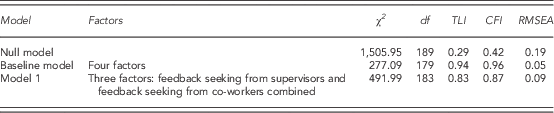
Note. n=228 with listwise deletion.
CFI=comparative fit index; RMSEA=root-mean-square error of approximation; TLI=Tucker–Lewis index.
Descriptive statistics
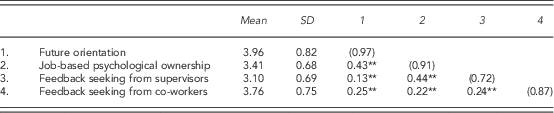
Table 2 presents the means, standard deviations, correlations, and reliabilities of the study variables for descriptive purposes. As can be seen, future orientation, feedback seeking from supervisors, feedback seeking from co-workers, and psychological ownership positively correlated with each other, providing preliminary support for Hypotheses 1a, 1b, and 2.
Deviations, reliabilities, and correlations among study variables
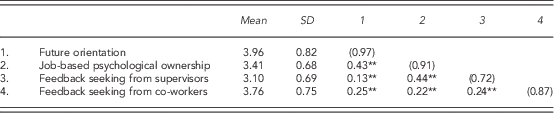
Note. n=228 with listwise deletion.
**p<.01.
Mediating effect
Mediation models tested the hypothesis that future time orientation exerted an indirect effect on feedback seeking through psychological ownership. As shown in Figure 1, future time orientation was indirectly related to employee feedback seeking from supervisors (a1 path=0.33, SE=0.06, p<.000) and co-workers (a2 path=0.36, SE=0.05, p<.000) via psychological ownership. Higher future time orientation was associated with increased psychological ownership (b1 path=0.39, SE=0.05, p<.000; b2 path=0.15, SE=0.08, p=.050), which in turn was related to greater feedback seeking from supervisors (indirect effects point estimate=0.13, SE=0.03, 95% BCa CI=0.0783–0.2051) and co-workers (indirect effects point estimate=0.06, SE=0.03, 95% BCa CI=0.0021–0.1246). Post hoc analysis also examined whether participants’ age, gender, level of education, professional position, or tenure with present employer moderated the mediation findings. Linear regressions showed that psychological ownership remained a significant predictor of employees’ feedback-seeking variables after controlling for the above-mentioned demographic variables.
Research model

DISCUSSION
The topic of feedback-seeking behavior has received and continues to receive research attention. What remains to be answered is whether and how future time orientation contributes to feedback seeking. In the present study, we have sought to answer this question by developing and testing a model that links employee future time orientation with feedback-seeking behavior from supervisors and co-workers while investigating the underlying mechanisms. The results revealed that (a) future time orientation was positively associated with feedback seeking from various sources (i.e., supervisors and co-workers) and (b) the positive relationships were mediated by employees’ perceptions of job-based psychological ownership.
Theoretical implications
The findings of the present study contribute to the literature with three primary theoretical implications. First, the role of employees’ future time orientation on promoting feedback seeking at work has hardly been investigated, either theoretically or empirically. Addressing this issue, we proposed and found that the future time orientation of employees is positively associated with their feedback seeking from supervisors and co-workers. Second, the findings of this research also shed new light on identifying job-based psychological ownership as a newly identified motivator in promoting feedback-seeking behavior. The focus on employees’ psychological ownership complements the content of other research exploring the motives of feedback-seeking behavior, such as the instrumental motive and image protection motive (e.g., VandeWalle & Cummings, Reference VandeWalle and Cummings1997; VandeWalle et al., 2000; Qian, Lin, & Chen, Reference Qian, Lin and Chen2012). Third, drawn upon psychological ownership theory and CLT, the findings support the mediating influence of job-based psychological ownership on the relationship between future time orientation and feedback seeking from supervisors and co-workers.
Practical implications
First, the findings suggest that organizations should develop employees’ future time orientation. As noted by Zimbardo and Boyd (Reference Zimbardo and Boyd2008: 139), ‘no one is born with a future time perspective’ and they suggest that it could be developed by experience and learning. Accordingly, a practical implication for organizations is to hire employees with high future time perspectives, while also developing such orientations and perspectives through interventions designed to help employees to look toward the future and to develop planning strategies (e.g., Zimbardo & Boyd, Reference Zimbardo and Boyd2008; Ferrari, Nota, & Soresi, Reference Ferrari, Nota and Soresi2010). Second, the finding concerning the mediating role of psychological ownership suggests that employees should operationalize their future orientation at work via developing job-directed psychological ownership, which serves as a bridge between future orientation and feedback seeking. Employees should therefore keep this in mind and strive to develop their sense of psychological ownership. This finding also suggests that managers need to be mindful that selecting or training employees on the basis of their future orientation alone will not guarantee feedback seeking, for it is the building up of the job-based psychological ownership of their employees that will provide the driving forces for future orientation to take hold and bring forth feedback seeking. Thus, managers can be instrumental here in terms of designing psychological ownership development features into future orientation training programs.
Limitations and future research
Despite the noted contributions, several limitations warrant discussion to properly interpret the results of this research, and these could also aid future studies. First, the use of cross-sectional data implies that cause–effect relations cannot be inferred from the findings. Our findings are consistent with the psychological ownership theory and CLT. Future research should, nonetheless, adopt a longitudinal design to fully address the issue of causality.
Second, the universal applicability of the results remains to be tested owing to several factors. The extent to which the results in the current study are applicable to other cultures is an open question as the hypotheses were only tested on Chinese samples. In addition, the data used in the present research were only collected from one organization within the hotel industry, meaning that the extent to which the results are applicable to other organizations or industries can only be speculated.
Third, we focussed only on future time orientation as an antecedent of feedback seeking. Future studies could also account for other individual difference variables or contextual variables that would predict feedback seeking. For example, supervisor’s demonstration of feedback seeking at work may lead employees to engage in feedback seeking from supervisors. Social learning theory suggests that individuals tend to perform the same type of behavior they observe others demonstrate (Bandura, Reference Bandura1986). In addition, the theory suggests that the essence of observational learning is to acquire behavior-related skills and strategies, rather than mimicking exactly what others have done. In this regard, observing and experiencing supervisors’ feedback seeking may lead an employee to engage in feedback seeking from supervisors.
Fourth, we did not examine the potential moderators for our hypothesized mediation model. This is because the main purpose of this study was to propose a new motive of job-based psychological ownership to explain the process of an employee’s feedback seeking. We suggest that future research should systematically examine how situational and individual variables could moderate the influence of psychological ownership on feedback seeking. For example, we propose a dual-level model for future studies to examine the joint moderating effect of group culture and the quality of the relationship between the feedback seeker and feedback source on the decision process of feedback seeking (see Figure 2). In this model, we propose that the effect of psychological ownership on feedback seeking from supervisor will be stronger when the group has lower power distance culture, or when an employee has better relationship with the supervisor (e.g., leader–member exchange); and this effect will be the strongest when group power distance culture is lower while the leader–member exchange is higher. As for the feedback seeking from co-workers, we propose that psychological ownership will have a stronger influence when the group has a higher collectivism culture, or when an employee has better relationships with the co-workers (e.g., team–member exchange). Psychological ownership will have the strongest influence when both group collectivism culture and team–member exchange are higher.
A proposed multiple-level model with group culture and interpersonal exchange relationships at work as moderators
CONCLUSION
Given the critical role of feedback seeking in the workplace, organizations often face the challenge of promoting this behavior. Our research addresses this challenge by proposing and testing a model where future time orientation serves as an important antecedent of employee feedback seeking from supervisors and co-workers, and where psychological ownership acts as a mediator through which future time orientation is made present to promote feedback-seeking behavior.
Acknowledgements
This research was supported by the National Natural Science Foundation of China (project 71302022) and the Fundamental Research Funds for the Central Universities (project SKZZX2013032).