INTRODUCTION
The decline in wild fish populations is a pressing global concern (Roberts & Hawkins Reference Roberts and Hawkins1999; Jackson et al. Reference Jackson, Kirby, Berger, Bjorndal, Botsford, Bourque, Bradbury, Cooke, Erlandson, Estes, Hughes, Kidwell, Lange, Lenihan, Pandolfi, Peterson, Steneck, Tegner and Warner2001; Pauly et al. Reference Pauly, Christensen, Guenette, Pitcher, Sumaila, Walters, Watson and Zeller2002). Marine systems are under ever increasing pressure due to rapidly growing human populations, rising wealth and higher demand for seafood (Worm et al. Reference Worm, Barbier, Beaumont, Duffy, Folke, Halpern, Jackson, Lotze, Micheli, Palumbi, Sala, Selkoe, Stachowicz and Watson2006; Fabinyi Reference Fabinyi2012; Hughes et al. Reference Hughes, Huang and Young2013). Declines in commercial or artisanal fisheries (Pauly et al. Reference Pauly, Christensen, Guenette, Pitcher, Sumaila, Walters, Watson and Zeller2002; Pinnegar & Engelhard Reference Pinnegar and Engelhard2008; Thurstan et al. Reference Thurstan, Brockington and Roberts2010) and their accompanied social and ecological implications (Foale Reference Foale2005; Worm et al. Reference Worm, Barbier, Beaumont, Duffy, Folke, Halpern, Jackson, Lotze, Micheli, Palumbi, Sala, Selkoe, Stachowicz and Watson2006; Christensen Reference Christensen2011) are well documented. However, the role of recreational fishing in fishery and ecosystem degradation is much less understood (Cooke & Cowx Reference Cooke and Cowx2004; Erisman et al. Reference Erisman, Allen, Claisse, Pondella, Miller and Murray2011; Altieri et al. Reference Altieri, Bertness, Coverdale, Herrmann and Angelini2012). Yet, there are calls for increased regulation of recreational fisheries and further research into their potential impacts and management (McPhee et al. Reference McPhee, Leadbitter and Skilleter2002; Cooke & Cowx Reference Cooke and Cowx2004, Reference Cooke and Cowx2006), as examples of declines in marine populations continue to emerge (Erisman et al. Reference Erisman, Allen, Claisse, Pondella, Miller and Murray2011; Cardinale et al. Reference Cardinale, Svedang, Bartolino, Maiorano, Casini and Linderholm2012).
Historical knowledge of past impacts and trends within fisheries is important for detecting fishery declines and for appropriate management (Pauly Reference Pauly1995; Swetnam et al. Reference Swetnam, Allen and Betancourt1999; Jackson et al. Reference Jackson, Kirby, Berger, Bjorndal, Botsford, Bourque, Bradbury, Cooke, Erlandson, Estes, Hughes, Kidwell, Lange, Lenihan, Pandolfi, Peterson, Steneck, Tegner and Warner2001). The significance of learning from history is eloquently described by a Chinese proverb, ‘Past experience, if not forgotten, is a guide for the future’. However, historical assessments of recreational fisheries are often missing, largely because monitoring data or catch records do not exist or are extremely sparse (Pauly Reference Pauly1995; Cooke & Cowx Reference Cooke and Cowx2004; McClenachan Reference McClenachan2009; Godoy et al. Reference Godoy, Gelcich, Vásquez and Castilla2010). In the absence of modern monitoring data, non-traditional data sources are critically important for establishing historical knowledge, evaluating the social and ecological costs of fisheries and for informing management (Pauly Reference Pauly1995; Swetnam et al. Reference Swetnam, Allen and Betancourt1999).
Often overlooked by past researchers, novel data sources such as photographs, observational reports, fishing competition results and grey literature may provide untapped opportunities for the assessment of fisheries (Coll et al. Reference Coll, Linde, García-Rubies, Riera and Grau2004; Saenz-Arroyo et al. Reference Saenz-Arroyo, Roberts, Torre and Carino-Olvera2005; McClenachan Reference McClenachan2009; Godoy et al. Reference Godoy, Gelcich, Vásquez and Castilla2010; Whatmough et al. Reference Whatmough, Putten and Chin2011). These alternative sources of data often lack information on fishing effort, but can reveal remarkable insights into fisheries trends and the behaviours of fishers through time, complement modern monitoring data and knowledge, and help to alleviate the extent of the shifting baseline syndrome, whereby fishers, scientists and managers form altered perceptions of fisheries in the absence of historical knowledge of past impacts (Pauly Reference Pauly1995; Swetnam et al. Reference Swetnam, Allen and Betancourt1999; Saenz-Arroyo et al. Reference Saenz-Arroyo, Roberts, Torre, Carino-Olvera and Hawkins2006). Such studies may also be useful for detecting shifts in target species, changes in gear types or fishing techniques, and for assessing biological metrics (such as length and weight) on reported captures (Saenz-Arroyo et al. Reference Saenz-Arroyo, Roberts, Torre and Carino-Olvera2005; McClenachan Reference McClenachan2009). It is also possible to extract past social information, institutional and legislative changes, and assess the perspectives of fishers through time (Saenz-Arroyo et al. Reference Saenz-Arroyo, Roberts, Torre and Carino-Olvera2005; Whatmough et al. Reference Whatmough, Putten and Chin2011). These novel data sources may provide valuable insights for future management and a platform for considered regulatory action.
Spearfishing has had substantial impacts on vulnerable and functionally important species in a number of countries, particularly where artisanal fishers have fished down the food chain and transitioned from high trophic level piscivorous fish species to lower trophic level herbivorous or planktivorous target species (Pauly et al. Reference Pauly, Christensen, Guenette, Pitcher, Sumaila, Walters, Watson and Zeller2002; Cinner et al. Reference Cinner, McClanahan, Graham, Pratchett, Wilson and Raina2009; Godoy et al. Reference Godoy, Gelcich, Vásquez and Castilla2010). However, there has been limited formal research into the potential impacts of ‘recreational’ spearfishing on fish populations, due to the scarcity of data on landings and effort (Coll et al. Reference Coll, Linde, García-Rubies, Riera and Grau2004; Lloret et al. Reference Lloret, Zaragoza, Caballero, Font, Casadevall and Riera2008). In the present study, we aim to address this knowledge gap by employing a novel approach and data source. We specifically set out to examine the impact of recreational spearfishing on fish populations, explore changes in recreational spearfishing catches, gear types and techniques, and to assess fisher attitudes and reporting from a spearfishing perspective in Australia.
METHODS
We examined a chronology of Australian spearfishing publications from 1952 to 2009 (see title chronology in Appendix 1, Table S1, see supplementary material at Journals.cambridge.org/ENC) for reports of trophy catches of two historically important coastal fish species, eastern blue groper (Achoerodus viridis) and grey nurse shark (Carcharias taurus). Four magazine issues per year (commencing in 1952 and subsequently every odd year) were sampled over the entire 58-year period (only two issues were accessible for 1987 and three issues for 1995, 1997 and 1999). Data on speared fish were extracted from trip reports, competition reports, club outing reports, and photographs within the magazines. Most reports within the magazines explicitly detailed species and size (weight or length) data of caught fish. Where these data were absent, fish identification and length estimates were made by assessing published photographs. For nine eastern blue groper specimens, length estimates were converted to weights using published length and weight values (Gillanders Reference Gillanders and Andrew1999). Reported captures that did not provide size data or photographs were excluded from any size-based analyses.
The proportion of the total catch represented per issue by eastern blue groper, and the number of grey nurse sharks (total per four issues sampled annually) were calculated over time from 1952 to 2009. Additional data on grey nurse shark beach meshing/net captures in New South Wales (NSW) were extracted from Pollard et al. (Reference Pollard, Lincoln Smith and Smith1996). Data were restricted to the state of NSW for both species because this was the region subject to the most intense fishing pressure. We carefully excluded reports of the closely related, but geographically distinct species Achoerodus gouldii (western blue groper). Linear and polynomial regression models were fitted to the proportion, count and size data (blue groper weight and grey nurse length) over time, and analysed with the statistical package R. Data were transformed with log or log(x + 1) transformations for analyses where appropriate, and were found to meet the assumptions of homogeneity of variance and normality of distribution.
We also examined the perspectives and attitudes of the spearfishing community in relation to eastern blue groper and grey nurse shark populations, through published comments. These comments/opinions were stated by many prominent members of the spearfishing community in reports, articles, opinion pieces, letters to the editor and columns within the magazine issues examined (Appendix 2, see supplementary material at Journals.cambridge.org/ENC). The commentary provides chronologically-based insights into the changing perspectives of recreational spearfishers over the 58-year study period. Developments in gear types, shifts in spearfishing techniques, or changes in fisheries regulations were also noted.
RESULTS
Blue groper and grey nurse sharks were prominent and prized target species for spearfishers in the 1950s and 1960s, and frequently appeared on magazine covers (Appendix 1, Fig. S1, see supplementary material at Journals.cambridge.org/ENC). Blue groper regularly featured in reports, competition results, and club trip reports. Grey nurse sharks appeared abruptly as trophy captures in the late 1950s, coinciding with the advent of powerheads (explosive spear tips, often made with shotgun shells) around 1962. Dead grey nurse sharks made for impressive photographs for magazine covers and trip reports. The focus on these species by spearfishing publications clearly demonstrated their significance to the recreational spearfishing community during this period.
The impact of spearfishing on eastern blue groper (Achoerodus viridis)
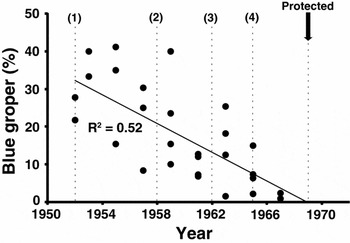
From the first magazine issues we assessed (1952) eastern blue groper were a common target species, comprising around 40% of the reported catch (Fig. 1). Reports of eastern blue groper subsequently declined significantly, halving by 1960 and virtually absent (4% of reported catch) by 1967 (linear regression: R2 = 0.52, F = 27.88, df = 1, 26, p < 0.001). This decline occurred prior to the protection of blue groper in New South Wales (NSW) in 1969.
Eastern blue groper (Achoerodus viridis) as a proportion of total fish reported in spearfishing publications through time. Each point denotes a sample issue. Numerals above dashed lines indicate a selection of key early warnings voiced by prominent members of the spearfishing community. (1) Plea to spearfishers to only take enough blue groper for their needs and allow others to breed, and first suggestion of imposing a bag limit as a means of self-regulation. (2) Concerned spearfishing groups approach the NSW government and request a bag limit on the capture of blue groper. (3) Due to further declines in groper and concern for ecological implications, spearfishers suggest a one fish bag limit. (4) The demise of eastern blue groper is considered symbolic of the folly of spearfishing, and alternative activities to reduce spearfishing pressure are discussed (also Appendix 2, Table S2, see supplementary material at Journals.cambridge.org/ENC).

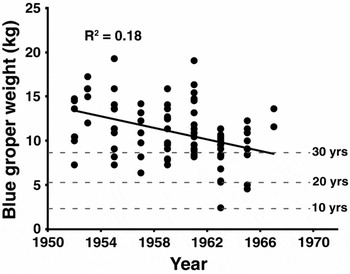
The size of speared eastern blue groper declined steadily between 1952 and 1969 from 12 to 8 kg on average (R2 = 0.18, F = 24.32, df = 1, 110, p < 0.001; Fig. 2). No fish larger than 15 kg were reported after 1961. The majority of blue groper killed by spearfishers were large and old, in excess 8.4 kg and probably over 30 years of age. These fish were also likely to be male, as the protogynous eastern blue groper change sex from female to male between 10–20 years of age.
Weight (kg) of speared eastern blue groper (Achoerodus viridis) through time. Also indicated are approximate ages at weight (Gillanders Reference Gillanders and Andrew1999).

The impact of spearfishing and beach netting on grey nurse shark (Carcharias taurus)
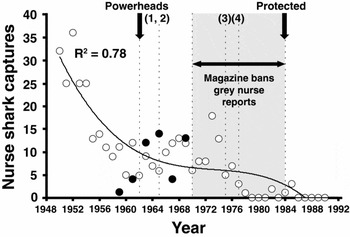
Grey nurse shark captures also declined precipitously from 1950 to 1990 (Fig. 3; 3rd order polynomial regression: R2 = 0.78, F = 44.66, df = 3, 37, p < 0.001). Beach mesh/net capture data reveal that grey nurse populations were dropping from the early 1950s, before the impact of spearfishing. Between 1956 and 1974 the annual mesh/net captures of grey nurse sharks steadied at less than half the 1950 level. Although grey nurse sharks represented a small proportion of the fish species reported in the magazines, the annual number reported by spearfishers generally increased after the introduction of explosive spear tips or powerheads (c. 1962). Following this, beach mesh/net captures continued to decline.
The number of grey nurse sharks (Carcharias taurus) reported in spearfishing publications through time (closed symbols). Each count represents a total of the four magazine issues sampled per year. Annual counts of grey nurse sharks captured in the New South Wales beach meshing programme (open symbols). Numerals above dashed lines indicate a selection of key early warnings voiced by prominent members of the spearfishing community. (1) Author highlights that grey nurse sharks are not man eaters and their populations are at risk of extinction. (2) It is acknowledged that the killing of grey nurse sharks is quickly wiping out the species and that neither the public nor fisheries department are interested in shark conservation. (3) The misconceptions about sharks and media sensationalism (coinciding with the release of the movie Jaws) are highlighted as major setbacks for any potential shark conservation measures. (4) The devastating impact of powerheads on shark populations is discussed (Appendix 2, Table S3, see supplementary material at Journals.cambridge.org/ENC). Grey shading from 1970 indicates the period prior to protection that Skindiving in Australia magazine voluntarily supported a ban on divers killing grey nurse sharks and refrained from publishing reports on their capture.

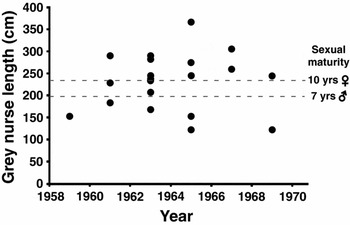
The length of grey nurse sharks taken by spearfishers ranged from 120 to 370 cm (Fig. 4). Nearly 50% of the grey nurse sharks killed were below the age of sexual maturity for females, at approximately 9–10 years of age or a length of 235 cm.
Length (cm) of speared grey nurse sharks through time. Dashed lines indicate average length at age for reproductively mature sharks (Goldman et al. Reference Goldman, Branstetter and Musick2006).

Blue groper and grey nurse sharks: the perspective of spearfishers
As reports of both eastern blue groper and grey nurse shark captures declined, our analysis of published comments within spearfishing publications revealed a simultaneous response of increasing concern from members of the recreational spearfishing community (Figs. 1, 3; Appendix 2, see supplementary material at Journals.cambridge.org/ENC). In both cases, prominent spearfishers repeatedly published warnings about declining fish populations, suggested regulatory measures, and lobbied government for action. Despite the early warnings and action by spearfishers, legislation for the protection of eastern blue groper and grey nurse shark took 17 and 19 years, respectively, to be enacted.
DISCUSSION
We used popular literature to assess historical trends, ecological data and social information on recreational fisheries. Our results reveal that recreational spearfishing may contribute to dramatic declines in vulnerable target species (Fig. 1, 3). Thus, careful monitoring and regulation is imperative in countries where recreational fisheries exist. However, in the present case studies, early concerns regarding declining fisheries actually emerged from within the spearfishing community (Appendix 2, see supplementary material at Journals.cambridge.org/ENC). Unfortunately, by the time governments responded to the warnings, the populations had already declined to extremely low levels (Pollard et al. Reference Pollard, Gordon, Williams, Flaherty and McAuley2003; Choat & Pollard Reference Choat and Pollard2010). Leaders among the spearfishing community presented a valuable but underused early warning system of fish declines.
Our results suggest that targeted spearfishing was a significant factor in the declines of these two focal species, although other drivers such as incidental commercial/recreational line fishing and netting may have contributed further pressures (Pollard et al. Reference Pollard, Lincoln Smith and Smith1996, Reference Pollard, Gordon, Williams, Flaherty and McAuley2003; Choat & Pollard Reference Choat and Pollard2010). Additionally, in many other fisheries worldwide the impact of spearfishing may be non-existent or negligible in comparison to commercial and/or line fishing (Pauly et al. Reference Pauly, Christensen, Guenette, Pitcher, Sumaila, Walters, Watson and Zeller2002; Thurstan et al. Reference Thurstan, Brockington and Roberts2010).
The demise of eastern blue groper (Achoerodus viridis)
The loss of eastern blue groper may have had major impacts on the ecology of coastal temperate reefs. Our analyses reveal that most reported blue groper were over 10 to 20 years old (Fig. 2), an age range in which most of the individuals in this protogynous species would have changed sex from female to male (Gillanders Reference Gillanders1995a ; Bax Reference Bax, Casper, Barrett, Bax and Hobday2011). Thus, exploitation by spearfishing may have contributed to a scarcity of males and the skewed sex distributions observed in the 1990s (Gillanders Reference Gillanders1995a ). Notably, the first scientific research on the biology and ecology of eastern blue groper did not commence until the early 1990s, more than 20 years after their populations had already declined. From a sample of 173 eastern blue groper collected between 1991 and 1993, the largest fish recorded was only 65 cm, or approximately 8 kg (Gillanders Reference Gillanders1995b ). Thus, the eastern blue groper populations examined by scientists in the 1990s were markedly different to those of the 1950s in terms of numbers, size and sex ratios, and thus presented a false baseline. Given the old ages of blue groper removed by spearfishing, and an estimated generation length of 12–15 years (Choat & Pollard Reference Choat and Pollard2010), population recovery to pre-1950s levels could take many decades.
As large eastern blue groper disappeared, sea urchin abundance appears to have increased by 3–4 fold (Appendix 2, Table S2, see supplementary material at Journals.cambridge.org/ENC), highlighting the potential importance of blue groper as predators in regulating sea urchin densities (Bax Reference Bax, Casper, Barrett, Bax and Hobday2011). Sea urchins occur in the gut content of 20% of small (< 30 cm) eastern blue groper and in 70% of large (> 30 cm) individuals (Gillanders Reference Gillanders1995b ). Given all blue groper reported in the present study exceeded 30 cm in length, the capacity for blue groper to prey on sea urchins was likely to be depleted (Young & Bellwood Reference Young and Bellwood2012). The relationship between the loss of fish predators of sea urchins, urchin population increases, decline in macroalgae and the expansion of urchin barrens is well established (McClanahan & Muthiga Reference McClanahan and Muthiga1989, Tegner & Dayton Reference Tegner and Dayton2000).
The demise of grey nurse shark (Carcharias taurus)
Beach meshing programmes commenced at numerous locations in NSW during the 1930s to protect swimmers from sharks. However, the nets were highly effective at removing harmless grey nurse sharks from the netted localities (Pollard et al. Reference Pollard, Lincoln Smith and Smith1996; Fig. 3). By the 1980s, grey nurse sharks had all but disappeared from the annual net catch. Spearfishing for sharks was popularized by media productions (films, books and magazines) that advocated their killing (Pollard et al. Reference Pollard, Lincoln Smith and Smith1996; Otway & Parker Reference Otway and Parker2000) and, from 1959, contributed to the decline in grey nurse (Fig. 3; Appendix 2, Table S3, see supplementary material at Journals.cambridge.org/ENC). While the netting programme captured roving sharks, spearfishers sought grey nurse habitat and promptly decimated newly discovered populations (Appendix 2, Table S3, see supplementary material at Journals.cambridge.org/ENC). Prominent spearfisher and later conservationist, Valerie Taylor, attributed the decline in grey nurse populations to spearfishing and the invention of the powerhead (Pollard et al. Reference Pollard, Lincoln Smith and Smith1996).
Grey nurse sharks faced serious declines, yet there had been little public pressure or political will to protect them due to the misconception that grey nurse sharks were ‘maneaters’ (Appendix 2, see supplementary material at Journals.cambridge.org/ENC See later query; Pollard et al. Reference Pollard, Lincoln Smith and Smith1996). Confounding the situation was the lack of scientific information on grey nurse shark behaviour (Otway & Parker Reference Otway and Parker2000), media sensationalism about the threat of sharks (including the release of the movie Jaws in 1975), and an irrational fear among the public (Whatmough et al. Reference Whatmough, Putten and Chin2011; Neff Reference Neff2012). In fact, the public had hailed spearfishers as heroes for removing the perceived threat of sharks (Appendix 2, Table S3, see supplementary material at Journals.cambridge.org/ENC). Ironically, calls for protection came from the spearfishers and divers themselves (Pollard et al. Reference Pollard, Lincoln Smith and Smith1996).
Both grey nurse sharks and eastern blue groper display characteristics typical of vulnerable species (Dulvy et al. Reference Dulvy, Sadovy and Reynolds2003). Long lifespan, slow growth, restricted range, inquisitive behaviour and an instinct to retreat into caves when threatened, contributed to the demise of eastern blue groper (Bax Reference Bax, Casper, Barrett, Bax and Hobday2011; Appendix 2, Table S2, see supplementary material at Journals.cambridge.org/ENC). Likewise, long lifespan, late maturity, low fecundity (1–2 pups biannually), long gestational period, aggregating behaviour and a passive nature made grey nurse sharks susceptible (Pollard et al. Reference Pollard, Lincoln Smith and Smith1996; Otway & Parker Reference Otway and Parker2000; Ahonen & Stow Reference Ahonen and Stow2009). Almost half of the speared grey nurse in our sample were below the reproductive age for females (Fig. 4; Goldman et al. Reference Goldman, Branstetter and Musick2006). Both coastal species were also readily accessible targets from shorelines or small boats due to their close proximity to shore and their high degree of site fidelity.
Evidence for potential self-regulation and an early warning system for management
Recreational fishers are often depicted and perceived to possess an anti-conservation agenda (Sutton & Tobin Reference Sutton and Tobin2009), yet here we present evidence of a recreational spearfishing community raising the alarm in response to declining fish populations well before management realised the need for protection (Appendix 2, see supplementary material at Journals.cambridge.org/ENC). Not only did spearfishers publish early warnings, they were also proactive, informing management authorities of their concerns, encouraging self-regulatory restrictions (such as bag limits) and requesting official regulation (Appendix 2, Tables S2 and S3, see supplementary material at Journals.cambridge.org/ENC). In fact, concern for the survival of grey nurse populations became so great among spearfishers that from 1970 the editor of Skindiving in Australia magazine refrained from publishing any further catch reports (Fig. 3; Appendix 2, Table S3, see supplementary material at Journals.cambridge.org/ENC). These early warnings from the spearfishing community emerged at a time when declines in both fish populations may have been prevented, illustrating the conundrum of management lag and the burden of proving fishery declines solely with traditional monitoring data (Pauly Reference Pauly1995).
Spearfishers spend much of their time in the water, which enables them to observe and monitor changes in marine populations. Therefore, witnessing declines in their valued resource first-hand may have prompted action (Lin Reference Lin2009). Seeing is perhaps, believing. This pattern of self-imposed regulation has occurred in other fisheries around the world, including beche de mer (Skewes Reference Skewes1990) and the ornamental aquarium trade (Donnelly Reference Donnelly2009). Thus, the two present case studies of recreational fishers raising their concerns with management is reflective of a broader global phenomenon, whereby stakeholders may take proactive steps to protect their resource. Although attempts at self-regulation in the present case studies were not sufficient to stem declines, it would be in the interest of management authorities to embrace, assess with caution and act upon stakeholder concerns, observations and actions at the earliest possible stage.
Other evidence also suggests recreational fishers can demonstrate strong support for regulatory measures (Sutton & Tobin Reference Sutton and Tobin2009). Following the 2004 rezoning of the Great Barrier Reef Marine Park (GBRMP), 68% of fishers believed that the rezoning was a good idea and 57% expressed support for it. However, recreational fishers also felt that management, scientific and government authorities inadequately consulted them on major decisions (Sutton & Tobin Reference Sutton and Tobin2009) or felt too ill-informed to make valuable contributions (Li et al. Reference Li, Sutton and Tynan2010). Few fishers (25%) believed that the consultation process was adequate for the 2004 GBRMP rezoning and this was largely attributed to issues in communication (Sutton & Tobin Reference Sutton and Tobin2009).
Public opposition resulting from insufficient or ineffective engagement and communication of the science behind management decisions (Lin Reference Lin2009; Sutton & Tobin Reference Sutton and Tobin2009; Li et al. Reference Li, Sutton and Tynan2010) can delay the development and implementation of conservation policies (Helvey Reference Helvey2004). Thus, in cases where representative recreational bodies raise conservation and sustainability concerns, we suggest that management authorities immediately heed these warnings, closely monitor the fisheries and enhance channels of communication. Too much valuable time can be lost in conflict and disagreement, when ‘the protection and propagation of fish’ (to quote the primary agenda of the Australian Underwater Skindivers and Fishermen's Association) is ironically the common goal of recreational fishers, fisheries management, scientists and conservationists.
CONCLUSION
This study demonstrates that recreational fisheries may have serious impacts on vulnerable fish species and marine ecosystems. However, it also reveals that recreational fishers could play a vital role in conservation and advocacy. Members of the groups responsible for depleting these populations of vulnerable species recognized the problem early on and attempted to stop it. Had the government listened and acted on their concerns they may have stopped the damage much sooner. With growing impetus for stronger management of recreational fisheries worldwide, our results highlight the importance of multi-directional channels of communication between fishers, managers and scientists, for the sharing of information, the minimization of conflict and in providing an early warning system for declines in targeted species. Since protection, evidence for the recovery of eastern blue groper and grey nurse shark populations is limited, with blue groper populations described as steady (Choat & Pollard Reference Choat and Pollard2010) and grey nurse shark populations listed on the IUCN red list as critically endangered and declining (Pollard et al. Reference Pollard, Gordon, Williams, Flaherty and McAuley2003). Too little, too late?
ACKNOWLEDGEMENTS
We thank David Welch, Gary Russ, Terry Hughes and three anonymous reviewers for valuable comments on earlier drafts. We also thank the Australian Research Council Centre of Excellence for Coral Reef Studies for financial support.
Supplementary material
To view supplementary material for this article, please visit Journals.cambridge.org/ENC.