INTRODUCTION
Decision making has been defined as the process through which a person forms preferences, selects and executes actions, and evaluates the outcome related to a selected choice (Ernst & Paulus, Reference Ernst and Paulus2005). In the last decade, there has been a growing interest to investigate the neural correlates of decision making in both healthy populations and brain-injured patients using neuropsychological and neuroimaging techniques. In the somatic marker hypothesis, Damasio (Reference Damasio1994) proposed that affective reactions induced by specific environmental events provide a substrate for guiding decision by signals to a large subcortical frontal network including the amygdala and the ventromedial prefrontal cortex. Converging evidences suggest that decision making is not mediated by the orbitofrontal cortex alone, but relies on a larger distributed network (Bechara, Reference Bechara2001; Bechara et al., Reference Bechara, Damasio and Damasio2000).
Given that multiple sclerosis (MS) is a disseminated process affecting primarily the white matter of the central nervous system, we hypothesized that this disease may influence decision making towards a more risky behavior. Using the Iowa Gambling Task (IGT) (Bechara et al., Reference Bechara, Damasio, Damasio and Anderson1994), we were able to demonstrate that patients with relapsing-remitting (RR) and secondary progressive (SP) MS exhibited impaired decision making and that these impaired decisions were associated with a decreased emotional experience as measured by the skin conductance response (Kleeberg et al., Reference Kleeberg, Bruggimann, Annoni, van Melle, Bogousslavsky and Schluep2004). Our data were confirmed by Nagy et al. (Reference Nagy, Bencsik, Rajda, Benedek, Beniczky, Kéri and Vécsei2006) and Roca et al. (Reference Roca, Torralva, Meli, Fiol, Calcagno, Carpintiero, De Pino, Ventrice, Martín, Vita, Manes and Correale2008) who assessed decision making using the IGT in two groups of RRMS patients with mild disability and a short disease duration and found that an altered decisional process was at play even in early MS. However, there has been to date no longitudinal study of decision making in MS patients. Since even in its early stages MS is characterized by an axonal loss (Pascual et al., Reference Pascual, Martínez-Bisbal, Boscá, Valero, Coret, Martínez-Granados, Marti-Bonmati, Mir, Celda and Casanova2007), we hypothesized that there would be a decline in decision-making performances with time in RRMS.
The present work was thus aimed at evaluating the dynamics of decision-making capacity at a two-year interval in a homogeneous group of RRMS patients with minor neurological deficits. Cognition, behavior, mood, fatigue, and clinical parameters reflecting MS activity and severity were examined in parallel.
METHODS
Participants
One hundred and twenty-eight patients with possible (n = 38) or definite (n = 90) MS according to McDonald diagnostic criteria (McDonald et al., Reference McDonald, Compston, Edan, Goodkin, Hartung, Lublin, McFarland, Paty, Polman, Reingold, Sandberg-Wollheim, Sibley, Thompson, van den Noort, Weinshenker and Wolinsky2001; Polman et al., Reference Polman, Reingold, Edan, Filippi, Hartung, Kappos, Lublin, Metz, McFarland, O’Connor, Sandberg-Wollheim, Thompson, Weinshenker and Wolinsky2005), with a RR course and a mild disability [Expanded Disability Status Scale (EDSS) ≤ 2.5; Kurtzke, Reference Kurtzke1983] underwent the IGT and a neuropsychological testing between February 2004 and September 2005 (Simioni et al., Reference Simioni, Ruffieux, Bruggimann, Annoni and Schluep2007; Souza Lima et al., Reference Souza Lima, Simioni, Bruggimann, Ruffieux, Dudler, Felley, Michetti, Annoni and Schluep2007). A retest IGT evaluation was planned after a minimal period of 2 years, dated from baseline assessment. Only patients with confirmed MS (n = 70) were retested, including 51 who already had definite MS at inclusion and 19 patients who had confirmed MS diagnosis since baseline. Nineteen patients who did not confirm MS diagnosis were excluded from retest, whereas 39 patients with confirmed MS could not participate (18 did not accept to be retested and 21 were not able to be retested within the period of time fixed for this study). Along with the IGT testing, neurological deficits were scored using the EDSS, and the administered medications recorded. Patients presenting relapses between baseline and retest were evaluated by two of the coauthors. Relapsing rate (number of relapses/year of study) and disability progression (change in the EDSS score/year of study) were calculated. The complete testing was performed at least six weeks from a relapse or a corticosteroid treatment. All patients included had previously signed an informed consent form approved by the university Ethics Committee according to the Declaration of Helsinki (1961).
Procedure
Cognitive and behavioral assessment
The screening neuropsychological evaluation, performed at baseline and at retest, has been described elsewhere (Simioni et al., Reference Simioni, Ruffieux, Bruggimann, Annoni and Schluep2007; Souza Lima et al., Reference Souza Lima, Simioni, Bruggimann, Ruffieux, Dudler, Felley, Michetti, Annoni and Schluep2007). We used the Rey’s Auditory Verbal Learning Test (RAVLT) to assess long-term memory, the Trail Making Test (TMT) for attention/processing speed, and the Behavioral Assessment of the Dysexecutive Syndrome (BADS) for executive functions because it was validated on a large group of patients with various neurological disorders, including MS. Alternate versions of the tests were used at retest for the RAVLT and the TMT to minimize practice effect. Cognitive impairment was defined as a performance two standard deviations (SD) below the given mean in at least one of the three cognitive measures, whereas cognitive decline was defined as a change in cognitive status from baseline to retest.
Questionnaires measuring dysexecutive behaviors [Dysexecutive Questionnaire (DEX)] and behavioral modifications between baseline and retest [Iowa Scale of Personality Change (ISPC)] were completed by a relative. Fatigue [Fatigue Assessment Instrument (FAI)], mood disorders [Hospital Anxiety and Depression scale (HAD)], handicap [London Handicap Scale (LHS)], and perceived health status (SEP-59) were assessed using self-reported questionnaires.
Iowa Gambling Task (IGT)
Decision making was tested at baseline using the original computerized version of the IGT (Version ABCD), and retested at follow-up with a parallel version of the task (Version KLMN). This latter version, recently validated by Hernandez et al. (Reference Hernandez, An and Bechara2006), was constructed with different win and loss values to be administered after the ABCD version. Decks A/B at baseline and L/N at retest were associated with high immediate wins, but even higher future losses, ending in a long-term loss (disadvantageous decks). To the opposite, decks C/D at baseline and K/M at retest were associated with low immediate wins, but even lower future losses, resulting in a long-term gain (advantageous decks). The total number of advantageous decks selected per block of 20 cards was computed [(C + D or K + M) – (A + B or L + N)]. Net scores below (vs. above) zero indicated that patients were choosing disadvantageously (vs. advantageously). A learning index, measuring how patients evolved from disadvantageous to advantageous decks, was defined as the difference between the averaged last three and first two block rates ([(B3 + B4 + B5)/3] – [(B1 + B2)/2]).
Statistical Analyses
Statistical analyses were conducted using a STATA software package (Version 10.0). The IGT learning index, DEX, ISPC, LHS, and SEP-59 scores, as well as the proportion of patients with cognitive deficits, anxious (HAD-Anxiety), depressive (HAD-Depression) or fatigue symptoms were computed at baseline and retest. A standardized change score [(score at retest – score at baseline)/standard deviation of baseline score] was calculated for scores expressed in a numerical scale. The hypothesis of an absence of change was tested using nonparametric tests (Wilcoxon or MacNemar tests) since we had no a priori on the Gaussian distribution of the scores and data presented with a few outliers. Significance was set at p < .05 for all statistics. As analyses involved nine measures, a Bonferroni corrected standard p level of p < .006 was applied.
Subsequently, standardized change scores were dichotomized and a score ≥ 0.5 towards worsening was defined as a threshold for a decline in performance. Patients who declined in the IGT learning index were compared with those who did not for their relapsing rate, disability progression, concomitant decline in cognition, and for DEX, ISPC, LHS, or SEP-59 scores (Fisher exact tests). A logistic regression approach was used to look for potential baseline predictors for a decline in decision making.
To control for a possible sampling bias in interpreting our results due to 33% missing questionnaires at retest, we evaluated whether a missing response to a questionnaire at retest (n = 22 to 27, depending on the scale) was associated with the score obtained for this questionnaire at baseline. Finally, we compared the baseline neurological and neuropsychological characteristics of the 39 confirmed MS patients who could not be retested with those of the 70 retested patients.
RESULTS
Demographic and Neurological Characteristics of the Patients
The 70 patients with definite MS (50 women and 20 men) with a median age of 35 years (range 19 to 62 years) were tested twice for the IGT with a median interval of 2.1 years (range 2 to 2.6 years) between baseline and retest. Of those, 60 patients (86%) had at least secondary education. Sixty-eight patients had a proven RRMS course at retest according to McDonald criteria (McDonald et al., Reference McDonald, Compston, Edan, Goodkin, Hartung, Lublin, McFarland, Paty, Polman, Reingold, Sandberg-Wollheim, Sibley, Thompson, van den Noort, Weinshenker and Wolinsky2001; Polman et al., Reference Polman, Reingold, Edan, Filippi, Hartung, Kappos, Lublin, Metz, McFarland, O’Connor, Sandberg-Wollheim, Thompson, Weinshenker and Wolinsky2005) while two patients had converted to SPMS since baseline. At retest, the median MS duration was 4 years (range 2.4 to 8.5 years), the median EDSS score was 2.0 (range 1.5 to 3.5), and 35 MS patients had experienced one to five relapses since baseline (median number of relapses during the study: 0.5). The median relapsing rate (number of relapses/year of study) was of 0.2 (range: 0 to 2.4). Overall, no progression in disability rate was observed [median change in the EDSS score/year of study: 0 (range: –0.3 to 0.7)]. Forty-nine patients were treated with interferon-β 1a or 1b at retest, including 20 newly treated patients since baseline. Nine patients had antidepressants at retest versus three at baseline, and four had amantadine or modafinil as a symptomatic treatment for fatigue versus two at baseline.
Evolution of Cognitive, Behavioral, and Functional Scores
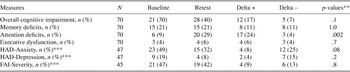
Results obtained for the cognitive and behavioral functions are presented in Table 1. All data were available for the 70 MS patients, except for some missing behavioral questionnaires completed at home (22 were not sent back, 5 had missing values). Between baseline and retest, the prevalence of cognitive deficits increased slightly from 30% to 40%, without reaching significance (p = .1). Specifically, the prevalence of deficits in attention increased from 9 to 29% (p = .002), whereas it remained unchanged for long-term memory and executive tasks. Concerning behavioral data, anxious symptoms (HAD-Anxiety) were marginally less frequently reported at retest (49% at baseline vs. 32% at retest; p = .08). No other changes were observed. (A) Mean scores of the multiple sclerosis (MS) patients for the IGT, behavioral questionnaires, handicap, and perceived health status evaluated at baseline and retest; (B) Number (%) of patients with cognitive impairment, mood disorders, or fatigue at baseline and retest, as well as number (%) of patients who declined (Delta +) or improved (Delta –) between the two evaluations. Note. IGT = Iowa Gambling Task, DEX = Dysexecutive Questionnaire, ISPC = Iowa Scale of Personality Change, LHS = London Handicap Scale, SEP-59 = perceived health status, HAD = Hospital Anxiety and Depression scales, FAI = Fatigue Assessment Instrument. *Wilcoxon signed rank test, **McNemar test, ***22 to 27 questionnaires were either not sent back by the patients or not fully completed.

Changes in IGT Performances
The learning index decreased from baseline to retest [from 0.3 (SD 0.4) to 0.1 (SD 0.3), p = .005] (Table 1). This result remained significant after Bonferroni correction.
Variables Associated with a Decreased Learning Index
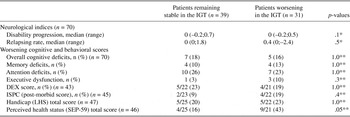
We compared MS patients who declined in the IGT (n = 31) with patients who did not (n = 39) on relapsing rate, disability progression, cognitive performances, DEX, ISPC, LHS, and SEP-59 scores (Table 2). MS patients who declined in the IGT were more likely to show a decline in the SEP-59 total score (p = .05) and in the SEP-59 emotional well-being subscale (p = .05). No other differences emerged. These results were not modified when using an analysis of covariance (ANCOVA) model taking the IGT standardized change score as a continuous dependent variable and the other standardized change scores as continuous independent variables. Adjusting for HAD-Anxiety, HAD-Depression, and FAI-Severity scores did not change the results (data not shown).
Association of a decrease in decision-making ability with a change in neurological indices, cognitive, or behavioral scores between baseline and retest.

Note.
IGT = Iowa Gambling Task, DEX = Dysexecutive Questionnaire, ISPC = Iowa Scale of Personality Change, LHS = London Handicap Scale, SEP-59 = perceived health status. *Wilcoxon signed rank test. **Fisher exact test.
Baseline Predictors of a Decline in IGT Performance
Odds ratio of a decline in the IGT was 0.75 [95% Confidence Interval (CI), 0.3–1.8] for a unit increase in relapsing rate and 0.14 (95% CI, 0.01–1.5) for disability progression. None of the potential baseline predictors (cognitive status, DEX, ISPC, LHS, SEP-59 scores) was associated with a decline in the IGT performance, except for the baseline IGT score itself (p < .0001).
Analysis of the Patients with Missing Data
No significant difference emerged between the 39 confirmed MS patients who could not be retested (see Methods) and the 70 patients who completed the retest examination in their demographic, neurological, cognitive, and behavioral features at baseline. Besides, missing data to a given questionnaire at retest was not associated with the score obtained for this given questionnaire at baseline (data not shown).
DISCUSSION
We found a significant decrease in the IGT performance over time in a group of RRMS patients with mild disability and short disease duration. Such a worsening in the IGT performance with the alternate version of the task is unexpected in a control population, as recently demonstrated by Hernandez et al. (Reference Hernandez, An and Bechara2006). By analyzing MS patients who participated to baseline assessment but did not undergo retest, we further ensured that our results were only minimally biased by missing values.
The IGT has been used to measure decision making under ambiguity (in contrast with decision making under certainty where the outcome is surely defined) in different neurological conditions. To solve the task successfully, subjects have to figure out advantageous decks by using the feedback they get after each choice and by following their own feelings and hunches, according to the somatic marker hypothesis of Damasio (Reference Damasio1994). Emotional reactions secondary to the outcomes of previous choices influence decisions on successive choices, meaning that subjects become more cautious and aversive to risk taking. Emotions are thus thought to serve an adaptive role speeding up the decisional process. Studying a group of MS patients more disabled than in the present work, we reported that an impairment in the emotional dimension of behavior (DEX) or in emotional experience was associated with risky decision making (Kleeberg et al., Reference Kleeberg, Bruggimann, Annoni, van Melle, Bogousslavsky and Schluep2004). Here, testing mild MS patients, we could not find a significant link between a decline in decision making and affective measures (HAD, DEX). However, such a result should be interpreted with caution, as it might be a result of lack of statistical power (missing values in the behavioral questionnaires). Yet, a decrease in a health status index of emotion (SEP-59 emotional well-being subscale) was marginally associated with a more risky behavior in the IGT.
Decline in decision making was independent of other neurological, cognitive, or behavioral changes occurring during the same period of time. Such as Nagy et al. (Reference Nagy, Bencsik, Rajda, Benedek, Beniczky, Kéri and Vécsei2006), we could not relate dysfunction in the IGT to executive deficits or to general cognitive impairment. In addition, decline in IGT performances occurred independently of MS course (i.e., sustained progression in disability or relapsing rate during the study period), giving weight to the hypothesis of Nagy et al. (Reference Nagy, Bencsik, Rajda, Benedek, Beniczky, Kéri and Vécsei2006) that decision-making difficulties at an early stage of the MS process may reflect subclinical pathology. In fact, our group remained mildly disabled throughout the study (EDSS score ≤ 2.5) except for five patients who had reached an EDSS score of 3.0 (n = 4) or 3.5 (n = 1) at retest. Although 35 MS patients (50%) experienced relapses between baseline and retest, these were rarely associated with a progression of disability. When occurring, changes in the EDSS score were mostly not clinically relevant (0.5 point increase) in such a mildly disabled population.
In conclusion, decline in decision-making capacity, especially under ambiguity, can appear as an isolated and earlier deficit in MS as compared to other functions. Given the IGT unique contribution, it might be considered in addition to more traditional tests when evaluating MS patients. Yet, the potential factors affecting the decisional process remain a subject of debate. While statistically significant, the IGT deterioration was not associated with other markers of cognitive, emotional, or disability changes. Therefore, the true significance of the IGT will await further investigation. Studies of neurological patients with decisional impairments showed that they are still able to make correct decisions in many situations, especially when the context is more certain. Thus, the study of other decisional processes in MS may be relevant.
ACKNOWLEDGMENTS
We thank Dr. A. Bechara for providing the IGT, Ms. C. Peter-Favre and A.-C. Juillerat for the ISPC French version, and Ms. G. Le Goff (MS nurse) for her support. This work was supported by the Swiss MS Society and the Swiss National Science Foundation (3200BO-104051).