INTRODUCTION
Barnacles constitute a major group of the fouling organisms in marine waters around the world (Desai et al., Reference Desai, Anil and Venkat2006). They are considered as model organisms for ecological modelling and monitoring programmes since they can reflect environmental conditions (Skinner et al., Reference Skinner, Siviero and Coutinho2007). Barnacles are of greater consequence than other fouling groups on account of their reproductive capacity, gregarious habit and settlement pattern. In barnacles, the abundance and distribution of adults has been mainly linked to the variations in reproduction, nearshore hydrographic conditions and substrate types (Barnes, Reference Barnes1956; Hawkins & Hartnoll, Reference Hawkins and Hartnoll1982; Sutherland, Reference Sutherland1990; Power et al., Reference Power, Myers, O'Riordan, McGrath and Delany2001; Faimali et al., Reference Faimali, Garaventa, Terlizzi, Chiantore and Catteneo-Vietti2004). In temperate regions, seasons have a significant influence on reproductive processes of many organisms leading to well-defined settlement seasons (Hatcher, Reference Hatcher1998; Taylor, Reference Taylor1998; Thomason et al., Reference Thomason, Hills and Mapson2000). In tropical waters, the environmental conditions are relatively stable and favour continuous breeding of barnacles. However, reproductive output may decline during monsoon seasons due to heavy rainfall (Fernando, Reference Fernando, Thompson and Nagabhushanam1999). Temperature is considered as an important environmental factor determining the length of the breeding season in barnacles (Hines, Reference Hines1978). Several species of barnacles in temperate, tropical and sub-tropical regions have been reported to produce numerous small broods during summer (Desai et al., Reference Desai, Anil and Venkat2006). It is also reported that the amount of food also plays a significant role in the breeding cycle of barnacles (Barnes & Barnes, Reference Barnes and Barnes1975; Desai et al., Reference Desai, Anil and Venkat2006). Studies on the breeding biology of barnacles assume significance in tropical waters due to the changes in salinity or more probably due to the nutrient status of the water especially during monsoon seasons.
Amphibalanus amphitrite Darwin (=Balanus amphitrite), is a common balanomorph barnacle species predominantly found on submerged marine structures such as piles, buoys and hulls of ships around the world. Most of the balanomorph barnacles are hermaphrodites (Charnov, Reference Charnov and Southward1987) and their life cycle consists of four main stages such as egg, planktonic nauplius, lecithotrophic cypris larva and attached sessile adult. The reproducing adults are capable of producing hundreds to thousands of eggs. The eggs develop in the ovary and are shed in the mantle cavity where fertilization takes place. The embryos develop inside the mantle cavity and the nauplii are released into the water as plankton. The free-swimming nauplius then moults to become cypris, which eventually attaches itself to a suitable substratum by its first pair of antennae and later metamorphoses into an adult. Amphibalanus amphitrite individuals can release 1000–10,000 eggs/brood and produce as many as 24 broods/year (El-Komi & Kajihara, Reference El-Komi and Kajihara1991).
Breeding biology of the barnacles in tropical and sub-tropical coastal waters was studied by Karande & Palekar (Reference Karande and Palekar1963), Pillay & Nair (Reference Pillay and Nair1972), Swami & Karande (Reference Swami and Karande1988), Dhandapani & Fernando (Reference Dhandapani, Fernando, Thompson, Nagabhushanam, Sarojini and Fingerman1994), Yan & Miao (Reference Yan and Miao2004), Desai & Anil (Reference Desai and Anil2005), Koh et al. (Reference Koh, O'Riordan and Lee2005) and Desai et al. (Reference Desai, Anil and Venkat2006). However, most of these investigations were restricted to a period of 12 to 15 months without replicating the seasons. Hence, in the present study an attempt has been made to investigate the breeding biology of the common fouling barnacle Amphibalanus amphitrite for a period of two years. The main objectives of the present study are: (1) to observe the seasonal variability in the breeding cycle of A. amphitrite in a tropical coast; and (2) to investigate the factors that contribute to the reproductive success of A. amphitrite. To do so, seasonal factors such as temperature, rainfall, salinity and phytoplankton abundance are correlated with the breeding activity. The general hypothesis to be tested is that the barnacles breed continuously in tropical waters without seasonal variation.
MATERIALS AND METHODS
The investigation was carried out at the Kudankulam coast (8°9′ N and 77°3′9 E), located about 25 km north-east of Kanyakumari on the east coast of India. Seasons at Kudankulam may be classified into pre-monsoon (June–September), monsoon (October–January) and post-monsoon (February–May). The study area gets the south-west monsoon current during June–September and the north-east monsoon current during October–January (Maruthanayagam & Subramanian, Reference Maruthanayagam and Subramanian2001). The wind direction is north–north-easterly from June to December and changes to westerly during the rest of the period. A new large nuclear power plant is now under construction in this region.
Samples of Amphibalanus amphitrite were collected at fortnightly intervals from wooden test panels exposed in coastal waters for a period of two years (July 2003 to June 2005). Teakwood panels (10 × 10 × 3 cm) were fitted onto a wooden raft and submerged in the coastal waters at 1 m below the mean sea level. The raft was continuously kept in the water column but the panels (usually three) were removed at fortnightly intervals for barnacle samples. About 100 individuals were removed from the test panels using a scalpel and their carino–rostral diameter (RCD) was measured. The individuals with RCD over 4 mm were considered for the observation of gonads, since Crisp & Patel (Reference Crisp and Patel1961) reported that embryos were present only in barnacles over this size. Five stages were identified on the basis of observation of ovary and the mantle cavity. A gonad index score was assigned to each stage (Karande, Reference Karande1965) and the mean gonad index was calculated:

The mean percentage of occurrence of each stage in a month was calculated from the fortnight interval data. The active breeding season was determined by the presence of a large percentage of individuals with fertilized eggs (Patel & Crisp, Reference Patel and Crisp1960).
Seasonal environmental factors such as rainfall, water temperature, salinity, dissolved oxygen content and the abundance of phytoplankton were monitored throughout the study period. The surface water temperature was measured in situ using a Celcius thermometer during early hours (6:00–6:30 a.m.). For the estimation of dissolved oxygen, water samples were collected in 125 ml BOD bottles and fixed immediately (Winkler's method). Salinity was estimated using a salinity refractometer (ATAGO). A nylon net (mesh size 25 µm) with 30 cm mouth diameter and 1 m length was used for the purpose of phytoplankton collection. One hundred litres of surface water was filtered randomly and the filtrate was washed into clean plastic containers. Plankton counts were performed using a Sedgwick–Rafter counting chamber. Rainfall data were obtained from the Environmental Survey Laboratory, Kudankulam.
Correlation between environmental parameters and breeding activity was analysed. Temporal variability of the breeding activity was analysed using three-way ANOVA (analysis of variance) with season (orthogonal), year (orthogonal) and month (nested within season and year) as factors. Alternatively, two-way ANOVA was also carried out by considering season and month (nested within season) as factors. For this, data related to the two separate years, i.e. first year (July 2003 to June 2004) and second year (July 2004 to June 2005), were taken into consideration.
RESULTS
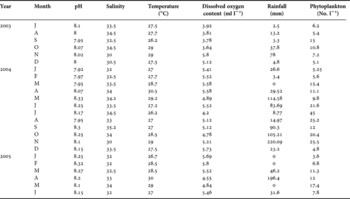
The monthly observations of the environmental parameters are given in Table 1. Salinity of the coastal waters varied between 30 and 34.5 during the period of study. Surface water temperature ranged between 26.2°C and 30.5°C and the dissolved oxygen content range was from 3.64 to 5.8 ml l−1. The pH of the coastal waters remained between 7.92 and 8.33. Phytoplankton density varied from 3.6 to 45 No. l−1 during the study period. Monthly rainfall levels of the study area varied between 2.5 and 220.09 mm. Rainfall levels were high during the second year (July 2004 to June 2005) of this study period.
Environmental parameters of the Kudankulam region during the study period.

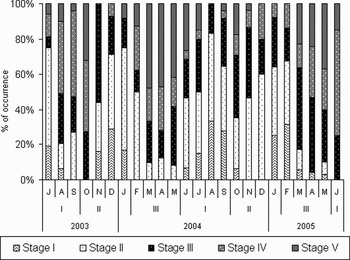
The percentage of Amphibalanus amphitrite having different stages of breeding activity is illustrated in Figure 1. The peak breeding activity was noticed during the March–May period. A high percentage of individuals with Stage V (nauplii in the mantle cavity) was observed in March 2004 (47.6%) and May 2004 (41.7%). Barnacles categorized under Stage V were low (3.75%) in November 2004. Individuals with free nauplii in the mantle cavity were not observed during November and December 2003, December 2004 and January 2005 (monsoon months). During the first year, barnacles with free nauplii in the mantle cavity were found in abundance from March to May (post-monsoon). But the same trend was not observed during the second year of this study period. The abundance of individuals grouped under Stage V did not vary in relation to month, season or year (three-way ANOVA; Table 2). However, significant intra-seasonal (month) variation was observed during the second year (two-way ANOVA; Table 4). The percentage of individuals with free nauplii in the mantle cavity did not show any significant correlation with the environmental factors (Figure 3).
Percentage composition of different stages of Amphibalanus amphitrite during the study period (I, pre-monsoon; II, monsoon; III, post-monsoon). Stage I, ovary not seen; Stage II, ovary with developing ova; Stage III, ovigerous lamella with fertilized eggs; Stage IV, ovigerous lamella with nauplii inside; Stage V: free nauplii in the mantle cavity.

Analysis of variance (three-way ANOVA) of the temporal variation of different stages and gonad index of Amphibalanus amphitrite. Season (orthogonal), year (orthogonal) and month (nested within season and year) as factors.

* P < 0.05.
The percentage of A. amphitrite grouped under Stage IV (embryo inside the egg) was high in June 2005 (60%) and low in September 2004 (4.15%). During the months of August, September and October 2003, the abundance of Stage IV individuals was comparatively high (40.37%, 48.25% and 40.65% respectively). Amphibalanus amphitrite bearing nauplii inside the egg was not observed in November 2003, January and August 2004. Three-way ANOVA indicated that the temporal variations in the abundance of Stage IV individuals were not significant for all the factors considered (Table 2). But the breeding activity was significantly influenced by the factors like season and month during the first year (two-way ANOVA; Table 3). Abundance of Stage IV individuals did not show any significant correlation with environmental factors (Figure 3).
Analysis of variance (two-way ANOVA) of breeding activity during the first year of the study period (July 2003–June 2004). Season and month (nested within season) were considered as factors.

* P < 0.05.
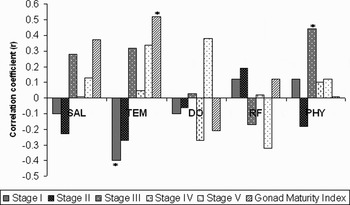
Amphibalanus amphitrite with fertilized eggs (Stage III) were found throughout the study period. The percentage of individuals that had grouped under Stage III was high in November 2004 (56%), March 2005 (46.7%) and April 2005 (42.8%). However, in July 2003 only 6.5% individuals had fertilized eggs. The percentage of individuals under the Stage III did not vary significantly between seasons, months or years (three-way ANOVA; Table 2). The two-way ANOVA also did not show significant variation in relation to season and month (Tables 3 & 4). The abundance of A. amphitrite categorized under Stage III showed a significant correlation with phytoplankton abundance (Figure 3).
Analysis of variance (two-way ANOVA) of breeding activity during the second year of the study period (July 2004–June 2005). Season and month (nested within season) were considered as factors.

* P ≤ 0.05.
The highest proportion of individuals with well-developed ovary (Stage II) was recorded in December 2005 (60%), January 2004 (58.3%) and July 2003 (56%). Generally, the incidence of Stage II was high from December to February. Percentage of individuals having Stage II ovary failed to show any significant temporal variability in relation to factors such as season, month or year (three–way ANOVA; Table 2). But the two-way ANOVA indicated significant seasonal and monthly variations in the first year (Table 3). Barnacles grouped under Stage I (without ovary) were also observed in most of the months during the study period. Maximum number of individuals without visible ovary was observed in April 2004 (33.3%) and February 2005 (31.3%). Abundance of Stage I ovary did not show any significant temporal variability (Tables 2, 3 & 4). The abundance of individuals grouped under Stage I showed a significant negative correlation with water temperature (Figure 3).
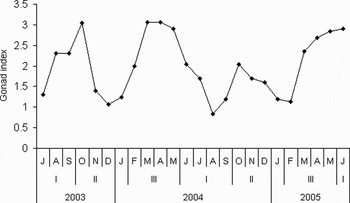
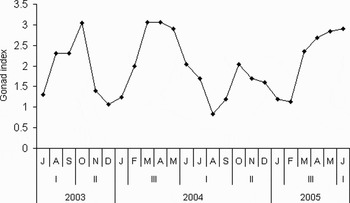
The mean gonad index observed during the study period is shown in Figure 2. The gonad index was lowest (0.83) in August 2004 and highest (3.06) in March and April 2004. Generally, the gonad index was high (above 2.5) during March–May (post-monsoon). However, three-way or two-way ANOVA did not show significant temporal variability in gonad maturity index (Tables 2, 3 & 4). The gonad index showed significant positive correlation with water temperature (Figure 3).
Temporal variability of gonad index of Amphibalanus amphitrite (I, pre-monsoon; II, monsoon; III, post-monsoon).
Correlation coefficient between environmental parameters of the study area and breeding activity (*significant at 5% level; SAL, salinity; TEM, temperature; DO, dissolved oxygen; RF, rainfall; PHY, phytoplankton).

DISCUSSION
The occurrence of individuals having fertilized eggs (Stage III) in all seasons without major variation indicated that breeding activity was continuous in the study region. Amphibalanus (Balanus) amphitrite has been shown to have the ability to reproduce throughout the year in Indian waters (Karande, Reference Karande1965). The three-way ANOVA model indicted that the breeding activity was not influenced by factors such as sampling month, season or year. This reinforces the findings of the previous investigations that A. amphitrite breeds continuously in tropical waters. Seasonal variability did however remain apparent in some stages from the two-way ANOVA especially during the first year of the study period. The lack of significant seasonal peaks in breeding activity may be due to the relatively constant environmental conditions prevailing in the study area. In a tropical environment, the identification of the proximate factors controlling breeding activity is difficult as the availability of food and other ecological factors are equable throughout the year (Subramoniam, Reference Subramoniam, Adiyodi and Adiyodi1977).
Species that breed continuously are relatively unspecialized in their food requirements and are either suspension feeders or browsers (Goodbody, Reference Goodbody1965). In the present study, abundance of individuals grouped under Stage III showed significant positive correlation with phytoplankton density of the coastal waters. This indicates that the increase in phytoplankton abundance may increase breeding activity. An increased breeding frequency in A. amphitrite with an increase in food concentration was also reported by Desai et al. (Reference Desai, Anil and Venkat2006).
Daniel (Reference Daniel1958) from Madras and Fernando & Ramamoorthi (Reference Fernando and Ramamoorthi1975) from the Vellar estuary reported that A. amphitrite bred throughout the year with a low intensity during monsoon months possibly due to the lowering of salinity. Similar results were also observed by Rege et al. (Reference Rege, Joshi and Karande1980) at Bombay and Pillay & Nair (Reference Pillay and Nair1972) at Cochin. In the present study, though a decline in gonad index was observed in the monsoon months, the salinity of the coastal waters did not show much variation and remained between 30 and 34.5. Hence, the lowering of gonad index during monsoon months may be due to some other factors. Barnes (Reference Barnes1989) suggested that the effect of salinity on the breeding season is particularly important in estuarine habitats where fresh water run-off due to the river discharge is high during the monsoon period. Rainfall levels did not appear to affect the breeding cycle of A. amphitrite at the study area. This was evidenced from the correlation analysis of breeding activity with rainfall. Further, a higher percentage of individuals with well-developed ovary (Stage II) was observed during July, November and January. This stage commonly occurred in barnacles during the breeding phase of the cycle (Fernando & Ramamoorthi, Reference Fernando and Ramamoorthi1975).
Barnes (Reference Barnes and Ray1959) observed that gametogenesis, fertilization, incubation and liberation of the fully developed nauplii from the mantle cavity are well-defined phases and any or all of them may be dependent on temperature. In the present study, temperature reached the maximum in April and the minimum from June to September, December and January of the study period. The observed significant positive correlation between surface water temperature and gonad index and the abundance of Stage V individuals during March, April, May and June indicated that the surface water temperature might be an important factor for breeding activity. A similar result of high percentage of fertilized individuals with increase in temperature was also observed by Alam et al. (Reference Alam, Khan, Nagabhushanam, Thompson, Sarojini and Nagabhushanam1988). Moreover, the percentage of individuals grouped under Stage I showed a significant negative correlation with temperature. This stage was generally encountered in barnacles during the inactive or spent phase of the breeding cycle. Though temperature showed significant positive correlation with the gonad maturity index, it does not necessarily imply that only this factor alone determines the breeding activity.
The observed relationship between breeding activity and water temperature is of interest in this region from the viewpoint of thermal ecology due to the emerging nuclear power plant. Though, A. amphitrite is considered as eurythermal in its tolerance, the Q10 (temperature coefficient) values were found to decrease with increasing temperature in the tropical barnacles (Rao et al., Reference Rao, Rao, Devi, Thompson, Sarojini and Nagabhushanam1988). The low Q10 values could result in the conversion of more energy for respiration. Whenever an organism is subjected to changing body temperatures, its respiratory Q10 has physiological meaning and could be of adaptive importance (Scholander et al., Reference Scholander, Flagg and Irving1953). Generally, low Q10 values were reported at the habitat temperature (20–30°C) for tropical barnacles like B. amphitrite and B. tintinnabulum (Rao et al., Reference Rao, Rao, Devi, Thompson, Sarojini and Nagabhushanam1988). Hence, further increase in habitat temperature may have a significant impact on the physiological activity of the barnacles in this region. According to Hartnoll (Reference Hartnoll2001), the increasing temperature caused a decrease in intermoult duration and also affected the metabolic process leading to reserve accumulation in crustaceans.
In conclusion, A. amphitrite grouped under different stages were observed throughout the year. This shows that the population is viable for reproduction without significant temporal variability, although there appears to be an increase in breeding activity during the post-monsoon months. Although, two-way ANOVA indicated significant variability in relation to season or month, there was no distinct pattern between years. This implies the necessity of future investigations having a multi-factorial approach by including multiple years in the model. Moreover, the stable salinity and ample availability of food in the study area provided a favourable condition for the continuous breeding of A. amphitrite.
ACKNOWLEDGEMENTS
We thank the Ministry of Earth Sciences, Government of India for providing financial assistance through DOD–OSTC. We are grateful to the two anonymous referees for their constructive comments on the manuscript.