I. INTRODUCTION
Knowledge of the thermal stability of nanocrystalline materials is important for both technological and scientific reasons. From a technological point of view, the thermal stability is important for consolidation of nanocrystalline particulates without coarsening the microstructure. That is, many methods for synthesis of nanocrystalline materials result in particulate products, which must be consolidated into bulk form. Since most consolidation processes involve both heat and pressure, the temperature stability of the nanoscale microstructure is always at risk. The goal of particulate consolidation is to attain essentially 100% theoretical density and good particulate bonding while preventing or minimizing grain growth of the nanocrystalline grains.
Understanding the scientific nature of stability, grain growth of nanocrystalline microstructures, is a criterion for allowing strategies for minimizing grain growth to be developed. A basic scientific question with regard to nanocrystalline materials is whether their behavior involves “new physics” or is simply the expected grain size-dependent behavior extrapolated to nanocrystalline grain sizes. Thermal stability is an important phenomenon to be addressed in this regard. The thermal stability in a broader sense involves not only the stability of the grain structure, i.e., the microstructure, but also the stability of the structure of the grain boundaries in nanocrystalline materials. A number of investigations on the thermal stability of nanocrystalline materials have been conducted. Grain growth in nanocrystalline materials has been reviewed by Suryanarayana,Reference Suryanarayana1 Weissmuller,Reference Weissmuller and Bourell2 and Malow and Koch.Reference Malow, Koch and Bourell3
In spite of the high driving force for grain growth and the observation of grain growth, at least abnormal grain growth, even at very low homologous temperatures, significant stabilization of nanocrystalline grain structures has been observed in many materials. The one common feature of such materials is that they are multicomponent, i.e., either alloys or contain impurities. There are two basic ways in which grain growth can be reduced. The first is the kinetic approach in which the grain boundaries are pinned in various ways to decrease grain boundary mobility. The second is the thermodynamic approach in which the driving force for grain growth is lowered by solute segregation.
In the kinetic approach, the grain boundary mobility is reduced by various possible mechanisms. These include porosity drag,Reference Hofler and Averback4 second phase Zener drag,Reference Boylan, Osstrander, Erb, Palumbo and Aust5 solute drag,Reference Michels, Krill, Ehrhardt, Birringer and Wu6 chemical ordering,Reference Bansal, Gao and Fultz7 and grain size stabilization.Reference Krill, Helfen, Michels, Natter, Fitch, Masson and Birringer8 The thermodynamic approach depends on introducing solutes that segregate to the grain boundaries such that the free energy of the system reaches a local minimum with respect to grain growth. This concept has been modeled by Weissmuller,Reference Weissmuller9, Reference Weissmuller10 Kirchheim,Reference Kirchheim11 Liu and Kirchheim,Reference Liu and Kirchheim12 Millett et al.,Reference Millett, Selvam and Saxena13 Trelowitz and Schuh,Reference Trelewicz and Schuh14 Chookajorn et al.,Reference Chookajorn, Murdoch and Schuh15 VanLeeuwen et al.,Reference VanLeeuwen, Darling, Liu, Koch and Scattergood16 and Saber et al.Reference Saber, Kotan, Koch and Scattergood17 The grain size at the metastable thermodynamic equilibrium was found in their analysis to be determined by the grain boundary energy, the enthalpy change of grain boundary segregation, and the solute excess of an equivalent grain boundary monolayer at saturation. A question regarding these strategies for stabilization of nanocrystalline grain sizes is: which approach can provide stabilization at the highest homologous temperatures? It has been statedReference Liu and Kirchheim12, Reference Krill, Ehrhardt and Birringer18 that the kinetic approach for reducing the grain boundary mobility will be limited since the mobility varies with temperature according to an Arrhenius law such that the drag effects will eventually be overcome at sufficiently high temperatures. It has also been suggestedReference Liu and Kirchheim12, Reference Krill, Ehrhardt and Birringer18 that a reduction in the grain boundary energy, which shows only a weak decreasing temperature dependence,Reference Murr19 might be more effective for stabilization of nanocrystalline grain sizes at the highest temperatures. However, this temperature dependence is only for the grain boundary energy of elements or stable equilibrium solid solution alloysReference Murr19 and does not consider the temperature dependence of the solute segregation effect or the loss of grain boundary segregates by formation of intermetallic compounds as the temperature is increased. The purpose of this paper was to critically evaluate the experimental evidence for the thermal stabilization of nanocrystalline metals and alloys and to determine whether the thermodynamic or kinetic—e.g., particle (Zener) pinning—is most effective for stabilization at the highest homologous temperatures.
II. CRITERIA FOR SELECTION OF RESULTS TO BE COMPARED
The criteria we have used in selecting alloy systems for comparison are as follows. First, the grain sizes reported should be obtained by a reliable method. For very small nanocrystalline grain sizes (typically less than ∼30 nm), analysis of x-ray line broadening measurements may be considered to be accurate. For larger grain sizes, microscopy methods, in particular transmission electron microscopy (TEM) using dark field images and determining grain size distributions from a statistically significant number of grains (>200), are desirable. While it is difficult to separate stabilization by the kinetic mechanism of solute drag and that of thermodynamic stabilization, we use predictions from the models that have been presented to define systems where thermodynamic stabilization may be likely. If nanoscale second phases are observed in the temperature range where the grain sizes are still nanoscale (<100 nm), we assume that the stabilization is likely to be due to the kinetic mechanism of particle—Zener—pinning. In several cases, it appears that both thermodynamic and Zener pinning may be operative and will be considered. Besides grain size as determined by x-ray diffraction (XRD) or TEM, other property measurements such as mechanical hardness can be used to define thermal stability.
III. CONSIDERATION OF POSSIBLE THERMODYNAMIC STABILIZATION SYSTEMS
An alloy system that has been studied extensively is nanocrystalline Pd with Zr additions.Reference Krill, Ehrhardt and Birringer18, Reference Krill, Klein, Janes and Birringer20 The results have been summarized by Krill et al.Reference Krill, Ehrhardt and Birringer18 The latter authors derive an expression for the grain boundary energy as affected by solute segregation as follows:
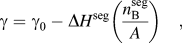 $${\rm{\gamma }} = {\rm{\gamma }}_{\rm{0}} - \Delta H^{{\rm{seg}}} \left( {{{n_{\rm{B}}^{{\rm{seg}}} } \over A}} \right)\quad,$$
where γ0 is the specific grain boundary energy of the pure element, ΔH seg is the enthalpy of segregation of B solute atoms to the grain boundary,  $n_{\rm{B}}^{{\rm{seg}}} $ is number of moles of B solute atoms segregated to the grain boundary phase, and A is total grain boundary area. Insertion of typical numbers for these quantities gives a value for γ ∼ 0 when ΔH seg =25 kJ/mol or more. The segregation enthalpy of Zr in Pd is estimated to be 31 kJ/mol.Reference De Boer, Boom, Mattens, Miedema and Niessen21 However, the solid solubility of Zr in Pd at 600 °C is 12 at.% and increases up to 17 at.% at the peritectic temperature.Reference Okamoto22 Furthermore, the equation derived for γ is valid only for the dilute segregation limit. In their initial studies of the Pd–Zr alloys, Krill et al.Reference Krill, Klein, Janes and Birringer20 found that ball milling induced metastable solid solutions up to 20 at.% Zr. At concentrations of 21 at.% Zr and higher, the intermetallic Pd3Zr phase formed. The lattice parameters of the metastable Pd–Zr alloys (>12 at.% Zr) showed an approximately linear increase with Zr concentration. The lattice parameters decreased on annealing at 500 °C, which the authors attributed to the segregation of Zr atoms to the grain boundaries. Annealing for 2 h at 500 °C increased the grain sizes, but the increase was less as Zr concentration increased. The approximately linear decrease in grain size with at.% Zr for the annealed samples has a higher slope than that of the as-milled alloys. The authors subsequently foundReference Krill, Ehrhardt and Birringer18 that raising the Zr concentration increased the onset temperature for significant grain growth and it suppressed the rate at which coarsening progressed. They attributed these effects to the segregation of Zr atoms to the grain boundaries. This segregation may lead to either kinetic stabilization by solute drag on the boundaries, or to thermodynamic stabilization by lowering the grain boundary energy, or a combination of the two. From their x-ray data for grain size and lattice parameter changes with Zr concentration and annealing temperatures up to 1125 °C, the authorsReference Krill, Ehrhardt and Birringer18 estimated the areal density of Zr atoms segregated to the grain boundaries, which increased with annealing temperature, and the specific grain boundary energy, which decreased with annealing temperature. The authors suggest that while the enhanced stabilization at low and moderate temperatures may be partly due to solute drag, only the thermodynamic stabilization can provide a credible explanation for the enhanced stability at high temperatures. Subsequently, annealing of the 15, 19, and 20 at.% Zr nanocrystalline alloys was conducted at 1500 °C, a temperature ∼ 95% of the melting temperatures. The grain size of the 15 at.% Zr sample grew slightly, while those of the 19 and 20 at.% Zr samples remained approximately at the values obtained at 1125 °C. However, the grain sizes in these studies were mainly determined by XRD line broadening analysis. Subsequent work by VanLeeuwen et al.Reference VanLeeuwen, Darling, Koch, Scattergood and Butler23 using microscopy [TEM and focused ion beam channeling contrast imaging (FIB-CCI)] indicated that significant grain growth occurred for a Pd–19 at.% Zr nanocrystalline alloy at temperatures >600 °C. As previously suggested,Reference Michels, Krill, Ehrhardt, Birringer and Wu6 it appears that the thermal stabilization for temperatures up to ∼600 °C is due to solute drag, and there is no effective stabilization above this temperature. Models for thermodynamic stabilization,Reference VanLeeuwen, Darling, Liu, Koch and Scattergood16, Reference Saber, Kotan, Koch and Scattergood17 which include chemical effects as well as elastic enthalpy, predict that the Pd–Zr system should not exhibit thermodynamic stabilization. Therefore, it appears that both experimental evidence and model predictions show that the Pd–Zr alloys do not exhibit thermodynamic stabilization.
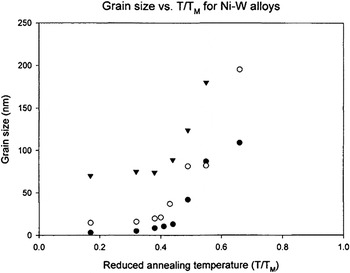
A very detailed study of grain boundary segregation has been carried out by Detor and SchuhReference Detor and Schuh24–Reference Detor, Miller and Schuh26 in nanocrystalline Ni–W alloys made by electrodeposition. The elastic enthalpy for W solute in Ni is estimated to be 60 kJ/mol,Reference De Boer, Boom, Mattens, Miedema and Niessen21 although there is significant solid solubility of W in Ni of >10 at.% W.Reference Okamoto27 From precise lattice parameter measurements as a function of W compositionReference Detor and Schuh24 and from atomistic computer simulationsReference Detor and Schuh25 and atom probe tomography,Reference Detor, Miller and Schuh26 it was determined that the segregation tendency for W to grain boundaries in Ni is weak. Segregation energy decreased with W addition from a dilute limit value owing to solute–solute interactions in the grain boundaries. The driving force for grain growth decreased with W additions but did not reach zero for any composition or grain size considered. Detor and SchuhReference Detor and Schuh28 have subsequently measured the grain growth in their electrodeposited nanocrystalline Ni–W alloys. The as-deposited grain size was a function of composition, with the smallest grain sizes (3 nm) corresponding to the highest W content (21 at.%) and the largest grain size (70 nm) for the lowest W concentration (6 at.%). The grain size for three Ni–W samples is plotted versus reduced annealing temperature (T/T M) in Fig. 1. These data were obtained by analysis of XRD line broadening. TEM studies on these samples showed good agreement with the x-ray data and gave no evidence for abnormal grain growth. While good stabilization compared to pure Ni occurs for these alloys up to about T/T M = 0.4, significant grain growth begins by T/T M ∼ 0.5, and the grains grow to above 100 nm (out of the nanoscale regime) by 0.6–0.7. The initial grain sizes of the electrodeposited alloys, and the stabilization, are strong functions of the W concentration. The Ni–21 at.% W alloy with as-deposited grain size of 3 nm is the most stable. It does precipitate the intermetallic compound Ni4W at the highest annealing temperature of 900 °C. The lower W content alloys maintain the fcc solid solution structure up to this temperature. The grain growth curves for the three alloys shown in Fig. 1 appear to be almost parallel. This suggests that the stabilization effectiveness for the various alloys may be similar if they were normalized to the same as-deposited grain size. Whether the stabilization is partially due to solute drag or thermodynamic stabilization is not clear.Reference Detor, Miller and Schuh26
Grain size versus reduced annealing temperature (T/T m) for Ni–6 at.% W (▼), Ni–13 at.% W (O), Ni–21 at.% W (●); data from Ref. Reference Detor and Schuh28.

The dependence of as-deposited grain size on composition in nanocrystalline alloys prepared by electrodeposition had been clearly noted in Ni–P alloys.Reference Farber, Cadel, Menand, Schmitz and Kirchheim29 The authors studied the microstructures of Ni–P alloys including the grain boundary segregation with tomographic atom probe analysis. The composition dependence of the grain size was explained by assuming a metastable grain boundary phase, of 15 at.% P, and thickness of 0.8 nm and using a mass balance calculation. It was possible to predict the grain size–P concentration relationship in as-deposited and annealed alloys. For low P content (less than about 5 at.%), the grain size increased upon annealing, while at the higher concentrations (>10 at.%), there was little difference between the as-deposited and annealed grain size. These were for annealing temperatures around 300 °C, which are below the critical temperature where Ni3P formation starts. At 15 at.% P, the samples become amorphous—in a sense, become “all grain boundary.” This same approach might also apply to the Ni–W nanocrystalline alloys made by electrodeposition, as discussed above. Whether similar ideas can be applied to nanocrystalline alloys made by other methods such as ball milling is problematic.
Nanocrystalline Co–1.1 at.% P was prepared by pulsed electrodeposition.Reference Choi, da Silva, Klement, Al-Kassab and Kirchheim30 Its thermal stability was studied by a variety of characterization methods including tomographic atom probe analysis. The thermal stability of the alloy at temperatures below about 733 K was attributed to the segregation of P to the grain boundaries. At temperatures between 673 and 733 K, the allotropic phase transformation, hcp Co to fcc Co, occurs and abnormal grain growth is observed. It was suggested that there is a synergistic relationship between the abnormal grain growth and the phase transformation.
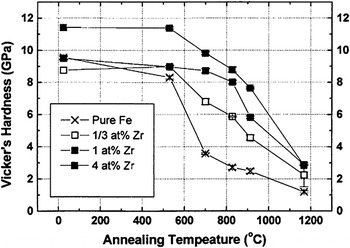
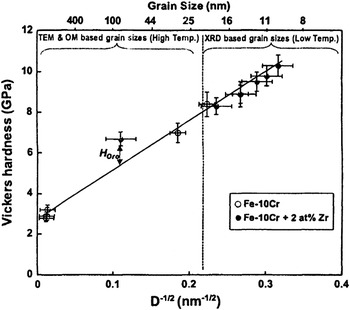
The thermal stabilization of Fe and Fe–Cr alloys with the addition of Zr was studiedReference Darling, Chan, Wong, Semones, Scattergood and Koch31–Reference Saber, Kotan, Koch and Scattergood33 since the recent models for thermodynamic stabilizationReference VanLeeuwen, Darling, Liu, Koch and Scattergood16, Reference Saber, Kotan, Koch and Scattergood17 predicted that Zr should be an effective solute addition. The initial research,Reference Darling, Chan, Wong, Semones, Scattergood and Koch31 which used XRD line broadening analysis, indicated that a nanocrystalline grain size (∼50 nm) was retained on annealing up to a homologous temperature (T/T m) of 0.92. However, measurements of hardness as a function of annealing temperature, Fig. 2, suggested that grain growth must have occurred at lower annealing temperatures. This was subsequently confirmedReference Darling, VanLeeuwen, Koch and Scattergood32 with optical, TEM, and FIB-CCI. It was found that the thermal stability increased with increasing Zr content, and the highest temperature where a nanoscale grain size was observed, 913 °C, was for a Fe–4 at.% Zr composition. At higher temperatures, grain sizes grew into the micrometer size range and precipitates of Fe2Zr were observed by TEM. Furthermore, detailed TEM also revealed precipitates at the lower annealing temperatures, 900 °C for the Fe–4 at.% Zr samples.Reference Darling34 Thus, the results of additions of Zr to nanocrystalline Fe provide apparent evidence for thermodynamic stabilization at elevated temperatures, but eventually, precipitation of intermetallic particles occurs so at the higher temperatures (∼900 °C), both Zener pinning and thermodynamic stabilization may be contributing to the thermal stability. The possibility of both mechanisms being operable was also suggested by the results of Zr additions to Fe–10 at.% Cr and Fe–18 at.% Cr nanocrystalline alloys.Reference Saber, Kotan, Koch and Scattergood33 Analysis based on the Hall–Petch grain size strengthening and the Orowan particle strengthening, Fig. 3, for the Fe–10 Cr–2 at.% Zr alloy annealed at 900 °C was used to extract the volume fraction of intermetallic particles having a mean particle size of 20 nm. The stabilized volume average grain size (from TEM) was 82 nm, whereas the Zener pinning model predicts a grain size of 168 nm. The additional stabilization may be attributed to the thermodynamic mechanism. For these Fe-based alloys, it appears that thermodynamic stabilization may be operative for annealing temperatures below homologous temperature of about 0.65. At about this temperature, both Zener pinning by precipitates and thermodynamic stabilization may be providing stabilization. At higher temperatures, as the precipitates coarsen, and Zr is taken out of the grain boundaries, thermal stabilization is lost.
Vickers hardness (25 g load for 15 s) versus 1-h isochronal annealing temperature for pure Fe and Fe–Zr alloys; data from Ref. Reference Darling, VanLeeuwen, Koch and Scattergood32.

Hall–Petch plot of Fe–10 Cr and Fe–10 Cr + 2 at.% Zr; data from Ref. Reference Saber, Kotan, Koch and Scattergood33.

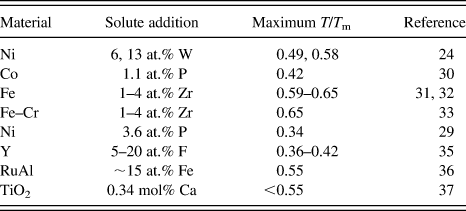
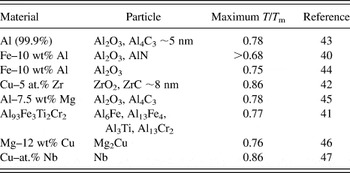
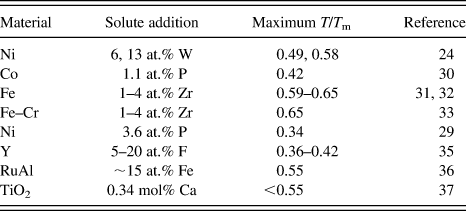
Other examples of the possible thermodynamic stabilization of nanocrystalline grain sizes are given in Table I along with the homologous temperature for apparent maximum stability (grain size remaining <100 nm) and the reference.
Thermal stabilization of nanocrystalline materials by the thermodynamic mechanism of solute segregation to grain boundaries.
IV. THERMAL STABILIZATION BY ZENER PINNING OF GRAIN BOUNDARIES
There have been a number of examples of grain boundary pinning in nanocrystalline materials by the presence of small second phase particles—the Zener drag mechanism.Reference Humphreys and Hatherly38 The expression for the pinning pressure exerted on the grain boundary by small particles is:
 $$P_Z = {{3F{\rm{\gamma }}} \over {2r}}\quad,$$
where PZ is the pinning pressure exerted by the particles on unit area of the boundary, F is the volume fraction of randomly distributed spherical particles of radius r, and γ is the specific grain boundary energy. It is clear that a high volume of small particles is desirable to increase the pinning pressure and thus to impede grain boundary mobility. It is also desirable for the nanoscale particles to resist coarsening at elevated temperatures. Several well-known properties such as coherent interface with the matrix (minimum interfacial energy), low solubility in the matrix, and low diffusivity in the matrix are needed but often not found in the same particles.
The stabilization in 5-nm grain size Ni–P alloys, which were produced by electrodeposition, did not take effect until after an increase of the grain size by a factor of 2–3.Reference El-Sherik, Boylan, Erb, Palumbo and Aust39 The solid solution of the Ni–1.2% P alloy did not measurably grow and was stable as a solid solution up to an annealing temperature of 473 K. For annealing temperatures of 523 and 623 K, the grain size initially increased by a factor of 2–3, before the grain size stabilized, which coincided with the precipitation of a second phase, Ni3P. Although other retarding effects in reducing the grain boundary mobility are considered (solute drag), the pinning of the grain boundaries by Ni3P as the second phase was believed to be the major factor of the grain size stabilization at 573 and 623 K. Another example of nanocrystalline grain size stabilization by second phase particles is the work of Perez et al.Reference Perez, Huang, Sharif, Lavernia and Bourell40 The authors studied the thermal stability of cryomilled Fe–10 wt% Al and found that a grain size of about 20 nm was maintained after annealing to about 600 °C, and even after annealing at 1100 °C, the grain size only grew to about 50 nm. This excellent grain size stability was attributed to the presence of nanoscale Al2O3 and AlN dispersoids. Another example of small particle-induced grain size stabilization is for an Al-based alloy by Shaw et al.Reference Shaw, Luo, Villegas and Miracle41 An Al93Fe3Cr2Ti2 alloy was prepared by mechanical alloying. The as-milled alloy was a solid solution of Al. After annealing at various temperatures, the internal strain was released, intermetallic compound particles precipitated, and there was some grain growth. The precipitation of a variety of intermetallics with Cr, Fe, or Ti was followed with several analytical techniques. There was essentially no grain growth at temperatures up to about 300 °C with the grain size distribution from TEM being about 6–45 nm. Even after heating to 450 °C (0.77 T m), the grain size distribution was still nanoscale, i.e., from 20 to 100 nm. The authors believe that the inhibition of grain growth at the lower annealing temperature was due to solute drag on the grain boundaries, but at the higher temperatures, it was due to pinning of the boundaries by the nanoscale intermetallic precipitates. Morris and MorrisReference Morris and Morris42 reported stabilization of nanocrystalline grain sizes (<100 nm) at annealing temperatures up to 900 °C in nanocrystalline Cu with ZrC particles pinning the grain boundaries. The carbide particles were 5–10 nm in diameter. TEM was used to measure the grain size and particle sizes. This provides a very high value of the homologous temperature, 0.86, where a nanocrystalline grain size is maintained. Other examples of probable thermal stabilization of nanocrystalline grain sizes by Zener pinning are listed with the above in Table II. As in Table I, the maximum homologous temperatures are given along with the references.
Thermal stabilization of nanocrystalline materials by the kinetic mechanism of Zener Pinning by nanoscale particles.

V. COMPARISON OF THERMODYNAMIC VERSUS ZENER PINNING STABILIZATION
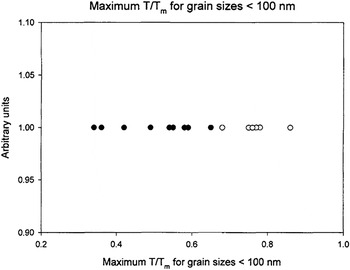
The data from Table I and Table II are plotted in Fig. 4 to illustrate the temperature ranges where thermodynamic stabilization or kinetic stabilization by Zener pinning are likely. This strongly suggests that the Zener pinning mechanism may provide the best thermal stabilization at the higher homologous temperatures.
Maximum homologous temperature (T/T m) for grain sizes <100 nm. Possible thermodynamic stabilization (●) and possible Zener pinning (O).

VI. DISCUSSION
While Fig. 4 summarizes the data for stabilization by thermodynamic or Zener mechanisms, there are questions regarding the data. In the case of the “thermodynamic stabilization,” it is not clear how this is separated from solute drag without detailed models and experiments. So it may be that these data we report as due to thermodynamic stabilization are actually from the solute drag mechanism.
A problem with predicting effective solute additions for thermodynamic stabilization is that typically, they should exhibit a large value of elastic enthalpy with the solvent matrix. This means that in general, the solutes will be insoluble in equilibrium and only nonequilibrium processing methods such as the severe plastic deformation of mechanical alloying can induce metastable solid solutions. The dilemma is then that on annealing the metastable solid solution, at sufficiently high annealing temperature, the solutes will come out of solution, and while they may segregate to the grain boundaries, it is more likely that they will form the equilibrium phase—an intermetallic compound (if the system has a negative enthalpy of mixing such as Fe–Zr) or the elemental precipitate (if the system has a positive enthalpy of mixing like Cu–Nb). However, with the optimum kinetics of nucleation and growth of the second phase, nanoscale phases can be obtained, which may be effective for Zener pinning. To prevent coarsening of these particles, it is desirable that they have low solubility in the matrix, coherent interfaces, and low diffusivity in the matrix.
The above suggestion that Zener pinning by nanoscale particles may be the most effective strategy for stabilizing nanocrystalline grain size at the highest homologous temperatures opens up the related question of how such particles may affect the mechanical properties of the nanocrystalline matrix. Brittle intermetallics or oxide, carbide, or nitride phases located at the nanocrystalline grain boundaries may adversely affect the toughness and ductility. However, there is not enough evidence in the literature to judge this. Clearly, more research is needed on both the stabilization by second phase particles and their effect on mechanical behavior.