Introduction
Inter-country adoptees run a number of risks of developmental and health-related problems (e.g. Verhulst et al. Reference Verhulst, Althaus and Verluis-den Bierman1990; Rutter et al. Reference Rutter, O'Connor, Beckett, Castle, Croft, Dunn, Groothues, Kreppner and Selman2000; Hjern et al. Reference Hjern, Lindblad and Vinnerljung2002; Tieman et al. Reference Tieman, van der Ende and Verhulst2005; van IJzendoorn et al. Reference van IJzendoorn, Juffer and Klein Poelhuis2005). In Sweden, the results have not been conclusive. In a study from 1999 of a sample (n=211) of international adoptees (aged 13–27 years) mental health was as good as in non-adoptees (Cederblad et al. Reference Cederblad, Höök, Irhammar and Mercke1999). However, in a series of register studies using whole national cohorts, some of the authors of the present study have contributed to findings of three- to fourfold (or even higher) increased risks of outcomes related to psychiatric hospitalizations including suicidal behaviour as well as to mortality and severe social problems (Hjern et al. Reference Hjern, Lindblad and Vinnerljung2002, Reference Hjern, Vinnerljung and Lindblad2004; Lindblad et al. Reference Lindblad, Hjern and Vinnerljung2003; Vinnerljung et al. Reference Vinnerljung, Hjern and Lindblad2006; von Borczyskowski et al. Reference von Borczyskowski, Hjern, Lindblad and Vinnerljung2006; Elmund et al. Reference Elmund, Lindblad, Vinnerljung and Hjern2007). Since the register studies are based on relatively rare outcomes, the seemingly contrary results may be understood by the attrition in the study by Cederblad et al. (19% of the families), reasonably implying that families having experienced severe problems were less likely to participate.
Both pre- and post-adoption factors contribute to this risk panorama. Due to the almost total lack of availability of individual-related data before adoption it is difficult – if not impossible – to link individual outcomes to specific background factors (see Vorria et al. Reference Vorria, Papaligoura, Sarafidou, Kopakaki, Dunn, van IJzendoorn, Steele and Kontopoulou2006 for a remarkable exception). For scientific purposes, however, it is possible to approach these questions at a group level by studying relations between nationally relevant characteristics of different donor countries and outcomes of the adoptees in the receiving country.
Social conditions of potential importance for adoptees' development vary between donor countries. First, major socio-economic differences are indicated by varying GNPs which imply different prerequisites for the pregnant woman and the infant. Differences concerning availability to and quality of health and social services contribute to the varying starting-points for adoptees with different geographic origins. Second, there may be strong variations between countries concerning the adoption procedure itself. Countries may to varying degrees have developed specific programmes for the care of pregnant women who are planning to adopt away their child, and for the care of the children when they are born. For example, approximately 80% of all inter-country adopted children are placed in different kinds of institutions in their first year of life (Johnson, Reference Johnson2002), and the standard of these institutions is a factor which may greatly influence the developmental potential of the children. Third, reasons for offering a child for adoption may differ between countries, which may influence the health risks of the children. If, for example, drug/alcohol abuse, psychiatric illness and/or poverty are common reasons, this would obviously influence the risks of the child through mechanisms like increased genetic vulnerability, fetal exposure to toxic substances and early malnutrition (e.g. Winick et al. Reference Winick, Meyer and Harris1975).
There are obviously several factors that may influence the psychosocial development of adoptees, contributing to explanations of the over-risks described initially. Given the register study approach of our group, intellectual capacity stands out as a potentially important factor for future mental health development that is able to be studied using the Swedish national registers. It is also a factor that is possibly related to conditions in the donor country. Childhood cognitive competence is an important predictor of general adult health, affecting also global outcomes such as age at death (Whalley & Dearey, Reference Whalley and Deary2001). In a recent study from Brazil, low IQ was not only related cross-sectionally to psychopathology but also predicted – even after adjusting for the initial symptoms – a worse prognosis at follow-up 3 years later (Goodman et al. Reference Goodman, Fleitlich-Bilyk, Patel and Goodman2007). Low IQ may also negatively influence the outcome, given a certain psychiatric diagnosis (Munro et al. Reference Munro, Russell, Murray, Kerwin and Jones2002). There are many pathways that may link intellectual function and later observed mental health. In one study, many of the correlations between IQ and psychosocial outcomes disappeared when early behaviour problems and family background were adjusted for (Fergusson et al. Reference Fergusson, Horwood and Ridder2005). This may in turn, be explained either by common genetic, social and familial processes in IQ and behaviour problems or by IQ predisposing for behaviour problems, or by both.
Cognitive ability may also be a potential mediator between early adversities and ill-health. Cognitive shortcomings imply risks for poor school performance, which – in interplay with environmental factors like child maltreatment and non-supportive parenting – is associated with a risk-taking behaviour that implies considerable health risks (Repetti et al. Reference Repetti, Taylor and Seeman2002). Furthermore, in several studies using Swedish national registers for studies on male conscripts, low IQ has proved to be a powerful risk factor for the development of poor mental health (see e.g. Gunnell et al. Reference Gunnell, Harrison, Rasmussen, Fouskakis and Tynelius2002, Reference Gunnell, Magnusson and Rasmussen2005).
A considerable number of studies have documented cognitive developmental disparities in inter-country adoptees compared to the population in the receiving countries (Rutter et al. Reference Rutter, O'Connor, Beckett, Castle, Croft, Dunn, Groothues, Kreppner and Selman2000; Howard et al. Reference Howard, Smith and Ryan2004; Judge, Reference Judge2004; van IJzendoorn et al. Reference van IJzendoorn, Juffer and Klein Poelhuis2005; van IJzendoorn & Juffer, Reference van IJzendoorn and Juffer2006). Several of the studies have focused especially on language development as a potential risk factor for cognitive delays. Most adopted children seem to learn their new language very rapidly but one third develop some form of language problems (Rygvold, Reference Rygvold, Rygvold, Dalen and Sætersdal1999; Dalen, Reference Dalen2001, Reference Dalen, Brodzinsky and Palacios2005; Glennen & Masters, Reference Glennen and Masters2002; Judge, Reference Judge2004; Roberts et al. Reference Roberts, Pollock, Krakow, Price, Fulmer and Wang2005; van IJzendoorn et al. Reference van IJzendoorn, Juffer and Klein Poelhuis2005). Adopted children's learning problems seem to be linked to deviant academic language (abstract and decontextualized language) development rather than day-to-day language (contextualized language anchored in the here-and-now situation) (Rygvold, Reference Rygvold, Rygvold, Dalen and Sætersdal1999; Dalen, Reference Dalen2001).
Few studies have focused on intelligence-test performances among inter-country adoptees although this has been a common theme in national adoption research (Duyme, Reference Duyme1990; Scarr, Reference Scarr1992, Reference Scarr1993; Duyme et al. Reference Duyme, Dumaret and Tomekiewicz1999). One exception is the now more than 30-year-old classic article on the effects of pre-adoption malnutrition on IQ test scores among 141 Korean children adopted in US families in the 1950s and the 1960s, by Winick et al. (Reference Winick, Meyer and Harris1975). They found that malnutrition was strongly related to both school-age IQ and school achievements. Stams et al. (Reference Stams, Juffer, Rispens and Hoksbergen2000) reported above-average scores on an IQ test in Dutch inter-country adoptees and especially emphasized the excellent performance of Korean adoptees. There are also several important studies (discussed below) on children adopted from Romania and their progress in intellectual development (Chisholm, Reference Chisholm1998; Rutter & ERA Study Team, Reference Rutter1998; O'Connor et al. Reference O'Connor, Rutter, Beckett, Keaveney, Kreppner and ERA Study2000; Rutter et al. Reference Rutter, Kreppner and O'Connor2001; Beckett et al. Reference Beckett, Maughan, Rutter, Castle, Colvert, Groothues, Kreppner, Stevens, O'Connor and Sonuga-Barka2006).
One pre-adoption factor of possible importance for the cognitive development is age at adoption. This is a classical factor in adoption research, but there has been some controversy about how to explain how these effects are mediated. Thus, age at adoption may be interpreted in an interpersonal context, meaning that a high age at adoption means a worse chance of developing a close relationship with the caregiver – and later on in life – also with other individuals. Another closely related focus is the increasing difficulties with age to compensate for the lack of positive experiences early in life, which may be important for development in a number of areas. A different – although not contrary – approach to the influence of age at adoption is to regard it rather as a marker of adversity; children adopted at a later age are often exposed to a variety of negative pre-adoption factors for a longer period of time than those adopted in infancy, e.g. institutional care (Dennis, Reference Dennis1973; Howe, Reference Howe1997; Vorria et al. Reference Vorria, Papaligoura, Dunn, van IJzendoorn, Steele, Kontopoulou and Sarafidou2003, Reference Vorria, Papaligoura, Sarafidou, Kopakaki, Dunn, van IJzendoorn, Steele and Kontopoulou2006; van IJzendoorm & Juffer, Reference van IJzendoorn and Juffer2006). It has been demonstrated that adopted children with long-term pre-adoption adversity are susceptible to delays in their cognitive and psychological development (Verhulst et al. Reference Verhulst, Althaus and Verluis-den Bierman1990, Reference Verhulst, Althaus and Verluis-den Bierman1992; Marcovitch et al. Reference Marcovitch, Goldberg, Gold, Washington, Wasson, Krekewich and Handley-Derry1997; O'Connor et al. Reference O'Connor, Rutter, Beckett, Keaveney, Kreppner and ERA Study2000; Vorria et al. Reference Vorria, Papaligoura, Dunn, van IJzendoorn, Steele, Kontopoulou and Sarafidou2003, Reference Vorria, Papaligoura, Sarafidou, Kopakaki, Dunn, van IJzendoorn, Steele and Kontopoulou2006; Juffer & van IJzendoorn, Reference van IJzendoorn, Juffer and Klein Poelhuis2005; Gunnar & Kertes, Reference Gunnar, Kertes, Brodzinsky and Palacios2005; Rutter, Reference Rutter, Brodzinsky and Palacios2005; van IJzendoorn et al. Reference van IJzendoorn, Juffer and Klein Poelhuis2005; van IJzendoorn & Juffer, Reference van IJzendoorn and Juffer2006). Studies on children adopted from Romania have indicated that age of adoption does have some effect on the children's further cognitive development (Rutter & ERA Study Team, Reference Rutter1998; O'Connor et al. Reference O'Connor, Rutter, Beckett, Keaveney, Kreppner and ERA Study2000; Beckett et al. Reference Beckett, Maughan, Rutter, Castle, Colvert, Groothues, Kreppner, Stevens, O'Connor and Sonuga-Barka2006). Other studies have not found support for age of adoption as a strong determinant for adopted children's overall development (Kvifte-Andresen, Reference Kvifte-Andresen1992; Cederblad et al. Reference Cederblad, Höök, Irhammar and Mercke1999; Dalen, Reference Dalen2001; Juffer & van IJzendoorn, Reference Juffer and van IJzendoorn2005). In the meta-analysis of adoption and cognitive development referred to above, the authors did not find evidence for any general effects of age at adoption on IQ (van IJzendoorn et al. Reference van IJzendoorn, Juffer and Klein Poelhuis2005). However, it did matter for their academic performance. Along the same lines, a Swedish register study reported that an adoption age of >4 years was associated with a lower educational attainment (Lindblad et al. Reference Lindblad, Hjern and Vinnerljung2003).
Another pre-adoption factor of possible importance for cognitive development is geographic origin, which is much less studied in this context than age at adoption. One way to approach this theme would be to focus on South Korean adoptees versus adoptees of other geographic origin, because of the special position of South Korea in international adoption (Selman, Reference Selman and Selman2000). There are three main reasons for such a choice. The first one concerns how South Korean children were selected for international adoption during the 1970s. Most of them were born ‘out of wedlock’ and relinquished by their mothers due to socio-cultural prejudices towards single parenthood (Tahk, Reference Tahk and Hoksbergen1986; Kim, Reference Kim1995). When compared with other types of selection criteria (e.g. mental illness, poverty – implying a risk for malnutrition, and drug/alcohol abuse) this background is most probably prognostically favourable for the child. The second reason for regarding the prerequistes of Korean international adoptees specially is the quality of care before adoption (Chandra et al. Reference Chandra, Abma, Maza and Bachrach1999). The pre- and postnatal care was well developed early, partly as a response to reactions from donor countries (Kim, Reference Kim1995). Third, for decades South Korea has been known for its high-level control of adoption agencies. Since the 1960s, agency staff requirements include a psychologist, a physician and a nurse. At least 50% of the children's counsellors must have 4 years of college-level social work training (Kim & Caroll, Reference Kim and Carroll1975). In addition to well functioning orphanages, adoption agencies in Korea for many years have also operated pre-adoptive foster family homes as an alternative to infant residential care (Tahk, Reference Tahk and Hoksbergen1986). Selection criteria and quality of care of the mother as well as of the child to be adopted in other donor countries probably vary considerably more (Triseliotis, Reference Triseliotis2000; Fonseca, Reference Fonseca2002).
Thus, there is reason to believe that many children adopted from South Korea are less exposed to many risk factors usually involved in international adoption. The outcome of South Korean adoptees rather reflects the impact of factors related to the adoption in itself, such as repeated separations and change of culture and language while the outcome of adoptees from other countries to a higher degree also reflect factors such as genetic vulnerability and perinatal adversities. Interestingly, Korean adoptees seem to display better language skills and school performances than inter-country adoptees from other donor countries (Frydman & Lynn, Reference Frydman and Lynn1989; Verhulst et al. Reference Verhulst, Althaus and Verluis-den Bierman1990, Reference Verhulst, Althaus and Verluis-den Bierman1992; Kvifte-Andresen, Reference Kvifte-Andresen1992; Dalen, Reference Dalen2001). This may also be reflected in better performances on intelligence tests.
A further question is to what degree cognitive development may be influenced by post-adoption factors. A series of French national adoption studies in the early 1980s, using a sibling-proband design, found that infant adoption had a positive effect on children's cognitive development, and that this process was positively correlated with the socio-educational background of the adoptive family (e.g. Dumaret, Reference Dumaret1985; Duyme, Reference Duyme1988). The results were later replicated in a study of late adoptions (4–6 years) of children abused or neglected in infancy (Duyme et al. Reference Duyme, Dumaret and Tomekiewicz1999). For inter-country adoptees research is not conclusive. In this group parental education seems to exert only a modest environmental influence on individual differences in IQ (Beckett et al. Reference Beckett, Maughan, Rutter, Castle, Colvert, Groothues, Kreppner, Stevens, O'Connor and Sonuga-Barka2006). Inter-country adoption seems to have the strongest positive effect on cognitive development in children with a low level of IQ (Beckett et al. Reference Beckett, Maughan, Rutter, Castle, Colvert, Groothues, Kreppner, Stevens, O'Connor and Sonuga-Barka2006)
The overarching aim of this study was to analyse relations between proxies for adoption- related circumstances and cognitive development. Our specific research questions were:
• Do mean scores on an intelligence test (global/verbal ability) differ between inter-country adoptees from South Korea and inter-country adoptees from other non-European donor countries?
• Is age at adoption related to these scores and – if so – is this relation different in the two adoptee groups?
• Does parental education influence these test scores and – if so – are there any differences in this respect between the adoptee groups and the general population?
Method
Participants
National registers in Sweden
All Swedish residents have a unique personal identification number (PIN) assigned to residents at birth or immigration, following each individual from birth/immigration to death. The national registers include data on, inter alia, demographic and socio-economic variables of the population in Sweden. This study was based on data from the Register of the Total Swedish Population (RTP), the Swedish Multi-Generation Register (MGR), the Military Service Conscription Register (MSCR) and the Population and Housing Censuses (PHCs) of 1985 and 1990, individually linked by using the PIN.
Study population
All male residents in Sweden born between 1968 and 1976 with confirmed country of birth and for individuals born outside Sweden with confirmed date of immigration were identified via the RTP in 2003 (n=601 863). The RTP contains information about PIN, sex, date of birth, country of birth, and date of emigration and immigration. Data on birth and/or adoptive parents of the study subjects were obtained from the MGR (Statistics Sweden, 2005). By linking the RTP with the MGR, we were able to identify birth and/or adoptive parents with confirmed country of birth of 542 034 study subjects, and among these, 438 777 (81.0%) individuals had a registered date of conscription in the MSCR before October 1994 (when new tests were introduced). Mean age of these men (n=438 777) was 18.2 years (s.d.=0.52 years). To avoid influence of potential unknown confounders, we only included males who were aged between 16 and 19 years at conscription (n=434 134). Furthermore, study subjects with missing information on any of the test variables were excluded (n=42 209, 9.7%). In total, information on 391 925 study subjects was linked with PHCs of 1985 and 1990. From this dataset 58 735 individuals were excluded from the statistical analyses: Swedish-born subjects with one or both registered biological parents born outside Sweden (n=44 695, 76.1%), non-Swedish-born subjects with both biological parents born outside Sweden (n=5229, 8.9%), Swedish-born subjects with only one registered Swedish-born biological parent (n=1892, 3.2%) and others (n=6755, 11.5%) including, e.g. domestic adoptees (n=1128, 1.9%).
Comparison groups
In total, 2294 inter-country adoptees were born outside the Western countries (Europe, North America and Australia) and adopted before age 10 years. Of these, 746 were born in South Korea [Korean adoptee (KA) group]. The remaining 1548 individuals were born in other countries, Non-Korean adoptee (NKA) group. India was the most common country of origin, followed by Thailand, Chile, Ethiopia, Colombia and Sri Lanka. These were the only donor countries for which the number of adoptees included in this study exceeded 100. The non-adopted population (NAP) group consisted of non-adopted individuals born in Sweden (n=330 896).
The Military Service Conscription Register
The MSCR comprises information about male residents in Sweden who have been conscripted for military service. Conscription is mandatory and enforced by law, except for individuals with severe handicaps. A total of 90.6% of the adoptees had a registered date of conscription compared to 93.9% in the NAP group. Parental level of education showed a similar (positive) correlation with the conscription rate in both groups.
Measures
Intelligence test
At conscription, the young men undergo a standardized physical health examination and – since 1944 – an intelligence test. The original test battery has been revised several times. The ‘Enlistment battery 80’ was used between 1980 and 1994, measuring intellectual performance by four subtests representing logical, spatial, verbal, and technical capabilities (Carlstedt, Reference Carlstedt2000). All test scores, and a global IQ score derived as a summary score from the four subtests, are standardized to give a Gaussian distribution of scores between 1 and 9. Higher values indicate enhanced intellectual ability. Due to military secrecy, the tests are not available for persons outside the Swedish conscription authority. However, a construct validity analysis of the global scale has been published (Carlstedt & Mardberg, Reference Carlstedt and Mardberg1993). In a confirmatory factor analysis it was demonstrated that the global score could be ‘seen as a good estimate of general intellectual ability defined as an ability to solve complex problems’ (Carlstedt & Mardberg, Reference Carlstedt and Mardberg1993). The logical test measures the ability to understand written instructions and apply them for problem solving. In the spatial test, the task is to determine which three-dimensional object (out of examples presented) will result from folding up a given one-dimensional object, which has marked lines, indicating where to fold (the ‘folding’ is performed mentally). The verbal test measures the knowledge of synonyms; the subject should determine which out of four alternatives is the synonym of a given word (40 words are presented as such key words). The aim of the verbal test is to measure ‘linguistic understanding and ability to use oral and written language’ (Carlstedt, Reference Carlstedt2000). The technical test, ‘technical comprehension’ also measures knowledge of chemistry and physics and implies a component of general knowledge. All tests are presented in succession to the subjects through written questionnaires. In this study, only global and verbal scores are used in the analyses.
Independent variables/potential confounding factors
Year of birth was categorized as born between 1968 and 1970, 1971 and 1973, or 1974 and 1976. Age at adoption was defined as date of immigration minus date of birth, and categorized as <2 years, 2–3 years, 4–5 years, or ⩾6 years at adoption. Year of conscription was categorized as 1985–1987, 1988–1990, 1991–1992, or 1993–1994. Data on maternal and paternal education were obtained from the Swedish Population and Housing Census 1990. The highest educational level of either parent was categorized as ⩽9 years of primary school, <3 years of secondary school, 3 years of secondary school, <3 years of higher education, or ⩾3 years of higher education (Statistics Sweden, 2000).
Statistical analyses
The registers were linked and data were analysed using SAS version 8.2 software (SAS Institute, Cary, NC, USA). Data are given as numbers, percent, means and 95% confidence intervals. Mean differences, and trend tests were calculated. Statistical significance for p values was set at three levels: p<0.05, p<0.01 and p<0.001. The study was approved by the Regional Ethics Committee (Karolinska Institutet, D No. 02/349).
A linear regression analysis was used to evaluate the effect of having a parent with university education on the test results performed separately in each study group. In this analysis test results were used as the outcome variable and a dichotomized independent variable of highest parental education being university (yes/no) was created. For the adoptee study groups two models were fitted, the first model crude and the second model adjusted for age at adoption. For the Swedish majority study group only the crude model was used.
Results
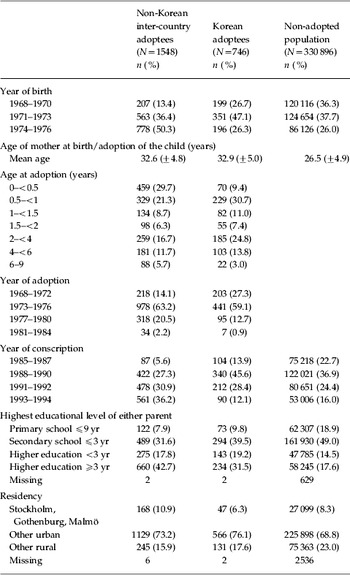
Demographic information about the study groups is presented in Table 1. In the inter-country adoptee groups, maternal age at the birth of the child was considerably higher than in the NAP group. A smaller proportion of the KA group, 9.4%, were adopted at <6 months compared to 29.7% in the NKA group. It was more common that adoptive parents – especially in the NKA group – had higher education than parents in the NAP group.
Demographics

Some percentages do not add up to 100 because of rounding.
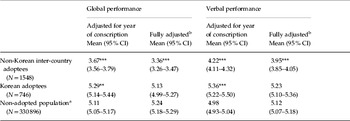
The NKA group had significantly lower mean global and verbal scores than the NAP group after adjustments for year of conscription (Table 2). When the scores were adjusted also for parental educational level and residency, these differences increased. The KA group displayed a different pattern with significantly higher (when adjusted only for year of conscription) or similar (when adjusted also for parental education and socio-economic status) scores when compared to the NAP group. The NKA group – and to a lesser degree also the KA group – performed better on verbal than on global scores when compared to the NAP performance.
Means and 95% confidence intervals (CI), and significant differences of intellectual performance among Non-Korean and Korean inter-country adoptees and the non-adopted populationFootnote a

a The non-adopted population served as the reference group.
b Adjusted for year of conscription, highest educational level of either parent and residency.
Significant difference:
** p<0.01, *** p<0.001.
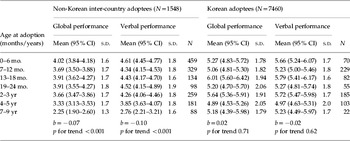
There were only small score differences related to age at arrival before 4 years (Table 3). Arrival at >4 years was related to markedly lower scores in the NKA group. Intellectual performance was no better for those adopted aged <6 months than for those adopted at older ages, provided that it was not >4 years. Mean global and verbal test scores were negatively correlated with increasing age at adoption in the NKA group, but for the KA group no such correlation was found.
Means, 95% confidence intervals (CI) and standard deviations (s.d.) of intellectual performance by age at adoption

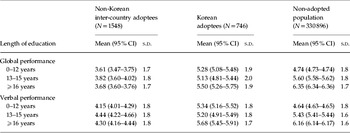
No effects of parental educational level on global test scores were found in the adoptee groups, whereas in the general population, such influence was prominent (Table 4). For verbal performance, higher mean scores were significantly related to higher parental education in the general population.
Means, 95% confidence intervals (CI) and standard deviations (s.d.) of intellectual performance by length of education of parent with highest education

In a linear regression analysis the effect of having a parent with university education on the global test score was 1.08 (p<0.001) units on the stanine scale in the Swedish majority, 0.10 in the KA group (p=0.56) and 0.08 in the NKA group (p=0.59). Adjustment for age at adoption did not change these estimates. On the verbal test score the effect was 0.98 (p<0.001) for the Swedish majority, 0.17 (p=0.19) in the KA group and 0.18 (p=0.059) in the NKA group. With adjustment for age at adoption the estimate increased slightly for the NKA group to 0.19 (p=0.043) but remained at 0.17 for the KA group.
Discussion
There were marked differences on global and verbal test performance scores between adoptees from South Korea (higher scores) compared to adoptees from other donor countries. Adoptees adopted after age 4 years had lower test scores if they were not of Korean ethnicity, while age did not influence test scores in South Koreans or in children adopted before the age of 4 years. Parental education showed marginal effects for adoptees' test scores but was prominently influential for non-adoptees.
The differences between the KA group and all other inter-country adoptees were notably large, 5.13 versus 3.36 (Korean/Non-Korean) on the stanine scale after adjustments for parental education and place of residence. It is well-known that interpretation difficulties arise when a test instrument designed for a specific culture is applied to individuals from quite a different culture (see e.g. Shuttleworth-Edwards et al. Reference Shuttleworth-Edwards, Kemp, Rust, Muirhead, Hartman and Radloff2004). Taking this into consideration, research on national intelligence – controversial and more often used in economy research – has given some empirical support for higher IQs (105–108) in the East Asian region (China, Japan, South Korea, Taiwan, Hong Kong and Singapore) (for a review see Lynn & Vanhanen, Reference Lynn and Vanhanen2002). However, even when such factors are accounted for, the large discrepancy between our two study groups cannot be explained. The only known major background differences between the study groups would have influenced the test performance differences in the opposite direction: a smaller proportion of the Korean group, ~10%, were adopted before age 6 months, compared to ~30% in the other adoptee group and there were fewer parents with higher education ⩾3 years in the Korean group. A reasonable interpretation is that the large differences between South Korean adoptees and other adoptees are to a high degree determined by varying selection procedures and the organization of care for mother and child in the donor country (as described above). These selection mechanisms – in turn – are related to several different factors (e.g. motives for offering a child for adoption, societal norms, the social welfare system, etc.). The organization of care is related to the economic level of the country, policy-making and traditions. In other words, cognitive function (as measured by intelligence test) may be unaffected – or only marginally affected – by the general preconditions for an international adoption (such as repeated separations, change of language and culture, lack of genetic bonds between adoptee and adoptive parents), given that adoptees have similar pre- and perinatally identifiable risks for developmental problems as non-adoptees and that the organization for the care of child and mother is ‘good enough’.
Geographic origin has been approached in previous register studies by some of the authors of the present study. In the first study (Hjern et al. Reference Hjern, Lindblad and Vinnerljung2002), we compared Asian origin (South Korea was the major donor country) with Latin American. The latter implied increased risks for mental health disorders (OR 1.6) and for social maladjustment (OR 1.8). In the next study (Lindblad et al. Reference Lindblad, Hjern and Vinnerljung2003) we compared the Far East (82% from South Korea) with origin from Latin America, Africa and other parts of Asia. Far East origin meant a better educational and professional outcome (e.g. origin from other regions meant ORs between 0.4 and 0.7 for reaching university degree level) as well as lower risk for psychiatric hospitalizations (origin from other regions meant ORs between 1.2 and 1.5 for such hospitalizations). The results from a recent study (Elmund et al. Reference Elmund, Lindblad, Vinnerljung and Hjern2007) – using similar geographic subgroups – imply two- to threefold increased risks for placement in out-of-home care after age 10 years in adoptees from Latin America and Africa/Middle East compared to those from the Far East. To summarize, Korean ethnicity seems to convey better outcome on many central aspects of adaptation and development.
The adoptees' mean score was more similar to the general population on the verbal test, which may seem contradictory, given the change of language that all inter-country adopted children have to adapt to (Dalen, Reference Dalen2001, Reference Dalen, Brodzinsky and Palacios2005; van IJzendoorn et al. Reference van IJzendoorn, Juffer and Klein Poelhuis2005). Again, the mean test score for adoptees from South Korea was the highest, even higher than for the general Swedish population (a difference that disappeared when parental education and place of residence were adjusted for). These results point to the fact that change of language in early childhood does not necessarily have a negative effect on a child's language development, provided that basic environmental needs are met. However, the results also indicate that adverse pre-adoption conditions make adopted children vulnerable to delays in their language development.
Language plasticity when changing to a new language during childhood is in line with findings from other studies. The traditional hypothesis about a critical period for acquiring a language ending at puberty was formulated almost 40 years ago (Lenneberg, Reference Lenneberg1967). Johnson & Newport (Reference Johnson and Newport1989) have extended this theory by demonstrating that this critical period is also valid for acquisition of a second language. Some authors have challenged the theory of a critical period and have focused on the grammar centre which seems to be active in similar ways as for the first language when acquiring a second language later on in life (for a review see Sakai, Reference Sakai2005). Pallier et al. (Reference Pallier, Dehaene, Poline, LeBihan, Argenti, Dupoux and Mehler2003) have described the language acquisition in Korean adoptees who were adopted to France between ages 3 and 8 years. Similar brain areas were activated (demonstrated by functional magnetic resonance imaging; fMRI) in similar ways when the adoptees were compared with native French controls in experiments involving exposure to French-language stimuli.
The aim of the verbal test used at military conscription is to measure ‘linguistic understanding and ability to use oral and written language’ (Carlstedt, Reference Carlstedt2000). It should be noted that verbal ability in this test reflects knowledge about synonyms, which is only one facet of verbal ability. Thus, the logical test (part of the global score) may have implied more sophisticated verbal demands, which are also more similar to the demands of academic language skills and formal education at different levels. Furthermore, the technical scale (part of the global score) may be a more sensible indicator of functional language than a synonym test.
Interestingly, the scores were almost identical for children, having arrived at different ages, if they had arrived before age 4 years. From age 4 years, however, there was a distinct drop of scores among non-Korean adoptees with very low scores among those who arrived at age ⩾6 years. Late arrival was not correlated to test performance in the KA group. In the Romanian study carried out by Rutter and colleagues, age of adoption was related to a cognitive index even at follow-up at ages 6 and 11 years (Rutter & ERA Study Team, Reference Rutter1998; Beckett et al. Reference Beckett, Maughan, Rutter, Castle, Colvert, Groothues, Kreppner, Stevens, O'Connor and Sonuga-Barka2006). Along similar lines, a number of research studies on domestic adoption suggest that children placed in adoptive families at age <6 months have IQ scores that are 1 standard deviation above the norm (Dumaret, Reference Dumaret1985; Duyme, Reference Duyme1988, Reference Duyme1990; Maughan & Pickles, Reference Maughan, Pickles, Robins and Rutter1990; Duyme et al. Reference Duyme, Dumaret and Tomekiewicz1999).
How should these differences between our results and the findings from the Romanian and the national adoptees be interpreted? A reasonable hypothesis is that individuals in our samples have suffered less – on average – from adversities of different kinds (although this cannot be proved since we lack data about pre-adoption characteristics). All the Romanian adoptees had been brought up in institutions of extremely poor quality. The national adoption samples include many special-needs adoptions. The tentative conclusion is that cognitive catch-up is dependent on a minimum quality of care before adoption.
Few studies have followed up inter-country adoptees' intellectual performance beyond the age of 11 years (Beckett et al. Reference Beckett, Maughan, Rutter, Castle, Colvert, Groothues, Kreppner, Stevens, O'Connor and Sonuga-Barka2006). The adoptees in the present study were tested at age 18, which means that they have had a longer catch-up period. One may hypothesize that this would mean a more marked positive influence on the IQ of the adoptees. However, the opposite may be true; previous research on national adoptees suggests that their cognitive performance – especially general cognitive ability and verbal ability – seems to become more like their biological parents and less like their adoptive parents with increasing age (Plomin et al. Reference Plomin, Fulker, Corley and DeFries1997).
There were no effects of parental education on global test scores in either adoptee group and only minor influence on verbal scores. In this respect both adoptee groups were quite similar but clearly different from the general population, in which a strong relation between parental education and cognitive performance of the offspring was found. The discrepancy is probably to a large degree explained by the genetic component of intelligence implying in itself a correlation between parental education (as a marker of parental intelligence) and cognitive performance of the biological offspring. In the study by Neiss & Rowe (Reference Neiss and Rowe2000) adopted adolescents were compared with matched biological children to estimate the effects of parental education, which explained only 3–4% of the variation in verbal intelligence of the adoptees. These effects were interpreted by the authors as being most prominent among families who were not able to provide adequate intellectual stimulation which negatively influenced the intellectual development of their child. In international adoption studies from countries with a homogenous and high level of parental education, e.g. Sweden, the effects of the childhood family environment on the cognitive performance of adoptees might be weaker than in societies with generally lower educational attainment or more uneven estimation of education.
Another way of describing these phenomena is to conclude that the basic stimulation of the adoptive family environment seems to be good enough for the intellectual development of the adoptees (cf. Scarr, Reference Scarr1992, Reference Scarr1993) and that the extra stimulation of a highly educated parent does not mean any further increase in intelligence scores, given the genetically and early environmentally (e.g. malnutrition) influenced individual prerequisites. The only exception from this is the small positive effect of parental university education on verbal performance in the NKA group. It seems reasonable that synonym knowledge is more sensitive to an ‘academic family environment’ and these findings fit well with previous results indicating that adoptive parents stimulate the vocabulary of their children more than other parents (Colombo et al. Reference Colombo, de la Parra and Lopez1992; Neiss & Rowe, Reference Neiss and Rowe2000).
Limitations
One obvious limitation in our study, as in most other studies on adoptee development, is the lack of more precise information on pre-adoption conditions and genetic background. Our study included only males and therefore the results cannot be generalized to females. The fact that the psychological conscription tests are secret creates some uncertainty about how the results should be interpreted and how they relate to results from other established cognitive tests, even if this limitation to a certain degree is balanced by the theoretical and empirical bases of these tests, the available surveying descriptions of the subscales, the referred examination of the construct validity and the comprehensive previous research using these registers.
The main strengths of the study are the use of national cohorts and the high number of participants in the study groups, allowing for meaningful statistical analyses.
Conclusions
The results show considerable variation in cognitive capacity (at a group level) between international adoptees of different geographic origin, even after adjusting for parental education and age of adoption. The lower intelligence test scores among non-Korean adoptees compared to the general Swedish population suggest that negative pre-adoption condition may have influenced their cognitive prerequisites. At the same time, the high test scores among adoptees from South Korea – on par with the non-adopted Swedish group – suggest that the prognosis from a cognitive perspective may be good regardless of age at adoption if the quality of care before adoption has been ‘good enough’ and the adoption selection mechanisms do not reflect an overrepresentation of environmental and/or genetic risk factors.
These, however, are tentative conclusions. In the absence of reasonably reliable data on individual pre-adoption factors, we cannot make any firm conclusions about causality. Considering the global scope of international adoption today – involving thousands of children, birth and adoptive families yearly – and the dearth of pre-adoption data in studies on the development of international adoptees, the research community should direct more attention to this fundamental gap of knowledge. One possible strategy is to enlist adoption agencies and researchers from the donor countries in a quest for systematic collection of pre-adoption data. We also need to know more about how cognitive capacity matters for the long- term development of international adoptees, e.g. how it is related to educational outcomes as well as to mental health issues.
Acknowledgements
This study was supported by grants from The Bank of Sweden Tercentenary Foundation.
Declaration of Interest
None.