Implications
In the pig industry, research evidence has shown that some nutritional strategies, such as reduced protein diets (RPD) with lysine deficient levels, increase intramuscular fat (IMF) content and promote a balanced fatty acid composition in longissimus lumborum, a white reference muscle, without an increase in subcutaneous adipose tissue. To the best of our knowledge, this is the first report on the effects of RPD on psoas major, which is representative of red muscles in pig’s carcass and an expensive tender piece of meat economically relevant and highly appreciated by the consumers.
Introduction
Pork is the most widely consumed meat in the world accounting for more than 36% of the total meat intake (Food and Agriculture Organization of the United Nations, 2014). Intramuscular fat is the main attribute affecting meat sensory characteristics and an important economic trait in pork production (Wood et al., Reference Wood, Enser, Fisher, Nute, Sheard, Richardson, Hughesand and Whittington2003 and Reference Wood, Richardson, Nute, Fisher, Campo, Kasapidou, Sheard and Enser2008). However, as a consequence of genetic selection towards reduced subcutaneous fat, the amount of IMF content in commercial pig lines has dramatically declined with the exception for some pig breeds, such as Alentejana and Iberian, which have high amounts of both subcutaneous fat and IMF content (Daza et al., Reference Daza, Mateos, Rey, Ovejero and López-Bote2007). In addition, fatty acid composition of IMF plays an important role on meat quality and, as a result, an adequate proportion of saturated fatty acids (SFA), monounsaturated fatty acids (MUFA) and polyunsaturated fatty acids (PUFA) should be maintained in order to assure high standards of nutritional value and eating quality (Wood et al., Reference Wood, Richardson, Nute, Fisher, Campo, Kasapidou, Sheard and Enser2008). Therefore, the production of pork with moderate amounts of IMF and a balanced fatty acid composition, without an increase in subcutaneous adipose tissue, is highly desirable for meat industry and pork consumers. The most successful nutritional strategy to enhance fat accumulation in muscle without a significant effect on subcutaneous fat is the use of RPDs (Doran et al., Reference Doran, Moule, Teye, Whittington, Hallett and Wood2006; Madeira et al., Reference Madeira, Costa, Alfaia, Lopes, Bessa, Lemos and Prates2013a) and/or low-lysine levels (Madeira et al., Reference Madeira, Pires, Alfaia, Costa, Luxton, Doran, Bessa and Prates2013b). The mechanisms underlying these effects are tissue- and genotype-specific and seem to be associated with the expression regulation of key lipogenic genes by RPDs, which can lead to the increase of de novo fatty acid synthesis (Doran et al., Reference Doran, Moule, Teye, Whittington, Hallett and Wood2006; Madeira et al., Reference Madeira, Costa, Alfaia, Lopes, Bessa, Lemos and Prates2013a and Reference Madeira, Pires, Alfaia, Lopes, Martins, Pinto and Prates2014). According to Madeira et al. (Reference Madeira, Costa, Alfaia, Lopes, Bessa, Lemos and Prates2013a), the genotype-specific effect of RPDs on IMF is attributed to lysine limitation and occurs via upregulation of the lipogenic enzyme stearoyl-CoA desaturase.
Longissimus lumborum (LL) is the reference muscle in meat producing species, including pig. In spite of this, depending on anatomical location, considerable variation exists in meat quality characteristics, such as between LL and psoas major (PM). However, it is well established that LL muscle is predominantly white (Maltin et al., Reference Maltin, Warkup, Matthews, Grant, Porter and Delday1997) and pork is recognised as red meat (Valsta et al., Reference Valsta, Tapanainen and Mannisto2005). This inter-muscle variation is often directly related to the metabolic and contractile properties, as determined by their muscle fibre type distribution (Klont et al., Reference Klont, Brocks and Eikelenboom1998). The metabolic differences between LL and PM are mainly characterised by higher activity of citrate synthase and lower activity of lactate dehydrogenase in the more oxidative red PM muscle as compared with the more glycolytic white LL muscle (Zhang et al., Reference Zhang, Zhou, Ma, Chen, Jiang, Zhu, Shuai, Wang, Li and Li2013). Muscle contractile-fatigue properties are determined by the composition of muscle fibre type (myosin heavy chain (MyHC)) and by biochemical properties of each muscle fibre, mainly energy substrates (Schiaffino and Reggiani, Reference Schiaffino and Reggiani2011). In addition, it is generally accepted that oxidative fibres are associated with higher IMF amounts (Pires et al., Reference Pires, Madeira, Dowle, Thomas, Almeida and Prates2016).
PM muscle is an expensive tender piece of meat highly valued by the consumers (Wood et al., Reference Wood, Nute, Richardson, Whittington, Southwood, Plastow, Mansbridge, Da Costa and Chang2004) and representative of red muscles in pig’s carcass. Attending to the fact that fibre type is an important source of variation in meat quality, we hypothesised that feeding a RPD not equilibrated for lysine (RPD) to growing-finishing pigs with different genetic backgrounds (lean and fatty) increases IMF by shifting the biochemical properties of PM muscle fibres from glycolytic to oxidative type. This effect was assessed in PM through fibre type switch, IMF content and detailed fatty acid composition.
Material and methods
Experimental design: animals and diets
This trial was conducted at the facilities of Unidade de Investigação em Produção Animal (Instituto Nacional de Investigação Agrária e Veterinária (UEISPA-INIAV), Santarém). The experimental procedures were reviewed by the Ethics Commission of the Centro de Investigação Interdisciplinar em Sanidade Animal/Faculdade de Medicina Veterinária (CIISA/FMV) and approved by the Animal Care Committee of the National Veterinary Authority (Direcção-Geral de Alimentação e Veterinária), following the appropriated European Union guidelines (2010/63/EU Directive). The staff members involved in animal trial hold license for conducting experiments in live animals from the Portuguese Veterinary Services.
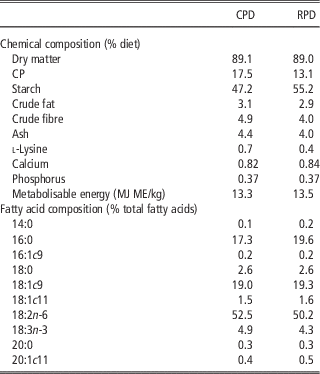
A total of 40 male pigs, 20 Alentejana purebred (an autochthonous high-fat porcine genotype) and 20 commercial crossbred pigs with three genetics lines (50% Large White×50% Landrace gilts mated to 50% Large White×50% Pietrain boars; a commercial low-fat porcine genotype) with an initial live BW of 59.9±2.10 kg (mean±standard deviation) were used. Before the trial, pigs were housed and fed the same conventional feed management (starter diet containing 13.0 MJ ME/kg and 1.2% total Lys from weaning to 1 month of age, followed by an intermediate diet containing 13.0 MJ ME/kg and 1.1% total Lys until 25 to 30 kg BW, and then, a finishing diet containing 13.0 MJ ME/kg and 0.9% total Lys until ~60 kg BW; Tecadi, Santarém, Portugal). Afterwards, pigs were divided into groups of 10 animals, which were randomly allocated into four groups of three pens (two pens containing four pigs and one pen containing two pigs) and randomly assigned to one of the two diets within a 2×2 factorial arrangement (two genotypes and two diets), with individual control of feed intake. Diets were based on barley, wheat and soybean meal (Madeira et al., Reference Madeira, Pires, Alfaia, Costa, Luxton, Doran, Bessa and Prates2013b), were isoenergetically formulated (13.4 MJ ME/kg), according to the NRC (1998) and differed in CP and lysine contents, as follows: 17.5% of CP and 0.7% of lysine (control protein diet (CPD)) and 13.1% of CP and 0.4% of lysine (RPD not equilibrated for lysine) (Table 1).
Chemical composition and fatty acid profile of the experimental diets

Dietary treatments: CPD=control protein diet equilibrated for lysine; RPD=reduced protein diet not equilibrated for lysine.
Diet samples were collected four times during the trial. Dry matter was determined by drying samples at 100°C to constant weight. Nitrogen content was determined by the Kjeldahl method (AOAC, 2000) and CP was calculated as 6.25×N. The determination of ash and starch contents were carried out according to the procedures described in AOAC (2000) and Clegg (Reference Clegg1956), respectively. Crude fat was determined by extracting feed samples with petroleum ether using an automatic Soxhlet extractor (Gerhardt Analytical Systems, Königswinter, Germany). Crude fibre was determined according to the procedures described in AOAC (2000). Fatty acid methyl esters (FAME) of feed samples were analysed by one-step extraction transesterification using heptadecanoic acid (17:0), as internal standard. Lysine was extracted according to the method described by AOAC (2005) and the quantification was performed by high-performance liquid chromatography (Agilent 1100; Agilent Technologies, Avondale, PA, USA), according to Henderson et al. (Reference Henderson, Ricker, Bidlingmeyer and Woodward2000).
Animal performance and muscle sampling
During the trial, all pigs were allowed to feed twice a day and water was provided ad libitum. Feed was withdrawn 17 to 19 h before slaughter. Pigs were slaughtered at a live weight of 93.2±2.20 kg at the UEISPA-INIAV experimental slaughterhouse following standard handling procedures, using electrical stunning before exsanguination. For IMF content and fatty acid composition, PM muscle samples were collected, immediately vacuum-packed and stored at −20°C until analyses. For muscle histological properties, samples with about 1 cm3 were taken from the middle layer of the PM muscle. These samples were mounted on flat sticks, frozen in isopentane cooled by liquid nitrogen, and stored at −80°C until further analysis.
Intramuscular fat content and fatty acid composition
IMF content was determined in fresh samples by hydrolysis with 4 M HCl, followed by Soxhlet extraction during 6 h with petroleum ether (AOAC, 2000). For fatty acid analysis, FAME were extracted from the lyophilised samples (ca 250 mg), according to the Folch and Stanley (Reference Folch and Stanley1957) method, using dichloromethane and methanol (2 : 1 v/v) instead of chloroform and methanol (2 : 1 v/v), as described by Carlson (Reference Carlson1985). All the extraction solvents contained 0.01% butylated hydroxytoluene as an antioxidant. Fatty acids were converted to methyl esters by a combined transesterification procedure with NaOH in anhydrous methanol (0.5 M), followed by HCl : methanol (1 : 1 v/v) at 50°C during 30 and 10 min, respectively, according to Raes et al. (Reference Raes, De Smet and Demeyer2001). The quantification of FAME was performed using a gas chromatograph HP6890A (Hewlett-Packard, Avondale, PA, USA), equipped with a flame ionisation detector (GC-FID) and a CP-Sil 88 capillary column (100 m×0.25 mm i.d., 0.20 µm film thickness, Chrompack; Varian Inc., Walnut Creek, CA, USA), using the conditions described in Alves and Bessa (Reference Alves and Bessa2009). The quantification of total FAME was done using nonadecanoic acid (19:0), as internal standard. Results for each fatty acid were expressed as a percentage of the sum of detected fatty acids (% total fatty acids).
Muscle colour and fibre profile
Objective colour was measured on the cut surface of PM sections 24 h postmortem, using a Minolta CR-300 chromometer (Konica Minolta, Tokyo, Japan) and applying the CIE L* (lightness), a* (redness) and b* (yellowness) system 1 h after air exposure to allow blooming. For determination of muscle histological properties, serial transverse muscle sections (10 µm thick) were cut on a cryostat at −24°C and stained for succinate dehydrogenase (SDH). The SDH protocol described by Sheehan and Hrapchak (Reference Sheehan and Hrapchak1987) was used to define fibre metabolic type as oxidative or glycolytic (Nachlas et al., Reference Nachlas, Tsou, DeCheng and Seligman1957), under a light microscope (Olympus BX51 equipped with a DP11 microscope digital camera system, Olympus, Tokyo, Japan). For morphometric analysis, the percentage of each fibre type and its mean surface area were measured in two randomly selected areas on serial sections with an image analysis software program (Olympus DP-Soft version 3.0 for Windows 95/98). On average, 200 fibres were analysed in each serial section.
Statistical analysis
All data were checked for normal distribution and variance homogeneity. As variance heterogeneity was detected for most of the variables, data were analysed using Proc MIXED of the SAS software package (version 9.4; SAS Institute Inc., Cary, NC, USA), with a model including the genotype and diet as fixed effects and the repeated statement considering the group option to accommodate the variance heterogeneity. The experimental unit was the animal. Results are presented as mean and standard error, and considered significantly different when the P-value was <0.05. Pearson’s correlation coefficients were calculated using the Proc CORR of SAS procedure in order to elucidate possible associations between muscle colour, major fatty acids and fibre profile. The correlations were considered significant at P<0.05. A principal component analysis (PCA) was carried out using STATISTICA software, with the variables for PCA being standardised to a mean of zero and a variance of one.
Results
The results of the present trial regarding pigs’ performance were published by Madeira et al. (Reference Madeira, Pires, Alfaia, Luxton, Doran, Bessa and Prates2016). Briefly, Alentejano pigs had higher average daily feed intake and lower gain : feed compared with crossbred pigs (P<0.05). The RPD, relative to CPD, increased average daily feed intake (P<0.05) but decreased gain : feed (P<0.05). Average daily gain was not affected by genotype or diet (P>0.05).
Intramuscular fat content and fatty acid composition
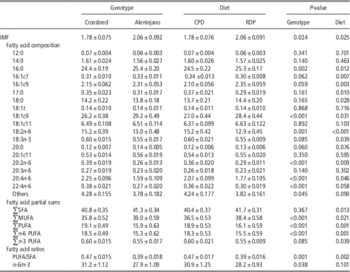
The results of IMF and fatty acid composition in PM muscle are presented in Table 2. Both genotype and diet affected IMF content, Alentejana purebred had higher IMF content than crossbred pigs (P=0.024) and RPD increased IMF content relative to CPD (P=0.025). For all experimental groups, the predominant fatty acids were 18:1c9 (26.2% to 29.2% of total FAME), 16:0 (24.4% to 25.4%), 18:2n-6 (12.9% to 15.2%), 18:0 (13.7% to 14.4%), and 18:1c11 (6.37% to 6.63%). 18:1 trans represents the sum of 18:1 trans 6 with trans 11. ‘Others’ refer to unidentified minor fatty acids and 16:0, 18:0 and 18:1 dimethylacetals derived from plasmalogens. The genotype influenced six of the 18 fatty acids identified (16:0, 18:1c9, 18:2n-6, 20:2n-6, 20:4n-6 and 22:4n-6). The percentages of 16:0 (P=0.002) and 18:1c9 (P<0.001) were higher in Alentejana purebred. In contrast, the percentages of 18:2n-6 (P=0.001), 20:2n-6 (P<0.001), 20:4n-6 (P<0.001) and 22:4n-6 (P<0.001) were higher in crossbred pigs. The diet affected 10 of the 18 fatty acids identified. Reduced protein diet increased 16:0 (P=0.012), 16:1c9 (P=0.003), 18:0 (P=0.028) and 18:1c9 (P=0.031) but decreased the percentages of 16:1c7 (P=0.007), 17:0 (P=0.009), 18:2n-6 (P<0.001), 18:3n-3 (P=0.039), 20:2n-6 (P=0.009) and 20:4n-6 (P=0.046).
Intramuscular fat (IMF; % muscle), fatty acid composition (% total fatty acids), partial sums and ratios of fatty acids in psoas major muscle of crossbred and Alentejano pigs fed control protein diet (CPD) and reduced protein diet (RPD)

IMF=intramuscular fat; SFA=saturated fatty acids; MUFA=monounsaturated fatty acids; PUFA=polyunsaturated fatty acids; ∑SFA=sum of 12:0, 14:0, 16:0, 17:0, 18:0 and 20:0; ∑MUFA=sum of 16:1c7, 16:1c9, 18:1t, 18:1c9, 18:1c11 and 20:1c11; ∑PUFA=sum of 18:2n-6, 18:3n-3, 20:2n-6, 20:3n-6, 20:4n-6 and 22:4n-6; ∑n-6 PUFA=sum of 18:2n-6, 20:2n-6, 20:3n-6, 20:4n-6 and 22:4n-6; ∑n-3 PUFA=18:3n-3.
Regarding partial sums of fatty acids (Table 2), the patterns observed are in line with the variations described above for major individual fatty acids of each dietary group. The percentage of MUFA (P<0.001) was higher in Alentejano than in crossbred pigs. In opposition, the percentages of PUFA (P<0.001), in particular of n-6 PUFA (P<0.001), were higher in crossbred pigs than in Alentejano. Reduced protein diet increased the percentages of SFA (P=0.013) and MUFA (P=0.021) and decreased the percentages of PUFA (P=0.001), n-6 PUFA (P=0.001) and n-3 PUFA (P=0.039). The PUFA/SFA (P=0.001) and n-6/n-3 (P=0.038) ratios were lower in Alentejano than in crossbred pigs. Reduced protein diet decreased the PUFA/SFA (P=0.002) ratio relative to CPD.
Muscle colour and fibre profile
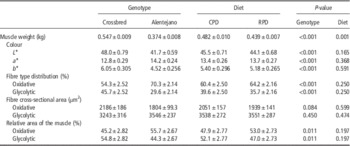
Muscle weight, colour and fibre profile assessed by SDH staining are presented in Table 3. PM weight was higher in crossbred pigs (P<0.001) when compared with Alentejano pigs. Reduced protein diet decreased PM weight (P=0.001). The genotype affected colour, with higher values for lightness (L*) (P<0.001) and yellowness (b*) (P<0.001) in crossbred pigs, whereas the redness (a*) score was higher in Alentejana purebred (P<0.001). The genotype influenced the fibre type distribution, being the percentage of oxidative fibres higher in Alentejano (P<0.001) than in crossbred pigs. However, the fibre cross-sectional area was not affected by genotype or diet (P>0.05). The oxidative relative area of PM muscle was influenced by genotype, with higher values in Alentejana purebred when compared with crossbred pigs (P<0.001).
Muscle weight, colour and fibre profile of psoas major of crossbred and Alentejano pigs fed control protein diet (CPD) and reduced protein diet (RPD)

Correlations between muscle colour, intramuscular fat content, fatty acid composition and fibre profile
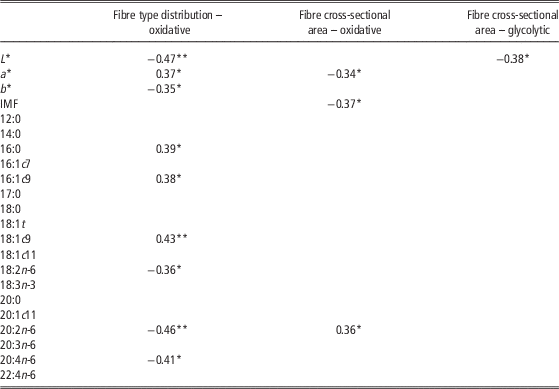
The correlations between muscle colour, IMF, fatty acid composition and fibre profile of PM are presented in Table 4. For both pig genotypes, the oxidative fibre type distribution was negatively correlated with lightness (P<0.01), 20:2n-6 (P<0.01), yellowness (P<0.05), 18:2n-6 (P<0.05) and 20:4n-6 (P<0.05), and positively correlated with 18:1c9 (P<0.01), redness (P<0.05), 16:0 (P<0.05) and 16:1c9 (P<0.05). The oxidative cross-sectional area was negatively correlated with redness (P<0.05) and IMF content (P<0.05). In turn, the glycolytic cross-sectional area was negatively correlated with lightness (P<0.05).
Pearson’s correlation coefficients among muscle colour, intramuscular fat content, fatty acid composition (% total fatty acids) and muscle fibre profile of psoas major muscle from crossbred and Alentejano pigs

IMF=intramuscular fat.
*P<0.05, **P<0.01.
Principal component analysis
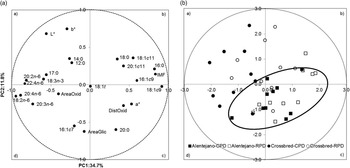
The PCA using muscle colour, IMF, fatty acid composition and fibre profile of PM from Alentejana purebred and crossbred pigs fed CPD and RPD is presented in Figure 1a and b. The score plot of the first two PC explained 46.5% of the total variability, accounting 34.7% for PC1 and 11.8% for PC2. The PC1 was characterised by variables with positive loadings, such as 18:1c9 (0.92), IMF (0.83), 16:0 (0.82), 16:1c9 (0.59), 18:1c11 (0.55), a* (0.53) and fibre type distribution (0.43), and by variables with negative loadings, such as 17:0 (−0.55), L* (−0.55), 18:3n-3 (−0.59), 20:2n-6 (−0.81), 22:4n-6 (−0.83), 20:4n-6 (−0.88) and 18:2n-6 (−0.95). Concerning PC2, small contributions were found for variables with loadings varying between −0.62 and 0.68. The PC1 was influenced on the left side by key PUFA, such as 18:2n-6 (−0.95), 20:4n-6 (−0.88), 22:4n-6 (−0.83), 20:2n-6 (−0.81), 18:3n-3 (−0.59) and 20:3n-6 (−0.73), which were located in opposition to the main SFA and MUFA, such as 18:1c9, IMF content, 16:0, 16:1c9, 18:1c11, 20:1c11 and 18:0. The PC2 was determined in the upper part by L* (0.68), b* (0.75), 14:0 (0.35) and 12:0 (0.29), and in the lower part by 20:0 (−0.60), 16:1c7 (−0.55) and glycolytic fibre cross-sectional area (−0.62) (Figure 1a). The score plot depicted in Figure 1b shows the location of the four experimental groups, Alentejana purebred and crossbred pigs fed CPD and RPD in the multivariate space of the first two PC. These scores were notable arranged in one cluster, corresponding to Alentejana purebred located mainly in quadrant c, but also in quadrants b and d, whereas crossbred pigs were dispersed across all quadrants, a, b, c and d. The discrimination of dietary treatments, CPD and RPD, was unattainable.
Loading plot of the first and second principal components (PC) of the pooled data (a) and component’s score vectors (b) for intramuscular fat (IMF; % muscle), fatty acid composition (% total fatty acids), colour and fibre profile of psoas major muscle of crossbred and Alentejano pigs fed control protein diet (CPD) and reduced protein diet (RPD).

Discussion
In the present study, the reduction by 25% of dietary protein (17.5% v. 13.1% of CP) increased IMF content by 15.7% in the PM muscle of both pig genotypes. Madeira et al. (Reference Madeira, Costa, Alfaia, Lopes, Bessa, Lemos and Prates2013a and Reference Madeira, Pires, Alfaia, Costa, Luxton, Doran, Bessa and Prates2013b) reported an increase of IMF content in the LL muscle of crossbred but not in Alentejano pigs. This finding was attributed to dietary lysine restriction, depending ultimately on pig’s genetic background (i.e. it was only effective in lean pigs). In fact, RPD has been reported as a successful nutritional strategy to increase IMF content in LL muscle of crossbred pigs (Doran et al., Reference Doran, Moule, Teye, Whittington, Hallett and Wood2006; Madeira et al., Reference Madeira, Costa, Alfaia, Lopes, Bessa, Lemos and Prates2013a, Reference Madeira, Pires, Alfaia, Costa, Luxton, Doran, Bessa and Prates2013b and Reference Madeira, Pires, Alfaia, Lopes, Martins, Pinto and Prates2014). However, in the present study, although Alentejano pigs had higher IMF in comparison with crossbred pigs (+15.7%), RPD increased IMF content in the PM muscle of both genotypes. In contrast, Wood et al. (Reference Wood, Nute, Richardson, Whittington, Southwood, Plastow, Mansbridge, Da Costa and Chang2004) reported that low-protein diets did not affect total fatty acids in PM muscle. Herein, the PM muscle weight decreased in pigs fed RPD. Conversely, Madeira et al. (Reference Madeira, Pires, Alfaia, Costa, Luxton, Doran, Bessa and Prates2013b) reported that RPD does not affect LL muscle weight. This finding points towards a muscle-specific effect of RPD in different types of skeletal muscle, red and white.
As far as fatty acid composition concerns, RPD increased SFA and MUFA percentages at the expenses of major fatty acids, 16:0, 16:1c9 and 18:0, and reduced PUFA percentages in the PM muscle. These results are in agreement with those reported by Madeira et al. (Reference Madeira, Costa, Alfaia, Lopes, Bessa, Lemos and Prates2013a) in the LL muscle. Also, Teye et al. (Reference Teye, Sheard, Whittington, Nute, Stewart and Wood2006) observed that low-protein and lysine diets decreased total PUFA proportions in crossbred pigs. Ntawubizi et al. (Reference Ntawubizi, Raes, Buys and De Smet2009) explained this effect as the result of higher triacylglycerols (TAG)/phospholipids ratios with the increase of IMF content, due to the distinct distribution of fatty acids between TAG (rich in SFA and MUFA) and phospholipids (rich in PUFA). Similarly, the increase of MUFA could be explained by the activation of stearoyl-CoA desaturase, which is the enzyme responsible for MUFA biosynthesis, by RPD (Doran et al., Reference Doran, Moule, Teye, Whittington, Hallett and Wood2006; Madeira et al., Reference Madeira, Costa, Alfaia, Lopes, Bessa, Lemos and Prates2013a).
A clear effect of genotype, but not of dietary treatment, was found for colour parameters in the PM muscle. Lightness and yellowness scores were higher in crossbred pigs in opposition to redness, which was higher in Alentejana purebred. Similar differences have been earlier reported on redness and yellowness scores for traditional Berkshire and Tamworth, and modern Duroc-based and Large White-breeds (Chang et al., Reference Chang, Costa, Blackley, Southwood, Evans, Plastow, Wood and Richardson2003). These findings are consistent with the positive correlation between L* and b* (r=0.82, P<0.001) and with the negative correlation between L* and a* (r=−0.36, P=0.024), which can be observed by colour parameters distribution on the loading plot of the first and second principal components of the pooled data.
In pig, as in other species, muscles with different anatomical locations assume different functions and display their own biochemical properties. PM is a postural muscle, classified as intermediate glycolytic and with high content of MyHC IIx fibres, involved in upholding and maintaining the position rather than the mechanical movement. In turn, the LL is a locomotor muscle, classified as fast glycolytic and with high content of MyHC IIb fibres, involved in long duration movements (Lefaucheur et al., Reference Lefaucheur2002; Zhang et al., Reference Zhang, Zhou, Ma, Chen, Jiang, Zhu, Shuai, Wang, Li and Li2013). The size and number of muscle fibres affect muscle growth potential and meat quality (Ryu and Kim, Reference Ryu and Kim2005). The increase of IMF in PM muscle promoted by dietary protein reduction in growing-finishing pigs could be mediated by shifting the metabolic properties of fibres from glycolytic to oxidative, as described by Pires et al. (Reference Pires, Madeira, Dowle, Thomas, Almeida and Prates2016) for the LL muscle. This process was based on a significant enrichment of contractile proteins, calcium-signalling proteins and glycolysis in the skeletal muscle (Pires et al., Reference Pires, Madeira, Dowle, Thomas, Almeida and Prates2016).
Histochemical methods, such as SDH and myosin ATPase staining are invaluable in describing the biochemical status of individual fibres (Chang et al., Reference Chang, Costa, Blackley, Southwood, Evans, Plastow, Wood and Richardson2003). However, some inconsistency in fibre type classification exists, which can easily lead to confusing associations between meat quality traits and fibre type characteristics (Henckel et al., Reference Henckel, Oksberg, Erlandsen, Barton-Gade and Bejerrholm1997; Chang et al., Reference Chang, Costa, Blackley, Southwood, Evans, Plastow, Wood and Richardson2003). SDH is a conventional histochemistry protocol used to classify fibres according to their oxidative metabolism (Nachlas et al., Reference Nachlas, Tsou, DeCheng and Seligman1957), as oxidative or glycolytic. According to Essén-Gustavsson et al. (Reference Essén-Gustavsson, Karlsson, Lundström and Enfält1994), the fibre type composition does not differ between pigs fed on high- and low-protein diets, but vary between muscles, LL and biceps femoris. Biceps femoris has higher proportions of type I and IIa fibres and a lower proportion of IIb fibres, when compared with LL (Essén-Gustavsson et al., Reference Essén-Gustavsson, Karlsson, Lundström and Enfält1994). These three main fibre types were determined on the basis of differences in the sensitivity of the actomyosin ATPase activity to pH pre-incubation (Brooke and Kaiser, Reference Brooke and Kaiser1970). Herein, the fibre profile of PM muscle after SDH staining was determined by the genetic background of pigs instead of diet. Alentejana purebred had a higher percentage of oxidative fibres and a lower percentage of glycolytic fibres, as observed by others for different breeds of pigs (Ruusunen and Puolanne, Reference Ruusunen and Puolanne1997; Lefaucheur, Reference Lefaucheur, Ecolan, Plantard and Gueguen2010). Still, RPD slightly increased oxidative fibre type distribution (although not statistically significant) in both genotypes of pigs, along with an increase of IMF content.
Hocquette et al. (Reference Hocquette, Gondret, Baéza, Médale, Jurie and Pethick2009) reported that the intensity of redness in muscle is probably a pre-requisite for IMF development because intramuscular adipocytes need blood vessels. However, redness does not guarantee fat development. It is frequently assumed that red oxidative muscles contain more IMF than white glycolytic muscles (Pires et al., Reference Pires, Madeira, Dowle, Thomas, Almeida and Prates2016). Moreover, oxidative fibres contain more phospholipids and more TAG (Hocquette et al., Reference Hocquette, Gondret, Baéza, Médale, Jurie and Pethick2009). Our results showed a negative correlation between oxidative fibre cross-sectional area and IMF content. Contrarily, Larzul et al. (Reference Larzul, Lefaucheur, Ecolan, Gogué, Talmant, Sellier, Le Roy and Monin1997) found a strong positive correlation between IMF content and muscle fibre cross-sectional area. Gondret et al. (Reference Gondret, Mourot and Bonneau1998) reported that the main part of IMF variability could rely on differences in the size and number of intramuscular adipocytes located between fibre bundles, which unfortunately we did not evaluate in this study. Conversely, a higher proportion of oxidative fibres was found in Alentejana purebred, whereas glycolytic fibres were predominant in crossbred pigs. The same pattern of variation was found for the relative area of PM muscle occupied for each fibre type, oxidative or glycolytic, assessed as percentage. Curiously, under the same experimental design and histochemical staining protocol, identical results were found for LL muscle. In this respect, some consistency between these muscles has been proven. In LL muscle, the fibre type distribution was influenced by genotype with Alentejana purebred having predominantly oxidative fibres (P=0.031) with smaller size (P=0.025), while crossbred pigs exhibited more glycolytic fibres (P=0.031).
For the LL muscle, Pires et al. (Reference Pires, Madeira, Dowle, Thomas, Almeida and Prates2016) reported that pigs fed CPD are more dependent on glycogen as a metabolic substrate, whereas those fed RPD spare more glycogen and are more dependent on fatty acid oxidation. In general, feed restriction favours the oxidative metabolism pathway at the expenses of the glycolytic. This was not confirmed by our results. Notwithstanding, one important limitation of this study should be acknowledged. On the topic of fundamental muscle research, the four main postnatal fibre types are identified by the presence of the four major corresponding postnatal MyHC gene isoforms (slow/I, fast/IIa, fast/IIx and fast/IIb), using in situ hybridisation to specific MyHC mRNA isoforms and immunohistochemistry (Schiaffino and Reggiani, Reference Schiaffino and Reggiani1994; Weiss and Leinwand, Reference Weiss and Leinwand1996). This latter molecular definition of fibre types based on MyHC expression is more precise and reliable than the histochemical criteria (SDH staining) here applied (Chang et al., Reference Chang, Costa, Blackley, Southwood, Evans, Plastow, Wood and Richardson2003). In bovines, restricted feeding has been reported to increase the proportion of red fibres in LL muscle (Nicastro and Maiorano, Reference Nicastro and Maiorano1994) and to reduce fibre hypertrophy in skeletal muscle (Yambayamba and Price, Reference Yambayamba and Price1991). A word of caution comes from the fact that fibre type characteristics in skeletal muscles might diverge between mammalian species, as pigs and bovines. Likewise, muscles with different fibre type composition have different patterns of postmortem change during muscle to meat conversion, which could ultimately influence pork quality (Ryu and Kim, Reference Ryu and Kim2005).
Conclusions
Available research on feeding strategies to improve pork quality using the PM muscle, a piece of meat representative of red muscle in pig’s carcass, is scarce. Under these experimental conditions, RPD increased IMF content as hypothesised and reduced PM weight, without affecting muscle colour scores. As far as fatty acid composition concerns, RPD increased MUFA and SFA contents and decreased PUFA. In addition, RPD did not shift the biochemical properties of PM fibres from glycolytic to oxidative. In turn, a clear effect of genotype was observed on fibre type distribution, being the fatty pig genotype more oxidative and the lean pig genotype more glycolytic.
Acknowledgements
The authors acknowledge financial support from Fundação para a Ciência e a Tecnologia (FCT) grant (PTDC/CVT/99210/2008), CIISA project (UID/CVT/00276/2013) and individual fellowships to M. S. Madeira (SFRH/BD/48240/2008 and SFRH/BPD/97432/2013) and P. Costa (SFRH/BPD/46135/2008). P. A. Lopes is a researcher from the FCT-MEC program Ciência 2008 and Incentivo 2014 project (AGR/BPD/2014/UI0276). The authors are also grateful to the EZN slaughterhouse staff for help with carcass data and meat samples collection.