Charles Wesley's vast corpus of hymn texts is the most defining cultural artefact of eighteenth-century Methodism. These texts shaped its practical and theological development in numerous ways, establishing for Methodists a reputation and legacy as a ‘singing people’ that has endured ever since.Footnote 1 Music has occupied a significant place in people's experiences of Methodism throughout its history, as well as being a matter that has warranted serious attention from the leaders of Methodism's many branches. Methodist hymnody has long been a subject of scholarly endeavour, especially the hymns of Charles Wesley, but also the work of other Methodist hymn-writers and the uses of music in Methodist practice.Footnote 2 However, the predominance of congregational hymnody within Methodism has tended to marginalize other ways in which it engaged with musical culture more broadly. While such engagements have exerted relatively little influence on Methodist practice and have received limited historiographical consideration, they offer revealing insights into the diversity of Methodism throughout its history.
This article examines one aspect of the interaction between Methodism and musical culture in the long eighteenth century: original settings of Charles Wesley's hymn texts by art-music composers, including John Frederick Lampe (1702/1703–1751), George Frideric Handel (1685–1759), Jonathan Battishill (1738–1801), and two of Charles Wesley's children: Charles junior (1757–1834) and Samuel (1766–1837). It considers the relationships of each with John and Charles Wesley and with Methodism more generally, as well as the musical environments within which they operated. It argues that their works reveal the porous boundaries between sacred and secular music while also challenging assumptions about Methodism's engagement with and attitude towards the arts.
Early Methodism's institutional engagement with broader musical culture is worth considering in some detail before turning to the compositions of these five musicians, as it provides an important background for assessing the history, content and reception of these musical settings. Methodism's liturgical history, its model of centralized authority and the diversity of its expression in local contexts have all meant that it has never developed a distinctive musical repertory that has influenced musical culture more broadly, such as the choral music or chant associated with Catholic, Anglican, Lutheran or Orthodox churches.
The earliest leaders of Methodism, especially John and Charles Wesley, intended it as a revival movement within the Church of England. Its meetings were therefore intended to supplement rather than replace the formal liturgies of parish churches. Its large-scale public meetings were not meant to be religious services analogous to those that took place within the Church of England. Although they generally followed a standard structure, these meetings did not include the regular recitation of liturgical texts in the manner of a service of Holy Communion or a daily office. Hymns played a central role in Methodist meetings, typically being sung before and after the sermon, but there was little need for other liturgical music. As Methodism expanded, so the need for greater liturgical provision grew, partly in response to an increasingly antagonistic relationship with the Church of England and partly to support its growing activity in North America. To meet this need, John Wesley naturally drew on what was familiar to him as a priest in the Church of England by adapting and abridging the Book of Common Prayer for use in different Methodist contexts. Thus the liturgical texts were those that had long been in use and, though there is no evidence to suggest they were sung in Methodist circles, musical settings were already available if required.
Later, following Methodism's formal separation from the Church of England and its fragmentation into multiple factions, its liturgical practices often differed from those of the Established Church, sometimes intentionally so. Where there were similarities, this was largely due to the continuing influence of John Wesley's abridgment of the Book of Common Prayer. Choirs flourished in Wesleyan Methodism and other branches of the movement; within the Wesleyan Connexion, psalms were sometimes sung or chanted, using music borrowed from Anglican sources. Where Methodist worship differed from the liturgies of the Church of England, it always moved away from the use of formal liturgical texts and towards services that, though usually following a regular order, had largely bespoke content devised and delivered by the preachers appointed to lead them, with the primary emphasis placed on the sermon. Congregational singing played a prominent role in all branches of nineteenth-century Methodism, while the dominance of the ‘preaching service’ tended to limit choirs’ role to the singing of anthems, rather than settings of liturgical texts.
John Wesley attempted to structure Methodism in ways that promoted unity and conformity. He devised a connexional governance model and a multi-layered organizational structure of societies, classes and bands that sought to bind individual Methodists and their various groups to one another both locally and nationally. The provision of hymns for use in the different types of meeting was built into this centralized model of governance through the practice of issuing authorized hymnals, which promoted a consistent corpus of hymns that had been tested for theological and doctrinal soundness. These hymnals provided texts for congregational singing; similarly, the three collections of tunes issued under John Wesley's authority very largely comprised tunes for congregational use, although the latter two collections, from 1761 and 1781, also featured a small number of set-piece anthems.Footnote 3
While the organizational structure created by John Wesley and the issuing of authorized hymnals aimed to ensure consistency across the movement, eighteenth-century Methodism was also characterized by local diversity. Jonathan Rodell's study of early Methodism in Bedfordshire argues that the movement was marked by ‘chaotic diversity’, in which the extent of the Wesleys’ centralized influence on local practice, organization and theology varied considerably.Footnote 4 Rodell highlights the different hymnals used, which extended beyond those issued by John Wesley to include locally compiled collections as well as John Newton and William Cowper's Olney Hymns and widely known volumes by Isaac Watts.Footnote 5 John Wesley's comments on musical practice and repertory during his travels indicate that he experienced considerable diversity. As well as recording instances of having to prevent singing from being dominated by a select group, his edicts in the minutes of the annual Conference and in ad hoc writings such as ‘Directions of Singing’ can be seen as attempts to impose uniformity where it was lacking.Footnote 6
The competing pulls of Wesley's centralizing impulse and the diversity of localized preference and practice contributed to Methodism's limited institutional engagement with the culture of art music. John Wesley recognized music's significance, but he was primarily interested in its ability to help communicate the message of salvation so central to Methodism's work. His attempts to censure grassroots musical variety meant that local initiatives had little prospect of influencing institutional thought and practice more broadly.
JOHN AND CHARLES WESLEY AND METHODIST MUSIC
John and Charles Wesley's engagement with the world of contemporary art music and their influence on the musical life of eighteenth-century Methodism are important factors in establishing the context for new settings of Charles's poetry. Particularly through their ministries in London and other urban centres, the Wesley brothers were acquainted with several prominent musicians and figures from the theatre. At times, both expressed their admiration for the performance of art music, but they also held reservations about certain genres and compositional techniques, especially in relation to sacred music. John, for instance, records his approval of parts of Handel's Messiah following a performance in Bristol in 1758 and describes parts of Arne's Judith as ‘exceeding fine’, having heard it performed at the Lock Hospital in 1764.Footnote 7 The latter, however, also prompted him to express his most common criticisms of modern composition: extensive textual repetition and the use of polyphonic vocal textures that obscured the lyrics. Charles, meanwhile, wrote affectionate poetic tributes to notable musicians but also humorous verses satirizing the qualities of modern compositions and instruments.Footnote 8 One of his tributes, the hymn ‘On the Death of Mr Lampe’, includes the lines ‘The brother of my choice is gone, / To musick sweeter than his own, / And concerts in the sky’.Footnote 9 In a more satirical vein, meanwhile, in an unpublished poem entitled ‘Modern Music’ he describes how its composers and advocates ‘Have cut Old Music's throat, / And mangled every Note’.Footnote 10
The Wesley brothers’ most direct influence on the music of Methodism came through their contributions to its hymnody. Charles, as Methodism's principal hymn-writer, was noted for the metrical variety of his work, which included many hymns in metres that demanded a musical range beyond that traditionally used for metrical psalmody in Britain. John, as well as being an author and translator of hymns, exercised considerable influence through overseeing hymnals for use by eighteenth-century Methodists, some of which included selections of music that he had sanctioned. The earliest of these – A Collection of Tunes, as they are commonly Sung at the Foundery (London: A. Pearson, 1742) – established the precedent of adapting secular art music for use as hymn tunes by repurposing a march from Handel's opera Riccardo Primo. The later volumes – Select Hymns, with Tunes Annext (London, 1761; second edition, entitled Sacred Melody, or A Choice Collection of Psalm and Hymn Tunes, London, c1765) and Sacred Harmony (London, 1781; second edition, London: G. Whitfield, c1790) – contained some of the music by Lampe, discussed below, that had been composed expressly for Charles's hymn texts. These volumes also introduced further adaptations of art music, both secular and sacred, alongside Germanic repertory borrowed from Moravian communities and metrical psalm tunes.
While the obscure figure of Thomas Butts is assumed to have had an editorial role in preparing these collections of tunes, they were issued with John Wesley's approval and clearly reflect his musical experiences and ideals, especially his taste for art music. Scholars of early Methodist hymnody have argued that these preferences were not widely shared among Wesley's followers across Britain, and thus these selections of tunes did not enable the full evangelistic and pedagogical potential of the hymns to be realized. Nicholas Temperley evaluates Wesley's musical preferences in relation to his evangelistic intent:
Wesley's choice of texts and music was a personal one, but because of his unique authority and tireless journeyings it prevailed far and wide for a long time. As in the matter of maintaining the Anglican liturgy, however, there was an acute conflict between his own cultivated tastes and his passionate desire to spread the Word to all classes of people. Many of the ornate tunes that he admired, by Lampe among others, were not really suited to congregational singing by a mass of unschooled people without musical leadership.Footnote 11
Elsewhere, he argues that ‘the full extent of that power [of music] could be realized only when it was set free from the constraint of the Wesleys’ relatively narrow musical tastes’.Footnote 12 Commenting on the musical complexity of some of the tunes found in these early collections, Erik Routley asserts that ‘there is no reason to believe that then, any more than now, every tune in a collection was well known. Almost certainly, those most sung were the pre-Wesley tunes, and the words used most often will have been those which fitted the psalm-tune style of music’.Footnote 13
The significant developments in musical repertory that occurred within Methodism during the nineteenth century back up Temperley's arguments and indicate that Routley's supposition may have some validity. Relatively few of the tunes from the collections overseen by John Wesley survived in the many nineteenth-century hymnals published for use in the different branches of Methodism. They were replaced by tunes in a wide variety of musical styles, including those that have since become regarded as traditionally Methodist. However, arguments such as those made by Temperley and Routley are focused on the influence of the Wesleys’ musical tastes on the wider Methodist movement rather than the relationship between the Wesleys and contemporary musical culture more broadly.
FIVE COMPOSERS AND CHARLES WESLEY
While each of the five composers considered here had a relationship with John and Charles Wesley, either of blood or of professional acquaintance, none of them can be described as a Methodist musician. None of them held a formal role, musical or otherwise, within the movement, and of the three non-family members, only Lampe appears to have participated, for a short time, in its religious life. Each, however, composed original musical settings of verses by Charles Wesley. Only Lampe's settings gained any contemporary traction within Methodism at an institutional level, and there is no evidence that either he or any of the other composers were responding to an identified need for new music from within the movement. Consideration of the texts set, the musical characteristics of the compositions and the contexts of each composer's contact with John and Charles Wesley and with Methodism helps us to understand the place of these compositions in relation to both Methodism and British musical culture.
LAMPE, HANDEL, METHODISM AND THE THEATRE
The earliest known original musical settings of Charles Wesley's verse are Lampe's Hymns on the Great Festivals and Other Occasions (London: M. Cooper, 1746). Lampe's association with the Wesley brothers had come about through a mutual acquaintance, Priscilla Rich, herself a Methodist convert, sometime performer at the Covent Garden Theatre and wife of its proprietor, John Rich. That the Wesleys and their religious movement should come into contact with John Rich – one of the most prominent figures in London's theatrical community as both a performer and a manager – is remarkable. However, that theatrical community was a site for Methodist activity in the 1740s, and the Wesley brothers leased a chapel on West Street, close to Covent Garden, to further this work. Lampe's collection of tunes, published at his own expense, testifies to the influence Methodism had upon him, while also bearing the hallmarks of the secular musical sphere in which he made his living variously as a composer, bassoonist, harpsichordist and conductor. The Wesley brothers’ appreciation of such music highlights the tension to which Temperley points between their musical preferences and those of their followers.
The settings are for solo voice with a figured bass and are entirely strophic. They are characterized by ornamented melodies encompassing a wide range and an extensive harmonic palette in which modulation features frequently. Lampe was also a theorist; his Wesley settings reflect the compositional principles he laid out in The Art of Musick (London: C. Corbett, 1740) and which also guided his secular compositions. Dennis R. Martin's analysis of Lampe's operatic style highlights several melodic and harmonic characteristics that are evident in Hymns on the Great Festivals. He observes that Lampe's melodies frequently open with a triadic figure, often extending beyond an octave, are heavily decorated with passing and neighbour notes and make much use of dotted rhythms, including the ‘Scotch snap’ or Lombardic rhythm.Footnote 14
The opening of Hymn IV, ‘On the Crucifixion’ (Example 1), illustrates one of the many triadic formulae Lampe employs across the collection, all of which create a strong melodic profile and play an important role in defining tonality. The final phrases of Hymn VII, also entitled ‘On the Crucifixion’ (Example 2), amply illustrate the ways in which Lombardic rhythms permeate Lampe's melodic writing, as well his predilection for large, dramatic leaps, his frequent repetition of the final line of the text and his use of sharp melodic contrasts between phrases. Hymn I, ‘On the Nativity’, demonstrates how such characteristics are integrated within a complete setting. It also shows Lampe's typical use of modulation: despite lasting only eighteen bars, the music moves away from the tonic, spending several phrases in the relative major and modulating to the dominant in bars 11–12 (Example 3).
John Frederick Lampe, Hymn IV, ‘On the Crucifixion’, from Hymns on the Great Festivals and Other Occasions (London: M. Cooper, 1746), bars 1–2

Lampe, Hymn VII, ‘On the Crucifixion’, from Hymns on the Great Festivals and Other Occasions, bars 11–14

Lampe, Hymn I, ‘On the Nativity’, from Hymns on the Great Festivals and Other Occasions

Aside from conforming to the traits of Lampe's own secular music, these settings, more broadly, also have much in common with other secular music of the time. Many features of Berta Joncus's description of Henry Carey's ballads might be applied to Lampe's hymn settings: ‘Carey articulated his “ballad style”: a binary air of an even number of bars (eight, twelve or sixteen) with galante dance metres, cadences in the dominant (or relative major or minor), syllabic word-setting, restrained embellishment, triadic melodies, symmetrical phrasing and frequent appoggiaturas on the bar's first beat (usually a 4–3 suspension)’.Footnote 15 This style of composition grew in popularity in eighteenth-century England, notably in the repertory of songs for pleasure gardens, which, as Christopher Hogwood notes, were ‘in the tradition of the strophic ballad, written to lyrics of various conventional types’.Footnote 16
The stylistic commonality with secular music provides direct evidence that there was overlap between Methodism in London and the city's fashionable musical culture. As we have seen, Lampe was acquainted with the Wesley brothers and seems to have used the collection to express his appreciation for their friendship. That he composed these settings and brought them to the Wesleys’ attention indicates that music and religion interacted in the Methodist circles of which he was a part and suggests that he was confident that John and Charles Wesley would approve of his work. This confidence was well founded, as reflected both in the brothers’ reminiscences of Lampe and by the inclusion of the majority of his compositions in the next collection of tunes issued with John Wesley's approval, Select Hymns with Tunes Annext.Footnote 17
As noted earlier, Temperley suggests that John Wesley's taste for tunes such as Lampe's inhibited the effectiveness of his musical choices for his followers nationwide. The localized variation in musical repertory described above seems to bear this out. While Lampe's musical style would certainly not have resonated equally across the whole of Methodism, it does represent one facet of the movement in its early years. This clearly illustrates the fact that Methodism was not culturally homogenous, and that its cultural diversity included an engagement with and appreciation for a style of art music that was both contemporary and fashionable, and through which some members of London's theatrical and musical community were attracted to the movement. Methodism's novelty may have contributed to its appeal, as might the willingness of the Wesley brothers to engage with members of a profession that generated much suspicion and antipathy in religious circles. Such engagement was a source of tension as well as opportunity, and conflicting attitudes towards musical style and the relationship between sacred and secular continued to characterize Methodism throughout the eighteenth century and beyond.
The texts Lampe chose to set also offer ways to understand the relationship between Methodism and broader musical culture. Aside from their topical content, covering the principal days and seasons of the liturgical year, the selection is remarkable for its metrical variety. Its twenty-four texts are written in nineteen different metres, with only four instances of patterns commonly associated with metrical psalmody: one each in Double Short Metre, Double Common Metre, Long Metre and Double Long Metre. Charles Wesley's skill in handling different metres in his poetry is widely recognized, yet his vast output is dominated by texts in a fairly small group of them. In this sense, Lampe's selection of texts is unusual in the sheer number of different metres. While thematic content evidently played a part in the selection of texts, it seems unlikely that such metrical variety was simply a product of chance. Assuming the metrical selection was deliberate, it can be read as a tribute to Charles Wesley; the skill and musical dexterity Lampe needed to display in setting these texts may be regarded as his recognition of Wesley's craftsmanship.
Though not discovered until 1826, Handel's settings of three texts by Wesley emerge from the same social milieu as Lampe's. Given Handel's much greater prominence compared to Lampe, his settings further emphasize the connections between Methodism and the world of fashionable art music in mid-eighteenth-century London. Donald Burrows provides clear evidence that Handel composed his settings in 1746–1747 and that Lampe's publication was his source for the texts.Footnote 18 Although Handel and the Wesley brothers had mutual contacts in Lampe, Priscilla Rich and the Granville family, there is no evidence that they were personally acquainted, nor that Handel was affiliated with their religious movement in any way. His engagement, therefore, was chiefly musical. Whether composed at Priscilla Rich's bidding or simply in response to Lampe's work, Handel's three tunes should be understood as a small contribution to the cultural life of a London-based community united in its artistic interests, values and practices, rather than having been in service to Methodism at large.
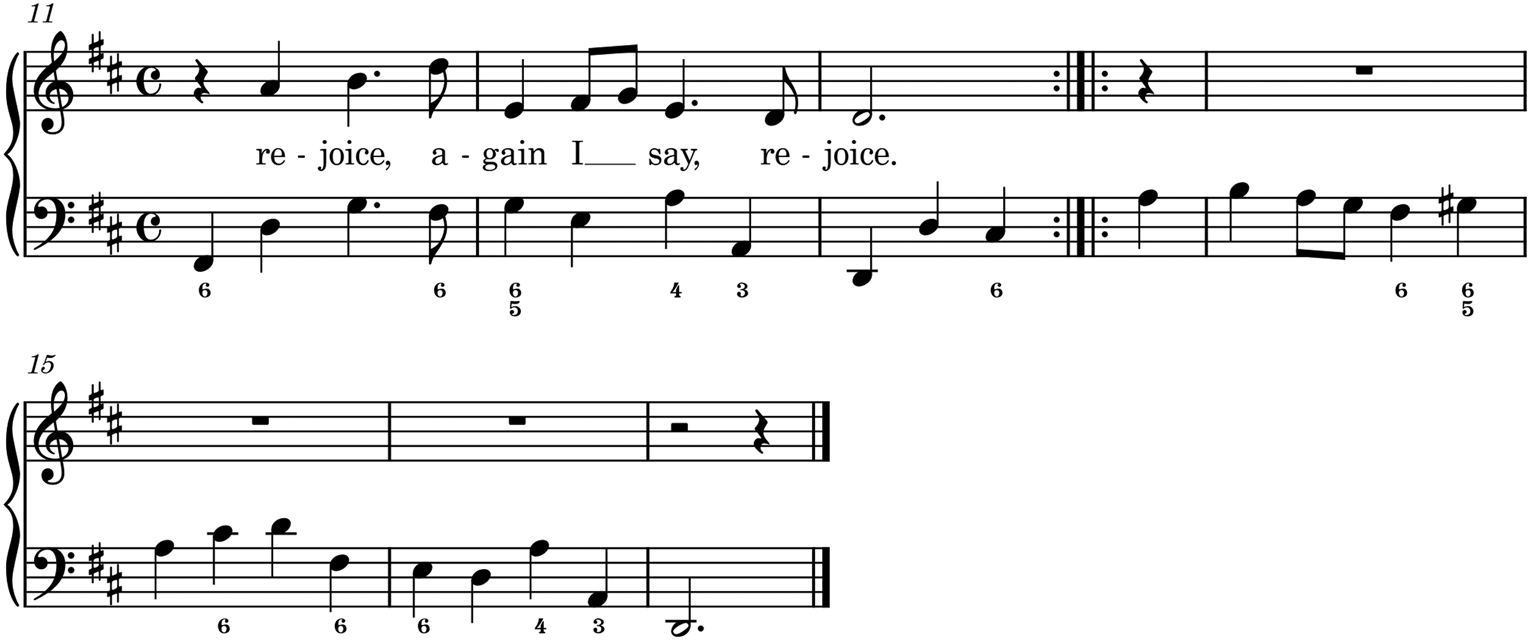
Handel's three tunes are stylistically similar to Lampe's settings, though with a little less ornamentation. Burrows suggests that both resemble the type of setting found in early eighteenth-century German collections such as Johann Anastasius Freylinghausen's Gesangbuch, itself known to the Wesleys through their contact with Moravian communities. The third phrase of Handel's setting of ‘Rejoice, the Lord is King’ resembles Lampe's setting of the same words in its melodic contour (Examples 4 and 5).
Lampe, Hymn VIII, ‘On the Resurrection’, from Hymns on the Great Festivals and Other Occasions, bars 5–8

George Frideric Handel, ‘On the Resurrection’, from George Frideric Handel: The Complete Hymns and Chorales, Including Complete Source Materials for the Handel–Wesley Hymns, ed. Donald Burrows (London: Novello, 1988), bars 5–8. © Hal Leonard Europe Ltd. Printed by permission

The novel feature of Handel's settings is the short figured-bass postlude appended to each setting, lasting just two bars in the first setting but stretching to four bars in the second and third; the harmony indicated by the figures is not merely a repetition of earlier material, but demands original melodic content to be improvised by the keyboard player (Example 6).Footnote 19
Handel, ‘On the Resurrection’, from The Complete Hymns and Chorales, bars 11–17. © Hal Leonard Europe Ltd. Printed by permission

Handel's three tunes are further evidence of the ways in which Methodism and particularly the work of Charles Wesley were recognized within art-music circles in mid-eighteenth-century London. The elegant melodies and figured-bass accompaniments suggest domestic performance contexts involving a solo singer and keyboard player. The postludes further reinforce the sense of musical sophistication, affording the keyboard player brief attention while allowing the listeners pause for reflection and appreciation at the end of the hymn.Footnote 20 While such a performance context might have been possible in the Methodist circle of which Priscilla Rich was a part, it was not representative of Methodist meetings at large. Publications that went through multiple editions and printings in the latter half of the eighteenth century suggest that there was a performance context for secular music that was of a very similar character.Footnote 21 For those who moved in this world and had made some level of personal religious commitment to Methodism, such as Priscilla Rich, the Countess of Huntingdon, the Sharp family and, to an extent, Lampe himself, bringing settings of sacred texts into this environment was doubtless a more appealing and familiar prospect than the large-scale outdoor preaching services that characterized Methodism's work elsewhere. From early in its history, Methodism's relationship with artistic culture is therefore more complex than its own historical narratives have often been inclined to acknowledge.
JONATHAN BATTISHILL'S TWELVE HYMNS, THE WORDS BY THE REVD. MR CHARLES WESLEY
Published around 1765, Battishill's settings of twelve texts by Charles Wesley (London: C. and S. Thompson) bear witness to the composer's friendship with Charles and his family.Footnote 22 Two of Charles and Sarah (Sally) Wesley's children, Charles junior and Samuel, had exhibited precocious musical talent from a very young age, which their parents sought to nurture. While encouraging their musical talent posed some challenges in relation to prevailing attitudes within Methodism, one of the outcomes that emerged was a series of concerts held in the family's London home on Marylebone Road from 1779 to 1787. Alyson McLamore's extensive study of these concerts identifies Battishill as one of the many guest performers, noting that he took part as a countertenor vocalist on four occasions in 1782–1783.Footnote 23
However, Battishill's contact with the Wesley family seems to predate the concerts, although the precise details are difficult to determine. Looking back at his childhood, Samuel Wesley recalled his father's fondness for Battishill and his music, as well as his own admiration for the composer. He also notes the existence of Battishill's Twelve Hymns: ‘Among the first rate musicians I have been acquainted with may be justly reckoned the late Jonathan Battishill, to whom my dear Father was very partial, and who composed a valuable set of beautiful Tunes to sundry of his hymns’.Footnote 24 Thomas Busby, with whom Samuel corresponded about Battishill in 1800, published a memoir of the composer in 1804, three years after his death, in which he asserts that the Twelve Hymns were composed at Charles Wesley's invitation:
He also, at the express desire of the Reverend Mr. CHARLES WESLEY, brother of the celebrated Mr. JOHN WESLEY, and father of the present scientific and ingenious Messrs. CHARLES and SAMUEL WESLEY, set to music a collection of Hymns, written by that Gentleman, the melodies of which are peculiarly elegant, yet exceedingly chaste and appropriate.Footnote 25
The memoirs of composer and scholar R. J. S. Stevens include a lengthy section on Battishill in which he claims that Charles Wesley, ‘who was a good classical scholar, having called upon Battishill at Islington, where he then lived, in order to see his library, told his Son Samuel Wesley that the Selection of Books was made with the greatest taste and judgment’.Footnote 26 While neither Busby's nor Stevens's claims are corroborated in any of Charles Wesley's writings, when set alongside Samuel Wesley's reminiscences and Battishill's later involvement in the family concerts, they suggest an earlier association. The period in which these tunes were composed was the most fruitful in Battishill's career in terms of both composition and performance; his later years were afflicted by alcoholism.Footnote 27 Given the likelihood that the Wesley family were aware of Battishill's settings, it is worth considering why they did not find their way into Sacred Harmony (1781).
The selection of texts set by Battishill offers one possible explanation. They are all taken from Charles Wesley's extensive two-volume collection Hymns and Sacred Poems (Bristol: Farley, 1749). However, the selection of texts is rather unusual; of the twelve, only five are to be found in other hymn books published with music prior to 1820.Footnote 28 More significantly, none of them are set in any of the collections of hymn tunes overseen by John Wesley, while only four are contained within the monumental A Collection of Hymns for the Use of the People called Methodists (London: Paramore, 1780), a collection of over five hundred hymns that he considered ‘large enough to contain all the important truths of our most holy religion’.Footnote 29
Unlike Lampe's Hymns on the Great Festivals, the texts are not ordered according to any liturgical or devotional framework, while the subjects of several of the texts suggest the reasons behind their omission from more general collections. Some deal with specific circumstances and, in one case, a personal event in Charles Wesley's life, the death of his mother, in ‘Epitaph on Mrs Susanna Wesley’. Hymns III and VIII form a pair and concern the itinerant nature of Methodist ministry, being headed ‘For a Minister at his departure’ and ‘For a Minister coming to a Place’. Their haphazard placing indicates that the collection was not intended for any particular function.
Battishill's texts are drawn from different sections of Hymns and Sacred Poems, and though they do not fit any overall liturgical pattern, a series of relationships between groups of hymns can be observed. The only one made explicit, however, is the pair of hymns concerning a minister's arrival and departure. In addition to the ‘Epitaph on Mrs Susanna Wesley’, the text ‘Thou very present aid’ comes from a set of hymns headed ‘Hymns for Widows’, while ‘Farewell thou, once a sinner’ is from a section entitled ‘Desiring Death’ and is given the heading ‘On the Death of a Friend’ by Wesley. Two other texts – ‘O God, thy righteousness we own’ and ‘Weary of my sad complaining’ – are drawn from a large section of Wesley's Hymns and Sacred Poems entitled ‘Hymns for One fallen from Grace’, while another – ‘Again my mournful sighs’ – is from a similarly themed section, ‘Hymns for One convinced of Unbelief’. Hymns on death and human sinfulness were prominent in the 1780 Collection: the third part of the hymnal contains nearly two hundred hymns on repentance, conviction and backsliding, while in the first section, thirteen hymns appear under the heading ‘Describing Death’, but these sections do not contain any of the texts set by Battishill. Despite these connections, the lack of any discernible structure in the ordering of the texts gives no clear indication of the purpose of the collection or the motivation behind its composition. However, the intensely personal nature of many of the texts suggests that the collection may have been intended for domestic devotional use, which is further borne out by the character of the music it contains.
Musically, Battishill's settings follow the solo-song style used by Lampe and Handel, with the vocal part in the treble clef above a figured bass. As well as the figured bass, two of the settings include more substantial evidence of the sophisticated performance practice intended by Battishill. Like Handel's short postludes, Hymn I (Example 7) concludes with a brief instrumental passage; unlike Handel, however, Battishill supplies a three-part texture in the treble clef above an unfigured bass. This section is labelled ‘Ritornell’, suggesting that it may have been intended for use at the conclusion of each of the four verses rather than just as a postlude to the whole hymn.
Jonathan Battishill, Hymn I, from Twelve Hymns, The Words by the Revd. Mr Charles Wesley, M. A. Late Student of Christ Church, Oxford. Set to Musick by Mr Jonathan Battishill (London: C. and S. Thompson, c1765)

Hymn XI (Example 8) is the most elaborate in the collection. Its melodic line is highly ornamented, and it includes a four-bar ritornello-like instrumental opening, a brief coda and a very active bass line, with much parallel and contrary motion between it and the melody. Battishill also makes greater use of melisma and written-out textual repetition in this setting compared to the collection overall. Together with the 12/8 metre and his use of siciliano-like rhythms, these features lend this setting the character of a miniature aria.
Jonathan Battishill, Hymn XI, from Twelve Hymns

Hymn XI most clearly shows the parallels between these sacred songs and contemporary secular equivalents. Its musical characteristics conform almost exactly to Stanley Sadie's description of solo-song repertory composed for amateur domestic performance:
Most such songs, like the pleasure-garden ones, were issued by the publishers on two staves, for voice and figured bass, with the upper one carrying a line for the keyboard player's right hand when the voice was resting – that is, in the opening and closing few bars, between the verses and sometimes between the lines; often instrumental sections were marked ‘Sym.’ or ‘Sy.’, denoting the ‘symphony’ or ritornello.Footnote 30
While the changes between John Wesley's Sacred Melody (1765) and Sacred Harmony (1781/1790) chiefly concerned musical arrangement, the latter adding bass lines and sometimes a third part to the melody-only format of the former, there were also some additions. The most significant of these involved expanding the provision of set-piece anthems. These elaborate, through-composed works had become popular in Methodism by the 1780s; while John Wesley sometimes expressed his disapproval of them, his willingness to include them in Sacred Harmony indicates an accommodation to popular preference, perhaps against his own personal judgment.Footnote 31 Assuming that he knew Battishill's settings, their absence from Sacred Harmony needs to be interpreted in the light of the musical direction that volume took, compared to its predecessor. While Wesley had shown his approval of Lampe's tunes and a willingness to promote them for congregational use by including them in Sacred Melody, the concessions to popular taste evident in Sacred Harmony may have counted against Battishill. While the Wesley brothers’ personal musical tastes may still have favoured the elegant style of Lampe and Battishill, Methodist preference and practice more broadly seems to have been different. This trend would continue into the nineteenth century and may be part of the larger reaction against the controlling authority of John Wesley that ultimately led to a plethora of breakaway Methodist groups, which, as Kevin Watson notes, tended to separate on grounds of practice and leadership rather than theology or doctrine.Footnote 32
In terms of the relationship between art music and Methodism, Battishill's Twelve Hymns indicate that the musical preferences of the Wesley brothers and of Methodism at large cannot be conflated. John Wesley's ability to align the two appears to have lessened over time, making the limited appeal of music such as Lampe's and Battishill's to a large section of the movement's membership more apparent. Battishill's own reputation as a composer with a fine command of the contrapuntal style of previous generations is also notable. While he balanced such writing in his church anthems alongside secular glees, catches and songs that reflected contemporary fashion, it is the more conservative elements of his output that largely shaped his legacy. His contrapuntal skill and command of an older style of composition may well have contributed to Samuel Wesley's admiration for him, pointing towards a further separation between art music's embrace of Charles Wesley's verse and Methodism's broader musical interests and practices.
THE MUSICAL SONS OF CHARLES WESLEY
The formative musical experiences of Charles Wesley junior and Samuel Wesley were complicated by several factors. While the uncertainty of some family members and the censorious attitude of other Methodists towards the encouragement of musical talent did not prevent them from receiving high-quality training or from being given performance opportunities, the family environment did shape them musically. As Jonathan Barry argues, their parents sought to reconcile musical taste with religious intent: ‘By limiting their musical education, and following the ideal domestic combination of hymns and Handel offered by Sarah, the Wesley family sought the best possible reconciliation between music and religion’.Footnote 33 The musical careers both ultimately pursued indicate that family reservations had not stymied their musical development, although, as Stephen Banfield suggests, the paths they took into those careers reflected the tensions that existed within their home and Methodism. Banfield argues that by opting not to enlist their sons in either the typical professional route as cathedral choristers or the tradesman-like system of apprenticeship, and perhaps influenced by the competing claims of familial pride, religious ambivalence and financial caution, Charles senior and Sarah ‘chose instead an equivocal middle path’.Footnote 34
The family concerts were a central part of this middle path, at once providing a source of income while also bringing the brothers into contact with members of London's musical elite. Although these concerts were hosted by their parents, Charles junior and Samuel were not young child performers; when the concerts began in 1779, Charles junior was twenty-one years old and Samuel was twelve. The concerts ran until May 1787, by which time Charles junior was twenty-nine years old and Samuel twenty-one. Although their father had some influence on the structure and content of the concerts, Alyson McLamore suggests that the brothers may also have shaped them according to their own ideas. She notes the striking omission of any musical settings of words by their father or their uncle: ‘we are left to wonder about what sort of musical distinctions the two boys were maintaining by including sacred works by Handel but none based on texts by their own relatives. Were the younger Wesleys deliberately trying to establish a separate sphere of expertise apart from their older kinfolk?’.Footnote 35 She also notes that, from the second season onwards, the programmes balanced performances of older works with those by living composers, including the brothers themselves, in a ‘middle passage between ancient and modern repertoires’.Footnote 36
None the less, some time after the deaths of their father (1788) and uncle (1791), the brothers both reflected their family's heritage in their musical activity, through composition and editorial work. In 1795 Charles junior published Six Hymns Respectfully Inscribed to Mrs Tighe, Composed by Charles Wesley, with a Hymn by the late Dr Boyce (London: author, c1795), which included two original settings of words by his father as well as William Boyce's setting of Charles senior's hymn marking the death of George Whitefield, leader of the Calvinistic branch of Methodism in England. Charles junior's settings follow closely the model of Lampe, Handel and Battishill, with elegant solo melodies and figured-bass accompaniments. Like Handel and Battishill, he includes short instrumental postludes, which are fully written out. Their soloistic character is well demonstrated in ‘If death my friend and me divide’ (Example 9), which includes the tempo marking ‘Larghetto’, a dominant pedal point and a wide-ranging melody line with decorations including a melismatic triplet in the final phrase.
Charles Wesley junior, Hymn V, from Six Hymns Respectfully Inscribed to Mrs Tighe, Composed by Charles Wesley, with a Hymn by the late Dr Boyce (London: author, c1795)

Almost half a century after Lampe and Handel's settings, Charles junior continued to use the same compositional model; his approach to harmony and melody is firmly rooted in the earlier style. This fits well with Banfield's assessment of his musical outlook; noting that in 1784 he had lamented the passing of Boyce and Kelway, both of whom had influenced his musical development, Banfield asserts that ‘Charles became musically more conservative as he got older’.Footnote 37 He goes on to note that ‘Charles was not alone in using the musical style of the past as a literal starting point in composition for church usage, almost as though it represented the theological authority of a text on which disquisition could be based’.Footnote 38 Though this remark concerns Charles junior's liturgical compositions, such as his service music, psalm chants and anthems, it also provides a helpful framework for interpreting his settings of his father's religious poetry. Both of his father's texts that he set cover themes of death and grief; as they were published some seven years after his death and just four years after John Wesley's death, it is possible to understand them as a memorial or tribute to either or both of his illustrious relatives. That he should turn to a musical style and model that had been familiar to and appreciated by them may therefore be understandable, particularly considering his own musical conservatism.
Some years after these compositions, Charles junior was also engaged as musical editor of a revised edition of Sacred Harmony (Sacred Harmony: A set of tunes collected by John Wesley for the use of the congregations in his connexion. An edition carefully revised and corrected by his nephew, Charles Wesley Esqr. (London: T. Blanshard, 1822)). Published by the Wesleyan Connexion, the edition attempted to reassert the suitability of this eighteenth-century musical selection for nineteenth-century Wesleyan Methodists. The preface claims that ‘Certain it is, that since the airs in the “Sacred Harmony” have been suffered to fall into neglect or oblivion, the character of our congregational singing has not generally improved’.Footnote 39 The period following John Wesley's death saw the publication of various collections of tunes for use among Methodists, compiled and edited by a geographically diverse range of musicians including William Miller of Yorkshire, Thomas Clark of Canterbury and Thomas Campbell. Stylistically, their contents are markedly different from the metrical psalm tunes and Germanic tunes borrowed from the Moravians that featured heavily in the collections overseen by John Wesley. They also differ from the solo-song style represented in Methodism since the advent of Lampe's tunes in their direct and uncomplicated harmony and their more emphatic melodic writing. While similar in their use of melisma and melodic decoration, overall they are squarely aimed at congregational rather than solo singers, as shown in Campbell's ‘Sagina’ (Example 10). This type of tune has been widely referred to as ‘Old Methodist’, Temperley noting that the style flourished from 1780 to 1830.Footnote 40 The layout of the score is typical of the period, with the principal melody placed directly above the bass for the ease of keyboard players, and alto and tenor parts printed above, written an octave higher than they would have been sung.Footnote 41
Thomas Campbell, ‘Sagina’, from The Bouquet: a collection of tunes composed and adapted to Wesley's hymns (London, c1825), bars 1–8. The brace between soprano and bass parts denotes that these two voices would have been doubled on a keyboard instrument

Charles junior's musical conservatism aligned well with the Wesleyan Connexion's desire to reassert the place of Sacred Harmony in Methodism's musical life, yet both stood in contrast to the general trend within the movement at large. Thus his editorial work, while in one sense drawing him more closely into the musical life of Methodism than before, also served to emphasize the increasing separation between the fashionable art music of half a century or more earlier and the prevailing contemporary musical expression within the movement.
Charles junior's younger brother Samuel appears to have distanced himself more resolutely from Methodism by converting to Roman Catholicism. The circumstances of his initial adolescent involvement in Catholicism are unclear. Philip Olleson writes:
It may be the case, as Samuel was later to assert, that what initially drew him to Roman Catholicism was its music rather than its doctrines. One needs, however, to put this statement in the context of his later violent opposition to Catholicism and his attempts to play down the extent and nature of his early involvement.Footnote 42
While the extent to which music contributed to his conversion remains unknown, Samuel invested significant time and effort into composing music for the Latin rite. Inevitably, his engagement with Roman Catholic church music exposed him to both its centuries-old traditions and its more recent developments. Olleson notes that his early Latin works ‘show familiarity with the style of late Renaissance polyphony and of more recent Italian church music’.Footnote 43 Later, through his association with Vincent Novello at the Portuguese Embassy chapel, Samuel harmonized plainchant for liturgical use in the London Embassy chapels.Footnote 44 Other works, meanwhile, were composed with large-scale orchestral accompaniment.
This familiarity and facility with music old and new is a more general characteristic of Samuel's musical output and interests.Footnote 45 His promotion of the music of J. S. Bach in Britain sat alongside his thorough absorption of galant compositional style. Despite his Roman Catholic affiliation and employment, Samuel, like his brother, engaged with the music of his Methodist heritage through composition and editing. He wrote several settings of texts by his father and other hymn-writers, including his uncle and Isaac Watts, as well as a collection of thirty-eight tunes for congregational use in Original Hymn Tunes, Adapted to Every Metre in the Collection by the Rev. John Wesley (London, c1828).
The solo settings continue the line of art music's engagement with Charles Wesley's verse that began with Lampe. Samuel essentially follows the same model, with decorative melodic lines and keyboard accompaniment. Unlike the settings of the earlier composers and his brother, however, most of his accompaniments are fully written out. Furthermore, they make greater affective use of chromatic harmony. Samuel's setting of ‘Gentle Jesus, meek and mild’ provides a striking example of this. Composed in 1808, a copy made by his friend and colleague Vincent Novello contains the note ‘an exquisite Gem by Master Sammy’.Footnote 46 Though in E major, much of the setting gravitates towards the dominant and the supertonic minor. The first appearance of the words ‘Pity my simplicity, Suffer me to come to thee’ (Example 11) demonstrates Samuel's use of chromatic harmony, employing accented diminished chords in bars 11 and 13 and a French augmented-sixth chord on the final beat of bar 13.
Samuel Wesley, ‘Gentle Jesus, meek and mild’, from Two Sacred Songs, ed. Robin Langley and Geoffrey Webber (Oxford: Oxford University Press, 1997), bars 11–14. Used by permission

The active bass line is also typical of the setting as a whole, being far more independent of the melody than most of the examples by earlier composers. Samuel's settings such as this are among the farthest removed from congregational hymn tunes of all those considered. While they follow the basic model from the previous century, they extend its parameters in ways that emphasize most clearly their separation from mainstream Methodist music of the period. By contrast, however, Samuel's compositions in Original Hymns bear a closer resemblance to the type of tune that was more widely popular in early nineteenth-century Methodism, with more robustly diatonic harmony and homophonic vocal textures. The Preface refers back to Lampe, noting how his tunes have been superseded by others of lesser quality, and offers a new collection of tunes for ‘the advancement and encouragement of devotional singing, in a style perfectly easy to all who can attain the intervals of a common psalm tune’.Footnote 47
Samuel's longest-lasting contribution to Methodist music, however, was his rediscovery and editing of the three manuscript tunes composed by Handel, discussed above, the third of which remains in widespread use. While the discovery of unknown works by a composer of Handel's fame was significant in its own right, Samuel's efforts to bring them into use by providing versions for solo performance with a fully realized accompaniment and for choral singing in four parts also suggests a regard for contemporary and historical Methodist music-making.
The musical approaches and attitudes of Charles junior and Samuel to their Methodist heritage thus exhibit similarities and differences. Both were evidently familiar with the eighteenth-century tradition of art-music settings of their father's verse and sought to continue this genre through their own compositional contributions. Their work also shows a concern for congregational singing in Methodism, but here their approach differs. Charles junior's editing of Sacred Harmony displays a conservative tendency in attempting to revive the older repertory, whereas Samuel's compositions in Original Tunes indicate a desire to perpetuate the use of his father's hymn texts by providing them with new musical settings in a contemporary idiom. That both brothers pursued careers as professional church musicians outside Methodism points to the increased separation of the Wesley family's close involvement in the world of art music and the musical life of Methodism at large. Their original musical responses to their father's hymn texts display a reverence both for his work and for the musical tradition with which they would have been familiar from their childhood through the works of Lampe and Battishill. Although Samuel's settings represent a different era stylistically, they follow the pattern established in the eighteenth century of bringing Charles Wesley's verse into contact with the world of art music.
THE WESLEYS, METHODISM AND MUSICAL CULTURE
The compositions by Lampe, Handel, Battishill and the younger generation of Wesley brothers reveal three principal points about the Wesley family, eighteenth-century Methodism and wider musical culture. First, Methodism was not, contrary to popular perception, uniformly opposed to or detached from the aesthetic considerations of artistic culture. Second, eighteenth-century Methodism and John and Charles Wesley cannot be regarded as synonymous. Third, in this period, sacred music encompasses rather more than church music and cannot be narrowly defined in opposition to secular music.
Methodism's engagement with artistic culture and John and Charles Wesley's relationship with and influence over Methodism at large are closely related. These solo settings of Charles Wesley's verse illustrate a clear relationship lasting approximately eighty years between Methodism and the world of art music, from the mid-1740s to the third decade of the nineteenth century. Despite this, these works and the relationships they represent have remained largely peripheral in studies of eighteenth-century Methodism and of eighteenth-century musical culture in Britain. The reasons for this are various and are influenced by religious and musical factors as well as circumstance. Lampe's death just five years after the publication of Hymns on the Great Festivals and the impact of Battishill's personal struggles on his compositional output meant that neither amassed a body of work that placed them at the centre of musical life either during or after their lifetimes, while the disappearance of Handel's three settings until the nineteenth century obscured an already marginal part of his output to the eighteenth-century public.
That most of these musical settings were apparently not widely used in Methodism during the eighteenth or nineteenth centuries owes much to John Wesley's attitudes to music and his influence over the movement. Kenton M. Stiles argues that ‘by formally remaining loyal to the Church of England and its traditions, [John] Wesley never had to formulate a Methodist liturgy or consider related matters such as the aesthetics of worship’.Footnote 48 He goes on to argue that while John Wesley sometimes recorded his own emotional responses to artistic experiences, primarily musical, these were typically inconsistent and were customarily subjugated to his concern to address spiritual matters.Footnote 49 Both brothers appreciated art music, and Charles's family life in particular brought him into close and sustained contact with notable figures in the musical life of Bristol and London. As noted above and emphasized by Stiles, however, such personal appreciation did not translate into a homogenized Methodist musical culture, despite the production of collections of hymn tunes and the efforts of John Wesley to stamp out musical practices of which he disapproved on his travels. Indeed, eighteenth-century Methodism's geographically and socially varied make-up makes it unsurprising that its musical practice and repertory differed from place to place. In comparison to the number of collections of hymn texts published by John and Charles Wesley, the number of hymn tunes issued with official approval is small, which, combined with John's limited writings on musical topics, may also have led to the lack of a consistent Methodist engagement with specific repertories, thus marginalizing the contributions of Lampe, Handel and Battishill. Nineteenth-century Methodism published music rather more extensively, but eighteenth-century repertory had largely fallen out of favour. Technological advancement facilitated the production of hymnals in which words and music were integrated, thus strengthening bonds between specific texts and tunes, often at the expense of earlier practice.
Stiles argues that the dearth of writing on musical matters by John Wesley and his inconsistent view ‘hardly provide . . . a solid foundation for Wesleyans interested in the relationship between Christian faith and high culture’.Footnote 50 Indeed, the peripheral status of the compositions of Lampe, Handel, Battishill and the younger Wesley brothers when it comes to understanding eighteenth- and early nineteenth-century Methodism is mirrored in subsequent Methodist historiography. Peter Forsaith argues that John Wesley's uncomfortable relationship with artistic culture has shaped the movement's attitude to the arts ever since:
Yet, one senses, even as he wrote, Wesley was himself in two minds – whether a landscape, building, picture, or piece of music is a vehicle for divine beauty or merely a worldly bauble. Should he admire or deplore? This schizophrenia continues to be reflected in Methodism's attitude to art, a grudging engagement coupled with a sense of moral dubiety.Footnote 51
Methodist attitudes to art have been widely influenced by ideas about the conduct and style of worship; David M. Chapman notes that as there has always been considerable variety in Methodist liturgical practice, there has been a strong tendency to view prescriptive liturgy with suspicion. He observes that in the latter half of the nineteenth century, ‘in the controversy between Tractarians and ultra-Protestants objecting to “ritual worship”, Methodists were pulled in the direction of anti-ritualism’.Footnote 52 The high value placed on aesthetic aspects of worship, including music, by ritualists may, in part, have influenced the suspicion with which art music and other manifestations of perceived ‘high culture’ were regarded by many within the movement. Much Methodist history has been written by Methodists and for Methodist audiences; histories of key figures, movements and practices published in the nineteenth and early twentieth centuries by the denomination's own Epworth Press, while typically thoroughly researched and detailed in coverage, tended to serve a largely internal audience rather than addressing a wider scholarly community. Similarly, as Westerfield Tucker notes, Methodist liturgical scholarship until the mid-twentieth century was dominated by scholarship on published texts, which overlooked both important aspects and contexts of liturgical practice.Footnote 53 Such an approach has also influenced studies of music and hymnody in Methodism. While the high value placed on hymnals both institutionally and individually throughout Methodist history makes them valuable historical artefacts, too narrow a focus on their contents overlooks the variety of musical repertory that has been associated with the movement since its inception.
The musical compositions of Lampe, Handel, Battishill and the younger Wesley brothers demonstrate that eighteenth- and early nineteenth-century Methodism did not exist in isolation from art music, but that this was one of many social contexts in which it was embedded. In its early years, Methodism caught the attention of members of London's fashionable art-music circles, as evidenced by the compositions of Lampe and Handel. The movement's novelty and the prolific lyrical talents of Charles Wesley may well have encouraged these relationships. It is also clear that for Lampe, at least, and for Priscilla Rich, these musical settings were an aesthetic response to religious conviction. As Stiles notes, such integration of aesthetics and spirituality has never been theorized in the Wesleyan tradition, but the existence of these compositions and the known affiliation of Rich and Lampe with the Wesleys strongly suggests that, at least for some eighteenth-century adherents, it was a significant part of their religious experience.
In terms of eighteenth-century British musical culture more broadly, these solo settings illustrate the porous boundaries between sacred and secular music and the extent to which sacred music extended beyond the confines of the Church of England and indeed beyond liturgical contexts altogether. They are, of course, hardly unique in this regard: oratorio represents a larger-scale and more pervasive example of such an overlap in terms of both musical style and performance context. However, these small-scale settings for domestic use employ a musical vocabulary more usually associated with secular song and were composed by musicians for whom secular music was a significant part of their professional activity.Footnote 54 Early Methodism, developing within the Church of England but operating outside its usual conventions and situations, was, it seems, broad enough to be a natural home for the composition and performance of sacred music that both in style and subject matter lay beyond the usual liturgical functions for which music was typically employed.
This aspect of Methodist musical repertory also points to an underlying and ultimately unresolved tension in the movement's cultural life. While the contributions of the five composers discussed here challenge the dominant narrative of early Methodism's musical life, the fashionable musical world that Lampe, Handel and Battishill, in particular, represented was never fully reconciled with general Methodist practice or principle. Tensions over musical style and the influence of the secular would persist within the various branches of Methodism well beyond the eighteenth century.
As nineteenth-century Methodism developed a more distinctive musical style and was later influenced by the burgeoning of congregational hymnody in the Church of England, it is unsurprising that this solo-song genre was not continued. That it had its final expression in the younger generation of the Wesley family ties it closely to the movement's early existence; their upbringing made them keenly aware of this facet of Methodism's musical heritage, while their own settings also suggest a desire to preserve their father's legacy. Their tendencies towards musical conservatism and antiquarianism and their detachment from the day-to-day life of Methodism may also have contributed to the genre's lack of traction in the movement in the nineteenth century. Taken as a whole, however, the settings by these five composers point to a complex web of interactions between the Wesley family, the Methodist movement more broadly, fashionable artistic culture in eighteenth-century London, and sacred and secular music.