Introduction
The international community seeks greater alignment of post-conflict reconstruction and development with local needs. Articulated in the Paris Declaration on Aid Effectiveness of 2005 and the subsequent Accra Agenda for Action of 2008,Footnote 1 this “alignment” is proving particularly difficult to realize. Despite determination to succeed, there appears little recognition of the socio-economic changes that typically occur throughout conflict and in the quasi-stability that follows the cessation of hostilities.Footnote 2 A policy default of “build back as before”Footnote 3 supposes that the actual condition of the infrastructure ante bellum is known and understood, and also that the population as a whole will generally return to their former patterns of life.
The effects of conflict are felt most at the local level, yet this perspective is rarely represented. Indeed, perspectives are often fundamentally different in each stakeholder. How each stakeholder perceives the need for infrastructure, and priorities for reconstruction, will naturally be based on their respective vision of what the desired outcome should be rather than on an accurate understanding of what exists. It seems obvious that if a common understanding of the current situation on the ground could be established, it would be much easier to also come to agreement on what the incremental needs are.
There are many approaches to post-conflict rehabilitation that identify infrastructure requirements based on community needs. Indeed, each country engaged in such work has its own subtle variation in approach according to its domestic and foreign policy influences. There are other approaches pursued by international and commercial organizations.Footnote 4 Community rehabilitation needs are absolutely the right driver for identifying infrastructure requirements, but it is less clear how this is informed. If one is to develop infrastructure for a particular purpose, it is generally accepted that one needs to understand what currently exists, in context, and any constraints and limitations on its development. This does not always appear to be the case – infrastructure reconstruction projects that result in stranded assets and contribute little if anything to rehabilitation are all too common. The various rehabilitation approaches need to be enabled, and that is what this article is about.
This article explores the requirement for post-conflict rehabilitation as it applies to the reconstruction between periods of violence in a protracted conflict. Developed out of a study into post-conflict infrastructure rehabilitation at the University of Toronto,Footnote 5 it is written from an infrastructure planning perspective. It offers a framework for improved common understanding of the current situation that is practicable, drawing on existing tools and heuristic practices. It centres on recognizing the current purpose and capacities of infrastructure systems, both natural and built, that enable existing essential services. By extension, this also provides an understanding of what the built and natural infrastructure can support through the rehabilitation process.
Before becoming preoccupied by details, it is useful to define what this article means by “infrastructure”. Certainly a whole range of specific infrastructures exist in urban areas, and these component systems relate to everything from housing and communication systems to transport systems and structures that permit the supply of water, food and energy. But more generally, “infrastructure” is used here as a system that enables a purpose. It may comprise a river that is used as a navigation for shipping or a series of built structures that house specific functions. However, the concept of infrastructure extends far beyond one or more assets, and centres on how all these individual components function together as a system to enable a purpose. For example, the purpose of water infrastructure may be the supply of potable water, but that purpose is only fulfilled by many assets and activities functioning in synergy as a system. This water system will extend from the water's source to its eventual disposal, comprising each component that enables pumping from rivers and wells, treatment, transmission and distribution, waste water collection, and processing and discharge. It also means that when one considers the possible failure of any component or activity, it does not necessarily mean that the entire system fails. Thus, if a booster pump on a water system fails, gravity may be sufficient to provide a minimum level of water supply to an area. Each situation will be different, and the infrastructure system in question will be defined by its purpose in context. In this article, infrastructure systems are the enablers of essential services such as water and sanitation.
The term “post-conflict” is used here in its operational sense, rather than implying the legally defined end of a conflict. Operationally, “post-conflict” refers to the period following an end of active hostilities, whether a final cessation has occurred or the conflict is experiencing an extended pause. This application of the term therefore recognizes that a state of war may still exist, and can be equally applied to protracted conflict areas. Much of the literature around this subject uses the term “post-conflict” in its operational sense, and this is continued in the present article.
This article explores the requirement for rehabilitation in post-conflict and/or protracted conflict areas, and how the existing approaches meet the local needs in a sustainable and resilient way. This raises the core issue of what can be understood about the current situation and the evidence-based interpretation of actual needs for intervention planning. The scope of what can be known about the local situation through investigation and direct observation is discussed, including the significant advantages offered through stand-off recognition.Footnote 6 The authors present a unifying concept of infrastructure that allows effective interpretation of what can be known, and how this can be represented for reconstruction planning. These threads of discussion are then drawn together around the practicable implementation of proposed reconstruction projects, centring on how the projects are delivered. The article concludes that one can readily understand the actual condition and needs of the post-conflict and/or protracted conflict area, that reconstruction can be better aligned with local needs without compromising donor interests, and that better outcomes are readily achievable.
The rehabilitation paradigm
The approach to rehabilitation created in the aftermath of World War II successfully enabled the rehabilitation of post-war Germany and Japan, as it was designed to do.Footnote 7 Popularly known as the Marshall Plan,Footnote 8 this approach combined aid, reconstruction and development to return countries to financial normalcy. This patterned approach, which we will call the rehabilitation paradigm, set a model for the rehabilitation of subsequent conflict areas, but its application has been less successful since.Footnote 9 Investigating this lack of successful rehabilitation in post-conflict countries, Girod identified two impediments, created by donor countries, that effectively reinforce exploitative institutions.Footnote 10 These are resource rents and strategic interest.Footnote 11 Girod identified some “Phoenix” countriesFootnote 12 that, in successfully rehabilitating, proved the exception, but these can be listed on the fingers of one hand. Nor is the issue a minor one. Since 1980, almost half of all low-income countries have experienced major conflict, and since 1990, almost all of these have been located in Africa.Footnote 13 In his forward to Post-Conflict Reconstruction: The Role of the World Bank, James D. Wolfensohn, president of the World Bank in 1998, said “the sustainable reconstruction of countries emerging from long periods of conflict is a challenge we ignore at our peril”.Footnote 14
So, why would a programme that was so successful in post-World War II Germany and Japan prove less so since? A comparison of conditions and, by extension, underlying assumptions is instructive. In post-World War II Germany and Japan, the social and professional/trade institutions were largely intact and the population generally returned to their pre-war occupations. These institutions provided the essential fabric that allowed former combatant reintegration, community reconciliation and reconstruction around a shared purpose and benefit.
In most modern conflicts, however, professionals and others with liquid assets will generally find ways to leave the conflict area. The longer the conflict continues, the less likely they are to return, either quickly or at all. Similarly, the longer the conflict, the less the working-age population remember what normalcy is like. This causes an erosion of the social and economic institutions that are necessary for reconstruction, particularly social capital. Social capital is the system of “networks and resources available to people through their connections to others”Footnote 15 and is far more than simply community cohesion and shared identity, though these do influence it. It has been shown to be particularly important for post-disaster recovery in communities.Footnote 16
Many professionals remained during the Iraq War (2004–05), yet were then removed from vital professional/trade institutions under the de-Ba'athification policies in Coalition Provisional Authority Order 1.Footnote 17 Membership of the State political party in a dictatorship is often a prerequisite for professional advancement, whether membership of the Nazi Party in 1930s Germany, the Communist Party in the former Soviet Union or the Ba'ath Party in Syria and Iraq.Footnote 18 Guiding a post-conflict country to financial normalcy requires a nuanced understanding of the situation and the wisdom to recognize when outcome is more important than process.Footnote 19 However, those in international organizations with such competency are few and typically occupy senior management positions; they are not involved in the specifics of a particular country file, raising the critical importance of the country watching brief.Footnote 20
The recurring challenge to any rehabilitation approach is that the relationship between individuals/communities and infrastructure is not well understood. It is possible to identify some general links, such as a contaminated water pump with an outbreak of cholera.Footnote 21 However, identifying why a newly installed water pump would not be adopted by the local population, despite the obvious and immediate need for water, is often far more nuanced and can only really be learned afterwards through participatory learning.Footnote 22 Recognizing that post-conflict rehabilitation is multifaceted, encompassing each aspect of the socio-economic fabric of the population, it is important to explore the value of infrastructure and the role it plays.
Exploring the purpose of infrastructure
All infrastructure is designed and constructed for specific purposes. Infrastructure is built to enable an operation, and when that operation is particularly important or high-value, the infrastructure is designed to enable continued operation even if one component asset or function fails. In a few cases, this may mean duplication of a critical component. More typically it means that alternative systems are employed to enable the same critical capability in an emergency, even if that isn't the alternative system's primary purpose. For example, a medical warehouse has diverse energy sources, from generators to solar panels to windmills. The generators are for the refrigeration units, because they provide reliable, steady electricity; all other functions draw on alternative sources. During an interruption to the fuel supply, the critical functions (refrigeration units) normally supplied by the generator can be supported by solar panels, in combination with battery storage, until the fuel supply is resumed. In defining the purpose of a facility, one is able to prioritize what is critical. This is typically specified as how the facility should perform and how it must be capable of performing in the event of some failure in the supporting services or infrastructure; it is the basis of Level 5 commissioning,Footnote 23 used in much of the developed world for facilities that must continue to function in an emergency. This reflects the fact that infrastructure is part of a system of operations rather than simply a collection of assets.
To understand infrastructure and what it is for, it needs to be thought of as a system. The system is based around an operation that fulfils a purpose; that purpose can be to support movement, industry, commerce, or municipal functioning. Ultimately, these operations all enable our society and its progress; they all contribute to health.Footnote 24 Whether supporting social, mental or physical well-being, the role of infrastructure is indivisible from how people live their lives. Those operations that directly affect health are typically termed “essential services.” Essential services provide communal support to the physical well-being of human beings. They encompass the provision of clean water, sanitation, vaccinations, nutrition, heat and light, and shelter; they provide for the physiological and safety needs of human beings.Footnote 25 Essential services are essential to effective rehabilitation, whether rural or urban. Each essential service is enabled by infrastructure, whether the water network that delivers potable water, the generator farm that provides electricity to the clinic, or roads that allow food to be brought into the community.
Infrastructure that enables an essential service is termed “critical”.Footnote 26 These categories of function and infrastructure are directly relevant to the post-conflict situation, because they directly affect public health. Many acute and chronic diseases can be directly linked to critical infrastructure systems performance, particularly around water and sanitation. Infrastructure also influences mental and social well-being by spatially defining the world around us.Footnote 27 Essential services and the critical infrastructure that enables them are a fundamental building block of rehabilitation, and it should be unsurprising that they attract the funding they do.
When something is essential, it clearly should be protected. Typically, a cessation in hostilities rarely means that there will not be a subsequent return to violence, however brief. If infrastructure is critical to the provision of an essential service, it is, by extension, critical to effective rehabilitation. Infrastructure is particularly vulnerable to damage during a return to violence, whether through collateral effects or directly targeted. Infrastructure is rarely hardened against conflict damage, unless specifically constructed to operate during conflict. Consequently, it is rare for critical infrastructure not to be damaged, with predictable consequences for the essential services that it enables.Footnote 28 The role of the critical infrastructure system, then, is not simply to enable operations during peace, but to have the capacity to enable continued functionality during a return to and during protracted violence. This means that the infrastructure systems must be resilient.Footnote 29
“Resilience” is a term now used widely in various contexts, and sometimes with quite varied meaning. Yet for many, Holling's 1973 ecology paperFootnote 30 has played a significant role. As Holling used the term, resilience refers to the ability of an ecosystem to adapt and respond to changes in its environment and to recover from shocks. This could as easily describe a planning approach used by Cyrus the Great when he laid out the Persian Empire,Footnote 31 government command facilities that were designed to continue operations during a nuclear conflict in the Cold War, or disaster-designated facilities that are designed today to provide response capability in an emergency. In this article, the concept of resilience has both a community and an operational aspect. The operational resilience of the essential services (and critical infrastructure systems) is one of several enablers of community resilience. When the community is resilient, it can access and benefit from the essential services. One cannot deliver the other, but neither can be developed in isolation of the other. This article focuses on the operational resilience of critical infrastructure systems as the enabler of community resilience. The definition used in this article is the one developed by the University of Toronto Centre for Resilience of Critical Infrastructure, which refers to operational resilience as “that essential ability of an operation to respond to and absorb the effects of shocks and stresses and to recover as rapidly as possible normal capacity and efficiency”.Footnote 32
What is required of infrastructure reconstruction for community rehabilitation?
Having identified what the rehabilitation paradigm is, why it is not as effective as it was when first devised, and the role of the essential services and enabling infrastructure, it is important to define what is required of it. The ultimate purpose of returning a post-conflict society to financial normalcy is unchanged.Footnote 33 In order to do this, the rehabilitation paradigm needs to be applied to the current situation and not to some external projection of what it is known in another country. It is necessarily local and bespoke to the context in which it is applied. The paradigm must provide an integrated approach that allows for the concurrent provision of aid, reconstruction and development, and the incremental restoration of essential services. This requires an integrated strategy that builds community resilience in concert with resilient essential services. Infrastructure has a key role to play, both during construction and in operation.
Both this discussion and experience suggest that how infrastructure projects are delivered is as important for community rehabilitation as their purpose. Enabling the local community to work on infrastructure rehabilitation projects by maximizing the use of local trade skills, affording local access to works, using local supply lines and providing a broad range of responsible paid employment typically leads to a greater sense of ownership and more inclusive institutions. When international donors require that work be done by their own nationals as a condition of fund release, this local-process benefit is lost.
Some key challenges to infrastructure project delivery
There are clearly challenges, otherwise there would be more successful international interventions in post-conflict areas. Several commentators and international organizations speak of adaptive capacityFootnote 34 and absorptive capacity,Footnote 35 coming down for or against the need for capacity-building.Footnote 36 This often presupposes that the local population defines capacity in the same way as the donor nation or agency.
In extreme cases, “capacity” can be interpreted as professional qualifications, which really only provide the means for newly qualified locals to escape to a new life in the donor country rather than contribute to the rehabilitation of their own society. Consequently, the local community loses the ability to interpret its actual needs as reconstruction or development requirements. Therefore, it falls to the international community's infrastructure engineer to interpret a locally identified community requirement, in its socio-economic context, as an infrastructure requirement that supports resilient essential services delivery. Quoting James D. Wolfensohn again, “we will not have peace without economic hope. We must approach the challenge with humility and constant review.”Footnote 37 This is particularly acute for the international infrastructure engineer, who is often required to plan in the absence of any real understanding of the situation and local needs, and so will perceive a need and associated infrastructure deficiencies that reflect what is personally familiar. This can lead to the construction of major capital assets (and monolithic systems) that create a single point of failureFootnote 38 during a return to violence. For example, if one replaces all local sewage processing with a single, centralized plant for the whole city, the loss of operation at that plant will compromise sewage treatment for the whole city. If sewage processing hadn't been centralized, the loss of a single plant would only have a local effect. The difference is simply the scale of impact, but this can become the determining factor when planning infrastructure in areas that may experience a return to violence. Better solutions require a highly nuanced balance between centralization of some functions and decentralization of others; without local understanding, it is impossible to develop a balanced approach that provides localized essential services along with a centralized capacity.
Elsewhere, one often finds infrastructure planning that has been deferred entirely to locally justified project requirements which are themselves a response to international aid and funding processes. For example, the Quick Impact Project (QIP) system in Afghanistan sought to stabilize areas by providing the essential infrastructure projects that the locals requested. In fact, QIPs became a cause of attacks on the security forces because they would lead to schools and other infrastructure.Footnote 39 There is a real role for a situationally intelligent partnership between the infrastructure engineers from the international community and local engineers in all parts of the rehabilitation paradigm. This is not always realized. For the reasons already discussed, the professional understanding of infrastructure systems capacity and laydownFootnote 40 is often lacking, even though the local community will have a clear understanding of the essential services deficiencies. Locals and international officers need some form of situational common reference to inform requirement.
Returning briefly to the centralized/decentralized sewage process example, one can see the benefit of dispersion of function as a mitigation of the risk of direct damage. Dispersion of function does not necessarily mean increased cost, and can become more manageable in terms of energy. For example, if the dispersed sewage processing was for first-stage processing, which could be achieved using no more than the electricity generated by a modest local solar power system, the overall resource burden is reduced. Conversely, the centralized plant will need a reliable grid supply of electricity, creating a supplementary dependency, as well as an increased resource burden. It is not unusual for communities in protracted conflict areas to have unreliable electrical supplies, even if they are connected to the grid. This reflects basic infrastructure protection concepts of dispersion of function and duplication of assets.Footnote 41 The first principle of infrastructure protection is to do no harm, meaning that one must not make the situation worse.Footnote 42 A simple whole cost of risk calculation, comparing the inherent risks in the existing situation with the proposed infrastructure solution cost and residual risk, will quickly indicate whether the proposed solution is viable. To take an example, assume the international community is considering the restoration of a cold-chain warehouse used to bring in frozen foodstuffs for the population. The existing plant has an ammonia refrigeration system installed. The area is still at risk of a return to violence, and the cost of repairs to replace like with like over the planned operational life of the refrigeration system is slightly cheaper for a new ammonia system than a carbon dioxide system. Both options are locally resourceable. In the event of damage to the warehouse, there is the associated risk of a catastrophic release of refrigerant. Ammonia is highly toxic, forcing the evacuation of the neighbouring areas; carbon dioxide does not require local evacuation. The disruption caused by either option and the associated costs of the risk being realized tip the balance in favour of a carbon dioxide refrigeration system being installed during the restoration works.
Common to each challenge is the lack of genuine understanding of the situation – that is, an understanding which is informed by the evidence of local circumstances, infrastructure condition and function, and local requirements. Aside from the need for professional humility by reconstruction planners and infrastructure engineers, that de facto understanding of the current situation must remain independent of any projections of bias or familiar solutions. This means that more than simply recognizing what exists, there needs to be a way of interpreting what it means for the local population, leading to a realization of what needs to be done, and how, and in what sequence. There needs to be a unifying concept of infrastructure that allows interpretation and is readily adaptable to emerging machine learning technologies, which will increasingly be able to automate much of the analysis over the coming years.
A lack of situational understanding also prevents effective intelligent resourcing. The concept of intelligent resourcing, first described by Vitruvius,Footnote 43 calls for the adaptation of concept designs to suit local resource supply and trade. This means that the essential performance of the concept design is retained, while the construction and finished product are locally resourceable. Further, if a new infrastructure can be maintained (i.e., serviced, operated and repaired) using local labour and materials, it is more likely to be so. When the routine operation and maintenance of infrastructure depends upon other nationals being contracted and deployed, or specialist materials that need to be imported from overseas, maintenance is likely to be lacking and eventually the facility fails. Take the example of a new water treatment plant in the Caribbean. The original 1950s plant was a sand-bed filtration system that could be easily operated and maintained using local skills and materials. When the new membrane plant was built, the local skills and materials were not available and the plant was soon bypassed in the water supply system. It became a stranded asset, and the local population did not benefit. There are many examples of critical infrastructure that relies on external skills and specialist equipment for maintenance and so is rarely repaired when broken and is not adopted by the local community.Footnote 44
The concept of intelligent resourcing also recognizes scale and developing the capacity of the supply chain without forcing prices out of local reach. Not all international donors practice intelligent resourcing, whether due to national constraints that reconstruction contracts must be given to their own companies or simply because it requires more design effort.
Understanding the current situation
At a minimum, infrastructure planners and engineers need to understand what infrastructure currently exists in a region and both its physical and social context. Working from a map with overlays depicting historical survey data is not representative of the current situation on the ground. This understanding must be current to properly inform planning and decision-making. Practicably, one would wish to understand the critical infrastructure laydown in its socio-economic context. In this regard, several key considerations come into play.
The most immediate consideration is to determine what is locally resourceable, to inform intelligent resourcing practice. This goes beyond what materials can be procured locally through the existing supply chains, extending to the availability of heavy equipment, trades and professional skills and competencies. External dependencies for materials and skills will rarely result in sustainable operation, any local sense of ownership, or stable recovery. These are essential when the community is again under stress, such as during a resumption of hostilities. Similarly, the community governance structures must be capable of communicating to the whole community, managing the disbursement of reconstruction funds, and the coordination and control of rehabilitation activities, whether at a local community, corporate, institutional or regional government level. The system of governance again needs to be inclusive for rehabilitation progress to stick and endure a resumption of hostilities. These aspects will also be set against a recognition of how the current needs of the local population have changed, which may be different to the previous pause in hostilities and different again from the situation before the conflict began.
The other considerations centre on the inherent risk profile of the area. The infrastructure laydown and the communities served may face inherent perils ranging from extreme weather events, seasonal flooding and drought to earthquakes and endemic diseases, as well as the risks associated with the actual damaged condition of the area. Given the nature of infrastructure and that its life extends beyond the immediate period of the pause in hostilities or even the conflict as a whole, these contextual risks will determine what solutions and approaches are sustainable. An expedient solution has little value if it is subsequently washed away in the seasonal rains. Where infrastructure rehabilitation fits the inherent risk context, it is more likely to endure and provide a foundation for subsequent rehabilitation efforts. Finally, it is important to understand how the infrastructure connects to other infrastructure systems, how the local communities connect to their neighbours, and the relationship between all users of the infrastructure and the authority controlling the infrastructure.
While the topography is unlikely to have changed significantly over the course of the conflict, what is discernible of the infrastructure will have. The infrastructure systems or networks may well have been damaged, and there will be rubble and other conflict debris to account for. One also needs to understand the physical environment, natural and built. This will allow one to determine inter-systems connectivity and can expose emergent patterns of life, such as the routes that people take between functions. One would also wish to know where people are and how they are living. This provides demand density profiles and distributions across the area, and hence an inferred relationship between the observable infrastructure and the demand. The closer to the conflict this situational observation begins, the more existential the relationships are. The behaviours and routines of the population will closely parallel Maslow's hierarchy of needs.Footnote 45 Where the needs are centred on food and shelter and basic survival, the adoption of the rehabilitation process and contribution to collective benefit is minimal. Conversely, when the existential needs are met, there is more active engagement in community rehabilitation and intellectual ownership over the direction and priorities. Parallel investigation of the available literature would provide some idea on geology, soils, hydrology, climate, and meteorological conditions.
From these investigations and through deductive reasoning, one can derive an inherent risk profile for the area in terms of natural hazards and the environmental limitations on any intervention, as well as an initial impression of scale of need, infrastructure function and community dynamics. Building this initial understanding is typically conducted using all available sources, from pre-conflict maps and surveys through to online mapping and sometimes crowd-sourced information such as the Ushahidi platform.Footnote 46 The process is typically iterative, as each new piece of information either fills a gap or corroborates/challenges an assumption. However, the conventional open source search has its own challenges, with questions over the quality of some of the reporting that one finds. It is not unusual for researchers to reject 40% of the open-source reports due to an apparent bias; statistical data may have been selectively included to support the author's agenda or may simply be absent of fact. While these reports may not provide auditable and objective assessment, they can still provide thematic value by highlighting the issues perceived by the author.
To satisfy the need for up-to-date information, aerial imagery has been obtained in some situations, where it was safe to do so. This generally meant an association with the security forces, which is not always practicable or desirable, particularly for humanitarian organizations. When obtained, aerial images would be analyzed to lend the desk-top study currency. However, more recent developments in satellite imagery capabilities, particularly from multi-spectral, hyper-spectral and radiometric sensors, provides a more powerful analytical tool for the infrastructure planner, and the data is generally commercially available. Satellite imagery, at suitable resolution, can provide the core of the analysis framework, rather than serving as a supplement to desk research.Footnote 47
The growing role of stand-off recognition
This ability to recognize infrastructure assets and function remotely is generically known as stand-off recognition. It is virtually impossible to develop effective plans to address problems if one has not understood what the challenges are. This is where stand-off recognition comes in. Stand-off recognition is a technique used to recognize the presence, function and operating context of infrastructure assets using a variety of remote-sensing technology platforms.Footnote 48 This enables the analyst to gain deeper initial insight before going onto the ground to conduct field research. In some cases, stand-off recognition can replace field research where conditions are unsafe due to damaged structures and/or a lack of security for the field team. However, field validation, or “ground truth”, is always preferable since remote-sensing results that have not been verified cannot usually be classified as “authoritative”. Stand-off recognition is a tool typically used in military planning, although similar tools and techniques are applied in a wide range of other domains such as disaster assessment, urban planning and precision agriculture.Footnote 49 It is based on the idea that given certain “tells” or indicators, one is able to recognize and interpret meaning from what can be observed. From this basic interpretation of the evidence, one may draw reasonable planning conclusions, based on typical patterns or trends founded in other evidence. For example, a military image analyst will look at an aerial image of some enemy tanks behind a hill on a battlefield and, recognizing various vehicle characteristics and features (or tells), he or she will be able to identify what type of tank they are, and their capabilities. From this the analyst will be able to deduce the type of unit the tanks belong to, their operational posture and their probable intentions. The same techniques can be applied to post-conflict stand-off recognition of infrastructure to determine its condition, vulnerabilities, and ability to contribute to post-conflict reconstruction.
During the Second Gulf War, British military engineers discussed the Iraqi electrical infrastructure with the German company originally involved in its laydown and identified various tells that would show how the electrical distribution was laid out. The infrastructure laydown had changed significantly in the intervening twenty-five years, but the configuration was unlikely to have changed significantly. In one case, the assessment was as simple as counting the number of insulators on the transmission and distribution poles to see what electrical power was distributed where, comparing this with the domestic demand, and so identifying any unusual power demands. It was possible to do this from aerial/satellite imagery. Immediately following the conflict, field teams would verify the insulator count and update the electrical distribution maps to inform reconstruction planning.
The application of multi-spectral satellite imagery, as one example, provides even more opportunities to inform our understanding of infrastructure capacity to contribute to post-conflict reconstruction. Multi-spectral imagery makes use of both the visible and non-visible light spectra, to detect different features on the ground that would otherwise go unnoticed. It is especially useful in understanding agricultural capacity and is used extensively in precision agriculture applications. Using principles similar to chromatography,Footnote 50 multi-spectral image analysis detects the unique light reflectance signature of each feature on the ground. Knowing what the signature of most ground cover features are, specialized software can classify each feature and present it visually in geospatial information system (GIS) software for analysis. Normalized difference vegetation index (NDVI) is especially useful in understanding food security potential or vulnerability in an affected area. At various times during the agricultural cycle (germination, cultivation and harvest), NDVI products can inform us about crop health, crop type and potential crop yield. When compared to food requirements by population, this information provides a useful gauge of near-term food security. The same techniques can be used to determine crop health and crop yield early in the germination phase, allowing targeted interventions as required. Further exploitation of NDVI ventures into the field of hyper-spectral imagingFootnote 51 and spectral cube analysis,Footnote 52 which extends beyond the scope of this article but presents a valuable analysis tool for complex situations in the future.
Stand-off recognition is also especially useful in understanding land use patterns and detecting change. Land use and land management are particularly complex issues, and the factors governing them are unique to each culture. There are, however, some enduring constants that cross all these boundaries, and which prove critical to our understanding of post-conflict recovery potential. Stand-off recognition can detect and expose these for analysis. The most obvious is that man-made structures preclude agricultural activity unless they are for the purpose of intense agriculture, such as automated dairies, poultry operations, or intensified horticulture or aquaculture. In post-conflict situations where large numbers of either refugees or internally displaced persons (IDPs) occupy previously productive agricultural land, that land and its output are removed from the food security calculation. Elsewhere, IDPs may be accommodated in existing urban areas. This sudden increase in demand density and the accompanying aid provision will stress the existing carrying capacities of the critical infrastructure. Over time, the IDPs will move out into new areas or sometimes displace the original residents, who will develop new conurbations. Where these temporary displacements become longer-term informal settlements, it becomes increasingly difficult to return the land to agricultural purpose, thus having a longer-term impact on food security and recovery capacity. Multi-spectral imagery collected on a frequent and persistent programme, properly calibrated to detect man-made structures, can detect such encroachments rapidly through the use of artificial intelligence (AI) change detection algorithms. Extrapolation of the resulting agricultural impact can be used to project the increasing vulnerabilities of the population to future reductions in the local food supply. For example, the publicly released maps for the Gaza Strip, generated by the local government and UN agencies, show that 178 km2 of the 358 km2 within the borders is under cultivation. Using multi-spectral satellite imagery, one can see that it is actually less than 100 km2. Much of this was subsequently compromised during the 2018–19 Great Return March demonstrations. Such analysis can significantly address many of the assumptions made in reconstruction planning.
Water is the frequent locus for refugee and IDP concentration. Each water source, surface water or ground water, has a natural carrying capacity most often determined by its recharge rate. Overuse of a water resource depletes the natural recharge capacity, often upsetting the natural hydraulic balance of the aquifer that supplies it, sometimes irrevocably. This is especially true in coastal regions, where there is a delicate natural balance between fresh water recharge pressure and sea water infiltration pressure. Overuse of the aquifer reduces the freshwater recharge pressure to a level below that needed to prevent sea water intrusion. Salination of the aquifer occurs, making the water brackish, even non-potable without the deployment of water treatment and desalination equipment. Various remote sensing techniques can be used to determine the natural carrying capacity of water sources as well as to discover overuse. Depending on the depth of the aquifer, ground-penetrating radarFootnote 53 can detect the presence and extent of ground water, while multi-spectral imagery and specialized analysis can determine surface water quality and contamination. By correlating local weather and precipitation data with the man-made structure overlay and using typical factors for surface porosity and evaporation, it is possible to calculate the surface precipitation recharge rate for the aquifer and from this to heuristically infer the carrying capacity of a water source. Ultimately, though, the degree of aquifer salination is determined by well-head testing. Recognizing through stand-off recognition that there is likely an issue, and where the areas of concern are, can focus the field teams’ efforts and provide a contextual understanding of problem scale and scope that informs strategy development.
Synthetic-aperture radar (SAR)Footnote 54 imagery is a system of satellite or airborne land survey that uses radar and so is largely unaffected by weather conditions such as cloud. By observing the land surface obliquely (at an angle) from different positions along a flight path, it can build a very accurate three-dimensional model of the area. This ability to build highly accurate and compelling models without depending on obsolete or falsified mapping information dramatically enhances real-time understanding and decision support in post-conflict reconstruction. When these models are combined with thematic data layers, one can create interactive “virtual reality” tableaux at an affordable cost. Radar interferometryFootnote 55 is the practice of comparing SAR imagery from different time periods to identify changes (known as deformations) in the surface of the Earth, in sizes ranging from millimetres to metres. By comparing SAR data before and after events/violence, one may detect and monitor change in many of the important infrastructure dimensions, such as displacements in the structural supports to a bridge or other critical infrastructure. Such data also informs changes in patterns of use, because of the evidence of recent changes in repeated human behaviour, and as such represents a step change in the decision support capability that stand-off recognition can offer.
Machine learning, both supervisory and non-supervisory, is already employed for image classification and feature extraction in advanced GIS applications. While these capabilities enhance data processing speed and accuracy, strong AI tools will enable high-fidelity, and potentially fully immersive, simulation tools that are able to simulate the effects of proposed reconstruction interventions. Such tools will allow deeper investigation of infrastructure project consequences, including unintended ones, before funds and effort are committed.
There are three levels of understanding that stand-off recognition can potentially inform.Footnote 56 The first is the physical laydown and position of the infrastructure systems, the second is the relationship between local demand and infrastructure carrying capacity, and the third is how the infrastructure influences community functions and behaviour. Depending on how reliable these three findings are, stand-off recognition can inform an intelligent approach to post-conflict areas at the initial stages, potentially preventing the often incompatible relief and reconstruction approaches that are not aligned with local need. It is instructive to explore each level of understanding.
• Physical laydown: Understanding where infrastructure assets are located, and therefore being able to observe or derive the infrastructure network, provides the basis for comparing the infrastructure laydown with demand clusters, political boundaries, supply chains and battle damage.
• Carrying capacity: Carrying capacity is normally bounded by how much demand the infrastructure can physically support and what is financially sustainable in terms of receipts for resources consumed against the cost of operating and maintaining the infrastructure. In a post-conflict and/or protracted conflict situation, these bounds are less relevant than the equilibrium that is reached between the demand and the infrastructure.
• Influence: How the infrastructure systems influence the behaviour and organization of the local communities has traditionally been a function of the analyst's professional experience and familiarity with the regional culture and social norms. However, a generic concept of infrastructure would provide the means to interpret what is recognized.
When the traditional desk research with supplemental imagery analysis was compared with stand-off recognition of the Gaza Strip, the findings were much as expected, though with some surprises.Footnote 57 Of particular note is that the stand-off recognition identified aspects that were not immediately discernable on the ground without extensive testing, such as soil and seawater contamination levels. It also identified stranded assets that were either no longer functional in the infrastructure network or simply lost from the corporate knowledge of the local utilities. The stand-off recognition provided far greater reliability in positional accuracy and network laydown than the traditional approach, yet it cannot replace the essential understanding of how the utilities operate and respond to incidents and crises. The authors see stand-off recognition as supplementary, providing framework information and whole systems perspective that enhances field engagement. In the Gaza case, it also provided a valuable initial assessment of the profile and density of demand across the area. This raises the issue of how one reconciles demand with carrying capacity – after all, the relationship is rarely, if ever, binary. There are levels of demand that must be met now, and others that can be addressed later. Those engaged in rehabilitation need to understand the thresholds of performance that the infrastructure systems must enable.
What is the minimum acceptable performance of essential services?
The level of essential services provision will depend upon what can be supported by the infrastructure. The local population can tolerate reduced levels, up to a point. That point may be dictated by the amount of time without a particular essential service. Electrical supply is one such example, where restricted periods of use are not uncommon, but are tolerated because the overall net level of essential service provision just satisfies essential needs. From this one can derive what the infrastructure must be capable of supporting. A key challenge in this domain is to understand what the critical priorities and goals are. Understanding what the minimum acceptable levels of performance (meaning essential service provision) are requires an understanding of what the available resources can support and what the envelope of needs are.
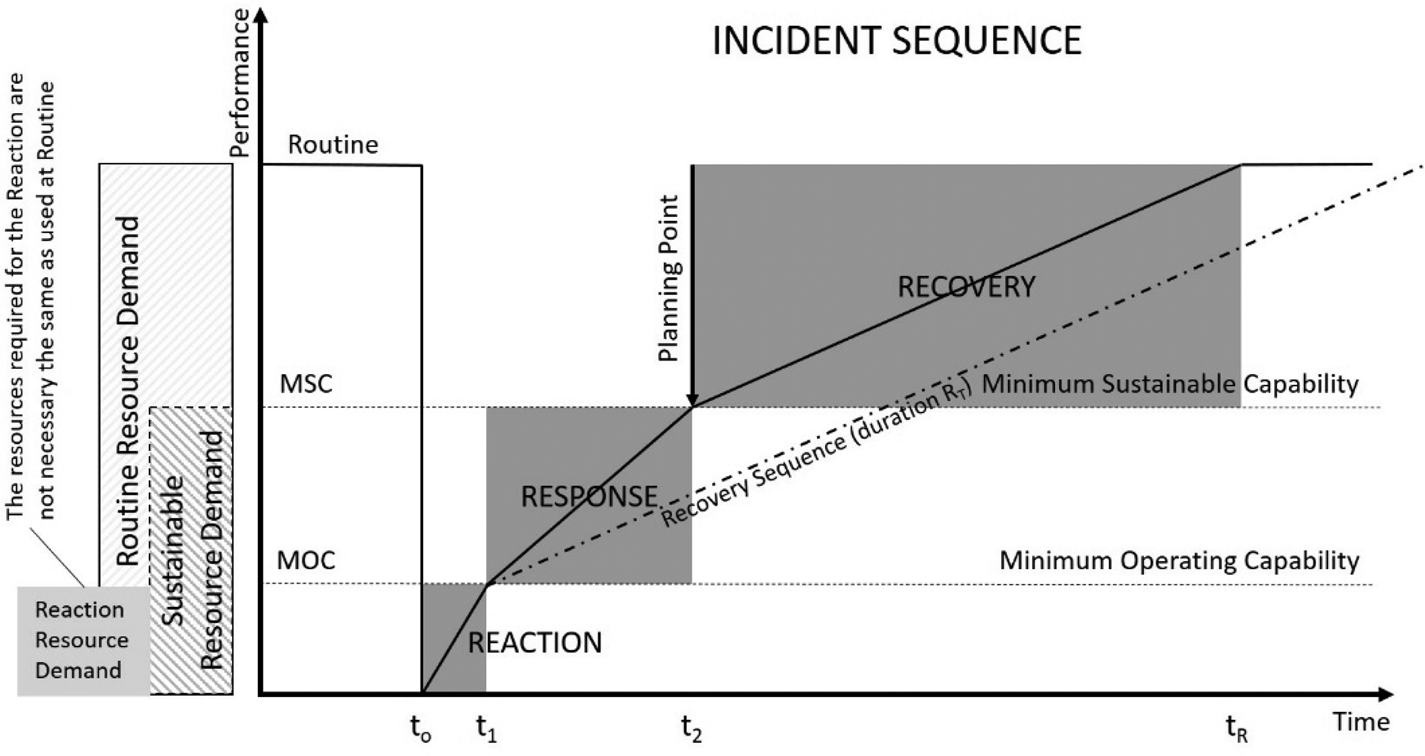
The incident sequence graphic tool seen in Figure 1 provides a useful illustration of performance levels and the local tolerances of service interruption. When an operation, any operation, fails, its performance will drop to zero or close to it. The system of systemsFootnote 58 that enables the operation will have a natural elasticity which reactively restores those essential functions necessary for survival, irrespective of what caused the failure or if the incident is ongoing. That natural elasticity is a feature of complex adaptive systems, which communities typically are.Footnote 59 This survival level of performance is known as the minimum operating capability (MOC). It will typically draw on resources that are not usually required for normal operations, such as diesel used for a stand-by generator when normal operation relies on grid-supplied electricity. Timing is critical, and the reaction must be followed up with a deliberate response. This is situationally dependent and requires clear direction on prioritization of function restoration and resource allocation to achieve a sustainable level of performance. This sustainable level of performance is known as the minimum sustainable capability (MSC). This is the natural stability of the operation. It is neither growing nor shrinking, and can theoretically continue indefinitely. In financial terms, the cost of operation is equal to the revenue received and is therefore cash-neutral. This means that the infrastructure performance is locally sustainable and not dependent upon external support. Understanding what level of performance represents the threshold of sustainability informs the types and scale of reconstruction project that can be transferred to local control, and helps to determine which projects will create a prolonged operational burden on donors.
Incident sequence graphic tool. This shows the relationship between performance of an operation and time over an incident. The performance is shown as routine prior to the incident, followed by failure and the gradual restoration of functionality through reaction and response, then eventual recovery back to a routine level of performance. The resources needed for each level of performance can be calculated, as can the maximum duration of interruption to the operation, sequencing of component function restoration and other risk planning criteria. By comparing the area under the graph with one for a proposed infrastructure development option, one is able to produce the difference in whole cost of risk, which indicates whether a proposed project is technically/operationally worth the investment or not. Source: Alexander H. Hay, “The Incident Sequence as Resilience Planning Framework”, Proceedings of the Institution of Civil Engineers – Infrastructure Asset Management, Vol. 3, No. 2, 2016, p. 57.
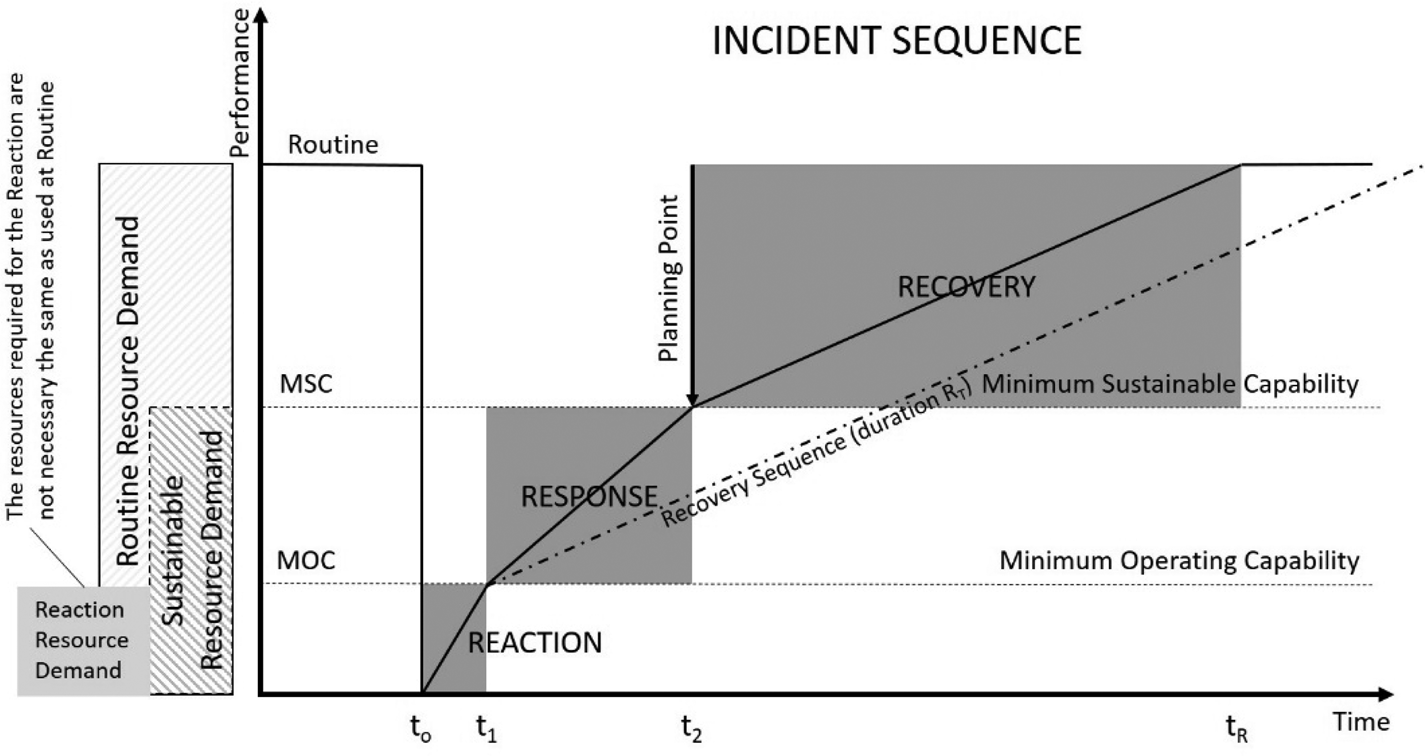
Both the MOC and MSC have particular resource requirements, which can be determined ahead of the crisis and pre-positioned under an emergency management plan. For example, consider a water treatment plant. Under normal conditions it is powered from the grid supply. The energy required to maintain MSC during periods of stress can be calculated and prioritized in the grid supply to maintain essential services to the community. This could also be provided by an alternative supply, typically a stand-by diesel generator. However, in the event of a total grid failure and an absence of district storage, one may calculate how much energy is required to achieve MOC levels of water supply, for hospitals etc., which might be provided by alternate power sources ranging from solar energy and battery storage to stand-by diesel generators. Each alternative source comes with its own maintenance and resource burden; this is knowable and can be set aside or prioritized for planned durations. When stress is applied for an extended period, communities will find a natural equilibrium and will stabilize within the available resources, irrespective of where they were previously. This is particularly true of community patterns of behaviour around infrastructure-supplied essential services. Interestingly, when there is an extended aid program, stability can be achieved, but only below MSC, because the productivity of the operation is below MSC and so its response capacity is limited to the quasi-stable level of performance. The flow of aid supports a stable community, but below its MSC.
The MSC is generic to all operations. It indicates quite literally an economically self-sustaining community, no more and no less. However, the MOC is less generic and can be difficult to assign. At its most basic definition it is the threshold of crisis, the level of performance below which there is complete social breakdown and acute outbreaks of disease. For the essential services, one would ordinarily focus on basic levels of public health, such as the conditions for cholera outbreaks. However, MOC is also influenced by regional and cultural norms. It would be lower for a low-density provincial town than an highly densified city. The planning agency must identify the point for a given region and conflict area where this threshold of crisis is – what crisis actually looks like, and not the hyperbole used for fundraising. While developed to indicate whether an emergency actually exists, the Office of the United Nations High Commissioner for Refugees (UNHCR) emergency indicatorsFootnote 60 provide a useful defined threshold of minimum levels to sustain human life and are internationally recognized; they also have the added advantage that they are relatively simple to measure. Conversely, such reference will likely attract political and legal complaints when the subject communities are internally displaced or the conflict is viewed as an internal matter. Alternately, the MOC criteria can be defined specifically for a given area but should be commonly agreed by all humanitarian actors involved to prevent arguments over whether or not a crisis is occurring.
Once the MOC and MSC are defined, estimating the current level of performance is a question of comparing demand density with the carrying capacity of the essential services. Practically speaking, the need for a resource is compared with its availability. As outlined above, stand-off recognition can provide both the infrastructure laydown and a reasonable sense of the demand density. This identifies whether concentrations of need (local communities) are served by the critical infrastructure that enables the local essential services. In practice, identifying an area of accessibility around the infrastructure laydown provides a sense of whether the essential service could be accessed by the local community. What is less clear is the condition of the infrastructure and ultimately its carrying capacity. Ideally, determining infrastructure carrying capacity is done through direct personal interaction between the infrastructure engineer and the local utility.
Stand-off recognition and incident sequencing can focus the discussions. Direct personal interaction is not always possible, but it is possible to still achieve some sense of the infrastructure carrying capacity by observing whether the local community's pattern of life is stable or not. One needs a way of interpreting what is observed to understand what it will likely mean. In effect, one needs a Rosetta Stone to provide meaning to recognition. The present authors propose a unifying concept of infrastructure to establish some simple protocols for interpreting meaning from what is recognized of the infrastructure.
A proposed unifying concept of infrastructure
This article proposes a unifying concept of infrastructure that comprises some simple protocols for interpreting how the infrastructure is arranged and its current functions and performance from the available evidence. For the time being these protocols provide a useful sequence of analysis, but ultimately they can be used to inform machine learning and AI interpretation. Focusing on the purpose of infrastructure, the role of infrastructure is more clearly defined around the essentials of life in conflict and post-conflict areas. One can reasonably assume that follies and theatres will not be built in preference over water supply and sewerage. That is not to say that there will be no theatre, as this is a common way of communicating with the population when literacy levels may be low in rural areas, for example. Nevertheless, such activities are more likely to make temporary/makeshift use of another existing facility. The purpose common to all infrastructure is ultimately health.Footnote 61 Out of this, one can see how infrastructure directly and/or indirectly supports that purpose and the essential services that deliver it. The interpretive analysis is more closely focused on public health in relation to infrastructure and where there may be a link to incidents of acute and chronic disease.
When infrastructure is viewed within the vitae system of systems,Footnote 62 one can consider the systems’ inter- and intra-actions, and how each contributes to the community's health within its operating and environmental context.Footnote 63 Drawing the key components of infrastructure function together and applying first principles, these authors have come to a long but crucial list of assertions:
a. Infrastructure is defined by its purpose; the continued fulfilment of that purpose defines the infrastructure requirement, and hence the design brief and specifications.
b. The value of the infrastructure is directly related to its use, performance and/or response capability. Therefore, irrespective of its configuration or expense in construction and operation, value will be defined by the local benefit.
c. The value must exceed the cost over the life of the infrastructure if the system is to be socio-economically viable.
d. Infrastructure changes the environment in which it exists and therefore also its own use over time. It is both the product and enabler of its context, influencing socio-economic change and market perceptions. Infrastructure risk and value are therefore dynamic; outcomes do not necessarily follow what is planned.
e. Infrastructure networks are complex adaptive systems.Footnote 64
f. Infrastructure systems design is optimized when the least energy is expended in reliably delivering a resource to its point of consumption.
g. The balance of the infrastructure domains with the human domain determines value and the capacity for resilience, since each domain may compensate for temporary deficiencies in others until a new balance is attained.Footnote 65
h. The measure of any infrastructure system is based on its outcome; the measure of whether infrastructure is likely to deliver the planned-for outcome is based on a convergence/coincidence of indicators of the anticipated outcome through its construction and operation. This measure is therefore based on the infrastructure purpose and is necessarily relative within a locally changing context over time, rather than any absolute measure.
i. The use and operation of essential services infrastructure is dictated by how it meets the community health purpose within the available resource capacity. The corollary of this is that the essential services infrastructure that is intelligently resourced will have the highest inherent capacity for rapid restoration of purpose.
j. The community need for health preservation in post-conflict communities will rapidly drive a new synergy between the infrastructure and human domains, resulting in a new local and regional equilibrium between communities and with infrastructure networks. This means that the new equilibrium will respond to relief aid as a contextual stress that changes inherent capacity for response and recovery.
Applying this unifying concept to stand-off recognition and ground survey, one is able to understand how the infrastructure enables essential service capability. In effect, one can develop an understanding of what the observed infrastructure networks actually mean in terms of function and capacity. It now just remains to make that understanding intelligible to others.
The common operating picture as common reference
The common operating picture (COP) is the common reference for all stakeholders, depicting the actual current situation; it is how this understanding of the infrastructure systems is represented. This is akin to the green LEGO board that is used to define a diorama model by positioning each item in space and, as it is played with, in time. The COP is effectively the LEGO board for the post-conflict and/or protracted conflict planning in the region. It provides an evidential representation of what currently exists. It will include the essential services infrastructure laydown in its topographical context, with associated hydrological, geological and meteorological data. The demand density distribution across the area is shown as a map overlay, as it is recognized from the geospatial analysis and interpolation between infrastructure and conurbation. The operation of essential services can then be overlaid again, showing the availability of essential services to the areas of demand density. These availability overlays will be based on the norms determined for the local area and region. For example, one might determine access to a central source of potable water, such as a standpipe, during a crisis in a UK city, measured in tens of metres or minutes of walking. Conversely, a similar situation in a sub-Saharan township may serve a far larger catchment. The combination of physical demand and social expectation will drive the need for accessibility.
The final overlay is of resource availability – that is, the resources necessary to support the essential services. The essential service of potable water is enabled by infrastructure, but the water has to come from somewhere. Therefore, the resource overlay for the water infrastructure will include the water sources and often an aquifer representation, if known. This knowledge informs alternative essential service provision such as through the use of tanker trucks if the water infrastructure networks are compromised. Together, this LEGO board and the overlays are the foundation of the COP, known as the “tableau”. It provides a common reference of what exists, and can be refined and developed with each new report and asset development. What it does not describe are the socio-economic, operational dynamics and the epidemiological overlays. In short, it provides a common reference of what is currently known about an area and not what is inferred.
The other part of the COP is the understanding of what the tableau means in context. This interpretation of meaning is analytical and judgement-based.Footnote 66 To be effective, it must have an evidential base to the understanding rather than being based on an opinion, expert or otherwise, that is not connected to the tableau. These interpretative overlays are situation- and mission-defined, but will typically include the identification of areas unserved by essential services or on the periphery of access. Most usefully, the contextual interpretation provides the connection between the built and natural domains and the human and virtual domains;Footnote 67 it provides the connection between tableau and operations. There are many operations modelling tools. By preference, the authors use a causal chain representation of the operation and its dynamics.Footnote 68 This maps the dependencies of each component function and the associated assets and services to the nth order of removal.
Importantly, this approach allows the analyst to capture the nature of complex adaptive systems, while remaining evidence-based, repeatable and entirely auditable. Applying the service thresholds of MOC and MSC allows estimation of a community's performance and its capacity to respond to a subsequent brief return to violence or other crises. One can achieve a qualitative assessment with such modelling very quickly, but achieving quantitative assessments requires significant amounts of data that will rarely be available early post-conflict, particularly in protracted conflict. This data collection issue is particularly acute when the international community's focus is necessarily crisis response and aid, rather than preparing for the next crisis. The unifying concept of infrastructure allows one to make the functional connections between the causal chain model and the tableau, providing the means to fully evaluate inherent risk across the vitae system of systems and the efficacy of proposed interventions.
The need for engagement
Equity of access: A critical infrastructure planning concept
Any humanitarian engagement, particularly one involving critical infrastructure, must not increase the vulnerability of the area or cause harm, directly or indirectly. Indeed, this is the first principle of infrastructure protection, which is “do no harm”, and requires a careful assessment of what new infrastructure means and the value that it represents – recall the centralized waste water treatment plant example discussed earlier. This is not to assume that a return to violence is inevitable, but rather that the progressive reconstruction and recovery of the essential services should not be compromised by it. Avoiding any increase in vulnerability, either through exposure to loss or the impact of loss, is consistently relevant in post-conflict situations, whether the focus is on crisis preparation and repair of existing facilities, development of new facilities, or something in between. There is also the question of whether in addressing an acute or crisis issue, the new or reconstructed infrastructure worsens the chronic disease profile of the population, such as through the provision of contaminated water. This is often a matter of working to a common purpose in aid, reconstruction and development planning. The delivery of this common purpose is what defines the value of the infrastructure. It must sustainably increase over the projected life of the infrastructure, immediately through construction to operation and into the future. That value is only realized if the infrastructure is accessible. Use of local labour during the infrastructure construction will reinforce access to employment and the collective ownership of the finished works. However, access to this work is less about the proximity of the labour force to the work site as it is about the ability of many working-age adults to work. Widowed households with young children are particularly vulnerable to losing out on work opportunities. The provision of community-based early-years education means that such households do not need to prioritize employment over childcare, for example. This has proved successful in different high-poverty-risk locations, and community-based early-years education is promising in addressing intergenerational trauma.Footnote 69
During the operation of the infrastructure, there has to be a beneficiary of the essential service that the infrastructure enables for it to have value. Value is a measure of use, and if the local population cannot access the essential services, the infrastructure investment has no value, irrespective of how much it might have cost. Value can be equated with the degree of local ownership to ensure continued function. Therefore, access is important at each stage of the infrastructure life cycle.
For the whole of community engagement, including the promotion of former combatant reintegration and reconciliation, it is important to provide that community focus where everyone is engaged around a common purpose. This requires an equity of access which makes allowance for individual circumstance. Equal access may simply be defined as everyone being within a defined catchment of an essential service, but equity of access is about everyone within that catchment being able to access the essential service. The challenge is to enable equity of access for the most vulnerable, who are often made more vulnerable by their lack of access. This can be due to physical or mental impairment, social isolation arising from their role in the conflict, or simply their physical location. Increasingly, urban conflict can isolate those in high-rise buildings, where the need to ascend multiple flights of stairs while carrying water is more onerous than the person who walks the same distance along the street. This can change the prioritization of reconstruction works, despite not being apparent when the problem set is defined by observations of deficiency without understanding.
Tableau(x) projection of resilient operations can stabilize systems
The need for aid and reconstruction projects to contribute to the overall resilience of the essential services and the community as a whole has been discussed above. Infrastructure reconstruction projects provide a useful tool to facilitate this. They could function similarly to a franchise operation, where the essential functions of the franchise define the brand value and are stipulated in the franchise agreement, and where the franchisee provides a facility that can support the essential requirements of the franchised operation. Similarly, with a reconstruction project, the performance and function of the restored infrastructure is defined, but it is adapted to and enabled by the local application of resources.
When projecting an essential service to an area, it is useful to define it as an operation. The operation will have its own tableau. This tableau is specific to the operation, providing only those components that the operation depends upon. When the operation is resilient, its essential requirements will be provided for by components that support a particular performance and enable a response and recovery capability. This operational tableau can then be projected to the area in question.Footnote 70 Any mismatch between the operational tableau and the host tableau will define what the infrastructure shortfall is and whether addressing the shortfall is achievable. Furthermore, this approach enables intelligent resourcing so that the essential service is delivered using locally resourceable materials and labour. Understanding the local situation enables tableau projection, building essential services, in post-conflict areas, that are locally aligned and sustainable in the current risk context.Footnote 71
Conclusion
There can be many reasons for an unsuccessful post-conflict rehabilitation strategy, ranging from simple staff obfuscation to donor nation self-interest. Nonetheless, what is proposed in this article is a common frame of reference for all stakeholders to at least understand what the current infrastructure situation is, and so inform the effective implementation of whichever rehabilitation approach is pursued. The proposed approach does not default to a situation ante bellum, but recognizes that the conflict has caused real change. For instance, populations may be displaced and separated, leading to changed ethnic and cultural composition of communities. Infrastructure systems and demand distributions therefore need to contribute to a new stability, and there will likely be a paucity of experienced professionals.
This common frame of reference for infrastructure engineers draws on leading heuristic practice and commercially available tools, so that it remains practicable. However, the practice of establishing a common reference is not exclusive to infrastructure engineers. The tableau that forms the basis of the COP is the most basic common reference and is developed by geospatial analysts, as required. The team within the International Committee of the Red Cross that works on the direct and indirect and cumulative impact of armed conflict and other situations of violence on essential services is building its geospatial and systems mapping capabilities to take advantage of stand-off recognition and the improved understanding that it affords. Tools such as stand-off recognition significantly inform all humanitarian engagement, especially infrastructure engineering in post-conflict areas, supplementing an asset-based field perspective with a holistic “system of systems” framework. They cannot replace the humanitarian actor, but by providing the humanitarian actor with a clear evidential common reference, decision-making and local engagement can be better informed, enabling greater and more effective alignment between projects and local needs.
There are several relevant emergent lines of research arising from this study, which are being pursued at the University of Toronto and elsewhere. These include the development of the unifying concept, geospatial analysis and post-conflict rehabilitation concepts.
Infrastructure engineers can and should inform the debate around rehabilitation strategies by providing the boundaries of possibility. These boundaries are defined by what is possible given the current situation, rather than a projection of what is familiar from elsewhere, and recognizing the rehabilitation principles. Improved common understanding of the situation informs better strategy integration between departments and agencies, and hence mission efficiencies, as well as making greater alignment of humanitarian engagement with local needs possible. This is particularly important in the alignment of different humanitarian mandates, from crisis preparation through to reconstruction and development. They are part of the same continuum and must be coordinated around a common risk-balanced strategy.