1. Introduction
The importance of trust (both interpersonal and political) has attracted much scholarly attention for the past two decades, and a general consensus has emerged regarding the positive influence of trust on the quality of democratic governance. Trust has been praised as bringing to society better economic performance, citizens’ active participation in politics, good government performance, less corruption, and healthy democracy (Putnam, Reference Putnam1993, Reference Putnam1995; Fukuyama, Reference Fukuyama1995; Levi, Reference Levi1996; Newton and Norris, Reference Newton, Norris, Pharr and Putnam2000; Inglehart, Reference Inglehart, Pharr and Putnam2000; Mishler and Rose, Reference Mishler and Rose2001, Reference Mishler and Rose2005; Uslaner, Reference Uslaner2002, Reference Uslaner, Lambsdorf, Taube and Schramm2005; Chang and Chu, Reference Chang and Chu2006; Morris and Klesner, Reference Morris and Klesner2010). However, scholarly works on trust diverge over where trust originates, whether interpersonal and political trust are associated, and how trust affects and is affected by other political, economic, and cultural components of a society.
Generally speaking, studies on the origins of trust are grouped into three theoretical perspectives: social-psychological, social-cultural, and institutional (Newton and Norris, Reference Newton, Norris, Pharr and Putnam2000; Mishler and Rose, Reference Mishler and Rose2001). The psychological approach suggests that interpersonal and political trust is largely shaped by an individual's personality type, a person's tendency to trust others, and political institutions or lack thereof. Meanwhile, the social-cultural approach focuses on a society's cultural norms and individuals’ early life socialization process to generate trusting tendencies toward other people, civic associations, and political institutions. Finally, the institutional approach argues that trust (especially political trust) is an outcome of the actual performance of government institutions; well-performing government increases citizens’ trust, while performance failure results in distrust of politics. Furthermore, scholars have debated whether interpersonal trust and political trust are interrelated and whether the former generates the latter, or vice versa. In sum, although scholars agree that trust matters, they differ over the origins and specific causal directions of different types of trust.
The main objective of this article is to explore the origins of political trust in three East Asian countries (Japan, South Korea, and Taiwan) that are well-functioning democracies and the most advanced economies in the region. Japan is the oldest consolidated democracy in Asia, while South Korea and Taiwan experienced democratization in the 1980s and 1990s and have been stable and consolidated democracies ever since. These East Asian democracies have sustained much faster economic growth for decades than have most other Organization for Economic Cooperation and Development (OECD) countries, although the growth has somewhat slowed in recent years. The three East Asian democracies are also culturally and ethnically homogeneous societies. All these socio-cultural, political, and economic conditions are expected to generate a high level of interpersonal and political trust. Against such expectations, however, these Asian democracies suffer from some of the lowest scores in terms of citizens’ trust in government. A recent survey conducted by the OECD (2013) reveals that Japan and South Korea score 27 and 32.4, respectively, in terms of citizens’ confidence in government (the average of OECD countries is 40.7). The two are ranked 29th and 26th out of 34 (Taiwan was not included in the survey).Why do these Asian democracies record such low levels of confidence in government? Where does political trust come from in these countries? This article conducts an empirical analysis of the origins of political trust based on testing relative strengths and weaknesses of the three abovementioned theoretical perspectives in East Asian contexts. The empirical analysis of this article suggests that, among the three arguments, the institutionalist theory best explains the origin of political trust, while the other two have very limited explanatory utility. Furthermore, the research confirms previous scholarly findings that social trust and political trust are conceptually distinct and originate from different sources; social trust does not translate into political trust.
The article is organized into four sections. The first section discusses the definitions and origins of interpersonal and political trust, from which three hypotheses are generated. The second section describes the research design that includes the data, definition, and measurement of key variables, and methods. The third section reports on an empirical analysis of the origins of political trust in three East Asian democracies. The article concludes with speculations on what the empirical evidence conveys and gives suggestions for future research.
2. What is trust?
Social and political trust has become an increasingly important subject across different fields of social science in recent decades, treating trust as a remedy for many problems that contemporary societies face and a lack of trust as an ominous sign of crisis in democratic governance. Since the Trilateral Commission's publication of The Crisis of Democracy (Reference Crozier, Huntington and Watanuki1975), concerns over the health of democratic governance have attracted scholarly attention, not just in the old Western democracies but also in new democracies around the world. At the heart of this concern is the decline in social trust, citizens’ confidence in their political leaders, government institutions, and beliefs in democratic norms and values. A more recent work (Putnam et al., Reference Putnam2000: 7) confirmed the Trilateral Commission's findings, suggesting that ‘public confidence in the performance of representative institutions in Western Europe, North America, and Japan has declined . . . and in that sense most of these democracies are troubled’. Citizens’ distrust of political leaders can be a sign of healthy democracy; political leaders come and go, as they are reelected or voted out of the office depending on their political performance. However, citizens’ lack of trust and confidence in political institutions and democratic rule can be a sign of serious crisis for a society. Such negative impact of low trust has been found to be more damaging in new democracies’ routes to democratic consolidation, as individuals who distrust government are willing to accept authoritarian alternatives (Rose et al., Reference Rose, Mishler and Haerpfer1998; Schedler et al., Reference Schedler, Diamond and Plattner1999; Canache and Allison, Reference Canache and Allison2005; Chang and Chu, Reference Chang and Chu2006; Manzetti and Wilson, Reference Manzetti and Wilson2007).
Then, what is trust and where does it originate? Conceptually speaking, trust conveys two different sorts: social and political trust. Social trust refers to generalized interpersonal trust, while political trust means citizens’ trust in government and political institutions. Social trust is one's belief that other constituents in society can generally be trusted and accepted as integral members of the community (Inglehart, Reference Inglehart and Warren1999; Uslaner, Reference Uslaner, Lambsdorf, Taube and Schramm2005). From the start, interpersonal trust is formed within a narrow range of family members and members of face-to-face groups. At the next level, interpersonal trust becomes ‘impersonal trust’ in individuals ‘who are not known personally and results from the generalization of personal trust discounted by the psychological distance of impersonal “others”’ (Mishler and Rose, Reference Mishler and Rose2005: 1053). Considering that interpersonal trust within family and face-to-face groups exists anywhere within a small and isolated community, what matters is the ‘radius of trust’, the extension of interpersonal trust to a much wider range of society's members and large-scale impersonal or political institutions (Fukuyama, Reference Fukuyama1995). Ultimately, according to this reasoning, political trust is a natural corollary of social trust.
Meanwhile, political trust denotes a much narrower and specific orientation to indicate citizens’ confidence in or evaluative attitudes toward their political leaders and political institutions (Stokes, Reference Stokes1962; Huntington, Reference Huntington1968; Hetherington, Reference Hetherington1998; Della Porta, Reference Della Porta, Pharr and Putnam2000; Newton and Norris, Reference Newton, Norris, Pharr and Putnam2000; Rothstein and Stolle, Reference Rothstein and Dietlind2002). Barber (Reference Barber1983: 14) presents two distinct components of trust: ‘expectation of technically competent role performance’ and ‘expectations of fiduciary obligation and responsibility’. That is, trust is based on citizens’ beliefs about their government's capability to perform the political functions citizens expect of it and a sense of moral responsibility to address others’ interests. In this sense, political trust involves citizens’ confidence in the competent performance and moral commitment of political leaders. A lack of political trust can be understood as resulting from a gap between citizens’ expectations and government performance. The following section offers an overview of three theoretical accounts of the origins of trust and formulates hypotheses.
3. The origins of trust: three hypotheses
Social-psychological explanations
The social-psychological approach suggests that individuals differ in terms of their predispositions to trust or distrust other individuals, and such differences are determined by personality type, which is shaped either during early childhood or in a later stage of adult life (Erikson, Reference Erikson1950; Rosenberg, 1956; Kramer, 1999; Uslaner, 1999, 2000). According to Erikson (1950), for example, one's personality trait of having a sense of optimism and trust is formed during the early stage of life, beginning with the mother–baby relationship. Such personality traits of optimism and basic trust tend to endure throughout life and influence a person's behavior. The social-psychological theory suggests that trust is ‘part of a broader syndrome of personality characteristics that includes optimism, a belief in co-operation, and confidence that individuals can resolve their differences and live a satisfactory life together’ (Delhey and Newton, Reference Delhey and Newton2003: 95).
The social-psychological theory advances two arguments in terms of when and how the individual traits of optimism and trust are formed, which Delhey and Newton (Reference Delhey and Newton2003) term ‘personality theory’ and ‘social success and well-being theory’. The personality theory of trust suggests that a person's experience of alienation or cooperation in early childhood shapes his or her personality characteristics of optimism and trust or pessimism and cynicism toward cooperation with others in society as well as toward political processes (Rosenberg, Reference Rosenberg1956; Kramer, Reference Kramer1999; Uslaner, 1999, 2000). Uslaner (Reference Uslaner and Warren1999, Reference Uslaner and Loomis2000) follows this line of argument to suggest that trust is learned from parents and tends to be consistent throughout life; social trust is not an outcome of repetitious experiences of reciprocity. A person's level of trust is associated more strongly with that person's personality type and subjective feelings of well-being than with his or her external experiences of economic conditions.
Meanwhile, the theory of social success and well-being is similar to personality theory in that both discover the origins of trust from variations in individual experiences that shape a person's beliefs and orientations toward others and the environment in which he or she is embedded. However, social success and well-being theory differs in that it rests on individuals’ experiences as adults and their socio-economic status rather than early childhood experiences. For instance, the rich are more trusting than the poor. Considering that trust conveys risks and makes the trusting person vulnerable, trusting behavior becomes a riskier business for the poor than for the rich. Bandfield (Reference Bandfield1958) suggests that ‘the poor cannot afford to lose even a little of what they have if their trust is betrayed; the rich stand to lose comparatively less, and they may gain comparatively more from trusting behavior’ (quoted from Delhey and Newton, Reference Delhey and Newton2003: 96). Furthermore, the haves will be repeatedly treated with more respect and honesty than the have-nots, which enhances the haves’ trusting tendencies. Empirical works find a strong association between an individual's economic status, education level, and level of happiness and subjective well-being on the one hand and the level of interpersonal trust on the other (Inglehart, Reference Inglehart and Warren1999; Putnam, Reference Putnam2000; Schoon and Cheng, Reference Schoon and Cheng2011).
Regardless of the differences, however, both psychological theories suggest that a person's psychological predisposition determines his or her level of social trust; there are trusters and cynics. By the same token, according to social-psychological theory, political trust as an extension of interpersonal trust is established by social-psychological predispositions (Putnam, Reference Putnam1993; Inglehart, Reference Inglehart1997; Schoon and Cheng, Reference Schoon and Cheng2011). From the social-psychological argument, we hypothesize that an individual shows a high level of political trust when he or she has an optimistic worldview and a sense of subjective well-being.
Social-cultural explanations
The social-cultural approach examines the origins of trust from the perspective of individual norms and beliefs that are deeply embedded in the socio-cultural norms of society. Although the literature of social-cultural explanations focuses on cultural components of society that shape individual norms and value systems and the ways that citizens interact with each other in society, it varies regarding how and what specific components of culture shape interpersonal and political trust. s1989; Putnam, Reference Putnam1993; Fukuyama, Reference Fukuyama1995; Inglehart, Reference Inglehart1990, Reference Inglehart, Pharr and Putnam2000), and still others highlight religious traditions (Fukuyama, Reference Fukuyama1995; La Porta et al., 1997; Inglehart, Reference Inglehart and Warren1999). Some of the social-cultural arguments overlap with the social-psychological perspective. However, one major difference is that social-cultural arguments tend to be geared toward macro-level social and cultural components and social-psychological studies focus heavily on individual psychological elements.
Social-cultural theory suggests that interpersonal trust is the product of ‘social experiences and socialization, especially those found in the sorts of voluntary associations of modern society that bring different social types together to achieve a common goal’ (Newton and Norris, Reference Newton, Norris, Pharr and Putnam2000: 60). Such arguments date back to Alexis de Tocqueville Reference Tocqueville2003, who emphasized the importance of civic volunteerism and citizens’ participation in voluntary organizations and associational activities as prerequisites for a vibrant democracy. Putnam's (1993, Reference Putnam1995) notion of social capital is consistent with the Tocquevillian tradition to suggest that social capital, defined as ‘features of social organization such as networks, norms, and social trust that facilitate coordination and cooperation for mutual benefit’, is the key to invigorating democracy (Putnam, Reference Putnam1995: 67).
Social capital theory contains two essential elements: networks and norms of trust. Social networks are formed through citizens’ active engagement in voluntary organizations, which generates reciprocal norms of trust among citizens. Social capital, once formed, is expected to bring major benefits to society: social trust and altruism, ‘templates’ for problem solving, and broadening citizens’ sense of self from ‘I’ to ‘we’ (Putnam, Reference Putnam1995). Citizens build social trust, civicness, and cooperative culture through active involvement in voluntary associations. Furthermore, social trust helps organizing effective political groups and government institutions, which in turn brings citizens’ confidence in government. In this respect, social trust and political trust are highly correlated and mutually reinforcing: ‘there is a direct and mutually reinforcing relationship between the types of people who express trust and confidence on the one hand and strong and effective social organizations and institutions on the other’ (Newton and Norris, Reference Newton, Norris, Pharr and Putnam2000: 61). In sum, social trust creates a virtuous cycle of interpersonal trust – effective political institutions – citizens’ trust in political systems – higher interpersonal trust.
Fukuyama (Reference Fukuyama1995) elaborates upon a social-cultural argument, suggesting that differing economic performances among individual countries are largely explained based on whether a society builds a community to bind people into networks of trust. Fukuyama's definition of social trust is consistent with Putnam, defined as ‘the expectation that arises within a community of regular, honest, cooperative behavior, based on communally shared norms, on the part of the members of that community’ (Fukuyama, Reference Fukuyama1995: 26). Here, social trust is the key to economic success because it enables large-scale modern industrial economies to function (Bandfield, Reference Bandfield1958; Putnam, Reference Putnam1993; Fukuyama, Reference Fukuyama1995).
Meanwhile, Inglehart (Reference Inglehart1997, Reference Inglehart and Warren1999) focuses on postmaterialism as a cultural shift that molds citizens’ value systems and political orientations. He explains how cultural transformation from materialism to postmaterialism shapes citizens’ attitudes toward government authorities and democratic norms and values. He suggests that economic development through industrialization brings changes in mass values and belief systems, which he calls the ‘postmodern shift’, or ‘a shift from the instrumental mentality that characterized industrial society, toward increasing emphasis on individual self-expression’ (Inglehart, Reference Inglehart and Warren1999: 237). Postmaterialist values are found to be positively associated with the level of interpersonal trust. Furthermore, societies’ religious traditions are strongly linked to the level of interpersonal trust: Protestant and Confucius-based societies demonstrate higher levels of interpersonal trust than societies based on other religions, including Roman Catholicism and Islam. Inglehart (Reference Inglehart, Pharr and Putnam2000) suggests that ‘horizontal, locally-controlled organizations are conducive to interpersonal trust, while remote hierarchical organizations tend to undermine it’ (p. 92).
To simplify the abovementioned social-cultural arguments, interpersonal trust is a reflection of a society's cultural norms and values ‒ civic organizations, postmaterial value systems, or religions. In addition, social trust is the main foundation of good governance and citizens’ confidence in government and political institutions as well as democratic values. To empirically test the social-cultural argument, we hypothesize that citizens demonstrate high levels of political trust if they are actively involved in voluntary associations, possess strong postmaterial values, and have a Protestant religious affiliation.
Institutional explanations
Social-psychological and social-cultural arguments, despite notable differences, share similar theoretical assumptions about the origins of social trust; both realize the significance of the socialization process and learning experiences at either the early stage or adulthood. Furthermore, both embrace the argument that interpersonal and social trust translates into political trust and, therefore, the origin of political trust is exogenous from the government and political institutions. The institutional explanations of political trust hold the same idea that elements such as culture, socialization, and political experiences play influential roles in shaping individuals’ confidence in government and political systems. At the same time, however, the institutional explanations argue that trust in politics is primarily endogenous to the political system (Mishler and Rose, Reference Mishler and Rose2001: 31). Citizens’ confidence in government is influenced by their short-term and long-term experiences with government performance.
The institutional account of trust assumes that social trust and political trust occupy qualitatively different domains and the former does not automatically translate into the latter. Political trust is primarily based on citizens’ evaluations of government performance and therefore trust in government and cooperation are a consequence of effective government (Huntington, Reference Huntington1968; Hetherington, Reference Hetherington1998; Della Porta, Reference Della Porta, Pharr and Putnam2000; Newton and Norris, Reference Newton, Norris, Pharr and Putnam2000; Kim, Reference Kim2005). The institutional argument questions the validity of Putnam's thesis that political trust is a natural extension of participation in voluntary associations and interpersonal trust. It suggests that civic culture, or ‘civicness’, is political by nature and therefore should be distinguished from citizens’ participation in voluntary associations in the community. Numerous empirical studies have demonstrated a weak or fictional association between citizens’ participation in voluntary associations and their level of political trust (Kaase, Reference Kaase1999; Newton, Reference Newton and Norris1999; Norris, Reference Norris2002; Kim, Reference Kim2005). Newton and Norris (Reference Newton, Norris, Pharr and Putnam2000), for example, suggest that social trust does not cause citizens’ confidence in government; that is, ‘social trusting people are not necessarily political trusting, and vice versa’ (p. 72). Rather, the empirical evidence in their study demonstrates that government performance best explains citizens’ confidence in government.
Furthermore, whereas social trust originates from social-cultural contexts and tends to be consistent for relatively long periods of time, political trust can fluctuate in a short time depending on government performance and citizens’ evaluations of it. From the political institutional argument, we hypothesize that citizens’ levels of confidence or trust in government is high when they believe their government is competent and functions effectively, and vice versa. The next section offers a research design that discusses relevant variables and their measurements, methods, and the data, followed by an empirical analysis that tests the aforementioned three hypotheses.
4. Research design
This article uses the 2006 AsiaBarometer survey to analyze the origins of political trust in Japan, South Korea, and Taiwan. Compared to other comparative public opinion surveys (e.g., the World Values Surveys and the Comparative Studies of Electoral Systems), the data provide more relevant questions for all three theoretical arguments of political trust (especially the social-psychological argument). As discussed above, the social-psychological and social-cultural arguments suggest that social trust may not only influence political trust but may also be affected by personal, socio-economic, and political factors. Two-stage least squares (2SLS) analysis takes account of the endogeneity problem in social trust, estimating two equations – one for social trust and the other for political trust. The predicted values for social trust are included in the equation of political trust instead of the actual values. The results from the OLS regression of the political trust equation are also reported for comparison.
Social trust as generalized interpersonal trust is commonly measured by the question of whether or not most people can be trusted. The AsiaBarometer survey asks the respondents, ‘Generally, do you think people can be trusted or do you think that you can't be too careful in dealing with people?’ The respondents who answered that most people can be trusted take on the value of 1 and otherwise 0. Since social trust as a dependent variable takes only two values, logistic regression is used. Based on the three theoretical arguments of the origins of trust, the social trust equation includes social-psychological, social-cultural, and institutional variables.
To test the social-psychological hypotheses (both personality and well-being hypotheses), individual optimism, life satisfaction, and income are included. The AsiaBarometer survey does not provide a specific question about optimism but lists 30 issues (e.g., poverty, terrorism, natural disasters, the decline in birthrate, moral decline/spiritual decadence) and asks whether each one causes the respondents great worry. Optimistic people tend to worry less and, therefore, the number of issues that make a respondent worry measures the degree of optimism. Life satisfaction is a composite measure of satisfaction with four aspects of individual life —household income, health, education, and job. Each item is measured on a 5-point scale, ranging from 1 (very dissatisfied) to 5 (very satisfied). Income is categorized into low, middle, and high. We expect all the social-psychological variables to have positive effects on social trust.
Social-cultural hypotheses require several groups of variables to test various cultural arguments. Membership or involvement in voluntary organizations and community size as indicators of social networks are common measures of social capital and civic engagement. To measure engagement in voluntary organizations, this study utilizes the importance of clubs and labor unions, as well as religiosity (not just belonging). Although questions about voluntary organization memberships themselves do not exist in the data, there are questions that ask about the importance of various groups: respondents were asked whether clubs and labor unions were important to them. Involvement in groups better fits in indicating socialization and networking. Retaining membership in a group per se does not say much about a person's socialization into that group. For the same reason, religiosity, not the religious denomination to which the respondents belong, is included and measured by how often a respondent prays or meditates, ranging from 0 (never) to 4 (daily). Finally, community size (rural or urban) is another indicator of social capital since a smaller community is expected to facilitate personal interactions, which advances social capital and trust. Residents of rural areas are coded 1; otherwise, they are coded 0.
To test the postmaterial arguments, the level of education, which is also a measure of social capital, and importance of self-expression are considered. The education variables are categorized into low, middle, and high education, and the low and high education groups are included in the equation for comparison with the middle group. For the self-expression variable, the AsiaBarometer survey asks whether expressing personality or using talent is important to the respondents, coding 1 for the respondents who answered that it is important and 0 for the others. The postmaterialist thesis expects education and the importance of self-expression to have a positive effect on social trust. The final group of social-cultural variables concerns religious traditions. Based on the argument that Protestant culture leads to higher social trust, a dummy variable for Protestants is included for comparison with social trust among other religious denominations. Confucian culture is also known to have higher social trust, but less than 1% of the respondents in the three countries identified Confucianism as their religious denomination.
Finally, the institutional account of social trust is tested by the following variables: income inequality, corruption perception, and evaluation of national economy and employment. One of the socio-economic issues people are concerned about is income inequality, which is also an indicator of social conflicts that may hinder social trust. Subjective perception of income inequality is measured by a question about whether income/wealth inequality should be ‘eagerly promoted’. Individuals who think that income inequality should be addressed are expected to have lower social trust. As a political performance variable, the perception of corruption question asks respondents to indicate how much they agree or disagree with the statement, ‘There is widespread corruption among those who govern the country’, on a 5-point scale ranging from 0 for strongly disagree to 4 for strongly agree. Respondents who strongly agree with the statement should be less trusting of others. Economic performance variables are measured by individual evaluation of the handling of the national economy and unemployment on a 4-point scale, ranging from 0 (not well at all) to 3 (very well). According to the political-institutional argument, both economic performance variables have a positive effect on social trust.
To test all three explanations of the origins of political trust, the second-stage regression of political trust includes all the variables considered in the social trust equation except for Protestant and income inequality, which serve as the instruments. The instruments influence social trust, while they do not directly affect political trust, which suggests that they are valid instruments. Representation as another indicator of political performance and the predicted values of social trust from the social trust equation are also added to the political trust equation. To measure the representation variable, respondents are asked to rate on a 5-point scale how much they agree or disagree with the statement, ‘Generally speaking, the people who are elected to the [NATIONAL PARLIAMENT] stop thinking about the public once they're elected’.
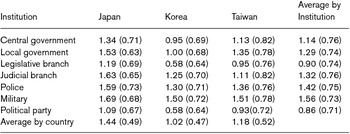
The final and main dependent variable to be discussed is political trust. To measure political trust, most surveys, including the World Values Surveys, ask how much confidence respondents have in various government institutions, such as the armed forces, police, legislature, civil services, political parties, the justice system, and the government. This question focuses on competence in the performance of each political institution, while overlooking moral commitment. In contrast, the AsiaBarometer survey provides a more direct measure of political trust, asking ‘to what extent [do] you trust the following institutions to operate in the best interests of society?’ The respondents rate each institution from 0 (Don't trust at all) to 3 (Trust a lot) and their answers are summed to create the political trust variable. Since the composite variable of political trust is considered an interval, ordinary least squares regression is used to estimate the political trust equation. Table 1 shows the level of political trust by each political institution in Japan, South Korea, and Taiwan.
Political trust in Japan, South Korea, and Taiwan

Source: AsiaBarometer (2006), https://www.asiabarometer.org/.
Respondents in all three countries trust the military most, while they consider political parties and the legislative branch as least trustworthy. Regarding the cross-national variation in political trust, South Korea has the lowest level of political trust, followed by Taiwan and Japan. The differences are statistically significant at the 0.01 level.
5. Empirical analysis
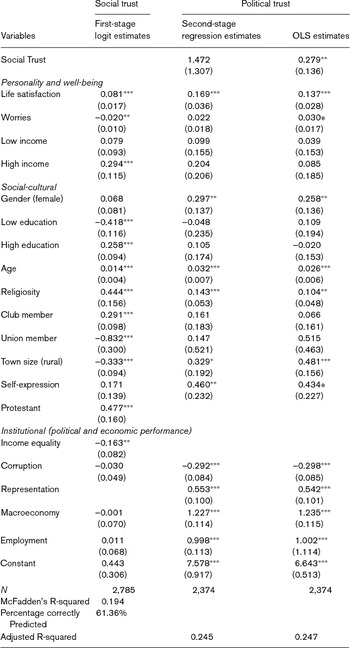
Table 2 shows the results of the first-stage logit regression of social trust and both the 2SLS and OLS estimates of political trust. The results from the social trust equation illustrate that both social-psychological and social-cultural factors are relevant predictors of social trust, while institutional variables are not. More satisfied people tend to have a higher level of interpersonal trust, while individuals with more worries are less likely to trust others. By the same token, more successful persons indicated by a high income level are more likely to trust others than individuals with middle-range incomes, although little difference exists between individuals with middle-range and low incomes. Most social-cultural factors – social capital and civic engagement variables in particular – are also significant determinants of social trust. Similar to the argument on social capital, older people are more likely to trust others than younger people because the former are more engaged in and concerned about their community than the latter (Putnam, Reference Putnam2000; Newton, 2001; Mishler and Rose, Reference Mishler and Rose2001). Gender is also included as a control variable but has no significant effect.
Two-stage least squares estimates of political trust in Japan, South Korea, and Taiwan

Notes: * p≤0.1 ** p≤0.05 *** p≤0.01.
One well-known indicator of social capital is voluntary organization membership. As the positive and statistically significant coefficient of the religiosity variable suggests, more religious individuals tend to trust others more than the less religious. Club members also have higher social trust, while labor union members have lower social trust, which implies that not all voluntary organization involvements enhance social trust. Another social network variable is community characteristics. People within a small community are expected to have more personal interactions, which improves social trust. However, the negative coefficient of the town size variable suggests that rural residents trust others less than those in urban areas. Considering that the three countries have a high level of population density and urban communities are tightly integrated with dense communication and transportation networks, the urban residents can be closer to each other than rural residents.
The final groups of social-cultural variables are related to postmaterialism and religion. The level of education has a positive association with social trust; higher educational achievement leads to the higher levels of social trust. Protestants are more trusting than people of other religions, as previous studies have suggested (La Porta et al., Reference La Porta, Florencio, Andrei and Robert1997; Inglehart, Reference Inglehart, Pharr and Putnam2000). On the other hand, the importance of self-expression does not make a significant difference in social trust.
The only statistically significant institutional or performance variable is concern about income/wealth inequality. People who have keen interest in income inequality tend to have a lower level of social trust. The outcomes of social trust suggest that the individual variation in social trust comes more from individual characteristics and socialization than from institutional performance.
The 2SLS estimates of the political trust equation elucidates that the origins of political trust are quite different from the origins of social trust. First, in contrast to the social-psychological and social-cultural arguments, social trust does not translate into political trust; trusting political institutions is distinct from trusting other people. The only statistically significant factor among the personality and well-being variables is life satisfaction: individuals with higher life satisfaction are more politically trusting, but greater optimism and financial well-being do not lead to higher political trust. Among the social-cultural variables, only some of the social capital variables fare well. While gender does not make much difference to social trust, it does in political trust; females tend to trust government more than males. Similar to the outcomes in the social trust equation, older people and the religious have higher levels of political trust. However, while group membership in social clubs and labor unions enhances social trust, it does little to improve political trust. Furthermore, people residing in rural areas have higher political trust, but they have lower social trust than their counterparts. People in rural areas tend to be conservative and ruling-party oriented, receiving government subsidies. In particular, all three East Asian countries have experienced (quasi) one-party dominance. The dominant party in each country has maintained strong and continuing support among rural voters. The importance of self-expression, one of the postmaterialism measures, has a substantial effect on political trust. Postmaterialistic individuals tend to have a higher political trust but not necessarily a higher social trust.
The most obvious but interesting outcomes in the political trust equation are that all the institutional performance variables have statistically significant effects on political trust: (1) The higher the level of perceived political corruption of an individual, the lower political trust the person has; (2) a person has a high level of political trust when he/she feels represented by elected officials; (3) an individual trusts the government when the person positively evaluates the government's performances in the macro-economy and unemployment. It is clear that people vary in their political trust not because of their different personalities or socialization but because of their diverse experiences with and evaluations of government performance. The explanatory power of institutional variables is also illustrated by the adjusted R-square of each group of variables. Economic and political performance variables explain 22.22% of the variation in political trust. Considering that the total R-squares are 24.5, institutional variables account for much of the individual variation in political trust. Social trust itself explains only 1.03% of political trust, personality and well-being factors account for 3.25%, and socio-cultural elements explain 2.97%.
Finally, the significant difference between OLS and 2SLS estimates of the political trust equation is the effect of social trust. The coefficient of the social trust variable is statistically significant in the OLS model, while it is not in the 2SLS model. In other words, without taking account of the endogeneity of social trust, individuals with a higher interpersonal trust tend to have a higher political trust as well. However, as much literature on social trust treats it as a dependent variable and the small p-value in the Durbin–Wu–Hausman (DWH) test of the endogeneity indicates, the 2SLS estimates are considered more consistent than the OLS ones. Other than social trust, the findings from both models are very similar. In short, political and economic performance variables are the main determinants of political trust.
6. Conclusions
This article is an attempt to test three theoretical perspectives – social-psychological, social-cultural, and political institutional – that explain the origins of political trust. We test the theoretical arguments against three East Asian democracies – Japan, South Korea, and Taiwan – that are well-functioning democracies but still suffer from low levels of political trust. The empirical evidence strongly supports the political-institutional argument: Respondents from the three countries display a high level of trust in political institutions when they believe their governments perform well, including macro-economic conditions (overall national economic conditions and unemployment rates) and political performance (especially representativeness of the elected officials and low level of perceived corruption). Furthermore, the empirical evidence invalidates the social-psychological and social-cultural arguments that social trust translates into political trust; the argument that individuals who trust other people in the community also trust their government. Socially trusting individuals are not necessarily politically trusting, as findings from the institutional arguments suggest (Della Porta, Reference Della Porta, Pharr and Putnam2000; Newton and Norris, Reference Newton, Norris, Pharr and Putnam2000; Newton, Reference Newton2001; Mishler and Rose, Reference Mishler and Rose2001; Uslaner, Reference Uslaner2002). Overall, social-psychological and social-cultural arguments effectively explain the origins of interpersonal and social trust but not political trust; only variables that are derived from the political-institutional theory consistently account for the origins of political trust.
From a comparative point of view, however, questions about the low levels of political trust in East Asian democracies remain. As discussed in the introduction, the three East Asian countries occupy the bottom half of the ranking in political trust among OECD countries. These countries have fared better in economic development than most other countries in different regions; if the political-institutional argument is true, they are supposed to have a higher level of political trust than countries in other regions. While this article has traced the origins of political trust among individuals in these countries, the empirical evidence does not explain the low level of trust at the aggregate level. Future research should address this puzzle by putting these Asian democracies in comparative analysis against other countries with similar politico-economic conditions but with different levels of political trust.
About the authors
Eunjung Choi is a visiting professor in Government and International Affairs at the University of South Florida. Her research interests are political behavior, corruption, and political trust. Her articles have appeared or are forthcoming in Asian Survey, International Journal of Comparative Sociology, Contemporary Politics, Pacific Focus, and Korea Observer, among others. Her current research project analyzes authoritarian legacies in Korea and Taiwan.
Jongseok Woo is an assistant professor of Government and International Affairs at the University of South Florida. He earned his MA (2004) and Ph.D. (2007) in Government from the University of Texas at Austin. His research interests include military politics, East Asian security, authoritarian survival, North Koran politics, and political corruption. His work has appeared or is forthcoming in Contemporary Politics, Pacific Focus, International Journal of Comparative Sociology, Communist and Post-Communist Studies, Korea Observer, and Problems of Post-Communism.
Appendix