Introduction
Hypertension is a common risk factor for cardiovascular diseases and is multifactorial in its origin.Reference Kannel1–Reference Iqbal, Ahmad and Malik3 Neural regulatory mechanisms such as baroreceptor feedback control act via arterial and cardiopulmonary baroreceptors, which sense changes in blood pressure and send afferent signals through the glossopharyngeal and vagus nerves to the brainstem.Reference Kougias, Weakley, Yao, Lin and Chen4 The signals are processed and efferent signals are sent through sympathetic and parasympathetic outflow to the heart, the smooth muscle of the peripheral blood vessels, and other organs such as the kidney.Reference Kougias, Weakley, Yao, Lin and Chen4–Reference Izzo and Taylor6
The sympathetic nervous system controls a range of cardiovascular functions via the activation of adrenergic receptors such as α-adrenergic receptors (αARs; adrenergic receptor alpha-1A (αAR1A) and adrenergic receptor alpha-1B (αAR1B)), which are ubiquitously expressed throughout the cardiovascular system.Reference Hein, Altman and Kobilka7–Reference Wang, McCloskey, Turcato, Swigart, Simpson and Baker9 They are known to play a role in cardiac contraction and automaticity in physiological as well as in pathological conditions such as arrhythmogenesis, hypertrophic growth, and cardiac remodeling.Reference Dampney, Coleman and Fontes5,Reference Hein, Altman and Kobilka7,Reference Shannon and Chaudhry8 Endothelin receptor type A (ETAR) and angiotensin II receptor type 1 (AT1R) are also expressed in the heart and contribute to positive inotropy (the strength of contraction) and chronotropy (the rate of contraction) of the heart and cardiac remodeling.Reference Kedzierski and Yanagisawa10–Reference Kohan, Rossi, Inscho and Pollock13 αAR, ETAR, and AT1R are also present in blood vessels such as the renal and mesenteric arteries, where they cause vasoconstriction of the smooth muscle cells and maintain blood pressure.Reference Smith, van der Velde and Sener14
Blood pressure in adulthood is dependent upon growth in utero, with evidence that babies born small have an increased risk of hypertension in adult life.Reference Curhan, Willett, Rimm, Spiegelman, Ascherio and Stampfer15–Reference Lackland, Egan and Ferguson17 Furthermore, studies have highlighted the importance of the nutritional environment of the oocyte and early embryo during the periconceptional period in determining cardiovascular health in later life.Reference McMillen, MacLaughlin, Muhlhausler, Gentili, Duffield and Morrison18–Reference Ceelen, van Weissenbruch, Vermeiden, van Leeuwen and Delemarre-van de Waal20 Studies in humans and animal models of periconceptional manipulation have shown associations with poor cardiovascular outcomes.Reference Padhee, Zhang and Lie21 Assisted Reproductive Technologies (ARTs) are one such in vitro manipulation where the nutritional environment of the developing oocyte and embryo is altered by procedures such as embryo transfer (ET) and in vitro embryo culture. In humans, studies have shown evidence of higher systolic and diastolic blood pressure (DBP) as well as vascular dysfunction such as the reduction in flow-mediated dilation of the brachial artery and a faster carotid-femoral pulse wave velocity in children conceived through ART at around 12 years.Reference Ceelen, van Weissenbruch, Vermeiden, van Leeuwen and Delemarre-van de Waal20,Reference Scherrer, Rimoldi and Rexhaj22
Preclinical studies have also found an association between ART and increased blood pressure at 21 days after birth in rats.Reference Watkins and Fleming23 However, to the best of our knowledge, no studies have investigated the impact of ART on blood pressure regulation in sheep whose timing of cardiovascular development and function are comparable to that of the human.Reference Morrison, Berry and Botting24 Furthermore, sheep are a model system for understanding the role of baroreflex control mechanism,Reference Segar25–Reference Ismay, Lumbers and Stevens32 and nutritional manipulations, such as maternal undernutrition, can program alterations in baroreflex control of heart rate (HR) in sheep.Reference Gardner, Pearce and Dandrea33–Reference Gopalakrishnan, Gardner and Rhind35
In this study, we aimed to investigate the impact of ART on blood pressure regulation in postnatal life. ET, in vitro embryo culture (IVC), and the use of human serum as a protein supplement are possible steps in ART.Reference Gardner36 Therefore in this study, the effect of ET, IVC, IVCHS, and IVCHS with methyl donor supplementation (IVCHS+M; methionine supplementation to replenish the loss of methyl donors in the media) on basal blood pressure, baroreflex response, and gene expression of molecules involved in blood pressure regulation in the renal artery have been investigated.
Materials and methods
All procedures were approved by the IMVS/University of South Australia and the Primary Industries and Resources South Australia Animal Ethics Committee. All investigators understood and followed the ethical principles outlined in Grundy et al.Reference Grundy37 and the principles of the 3Rs, specifically the reduction of the use of animals in research. Unless otherwise specified, all chemicals were purchased from Sigma-Aldrich (St Louis, MO, USA).
Animals and experimental design
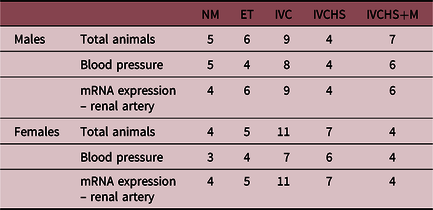
Ewes were randomly selected and grouped into either donor, intermediate, or final recipients. Presumptive zygotes from donor ewes were randomly allocated among treatment groups as follows; either transferred to a synchronized intermediate recipient for 6 days (ET) or cultured in a defined synthetic oviduct fluid medium (SOFM)Reference Tervit, Whittingham and Rowson38 containing 8 mg/ml BSA (Fraction V; Invitrogen Corp, Auckland, New Zealand) and amino acids at sheep oviduct fluid concentrationsReference Walker, Hill, Kleemann and Nancarrow39 (in vitro culture, IVC) and supplemented with 20 % (v:v) human serum (IVCHS) or 20% (v:v) human serum plus 100mM methionine (methyl donor supplementation IVCHS+M). Note that elongation of the embryo begins at day 7 with implantation at day 17 and thus ET must occur no later than day 6. Zygotes (n = 20–25 per well) were cultured in 600 µl of each IVC treatment under 300 µl of mineral oil in four-well culture dishes (Nunc Inc., Naperville, IL, USA) in a humidified atmosphere of 5%CO2:5%O2:90%N2 at 38.6°C until day 6 (day 0 = day of fertilization). Recipient ewes were randomly allocated to ET (n = 11), IVC (n = 20), IVCHS (n = 11), and IVCHS+M (n = 11) treatment groups (Table 1). On day 6, single embryos from the ET, IVC, IVCHS, and IVCHS+M groups were transferred via laparoscopy to synchronized final recipients to produce only singleton pregnancy. The control group consisted of ewes that were naturally mated (NM; n = 9) and carrying singleton fetuses. The ewes lambed spontaneously at term.
Surgery and blood pressure measurements
At 20–23 weeks, lambs underwent surgery to implant catheters in the carotid artery and jugular vein. Sodium thiopentone (Pentothal; Boehringer Ingelheim, North Ryde, NSW, Australia) was used to induce anesthesia prior to the surgery and isoflurane (1.5%–2.5%; Lyppards, Adelaide, SA, Australia) was used to maintain anesthesia. Xylazil (Lyppards, Adelaide, SA, Australia) was administered postoperatively as analgesia. After 3 days of recovery, arterial catheters were connected to pressure transducers and blood pressure was recorded using PowerLab (ADInstruments, Sydney, Australia). The lambs were placed in slings during the blood pressure measurements. They were side by side and facing other lambs approximately 2 m apart. Basal blood pressure was recorded for at least 1 hour prior to bolus injections of phenylephrine (PE) (IV bolus; 4, 8, 16, and 20 µg/kg; Sigma-Aldrich, Australia) via the jugular vein catheter. Systolic blood pressure (SBP) and DBP were calculated as the maximum and minimum pressure, respectively. HR was derived from the blood pressure signal. Mean arterial pressure (MAP) and rate pressure product (RPP) were calculated using the formulae: DBP + (0.4 × (SBP − DBP)) and SBP × HR, respectively.Reference Edwards and McMillen40
Postmortem and tissue collection
Lambs were humanely killed with an overdose of sodium pentobarbitone (Virbac Pty. Ltd., Peakhurst, NSW, Australia) at 24 weeks of age. The left renal artery was dissected and snap frozen in liquid nitrogen and stored at −80°C for subsequent gene expression studies.
Quantification of mRNA transcripts in the renal artery
RNA was extracted from left renal artery samples using TRIzol reagent (Invitrogen, Groningen, the Netherlands) and purified using RNeasy Mini Kit (Qiagen, Basel, Switzerland). The quality and concentration of the RNA were determined by measuring absorbance at 260 and 280 nm and the integrity of the RNA was confirmed by agarose gel electrophoresis. cDNA was synthesized using 1 µg RNA by reverse transcription using SuperScript III with random hexamers (Invitrogen Australia Pty Ltd, Mount Waverley, Victoria, Australia). Negative controls containing no RNA or SuperScript III were used to test for DNA contamination and reagent contamination.
Quantitative real-time RT-PCR
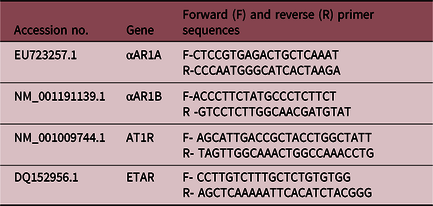
All essential information regarding our procedure is included as per the MIQE guidelines.Reference Bustin, Benes and Garson41 Quantitative real-time reverse transcription-PCR was used to measure the expression of mRNA transcripts of αAR1A, αAR1B, ETAR, and AT1R (Table 3) relative to three housekeeper genes: hypoxanthine phosphoribosyltransferase (HPRT; NM_001034035.1),Reference Wang, Lim, McMillen, Duffield, Brooks and Morrison42 beta-actin (ACTB; U393737),Reference Passmore, Nataatmadja and Fraser43 and peptidylprolyl isomerase A (PPIA; AY251270).Reference Wang, Lim, McMillen, Duffield, Brooks and Morrison42 The housekeeper genes were selected based on their stability across treatment groups using GeNorm,Reference Wang, Lim, McMillen, Duffield, Brooks and Morrison44,Reference Hellemans and Vandesompele45 on a ViiA7 Fast Real-time PCR system (Applied Biosystems, CA, USA). Each amplicon was sequenced to ensure the authenticity of the DNA product, and amplicon homogeneity was determined by dissociation melt curve analysis. Each primer pair previously published or newly designed was validated to generate a single transcript, and was confirmed by the presence of a single double-stranded DNA product of the correct size. Amplification efficiencies were determined from the slope of a plot of cycle threshold (Ct; defined as the Ct with the lowest significant increase in fluorescence) against the log of a series of diluted cDNA concentrations (ranging from 1 to 100 ng/μl). The amplification efficiency slopes for the qRT-PCR assays were between −3.01 and −3.74. Each qRT-PCR reaction well contained 3 µl of Fast SYBR Green Master Mix (Applied Biosystems, California, USA), 0.8 µl H2O, 0.6 µl each of forward and reverse primer (GeneWorks, SA, Australia) for the candidate genes. and 1 µl of diluted relevant cDNA. Three replicates of each cDNA were performed for each gene and Controls containing no cDNA were also used to check reagent contamination for each run. The data were analyzed using DataAssist Software v3.0 (Applied Biosystems) and expressed as mean normalized expression (MNE).Reference Hellemans, Mortier, De Paepe, Speleman and Vandesompele46–Reference McGillick, Orgeig, McMillen and Morrison48
Data analysis
Analysis of basal blood pressure and blood pressure response to PE
Basal values for SBP, DBP, MAP, HR, and RPP were calculated by analyzing the average of every minute for a period of 1 h in the morning between 0800 and 1200. To measure the response to PE, BP, and HR were calculated by averaging 10 s epochs for 1 min after PE injection (4, 8, 16, and 20 µg/kg).
Analysis of baroreflex
The relationship between MAP and HR was analyzed using a logistic sigmoid function using the following formula
HR = P1 + P2/[1 +e PReference Iqbal, Ahmad and Malik3 (MAP-P4)],Reference Ricketts and Head49,Reference Head and McCarty50
where P1 = lower plateau, P2 = HR range, P3 = a curvature coefficient that is independent of range, and P4 = the median blood pressure (BP50, mmHg) at the point halfway between plateaus (LabVIEW, NI, Victoria, Australia). With only bolus doses of PE, we were able to calculate half of the sigmoid curve representing the relationship between MAP and HR and thus the data were mirrored to give the full curve. These sigmoid curves were analyzed for individual animals and the upper plateau, BP50 (set point) was determined in each individual. The maximal gain (G) or slope of the curve that determines the baroreflex sensitivity was calculated using the following formula:
G = −P2 × P3/4.56.Reference Ricketts and Head49,Reference Head and McCarty50
BP50 and maximal gain were averaged within each treatment group and compared between the treatment and control groups.
Statistical analysis
The effect of treatment and sex on lamb birth weight, body weight in adolescence, basal blood pressure, baroreflex function, and gene expression was determined using two-way ANOVA (SPSS 18 for Windows, Statistical Package for Social Scientists Inc., IL, USA). When there was an interaction between the effects of treatment and sex, the effect of treatment was determined in females and males separately using one-way ANOVA. Duncan’s post hoc test was used to determine if there was a significant difference between treatment groups. Data are presented as mean ± SEM. A probability level of 5% (P < 0.05) was taken as significant.
Results
Culture and transfer of embryos did not alter lamb weight at birth or in adolescence
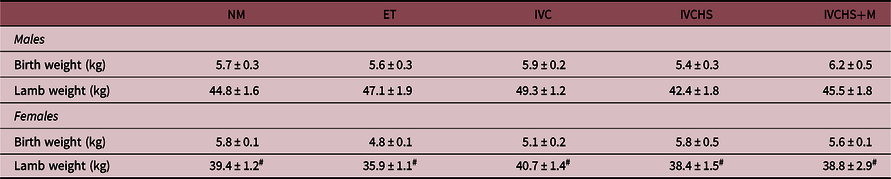
There was no significant difference between the treatment groups or sex on lamb birth weight (Table 2). In adolescence, female lambs had significantly lower body weights than male lambs. There was no effect of ET or culture on the body weight of either male or female adolescent lambs (Table 2).
Number of male and female offsprings in each treatment group

Weight of lambs at birth and in adolescence

Data are presented as mean ±SEM and analyzed by a two-way ANOVA with Duncan’s post hoc test.
* Significant effect of sex within the given treatment group. P < 0.05.
Sequences of oligonucleotide primers used for quantitative real-time RT-PCR

Culture and transfer of embryos did not alter basal blood pressure in any of the treatment groups
There was no significant difference in basal SBP, DBP, MAP, HR, or RPP in lambs at 6 months of age (Fig. 1).
In vitro embryo culture and the transfer does not alter basal blood pressure or heart rate in postnatal life. There was no difference in SBP (a), DBP (b), MAP (c), HR (d). and RPP (e) in in vitro embryo culture without and with human serum and methyl supplementation and transfer groups when compared to the naturally mated group in both males and females.
DBP, diastolic blood pressure; ET, embryo transfer; HR, heart rate; IVC, in vitro embryo culture; IVCHS, in vitro embryo culture with human serum; IVCHS+M, in vitro embryo culture with human serum and methyl donor supplementation; MAP, mean arterial pressure; NM, naturally mated; RPP, rate pressure product; SBP, systolic blood pressure;.

Baroreflex control of HR was maintained in ET and in vitro embryo culture groups
There was no significant difference in the maximal gain coefficient (baroreflex sensitivity) or upper plateau and BP50 (set point) between the treatment groups at 6 months of age (Fig. 2).
Embryo transfer and in vitro embryo culture does not alter the baroreflex function. There was no difference in maximal gain (measure of slopes) between the treatment groups (a), upper plateau (b), and BP 50 (c) also did not differ between treatment groups.
ET, embryo transfer; IVC, in vitro embryo culture; IVCHS, in vitro embryo culture with human serum; IVCHS+M, in vitro embryo culture with human serum and methyl donor supplementation; NM, natural mate.

In vitro culture and transfer of the embryo did not alter the mRNA expression of molecules involved in blood pressure regulation in renal artery
ET and in vitro embryo culture did not alter the mRNA expression αAR1A, αAR1B, AT1R, and ETAR in the renal artery in 6-month-old lambs (Fig. 3).
No difference in gene expression of molecules involved in blood pressure regulation in the renal artery. Embryo transfer and in vitro embryo culture without and with human serum and methyl donor supplementation did not alter the mRNA abundance of αAR1A (a), αAR1B (b), AT-1R (c), and ETAR (d). In renal artery in 6–month-old lambs.
ET, embryo transfer; IVC, in vitro embryo culture; IVCHS, in vitro embryo culture with human serum; IVCHS+M, in vitro embryo culture with human serum and methyl donor supplementation; MNE, mean normalized expression; NM, natural mate.

Discussion
ARTs have been associated with increased risk of cardiovascular diseases such as increased blood pressure and hypertrophic growth of the heart in both humans and animals.Reference Lim51–Reference Padhee, Zhang and Lie53 In this study we found no programmed effect of important steps of ART such as ET and in vitro embryo culture on basal blood pressure or baroreflex function. There was also no difference in the expression of molecules involved in blood pressure regulation in the renal artery.
Impact of embryo culture and transfer on basal blood pressure
Previous studies have shown that children who were conceived through ARTs had higher blood pressure in postnatal life.Reference Ceelen, van Weissenbruch, Vermeiden, van Leeuwen and Delemarre-van de Waal20,Reference Sakka, Loutradis and Kanaka-Gantenbein54 In this study, we found no difference in the basal blood pressure in in vitro embryo culture and transfer groups when compared to the NM control group in 6-month-old (adolescent) lambs. Similarly, maternal nutrient restriction during the periconceptional period did not alter basal blood pressure in 1-year-old lambs.Reference Gardner, Pearce and Dandrea33 However using the same model of periconceptional undernutrition, there was elevated pre-feeding blood pressure in 3-year-old lambs.Reference Gopalakrishnan, Gardner and Rhind35 This suggests that the programmed changes in cardiovascular function due to nutritional manipulation may emerge with age.Reference Gopalakrishnan, Gardner and Rhind35 Thus, we speculate that the adolescent stage of development of the lambs in this study may have been too young to observe programmed changes in blood pressure due to nutritional manipulation during the periconceptional period and that changes to blood pressure and blood pressure regulatory mechanisms may develop later in the life course.
Impact of embryo culture and transfer on baroreflex control of HR
In this study, the baroreflex control was assessed in response to four different bolus doses of PE and it was found that there was no difference in the slope of the curve between MAP and HR suggesting that the baroreflex sensitivity remained unaltered in ET and in vitro embryo culture without and with serum and methyl donor groups in 6-month-old lambs. This is similar to the finding that maternal nutrient restriction during the periconceptional period did not alter baroreflex sensitivity in sheep at 1 year of age.Reference Gardner, Pearce and Dandrea33 However, in this same model of nutrient restriction, blunted baroreflex sensitivity was observed at 3 years.Reference Gopalakrishnan, Gardner and Rhind35 These findings suggest that the programming of baroreflex control is more likely to be observed at later stages of life. We also showed no differences in BP50 (set point) in any of the treatment groups, suggesting that there was no baroreflex resetting due to PE bolus doses. However, lambs exposed to nutrient restriction during the periconceptional period had a shift in the set point to a lower pressure in response to a single bolus dose injection and stepwise infusion of PE at 1 and 3 years after birth, respectively.Reference Gardner, Pearce and Dandrea33 This difference in findings may arise from the different types of nutritional manipulation in these studies, which may have a differential effect on baroreflex resetting. In addition, there was also no difference in the upper plateau in any of the treatment groups. These findings suggest that there was no programmed effect of in vitro embryo culture and transfer on baroreflex control of HR responses to PE in 6-month-old (adolescent) lambs.
Impact of embryo culture and transfer on molecules involved in blood pressure regulation
αARs promote sympathetic vasoconstriction in blood vessels by binding to noradrenaline released from the sympathetic nerve terminals.Reference Thomas55 ETAR can cause vasoconstriction in vessels and the renal vasculature is known to be particularly sensitive to its vasoconstrictive effect.Reference Pernow, Boutier and Franco-Cereceda56–Reference Kohan58 The renin–angiotensin system (RAS) also plays a major role in maintaining blood pressure by activation of AT1R, which binds to angiotensin II and causes constriction of vessels.Reference Thomas55,Reference Billet, Aguilar, Baudry and Clauser59 This leads to an increase in peripheral resistance and blood pressure. In this study, we found no difference in the gene expression of αAR1A, αAR1B, ETAR, and AT1R in the renal artery of 6-month-old lambs in any of the treatment groups. This suggests that ET and in vitro embryo culture has no programmed effect on molecules involved in vasoconstriction in adolescence.
Summary
Herein, we have shown that ET and in vitro embryo culture in the absence of human serum and in the presence of human serum with the addition of a methyl donor has no effect on basal blood pressure and baroreflex control in the adolescent lamb. There was also no difference in the gene expression of molecules involved in blood pressure regulation. The data from this study has provided evidence that there are no effects of ART on blood pressure regulation at a relatively young age (adolescence). However, to understand the long-term impact of ART on blood pressure regulation, more follow-up studies across the life course should be performed to improve our understanding of the mechanistic links between ART and adult cardiovascular health.
Author contributions
MP, ICMcM, SZ, SMM, DOK, SKW, and JLM were responsible for the conception and design of the experiments.
MP, SZ, DOK, JMK, SRR, and JLM were each involved in data acquisition.
MP, SZ, JAA, GH. JRTD, and JLM were involved in analysis and interpretation of the data.
MP, SZ, JA, GH, and JLM drafted the article and all authors contributed to and approved the final version.
Acknowledgments
We are grateful to Stacey Holman and Bang Hoang for their expert assistance during sheep surgery and the conduct of the protocols using the pregnant ewes and lambs in this study. We are also thankful to Robb Muirhead for his help in running quantitative real-time PCR.
Financial support
The animal component of this project was funded by an NHMRC Project Grant (ICMcM and JLM). The molecular analysis component of this project was funded by a South Australian Cardiovascular Research Network Fellowship (CR10A4988). JLM was funded by CR10A4988 and an NHMRC Career Development Fellowship (APP1066916).
Conflicts of interest
The authors have nothing to disclose.