Acute respiratory tract infections (RTIs) represent a cumbersome and pervasive public health problem. In the United States, they culminate in more morbidity and mortality than any other infection.Reference Mizgerd 1 , 2 Published studies indicate that viral etiologies account for 11%–55% of community-acquired pneumonia cases among adults, and mixed viral-bacterial co-infections constitute as many as 39% of pneumonia cases with an identified pathogen, particularly in patients who present later after development of symptoms.Reference De Roux, Marcos and Garcia 3 – Reference Bello, Minchole and Fandos 7
The course of influenza disease ranges from self-limiting respiratory symptoms characterized by cough, headache, fever, and muscle aches in healthy individuals to complications such as bronchitis, acute otitis media, and pneumonia.Reference Harper, Bradley and Englund 8 – Reference Thompson, Shay and Weintraub 10 Serious complications including secondary bacterial infection, acute respiratory distress syndrome, and other organ-system dysfunction can occur in all populations, but particularly in the elderly, young children, patients with co-morbidities, and those who are immunocompromised.Reference Belshe 11 – Reference Oxford 13 As a result, the disease can cause hospital admissions and fatalities among the most susceptible patients. In addition, the economic burden is estimated to be billions of dollars from absenteeism and loss of productivity.Reference Lipatov, Govorkova and Webby 14
The optimal management of viral infections, logically, does not necessitate the use of antibacterial agents, but studies suggest that approximately 50% of antibiotics prescribed in emergency departments (EDs) for acute RTIs are inappropriately administered for non-bacterial infections.Reference Grijalva, Nuorti and Griffin 15 – Reference Xu, Roberts, Sulapas, Martinez, Berk and Baldwin 17 Implementing strategies to aid in appropriate antibiotic use is increasingly paramount due to the rapid rise in bacterial resistance coupled with fewer novel antibiotics under development. Meanwhile, the use of antibiotics can lead to collateral damage such as the development of Clostridium difficile infection (CDI) and antibiotic-related adverse events.Reference Loo, Bourgault and Poirier 18 Empiric antibiotic use for patients presenting with RTIs, however, may be warranted until a diagnosis can be made, particularly for critically ill patients. Implementing antimicrobial stewardship strategies to improve the overall appropriate use of these important drugs has proven to optimize patient care in a cost-effective manner.Reference Dellit, Owens and McGowan 19 – Reference Bartlett and Siola 21
In this study, we sought to describe the frequency of inappropriate antibiotic utilization for influenza patients with no evidence of bacterial infection, to explore its relationship with negative outcomes, and to evaluate the economic impact in terms of cost of treatment versus reimbursement. These data, collectively, can be used to help identify prospective antimicrobial stewardship initiatives related to acute RTI caused by influenza.
METHODS
Study Population and Design
This retrospective, cohort, single-center study was conducted at Hartford Hospital, an 890-bed, tertiary-care, public medical center in Hartford, Connecticut. Eligible patients included adults (≥18 years old) who were admitted during the 2012–2013 and 2013–2014 respiratory flu seasons (October–April) with diagnoses of influenza RTI confirmed by reverse transcriptase-polymerase chain reaction (RT-PCR Xpert Flu, Cepheid, Sunnyvale, CA). Patients were excluded if they had influenza diagnosed by another methodology, had other active viral infections, or had influenza diagnosed at least 48 hours or later after arrival to the ED or direct admission. Patients admitted to an observation unit, discharged directly from the ED, or who had chronic bacterial infections for which they were already receiving antibiotics were also excluded. The study was reviewed and approved by Hartford Hospital’s Institutional Review Board.
Definitions and Study Endpoints
The objective of the study was to define inappropriate antibiotic utilization and the associated consequences. Because it is clinically reasonable to prescribe antibiotics empirically in the setting of suspected RTIs warranting hospital admission, those antibiotics administered early during presentation (first 24 hours) or in the presence of signs (ie, chest x-ray findings, positive culture) suggesting possible bacterial infection were considered appropriate. An a priori definition was developed, therefore, to define inappropriate antibiotic duration (IAD). At our institution, RT-PCR testing is available 24 hours daily, 7 days per week, during the respiratory flu season, typically available within 6 hours of specimen collection. For this study, an additional 24 hours before a provider modified antibiotic therapy was permitted. Therefore, IAD was defined as the receipt of antibiotics for longer than 24 hours after the positive result of influenza RT-PCR was electronically available. This definition was applied only to patients presenting with <72 hours of RTI symptoms (ie, early presenter) and who had no microbiological or radiological evidence of bacterial infection. Patients who presented to the ED with >72 hours of RTI symptoms were a priori assigned to the appropriate antibiotic duration cohort unless respiratory cultures and radiological evidence suggested otherwise. This criterion was used to account for the possibility of a bacterial superinfection in patients who presented later during their syndrome.Reference Joseph, Togawa and Shindo 22 Patients who did not receive any antibiotics were categorized as a separate group. Once these cohorts were established, the primary endpoint was mortality at hospital discharge between the 3 groups. Secondary endpoints included hospital length of stay (LOS), 30-day hospital readmission, total hospital cost, hospital net revenue (defined as total payment received minus total hospital cost), antibiotic adverse events (defined as any major clinical reported adverse events including the development of Clostridium difficile infection [CDI], rash, or non-CDI diarrhea), and a new nosocomial infection (defined as the development and identification of a bacterial infection at any source in a patient at least 72 hours after admission). Time to normalization of fever and white blood cell (WBC) count were assessed to determine the rate of response to treatment.
Data Collection
Data were acquired from patient medical records and included patient demographics (eg, age, gender, race, pertinent comorbidities, eg, diabetes, COPD, malignancy, etc), prior disposition, clinical progression of influenza and history of symptom onset from the ED record, pertinent infection signs (eg, fever, leukocytosis, chest radiogram results, etc), daily temperature and WBC count, antiviral and antibiotic administration records, dates of interest (eg, admission, discharge, ICU stay), discharge disposition, CDI, nosocomial infection, and details of any microbiologic cultures (eg, respiratory, blood, urine, cerebrospinal fluid, or others) or Gram stain results. All economic data (eg, cost, reimbursement, and readmission) were acquired from the hospital accounting database and are presented in US dollars. No inflation of dollars was conducted because the study took place during 2 consecutive respiratory flu seasons.
Statistical Analysis
Descriptive statistics were used to describe the entire population of influenza patients included in the study. All primary and secondary endpoints were compared between the 3 cohorts as follows. For continuous data, analysis of variance was employed to detect significant differences between the groups. For categorical data, a χ2 test for independent samples was used for comparisons. Mortality and LOS were explored further in multivariate models. Variables with P<.20 on univariate analyses for mortality and LOS (based on univariate linear regression) were entered into the multivariate analysis simultaneously. A final model was selected based on the significance of included variables. Multivariate logistic regression was conducted to identify factors contributing to mortality in this population, whereas multiple linear regression was employed to control for confounding variables on LOS. An a priori P<.05 was considered statistically significant. All statistical analyses were performed using Sigma Plot 12 (Systat Software, San Jose, CA).
RESULTS
Patient Demographics and Frequency of Inappropriate Antibiotic Duration
A total of 395 patients were diagnosed with influenza and admitted during the 2 consecutive respiratory flu seasons studied (187 patients in 2012–2013 and 207 patients in 2013–2014). Ultimately, 72 patients were excluded for the following reasons: 25 patients were only admitted to an observation unit; 27 patients had an RT-PCR test ordered later than 48 hours after admission; 16 patients were diagnosed with influenza by a non-PCR based diagnostic method; 3 patients requested that their files be inaccessible; 1 patient had a concomitant viral infection; and 1 patient had chronic bacterial osteomyelitis. Thus, 322 patients met all inclusion criteria.
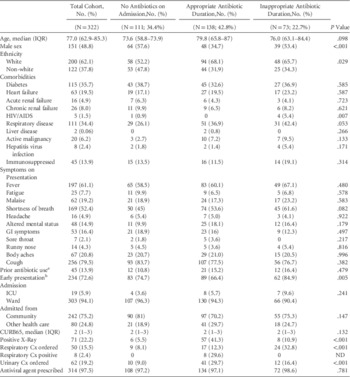
Demographics and characteristics for the entire cohort are provided in Table 1; these data are further separated by no antibiotics on admission versus appropriate duration versus IAD. Overall, patients were typically older, with at least 1 comorbidity, and presented to the ED from the community within 72 hours of initial symptom onset. The most common RTI symptoms on presentation to the ED included cough (256 patients; 79.5%), fever (197 patients; 61.1%), shortness of breath (169 patients; 52.5%), myalgia (67 patients; 20.8%), gastrointestinal symptoms (53 patients; 16.4%), and altered mental status (48 patients; 14.9%).
Baseline Characteristics of Study Population Groups Classified as No Antibiotics on Admission Versus Appropriate Antibiotic Duration Versus Inappropriate Antibiotic Duration (IAD).

NOTE. All data are presented as number (%), unless otherwise indicated. IQR, interquartile range (25th–75th percentiles).
ND, not done; Cx, culture.
a Antibiotic use within the past 7 days prior to admission.
b Presentation within 3 days of symptom onset.
Of the 322 study participants, 211 (65.5%) were prescribed an antibiotic empirically on admission. According to our definition, 73 patients (34.5%) on antibiotics were classified as receiving IAD. We observed subtle differences between patients treated with IAD, patients treated with adequate antibiotic duration, and patients treated without antibiotics, although many of these comparisons did not reach statistical significance (Table 1). Notably, patients not receiving antibiotics tended to be younger, male, had less prior respiratory disease at baseline and were less likely to be admitted from another healthcare setting. In contrast, more IAD patients had HIV/AIDs (n=4), fever, and shortness of breath.
The majority of patients (314; 97.5%) were prescribed antiviral treatment. Diagnostic x-rays were ordered for 319 patients (99%), and 71 patients (22%) had radiologic findings suggestive of pneumonia. Respiratory cultures were ordered for 50 patients (15.5%), and pathogenic bacteria were isolated for 8 of these patients (2.4%). More patients (32.8%) in the IAD group had cultures ordered, but none were positive. Blood cultures were ordered for 262 patients (81.4%); none were positive. Finally, urine cultures were ordered for 67 patients (20.8%), and pathogenic bacteria isolates were identified for 19 patients (5.9%). All patients with positive respiratory and urine cultures received antibiotics accordingly and were included in the appropriate antibiotic duration group.
Antibiotic Duration
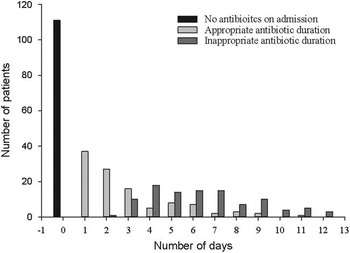
Patients in the IAD group received antibiotics for significantly longer (median, 6 days; interquartile range [IQR], 4–8 days) compared with the appropriate duration group (median, 3 days; IQR, 1–5 days; P<.001). Figure 1 depicts the frequency of patients receiving antibiotics for specified durations in days. Notably, few patients received antibiotics longer than 7 days.
Number of patients treated with antibiotics per number of days in appropriate antibiotic duration versus inappropriate antibiotic duration groups.

Mortality and Time to Clinical Resolution
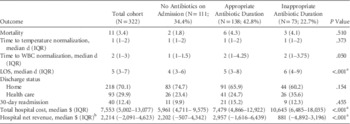
Results for primary and secondary study endpoints are provided in Table 2. Overall mortality was low among these patients (3.4%); no differences were observed between the no antibiotics group, the appropriate duration antibiotics group, and the IAD group. Multiple logistic regression identified only older age (odds ratio, 1.1; 95% CI, 1.1–1.2; P=.01) and ICU admission (odds ratio, 10.9; 95% CI, 2.3–52.1; P=.003) as being significantly associated with mortality. No difference in time to temperature normalization was observed; most patients became afebrile within 1–2 days of admission. The WBC counts of patients not receiving normalized 1 day sooner than those of patients who received antibiotics (P=.05).
Clinical and Economic Outcomes by No Antibiotics on Admission Versus Appropriate Antibiotic Duration Versus Inappropriate Antibiotic Duration

NOTE. All data are presented as number (%), unless otherwise indicated.
LOS, length of stay; IQR, inter-quartile range (25th–75th percentile); SNF, skilled nursing facility; WBC, white blood cell count.
a Inappropriate antibiotic duration (IAD) group was significantly different from the other groups.
b Hospital net revenue=gross payments received − total hospital cost.
Length of Stay, Cost, and Adverse Reactions
Patients treated with IAD had significantly longer LOS and total hospital costs (Table 2). No differences were observed in discharge location or 30-day readmission. Subtracting total cost from reimbursement, hospital net revenue was a median of $2,202 for patients who had no antibiotics on admission; $2,957 for those given antibiotics for an appropriate antibiotic duration; and $881 for those treated with IAD. Based on median estimates, the hospital lost approximately $2,076 in opportunity costs per IAD patient. While controlling for comorbidities, ICU admission, and admission from a healthcare setting, multivariate regression indicated IAD to be significantly associated with LOS (P<.001).
The occurrence of Clostridium difficile infection (1 IAD patient; 0.03%), new nosocomial infection (6 IAD patients; 1.8%), and antibiotic-related side effects (12 IAD patients; 3.7%) were infrequent and insufficient for the detection of differences between the study cohorts.
DISCUSSION
Antibiotic stewardship may soon be a Condition of Participation for US hospitals in the Centers for Medicare and Medicaid Services (CMS) payment program. 23 While many stewardship interventions focus on antimicrobial utilization in the inpatient setting, addressing inappropriate therapy that begins in the ED is currently needed. Influenza RTIs are infections for which antibiotic therapy clearly provides no value; however, our data from a single center reveal antibiotic treatment of 65.5% of patients who were admitted. Furthermore, we observed that antibiotics at our center were continued for an inappropriate duration in 34.5% of influenza patients receiving antibiotics, even in the absence of any clinical signs or diagnostic results suggesting bacterial infection. Patients receiving antibiotics for an inappropriate duration (IAD group) had significantly longer hospital LOS, higher hospital costs, and as a result, lower net revenue for the institution.
Our observations of antibiotic treatment of 65.5% of patients with influenza RTI are consistent with other reports.Reference Grijalva, Nuorti and Griffin 15 – Reference Xu, Roberts, Sulapas, Martinez, Berk and Baldwin 17 Jeong et alReference Jeong, Heo, Park and Kim 24 determined the rate of antibiotic prescriptions in patients presenting to their ED with influenza-like illness before and after implementation of an influenza virus rapid-antigen test. Antibiotics were used to treat 43.9% of these patients before the implementation of RT-PCR testing; this rate was reduced to 25% after this intervention. Notably, their study excluded patients admitted to the hospital from the ED, who presumably would have higher rates of antibiotic treatment. A study by Linder et alReference Linder, Bates and Platt 25 assessed antibiotic utilization in US ambulatory clinics and EDs over a 7-year period. They observed inappropriate antibiotic prescriptions in 26% of visits. Notably, although 65.5% of our influenza patients received antibiotics on admission to the hospital, two-thirds of these patients had their antibiotics discontinued early or appropriately continued based on positive cultures, radiology, or late presentation. The remaining 34.5% of these patients had antibiotics continued without the presence of strong data to suspect a bacterial co-infection. This latter observation is unique in the medical literature and indicates a targeted opportunity for antibiotic stewardship intervention.
In our study, the extension of antibiotic administration for an inappropriate duration neither improved clinical outcomes nor made the patients less likely to return to the hospital within 30 days. These patients also appeared to respond to overall treatment (based on temperature resolution and WBC count normalization) in a similar time period compared with patients treated with an appropriate antibiotic duration. Patients had similar CURB-65 scores on admission, suggesting similar severity of illness. Only older age and ICU admission were associated with mortality. Adverse events and collateral consequences of antibiotic therapy, including the development of CDI or multidrug-resistant superinfections, were uncommon in all groups; nonetheless, the single CDI case observed occurred in the IAD group. Furthermore, patients receiving prolonged antibiotics inappropriately received no identifiable benefits and only potential negatives, including increased LOS and hospital costs. For IAD patients, LOS was increased by 1 day and median hospital costs were approximately $2,500 higher, while net revenue to the institution was significantly lower for these patients. This difference represents lost opportunity costs associated with prescribing antibiotics for an inappropriate duration in this population and provides a valuable statistic to help justify antimicrobial stewardship support within an institution.
Our observations highlight the need not only for testing systems that aid in influenza diagnosis but also for testing systems that can assist in ruling out bacterial coinfection. Notably, respiratory cultures were ordered for only 15.5% of patients included in our study. Furthermore, respiratory cultures were collected from only 47% of patients admitted directly to the ICU. In contrast, blood cultures were ordered for 81.4% of patients, and none were positive. These differences are likely due to the ease of collecting blood for cultures over that of respiratory tract specimens. Current guidelines by the Infectious Diseases Society of America and American Thoracic Society for treatment of community-acquired pneumonia discuss the role of respiratory cultures in the diagnosis of bacterial pneumonia.Reference Mandell, Wunderink and Anzueto 26 Sputum cultures are recommended in certain special populations and only for patients who can provide quality specimens (eg, those with productive cough). Notably, these guidelines were written with the intent of determining the most likely cause of community-acquired pneumonia to provide directed antibiotic treatment but without considering a need to rule out bacterial infection. Indeed, the specificity for RTIs caused by Streptococcus pneumoniae and Hemophilus influenzae were 93.8% and 100%, respectively, in 1 study.Reference Miyashita, Shimizu and Ouchi 27 Although the retrospective medical records used in this study did not consistently indicate whether a patient’s cough produced sputum, cough was the most common influenza symptom present in our patients (ie, 79.5%), suggesting an opportunity for sputum collection to rule out bacterial coinfection. A recent prospective surveillance study in 5 US hospitals found that 41% of patients had a cough and produced sputum for culture.Reference Jain, Self and Wunderink 28 Reconsideration of the value of sputum cultures could be a viable and easy addition to antimicrobial stewardship interventions in the ED; currently, we are implementing a more formal protocol for collection of sputum for culture with the assistance of respiratory therapists.
While the availability of influenza rapid diagnostic testing decreases the rate of antibiotic prescriptions, these data suggest that RT-PCR alone may not be sufficient and that other diagnostic tools should be considered to further reduce the inappropriate use and continuation of antibiotics. For example, the use of procalcitonin as a diagnostic biomarker has been described abundantly in the literature.Reference Schuetz, Christ-Crain and Thomann 29 – Reference Lindstrom and Wong 32 A prospective cohort study found that procalcitonin levels were significantly elevated in patients admitted with bacterial pneumonia compared with patients infected with H1N1 influenza; the negative predictive value was 82%.Reference Pfister, Kochanek and Leygeber 30 In the setting of inpatient RTI, protocolized antibiotic therapy guided by procalcitonin concentrations produced a 34.8% reduction in antibiotic duration with no significant difference in the overall rate of adverse outcomes.Reference Schuetz, Christ-Crain and Thomann 29
Our study has several limitations. First, this study was retrospective and took place at a single center in the northeastern United States. Thus, our observation may not be generalizable to other institutions. Nonetheless, we encourage other antimicrobial stewardship programs to add the prevention of inappropriate antibiotic continuation in influenza-positive patients to their lists of intervention strategies. Second, we presumed that respiratory culture rates might be low; therefore, we developed an a priori definition for inappropriate antibiotic duration. This definition considered antibiotic use in patients with chest radiograph findings alone as appropriate. We also grouped all patients presenting with self-reported symptoms of a duration >72 hours (ie, late presenters) into the appropriate antibiotic group due to higher risks of bacterial co-infection.Reference Joseph, Togawa and Shindo 22 We believe our definition is conservative and that some of these patients would not have had bacterial pathogens identified upon additional diagnostic testing and therefore would not have required antibiotic therapy. Thus, our result indicating 34.5% inappropriate antibiotic treatment duration is likely an underestimate.
In conclusion, antibiotic treatment was observed in 65.5% of patients admitted with influenza and was inappropriately continued in 34.5% of patients with no evidence of bacterial co-infection. Inappropriate antibiotic duration did not improve clinical outcomes but was associated with increased length of stay, higher costs, and reduced net revenue for the hospital. Antibiotic stewardship interventions aimed at improving diagnostics to rule out bacterial pathogens should be explored in an effort to reduce inappropriate antibiotic duration.
ACKNOWLEDGMENTS
We acknowledge Arlinda Carr and Gilbert Fortunato for assistance with data collection.
Financial support: This work was supported by a research grant from Hartford Hospital (grant no. HHC 2104-1051).
Potential conflicts of interest: All of the authors are employees of Hartford Hospital.