Introduction
Studies of the early Permian fauna, flora, and geology of Texas date to the origins of vertebrate paleontology in North America. Some of the earliest discoveries were made in the mid-nineteenth century by B.F. Shumard, the state geologist (e.g., Shumard, Reference Shumard1858, Reference Shumard1859). Extensive collection and study of the vertebrate fauna was primarily undertaken in the late nineteenth century and into the twentieth century by classic paleontologists such as Cope, Williston, Case, and Olson and resulted in a significant expansion of the knowledge of the early Permian landscape with the discovery of many of the iconic taxa that typify the time period, such as Eryops Cope, Reference Cope1877b, Diplocaulus Cope, Reference Cope1877a, Trimerorhachis Cope, Reference Cope1878, and Dimetrodon Cope, Reference Cope1878 (Cope, Reference Cope1877b, Reference Cope1878). Even with exploration expanding into the southwest (e.g., New Mexico) and other areas of the midcontinent of North America (e.g., Oklahoma) from the mid-twentieth century to the present day, the described vertebrate fauna from Texas remains among the best characterized and the most diverse of early Permian assemblages. Many vertebrate taxa are known from the Clear Fork Group (Leonardian) of Texas, which has traditionally comprised three formations (from oldest to youngest): the Arroyo, the Vale, and the Choza (e.g., Lucas, Reference Lucas2006; Nelson et al., Reference Nelson, Hook and Chaney2013, but see Hentz, Reference Hentz1988 for a different model). Of these, the Arroyo Formation was the first to produce vertebrate material (dating back to work in the nineteenth century by Cope) and has been extensively explored and studied, resulting in the most diverse vertebrate assemblage of the three formations (e.g., Olson, Reference Olson1989, table 1). By contrast, material from the Vale and Choza formations was not reported until the mid-twentieth century (Olson, Reference Olson1948, Reference Olson1951c). Although these vertebrate assemblages contain significant overlap with the Arroyo assemblage at higher taxonomic levels, the documented taxonomic diversity is notably reduced.
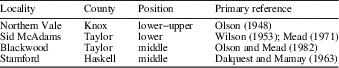
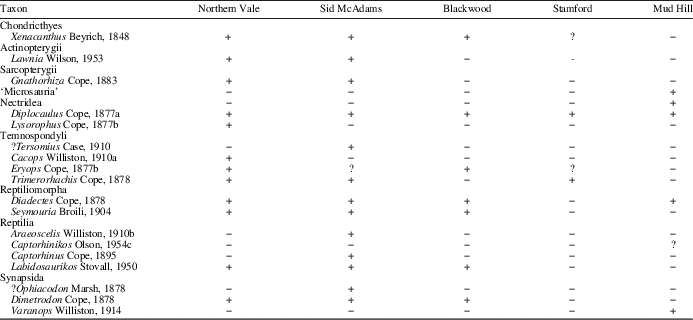
Four relatively fossiliferous localities within the Vale Formation of Texas have been previously described (Table 1). The geology and faunal assemblage of the Vale Formation was first described in detail by Olson (Reference Olson1948) based on a locality near Vera (Knox County), often referred to as the ‘northern Vale’ by the author, and was later expanded on in a number of separate articles that included fauna of the Choza Formation (Olson, Reference Olson1951b, Reference Olsonc, Reference Olson1952a, Reference Olsonb, Reference Olson1954a−Reference Olsonc, Reference Olson1955, Reference Olson1956a−Reference Olsonc, Reference Olson1958). Although Olson (Reference Olson1948, p. 186) indicated that workers had been previously unable to recover vertebrate material from post-Arroyo sediments of the Clear Fork Group, this was in error. The earliest reported collection of significant vertebrate material from the Vale Formation was from 1939−1940 on the land of C.O. Patterson near Lawn (Taylor County) under the direction of a Works Projects Administration (WPA) excavation led by the University of Texas, Austin; this material was first noted in an abstract by Wilson (Reference Wilson1948) but was not fully reported until 1953 by the same author, who limited the bulk of the description to a new paleoniscoid taxon, Lawnia Wilson, Reference Wilson1953. Wilson noted the co-occurrence of well-known early Permian tetrapods (Trimerorhachis, Diplocaulus, Seymouria Broili, Reference Broili1904 , Dimetrodon) but stated that this material did not contribute novel information regarding these taxa (Wilson, Reference Wilson1953, p. 456) and thus did not describe, discuss, or figure any of this material. The locality’s tetrapod fauna, which includes an unusually dense assemblage of Dimetrodon specimens, was redescribed in an unpublished master’s thesis (Mead, Reference Mead1971) that was incorporated into a summary of comparative Vale paleontology by Olson and Mead (Reference Olson and Mead1982). Material of T. insignis Cope, Reference Cope1878 was collected from the same property but from a slightly younger horizon within the Vale Formation and was described by Olson (Reference Olson1979a). A large, nearly monotaxic assemblage of Diplocaulus was described by Dalquest and Mamay (Reference Dalquest and Mamay1963) from the property of V.B. Rowland near Stamford (Jones County). Additionally, a new locality on the property of L.A. Blackwood near Buffalo Gap (Taylor County) was discovered in 1970 by David Berman and was described by Olson and Mead (Reference Olson and Mead1982). Brief lithological notes and faunal lists of less productive localities from the lower Vale (Baylor County) and the middle to upper Vale (Knox County) formation were compiled by Olson (Reference Olson1958). Since then, no new vertebrate localities have been reported, and general work on the tetrapod taxa has been extremely limited (e.g., Hunt and Lucas, Reference Hunt and Lucas2005; Lucas and Hunt, Reference Lucas and Hunt2005; Modesto et al., Reference Modesto, Lamb and Reisz2014). The ambiguity associated with some localities within the Clear Fork Group, particularly the Cacops Bone Bed from which the dissorophid Cacops aspidephorus Williston, Reference Williston1910a, the caseid Casea broilii Williston, Reference Williston1910b, and the varanopid Varanops brevirostris Williston, Reference Williston1914 are known, and which occurs at either the top of the Arroyo Formation or at the bottom of the Vale Formation (Olson, Reference Olson1989), suggests that material from the latter might have been collected prior to the WPA project, but none is confidently or explicitly referred to in the literature.
Major previously described early Permian vertebrate localities within the Vale Formation of Texas. The northern Vale localities described by Olson (Reference Olson1948) pertain to numerous sites spanning the entire stratigraphic section of the Vale.

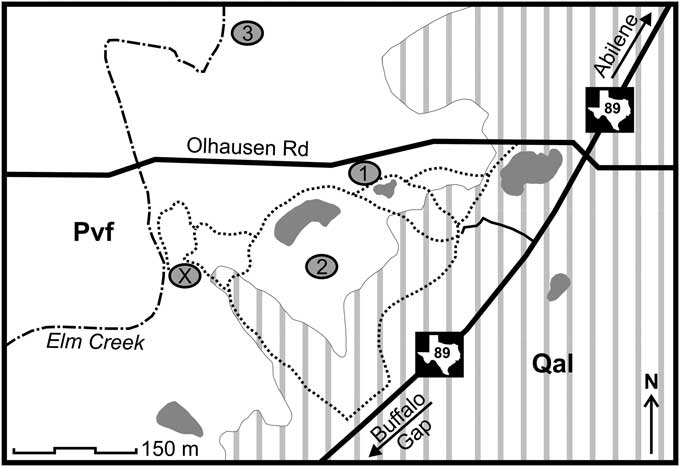
Here we describe the faunal assemblage of a vertebrate-bearing locality (Mud Hill) from the Olhausen Estate near Abilene, Texas (Taylor County) that occurs within the lower to middle Vale Formation (Figs. 1, 2). The locality is ~30 km north of the Patterson locality described by Wilson (Reference Wilson1953). This site has been previously referenced in the locality details of two publications regarding a nearly complete varanopid (e.g., Reisz and Tsuji, Reference Reisz and Tsuji2006; Campione and Reisz, Reference Campione and Reisz2010) but has never been formally presented with an overview of the geology and the broader vertebrate assemblage. The assemblage includes some of the common early Permian forms (e.g., Diplocaulus) but is most notable for the absence of typical early Permian taxa (e.g., Dimetrodon, temnospondyls), for the presence of rare clades (e.g., diadectids, Varanops), and for the sole occurrence of some clades (e.g., recumbirostrans) within the Vale Formation. This unusual taxonomic composition and various aspects of the depositional environment, such as the articulation of much of the varanopid skeleton and the rarity of fully aquatic taxa commonly found in early Permian floodplain deposits, suggest in-situ preservation in an ephemeral aquatic setting. The description of this unusual assemblage contributes additional data regarding the Vale Formation, which is less well-characterized than the older Arroyo Formation, provides new insights regarding the paleobiology and the evolutionary history of forms that were previously rare or unknown from the formation, and permits the updating of the faunal list for the entire Vale Formation for the first time in 35 years.
Mud Hill locality map. 1, 2, 3=dig sites D1, D2, and D3; dotted lines=trails; unshaded area=exposure of the underlying Permian Vale Formation (Pvf); vertical striped area=Quaternary alluvium deposits (Qal); X=measured section site.

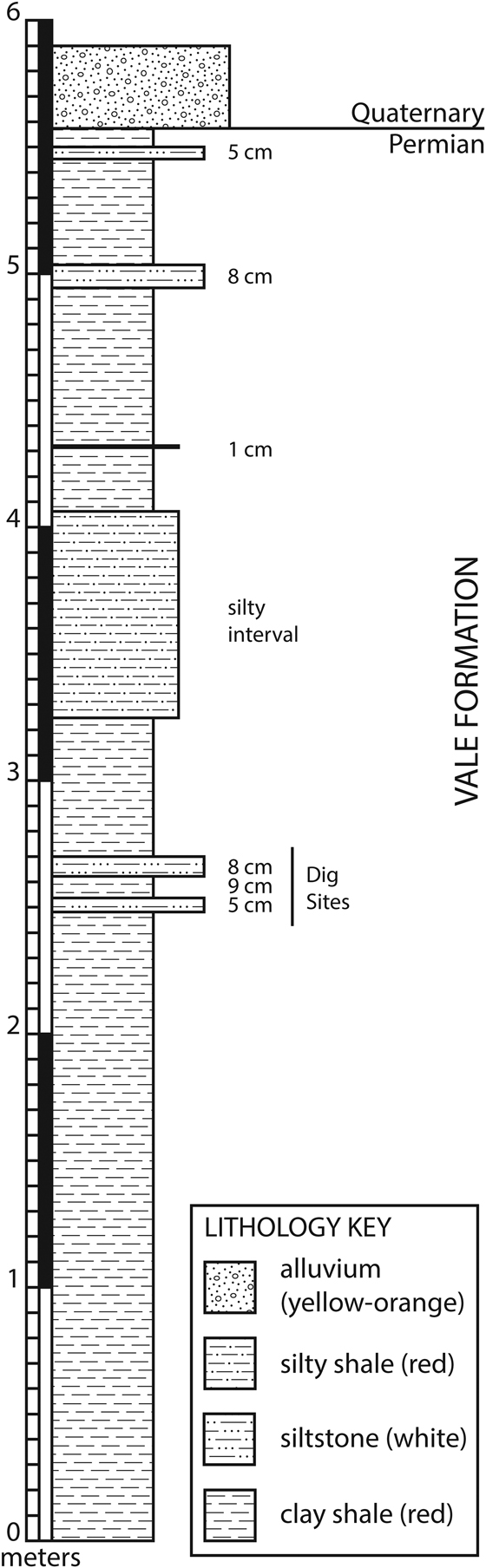
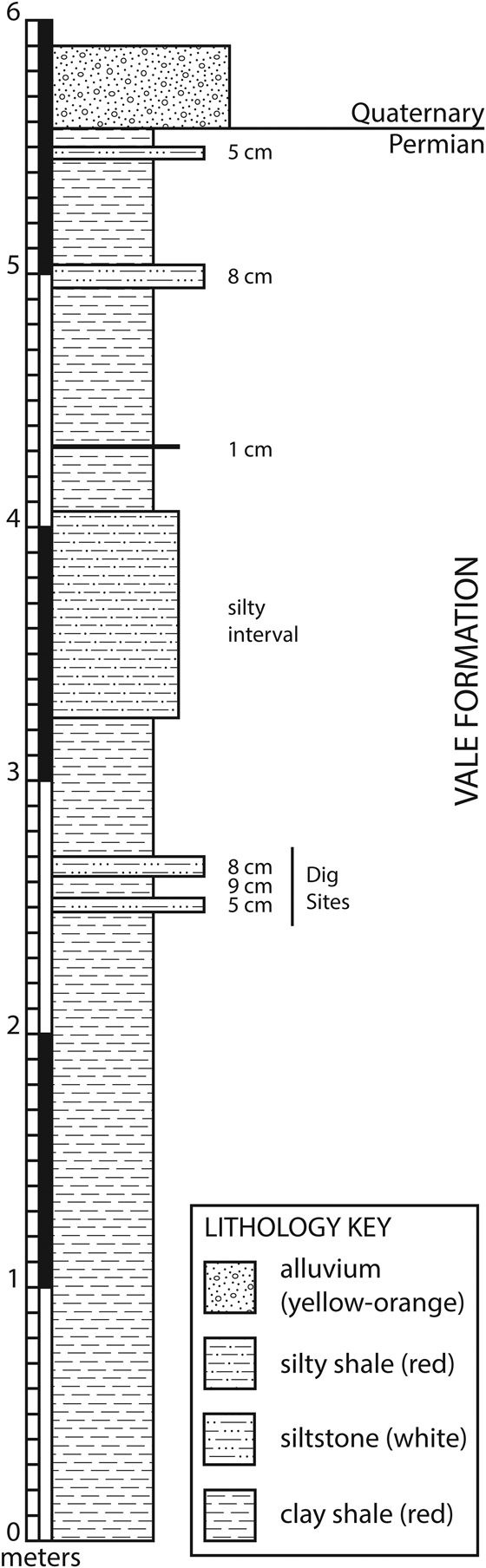
Measured section of the Vale Formation exposed along Elm Creek at the Mud Hill locality.
Geologic setting
The Vale Formation is early Permian (Leonardian) in age and is exposed along a roughly northerly trend through central Taylor County, Texas. In southern Taylor County, the Vale is truncated by a major unconformity that separates Permian strata from the Cretaceous strata of the Callahan Divide. The Callahan Divide (trending west to east) is composed of the Antlers Sandstone at its base and is capped by the Edwards Limestone. A deposit of alluvium (Quaternary) extends to the north, from the Callahan Divide, and was laid down directly on the underlying Permian Strata by northward flowing streams. The alluvium thins to the north, and in many areas has been eroded away. In western Taylor County, the Vale Formation is overlain by the Choza Formation, which in turn is truncated by the same unconformity that truncated the Vale Formation to the east. In eastern Taylor County, the underlying Arroyo Formation is exposed where it has been truncated by the unconformity.
The Vale Formation is exposed in road cuts, streams, and along many hillsides in the exposure area. Although the bulk of the Vale Formation could be considered monotonous red shale, there is some diversity in its deposits, especially south of the Mud Hill locality (described below). A small channel deposit composed of fine to medium plane-bedded quartz sand is found in one such exposure. The bounding shales at this locality have been known to produce fragmented plant impressions. A more productive fossil plant locality is found further to the west and has been known to produce several different plant species and trace fossils. Throughout the Vale exposure region, hematite nodules are commonly recovered after being weathered out of exposed shale deposits.
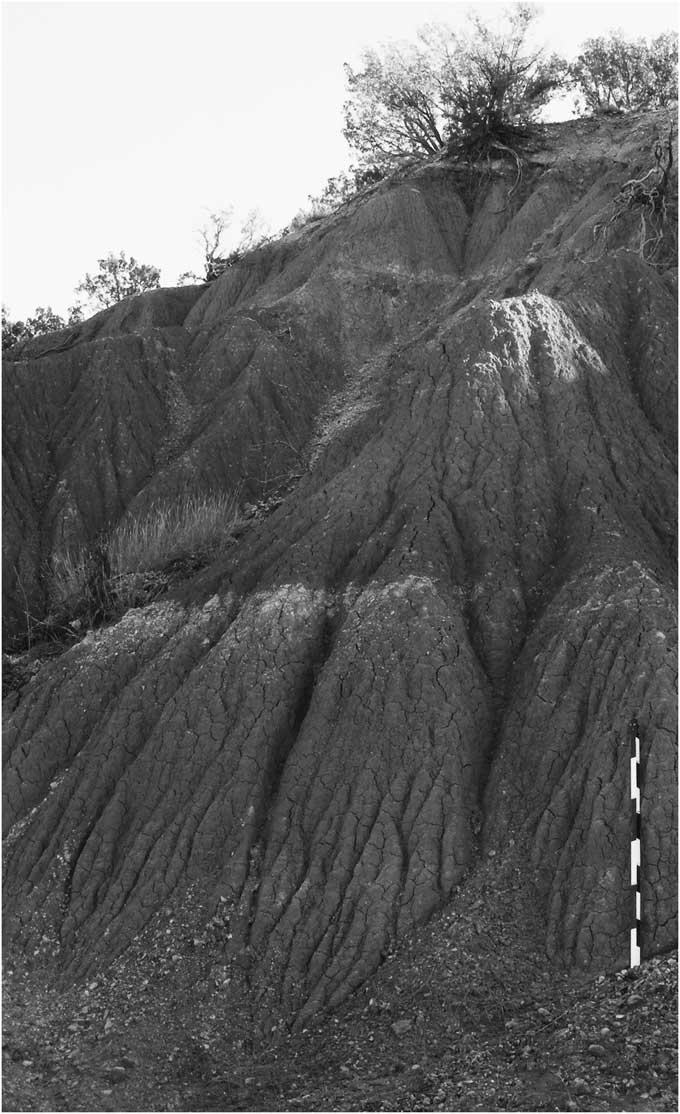
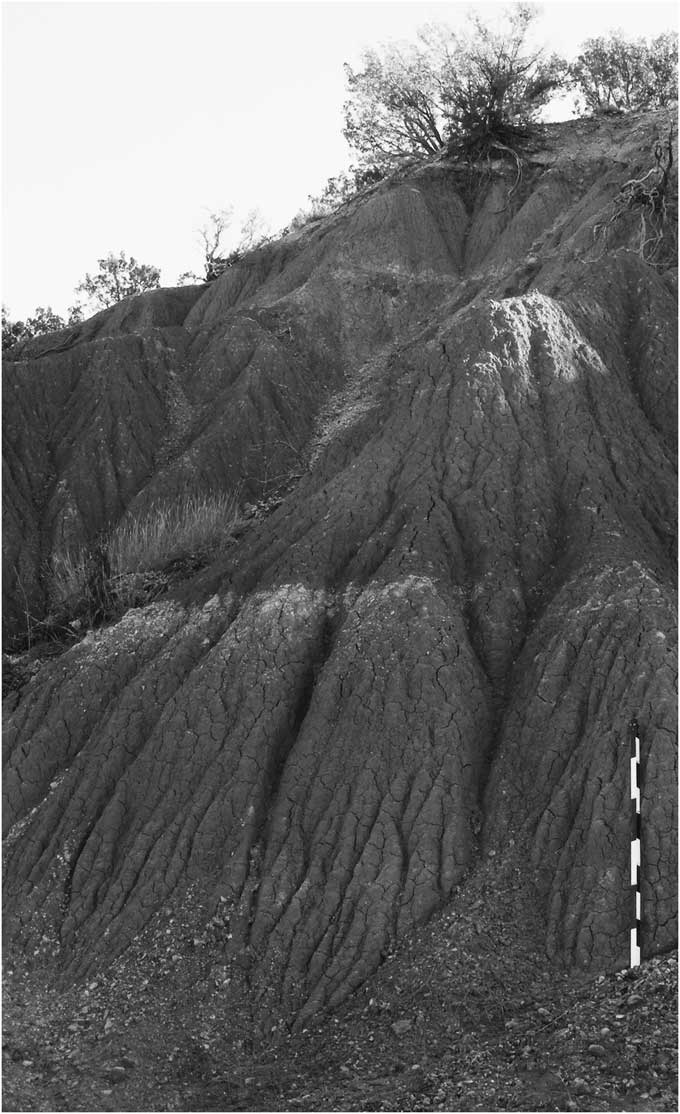
At the Mud Hill locality (Fig. 1), between six and eight meters of the Vale Formation are exposed along intermittent creeks and are capped by a half meter of alluvium (Figs. 2, 3). There are two lithofacies evident in the Vale at this locality. The dominant lithofacies is the red shale facies (Fig. S1.1). The shale is predominantly clay but can contain up to 3% very fine sand. The sandy constituent is dominated by iron-stained, translucent to transparent, subrounded quartz. Hematite and orthoclase account for less than 5% of the sand-sized grains. The siltstone-sandstone facies (Fig. S1.2) appears as distinctive white to light gray thin horizons within the shale. Grain-size varies substantially from horizon to horizon, ranging from dominantly silt to over 50% very fine to fine sands. The dominant subrounded to subangular quartz, along with minor amounts of subangular to angular hematite and orthoclase, is well cemented by calcite. The top of the siltstone-sandstone facies is associated with intermittent red caliche nodules (Fig. S1.3). The nodules are mostly calcite with up to ~25% silt and sand. Poorly preserved root traces and potential burrow fills are common and give the caliche nodules a ‘vuggy’ appearance. Frosted quartz grains dominate in the sand fraction with minor amounts of orthoclase and lithic fragments.
Site of the Elm Creek measured section at the Mud Hill locality. Photographic scale with 0.5-m divisions (left front) shown at lower right.
The alluvium that caps the Vale Formation at the Mud Hill locality is composed of Cretaceous material removed from the Callahan Divide, south of the locality. Clasts of conglomerates, sandstones, and limestones along with a diverse marine fossil assemblage are found in a matrix of loosely cemented quartz sand. The sands and conglomerates originate from the Antlers Sandstone, whereas the limestone and marine fossils are derived from the Edwards Limestone. The marine fossils are commonly fragmented and are representative of the molluscan dominated assemblage found in the Edwards Limestone.
Material at the Mud Hill locality was collected from several sites (Figs. 1, 3):
D1: vertebrate collection site in a bank northeast of an excavation for dam construction, north of a small water tank, south of Olhausen Road (32.335881°N, −99.799503°W); D2: vertebrate collection site in a bank south of a large tank, south of Olhausen Road (32.334817°N, −99.800989°W), which can be covered by an adjacent water tank in extremely wet weather; and D3: vertebrate collection site on a hillside exposure, north of Olhausen Road (32.337454°N, −99.801463°W). The D3 site is on private property that is not associated with the Olhausen Estates; collections were made under a private agreement with the landowner.
Materials and methods
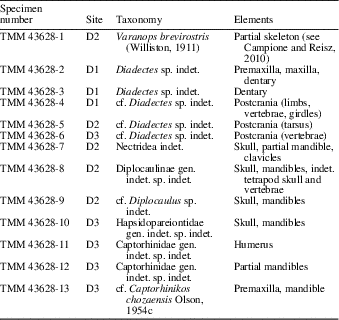
All materials (Table 2) come from the Mud Hill locality on the Olhausen Estate near Abilene, Texas (Figs. 1–3, S1). An isolated diadectid centrum was collected from the estate by JO in the early 1970s, but the first bonebed site (D1) was not discovered until 1997 by Jacob and James Olhausen. The D2 site was found in 1998 by Robert Burt, and the D3 site was found in 2007 by Dale Ostlien. All three sites were periodically explored and partially excavated following their initial discovery. Because the sites were not excavated in a systematic fashion and without a quarry map, materials that are presently disarticulated could in fact have been associated at some point (e.g., right and left partial captorhinid mandibles).
Specimens from Mud Hill described herein, with site of recovery, taxonomic identification, and recovered material.

Initial excavation, sorting, and preparation of some of the material was conducted by the family at the estate, primarily Jo Helen Cox, following collection; upon loan of the material to RRR, preparation of specimens in a formal laboratory was conducted with pin vises and air scribes by students at the University of Toronto Mississauga under the supervision of DS. Specimen photographs were taken by DS with a Canon EOS 40D digital SLR camera and a Leica DVM6 tilting microscope with Leica Application Suite X (LAS X) software; figures were compiled using Adobe Photoshop and Illustrator CS6.
Repositories and institutional abbreviations
All specimens are deposited in the Texas Memorial Museum (TMM) in Austin, Texas, USA. Other institutions referenced in the text are: CNHM-UR=Chicago Natural History Museum (Field Museum of Natural History), Chicago, Illinois; UCLA VP=University of California Los Angeles, Vertebrate Paleontology, Los Angeles, California; USNM=United States National Museum (now National Museum of Natural History, Smithsonian Institution), Washington, DC.
Systematic Paleontology
Superclass Tetrapoda Goodrich, Reference Goodrich1930
Tetrapoda indet. and Diplocaulinae gen. indet. sp. indet.
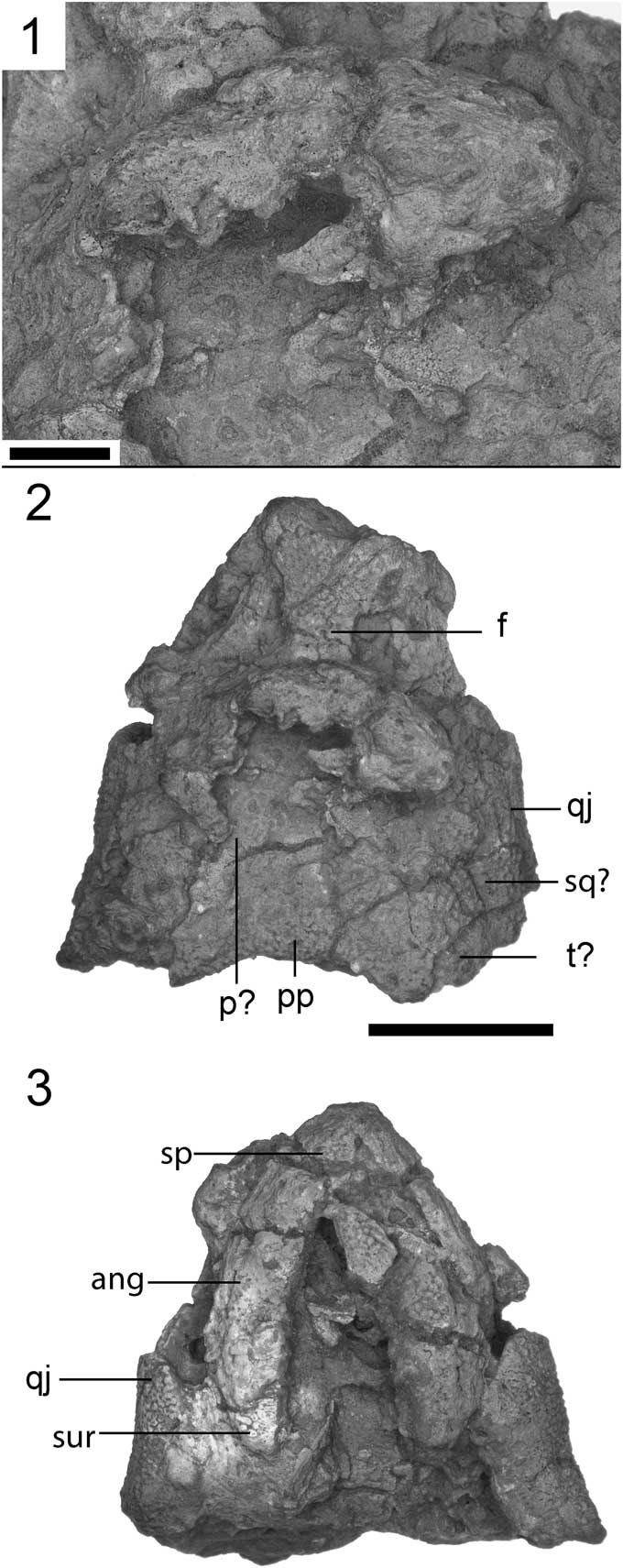
Tetrapoda indet. and Diplocaulinae gen. indet. sp. indet., a juvenile diplocauline with an indeterminate tetrapod on the dorsal skull roof (TMM 43628-8): (1) close-up of the indeterminate tetrapod; (2) dorsal profile of the diplocauline; (3) ventral profile of the diplocauline. ang, angular; f, frontal; p, parietal; pp, postparietal; qj, quadratojugal; sp, splenial; sq, squamosal; sur, surangular; t, tabular. Scale bars=2.5 mm (1); 1 cm (2, 3).

Description
This intriguing, although unfortunately poorly preserved, specimen is a diminutive partial skeleton of a tetrapod cemented to the skull roof of a diplocauline (TMM 43628-8) noted below from the D2 site (Fig. 4.2, 4.3). The general contours of an elongate, rounded skull with a posterolateral projection on the right side can be made out, but the small size of the specimen in conjunction with weathering and encrusting obscures all other details. A series of vaguely vertebrae-appearing elements is associated with the skull and extends posteriorly to the margin of the diplocaulid skull, but as with the former, no details can be resolved that would further inform the identification.
Subclass Lepospondyli Zittel, Reference Zittel1888
Order Nectridea Miall, Reference Miall1875
Nectridea indet.
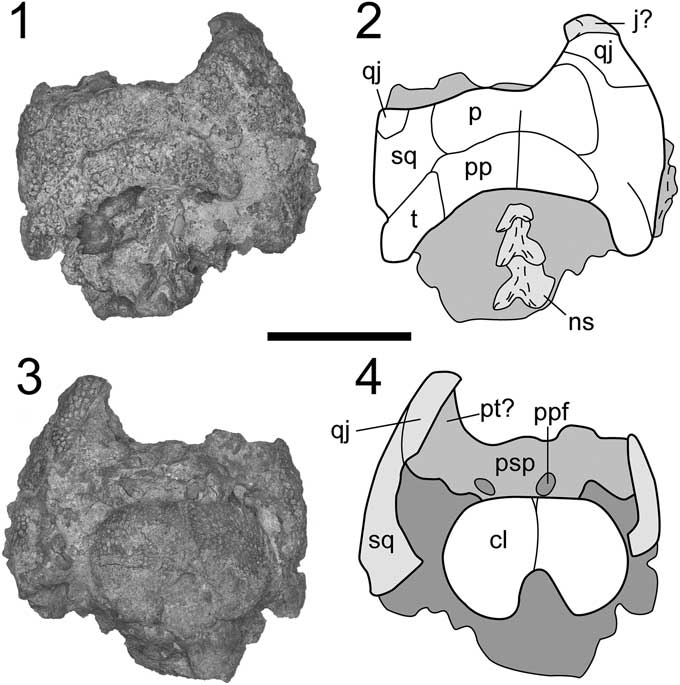
Nectridea indet. (TMM 43628-7): (1) photograph in dorsal profile; (2) illustration of Figure 5.1; (3) photograph in ventral profile; (4) illustration of Figure 5.3. cl, clavicle; j, jugal; ns, neural spine; p, parietal; pp, postparietal; ppf, postpterygoid fossa; psp, parasphenoid; pt, pterygoid; qj, quadratojugal; sq, squamosal; t, tabular. Scale bar=1 cm.

Description
This specimen (TMM 43628-7) comprises the postorbital margin of a nectridean, with the fragment being roughly symmetrical, but with better preservation of the elements on the left side of the skull; it was collected from the D2 site. It is broken off anterior to the pineal foramen, and the parietals and squamosals are incomplete (Fig. 5.1, 5.2). Of the three nectridean specimens, the sutural contacts can be most readily defined in this specimen and are comparable to both those of a referred specimen of Diplocaulus sp. from this locality (below) and to previously described immature specimens of the genus (Olson, Reference Olson1951a). The postparietals are transversely elongate rectangles, as in nectrideans with broader skulls. The quadratojugal has both dorsal and ventral exposures in association with the dorsoventral compression of the skull in diplocaulines. The tabular horns are incompletely developed but extend posteriorly and slightly laterally. The posterior margin of the skull forms a smooth concave curve, typical of diplocaulines in comparison to the squared-off margin of other nectrideans such as Scincosaurus Fritsch, Reference Fritsch1876 and Diceratosaurus Jaekel, Reference Jaekel1903 (Bossy and Milner, Reference Bossy and Milner1998; Milner and Ruta, Reference Milner and Ruta2009). The posterior portion of the palate is highly fragmentary but identifiable based on the presence of symmetrical, oval postpterygoid fossa. However, this specimen is the most difficult to further resolve because of the nature of a pair of clavicles that are preserved in the palatal region (Fig. 5.3, 5.4). The clavicles are of identical shape and comparable ornamentation to those of Diplocaulus (Williston, Reference Williston1909b), but they contact each other anteriorly before being divided posteriorly by a small anterior process of the absent interclavicle in a similar fashion to that figured by Germain (Reference Germain2010, p. 38) for Scincosaurus; this relationship is not seen in any diplocauline and among nectrideans, is known only in Scincosaurus and Diceratosaurus (Bossy and Milner, Reference Bossy and Milner1998). That this disparity from previously described diplocauline material could be an ontogenetic shift cannot be excluded; the pectoral girdle of diplocaulines has not been extensively described or figured in articulation beyond that of Williston (Reference Williston1909b, p. 129, pl. 4), who described much larger specimens. Scincosaurus is known only from the Carboniferous of Europe, lacks a dorsal exposure of the quadratojugal, and the posterior margin of the skull roof is squared-off, rather than markedly indented as in diplocaulines and in this specimen (Milner and Ruta, Reference Milner and Ruta2009). Diceratosaurus is known only from the Carboniferous of Ohio, features more equant postparietals, and lacks a dorsal exposure of the quadratojugal (Bossy and Milner, Reference Bossy and Milner1998). Three neural spines are exposed dorsally in articulation with the skull, but they are only partially exposed and are uninformative for improving the resolution of the taxonomic identification.
Family Diplocaulidae Cope, Reference Cope1881
Subfamily Diplocaulinae Cope, Reference Cope1881
Diplocaulinae gen. indet. sp. indet.
Description
An indeterminate diplocauline is represented by a nearly complete skull with articulated mandible on which the small indeterminate tetrapod material is preserved (TMM 43628-8); this was collected from the D2 site. Major features such as the orbits are identifiable, as are the posterior and lateral skull margins; the anteriormost portion of the snout appears to have been lost. The specimen can be referred to the Diplocaulinae based on an unpaired frontal that forms the entirety of the interorbital region (Fig. 4.2), but further taxonomic resolution is not possible because the palate is obscured by the mandible, most of the cranial sutures are obscured due to weathering and the overlying small-bodied tetrapod, and there is damage to the characteristically elongated tabular horns.
Genus Diplocaulus Cope, Reference Cope1877a
Type species
Diplocaulus salamandroides Cope, Reference Cope1877a from the Bond Formation of Illinois, by original designation.
cf. Diplocaulus sp. indet.
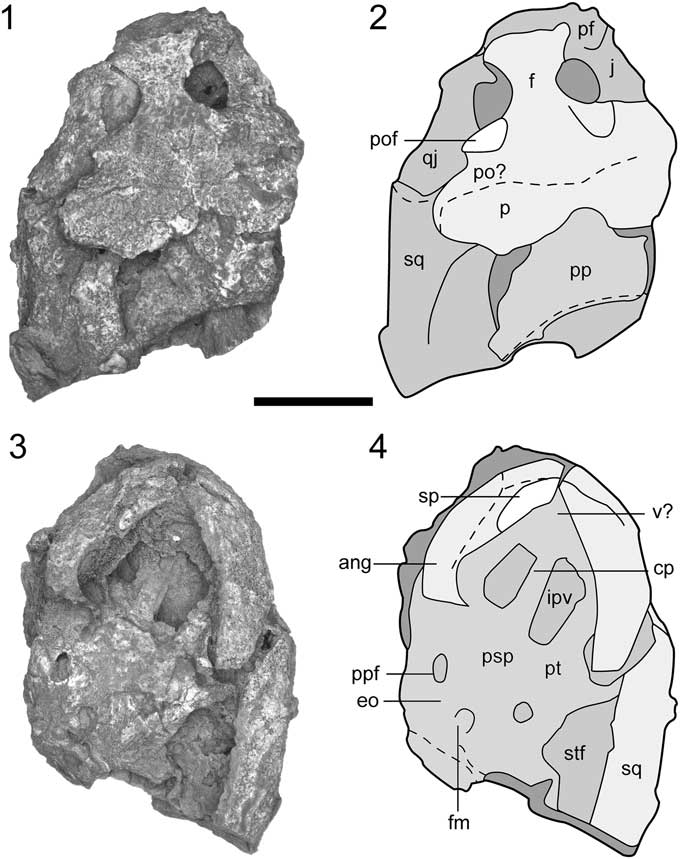
cf. Diplocaulus sp. indet., juvenile specimen (TMM 43628-9): (1) photograph in dorsal profile; (2) illustration of Figure 6.1; (3) photograph in ventral profile; (4) illustration of Figure 6.3. ang, angular; cp, cultriform process; eo, exoccipital; f, frontal; fm, foramen magnum; ipv, interpterygoid vacuity; j, jugal; p, parietal; pf, prefrontal; po, postorbital; pof, postfrontal; pp, postparietal; ppf, postpterygoid fossa; psp, parasphenoid; pt, pterygoid; qj, quadratojugal; sp, splenial; sq, squamosal; stf, subtemporal fenestra; v, vomer. Scale bar=1 cm.

Description
A small skull with articulated mandible (TMM 43628-9) was collected from the D2 site. The skull is broken in several places, but the fragments remain in relative articulation, and much of the palate is well exposed from the exoccipitals to the left vomer (Fig. 6). The skull would have been subequal in length and width and does not appear to have had well-developed tabular horns with a strong posterolateral orientation. The posterior midline elements (parietal, postparietal) are proportionately short transversely relative to those of large-bodied individuals. The unpaired frontal (a diplocauline synapomorphy) constitutes the entirety of the interorbital region. A left postorbital is tentatively identified, separating it from Peronedon Olson, Reference Olson1970 (Haglund, Reference Haglund1977). The proportions of the skull roof conform favorably with those of a small-bodied specimen of Diplocaulus sp. that was briefly described by Chaney et al. (Reference Chaney, Sues and DiMichele2005) and the early stages of a detailed ontogenetic series described by Olson (Reference Olson1951a). In palatal view (Fig. 6.3, 6.4), the broad basal plate of the parasphenoid and the rectangular cultriform process are well preserved, as are several of the openings on the palate (e.g., subtemporal fossa, interpterygoid vacuity). The mandibles remain mostly articulated, although sutures are not clearly defined.
The specimen is not sufficiently preserved to confidently separate the specimen from the closely related Diploceraspis Beerbower, Reference Beerbower1963 (unknown from Texas) based either on phylogenetic characters (e.g., Germain, Reference Germain2010) or on informal differentiation (e.g., Beerbower, Reference Beerbower1963; May and Hall, Reference May and Hall2016). The immaturity of this specimen further confounds efforts to identify the subtle distinctions between them, and the referral is based on the indistinguishable nature from juvenile Diplocaulus and the abundance of Diplocaulus in Texas compared to the absence of Diploceraspis.
Remarks
Differences between the various, highly-conserved species of Diplocaulus are relatively minor and characterized only for large-bodied specimens. Furthermore, Olson (Reference Olson1952a, p. 166) distinguished the two species that are found in the Vale Formation, D. magnicornis Cope, Reference Cope1882 (Arroyo Formation and lower Vale) and D. recurvatus Olson, Reference Olson1952a (upper Vale), only by the “frequency of occurrence of the recurved horn,” which is not as developed in immature individuals and not well-preserved in these specimens, inhibiting further taxonomic resolution.
Subclass Lepospondyli Zittel, Reference Zittel1888
Order Microsauria Dawson, Reference Dawson1863
Microsauria indet.
Description
Several poorly-preserved ‘microsaurian’ vertebrae are preserved within cylindrical segments of matrix, somewhat reminiscent of burrow-like structures. However, ‘microsaurs’ are highly conserved in their vertebral morphology, and the exposures are limited to different cross-sectional profiles, preventing further resolution of these specimens. Additionally, most early Permian ‘microsaurs’ are recovered within Recumbirostra, which is identified as having a number of synapomorphies for fossorial behavior, so the occurrence within a putative burrow is also uninformative.
Clade Recumbirostra Anderson, Reference Anderson2007
Family Hapsidopareiontidae Carroll and Gaskill, Reference Carroll and Gaskill1978
Hapsidopareiontidae gen. indet. sp. indet.
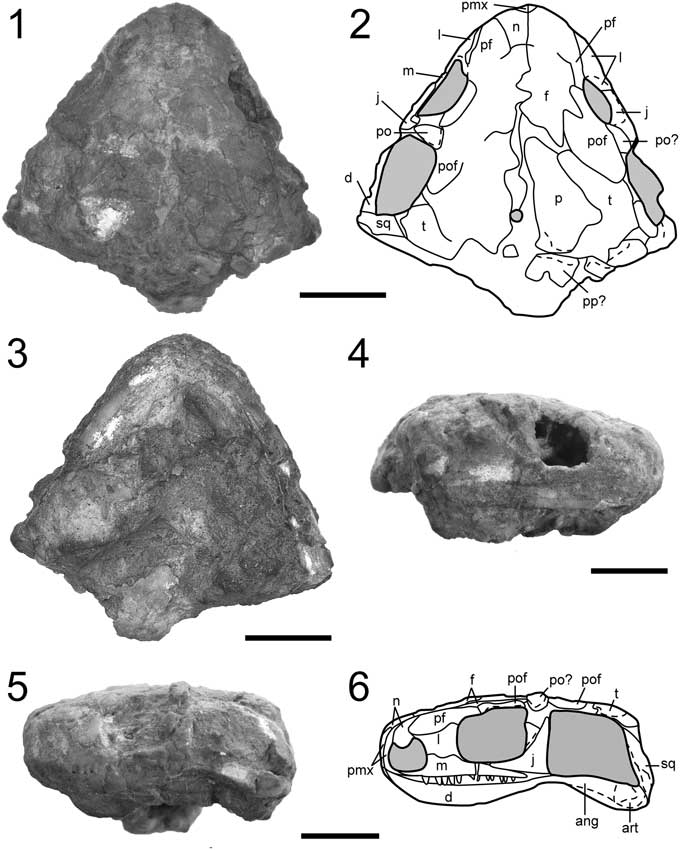
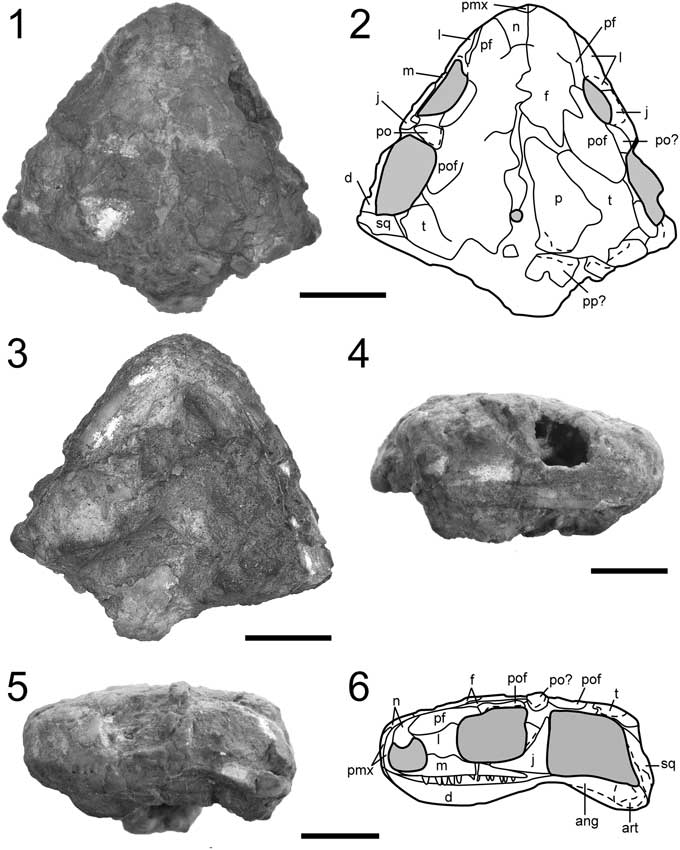
Hapsidopareiontidae gen. indet. sp. indet. (TMM 43628-10): (1) photograph in dorsal profile; (2) illustration of Figure 7.1; (3) photograph in ventral profile; (4) photograph in right lateral profile; (5) photograph in left lateral profile; (6) illustration of Figure 7.5. ang, angular; art, articular; d, dentary; f, frontal; j, jugal; l, lacrimal; m, maxilla; n, nasal; p, parietal; pf, prefrontal; pmx, premaxilla; po, postorbital; pof, postfrontal; pp, postparietal; sq, squamosal; t, tabular. Scale bars=1 cm.
Description
Recumbirostrans, a fossorially-adapted clade of tetrapods, are represented by a complete skull with articulated mandible (TMM 43628-10) measuring 16.3 mm from the premaxilla to the postparietal that was collected from the D3 site. The specimen is slightly compressed dorsoventrally on the left side, resulting in a slightly exaggerated width. In dorsal profile (Fig. 7.1, 7.2), the skull forms an equilateral triangle, with subequal width and length, similar to brachystelechids, pantylids, some ostodolepids, and microbrachomorphs. In lateral profile (Fig. 7.4, 7.5), the skull is nearly entirely flat, with the tip of the snout oriented vertically in a fashion reminiscent of gymnarthrids, pantylids, and hapsidopareiontids. The posterior skull margin extends slightly posteromedially, forming an inverted triangle relative to the main skull roof. The dorsal exposures of the nares and the orbits are limited. The maxillary tooth count, estimated on the left side, is ~19–21. Sutural patterns of the skull roof are difficult to confidently elucidate, particularly on the posterior skull table and on the left side. A noteworthy observation is that the specimen appears to have a large temporal emargination of comparable size and relationship to that of hapsidopareiontids, being open ventrally; framed anteriorly by a reduced postorbital and a posteriorly truncated jugal with a rounded posteroventral terminus; framed dorsally by some combination of the postfrontal, the postorbital, the supratemporal, and the tabular; and framed posteriorly by a tall, slender squamosal that meets a small quadratojugal ventrally. That this opening appears on both sides of the skull suggests that it is not a taphonomic artifact and thus forms the basis for the taxonomic assignment. The emargination in other hapsidopareiontids (Daly, Reference Daly1973; Bolt & Rieppel, Reference Bolt and Rieppel2009) differs from that of most other emarginated recumbirostrans (e.g., ostodolepids) in its large size, which occupies most of the temporal region. This results from the greater reduction of the temporal elements that produces the narrow, vertically oriented squamosal; the posteriorly truncated jugal with a ventral margin dipping below the level of the maxilla; and the reduced lateral exposure of the tabular (e.g., Carroll & Gaskill, Reference Carroll and Gaskill1978; Anderson et al., Reference Anderson, Scott and Reisz2009); these features are also seen in this specimen. The emargination of Brachydectes Cope, Reference Cope1868 is comparable in size (Pardo & Anderson, Reference Pardo and Anderson2016) but is open posteriorly. The lacrimal is blocky and tapers anteriorly; it joins both the narial and orbital margins. Two perforations for the lacrimal duct are present on the right side. The frontals are narrowly excluded from the orbital margins by the pre- and postfrontal and posteriorly; they feature two slender processes that incise into the postfrontal and the parietal and a prominent medial flange from the left element that incises into the right counterpart. The dorsal exposure of the premaxillae is minimal. Aspects of the palate and mandibles are mostly unidentifiable. Because of the poor preservation of the material, further taxonomic resolution is not possible. The specimen likely represents a new taxon insofar as it is distinct from all known ‘microsaurs’ and given the current absence of any ‘microsaurs’ in the Vale Formation, but because of the poor preservation and the difficulty in characterizing many aspects of the specimen, we refrain from erecting a new taxon at present.
Clade Eureptilia Olson, Reference Olson1947
Family Captorhinidae Case, Reference Case1911
Captorhinidae gen. indet. sp. indet.
Figures. 8.1–8.3, S2
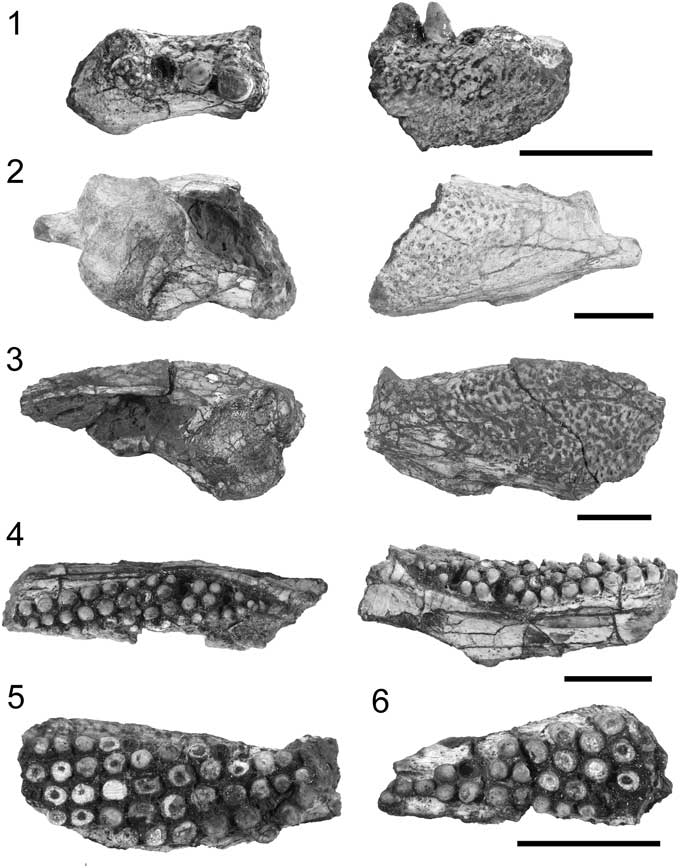
Dentulous fragments of captorhinids: (1−3) Captorhinidae gen. indet. sp. indet. (TMM 43628-12): (1) right mandibular symphysis in dorsal profile (left) and labial profile (right); (2) posterior right lower jaw in dorsal profile (left) and labial profile (right); (3) posterior left lower jaw in dorsal profile (left) and labial profile (right); (4−6) cf. Captorhinikos chozaensis Olson, Reference Olson1954c (TMM 43628-13): (4) partial right dentary in dorsal profile (left) and labial profile (right); (5) posterior maxillary fragment in dorsal profile; (6) anterior maxillary fragment in dorsal profile. Scale bars=1 cm.

Description
Indeterminate captorhinid material comprises both postcranial material consisting of several thoracic vertebrae and a right humerus (TMM 43628-11, Fig. S2) and mandibular material consisting of partial left and right mandibles and a partial symphysis with two enlarged (caniniform) teeth (TMM 43628-12, Fig. 8.1–8.3) from the D3 site.
The two partial mandibles (Fig. 8.2, 8.3) are of an identical size but are also of markedly different preservation and cannot be confidently assigned to the same individual. Only the posterior and labial regions are preserved, including portions of the articular, surangular, and possibly the angular; no teeth are present, which inhibits further resolution. The medial wall of the adductor chamber is lost in both specimens. The labial surface is ornamented with the shallow ridging and pitting typical of captorhinids, being less developed and more irregular in patterning than in coeval temnospondyls. The glenoid region is slightly wider than long and consists of medial and lateral facets that are divided by a slight ridge, as in Labidosaurus Cope, Reference Cope1896 (Modesto et al., Reference Modesto, Scott, Berman, Müller and Reisz2007) and in contrast to Captorhinus Cope, Reference Cope1895 (e.g., Fox and Bowman, Reference Fox and Bowman1966). Conversely, the greater development of the retroarticular process and the posterior boss rising dorsally to frame the glenoid are more comparable to Captorhinus. Shallow bosses also frame the glenoid anteriorly and laterally. The partial symphysis appears to comprise only the dentary and features two complete teeth with circular cross sections and pointed tips. Positioned anterior to these are an additional empty socket and a lateral protuberance that houses two teeth broken at the level of the jaw. The lateral surface is lightly ornamented with a few pits.
The vertebrae consist mostly of the amphicoelous centra that are tightly sutured to the expanded bases of the neural arches. All of the vertebrae pertain to the presacral region, but some feature prominent, laterally directed transverse processes, indicating a more anterior position, whereas others lack them entirely, indicating a more posterior position. The pre- and postzygapophyses are mostly anteroposteriorly directed, with the facets parallel to each other in the dorsoventral axis. The base of the neural arch is a rough square and becomes slightly longer posteriorly in the column. The spines are frequently damaged so that determining their original height for additional axial determination is not possible. The humerus is typical of early reptiles, featuring expanded ends set at approximate right angles; a thin shaft; a small, oval entepicondylar foramen; and a prominent deltoid process. It is more comparable to the humerus of small captorhinids such as Captorhinus aguti Cope, Reference Cope1895 (Fox and Bowman, Reference Fox and Bowman1966) in which the features are less robust than in a large taxon like Labidosaurus (Sumida, Reference Sumida1989), but to cite one differential feature, the ectepicondyle of TMM 43628-11 is intermediate between the two. Both elements are relatively conserved among captorhinids and cannot be further resolved in isolation. Because the material comes from the same site as the moradisaurine material described below, it might all pertain to the same individual, or at least to the same taxon, but this cannot be demonstrably proven, hence the separate specimen numbers and taxonomic identifications.
Subfamily Moradisaurinae de Ricqlès and Taquet, Reference de Ricqlès and Taquet1982
Genus cf. Captorhinikos Olson, Reference Olson1954c
Type species
Captorhinikos valensis Olson, Reference Olson1954c from the Vale Formation, Texas, by original designation.
cf. Captorhinikos chozaensis Olson, Reference Olson1954c
Holotype
Cranial and mandibular fragments (CNHM UR 97) from the lower part of the Choza Formation, Texas (Olson, Reference Olson1954c, fig. 86A–E).
Description
Dentulous maxillary fragments and a partial dentary (TMM 43628-13) from the D3 site are confidently referable to the Moradisaurinae on the basis of a high number of tooth rows arranged in parallel, and on the basis of the shape of the teeth. Five tooth rows arranged in parallel are present on one maxillary fragment (Fig. 8.5), likely representing a more posterior region of the element, whereas the second fragment (Fig. 8.6) preserves a transition from one to four rows, likely representing the anterior region. The dentary (Fig. 8.4) features the typical torsion along its length and a transition from one to four rows, with teeth arranged in parallel. The teeth are worn and often lacking the tip of the crown, but when intact, they are generally circular in cross section, without any compression, and with rounded tips. An intact anterior dentary tooth from the single-tooth-row region, and a lingual (younger) tooth from the mid-region of the multiple-tooth-row area each have the typical moradisaurine conical shape. The captorhinids from the Arroyo Formation, Captorhinus and Labidosaurus (Olson, Reference Olson1989), have up to four rows of somewhat randomly arranged teeth and one row, respectively; both are found in the Vale Formation in addition to Captorhinikos Olson, Reference Olson1954c (Olson and Mead, Reference Olson and Mead1982). An indeterminate moradisaurine tooth plate was described from the Vale Formation by Modesto et al. (Reference Modesto, Flear, Dilney and Reisz2016), but that specimen possesses eight tooth rows and is evidently distinct from TMM 43628-12. The presence of five tooth rows on the maxilla is shared with Rothianiscus Olson, Reference Olson1965, Gansurhinus Reisz et al., Reference Reisz, Liu, Li and Müller2011, and Captorhinikos. There is no evidence of the slight cusp and recurvature seen in Gansurhinus, which is known from middle Permian deposits (Reisz et al., Reference Reisz, Liu, Li and Müller2011). Rothianiscus is said to have up to seven tooth rows on the dentary (Olson, Reference Olson1965). The maxillary teeth do not appear to be radiating insofar as the rows remain equally spaced throughout their length in the larger fragment, contrary to those of Captorhinikos valensis (see Modesto et al., Reference Modesto, Lamb and Reisz2014).
The material is tentatively assigned to Captorhinikos chozaensis because the taxon is known to occur in the same geographic region and because it does not display any differences from previously described material (Olson, Reference Olson1954c; Vaugh, Reference Vaugh1958). It should be noted that although Vaughn (Reference Vaugh1958) did not figure any of the specimens that he referred to this taxon, photographs of Vaughn’s specimen (USNM 21275) are publicly available on the Smithsonian Institution’s website.
Remarks
The study of Captorhinikos valensis and broader phylogenetic analysis of captorhinids by Modesto et al. (Reference Modesto, Lamb and Reisz2014) recovered C. chozaensis as the sister taxon to a clade containing Labidosaurus hamatus Cope, Reference Cope1895 and the Moradisaurinae and suggested that it could warrant placement in a new genus. Because we have not reappraised the type or previously referred material of C. chozaensis and because the referral of the Mud Hill specimens is more tentative given the disparity in stratigraphic occurrence, we utilize the traditional taxonomic standing sensu Olson (Reference Olson1954c).
Order Diadectomorpha Watson, Reference Watson1917
Family Diadectidae Cope, Reference Cope1880
Genus cf. Diadectes Cope, Reference Cope1878
Type species
Diadectes sideropelicus Cope, Reference Cope1878 from the Admiral Formation, Texas, by original designation.
cf. Diadectes sp. indet.
Figures. 9, S3–S5
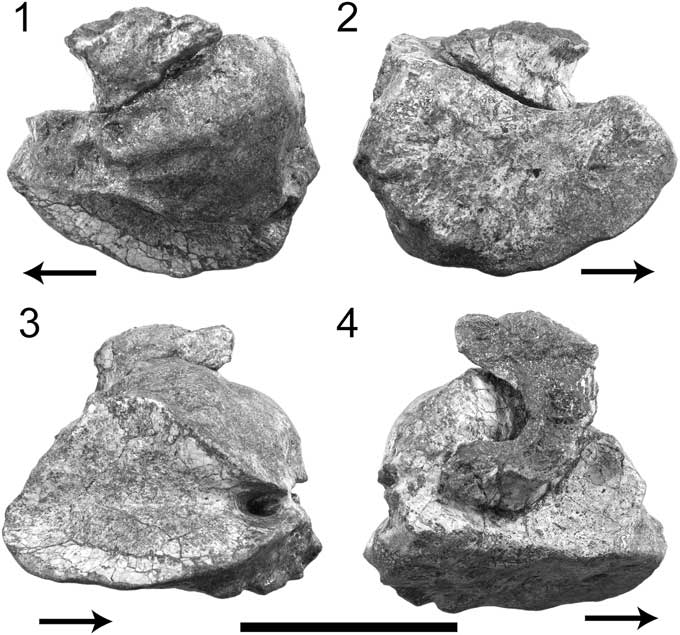
cf. Diadectes sp. indet., astragalus and partial tarsal bone (TMM 43628-5) from the D2 site: (1) ventral profile; (2) posterolateral profile; (3) anterior profile; (4) medial profile. Arrows point distally. Scale bar=5 cm.

Description
The vast majority of the well-preserved diadectid is postcranial material, mostly vertebrae, with limb and girdle elements also being represented. An extremely fragmentary parabasisphenoid is also present. Because most diadectid diagnoses are based solely on cranial material, resolution for disarticulated remains is difficult. Most of this material was collected from the D1 site (TMM 43628-4). A large portion of the material pertains to isolated thoracic and caudal centra that are characterized by markedly amphicoelous morphology and the lack of fusion to the neural arches (Fig. S3.1); at least 65 centra have been collected from Mud Hill. The centra are slightly wider than they are long and with concave ventrolateral surfaces that meet at a shallow ventral midline ridge, differing from the centra of coeval synapsids (e.g., Dimetrodon), which are narrower and with a sharp ridge. The haemal arches are mostly lost. Neural arches are rare and fragmentary, which is again an indication of immaturity. A pair of articulated neural arches (TMM 43628-6) with the characteristic ‘swollen’ morphology was collected from the D3 site (Fig. S3.2). A large number of fragmentary ribs are also present. The appendicular material of TMM 43628-4 comprises three humeri (Fig. S4), a femur, a fibula, an ulna, and a radius. Extremely fragmentary limb material is also present. The limbs are characterized by unfinished bone at the ends, indicative of relative immaturity. A significant number of isolated phalanges, elements pertaining to the carpus and tarsus, and a complete left astragalus with a partial, articulated calcaneum are present (Fig. 9); some of these were collected from the D2 site (catalogued as TMM 43628-5). Association between any of these elements is unknown. Pectoral material is represented by a dorsal fragment of a scapulacoracoid with a partial cleithrum (Fig. S5.1) and a partial clavicular stem. Pelvic material is represented by an ilium, a pubis, and an ischium (Fig. S5.2–S5.4); all three are of an appropriate size to pertain to a single individual, but they display a range of preservation and cannot be confidently fit together. At least two individuals were present based on the humeri count, but an association with more diagnostic cranial material (listed below) is unclear. The material cannot be confidently referred to Diadectes in the absence of preserved autapomorphies, but the taxon is abundant in the early Permian of North America and is confidently documented at the site (see below).
Diadectes Cope, Reference Cope1878
Diadectes sp. indet.
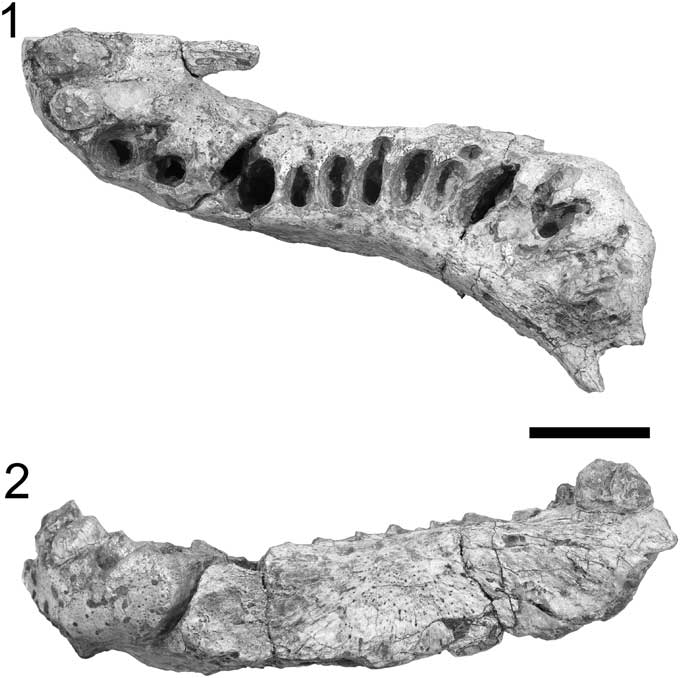
Diadectes sp. indet., upper jaw (premaxilla and maxilla) (TMM 43628-2): (1) dorsal profile; (2) lateral profile. Scale bar=2 cm.

Description
Diagnostic material referable to the genus is limited to a right premaxilla articulated with a partial maxilla and associated with a pair of dentaries (TMM 43628-2), which are referred to the genus on the basis of the tooth count and mandibular morphology. The maxilla features a concave dorsal margin and a mostly flat ventral margin that is upturned only at the posterior region. The lateral surface is irregularly ornamented in small pits and shallow grooves. Four tooth positions are present in the premaxilla, two with partial incisciform teeth in place. The incisiform teeth found in diadectids typically feature cusps, but the teeth here are broken off at the level of the jaw. A slight decrease in size posteriorly is noted. Eleven tooth positions are present on the maxilla, which informs its taxonomic identification; most other diadectids possess 12 (e.g., Orobates Berman et al., Reference Berman, Henrici, Kissel, Sumida and Martens2004). Only the vacant sockets for the anterior molariform teeth are preserved, but they are compressed into oval cross sections, as in diadectids. The posteriormost teeth are weathered but preserve the general cusped morphology (Fig. 10.2). The tooth sockets increase in width to the seventh position and then decrease posteriorly.
Another dentary (TMM 43628-3) was histologically sampled in a study of dental tissues by LeBlanc and Reisz (Reference LeBlanc and Reisz2013). Both specimens are from the D1 site and thus indicate the presence of at least two individuals, as with the humeri.
Remarks
The specific identity of the diadectid material is unresolved, as all previous material recovered from the Vale Formation was undiagnostic below the genus (and in some cases might not even warrant referral below the family level). Olson (Reference Olson1956c) suggested possible affinities of this material with Diadectes tenuitectus Cope, Reference Cope1896, the highest occurring taxon at the time, but the extent of faunal overlap at the specific level between the Vale and the Choza formations remains poorly defined, and the material described here is only sufficient to merit referral to Diadectes sp.; the same assignment was utilized in the histological sampling of this material by LeBlanc and Reisz (Reference LeBlanc and Reisz2013).
Class Synapsida Osborn, Reference Osborn1903
Clade Eupelycosauria Kemp, Reference Kemp1982
Family Varanopidae Romer and Price, Reference Romer and Price1940
Genus Varanops Williston, Reference Williston1914
Type species
Varanosaurus brevirostris Williston, Reference Williston1911 from the Arroyo Formation, Texas, by subsequent designation (Williston, Reference Williston1914).
Varanops brevirostris (Williston, Reference Williston1911)
1911 Varanosaurus brevirostris Reference WillistonWilliston, p. 85, pls. 1–13.
1914 Varanops brevirostris Reference WillistonWilliston, p. 387.
Holotype
Nearly complete skull with mandibles and articulated skeleton (FMNH UC 644) from the Arroyo Formation, Texas (Williston, Reference Williston1911, pls. 1–13).
Description
Material of Varanops from the locality has been previously described with a focus on scavenging of the postcrania of a large, nearly complete skeleton (TMM 43628) from the D2 site by Reisz and Tsuji (Reference Reisz and Tsuji2006), and in greater detail in the description of the same specimen (referred to as TMM 43628-1) by Campione and Reisz (Reference Campione and Reisz2010) in a broader review of V. brevirostris. The cranial material comprises a partial skull with a braincase and associated mandible. The postcranial skeleton consists of both humeri, an ulna, a complete femur and one comprising the distal and proximal ends, both tibiae, the pectoral girdle (interclavicle, partial clavicles, and scapulacoracoid), the pelvic girdle (pubis, ilia, and ischia), vertebrae from all major regions (cervical, thoracic, lumbar, sacral, and caudal), ribs, gastralia, and portions of the left manus and left pes. All materials pertaining to this specimen were figured and described in detail by Campione and Reisz (Reference Campione and Reisz2010).
Remarks
The revised osteology by Campione and Reisz (Reference Campione and Reisz2010) was primarily based on the Mud Hill specimen, and no new information is contributed here.
Discussion
Depositional environment and paleoenvironment at Mud Hill
The geology and paleoenvironmental interpretations of the Vale Formation have been frequently discussed in descriptions of vertebrate taxa (e.g., Olson, Reference Olson1948; Wilson, Reference Wilson1953), but more extensive discussions have also been presented by Olson (Reference Olson1958) and were well-summarized by Nelson et al. (Reference Nelson, Hook and Chaney2013). The red shale facies (Fig. S1.1) is interpreted as alluvial plain deposits resulting from the settling of suspended clay from shallow overbank sheet floods. The absence of well-developed laminations and of varves suggests that perennial lacustrine deposition can be ruled out. The red color strongly supports the early oxidation of clay and indicates prolonged subaerial exposure. Diagenesis associated with early oxidation of the clays results in the formation of nodular hematite. The siltstone-sandstone facies (Fig. S1.2) is interpreted to represent deposition immediately following flood events. The thick laminations of coarse silt and fine sands, and subrounding of the quartz grains in association with orthoclase and granite clasts, indicate flux from a fluvial source. The associated caliche nodules (Fig. S1.3) are almost always found just above or within the siltstone-sandstone facies discussed above and are directly associated with the vertebrate dig sites found on the property. Further characterization of the facies (e.g., paleosol classification) is confounded by the absence of pedogenic structures. The early diagenesis required for caliche development, the presence of calcified root/burrow structures, and frosted subrounded quartz grains in this facies indicate a prolonged period of subaerial exposure. The frosted quartz grains recovered from caliche nodules are indicative of the input of windblown quartz during the period of exposure. Subaerial exposure is also supported by the surface characteristics of the bones. They are uniformly cracked, which is usually caused by prolonged exposure to the sun and strong desiccation (e.g., Behrensmeyer, Reference Behrensmeyer1978). Prolonged subaerial exposure of remains would also explain the prevalence of scavenging marks on many of the elements (Reisz and Tsuji, Reference Reisz and Tsuji2006; Flear et al., Reference Flear, Modesto and Reisz2017).
Any determination of the relation of the section at Mud Hill with those of other localities in the Vale Formation, particularly those of a greater distance away, is limited at present without a high-resolution dataset of stratigraphic sections and without more detailed lithological and petrographic descriptions of those localities. As noted by Wilson (Reference Wilson1953), most beds appear fairly localized and nontraceable over broad distances, and the fossil record is not sufficient to provide reliable correlation. Similar concerns about the possible scope of extrapolation from a limited localized dataset were noted by Olson (Reference Olson1958, p. 422, 423). The lack of any exposures of the underlying Arroyo Formation and the loss of the overlying Choza Formation at Mud Hill presents additional challenges. Furthermore, the Vale Formation is noted to be several hundred meters thick in some areas (Olson, Reference Olson1958), whereas the exposure at Mud Hill (Figs. 2, 3) does not exceed 8 m. The general position can be determined based on the stratigraphic patterns listed by Olson (Reference Olson1958) and Olson and Mead (Reference Olson and Mead1982). Red shales are persistent throughout the Vale Formation, but there is a pronounced coarsening upward in the upper Vale that results in widespread conglomeratic deposits with clasts that are sourced from the incised strata (Olson and Mead, Reference Olson and Mead1982). The dominance of finer-grained shales and sandstones at Mud Hill suggests that the locality is relatively low, and Mead (Reference Mead1971) suggested that calcareous clasts at the Sid McAdams locality (situated in the lower Vale) were caliche nodules and hematite concretions, both of which are found at Mud Hill.
Previous paleoenvironmental interpretations of the Vale Formation, both on local and regional scales, are consistent with those presented here. The conditions necessary to form caliche, as well as aspects of the facies at Mud Hill (e.g., frosting of the quartz), reflect subaerial exposure that was likely associated with periodic desiccation at the site (further discussed below). Pronounced seasonality, likely associated with the development of a monsoon system around the equatorial regions (e.g., Tabor and Montañez, Reference Tabor and Montañez2002; Tabor et al., Reference Tabor, Montañez and Southard2002, Reference Tabor, Montañez, Scotese, Poulsen, Mack, Fielding, Frank and Isbell2008; Woodhead et al., Reference Woodhead, Reisz, Fox, Drysdale, Hellstrom, Maas, Cheng and Edwards2010), would have resulted in episodic inundation and overflowing of stream channels that would have provided both the lithological material and the transport for many of the fossils that are preserved. Subsequent desiccation would result in subaerial weathering of the fossils and their encapsulating horizons and the formation of pedogenic carbonates. Because the section at Mud Hill does not capture any higher-energy depositions such as channel fills, it is unclear whether the localized environment contained perennial bodies of water.
Comparison of Mud Hill with other Vale Formation localities
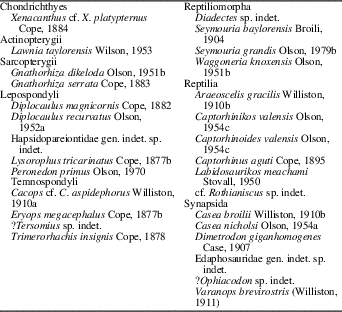
Mud Hill is characterized by a relatively abnormal faunal assemblage for the early Permian of Texas (Table 3). Some of the represented taxa (e.g., Diplocaulus, captorhinids) are commonly recovered constituents of other deposits, but others are significantly rarer (Diadectes, Varanops) or previously unknown (the recumbirostran). Additionally, many of the common constituents of other Vale Formation localities, such as xenacanthid sharks, temnospondyls (e.g., Trimerorhachis, Eryops), and Dimetrodon are absent at Mud Hill. The specimens of the sole aquatic constituent, Diplocaulus (and the other nectridean specimens), are small and likely represent early stages of ontogeny. The lack of a more precise context for the locality within the Vale Formation and relative to the other localities prevents any confident characterization of these faunal trends as faunal turnover, because taphonomic bias remains a likely contributor to some degree; the presence of only extremely small-bodied Diplocaulus is one line of evidence in this regard. The disarticulation but general association of some of the specimens at each of these localities is indicative of relatively little transport, and in the case of Mud Hill, in situ preservation with minimal disturbance of skeletal remains.
Comparison of vertebrate assemblages between major described Vale Formation localities, derived from original locality descriptions (Olson, Reference Olson1948; Wilson, Reference Wilson1953; Dalquest and Mamay, Reference Dalquest and Mamay1963; Mead, Reference Mead1971; Olson and Mead, Reference Olson and Mead1982) and the faunal lists of Olson (Reference Olson1958, table 2) and Olson and Mead (Reference Olson and Mead1982, table 1). Taxa that occur within the Vale but that are not found at any of these localities are excluded. The sole occurrence of Cacops is predicated on the synonymizing of Trematopsis seltini Olson, Reference Olson1956b with Cacops cf. C. aspidephorus Williston, Reference Williston1910a by Milner (Reference Milner1985). +=present; −=absent.

The Sid McAdams locality features a significant skew toward Dimetrodon; Mead (Reference Mead1971) estimated a minimum number of individuals (MNI) of 22, and even relatively common taxa such as Diplocaulus and Trimerorachis are represented only by a handful of fragmentary specimens at the site. Mead’s interpretation, as was the classic interpretation of many Paleozoic and Mesozoic mass death assemblages of a particular taxon, was that some sort of abnormal event produced an unusually dense concentration of fossilized individuals. Because Mud Hill has not been extensively quarried, more individuals, particularly of diadectids affinities, might be preserved but are presently unknown. Whether the general paucity of aquatic forms is associated with a small size and isolation or with ephemerality of the aquatic environment in which the localities formed is unclear. The hypothesis of an ephemeral body of water could explain the Mud Hill site, as it would account for the general paucity of aquatic forms and the relative immaturity of such forms when they occur; it could, for example, have been utilized as a habitat by small diplocaulids. The extreme abundance of Diplocaulus at the Stamford locality, which otherwise preserves only the similarly aquatic Trimerorhachis and Xenacanthus Beyrich, Reference Beyrich1848, suggests in situ preservation of an isolated, desiccating aquatic environment (Dalquest and Mamay, Reference Dalquest and Mamay1963). The Blackwood locality features a more even distribution of various taxa with significant disarticulation and abrasion of the material, indicative of greater transport and sorting (Olson and Mead, Reference Olson and Mead1982).
Several aspects of the taxonomic assemblage merit further exploration as well in the broader context of the vertebrate assemblage characterized from the Vale Formation (Tables 3, 4). ‘Microsaurs’ have a well-documented record from the early Permian of Texas, including taxa such as Pantylus Cope, Reference Cope1881; the gymnarthrids Cardiocephalus Broili, Reference Broili1904 , Euryodus Olson, Reference Olson1939, and Pariotichus Cope, Reference Cope1878; and the ostodolepids Ostodolepis Williston, Reference Williston1913, Pelodosotis Carroll and Gaskill, Reference Carroll and Gaskill1978, and Micraroter Daly, Reference Daly1973 (BPI 3839), but all of these taxa occur in the Arroyo Formation or older units (Carroll and Gaskill, Reference Carroll and Gaskill1978). The hapsidopareiontid skull noted here thus represents the first ‘microsaur’ of the Vale Formation and possibly one of the youngest ‘microsaurs’ known to date. Early Permian localities within North America and outside of Texas that preserve ‘microsaurs’ are limited to two sites, each bearing a number of taxa. A locality near Norman, Oklahoma that is considered equivalent to the Choza Formation includes the recumbirostrans Rhynchonkos Schultze and Foreman, Reference Schultze and Foreman1981, Aletremyti Szostakiwskyj, Pardo, and Anderson, Reference Szostakiwskyj, Pardo and Anderson2015, and Dvellecanus Szostakiwskyj, Pardo, and Anderson, Reference Szostakiwskyj, Pardo and Anderson2015 (Olson, Reference Olson1970; Szostakiwskyj et al., Reference Szostakiwskyj, Pardo and Anderson2015), and the site at South Grandfield, Oklahoma that is considered equivalent to the Arroyo Formation includes Hapsidopareion Daly, Reference Daly1973, Cardiocephalus, Micraroter, and possibly Pariotichus (Daly, Reference Daly1973). However, suggested biostratigraphic correlation of the latter site has often been made with the well-known Richards Spur locality, which was similarly proposed as being equivalent to the Arroyo Formation until it was resolved as being Sakmarian in age based on radioisotopic work (Woodhead et al., Reference Woodhead, Reisz, Fox, Drysdale, Hellstrom, Maas, Cheng and Edwards2010); this could accordingly pull back the age of South Grandfield. Because of the poor preservation of sutural contacts, it is difficult to refine the taxonomic identity of TMM 43628-10, but it appears distinct from the clade comprising the three taxa from the Choza Formation equivalent on several grounds (e.g., weakly recumbent snout, higher maxillary tooth count).
Revised vertebrate faunal list of the Vale Formation derived from Olson and Mead (Reference Olson and Mead1982). Although we have eliminated taxa that have since been synonymized with other Vale taxa (e.g., Trematopsis seltini with Cacops cf. C. aspidephorus) and updated nomenclature for taxa synonymized with non-Vale taxa (e.g., Trematops milleri Williston, Reference Williston1909a with Acheloma cumminsi Cope, Reference Cope1882), the original taxonomic assignments, including somewhat tentative referrals to particular species, e.g., ‘Xenacanthus’ platypternus (Cope, Reference Cope1884), remain unchanged unless figures provide strong evidence to contradict Olson and Mead’s classification.

The diadectid material represents the most complete assemblage of material from the clade known from the entirety of the Vale Formation. In all likelihood, all of the diadectid material belongs to Diadectes; the size of all materials is consistent for a few modestly large (but still immature) individuals, but the postcrania of diadectids is relatively conserved and thus non-referable under an apomophy-based identification system. Even when considering only the material that is properly referable, the Diadectes from Mud Hill is still quite significant in the context of the Vale Formation. Prior to this study, Diadectes was represented only by a single tooth (TMM 30966-321) from the Sid McAdams locality (lower Vale), one vertebra from the lower Vale Formation of Baylor County (CNHM-UR 270), and two fragments, an incomplete quadrate (UCLA VP 558) and an incomplete vertebra from the Blackwood site (middle Vale) (Olson, Reference Olson1956c; Olson and Mead, Reference Olson and Mead1982); under an apomorphy-based identification, most of this material is probably referable only to Diadectidae gen. indet. sp. indet. In general, the taxonomy of Diadectes needs revision, because taxonomic separation at the species level is often on the basis of relative differences in size and proportions of the skeleton and stratigraphic occurrence within the early Permian. Diadectes tenuitectus is the highest occurring taxon within Texas, but referable material is also known only from the Arroyo Formation (Olson, Reference Olson1956c). Despite a significantly improved record of diadectids in the Vale Formation via the Mud Hill material, the general paucity of the clade could still be correlated with a decline in abundance of these large herbivores, possibly as a result of increased aridity and subsequent changes to the local environment. The preservation of diadectids at this particular locality is probably associated with the nuances of the depositional environment; low-energy aquatic settings were likely conducive for vegetation.
The documentation of Varanops brevirostris at Mud Hill in contrast to other Vale Formation localities is more difficult to explain. No varanopid material has ever been confidently reported from the Vale Formation, although the lack of stratigraphic resolution of the Cacops Bone Bed to the upper Arroyo Formation or to the lower Vale Formation might alter this pattern. The specimen from Mud Hill is the first unequivocal documentation of the taxon in the Vale. Varanopids where they occur are typically restricted to a single taxon, but this does not explain the general absence of Varanops from other localities in the Vale Formation; the taxon is otherwise known only from the Cacops Bone Bed and tentatively from the Richards Spur locality (Maddin et al., Reference Maddin, Evans and Reisz2006; Campione and Reisz, Reference Campione and Reisz2010). Beyond inference of in situ preservation based on the exceptional articulation of much of the skeleton, little more can be confidently proposed regarding explanations for its apparent paucity. It might simply be that varanopids were exceedingly rare in Texas throughout the early Permian; younger varanopids (e.g., Varanodon Olson, Reference Olson1965; Watongia Olson, Reference Olson1974) are found outside of Texas.
Conclusion
The Mud Hill locality described here is the first major vertebrate-bearing locality to be described from the Vale Formation in several decades. Preservation of rare forms (diadectids), previously undocumented forms (hapsidopareiontid), and forms only tentatively reported from the formation (Varanops) expand both the biostratigraphic ranges of these clades and the tetrapod assemblage of the Vale at large (Table 4), and augment the morphological characterizations of these groups. The unusual taxonomic assemblage at Mud Hill is indicative of an atypical depositional environment and probably represents a low-energy aquatic environment in which most organisms were preserved in situ and in which obligately aquatic taxa (e.g., temnospondyls, fishes) were not abundant or permanent constituents.
Acknowledgments
The following people are thanked for their contributions to the discovery, exploration, and work on the Mud Hill locality: D. Ostlien, owner of the Olhausen estate; Jac. and Jam. Olhausen, R. Burt, and D. Ostlien for discovery of the localities; R. Burt, L. White, D. Ramos, and E. Ramos for exploration and excavation; E. Ramos for early photography; L. White and J.H. Cox for identification and initial preparation; and J.H. Cox and T. Cox for constructing the screening table. The following people are thanked for early discussions of the material and locality: D. Berman (Carnegie Museum); J. Bolt (Field Museum of Natural History); E. Harrison (Hardin-Simmons University); L. Jacobs (Southern Methodist University); W. May (Sam Noble Oklahoma Museum of Natural History); S. Sumida (California State University, San Bernardino); and T. Rowe and W. Langston (University of Texas, Austin). Thanks to J. Chris Sagebiel (University of Texas, Austin) for assistance with collection numbers. The following University of Toronto Mississauga students are thanked for their contributions to preparation of the materials: A. Jhajj, M. Munawar, P. Ngu, and K. Upadhyay. Thanks to the reviewers, H. Maddin and J. Anderson, and to the editor, N. Fröbisch, for constructive feedback that improved this paper. Funding for this project was provided by grants from the NSERC Discovery Grant, Canada and the University of Toronto to RRR.
Accessibility of supplemental data
Data available (Figs. S1−S5) from the Dryad Digital Repository: https://doi.org/10.5061/dryad.4rc74sp.