Introduction
Long ago, Janzen (Reference Janzen1977) reviewed the tactics employed by terrestrial microorganisms to defend their food from much larger metazoan scavengers. The current paper presents marine observations demonstrating bacterial defences against scavengers in an Antarctic benthic community. This is of general interest because virtually all benthic deposit feeders ingest bacteria, and the present work suggests that the common Beggiatoa/Thioploca-like filamentous bacteria effectively resist predation.
The importance of carrion falls in the deep sea is well established, especially for large animals (Smith & Baco Reference Smith and Baco2003, Treude et al. Reference Treude, Smith, Wenzhöfer, Carney, Bernardino and Hannides2009, Higgs et al. Reference Higgs, Gates and Jones2014, Smith et al. Reference Smith, Bernardino, Baco, Hannides and Altamira2014, Smith et al. Reference Smith, Glover, Treude, Higgs and Amon2015). Carrion falls are common on the east side of McMurdo Sound where dead seal pups are frequently observed. Scavengers, especially lysianassid amphipods, echinoderms (Odontaster validus Koehler, Sterechinus neumayeri Meissner), and the nemertean, Parborlasia corrugatus McIntosh respond almost immediately to the presence of carrion, especially dead Weddell seal pups, wounded asteroids (see Dayton et al. Reference Dayton, Robilliard, Paine and Dayton1974), and pieces of large Dissosticus mawsoni Norman discarded by seals. In most cases the dead animal was quickly reduced to clean bones, usually within days. This has also been observed along Ross Island for over a century by biologists using seal and fish as bait in traps.
Carrion
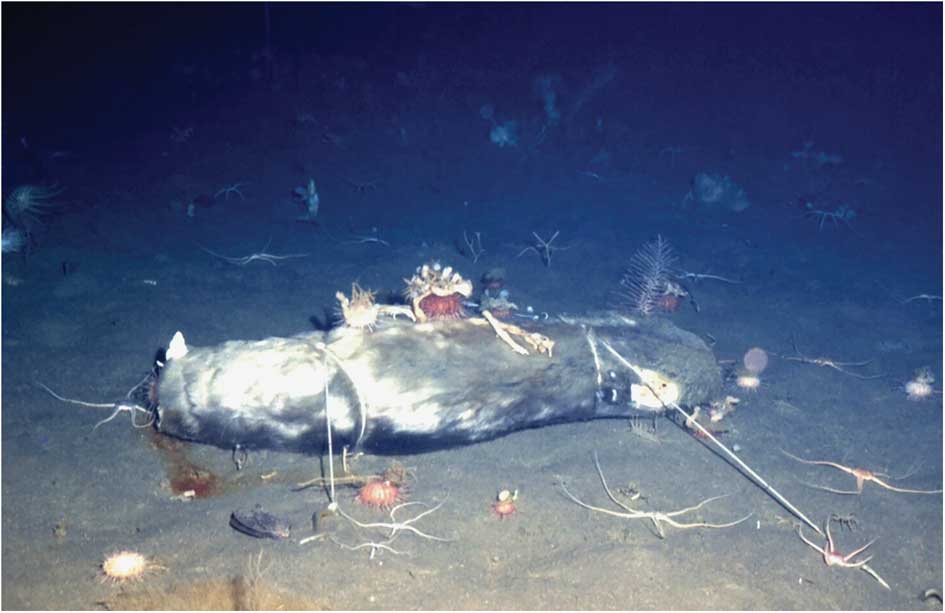
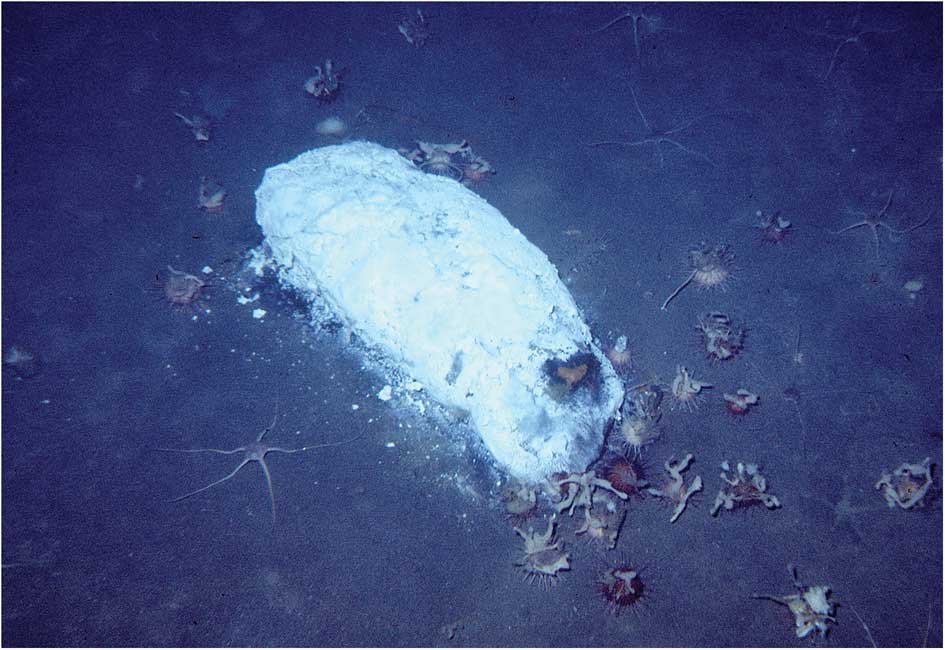
Explorers Cove in New Harbour and Salmon Bay on the west side of McMurdo Sound have very different soft bottom habitats (see Dayton et al. Reference Dayton, Jarrell, Kim, Thrush, Hammerstrom, Slattery and Parnell2016 & Dayton et al. Reference Dayton, Jarrell, Kim, Parnell, Thrush, Hammerstrom and Leichterin press, for history of the site) and the scavenging species that were so effective on the east side were inconspicuous on the west side. This posed the question: would carrion be consumed in the same way? In 1975 the present authors attempted to evaluate the response to carrion at Explorers Cove by transporting dead seal pups from Turtle Rock on the east side of the Sound and placing them at 30 m depth in Explorers Cove (see Fig. 1).
A dead seal pup at 30 m depth at Explorers Cove in December 1975. It had been placed there about 1–3 weeks earlier and shows Ophionotus victoriae, Sterechinus neumayeri, Diplasterias brucei, and Neobuccinum eatoni converging toward the dead seal.
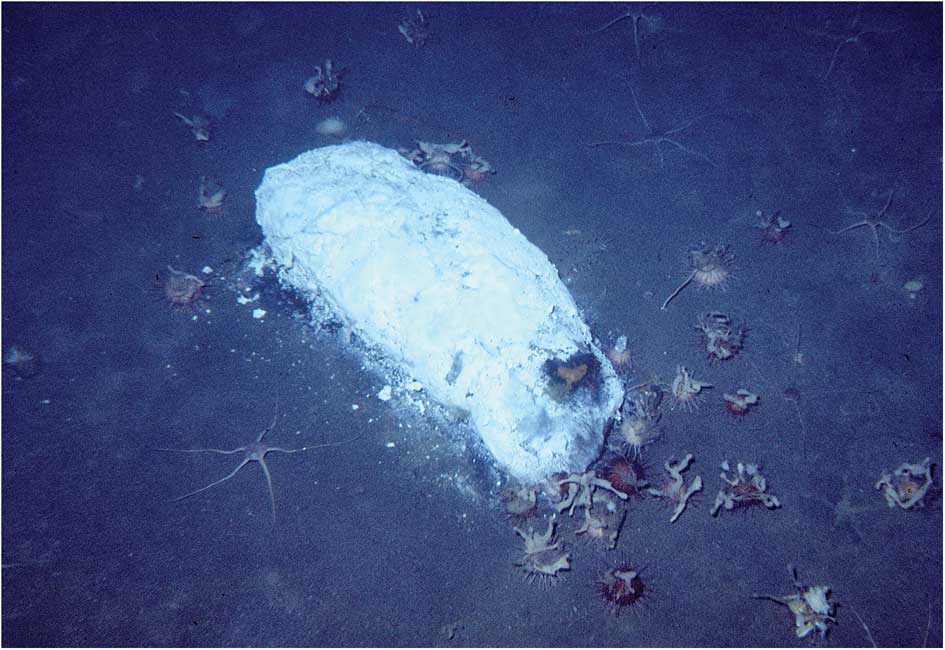
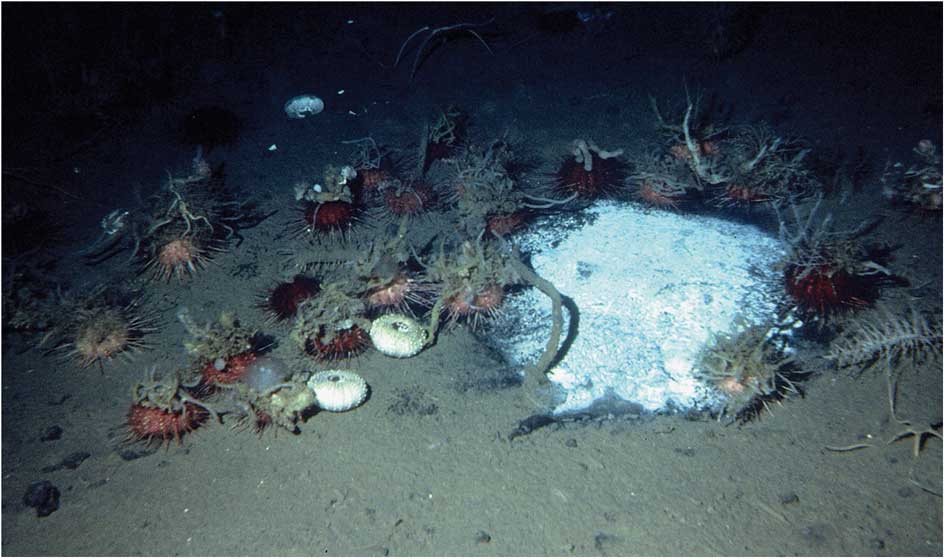
Upon returning one and two years later, all the carrion were found to be covered by a thick layer of Beggiatoa/Thioploca-like filamentous bacteria overlying anaerobic sulphate-reducing bacteria (see Fig. 2). This attracted many scavengers, especially S. neumayeri, but when they broke up the mat of Beggiatoa/Thioploca-like material, it effectively released hydrogen sulphide that apparently killed the urchins. These bacterial–carrion deposits persisted over the next decade as the bacteria slowly consumed the seal carcass. They were not observed in 2010.
The dead seal in 1977, two years after it was emplaced, showing the white outer layer of Beggiatoa/Thioploca over dark anaerobic sulphate-reducing bacteria with a patch of the white bacteria removed. At this time most of the scavengers were the urchins, Sterechinus neumayeri, carrying the sponges and other debris.
Algal mat
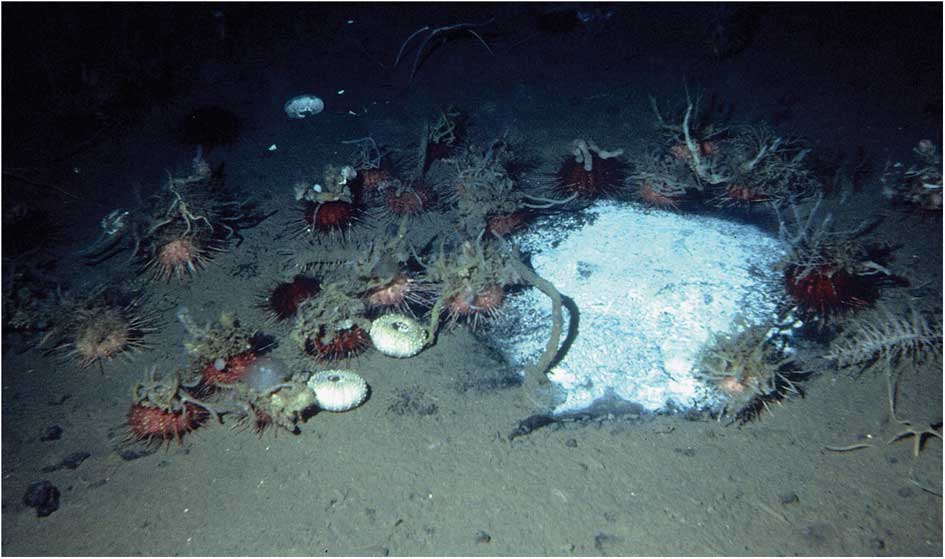
These authors attempted a similar experiment in 1988 but using the native algal mats that developed in melt ponds adjacent to the sea ice at Salmon Bay. Local algal mats were collected, saturated with table salt so they would stay in place, and used to evaluate responses of benthic animals to the same algal material that is flushed over the ice wall (see Dayton et al. Reference Dayton, Jarrell, Kim, Thrush, Hammerstrom, Slattery and Parnell2016). It is assumed that the small amount of salt was soon dissolved in the seawater and had no effect on the observed results. The algal mats were photographed in 1989, a year later, when they had developed a layer of sulphate-reducing bacteria covered by Beggiatoa/Thioploca-like bacteria, and they too were surrounded by Sterechinus neumayeri, some of which appeared to be using the ends of the spines to break up the bacterial mats such that they were able to eat some of the filamentous bacteria while avoiding the hydrogen sulphide from below. However, less cautious urchins were killed by the hydrogen sulphide. Interestingly, a polychaete, Chaetopterus variopedatus Renier, dragged its tube almost 2 m to get near the bacterial feast (Fig. 3) where it was close enough to pump bacteria into the tube.
Beggiatoa/Thioploca-like bacterial mat on algal material at 28 m in Salmon Bay in 1989.
Discussion
These observations may be of general interest as they demonstrate that the well-known Beggiatoa/Thioploca−sulphate-reducing relationship effectively excludes metazoan scavengers. The fact that the relationship developed rather quickly on an algal mat suggests that the chemosynthetic fauna do not need lipid-rich substrata to develop (Bernardino et al. Reference Bernardino, Smith, Altamira, Baco-Taylor and Sumida2010, Smith et al. Reference Smith, Glover, Treude, Higgs and Amon2015). These observations also suggest that the observed scavenging by echinoderms and nemerteans in McMurdo Sound may actually depend on the fast-reacting lysianassid amphipods that swarm over food falls in the gravelly areas where they occur, but since they are rare in the soft mud of the west sound, the sulphate-reducing microbes that produce sulphide allow the sulphur oxidizing Beggiatoa/Thioploca mats to develop. This is an interesting generalization of the Janzen (Reference Janzen1977) speculation to a marine system.
Acknowledgements
We thank Don Siniff for allowing us to collect the dead seal pups on his NOAA collection permit. Jim Barry, Judi Hansen and Eric Vetter helped with the diving. Chuck Amsler, Craig McClain, and Marshall Bowles encouraged this manuscript with constructive suggestions. We also appreciate the constructive reviews by an anonymous reviewer and by Craig Smith. This work was funded by the National Science Foundation.