1 Introduction
In recent times, the defined benefit pension scheme has, in theatrical parlance, emerged from the relative obscurity of an understudy in the actuarial world to a leading role in the financial world. The ‘perfect storm’ of the early years of the new millennium, which unusually combined falls in the equity markets with a decrease in interest rates, hit these schemes particularly hard by simultaneously reducing the largely equity-based assets and increasing the interest rate sensitive liabilities. As a consequence, scheme deficits soared and companies often reacted by closing their pension schemes to new members. The attention of accounting regulators and government legislation became focussed upon defined-benefit schemes in an attempt to improve both the transparency of disclosure and also protect the interests of scheme members in the event of sponsor failure. Furthermore, ongoing improvements in longevity are placing additional burdens on the schemes along with continued volatility in the financial markets.
Somewhat perversely, the current credit crunch has generally improved the financial position of many schemes as a consequence of increasing corporate bond yields which reduce the present value of the liabilities. Indeed recent figures have suggested that there is a combined surplus of £36 billion on FTSE100 pension schemes at the 31 March 2008 (Pension Capital Strategies, 2008) compared with a deficit of £20 million one year previously, although there is a suggestion that many companies remain conservative regarding improvements in longevity. The magnitude of both pension liabilities and pension deficits can be illustrated by recently published figures for British Telecom, whose pension liabilities amount to almost £39 billion (in excess of twice its equity market value), and British Airways, whose pension deficit equates to 48% of its equity market value (Pension Capital Strategies, 2008). The total amount contributed by companies to FTSE100 pension schemes has remained relatively constant at £13 billion for the past two financial years as companies actively seek to reduce the deficits on their scheme, perhaps to reduce the levy imposed upon them by the Pensions Regulator.
Against this backdrop of increasing accounting disclosure, volatile financial markets and improving longevity, this research strives to investigate the influence of scheme deficits upon measures of company risk, in particular the systematic equity risk and corporate debt ratings. The underlying objective is to examine the extent to which the financial markets efficiently incorporate the complex information revealed in accounting disclosures into the various risk metrics. More specifically, a panel data approach is applied to those FTSE100 companies which operated defined benefit schemes during the period 2002–2006 (in 2006, 92 FTSE100 companies fell into this category).
In Section 2, we review and synthesize the relevant literature pertaining to defined benefit pension schemes in relation to developments in the accounting disclosure and pension plan funding and risk. The data set is described in Section 3 and the relationships to be estimated are detailed in Section 4. Section 5 presents the results obtained from the empirical analysis, while Section 6 concludes and offers directions for potential future research.
2 Literature
There are various characteristics of defined benefit pension scheme accounting disclosure which may call into question the ability of investors to efficiently process and accurately impound relevant information into market values. The rapidly changing disclosure regulation accompanied by its relative technical complexity can be viewed as an initial major hurdle to surmount; moreover, the bulk of the prescribed disclosure is currently positioned in footnotes to the accounts rather than more prominently on the financial statements. In addition, the relatively dramatic impact of seemingly minor alterations in the actuarial assumptions critical to the valuation of the pension plan assets and liabilities renders intercompany comparisons difficult. Furthermore, the opportunities for earnings management appear attractive, whilst flexibility remains regarding, inter alia, the expected return on pension assets and ongoing improvements in longevity. The intervention of the Pensions Regulator via the Pension Protection Fund provides an incentive for companies to improve the funding of their plans and thereby reduce the levies payable. Finally, the current instability in the financial markets impacting upon equity values, interest rates, and potentially inflation rates makes any long-term predictions untenable except perhaps that access to defined benefit schemes will continue to narrow as the associated costs escalate.
The main stream of research pertinent to our study relates to the extent to which the financial markets (both UK and US) are efficient at processing the complex information disclosed in the financial statements compiled on the basis of current disclosure requirements. In addition, related research which identifies earnings management activities surrounding pension disclosure and the extent to which analysts and investors see through such behaviour will also be evaluated.
One of the first studies to explore the effect of a firm's pension deficit on its share price was Feldstein and Seligman (Reference Feldstein and Seligman1981). Using a sample of 200 US firms, they concluded that a deficit is rapidly incorporated into the share price, suggesting that the unfunded pension liability is being recognized by shareholders as equivalent to corporate debt. Similarly, Bulow et al. (Reference Bulow, Morck, Summers, Bodie, Shoven and Wise1987), using a variable effect event study methodology, conclude that unfunded pension liabilities are accurately reflected in lower share prices, whereas Aldersen and Chen (Reference Aldersen and Chen1987) find that an abnormal rise in the share price is experienced by companies which recover a pension plan surplus.
Of most direct significance to the current study, Jin et al. (Reference Jin, Merton and Bodie2006) examine whether the systematic equity risk of 4,500 US companies during the period 1993–1998 reflects the risk of their pension plans. Whilst initially suggesting reasons why this may not be the case, such as the opaque nature of accounting rules and the existence of the Pension Benefit Guaranty Corporation, their findings are consistent with the capital markets exhibiting informational efficiency in processing the pension information. However, despite this positive conclusion they also suggest that standard cost of capital calculations used for capital budgeting do not distinguish between operating asset risk and pension plan risk. The outcome is a significant overestimation of the discount rate, as much as 30% higher than its true value, thereby leading to the rejection of positive net present value projects. Whilst Jin et al. are quite positive regarding the ability of the equity market to accurately reflect, other studies tend to portray rather mixed results regarding the efficiency of the financial markets.
Franzoni and Marin (Reference Franzoni and Marin2006), using 36,651 company-years between 1980 and 2002, find that the market significantly overvalued firms with severely underfunded pension plans. The consequence of this is that such companies earn lower raw and risk adjusted stock returns than firms with healthier pension plans for at least five years after the first emergence of the underfunding. The explanation provided by the authors is that investors are systematically surprised by the negative impact of the pension underfunding on earnings and cash flows.
Coronado et al. (Reference Coronado, Mitchell, Sharpe and Nesbitt2008) considered whether investors could look beyond the financial statements to identify the economic value of pension assets and liabilities. Extending previous research (Coronado and Sharpe, Reference Coronado and Sharpe2003), which focussed on a more benign period for defined benefit pension schemes (1993–2001), they investigate the period from 2002 to 2005 when huge variations in pension valuations encouraged increased scrutiny from analysts and policyholders. Despite this heightened attention, they conclude that the equity values of defined benefit sponsoring companies continue to inadequately reflect the true economic value of pension assets and liabilities. Instead company valuations appear unduly influenced by the accrual reported on the company income statement, whilst placing little emphasis upon the incremental information reported in the footnotes. Although in aggregate the errors estimated are not large, they can be significant for individual companies. They suggest that ongoing FASB reform will result in the migration of key footnote information to the balance sheet.
Picconi (Reference Picconi2006) arrives at a similarly pessimistic conclusion regarding the ability of investors and analysts to fully process the information available under SFAS87. Initially addressing changes in the pension plan parameters which exert a quantifiable impact upon future (year-ahead) earnings, he suggests that both analysts and the equity market only gradually reflect the information. Subsequently taking a longer-term perspective, a similar conclusion is reached in that investors appear unable to properly account for both the magnitude of a company's pension liability and the importance of the unfunded liability that has yet to be recognized on the income statement. In other words, investors fail to fully impound the valuation impact of pension liabilities disclosed only in the footnotes.
Kiosse et al. (Reference Kiosse, Lubberink and Peasnell2007) examine the measure of pension expense required under SFAS87 (the GAAP method) together with two alternatives based upon the S&P Core Earnings Concept (2002) and another method which substitutes a fair value pension expense for the smoothed expense reported under the GAAP method. Their analysis suggested that the pension expense as currently reported better captured the market's aggregate valuation of pension costs compared to the S&P method. However, when the pension cost was disaggregated it was revealed that the unexpected return on pension assets included in the fair value specification was significant. Again the results emphasize the importance of the information only currently disclosed in footnotes.
The corporate debt markets also appear to incorporate the impact of pension deficit in establishing corporate debt ratings. Bodie et al. (Reference Bodie, Light, Morck and Taggart1985) was one of the earliest studies to find a negative relationship between pension plan funding and corporate debt ratings. Carroll and Niehaus (Reference Carroll and Niehaus1998) implement an ordered probit model of debt ratings, controlling for non-pension plan related risk variables, and present evidence indicating that excess pension assets and unfunded pension liabilities influence debt ratings. Moreover, the authors identify an asymmetric relationship in that unfunded pension liabilities decrease debt ratings more than an equivalent amount of excess pension assets increase debt ratings, ceteris paribus. This is consistent with the view that unfunded pension liabilities are corporate liabilities that compete with debt claims, but that there are costs associated with quickly accessing excess pension assets due to the mandated sharing of reverted excess assets. Watson Wyatt Worldwide Insider (2005), using data from Fortune 1000 pension sponsors, find a notable positive relationship between higher pension deficits and lower credit ratings. For example, for 2004, AA rated firms had a funding ratio of 94%, whereas that of BBB rated companies was 82%.
Cardinale (Reference Cardinale2007) found that market bond prices reflect corporate pension liabilities in both the UK and US. More specifically, defined benefit plan liabilities appear to be recognized by the US bond market, particularly if they are unfunded. The US bond market considers deficits three times riskier than ordinary leverage with the effect becoming stronger more recently. In the UK bond market, pension information appears to be assessed somewhat differently, with the absolute size of liabilities, rather than the deficit, being of more significance.
As previously mentioned, the current defined benefit disclosure requirements appear to offer significant potential for earnings management, particularly with regard to the actuarial assumptions. Such opportunistic behaviour tends to manifest itself when earnings targets are likely to be missed, prior to acquisition activity and, perhaps unsurprisingly, associated with the exercising of stock options. The assumption which has attracted most research interest is that of the expected return on pension assets.
Bergstrasser and James (Reference Bergstrasser and James2004) developed alternative measures of the sensitivity of reported profits to the assumed return on pension assets. The conclusions suggest that, firstly, managers do indeed exploit the considerable discretion available to them and, secondly, that it is easier to rationalize higher assumed returns with higher equity allocation. The latter result could partly explain why defined benefit schemes continue to hold significant equity allocations and, furthermore, could imply that pension accounting could have contributed to market overvaluation as suggested by Coronado and Sharpe (Reference Coronado and Sharpe2003).
Brown (Reference Brown2004) also examines the incentives of managers to exercise discretion in the choice of assumptions used to compute the pension obligation and whether analysts implicitly adjust for the likely effect of such incentives. A further incentive referred to is that of reducing the reported obligation to minimize the payment to the pension fund required under the Employment and Retirement Income Security Act (ERISA) in the US. Brown finds strong evidence that aggressive assumptions are made by companies with under-funded pension plans, but that analysts tend to see through such opportunistic choices by placing lower valuations on such companies.
Finally Asthana (Reference Asthana2008) again focuses upon the expected return on pension assets (EXPRORPA) surmising that managers would consider it a ‘safe and handy tool to manage earnings’ given its significant impact upon net periodic pension costs and earnings. The evidence presented is consistent with the use of EXPRORPA to inflate earnings per share when earnings expectations are likely to be missed. The market is described as being semi-efficient in that company values appear to be adjusted to take account of this manipulation but post-announcement investment decisions by market participants appear to be based upon the manipulated earnings rather than ‘true’ earnings. Asthana recommends the compulsory use of an EXPRORPA based upon a population mean with companies then being required to justify any difference between standardized and reported earnings.
3 Data overview
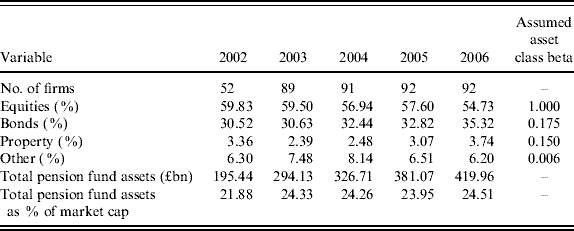
The data for this study are drawn from a number of sources – Moody's Rating Agency, Standard & Poor's Rating Agency, Worldscope Database, annual reports of FTSE companies, and London Business School (LBS) Risk Management Service. The analysis is carried out for those FTSE100 companies which operate a defined benefit pension plan. A panel framework is used covering the period 2002–06. Prior to 2002, few companies provided details of their defined benefit schemes in their annual accounts. (Although FRS17 was introduced in November 2000, it was not until year end 2002 that its impact reached most balance sheets.) Table 2 reinforces the issue of gradual transparency where it can be seen that in the first year of our sample, 2002, we were only able to obtain full information for 52 FTSE100 companies; thereafter the number jumps considerably and stabilizes at 92 for 2005 and 2006.
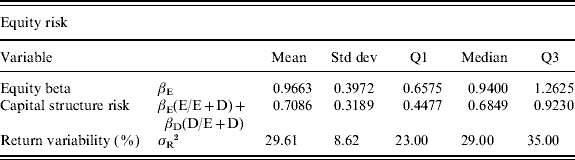
The hypothesis to be tested is that a higher pension plan risk translates into higher overall firm risk both in terms of a firm's equity risk and its corporate debt rating. The initial issue to be considered is the measurement of the dependent variable, variously defined as either equity risk or corporate debt risk. In the equity risk specification, three alternate measures are considered. The first, and theoretically most appropriate, is that of capital risk structure and is defined as

The equity beta βE is taken from the LBS Risk Management Service. For a small number of companies βE was not available from this source and consequently we estimated βE using five years of daily data and employing the Dimson (Reference Dimson1979) adjustment with one lag and no lead to control for non-synchronous trading.Footnote 1 Following Jin et al. (Reference Jin, Merton and Bodie2006) a value of 0.175 was taken as the beta value for debt βD.
To test the robustness of our empirical results we also report findings based on two alternate measures of the dependent variable: they are systematic risk and the variance of returns


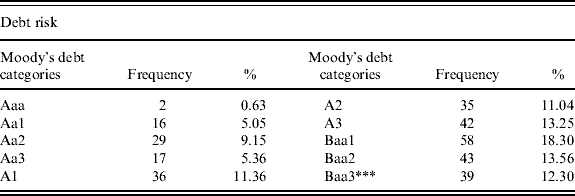
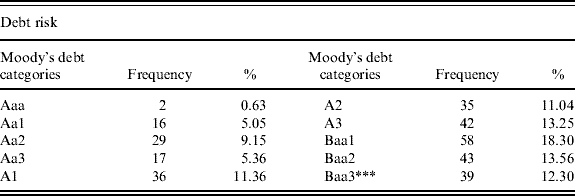
In the debt risk specification, the dependent variable was that provided by Moody's Rating Agency, and where a Moody's rating was not available and a corresponding Standard & Poor's rating existed, the latter rating was converted to its Moody's equivalent. Moody's assigns bond credit ratings of Aaa, Aa, A, Baa, Ba, B, Caa, Ca, C, and will also assign intermediate ratings at levels between AA and B resulting in a total of 19 categories. In this study, only the first ten rating categories are relevant with the highest risk category used that of Baa3. Debt obligations designated below the Baa3 benchmark are considered more speculative and are subject to higher levels of credit risk. In Table 1, a profile is presented of the equity and debt risk characteristics of the companies in the sample. The data reveal a relatively tight equity risk spread. Furthermore, we note that 20.19% of credit ratings are categorized as ‘safe investment with low risk of failure’ (Aaa to Aa3); 35.65% are viewed as ‘safe investment, unless unforeseen events should occur in the economy at large or in that particular field of business’ (A1 to A3); and 44.16% are viewed as subject to moderate credit risk and as such may possess certain speculative characteristics. (Baa1 to Baa3.)
Measures of equity and debt risk Note: *** None of the companies in our sample had a debt rating below Baa3 over the period analysed.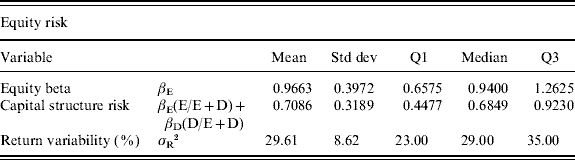
The key independent variable is that of pension plan risk. We utilize three alternate measures. These are:



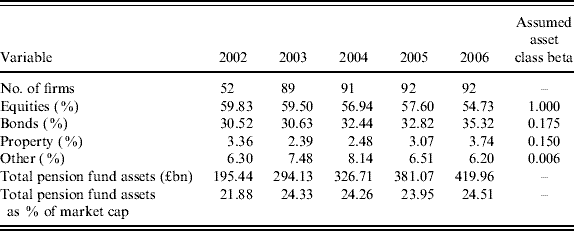
The first measure is guided by the work of Cardinale (Reference Cardinale2007) who suggested that UK bond market prices reflect corporate pension liabilities and what is important is the absolute size of liabilities and not pension deficits. The second is a version of that used by Franzoni and Marin (Reference Franzoni and Marin2006), with emphasis in this instance on whether the pension fund is in deficit or surplus. The third measure is that used by Jin et al. (Reference Jin, Merton and Bodie2006) and links directly to our key measure of equity risk, capital risk structure (equation (1)). Pension liabilities are taken as reported in terms of FRS17/IAS19 and are the projected benefit obligation which represents the actuarial present value of vested and non-vested benefits earned by an employee for service rendered to date plus projected benefits attributable to salary increase. The pension assets are represented by the contributions made by the sponsoring firm over the life of the defined benefit scheme. These contributions tend to be invested in traded assets and are valued at their market prices. In the Jin et al. (Reference Jin, Merton and Bodie2006) measure of pension risk, the pension assets and liabilities are weighted by average systematic risk exposure. The systematic risk exposure from pension plan assets average βPA is measured by making certain assumptions about the beta risk of the various categories of assets (equity, bonds, property, cash, and other). In Table 2, we provide summary data for the pension plan assetsFootnote 2 allocations for the sample companies plus the assumed β for the various classes.Footnote 3 It is clear from the asset allocations in Table 2 that there has been a rebalance of pension plan assets away from equity and towards debt. This may be explained by the fact that recent legislative changes have clarified that pension liabilities are a form of corporate debt and that available evidence suggest mismatched investment strategies in pension schemes reduce shareholder value.Footnote 4 With regard to the systematic risk of pension liabilities βPL, we adopt a similar approach to that followed by Jin et al. (Reference Jin, Merton and Bodie2006), although in this instance UK bond data are utilized. Monthly closing prices for a 30 year UK treasury bond and the FTSE all-share index were employed in a market model regression to estimate a value for βPL. Using the in-sample estimate of 60 months data (i.e. the 60 months from 2002 to 2006), the pension liability is βPL=0.38. Also calculated were five yearly estimates using 60 months rolling data up until the end of the prior years. The average of these yearly estimates from 2002 to 2006 is βPL=0.28. In the empirical analysis, we report findings on the basis of these two values and it will be noted that our findings are quite sensitive to the chosen value of pension liability systematic risk.
Asset allocation
Although findings for univariate specifications between the various measures of pension and firm risk are presented, it is important to assess whether the pension risk variable is merely a surrogate for other variables which might impact upon firm risk. There are a plethora of studies exploring the equity risk of firms and consequently an equally large number of control variables viewed to be important. Young et al. (Reference Young, Berry, Harvey and Page1991) suggest that liquidity and capital intensiveness are of importance. Chan et al. (Reference Chan, Lakonishok and Sougiannis2001) argue that research and development and advertising expenditure have a systematic impact upon stock returns. Rosett (Reference Rosett2001) highlights the importance of leverage, while a majority of studies point to the importance of firm size, profitability, and growth (see for example, Gombola and Ketz, Reference Gombola and Ketz1983). Data for a small number of these variables were not available, notably research and development and advertising expenditure, while others, such as liquidity and capital intensiveness, did not prove significant.
In prior studies of corporate debt ratings factors, a variety of control variables are also deemed to be of importance. Asset size, systematic risk, profitability, and leverage have all proved statistically significant control variables (see, for example, Kaplan and Urwitz, Reference Kaplan and Urwitz1979; Iskandar and Emery, Reference Iskandar and Emery1994; Carroll and Neihaus, Reference Carroll and Niehaus1998). In general, these studies suggest that larger, more profitable firms with lower levels of systematic risk and leverage have superior credit ratings.
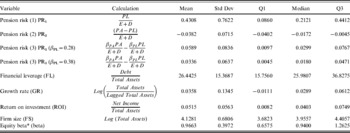
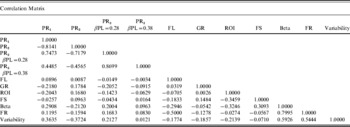
In Table 3, we present a profile of all the explanatory variables which proved to be of importance in at least one of our equity and debt specifications. A correlation matrix is also detailed. A key feature of this correlation matrix is that it highlights that the various measures of pension risk are strongly correlated.
Independent variables


Note: * Equity beta appears as an independent variable in the credit rating analysis only.
4 Estimating relationships
In this section, we derive specifications which link equity risk to pension risk and credit risk to pension risk. We establish univariate specifications and, drawing from the literature, multivariate specifications which include relevant control variables.
Equity specifications
For illustrative purpose consider a specification involving our primary measure of equity risk, capital structure (equation (1)), and the linked measure of pension risk denoted PR3 (equation (6)). Following Jin et al. (Reference Jin, Merton and Bodie2006), we define the ‘integrated’ company's balance sheet as

OA is operating assets and the other terms are as before. The company's financial capital (E+D) can then be found by rearranging (7), that is E+D=OA+PA – PL.
Therefore, the company's capital structure risk can be reworked in the following form

or
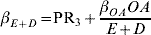
and the estimating equation can then be specified as

b represents the sensitivity of firm risk to firm pension risk and α represents the part of the expected firm risk that cannot be picked up by the pension risk. The expectation is that b is positive and close to one.
Equation (10) is estimated in panel data form with fixed effects at industry level controlled for by incorporating a dummy variable for each one-digit Standard Industrial Classification (SIC).
Petersen (Reference Petersen2006) notes that in corporate finance and asset pricing empirical studies, researchers are often confronted with panel data where the residuals may be correlated across firms or across time,Footnote 5 and OLS standard errors can be biased. Historically, the two literatures have used different solutions to this problem. Corporate finance has relied on clustered standard errors (Rogers, Reference Rogers1993), while asset pricing has used the Fama-MacBeth (Reference Fama and MacBeth1973) procedure. Petersen (Reference Petersen2006) shows that in the presence of an unobserved firm effect both OLS and the Fama-MacBeth standard errors are biased downward and only clustered standard errors are unbiased as they account for the residual dependence created by the firm effect.Footnote 6 In the results section we report findings using both approaches. As is expected the Fama-MacBeth standard errors tend to be generally smaller, leading to a marginal improvement in the significance of coefficient estimates.
Earlier it was emphasized that it is important to assess, through the introduction of control variables (see Table 3), whether pension risk is merely a surrogate of other variables, which might impact upon firm risk. This point is reinforced through examination of equation (9) and the estimating relationship, as given by (10). The regression specification only gives an unbiased estimate of the impact of pension risk on capital structure risk if operating asset risk is uncorrelated with pension risk. This is unlikely to hold because as Jin et al. (Reference Jin, Merton and Bodie2006) note: ‘Much of the risk in the pension fund comes from its equity holdings and firm human resource policy, and these are potentially highly correlated with the firm's own operating asset risk.’
In this analysis we also consider the extent to which pension risk impacts upon credit risk as proxied by debt ratings obtained from Moody's and Standard & Poor's. Given the ordinal nature of the dependent variable, a random effects ordered probit model was employed in the estimation. Underlying the estimating process is the assumption that the rating agency calculates an index which measures expected default loss with higher expected default loss corresponding to lower values for the index and the index in turn is divided into intervals with the lowest interval receiving the lowest debt rating and so on. Each rating, as detailed in Table 1, is given an ordinal assignment ranging from 0 which equates to the highest risk rating, Baa3, to 9 which equates to the lowest risk category, Aaa. Assuming that the unobservable index is a linear function of observable firm characteristics (including pension risk) and the error term is normally distributed, the following specification results.

In this instance, b represents the sensitivity of the credit rating, CR, to pension risk, PR, variously measured. The model is parameterized in such a way that the intercept is already implicitly contained by the estimation cut-off points. Given the categorization of credit risk, a negative relationship is expected. Random effects ordered probit panel models are estimated, controlling for fixed effects at the industry level using one digit SIC. Findings are reported for univariate and multivariate (includes control variables) specifications.Footnote 7
5 Empirical findings and interpretation
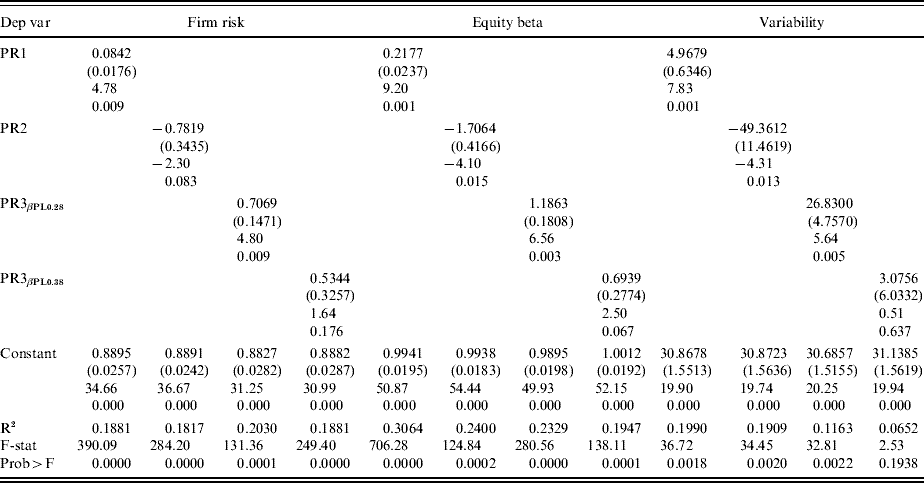
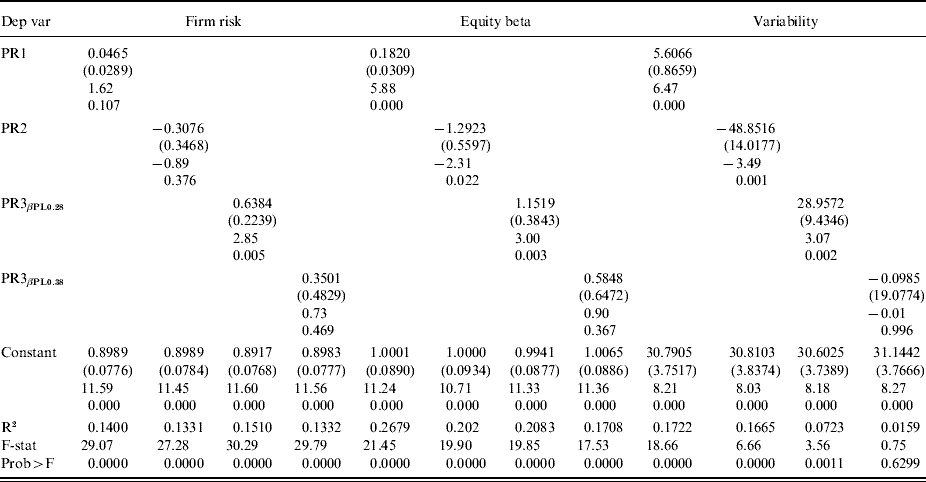
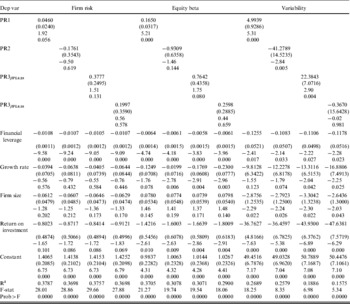
In Tables 4 and 5, empirical findings of various univariate specifications are detailed. In Table 4, the Fama-MacBeth methodology is used to compute robust standard errors while in Table 5 Rogers clustered standard errors are employed. In broad terms, a similar picture emerges from both tables. The coefficient estimates on PR1 (pension risk metric derived from Cardinale, Reference Cardinale2007) and PR3 (based on Jin et al., Reference Jin, Merton and Bodie2006) are generally positive and significant, indicating that higher levels of pension risk feed into higher levels of capital structure risk, systematic risk, and return variability. The exception to this uniform picture is when PR3 is based on the pension liability upper limit βPL=0.38. In both Tables 4 and 5, the specifications based upon βPL=0.38 do not pass the F-test of joint significance of regressors at acceptable levels of significance. With respect to PR2 (risk measure derived from Franzoni and Marin, Reference Franzoni and Marin2006), the coefficient estimates are negative as expected, although two of the six estimates are not significant at normal levels.
Univariate analysisFootnote * – Fama–Macbeth standard errors
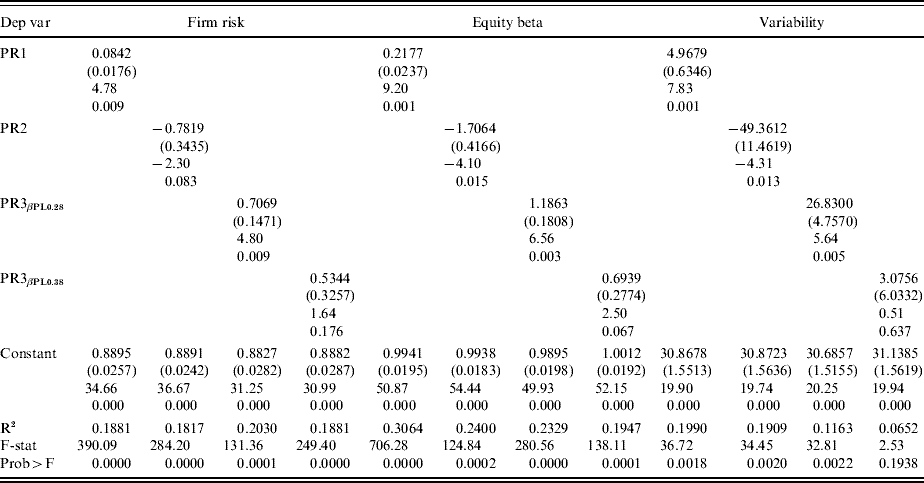
Note: * Coefficient, std error (in parentheses), T-statistic, P-value.
Univariate analysisFootnote * – Rogers clustered standard errors
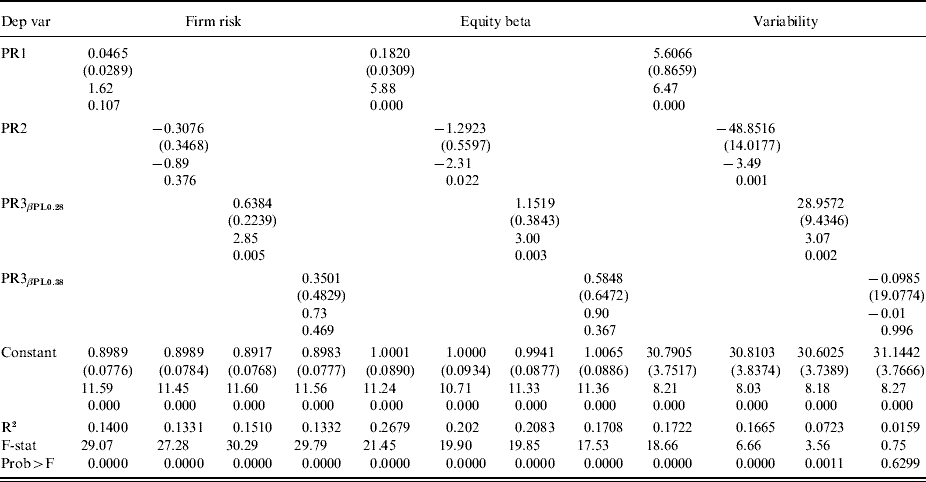
Note: * Coefficient, std error (in parentheses), T-statistic, P-value.
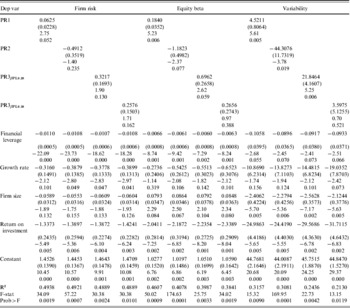
In Tables 6 and 7, we explore whether the pension risk variable, variously measured, is merely a surrogate for other variables which may impact upon company equity risk. In both tables, all specifications pass the F-test of joint significance of regressors at the 5% level of significance or better. Four control variables proved significant in this aspect of the analysis (financial leverage, firm size, firm growth, and the return on investment). The coefficient estimates on financial leverage, firm growth, and the return on investment were consistently negative and mostly significant, with the incidence of significance more pronounced in Table 6 where standard errors were calculated using the Fama-MacBeth methodology. Overall, these coefficient estimates suggest that FTSE100 companies which were more levered, more profitable, and faster growing had reduced levels of capital structure risk, systematic risk, and return variability. The other control variable, firm size, was also negative when the dependent variable was either capital structure risk or return variability, but positive when the dependent variable was systematic risk. In this latter instance the larger the FTSE100 company, the greater the equity β. (In Table 7, many of the firm size estimates were not statistically significant at acceptable levels of significance.)
Multivariate analysisFootnote * – Fama–Macbeth standard errors

Note: * Coefficient, std Error (in parentheses), T-statistic, P-value.
Multivariate analysisFootnote * – Rogers clustered standard errors

Note: * Coefficient, std error (in parentheses), T-statistic, P-value.
The pension risk estimates in Tables 6 and 7, relative to those in the previous two tables, are similar in sign, slightly smaller in absolute magnitude and a marginally greater number of the pension risk estimates (eight out of 24) are not different from zero at acceptable levels of significance. It is also the case that six of the insignificant estimates relate to the PR3 metric calculated using the pension liability upper limit βPL=0.38. This confirms that βPL assumptions materially impact upon our findings with respect to this risk measure. When the pension liability lower limit, βPL=0.28, was used to calculate PR3 the resultant estimates, detailed in Tables 6 and 7, for the capital structure risk specification were 0.3217 and 0.3777. This implies that one unit of pension risk increases capital structure risk by 0.3217–0.3777 units. This is decidedly below the earlier hypothesized 1-to-1 relationship. That the coefficient is lower than expected may be due to differing and/or opaque actuarial assumptions blurring the relationship between pension and firm risk. It may also in part be due to the quasi-underwriting role provided by the pension protection fund or it may centre on accounting practice which now recognizes actuarial gains and losses direct in equity and there is deferred taxation on the actuarial gain or loss with this charged straight to reserves.
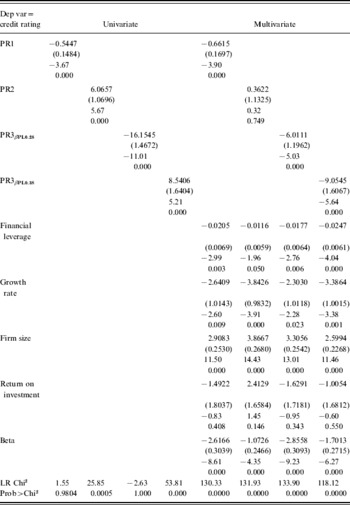
In Table 8, we present both univariate and multivariate results for the random effects ordered probit specifications. The dependent variable is the company's debt rating, and, according to the integrated balance sheet perspective, the company's pension plan funding, in that it impacts upon the expected payoff to debtholders, can be expected to influence credit rating. As in the previous analysis of equity risk, industry fixed effects controls are introduced using the one digit SIC code. The non-linear nature of the ordered probit model restricts the range of adjusted standard errors that can be estimated. Therefore, we report in Table 8 the ordered probit random effects model with one-dimensional clustering based on firm identity.
Random effects ordered probit analysis

In the univariate specification, the coefficient estimates on all pension risk metrics are significant. For the most part the results are as expected, that is the greater the pension risk, the greater the probability of obtaining a lower credit rating. This situation is consistent with a negative coefficient estimate for PR1 and PR3 and a positive coefficient for PR2. The exception to this uniform profile, as in the equity risk analysis, is when PR3 is estimated using βPL=0.38 and confirms the sensitivity of results based on this metric to the choice of βPL. Also evident from Table 8 is that two of the univarate specifications fail the likelihood ratio test of joint significance of regressors, indicating that the output lacks explanatory value.
In the multivariate models, the likelihood ratio test raises no concerns regarding joint significance of regressors. The coefficient estimates on the pension risk variables are all significant and have the expected signs highlighting that the greater is pension risk, the greater the probability of obtaining a lower credit rating. Three of the control variables are negative and significant at either the 1% or 5% level. These variables are financial leverage, asset growth, and systematic risk as measured by beta and imply that firms that are more levered, have faster asset growth, and have higher equity risk can be expected to obtain lower credit ratings. The performance variable, return on investment, does not prove significant while the firm size estimates are positive and significant at the 1% level, highlighting that larger firms have a greater probability of obtaining superior credit ratings.
6 Concluding comments
This study has examined pension plan risk, variously measured, and its impact upon both equity risk, variously measured, and debt ratings for FTSE100 companies over the period 2002–06. This period has coincided with the introduction of the pension protection fund, greater transparency, and standardization in pension accounting and increased efforts to disclose and harmonize actuarial assumptions. Over the period under investigation, the majority of defined benefit pension schemes of FTSE100 companies have been categorized as in deficit. In addition, it was noted that there has been a trend for pension plan assets to marginally shift away from equities and towards bonds. For the post-2004 period, when the pension protection fund was in operation, this shift is somewhat of a surprise because pension insurance may be viewed as providing the pension plan with a put option that can be exercised in the event of sponsoring plan failure, but moreover the insurance is also expected to create an incentive for the pension plan to take greater investment risk through a high-risk, equity-led investment strategy. This is not apparent for FTSE100 companies over the period. We argue that this may be because plan premiums are risk based or it may be because legislative changes have clarified that pension liabilities are a form of corporate debt and evidence suggests mismatched investment strategies in pension schemes reduce shareholder value.
In general terms, our analysis also indicates that for FTSE100 companies, over the 2002–06 period, pension plan risk does feed into firm equity and debt risk. This suggests that the market views the assets and liabilities of the company pension scheme as part of the assets and liabilities of the firm itself. Having made this point it is also the case that there is some sensitivity to model specification and the adjustment techniques utilized. More specifically, we note that the measure of pension risk proposed by Jin et al. (Reference Jin, Merton and Bodie2006) can result in quite divergent findings influenced by only relatively small variations in the assumed value of the systematic risk of pension liabilities. Where the correct sign was obtained, with respect to this measure, it was also apparent that the resultant estimate was significantly lower than one, raising doubt on the hypothesized 1-to-1 relationship between pension risk and capital structure. This in turn raises the spectre that there may be a weakness in the informational efficiency of equity markets which may be caused by shadows cast on the market by the plethora of accounting rules and actuarial assumptions.
Pension risk was also demonstrated to be factored into credit ratings with the analysis highlighting that the greater the pension risk, the greater the probability of obtaining a lower debt rating. From a rating agency viewpoint, this is positive news, particularly at present when agencies are being criticized for a perceived failure to reflect sub-prime mortgage problems in firm-specific ratings. Having made this point, our analysis offers only a relative perspective and provides little insight into whether ratings agencies systematically under- or overestimate pension risk in their debt ratings.
In terms that are more general, this analysis, in that it reveals some evidence of a weakness in informational efficiency, particularly in the manner in which pension risk is reflected in equity risk, suggests the need for enhanced transparency in the actuarial and accounting frameworks within which defined benefit pensions are cast. This is a task which the Pensions Regulator is best placed to undertake.
Finally, the question arises whether the findings in this study can be generalized for firms not as actively traded as those in the FTSE100 and for countries outside the UK. An answer can only be ascertained through extending the data analysis. Having emphasized this it would, however, be our expectation that where pension structure exist comparable to the UK then similar relationships between pension risk and financial market risks would emerge. It is therefore unlikely that a uniform picture will emerge across, for example, all European countries. As noted in Mercer (Reference Mercer2008), Europe is historically divided into sectors that either have very strong defined benefit traditions (Belgium, Germany, Norway, Portugal) and strong state pensions or have very limited defined benefit pensions (Austria, France, Luxembourg Switzerland, and most East European countries).