

Although it has long been accepted that Henry VIII was a ‘conservative’ in matters of religious ritual, comparatively little has been proposed to describe the salient characteristics of that conservatism in detail.Footnote 1 The king's views on numerous points of doctrine have been well highlighted in historical writing, whether dealing with the eucharist, clerical marriage, private Masses, prayer for departed souls, pilgrimages, shrines, images, icons, relics or auricular confession.Footnote 2 It has also been well acknowledged that Henry showed respectable prowess as a scholar, involving himself integrally with his bishops in the formulation of religious policy before and after the break with Rome. Of course, the regime's successive acts of religious reform from 1533 have been subjected to a broad range of historical interpretations.Footnote 3 But the king's unwavering advocacy of what repeatedly he calls the ‘honest lawdable and tolerable ceremonies usages and customes of the church’ has received disproportionately less attention, even though the balance of primary source material suggestive of his position is considerable.Footnote 4
The most fundamental controversies of the Reformation, it is true, centred on doctrinal debate. Ritual tradition occupies a comparatively small part of the dialectic, much less the details of its precise conduct. What is more, when doctrine and ceremonial are dealt with as matters of official policy, they tend to be handled in disconnection from one another – a point historically confirmed through the determinations of church councils, convocations, synods and approved formularies of faith. There is of course some incongruity to this distinction inasmuch as corporate ritual represents probably the most visible suggestion of doctrinal consensus. In dealing with issues of orthodoxy, historians of the Reformation tend to focus first on doctrinal debate; the musicologist goes straight for the documentation of ecclesiastical ‘rites’ and ‘uses’ – the domain of sacred polyphony. The gulf inevitably resulting from this methodological disjunction has much yet to reveal.
While musicologists have deplored a lack of evidence for the early Tudor period, historical scholarship has enjoyed a comparative wealth of it. Yet it would be rash to conclude that an abundance of primary source material necessarily eliminates historical ambiguity. Even a windfall discovery of musical evidence for this period might not fully address the analytical priorities established thus far by historical musicologists. For at the heart of primary source engagement in Reformation research continues the task of disentangling accretive layers of historical interference and confessional bias.Footnote 5
Although polemical literature critical of early Tudor church polyphony has been highlighted in musicological narratives, this study offers for the first time evidence of the parallel conservative view. It will bring us to a reconsideration of the document Ceremonies to be used in the Church of England, commissioned in April 1540 and drafted by a committee of bishops selected by Henry VIII. Although the project did not reach completion or official sanction, Ceremonies contains the only extant rhetoric coming from the hierarchy of the Henrician church to provide explicit validation for music. Thus far, that brief passage has received cursory attention at best. Despite this, its precise wording in first-draft form was intended to allow full licence for the continuance of elaborate polyphony. In a timely way, it derived from a conventional topos in the medieval tradition of ritual exegesis – still part and parcel of the ceremonial ethos of Henry VIII's church.
That ethos, however, cannot usefully be assessed through appeals to Reformation theology and historiography alone. The first part of this study introduces new evidence in a reconsideration of the musicological narrative of Henrician ritual reform; the second part offers a broad (and inevitably condensed) overview of the relevant patristic and medieval literary precedent from which that evidence derives, as revealed in citations ranging from St Augustine to Durandus of Mende. Analytically, it undertakes an etymological re-examination of key terms that surface again and again in exegetical explications touching on music. These terms, when understood in their proper literary and historical contexts, provided the rhetorical means through which the clergy could justify and authorise expansions of musical practice in divine worship; the third part brings all of the foregoing evidence together, demonstrating its influence on the musical passage in the Henrician Book of Ceremonies, with an account of the politics that brought about the manuscript's genesis and subsequent suppression.
My approach to reading the literary evidence presented in this study, therefore, has less to do with scrutinising the subtleties of surface argument than with considering how writers supported their positions with patristic and scriptural citations in marginalia. These citations constituted the authority around which all doctrinal argument revolved. When an author put forward a nuanced view about some aspect of the eucharist or a contentious opinion about ceremonial propriety, this was normally supported by a stereotypical set of literary references linked with the topic at hand. This had been the sine qua non of theological exposition in its variegated forms for over a millennium. During the religious upheavals of the sixteenth century, however, it became more and more typical for writers on opposing sides of the broadening confessional divide to cite identical passages from Scripture to argue contradictory views of the same doctrine. Naturally, the subject of music was bound to surface within that dialectic from time to time; but in comparison with other more fiercely contested issues (such as the sacrifice of the Mass), even the most thoroughgoing criticism of church polyphony rarely involved sophisticated theology or complicated arguments.
The conclusions advanced below come clearly into view when one takes into account these contending patterns of biblical and patristic allusion. Theological treatises of the high Middle Ages offer an array of citations that reveal the long history of scriptural exegesis, bringing to light the archetypical topoi that endured successive eras of church history. Scriptural and ritual exegetes offer remarkable continuity in their literary method from the ninth to the fourteenth centuries. Accordingly, ecclesiastical historians have inherited a reasonably safe domain through which to examine key documents with a measure of rhetorical consistency – often across unwieldy periods of change.
I. SACRED POLYPHONY AND HENRICIAN REFORMATION HISTORIOGRAPHY
In dealing with Henry VIII's Reformation, virtually all musicological narratives have begun with Erasmus. His acerbic criticism of English sacred polyphony has been held up as a watershed that would heavily influence subsequent musical reform. The issue of defining importance here, however, involves not what Erasmus had to say, how he said it, or the indefinite degree to which we can measure his influence on polyphonic style under Henry VIII. Rather, it is the biblical excerpt upon which his polemic was founded: 1 Corinthians 14, especially verses 15 and 19:
v. 15: Quid ergo est? orabo spiritu, orabo et mente; psallam spiritu, psallam et mente.
v. 19: sed in ecclesia volo quinque verba sensu meo loqui, ut et alios instruam, quam decem milia verborum in lingua.
Reformers of all doctrinal colours cited variously from the same chapter when arguing against the old ceremonial traditions in favour of divine service and music in the vernacular tongue. Indeed it would not be going too far to suggest that it was the most ubiquitously cited passage in polemics aimed against church music in Western Christianity on the eve of the Reformation. It seems a matter of common sense, then, that traditional views on the subject might be found through looking at the corresponding conservative commentaries dealing with the same biblical excerpts.
The cleric in the English church who offers such evidence is Richard Sampson, Dean of Henry VIII's Chapel Royal from 1522 to 1540. Sampson's importance for our understanding of ritual and musical practice during this period has largely been overlooked.Footnote 6 Musicologists first took note of his name on the basis of music manuscript evidence dating from about 1516 that seemed to indicate his status as a composer. Although this supposition has largely been accepted, it is a highly fragile claim at best.Footnote 7
It was nevertheless under the same assumption that Paul Doe first speculated about Sampson's influence on musical reform within the Chapel Royal in a seminal article published in 1969.Footnote 8 Doe began by summarising the contemporary musicological view: ‘The progress of the Reformation during the last decade of Henry VIII's reign has been described in many histories of music, but always from the standpoint of an embryonic vernacular liturgy.’Footnote 9 He focused instead on the Latin repertory and its apparent stylistic susceptibility to ‘Lutheran’ influence.Footnote 10 More recently, Robin Leaver's work on Miles Coverdale has highlighted parallel influences on private devotion in the vernacular tongue.Footnote 11 The chief obstacle to hypotheses emphasising ‘Lutheran’ influence on musical and ritual style in the Henrician church – and especially within the Chapel Royal – is the rather plain reality that Henry himself despised Luther. Despite the apparent spread of ‘Lutheran’ ideas within the universities and among English divines, the term as it was contemporaneously understood is problematic: it signified social and political discredit. Doctrine was still a relatively fluid commodity, even where leaders of ‘newer sects’ seemed to prevail in putting forward rival interpretations, provoking polemical reaction from establishment ‘conservatives’. Of course, it has for some time been acknowledged that the terms ‘Catholic’ and ‘Protestant’ are no less problematic.Footnote 12 Doctrinal novelty survived through shrewd political alliance and the meticulous fostering of consensus. As Peter Marshall has observed, ‘Henry's curious Reformation looks distinctly like the product of a pre-confessional age’.Footnote 13 That the English Reformation might acknowledge direct doctrinal and ritual inspiration along explicitly ‘Lutheran’ lines would have been abhorrent to the KingFootnote 14 – notwithstanding any apparent resonances evinced in government acts uncritically labelled by past historians as ‘Lutheran’.Footnote 15 Hypotheses emphasising musical experimentation with an ‘embryonic vernacular liturgy’ were at least supported by the evidence of the Wanley manuscripts, which, although not securely datable, include prayers found in late-Henrician primers.Footnote 16
Regardless of the speculative bias, however, virtually all music historians have seized on the Act of Royal Supremacy (1534) as the moment from which polyphonic experimentation of various types began. Peter le Huray emphasised that the crown's break from Rome released the king's chapel from ecclesiastical jurisdiction, ‘to make it pre-eminent’.Footnote 17 The Chapel Royal choir of the later 1530s through to the end of Henry's reign, therefore, became the ‘obvious test-bed for new ideas about music’.Footnote 18 Drawing attention to Cranmer's archiepiscopal authority, Doe introduced Sampson into the scene as Dean of the Chapel Royal, pointing out his role as bishop in Cranmer's neighbouring diocese of Chichester. As Sampson was ‘evidently a competent musician as well’, a liturgical alliance seemed plausible between the two churchmen. The purpose of that alliance was interpreted on the weight of contemporary Reformation historiography coming from A. G. Dickens – a perspective that has (since the 1970s) been thoroughly revised. It saw the ‘progress’ of the king's Reformation as a foreseeable trajectory brought about by the inevitable influences of ‘Protestantisation’.Footnote 19
Doe's account emphasised Cranmer as ‘the key figure in any question of liturgical experiment’.Footnote 20 But while it is true that the Archbishop was pushing tirelessly for liturgical reform to the end of Henry's reign, his actual authority and influence have consistently been overstated in musical histories of the period. Cranmer's spiritual jurisdiction and direct access to the monarch were certainly eclipsed from 1535 by Henry's appointment of the Vice-Gerent in Spirituals, Thomas Cromwell.Footnote 21 Moreover, Cranmer held limited authority at best within the royal household chapel, particularly from 1536, by which time Richard Sampson had been elevated to the episcopate.
In 1534 for example, Sampson's authority was overridden by Cranmer in order to bring the controversial evangelical Hugh Latimer into the chapel's preaching rota on Wednesdays during Lent, with another slot allotted to Nicholas Shaxton, one of Queen Anne's reformist chaplains. Sampson's resentment over this intrusion showed clearly in a letter to Cranmer in which he emphasised his rank as ‘a poor member’ of Convocation – lacking in episcopal status.Footnote 22 But after Sampson's elevation to the See of Chichester in 1536, the tables were turned. While preaching had been the issue between the two churchmen in 1534, ceremonial was at the centre of contention from 1537. Cranmer apparently exercised no control over liturgical observance in the Chapel Royal when he expressed exasperation in August 1537. He did not appeal to the monarch directly, as had been the case four years earlier. Rather, his chosen avenue of communication was indirect, through the Vice-Gerent, Cromwell:
my lorde, if in ye courte you do kepe such holly dayes & fastynge dayes as be abrogated, when shal we p(er)swade ye people to ceasse fro(m) kepynge they(m)? ffor the kynges own howse shal be an example unto al ye realme to breake his own ordinance.Footnote 23
While Sampson and Cranmer had indeed been working together on ecclesiastical commissions by the late 1530s, the king had contrived that arrangement not because they saw eye to eye on doctrine, but because they held conflicting visions of reform. Henry regularly created committees made up of opposing religious partisans in equal numbers.Footnote 24 Ostensibly, it presented the public image of a king championing the ‘middle way’ in religion. But when particularly contentious issues were involved on which the king was not willing to negotiate – such as traditional ceremonial, communion in both kinds, prayers for the dead, clerical marriage and private Masses – the same tactic found deadlocked committees referring final decisions back to his authority.Footnote 25
The evidence introduced below confirms that Dean Sampson, in accordance with contemporary orthodoxy, proscribed the singing of music set in the vernacular tongue, and (unquestionably by extension) ‘Lutheran’ approaches to polyphonic style. Three sources verify this conclusion: a holograph letter in the British Library (1538), Sampson's commentaries on the first fifty psalms (1539), and his paraphrases on the epistles of St Paul to the Romans and the Corinthians (1546). The theology contained within these hitherto neglected sources variously articulates the religious policy of the post-supremacy Henrician regime on a variety of subjects. When the implications of this evidence are considered thoroughly, new light is shed on the musical paragraph in the first extant draft of the Henrician Ceremonies to be used in the Church of England (1540).
1 Corinthians 14: religious ritual and the traditionalist view
In the diocese of Chichester where Sampson was bishop, Cromwell's operatives were zealous to push the limits of ceremonial reform during the spring of 1538, advocating services in the vernacular, possibly to include the Mass.Footnote 26 With Sampson's energies absorbed largely in matters at court, Cromwell used his agents to implement reform through assertive means. Conservative resistance from one parish curate was fierce, and his behaviour (conveniently for Cromwell) reflected negatively on Sampson. As many evangelicals were tacitly encouraged to be bold in interpreting and implementing new injunctions – building on direct support from Cromwell himself – so it was conversely the case with provincial traditionalists aligned with counterparts higher up the conservative ladder of authority.
In Rye, conflict arose between a group of evangelicals and their conservative curate. The cleric had reputedly been railing against the injunctions of 1538 and continued to observe abrogated feast days. While Rye had been steeped in religious traditions connected with miracles attributed to Henry VI, it had also produced an enclave of evangelical activity from the mid-1530s. After the passing of the abrogation act of 1536, Rye nevertheless continued to keep the feasts of St Anne, the Transfiguration and the Holy Name, with ‘solemn singing, procession, decking of the churches’.Footnote 27 Moreover, a letter to Cromwell from angry evangelicals in 1538 added the inflammatory grievance that ‘the bishop of Rome has not been preached down by our curate since the being of [Bishop Sampson] with us’.Footnote 28
Sampson received a letter on 17 August from a certain Mr Welles, an embattled priest who had just stepped into the melee. Describing his difficulties with zealous reformers, Welles asked Sampson for guidance. Replying four days later, the Bishop of Chichester advised:
wheras you writ / that you enterprised not to sing any s[er]uice opinly in the chirche / in the Inglise tong / I am so moch the more glad / praying you / ffor the common quietnesse to fobeare ony such nouellities / tyll it shall pleas the kinges maiestie / to declare his pleassor.Footnote 29
The conflict at issue had been a source of frustration on both sides of the confessional divide for a year. The previous summer, the popular but recently abrogated feast of St Lawrence was celebrated in the king's chapel. Infuriated by this, Cranmer sent a letter (cited above) to Cromwell deploring what he saw as a widespread disregard of religious reforms, finding the people ‘very obstinately giuen to obserue and kepe w(i)th solempnitie the halidayes, lately abrogated’, suspecting that they were ‘animated therunto by thair Curates’.Footnote 30 Sampson's advice to Mr Welles continued, explaining the rationale behind his counsel:
The ministres off the chirche in all places / both with the latins and grekes / hath song and seyd there offices / or prayers / in the latin / or greke grammaticall tong / and not in the uulgare / the people hath prayed a parte / in such tonge os they wolde / And so is it a commune prayer off the ministres and the people together …Footnote 31
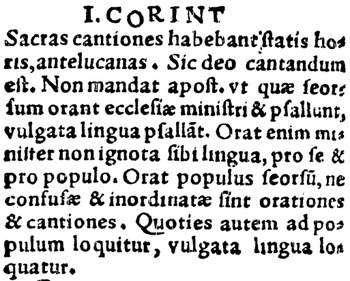
The same perspective is revealed in Sampson's ‘brief explanations’ of St Paul's epistles, printed eight years later while he was Bishop of Coventry and Lichfield. Well aware of the competing rhetoric, Sampson offered an interpretation of 1 Corinthians 14 in terms compatible with his practical advice to Welles (Figure 1):
The apostle [Paul] does not command that the ministers of the church making their prayers in song separately should sing in the vulgar tongue. For the minister prays in a language not unknown to himself, both on his own behalf and on behalf of his people. The common people pray apart so that their prayers and songs shall not be confused and disordered.Footnote 32
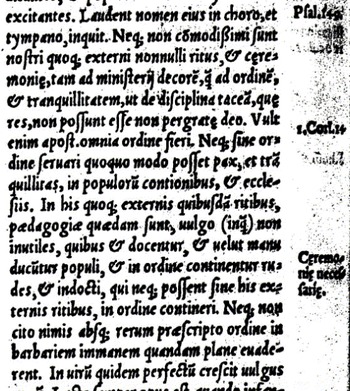
Of particular interest is Sampson's implication that public prayers in the vernacular tongue might compromise the social order of the church. In his letter to Welles, concern was clearly centred on maintaining ‘the common quietness’, and hence Sampson's relief that no significant ‘novelties’ had been introduced. His language reveals a medieval view of the clerical estate. Popular religious belief held that prayers carried apotropaic power. The priest, as the intermediary of corporate devotion, brought the diversity of lay ritual gesture and private utterance into unity so that prayers were not raised in disorder. Traditional ecclesiastical ceremonies were ultimately fitting, according to Sampson, in that they supported ‘the worthiness of the ministry’, as well as ‘order and tranquillity’ (Figure 2).Footnote 33
Sampson's ‘short explanations’ interpolated in 1 Cor. 14: 15. STC 21678, fol. 217v. Reproduced by kind permission of the Syndics of Cambridge University Library

Sampson's commentary on Ps. 12, citing 1 Cor. 14. © Bodleian Library; STC 21679, fol. 57v. Used by permission

The Henrician church's view of social order, like its medieval forebears, was a culturally pervasive model: it did not make many of the now familiar a priori distinctions between the ‘sacred’ and the ‘secular’.Footnote 34 There were definitions for each, but as spheres of influence, their operation was regarded as concentric. All facets of society combined to form a unitary reflection of the heavenly order. In its Henrician guise, this perspective diverged from medieval precedent only in contemporary emphases dealing with authority and obedience.Footnote 35 Sampson makes this idea clear in a short defence of church ceremonies in his exposition on the twelfth psalm. Rites and ceremonies – both ‘civic’ and ‘ecclesiastical’ – are defined without distinction from one another. Citing Paul (again from 1 Cor. 14), who ‘wishes that all things be done with order’, Sampson stresses that ceremonies are of great utility ‘both in the assemblies of the people and in the churches’ (Figure 2).Footnote 36 He then continues:
And in these certain external rituals, there are certain pedagogical elements, useful (I say) for the multitude, by which the people are taught, and as it were guided by hand, and the uncultivated and unlearned are kept in order, who could not be kept in orderwithout these external rituals. Nor would they tarry, without a prescribed order of things, to pass over into a kind of frightful barbarity …Footnote 37
Sampson's letter to Welles, then, upheld more than a convenient rhetorical platitude. Of all the formal vehicles of public order, religious ceremonies were arguably the most pervasive. Even royal entries and civic processions – ostensibly secular proceedings – had long been founded on liturgical roots and were understood by participants and spectators alike to be ecclesiastical events.Footnote 38 Church ritual was far more fluid as a cultural phenomenon than musical and liturgical historians have often supposed.Footnote 39
In 1536, an early threat to the public order emerged in northern rebellions, particularly the ‘Pilgrimage of Grace’, a movement decking itself in the symbols of traditional religion.Footnote 40 Pilgrimages and other medieval practices had taken a heavy pummelling in the Henrician reforms and in prefaces to the new primers sponsored by Cromwell's government. For parishes situated in bastions of radical reformism, especially in the south-east, the older rites and traditions were heavily attacked by zealots.Footnote 41 Indeed, the Act of the Ten Articles (1536) had opened the door to overt contention. Henry VIII showed immediate indignation when partisan conflict escalated beyond his control. He wrote an extended letter to Cranmer (directed to all clergy) opening with a rebuke, blaming the Archbishop for the ‘contrauretie of presching w(i)t(h)in this our Realme’, especially with regard to ‘honest Lawdable and tolerable Ceremonies usages and customes of the churche’.Footnote 42 Recalling the Ten Articles that had prescribed ritual continuity four months earlier, Cranmer was both admonished and reminded of the king's role in that process:
we wer constrained to putt o(u)r own penne to the boke and to conceyve certaine articles which were by all you the bisshopes and hole clergie of this our Realme in con(u)ocacion agreed on / as Catholique / mete and necessary to be by o(u)r Auc(o)r(iti)e for avoiding of all contencion …Footnote 43
Henry presumed that maintaining continuity in ritual tradition prevented resistance and disunity. He twice charged his priests and bishops with abusing the privileges of their estate by surreptitiously promoting a radical agenda in the name of his Reformation. The king put dissenters on notice. Disobedience going further unchecked by prelates would result in the ‘paine of deprivacion from yo(ur) bisshopriche’. Henry clarified his threat with legalistic precision, warning
that neyther in your private communicac(i)ons you shall vse any wordes that may sounde to the contrary of this our com(m)aundment n(o)r you shall kepe or retayne any man of any degree that shall in his wordes p(ri)vatilyes I(m)plly directly or indirectly speke in those matters of the ceremonies contenciously or contemptuously …Footnote 44
The same position was upheld in the famous proclamations of November 1538 and February 1539, the latter warning that the people should ‘neither by deed, word, nor behaviour despise these ceremonies … nor superstitiously abuse them’.Footnote 45 While church doctrine could undergo considerable change on an uncertain path to reform, ritual continuity was to be upheld because ceremonies were ‘matters indifferent which be [not] necessary to o(u)r saluacion’, but functioned rather as ‘motions to vertue’, and ‘allurementes to deuocion’.Footnote 46 This very point has been cited as evidence of incipient Protestantism; but as we shall see further below, it was just as essentially a medieval view. Naturally, however, the king's language opened capacious margins for interpretation. As George Bernard put it, ‘the rhetoric of abuses offered polemical opportunities both to conservatives … in the hope of retaining duly purified ceremonies themselves, and to radicals who welcomed criticisms of abuses in the hope that they would point the way to their total abolition’.Footnote 47 The king knew well that as principal vehicles of public order, religious ceremonies carried influence that went far beyond the physical confines of parish churches, abbeys and cathedrals. In the view of monarchy, church ritual could be as much an apparatus of ‘secular’ governance as it was the instrument of religious order and orthodoxy.
1 Corinthians 14: music and traditionalist theology
In a more literal interpretation of Paul's epistle, speaking in an unknown tongue signifies ‘ecstatic utterance’, or ‘speaking in tongues’. Sampson's treatment of this passage reveals a fundamentally important distinction: rather than reinterpret the ‘unknown tongue’ in 1 Corinthians 14 as the Latin that the unlearned medieval laity could not understand (as did most reformist polemics), Sampson follows Paul's gloss literally by focusing on whether or not the ‘ecstatic utterance’ could be interpreted by the minister – an ability which Paul considered to be a key pastoral responsibility. Only someone with the gift of interpretation, says Paul, will be able to expound upon ecstatic utterance in vernacular terms that unlearned members of the congregation can understand.Footnote 48 Even a man experienced with speaking in tongues does not necessarily understand his inspired expression in vernacular terms, although he is still well ‘edified’ in ‘heart and spirit’. Brethren with similar experience might undertake the exercise together as a group; but without the benefit of interpretation for laymen uninitiated in the practice, there can be no collective edification, because no one – including the pastoral leader – can put the sounds into common language that the entire assembly can comprehend.
Such points became the basis of criticism advanced by conservatives and evangelicals alike: uneducated priests, deacons, monks, nuns and friars in certain cases could not fully understand the Latin in the rites over which they presided. Humanist writers satirised this state of affairs by creating the stereotype of the cleric reluctant to reform his ritual conduct – the mumpsimus. Near the end of his reign, Henry made a notable reference to this linguistic parody in a famous speech delivered to Parliament at Christmas 1545.Footnote 49 Thus Sampson lamented in his letter to Mr Welles in Rye (1538): ‘I wold wische that all the ministres ware so well lerned that they undyrstode there offices s(er)vices or prayers which they sey in the latin tong.’Footnote 50
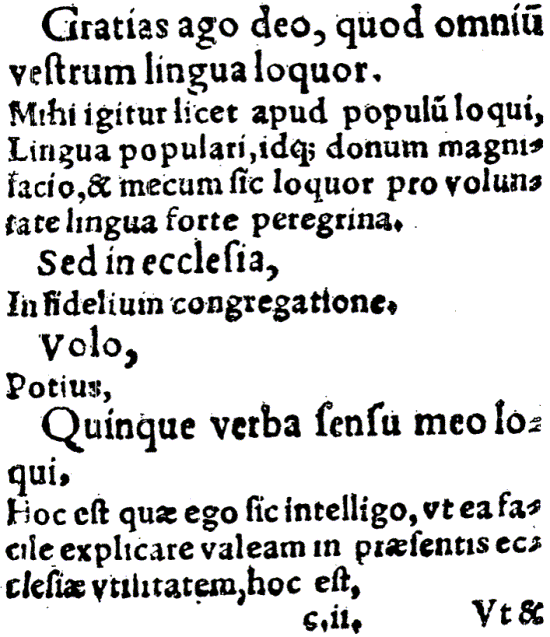
Sampson continues with Paul addressing leaders of the early Christian church in Corinth, giving thanks that both he and they enjoy the sevenfold gifts of the Holy Spirit. Interestingly, these gifts are reinterpreted in terms of Henrician social order and privilege, remembering that during certain periods, private access to the Bible in English had been restricted only to the clergy and learned aristocracy (Figure 3):
I give thanks to God, because I speak in the language of you all.
Sampson's gloss on 1 Cor. 14: 18. STC 21678, fol. 218r. Reproduced by kind permission of the Syndics of Cambridge University Library
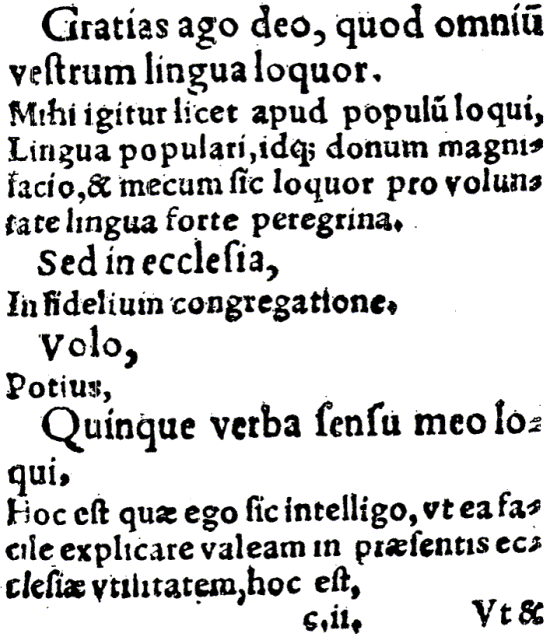
Therefore, it is granted to me to speak among the people in the language of the people.
But in the church,
in the congregation of the faithful,
I want,
rather,
to speak five words by my understanding.
This is that which thus I understand, that I may prevail to explain these things easily as useful for those present of the church …Footnote 51
The problem emphasised repeatedly by reformers was that incomprehension of an ‘unknown tongue’ contravened what they believed to be theprinciples of common prayer as it was first practised during the apostolic period of the church. This rhetoric was not at all new.Footnote 52 Well acquainted with these ideas, Richard Sampson constructed his own Pauline gloss on prayer, incorporating the role of ritual music.
‘Iubilare uel iubilum’
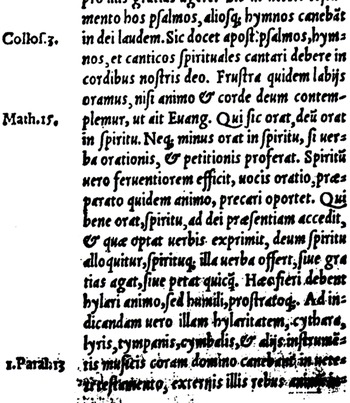
Prerequisite to the proper practice of prayer, says Sampson, is ‘a joyful spirit’. In his commentary on Psalm 12, he defines the practice of corporate prayer with a citation from Paul normally invoked to support the importance of music in the church. Against this he sets a cautionary verse from Matthew's gospel, typically cited by reformists (Figure 4):
The apostle teaches that psalms, hymns and spiritual songs ought to be sung to God in our hearts. For we pray in vain with our lips, unless we contemplate God in soul and heart, as the evangelist says. He who prays thus, prays to God in spirit.Footnote 53
Sampson's commentary on Ps. 12: 12. © Bodleian Library; STC 21679, fol. 57v. Used by permission

Briefly, Thomas Cranmer's homiletic ‘An Exhortation unto Prayer’, which prefaced the English Litany of 1544, demonstrates the evangelical utility of the aforesaid citation from Matthew. Cranmer's Exhortation was to be read aloud to congregations throughout the realm before processions – and one particular phrase could not have gone completely unnoticed by ecclesiastical singers:
We must take hede also, that we thinke not the vertue of prayer, to consiste in multiplyinge of manye wordes wythoute fayth and godly deuotion, thynkyng … that for our manye wordes or moche speakynge, we shal be herde of our heavenly father. … for God doth not regarde neyther the swete sounde of our voice, nor the greate number of our wordes, but the ernest ferventnesse and true faythfull deuotion of our hartes.Footnote 54
In marked contrast, Sampson characterises sung and spoken prayer as entirely laudable – even as a virtuous exercise. Accordingly, he prescribes a process through which the voice serves as an instrument to ‘pray well’ (Figure 4):
Nor does he pray any less in spirit, if he pronounces [audibly] the words of prayer and petition. Now the praying of the voice makes the spirit more fervent; it is with a well-prepared soul that one ought to pray. He who prays well comes in spirit into the presence of God, and expresses what he desires in words; he speaks to God in spirit, and in spirit offers those words … These things must be done with a joyful soul, but a humble one, and prostrated.Footnote 55
Having duly come ‘into the presence of God’, the ‘joyful soul’ is revealed in musical terms:
In order to show that joyfulness, in the Old Testament they used to sing before the Lord on the cithara, lyres, drums, cymbals and other musical instruments, revealing their spirits through those external things, and stirring up the people to that same joyfulness.Footnote 56
Sampson's advocacy of that joy is amplified in his commentary on Psalm 32, and it would find no affinity with Cranmer's ‘sober’ devotion:
you need to sing psalms in a loud voice; that is with firm belief, the whole passion of your mind, with the fervent ardour of the spirit, complete joy, from your whole heart, your whole mind and your whole soul … sing psalms to God with such happiness of soul, such emotion, such ardour that you are unable to explain it with words.Footnote 57
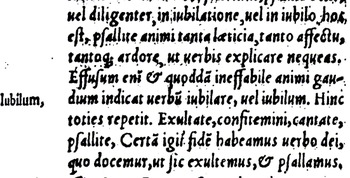
Following directly in the tradition of St Augustine's exposition on the same psalm – which crucially forms the basis of the second part of this study – Sampson deploys the much-repeated terms upon which explications of this ‘effusive and ineffable joy of the soul’ ultimately rest: ‘iubilare uel iubilum’ (Figure 5).Footnote 58 Historically, as we shall see, these words had come to represent a state of awakened spiritual fervour that was vaunted by ritual commentators of the high Middle Ages. Importantly, that fervour came not through the recitation of edifying words, but from a source that lay beyond the capacity of human intellect and reason. Taken together with his paraphrase of 1 Corinthians 14 where the common people could be edified even if they did not fully understand the priest's Latin, Sampson's advocacy of a prayerful state of being – defined by a joy that ran beyond the ability of the supplicant to express it – becomes all the more revealing. Moreover, the theological bases of that joy can be found through a close examination of the terms iubilare, iubilum and iubilus through the shifting context of their use at different periods in the history of Western Christian literature.
Sampson's commentary on Ps. 32 on the word ‘iubilare’. © Bodleian Library; STC 21679, fol. 166r. Used by permission

II. LITERARY PRECEDENT: AUGUSTINE AND MEDIEVAL RITUAL EXEGESIS
In order to understand the complicated development of these key terms over many centuries, in proper historical context, a digression at length is necessary. When deconstructed historically, they reveal layers of meaning that uncover a remarkable linguistic odyssey. James McKinnon laid the most scrupulous groundwork, putting right what had been a misguidedly restrictive musicological definition of the iubilus. Until recent decades, the word had been narrowly defined as the extended monophonic melisma appended to the Alleluia of the Mass during Paschaltide. But McKinnon was able to reveal that there were fundamental problems with that understanding.Footnote 59 His perceptive examination of psalm commentaries written in the first centuries of the church led to a telling conclusion:
the patristic references to [iubilus] have nothing to do with the Alleluia of the Mass; nor, for that matter, with any other genre of early Christian ecclesiastical song. … Not one of these passages refers to the jubilus as a kind of ecclesiastical chant; rather, they speak of it as a sort of shout or song of the people, particularly the country folk at work.Footnote 60
The descriptions turn up in psalm commentaries on the word ‘iubilare’, not ‘alleluia’, and the latter term does not so much as appear in those passages.Footnote 61
Although by the time of the Middle Ages the iubilus does fall (more or less) under the traditional musicological definition, its range of semantic associations ultimately proceeded far beyond that. It cannot be too strongly emphasised that the origins of all such meaning stemmed from the allegorical use of Scripture in the literary genre of ritual exegesis. It is through a basic grasp of medieval exegetical method, then, derived as it was from patristic biblical commentary, that we can gain a historically tenable understanding of these terms. For by the twelfth century the words iubilare, iubilatio, iubilum and iubilus had become associated with melismatic chant of virtually every type. By the eve of the Reformation (as we shall see further below), that path of linguistic accretion would find the same terms applied to polyphony in humanist treatises on music. Crucially, the longue durée of this development has an essential role to play in a particularly formative segment in the history of Western music.
Authoritative as McKinnon's argument was, his main objective had less to do with establishing a long history of the iubilus than it did with arguing that in earliest Christianity the Alleluia of the Mass had not yet been accorded a ritual function in its own right.Footnote 62 The accepted musicological definition of iubilus annoyingly interfered with his line of argument. He situated responsibility for all misunderstanding squarely on the shoulders of St Augustine (354–430), who, ‘not knowing Greek, and more interested in larger spiritual values than exegetical technicalities, establishes the meaning of the term iubilus as it would endure for a millennium in Christian literature’.Footnote 63
But if linguistic meaning constitutes the sum of linguistic usage, Augustine's definition of iubilare far outweighs both Greek and Roman literary precedent. To put McKinnon's argument into sharpest focus, we must confine our historical view to look retrospectively from Augustine to the beginnings of Christian antiquity. Conversely, if we aim our sights forward with equal historiographical commitment, the resulting view carries by far the most useful implications for the growth of musical practice in the church – from monophonic chant to florid polyphony. We would also be getting it wrong to diminish the role of ‘larger spiritual values’ in a critical reading of the patristic literature. It was in fact the ‘larger spiritual values’ that often shaped and determined the most essential of all ‘exegetical technicalities’ – iubilare is a clear case in point. Musicological views aside, however, Augustine does unwittingly establish the rhetorical foundation of what would become a significant principle in the corporate worship of the Western Church. My argument is that it was the reception of that principle over the course of the Middle Ages that provided sanction for the increase and expansion of musical practice in church ritual, with continuity extending to early Tudor England.
Iubilare: Augustine's topos
Needless to say, Augustine's influence on Western Christianity has shaped very much more than medieval understanding of the iubilus. With the exception of St Paul, he is the most frequently cited authority in the theological literature from Bede to the Counter-Reformation. It has been well argued that many of his notable influences on church history resulted from the spiritual crises he endured during his lifetime. One argument put forward nearly a century ago suggested that the Reformation itself, ‘inwardly considered, was just the ultimate triumph of Augustine's doctrine of grace over Augustine's doctrine of the church’.Footnote 64 In one respect, then, as Diarmaid MacCulloch has put it, the sixteenth-century Reformation would amount to a highly charged series of political tableaux that dramatised Augustine's personal crises of the fourth century.Footnote 65
In the same way, while Augustine could respond with intellectual amazement to Pythagorean musical theories,Footnote 66 he also wrote of being of two minds when it came to understanding the responses of his physical senses to music in divine worship.Footnote 67 It is this cautionary emphasis on music's tendency to distract attention from the focus of prayer that seized the thought of reformers during the sixteenth century. Augustine's musical rhetoric runs a gamut from ecstatic revelry to guilt-ridden regret. For much of Western ecclesiastical history, churchmen who were not particularly fond of music depended heavily on Augustine's musical misgivings.
Remarkably, although Augustine's exposition on Psalm 32 reveals him at his most musically impassioned, his definitive treatment of the Latin verb iubilare in that example has never been quoted fully in a musicological context. It seems appropriate, then, to supply it here in extenso:
Each one of us is anxious to know how to sing to God. Sing to him, yes, but not out of tune. We do not want to grate on his ears. Sing skillfully, my friend. If you have to give a performance before some musical expert, and you are told, ‘Be sure to sing in a way that will please him’, then, if you want to sing with some musical competence, you are nervous lest you displease the master, because any shortcoming which someone ignorant of music might overlook will be criticized by the expert. Which of us, then, would volunteer to sing skillfully to God, who so shrewdly judges the singer, who so closely scrutinizes every detail, who listens with such discrimination? When will you ever be able to present him with so polished a performance that you at no point jar upon such a perfect ear?
Do not worry, for he provides you with a technique for singing. Do not go seeking lyrics, as though you could spell out in words anything that will give God pleasure. Sing to him in jubilation. That is what acceptable singing to God means: to sing jubilantly. But what is that? It is to grasp the fact that what is sung in the heart cannot be articulated in words. Think of people who sing at harvest time, or in the vineyard, or at any work that goes with a swing. They begin by carolling their joy in words, but after a while they seem to be so full of gladness that they find words no longer adequate to express it, so they abandon distinct syllables and words, and resort to a single cry of jubilant happiness. Jubilation is a shout of joy; it indicates that the heart is bringing forth what defies speech. To whom, then, is this jubilation more fittingly offered than to God who surpasses all utterance? You cannot speak of him because he transcends our speech; and if you cannot speak of him, yet may not remain silent, what else can you do but cry out in jubilation, so that your heart may tell its joy without words, and the unbounded rush of gladness not be cramped by syllables?Footnote 68
Unacceptable to religious reformers of the sixteenth century would have been the notion that jubilation could be ‘cramped by syllables’ at all. More objectionable still would have been Augustine's caution against placing too high a premium on the written text, ‘as though you could spell out in words anything that will give God pleasure’. No idea could more strongly contravene the Reformation's most cherished dictum: sola scriptura.
Yet Augustine was clearly providing consent and licence of a particular kind. This all-important emphasis on a joy that runs beyond the capacity of human language was central to the charismatic tendencies of the early church, especially in North Africa, where Augustine was himself native. The Corinthians received a good deal of advice from St Paul about their ritual reliance on the gifts of the Holy Spirit, or charismata (Greek for ‘gifts of grace’). Most crucially, it was precisely this reliance that moved St Paul to offer his cautionary words in 1 Corinthians 14 – the passage so consistently cited by sixteenth-century reformers criticising elaborate church music. By the end of the first century, a Christian movement reflecting Corinthian ritual fervour had begun to influence ecclesiastical politics. Later called ‘Montanists’, the sect placed a great deal of confidence and authority in the charismata, upholding a theological vision with political implications that the church came to view as a threat.Footnote 69 After the movement's collapse under condemnation of the Bishop of Rome and then the authority of a church council, charismatic styles of worship continued sporadically with limited toleration in North Africa. A generation later, a man from Carthage who would become the father of Latin Christian literature, Tertullian (c. 160–c. 225), championed prophecy, ecstatic utterance and other forms of ‘inspired’ worship. Two centuries before Augustine, Tertullian wrote in a forthright voice about this elevated state of spiritual joy that surpassed reason. In fact, he judged it to be the ultimate precondition and vehicle for manifesting the gifts of the Holy Spirit. He also maintained that he was taking St Paul's position on the issue.Footnote 70
It is my provisional hypothesis that Augustine's topos on iubilare figuratively reconciled the structured ritual ethos of the established church with its charismatic impulses by sublimating the charismata to a more accessible means of expression – singing. Graeco-Roman etymology aside, the harvester's chant supplied a useful metaphor and link to the Christian message; the gospels are replete with signs and parables of agrarian allusion.Footnote 71 But it cannot be too strongly emphasised that Augustine shifted the received understanding of iubilare to signify not the shout of joy itself, but the rapture of spiritual contemplation for which the vocal utterance had now become the signifier. This is precisely the perspective that would receive rhetorical force from Augustinian reformers and ritual exegetes of the high Middle Ages seeking to convey a mystical understanding of the worship of heaven. Music stood as the quintessential vehicle through which that vision could be expressed in a regulated ceremonial context.
As Margot Fassler's study of the twelfth-century sequence in Paris has shown, the term iubilare had broadened sufficiently in meaning to become synonymous with the verb (p)neumatizare,Footnote 72 as the custom of ‘pneumatising’ chants emerged in various churches to represent heaven's jubilation in wordless sound. The anonymous Speculum de mysteriis ecclesiae of the same period and provenance offers an explanation of the underlying principle:
Therefore since this joy is neither fully to be expressed with words, nor is fully able to be still, the church, as if jubilating with suppressed words, bursts forth in admiration … For here words do not suffice nor the intellect, but neither does love permit silence. Therefore the church, wondrous to say, by making pneumas, somehow indicates more expressly, and better without words than through words, how great may be the joy of God where words will cease. … And because the praise of eternal life will not resonate with human words, certain churches pneumatise the sequence mystically without words. For no significance of words will be necessary where the hearts of each lie open to each gazing upon the book of life.Footnote 73
Yet chant melodies without words were not the only means through which to portray the soul's encounter with the ceaseless praises of heaven. That bliss equally inspired abundant poetry from medieval Christian writers. Texts set to the monophonic sequence at Mass mingled jubilant prose with jubilant sound:
The early medieval sequence was understood as a translation of [heavenly] song into speech, of the wordless into the worded, of the formless into the formed. It imposed the imagery of human utterance upon the freely expressed joy symbolised by the melody, making sound without signification signify.Footnote 74
Lori Krukenberg's recent study of special liturgical performances of the sequence highlights further the evidence of contemporary exegetical commentary. The acknowledged wellspring of the tradition was Amalarius of Metz (d. 852/3), who believed that ‘pneumatised’ sequences in certain instances were imbued with divine power to ‘insinuate doctrine’ – with singers accordingly touched by the ‘spirit of wisdom and understanding’ and afforded even ‘a glimpse of eternity’.Footnote 75 This climactic ritual event anticipated the reading of the Holy Gospel, second in importance only to the consecration of the Mass. Indeed, it was through these wordless melodies – not understood – that the hidden wisdom of heaven was thought to be conveyed, preparing the faithful to receive more rightly the supreme words of the gospel. The wordless melodies of the sequence represent the musical antithesis of ritual propriety during the Reformation.
Now although this ritual milieu had developed over centuries, it bemuses modern understanding when assessed from the perspective of the doctrinal priorities of the Reformation (and to some extent the Counter-Reformation). Yet as fanciful as medieval liturgical commentary has seemed to modern scholars, its methodology was founded on an essentially concrete system of classification – one that has not yet been incorporated into musicological studies of the Middle Ages. In the taxonomy of ritual commentary, exegetes from the ninth to the fourteenth century spoke of music using descriptions that fell under the classification of ‘anagogy’. This point is essential in understanding not only the church's supportive position on ritual music during the high Middle Ages, but also the increase and growing complexity of newer polyphonic forms and practices during the centuries that preceded the Reformation. Anagogy was as simple a concept to grasp as it was ubiquitous among the learned; medieval exegetes had little or no need to emphasise or explain it. For centuries it had been well understood as one of four overarching categories in the method of biblical exegesis.
The ‘four senses of the Bible’
Although the ‘allegorical method’ of biblical commentary is patristic in origin, it produced a number of subgenres during the Middle Ages. The turning point was Bede (c. 672/3–735), who offers the first extant model of an exegetical system which deployed what came to be known as the ‘four senses of the Bible’.Footnote 76 It was only natural that a tradition which scrutinised every possibility of biblical interpretation would later be applied to the conduct of the Mass in the genre Expositiones missae and later extended to every appurtenance and gesture of divine worship. It was Amalarius of Metz who annexed Bede's method to the service of ritual commentary and drew the first explicit link between the patristic iubilus and the Alleluia of the Mass. More critically, he established the genre of liturgical exegesis as it would develop for four centuries, reflecting and running in parallel with the first reformation of the Western Church (c. 1000–1300). The summa of that tradition finds its most exhaustive synthesis in the Rationale officiorum divinorum of Durandus of Mende (c. 1230–96).Footnote 77
Durandus's Rationale is a useful text for the historian because it stands as a literary synthesis on four centuries of tradition.Footnote 78 It also incorporates a voluminous knowledge of contemporary Roman canon and civil law. The work can thus be taken to represent the church's definitive perspective on ritual from the late Middle Ages to the Reformation. But at the same time, it was not at all intended to function as some sort of rigid rubric to promote uniformity. Its purpose was to serve as a didactic instrument for the clergy at any level – including many lacking the benefit of a Latin educationFootnote 79 – providing a means through which they could understand, contemplate and link in their minds each element of divine service. The knowledge gained from that exercise provided the requisite assurance needed to adapt regional diocesan rites to local parochial circumstances. Durandus's ultimate objective was, therefore, to explain the ‘numerous variations’ in ecclesiastical ritual, and he clearly deemed music to be among its essential elements:
Indeed, each church has, for the most part, its own observances, which in their own sense abound; but it should not be judged reprehensible or absurd to venerate God or his saints with a variety of songs, melodies, and observances, since according to the Prophet, the Church triumphant is clothed with diverse attire.Footnote 80
Now although the centuries between Amalarius and Durandus cover a vastly complex period in church and music history, it is again this stability of literary method that can assist the historian to discern key patterns of change and continuity. Durandus defines clearly in the proemium of the Rationale the ‘four biblical senses’ established half a millennium earlier: the Historical (literal), Allegorical (spiritual), Tropological (moral) and Anagogical (celestial, invisible).Footnote 81 Durandus states in his introduction, ‘Allegory is present when what is said literally has another meaning spiritually … If what is represented is visible, then it is simply allegory; if it is invisible and celestial, then it is called anagogy’:
Anagogy comes from ana, which is ‘upward’, and goge, which is ‘lead’, as if to say, ‘lead upward’. Hence that which is called the anagogical sense leads us from visible to invisible things, as the light that was created on the first day signifies something invisible, that is, the angelic nature created in the beginning of time. Anagogy is therefore a sense of speech that leads to higher things or things above the heavens, namely, the Trinity and the orders of angels, or the future reward and future life in heaven, discussed plainly or in mystical words.Footnote 82
Durandus's explication of anagogy finds reflection in the rhetoric used by virtually all exegetes with something supportive to say about the ritual value of music. Although as a concept, anagogy was uncomplicated, it could open the door to a broad range of musico-liturgical interpretations. Not only chant, but polyphony of various types – given requisite sanction – might be thought to fall securely under the classification of anagogy.Footnote 83
Anagogy in Grocheio's De musica
Importantly, Durandus's Rationale achieved pre-eminent influence at a time when Johannes de Grocheio's De musica was revealing from the perspective of another literary genre that many apparent distinctions between secular and sacred musical forms had eroded over time. While Grocheio set out to blur these distinctions further, his ultimate aim was not to secularise church ritual but to sacralise secular musical forms. As Christopher Page has argued, Grocheio aimed to establish a literary model that validated music as a benign social force with the power to reconcile the intellectual and political diversities of contemporary Parisian culture.Footnote 84 That formidable task meant devising a comprehensive system of classification that could accommodate all ascendant taxonomies across the arts, literature and theology. Aristotle's ‘theory of four causes’ and medieval reception of the ars rhetorica have already been discussed in this regard.Footnote 85 Significantly, it was Grocheio's opportune blending of all such systems that strengthened his rhetorical force. In the process, he annexed ‘nearly all genres of secular music … for his particularly clerical vision of society’. Previous boundaries between the sacred and secular underwent a ‘collapse of both affective and formal distinction’.Footnote 86 The clerical world had been divided periodically on such matters. Page has also highlighted the secular/sacred antipathies that surfaced frequently in conflicts over ritual propriety. One view held that worship was first and foremost a means of penitence and atonement; the other stressed the church's aspiration to align itself with heaven through rites that emphasised fellowship with the angels and saints partaking in the unceasing jubilations of eternal life.Footnote 87
In defining the musical practices of his own time, Grocheio devises terminology to suit his literary purposes. His introduction of the ductia, in particular, has evaded explanation. In common with a group of corresponding ‘secular’ forms, Grocheio categorises six ecclesiastical chants under the heading ad modum ductiae. Among these, for example, he provides explications for the sequence and the offertory:
Sed sequentia cantatur ad modum ductiae, ut ea ducat et laetificet, ut recte recipiant verba novi testamenti, puta sacrum evangelium …
But the sequence is sung in the manner of the ductia, that it may lead and make glad so that, in turn, they may rightly receive the words of the New Testament, that is, the Holy Gospel …
Offertorium … cantatur ad modum ductiae … ut corda fidelium excitet ad devote offerendum.
The offertory is sung in the manner of the ductia … so that it may inspire the hearts of the faithful to make their offerings devoutly.Footnote 88
Page put forward a linguistic assessment: ‘Grocheio is etymologising the name of a genre (ductia), or at least assaying a point of Latin style, by establishing the pairing ductia/ducere’.Footnote 89 Emphasising the last of Aristotle's ‘four causes’ theory, Judith A. Peraino has further observed:
The ductia, for which we have no extant examples and only his unique testimony, functions as a genre with a certain rhetorical force in Grocheio's writing. Fashioned from the Latin ducere (to lead, to command), ductia becomes a polysemous signifier for both the empirical object (a musical form) and an idealized action of function (leading). In its frequent appearances, ductia reiterates Grocheio's own idealized, or rather thematized, subject position as an educated cleric and his social design for music to lead, or rather to educate and regulate, the laity (final cause and purpose).Footnote 90
Taking these points into full account, I would further suggest that Grocheio was appropriating the verb ducere from its essential place in exegetical method. This is revealed through a turn of translation that has hitherto gone unnoticed, simply because it is linguistically once removed from the real key word in this case. In the proemium of the Rationale, it is Durandus's Latin rendering of the Greek term ‘anagogy’ that provides the key: ‘ana, quod est sursum, et goge, quod est ductio, quasi sursum ductio … qui visibilius ad invisibilia ducit’.Footnote 91 Grocheio, I would argue, was deploying a word rich in its ritual significance for Parisian and Burgundian clerics steeped in exegetical method – clerics who would have comprised the greater bulk of his readership. The ductia, introduced as an additional category under which to mingle secular and sacred musical practices, helped to confirm music's overarching moral function as a chief anagogical tool across all spheres of culture. Most importantly, Grocheio was making a bold attempt to bring the practical musical world of his own time into the centuries-old canon of accepted ritual taxonomy.
But regardless of the genre or form, music is rarely intended by commentators to constitute more than a signifier enhancing the fervour of devotion. In Book 4 of the Rationale, Durandus never confuses music itself with the ‘iubilus’; the true iubilus was believed to originate from beyond the reaches of human experience: ‘but today sequences are sung with signifying voice, to note that in the great festival of the eternal life the iubilus will be known fully’.Footnote 92
During the later Middle Ages, then, writers tend to describe extended melismatic chant not as the iubilus but as neumata. A century before Durandus, Hugh of St Victor (d. 1142) makes this point clear, emphasising music's ritual utility to signify: ‘Neumata, which take place in the alleluia and in other chants of few words, signify the iubilus, which happens when the mind is so fixed upon God … that it is not able to express fully what it feels.’Footnote 93 Importantly, Hugh's words, representative of ritual currents in and around Paris, would be cited ubiquitously in monastic regula. In England, the Ordinal of the wealthy Abbey of St Mary's York stands as a prime example.Footnote 94
From the high Middle Ages to the English Reformation
As notions of ritual propriety expanded to encompass a broader range of musical practices, so too did the verb iubilare correspondingly increase in its semantic scope from Durandus to the Reformation. A telling example in England comes from the secular rite of Exeter Cathedral, devised in 1337 by Bishop John Grandisson. Grandisson is the only English cleric before Thomas Wolsey to have left very specific evidence indicative of a high level of first-hand patronage of music, the visual arts and the liturgy.Footnote 95 That comprehensive achievement, embodied in the Exeter Ordinal, provided guidelines that were in England ‘the most comprehensive for the use of polyphony in a secular liturgy’.Footnote 96
By Grandisson's lifetime, the verb iubilare had long been synonymous with the term pneumatizare in the genre of ritual commentary. Grandisson's use of iubilare in the Exeter Ordinal finds its associations further extended to encompass the terms discantare and organizare,Footnote 97 indicating specific polyphonic forms – notated and improvised – performed by singers or played on the organ.Footnote 98 A century later, with the founding of King's College Cambridge, iubilare appears in college statutes to describe the skill ‘psallendi et cantandi’ required of one of its six clerici to ‘iubilare in organis in Ecclesia Collegiata’.Footnote 99 Frank Ll. Harrison was especially taken with Grandisson's document and its exceptional allowances ex licencia:Footnote 100
Like all Grandisson's liturgical provisions they are detailed and specific, but the surprising thing about them in this case is their liberality, for they include several parts of the ritual of which there are no known polyphonic settings either in the fourteenth century or later.Footnote 101
Issues of manuscript survival aside, Harrison's point does leave open the credible possibility that a significant amount of this polyphony was performed extempore. Would there be particular reason to doubt that ‘spontaneous’ approaches to realising polyphony epitomised best the traditional ethos long inherent to the term iubilare?
The connection between iubilare and extempore counterpoint is further strengthened throughout Europe by the early fifteenth century in surviving literary evidence. Among examples, Rob C. Wegman has drawn attention to the verse autobiography of the German musician Johann van Soest (c. 1440): ‘I entered the choir school, where I quickly learnt fully to command the art, so that I could solmize artfully, and jubilate counterpoint; and in addition I learnt to compose.’Footnote 102 More broadly, Wegman hypothesised that the tradition of singing alla inglese (as the Italians called it) may have as much to tell us about improvised discant techniques as it does about the contemporary dissemination of English polyphony on the Continent. Similarly, notions of contenance angloise may have been more closely bound up with extempore techniques than analysts have generally supposed.Footnote 103
Of course, probably the most provocative appearance of the verb iubilare to be cited within the musicological literature of the past six decades comes from the proemium of Johannes Tinctoris's Proportionale musices (c. 1472).Footnote 104 But in that case it must be said that Tinctoris's appropriation of the term served purposes significantly removed from its origins in the exegetical traditions of preceding centuries. Like most fifteenth-century rhetoricians grounded in studia humanitatis, Tinctoris knew how to address the sensibilities of his patron. His use of the verb iubilare in a disparaging characterisation of contemporary English church polyphony set it up in contradistinction to the ‘New Art’ premise underlying his treatise. Like many humanist writers seeking to maintain a steady flow of benefaction, Tinctoris introduced this ‘New Art’ while effectively positioning himself as its chief expositor and literary fountainhead. Whether or not his incidental reference to ‘national’ styles is factual or manages to convey historically concrete information to modern analysts is of secondary importance; the bigger issue is his literary milieu and method. Tinctoris's opening strategy was generic: the humanist preface provided a rhetorical opportunity through which to imply (or to contend) that the ensuing treatise would add well-timed intellectual authority to the social prestige of the dedicatee.Footnote 105 More broadly still, by the early sixteenth century, these exercises in literary one-upmanship and erudition had become the benchmark of political acceptability and success in virtually all spheres of learned culture.Footnote 106
During the same period, however, humanist treatises of ecclesiastical provenance defended elaborate polyphony with arguments presented chiefly in the anagogical rhetoric of medieval tradition. For Aegidius Carlerius (c. 1390–1472), Dean of Cambrai Cathedral, the verb iubilare signified virtually every type of sacred polyphonic practice, notated and improvised.Footnote 107 In his Tractatus de duplici ritu cantus ecclesiastici in divinis officiis, Carlerius discusses two types of music: cantus simplex (plainchant) and musicalis iubilatio (polyphony), defending the latter against its critics. Carlerius aligns these types with the abovementioned ‘penitential’ and ‘celebratory’ styles of worship – the age-old axis of contention for partisan ritual commentators. Of the two types of music, Carlerius ascribes six ‘special claims’ only to the jubilant. The first claim affirms that polyphony is ultimately
a reflection of heavenly joys. Sweet and well-constructed music conveys an image of angels and saints continuously praising the name of the Lord. … in Revelation we read: ‘The four living creatures never rested as they sang: “Holy, Holy, Holy …”’Footnote 108
Briefly, then, judging from fourteenth- to early sixteenth-century use of the verb iubilare and its linguistic equivalents in documents of ecclesiastical provenance – whether coming from the Benedictine Regula of St Mary's Abbey in York, the Exeter Ordinal, the statutes of King's College Cambridge, the Dean of Cambrai Cathedral, or psalm commentaries written by the Dean of Henry VIII's Chapel Royal – two essential attributes come to the fore. First, the worship of heaven could be signified by music that did not require a text in order to serve as a vehicle of human edification. Second, its ritual purpose was classified under a category of exegetical method prevalent in theological writing since the time of Bede – anagogy: to lead and incline the faithful from visible to invisible things, suggesting the soul's elevation to ‘heavenly joys’. These points resurface as the rhetorical pillars of the one surviving passage of prose intended to establish the importance and place of music in the English church under Henry VIII's Reformation.
III. CEREMONYES TO BE VSYD IN THE CHURCHE OF ENGLONDE
In April 1540, Thomas Cromwell delivered a speech to parliament announcing the king's intention to ‘set forth true doctrine: then to separate pious from impious ceremonies, and to teach the right use of them’.Footnote 109 Henry VIII split the episcopal bench in half to revise the Bishops' Book (1537); one group would deal with doctrine and the other with ceremonies. Richard Sampson was placed on the latter committee and both groups were admonished to make haste in completing the project. As the ostensible objective had been to settle disputes over the proper adherence to Henry's ‘middle way’ in religion, Sampson's arrest by Cromwell (see below) roughly six weeks into the process would alter the ritual committee's conservative partisan balance as it had been contrived by the king.Footnote 110
The task was to produce a book entitled Ceremonies to be used in the Church of England. It survives in two sources, housed respectively at the Archiepiscopal Library in Lambeth Palace and at the British Library.Footnote 111 It was never released as an official document, although speculation about its suppression variously suggests the efforts of Thomas Cranmer, Thomas Goodrycke and Robert Holgate.Footnote 112 Most importantly, Ceremonies is a document of valuable relevance to Tudor music historiography.Footnote 113 Had the book been authorised, it would have constituted the only official Henrician statement to incorporate music into its definition of ‘laudable ceremonies’. While injunctions and articles of reform coming from Cromwell's administration had dealt with ritual in part, reference to music as an act of worship in its own right had been consistently absent.Footnote 114 That there has been no previous discussion in musicological studies about Richard Sampson's potential role in compiling Ceremonies is remarkable, given his position on the ceremonies committee, his role as Dean of the Chapel Royal and the abilities uncritically ascribed to him as a composer. Significantly, the musical passage in Ceremonies was subjected to evangelical amendment in both manuscript sources. Cyril Cobb, the nineteenth-century historian who first combined extant versions in a single transcription, suggested that Sampson probably played no role in its creation, as he was ‘perhaps too much upset’ by his imprisonment in the Tower.Footnote 115
While work on Ceremonies had been ordered in mid-April, with the king emphasising his wish for a prompt result, it should be pointed out that Sampson's arrest did not come until the end of May. Predictably, the doctrinal committee faced internal dissent virtually from the start. By mid-June they were still deliberating.Footnote 116 According to the eighteenth-century historian John Strype, Cromwell addressed the Convocation of Canterbury on 5 May and ‘expounded them certain articles’ – very probably referring to those at the centre of the doctrinal committee's dispute.Footnote 117 Three days later, Ambassador Marillac wrote to Francis I reporting unresolved contentions between the bishops on ‘affairs proposed in this Parliament’.Footnote 118 On 21 May, a letter from Marrillac to Montmorency again mentions that ‘the bishops are not yet agreed, but rather seem inclined to put things in greater doubt, were it not that the king holds them so close, examining reasons and deciding for himself’.Footnote 119 From the tower on 7 June, Sampson indicated in a letter to Cromwell his awareness via Bishops Stephen Gardiner and Nicholas Heath that the doctrinal committee had variously ‘stayed’ on key issues.Footnote 120 If there had been a similar impasse reached within the committee on ceremonies, no record of this survives. In any case, it is clear that channels of communication between conservatives in both groups were open and fluid. In the light of the foregoing evidence, it seems all but certain that for the six weeks preceding his arrest in late May, Bishop Sampson's involvement in Ceremonies was engaged. As will be shown below, his letter from the tower further supports this view. According to Strype, Sampson was accused of conspiring with bishops Stephen Gardiner, Cuthbert Tunstall and John Stokesley ‘to preserve the old religion, and the usages and traditions thereof’. But it was the evidence of Sampson's letter to Cromwell from the tower that Strype cited to support his own conservative-conspiracy theory which looked back to the drafting of the Bishops' Book (1537).Footnote 121 For Sampson, serious danger would not be imminent in any case, as Cromwell was arrested three days after the letter was completed.
Turning to the primary sources, it is the Lambeth manuscript that is of greatest significance. When Cyril Cobb transcribed and published his edition in 1910, he followed the Lambeth source as his exemplar, adding insertions in italics to signify variants coming from the British Library manuscript. This process was adopted under the assumption that the latter constituted the final presentation draft and therefore represented the latest deliberations of the working committee of bishops. Diarmaid MacCulloch has questioned that supposition, suggesting that the Lambeth source is the more evangelical and the only version to incorporate a concluding section.Footnote 122 Yet as the British Library source does refer to a conclusion in its list of contents,Footnote 123 it may also be that the scribe was simply unable to finish the draft, either because that version was suppressed before it could be completed, or because the process became abortive under the greater turbulence of Cromwell's fall and execution.
Neither document is overtly evangelical, but in considering the musical passage alone, the British Library source is more sympathetic to the evangelical stance and represents the later editorial phase. Even though Cobb looked to the Lambeth document first, his approach produced a text identical to the British Library version. There has yet to be careful musicological scrutiny of the Lambeth evidence before deletions, insertions and editorial marginalia. Fortunately, this is still a practical exercise. The divergence between these sources exemplifies the subtle yet definitive gulf separating conservative and evangelical attitudes towards church music. That these opposing viewpoints could be deftly mediated to serve reformist ends by emending the Lambeth version with a deletion of three words, followed by a later addition of six words in the British Library source, suggests Cranmer's editorial skill, since he replaced Sampson on the ceremonies committee following his arrest.Footnote 124 After Sampson was taken into custody, Cranmer was the only bishop to exert a direct measure of control over both the doctrinal and ceremonial committees.
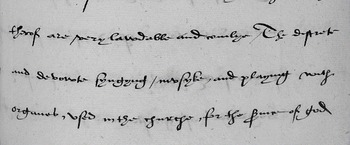
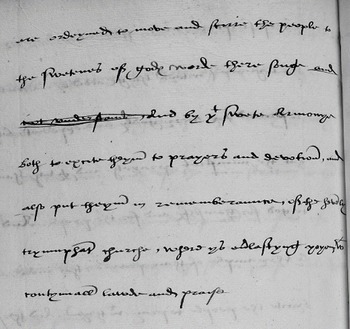
The musical passage in Ceremonies is preceded by a brief description of the church's ritual organisation, reflecting the medieval view of the clerical estate. The ceremonies of the church were deemed to be ‘very godly and expedient, both for that the ministres prayeth and gyvith thankes to god for themselfe and for the people / And also yt by thexample of thair prayers, thei move, and excite the people to pray wt theym …’.Footnote 125 The sentences immediately following articulate the same ritual concept in musical terms. Importantly, their rhetorical coherence becomes clear when we take into full account the medieval precedent considered in the second part of this study, with due cognisance of ‘anagogy’ in the method of ritual exegesis (Figure 6):
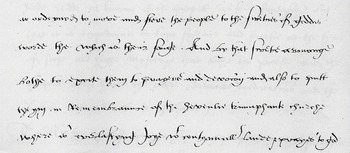
The discrete and devowte syngyng / mvsyke, and playing with organs, vsed in the churche, for the s(er)uice of god are ordeynid to move and stire the people to the swetenes of godes worde there songe and not vnderstan[d]id, and by yt swete armonye both to excite theym to prayers and devotion, and also put theym in rememberaunce, of the heve(n)lye tryumphante churche, where ys everlasting yoye, wth contynuall lawde and praise.Footnote 126
Musical passage from the Lambeth draft of Ceremonies. © Lambeth Archiepiscopal Library, MS 1107, fol. 179r–v. Used by permission


Recalling Margot Fassler's perceptive explanation of the medieval sequence – where text and music could independently or jointly give form to the formless – it is also worth quoting the late fifth-century Pseudo-Dionysus, who offers the same perspective as it was understood from Amalarius to Durandus. The anonymous commentator offers a revealing argument in support of the church's ritual obligation to give ‘shape to what is actually without shape’:
First, we lack the ability to be directly raised up to conceptual contemplations. We need our own upliftings that come naturally to us and which can raise before us permitted forms of the marvellous and unformed sights. Second, it is most fitting to the mysterious passages of scripture that the sacred and hidden truth about the celestial intelligences be concealed through the inexpressible and the sacred and be accessible to the [common people].Footnote 127
Above all, then, to give form to the formless through inspired words or music was to participate in a grand ritual design that ultimately sought con-celebration with the eternal. This crucial dialogue was emphasised time and again by medieval exegetes. In the musical passage of the Henrician Book of Ceremonies, the same concept finds expression through the words ‘that swete armony’ – a turn of phrase not intended to refer to musical sounds alone. It suggested a special ritual union with heaven that could link Holy Scripture, both in written and spoken form, with its hidden celestial shapelessness represented in musical form – ‘the sweetness of God's word there sung and not understanded’. This conception provides the quintessential raison d'être for the medieval anagogy applied in this case: to lead the people to ‘prayers and devotion’, putting them ‘in remembrance of the heavenly triumphant church’, with its ‘everlasting joy’ and ‘continual laud and praise’. Aegidius Carlerius invoked the classic biblical reference to that vision (Revelation 4:8), placing it at the top of his six ‘special claims’ upholding iubilatio armonica. In his commentary on Psalm 46, Richard Sampson goes a step further, exhorting his readers that jubilation should be proclaimed ‘in exultation to others that they may learn from you’.Footnote 128 This point recalls Amalarius's claim that the wordless medieval sequence could ‘insinuate doctrine’ (see above p. 59) – thereby linking the ‘shapeless’ with edification – an idea that no sixteenth-century reformer would have accepted.
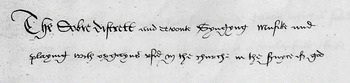
Of course, evangelicals favoured an across-the-board purging of the ‘formless’ in corporate worship. The very notion of leading the unlearned from visible to invisible things had become highly suspect and abhorrent to the radical reformists, recalling again the maxim sola scriptura. Accordingly, the words ‘and not understanded’ were crossed out in the Lambeth source and did not make their way into the British Library manuscript. From that stage, a judicious addition of six well-placed words fostered a subtle strengthening of partisan imperative, identified below in angle brackets (Figure 7):
The <Sober> discrete and devoute Syngyng / musike and playing with orgaynes vsid in the church in the servyce of god ar ordeynyd to move and stere the people to the swetnes of goddis worde <the which is> their songe. And by that swete armonye bothe to excite them to prayers and devocion and also to putt theym in remembraunce of the hevenlie triumphante churche where is everlasting Joye wt contynuall laude & prayis <to god>.Footnote 129
What began as a manifestly traditionalist passage in the uncorrected Lambeth source, therefore, was altered with skilful economy to reflect a less conservative theology. The word ‘sober’ suggests a timely evangelical countering to the complicated fancies of the ‘old learning’. The term is also found in Cranmer's extant references to church music.Footnote 130 Insertion of ‘the which is’ is best taken to emphasise the view that ritual music should only be set to texts found in canonical Scripture. The final insertion, ‘to God’, excludes by default individual saints and the Virgin as subjects of devotion. As Diarmaid MacCulloch has shown, this editorial approach was used consistently by evangelicals as a means of stealthy advance from the fall of Cromwell through to the introduction of the second Book of Common Prayer in 1552.Footnote 131
Musical passage from the British Library version of Ceremonies. © British Library Board; Cotton MS Cleopatra E.v., fol. 275r–v. Used by permission


AFTERWORD
By starting with the biblical passage cited most often by reformers taking a hard line against elaborate church polyphony, Richard Sampson's traditionalist explication of the same text has prompted a series of enquiries that shed new light on Henrician attitudes towards church ritual and music. A fresh look at the verb iubilare in patristic and medieval exegetical literature, together with due cognisance of anagogy in exegetical method, has been critical to understanding the sixteenth-century evidence at the centre of this study. Richard Sampson's all but certain contribution to the first draft of the musical paragraph in the Lambeth version of Ceremonies agrees with the theological rhetoric found elsewhere in his writing. It is not matched in surviving documents coming from any other bishop under Henry VIII. Although bishops Fisher, Tunstall, Clerk, Gardiner, Stokesley, Heath and Longland would probably have agreed in the main with Sampson's musical views, their literary skills were absorbed elsewhere under more pressing matters of doctrine.Footnote 132 That state of affairs leaves Sampson as an important source for orthodox views on ceremony, music and related aspects of Henrician ecclesiastical polity.Footnote 133
While Sampson has not emerged in historical writing as a first-tier bishop, he was nevertheless a taciturn force to contend with for evangelicals in high places. Sampson's removal from power eradicated a chronic political irritant for Cranmer and Cromwell. In the months preceding his arrest, heavy crossfire in partisan politics led Cromwell to take desperate measures. Sensing conspiracy, he threatened a ‘holocaust of conservative opponents’.Footnote 134 With the welcome news that one of the Lord Deputy ofCalais's chaplains had defected to Rome and certain members of his household might have known about it, Cromwell seized the opportunity for a conservative round-up.Footnote 135 With the arrest of Sampson (on trumped up charges of papal sympathies), the Dean of the Chapel Royal and St Paul's Cathedral no longer held authority over preaching in the king's chapel or at Paul's Cross – the most public mouthpiece for delivering the regime's religious policy. Cranmer conveniently stepped into the vacancy. With a transformed rota of authorised preachers, the most influential ecclesiastical venues in the land were free of conservative presence. Moreover, Sampson had been on the threshold of further advance that would have positioned him at the summit of his career as the first Bishop-designate of Westminster – the flagship of the cathedrals of the new foundation and the international face of the Henrician church for foreign visitors in London.Footnote 136
Although he was brought up on charges of papal sympathies, Sampson, in his letter to Cromwell from the Tower, offers no references to those accusations.Footnote 137 He focuses only on his role in preserving traditional church ritual, naming supporters among conservative bishops: Cuthbert Tunstall, Stephen Gardiner, Nicholas Heath and the late Bishop of London, John Stokesley.Footnote 138 Sampson wrote that Gardiner had been comforting him ‘now lately not to feare to helpe thinges forwarde’ in matters of ceremonies, ‘ffor the kinges highnesse was very gode lord in them’: ‘Trewth it is that except it ware now in ceremonies in the which [Gardiner] wylled me to be diligente and to leve noon but to leve that ordre to the kinges maiesties pleasor to co(n)tynew or take aweye which it shall pleas his maiestie.’Footnote 139 As the letter was written about ten days into his arrest, Sampson makes the point clear that Gardiner – Cranmer's conservative nemesis on the doctrinal committee – had been encouraging him to push the proceedings of the ceremonies committee forward, perhaps even while the doctrinal committee had ‘stayed’. Leading conservatives and evangelicals knew well that the king was supportive of traditional ritual; conservatives had their advantage by default. Bishops Sampson, Tunstall and Stokesley had served the king in his chapels royal during different periods. Each would have gained rare insight into the monarch's own predilections in matters of religious ritual and thus reason to feel mutual confidence in asserting a conservative position. According to Sampson, Stephen Gardiner had at ‘dyvers other tymes’ stated his view that the rites of the church ‘ware not to be brokyn withowt a great cause, and that some of them in no wyse ware to be brokyn’.Footnote 140 That language tellingly reflects the concluding sentences of Ceremonies in the Lambeth source:
Finally these rites and ceremonies … are very commendable and to be observed, and in no wise to be omitted without a reasonable cause, except it shall be seen to the rulers and governors upon good consideration to take away … taking them for good tokens and signs to put them in remembrance of things of higher perfection, and for a decent and convenient order to be had in the church, and none otherwise … but to stir and lift up their minds to God by whom with the Holy Ghost, be laud, honour, and praise for ever. Amen.Footnote 141
Finally, it is worth mentioning that the ostensibly ‘evangelical’ tone of this passage (given its emphasis on ceremonies as ‘signifiers’ rather than as ‘sacramentals’) has been interpreted as evidence of the regime's progressively ‘evangelical’ stance on ceremonies. Nevertheless, its language fails to contradict that ritual tome of medieval arch-conservatism, Durandus's Rationale. Durandus's chapter on icons and images, for example, begins in cautionary terms that draw upon the same essential ritual distinctions. Musically speaking, these principles also apply to Durandus's understanding of the iubilus, vis-à-vis the music that signified it (p. 63). While religious radicals would have seized on the polemical opportunities offered by the rhetoric in Ceremonies, its language in this case neither constitutes evidence of incipient ‘Protestantism’ nor prefigures the positions of later Protestant regimes. It could as easily be construed as a reaction against Roman orthodoxy from Tudor regimes that had since the reign of Henry VII held medieval views that were, to varying degrees, ‘nominalist’. Paradoxically, although his scholasticism was anathema to evangelicals and traditionalist reformers, William of Ockham (c. 1288–c. 1348), whose texts had long been enshrined in the curricula of the universities (and in 1535 were shredded publicly at New College Oxford), professed doctrinal views that were decidedly ‘nominalist’ in nature, particularly on those most divisive issues connected with the eucharist.