Introduction
The increased life expectancy in the past century has resulted in an increasing number of people suffering from dementia. In 2013 the WHO estimated that a total of 35.6 million people had dementia worldwide (www.who.int/mediacentre/factsheets/en/, downloaded on 6 December 2013). Numbers are expected to double by 2030 and triple to 115 million by 2050 (Prince et al., Reference Prince, Prina and Guerchet2013). The need for long-term care for people with dementia will therefore increase. The strong need for high-quality care to contribute to the quality life of people with dementia will be an ever growing challenge.
In the community, in psychogeriatric care, and also in residential care settings, past decades have shown a shift from standard offered care to demand-oriented care (Prince et al., Reference Prince, Prina and Guerchet2013). Goals of demand-oriented healthcare are to provide means to meet the variety of wishes, needs, and preferences of individual care seekers. This type of care is therefore also referred to as person-centered care (Kitwood, Reference Kitwood1997). Person-centered care is expected to provide benefit to individuals with dementia as well as their caregivers. It is characterized by valuing the persons with dementia, treating them as individuals, seeing the world from their point of view, and creating a positive psychosocial atmosphere (Brooker, Reference Brooker2004). This requires an understanding of the needs, wishes, and preferences of people with dementia (Dröes, Reference Dröes2007; Van der Roest et al., Reference Van der Roest2009), and specific caring skills (Van der Kooij, Reference Van der Kooij2003). In the past 25 years many interventions have been developed and initiatives taken to shape this specific type of care (Dröes, Reference Dröes, Miesen and Jones1997a; Reference Dröes, Miesen and Jones1997b; Finnema et al., Reference Finnema, Dröes, Ribbe and Van Tilburg2000; Van Mierlo et al., Reference Van Mierlo, Van der Roest, Meiland and Dröes2010). Person-centered care is proven to be more favorable with regard to supporting the everyday functioning and quality of life of those who receive it than the standard offered care (Van Weert et al., Reference Van Weert, Van Dulmen, Spreeuwenberg, Bensing and Ribbe2005a; Reference Van Weert, Van Dulmen, Spreeuwenberg, Ribbe and Bensing2005b; Edvardsson et al., Reference Edvardsson, Fetherstonhaugh and Nay2010; Terada et al., Reference Terada2013).
The main focus in past research has been on the effectiveness of person centered care, including different types of psychosocial interventions such as reminiscence, validation, movement activation, and snoezelen, on behavior, mood, and/or quality of life of elderly people with dementia (Olazaran et al., Reference Olazaran2010; Vernooij-Dassen et al., Reference Vernooij-Dassen, Vasse, Zuidema, Cohen-Mansfield and Moyle2010; Dröes et al., Reference Dröes, Van Mierlo, Van der Roest and Meiland2011). Far less research has been conducted into the successful implementation of such psychosocial interventions in daily dementia care over a longer period of time. Several intervention studies, using process evaluations, demonstrate the importance of paying attention to implementation facilitators and barriers. These process evaluations determine whether the program was implemented according to plan and often conclude that implementation difficulties could possibly explain the (partial) absence of intervention effects (Finnema et al., Reference Finnema, Dröes, Ribbe and Van Tilburg2000; Burgio et al., Reference Burgio2001; Schrijnemaekers et al., Reference Schrijnemaekers, Van, Van Heusden and Widdershoven2002). This implies that effective implementation of care innovations is not always obvious. Without an accurate assessment of whether the intervention was delivered as intended, conclusions regarding outcome measures of the intervention are questionable (Burgio et al., Reference Burgio2001). Furthermore, the act of evaluating the implementation can be an intervention itself, because it can stimulate the implementers to think more consciously about their work, which can in itself have an immediate effect on the implementation (Bliss and Emshoff, Reference Bliss and Emshoff2002). In addition to the fact that less research is conducted into the implementation of psychosocial interventions, the implementation of innovations in daily dementia care is very complex. The world of healthcare professionals, with their multiple and competing demands within routine care settings has obvious impacts on treatment fidelity and the assumption that interventions are always carried out to plan is at best naïve (Grol and Grimshaw, Reference Grol and Grimshaw2003; Vernooij-Dassen and Moniz-Cook, Reference Vernooij-Dassen and Moniz-Cook2014). Also, there is a lack of insight in the so-called “implementation black box,” which makes it difficult to know what facilitates an implementation in what context (Finnema et al., Reference Finnema, Dröes, Ribbe and Van Tilburg2000; Burgio et al., Reference Burgio2001; Schrijnemaekers et al., Reference Schrijnemaekers, Van, Van Heusden and Widdershoven2002). Although up to the year 2000 most researchers focused on the transfer of knowledge and skills related to new interventions to professional caregivers, almost no attention was paid to the process of implementing psychosocial interventions. The extent to which the intervention changed the behavior of caregivers determines whether the implementation was successful or not. After all, if the actions of the caregivers have not changed, there will be no effects on older people with dementia. From 2000 on researchers more often report on the evaluation of the implementation process. However, few intervention studies systematically evaluate the implementation of an intervention by the caregiver in a natural care setting (Burgio et al., Reference Burgio2001). This applies to community-based interventions and residential settings as well as isolated care interventions, individually or in groups, and interventions integrated in daily 24-hour care. Gaining more insight into the facilitating and impeding factors of implementation processes can contribute to a more successful implementation of new interventions, as well as gaining more insight into the efficiency of the used implementation strategy (Grol and Grimshaw, Reference Grol and Grimshaw2003). This knowledge may lead to the optimization of the context of the implementation (Craig et al., Reference Craig, Dieppe, Macintyre, Michie, Nazareth and Petticrew2008), and, eventually, to the provision of better care.
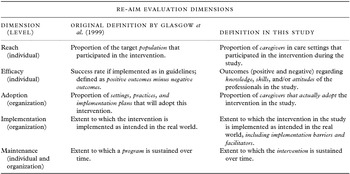
The purpose of our study was to obtain insight into strategies for successful implementation of psychosocial interventions in the daily residential dementia care as offered by professional caregivers by means of a systematic review of the literature. We want to uncover how psychosocial interventions are implemented and which factors contribute to a successful implementation. To this end we focus on behavior changes in the caregivers and (organization-related) facilitating and impeding factors. There are different implementation models available, like the Promoting Action on Research Implementation in Health Services (PARIHS) Framework (Kitson et al., Reference Kitson, Rycroft-Malone, Harvey, McCormack, Seers and Titchen2008), the Implementation Model of Change (Grol et al., Reference Grol, Bosch, Hulscher, Eccles and Wensing2007), or the Consolidated Framework For Implementation Research (CFIR; Damschroder et al., Reference Damschroder, Aron, Keith, Kirsh, Alexander and Lowery2009). In this review we choose for the RE-AIM framework to structure the different implementation factors that are considered important for implementation effectiveness (Glasgow et al., Reference Glasgow, Vogt and Boles1999). The RE-AIM framework consists of five dimensions, namely Reach, Efficacy, Adoption, Implementation, and Maintenance, and it is widely used to assess interventions with multiple process indicators (Dzewaltowski et al., Reference Dzewaltowski, Glasgow, Klesges, Estabrooks and Brock2004). In evaluating these dimensions, not only the strengths of a program but also its limitations can be identified (Lakerveld et al., Reference Lakerveld, Bot, Chinapaw, Van, Kingo and Nijpels2012). Moreover, the RE-AIM framework is suitable for evaluations at an individual and an organizational level, which is important because each level provides valuable independent information on intervention impact. Reach and Efficacy are individual levels of impact, whereas Adoption and Implementation are organizational levels of impact. Maintenance can be both an individual and an organizational level of impact (www.re-aim.org, downloaded on 26 June 2013). Table 2 describes the definitions of the five dimensions of the RE-AIM framework, including the level of every dimension. To our knowledge no previous review about the implementation of psychosocial interventions in the daily nursing home care has used the RE-AIM framework as a tool for analysis.
Methods
We reviewed papers of studies that met the criteria as defined and specified below.
The inclusion criteria were:
-
1. Studies evaluating the psychosocial interventions aimed at people with dementia living in residential care settings and potentially giving a professional caregiver insight and/or tools to improve care. We defined the term “psychosocial intervention” as a non-pharmacological intervention, aiming to improve quality of life and (non-verbal or verbal) communication or interaction between residents in different stages of dementia and their professional caregivers (Van Mierlo et al. Reference Van Mierlo, Meiland, Van der Roest and Dröes2012). This could be any (communication) training for professional caregivers, single or multi-component interventions, expressive or creative interventions.
-
2. Studies in which a psychosocial intervention for people with dementia was implemented in daily care.
-
3. Empirical studies aimed at the implementation-effectiveness of psychosocial interventions by professional caregivers.
-
4. Studies in which implementation-activities to reach implementation of the psychosocial intervention are described.
-
5. Studies published in English or Dutch between January 1980 and December 2012.
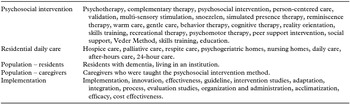
A search strategy combining medical subject headings and text words relating to “dementia,” “psychosocial intervention,” “daily care,” and “implementation” was devised and adapted for the electronic databases PubMed, PsycINFO, and Cinahl. For every category a search strategy was developed based on keywords “Mesh,” “Thesaurus,” and free text words. Table 1 provides a summary of the search strings. The search started in PubMed, and we subsequently translated the search strings for the other databases. We augmented the electronic search by scanning reference lists (forward and backward searching), according to the so-called “snowball-method.”
Summary of the search strings

Review procedures
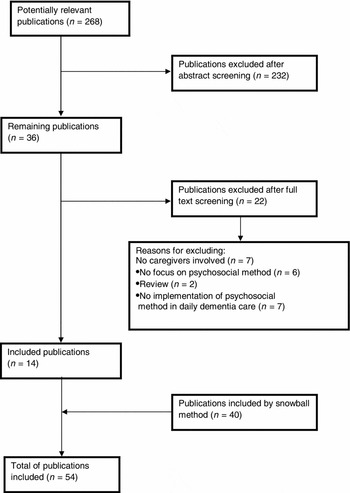
The initial and inclusive search retrieved 268 papers. Two researchers independently screened the titles and abstracts. All abstracts of the papers were judged by the first author (PB), and two other researchers (JvW and RMD) each reviewed half of the abstracts as second reviewer.
Disagreements between the reviewers were resolved through discussion, this occurred in about 2% of the abstracts of the initial and inclusive search. Some disagreements related to the abstracts not being clear about whether a study met the inclusion criteria. For example, the word “implementation” was mentioned in the abstract but no results were described on the process of implementation or the extent to which the caregivers had applied the intervention. In these cases a paper was judged on the full text and again discussed until consensus was reached. After the title and abstract screening, full text versions of the selected papers were screened by the first author (PB) and a final decision was made whether the manuscripts met all the inclusion criteria. If disagreement persisted, a second/third reviewer (JvW or RMD) was consulted. In total, 54 papers covering 47 individual studies were included in the data synthesis. Of the 54 papers, 13 described qualitative studies, five used a mixed-method, and 36 papers related to quantitative studies. The search results and selection process are shown in Figure 1.
Flowchart of the search strategy.

Data extraction
Record data from the 54 papers were entered in tables and summarized using a qualitative narrative approach (Chalmers and Altman, Reference Chalmers and Altman1995). As mentioned above, we used the RE-AIM framework to structure the different implementation factors. The degree of implementation of the psychosocial interventions was mapped by reviewer PB for the five dimensions of the RE-AIM framework (Glasgow et al., Reference Glasgow, Vogt and Boles1999). To ensure reliability of the results, a second reviewer (JL) mapped 15% of the 54 papers independently in the RE-AIM framework. The mapping of these papers was discussed in detail until consensus was reached.
Using the five dimensions of the RE-AIM framework (Reach, Effectiveness, Adoption, Implementation, Maintenance) enables us to provide a unique overview of a range of outcome parameters of a variety of psychosocial interventions in daily dementia care. Because the current study focused on the degree to which the implementation is carried out by caregivers, the execution of the RE-AIM framework has been slightly altered. We looked at outcomes with respect to the caregivers in all five dimensions, the outcomes of the residents with dementia were not considered. As such, the dimension Reach was defined as the proportion of the caregivers that were included in the study. In the dimension Effectiveness, the effect of the intervention on the knowledge, attitude, and/or skills of the caregivers is described. The dimension Adoption summarizes how many of the included caregivers adopted the intervention (e.g. followed the training or showed compliance with the intervention). The operationalization of Implementation was not modified for this study; we also described the facilitating and impeding factors for successful implementation under this construct. Finally, we changed nothing in the dimension Maintenance, which is the extent to which the intervention is sustained over time. In Table 2 we explain the use of the five different constructs from the RE-AIM framework for this study.
Definitions of the five dimensions of the RE-AIM framework and definition in this review

Results
Description of the interventions
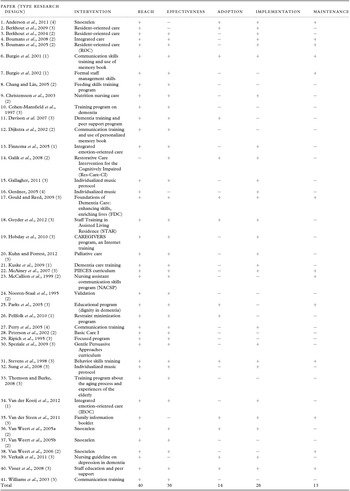
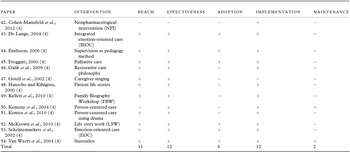
The 54 included publications reported on 47 different studies, and described various psychosocial interventions. About half of the interventions concerned person-centered care in general (13 studies) or an educational program aiming to gain knowledge on dealing with difficult behavior of people with dementia (12 studies). Four publications focused on the application of music on elderly with dementia and three interventions on the use of the residents’ biography in the care for elderly people with dementia. Five publications reported on the implementation of “snoezelen,” and another five about caregivers who were taught communication skills. The remainder of publications concerned the following interventions: restorative care, validation, palliative care, a feeding skills program, supervision, a nursing guideline for depression, non-pharmacological interventions in general and a minimal restraint program. Tables 3a and 3b give an overview of the different interventions studied and summarize on which of the five constructs of the RE-AIM framework information is provided in the papers. A more detailed description of this information, including the applied implementation strategies in the different studies, is presented in Appendix A (see Appendix A, available as supplementary material attached to the electronic version of this paper at www.journals.cambridge.org/jid_IPG).
Provided information on implementation in the included quantitative and mixed intervention studies ordered by the dimensions of the RE-AIM framework

Notes: + = criterion (partly) met; − = criterion not met.
Type design: True experimental design (1); Quasi-experimental design (2); Pre-experimental design (3); Qualitative design (4).
The full description of the references of Table 3a can be found in Appendix B (see Appendix B, available as supplementary material attached to the electronic version of this paper at www.journals.cambridge.org/jid_IPG).
Provided information on implementation in the included qualitative intervention studies ordered by the dimensions of the RE-AIM framework

Notes: + = criterion (partly) met; − = criterion not met.
Type design: True experimental design (1); Quasi-experimental design (2); Pre-experimental design (3); Qualitative design (4).
The full description of the references of Table 3b can be found in Appendix B (see Appendix B, available as supplementary material attached to the electronic version of this paper at www.journals.cambridge.org/jid_IPG).
Outcomes of the implementation based on the RE-AIM framework
The constructs that were addressed in the included publications are depicted in Tables 3a and 3b. In order to interpret the quality of the securities described in the construct effectiveness properly, we included the type of study in Tables 3a and 3b (Shadish et.al., Reference Shadish, Cook and Campbell2002). In six papers – from a total of 54 papers – the research has been carried out with a true experimental design (6, 7, 13, 21, 26, 34). Further details on how the constructs were addressed are described in the following paragraphs (see also Appendix A, available as supplementary material attached to the electronic version of this paper at www.journals.cambridge.org/jid_IPG).
Reach
An intervention's reach shows the proportion of the target population that participated in the intervention. Although all included publications had a clearly described target population, i.e. caregivers who provide psychosocial care to residents with dementia living in an institution, the studies differed in how they defined the proportion of the target population that actually participated in the intervention. Five of the 54 publications (9%) did not indicate the number of participating caregivers in their study (14, 31, 42, 50, 52). Twelve papers (22%) did specify the percentage of individuals who participated based on a valid denominator, for example total number of caregivers who worked in the participating nursing home or ward (2, 4, 6, 9, 17, 18, 20, 28, 30, 33, 39, 46). The reach of these studies varied between 34% and 97%, with a mean reach of 60%.
According to the RE-AIM framework, studies should also describe the characteristics of participants of the target population compared to non-participants; none of the included studies did this. Thirteen publications (24%) did not provide information about the characteristics of the participating caregivers (8, 9, 14, 17, 25, 27, 30, 42, 49, 50, 52, 54). Finally, 15 publications (28%) described the qualitative methods that were applied to recruit participants and how this affected the reach of the studies (7, 9, 13, 18, 21, 24, 34, 36, 37, 38, 39, 40, 43, 46, 51).
Effectiveness
As mentioned above, the outcomes of effectiveness are divided into knowledge on the one hand and skills and/or attitudes on the other.
Knowledge
Twelve studies (60%) with a quantitative research design found a significant increase in knowledge of dementia care after the implementation of the intervention (7, 8, 14, 15, 19, 25, 26, 28, 29, 32, 34, 40). Of these twelve studies, three used a true experimental design. Eight studies (40%) with a quantitative research design reported no increase in knowledge, or a non-significant increase in knowledge in the trained caregivers (10, 18, 20, 21, 23, 24, 30, 33). Of these eight studies, one used a true experimental design.
Of the twenty quantitative studies, eight used a single implementation strategy. This means that they executed one implementation activity, training, sometimes offered at different times and/or in different places. In three studies (38%) this led to significantly more knowledge among caregivers (19, 25, 28), in five studies (62%) the single implementation strategy did not lead to a significant increase in the caregivers’ knowledge of dementia (10, 18, 21, 30, 33).
Twelve of the twenty quantitative studies followed a multiple implementation strategy. This means that they used two or more implementation activities, such as training with a follow-up or mono- / interdisciplinary conferences, a project leader who is responsible for the implementation or an individual care plan in which the intervention could be integrated. These studies investigated whether the use of implementation activities affected the knowledge of caregivers regarding dementia. In eight of these publications (67%) a multiple implementation strategy leads to a significant positive effect on knowledge acquisition (7, 8, 14, 15, 26, 32, 34, 40). In one publication (8%) the implementation strategy led to significant positive results on two of the five modules (29). Finally, in three publications (25%) the multiple implementation strategy did not yield significant results on caregiver knowledge (20, 23, 24).
Two qualitative papers described a single implementation strategy, and researched whether this increased the knowledge of caregivers: in study 49 is described that the intervention, supported the caregivers in managing difficult situations, and in study 45 the caregivers gained new knowledge of pain control. Finally, in study 44 is described that a group of caregivers asked for knowledge about dementia and medication during supervision. In this study a multiple implementation strategy was used. It is unknown if the caregivers actually learned more about dementia and medication.
In summary, the results seem to demonstrate it is important to apply a multiple implementation strategy to increase knowledge in caregivers. Furthermore, it also seems important to offer training at different times, so that more caregivers can follow the training. The studies that showed an increase of knowledge in caregivers all offered a follow-up after training and additional support by means of a project leader responsible for the implementation, and/or support regarding how to integrate the intervention in the individual care plan. No conclusions could be drawn regarding which additional implementation strategy besides training and follow-up leads to more knowledge.
Attitude and/or skills
Fourteen of the 28 publications (50%) with a quantitative research design described significant positive effects on attitudes and/or skills after implementation of the intervention (3, 4, 8, 11, 12, 16, 21, 25, 26, 29, 33, 36, 37, 38). Two of these used a true experimental research design. Six studies (21%) described few significant results on attitudes and/or skills (5, 6, 7, 22, 40, 41). Here, two studies also used a true experimental research design. Eight studies (29%) with a quantitative research design found no significant results on attitudes and/or skills after implementation of the intervention (9, 10, 17, 20, 24, 30, 31, 34). One of these studies used a true experimental design. It should be taken into consideration that in 19 of the 28 papers (68%) the change in attitudes and/or skills is measured with a self-report questionnaire (3, 4, 9, 10, 11, 12, 16, 17, 20, 21, 22, 24, 25, 26, 29, 30, 33, 36, 40).
From the 28 quantitative studies, nine applied a single implementation strategy to influence attitudes and/or skills. This means that they executed one implementation activity. They offered training, sometimes at different moments. Five of these interventions (56%) led to a significant positive effect on change of attitude and/or skills of the caregivers (16, 21, 25, 26, 33). Four publications (44%) reported no change in attitude and/or skills of the caregivers (9, 10, 17, 30).
Nineteen of the 28 studies with a quantitative research design used a multiple implementation strategy, i.e. two or more implementation activities were executed, and investigated whether this affected the attitude and/or skills of the caregivers. In nine publications (48%) significant positive effects are reported (3, 4, 8, 11, 12, 29, 36, 37, 38). Four publications (21%) found no significant results on change in attitude and/or improved skills (20, 24, 31, 34). The six studies (31%) in which few significant positive results were found all used a multiple implementation strategy.
Twelve qualitative papers and one mixed method paper described to what degree the interventions influenced the attitude and/or skills of the caregivers. From the 13 surveys, seven applied a single implementation strategy (27, 45, 46, 47, 50, 51, 53) and six applied a multiple implementation strategy (43, 44, 48, 49, 52, 54). The themes in these 13 publications that reported positive changes as a result of the intervention, were “knowing the needs of the residents” (43, 46, 48, 50, 51, 54), “knowing the person behind the patient” (43, 46, 48, 49, 51, 52), more patience (46, 50, 51, 53), flexible scheduling and saving time (45, 46, 51, 53), less resistance to care (47, 51), various communication strategies (27, 45, 50, 52, 46), and overall attitude changes (43, 48, 49, 50, 53).
Three qualitative studies, which had applied a single implementation strategy, found no changes on some aspects of attitude and/or skills. A paradoxical effect was found in study 47: cooperation of care between caregivers and residents increased, but verbal communication decreased. No differences in interactions were found between caregivers and residents in study 53. The intervention palliative care had no effect on the organizational approach to care of the residents (45).
A number of qualitative papers which applied a multiple implementation strategy also showed no changes on attitudes and/or skills. In study 43 no changes were found on “resistance to care” or on “social interactions.” The same applies to study 44, where also no changes were found on attitude. Despite the positive effects on attitude and/or skills some caregivers in study 48 stated that they did not see any favorable effect of the intervention on the quality of care.
Summarizing: the change of attitude and/or skills of the caregivers shows that applying a multiple implementation strategy at its best has minimal positive results. However, based on the conducted research no statement can be made on which combination of implementation strategies is most effective.
Adoption
In this review study we defined adoption as the proportion of caregivers that actually adopt the intervention. To achieve adoption various implementation strategies were applied in the included studies. In nearly all some type of training was offered (n = 48). Most of the provided courses were given at different times and/or several days in order to ensure all caregivers, who are usually working according to a schedule, could follow the training. In study 18 they offered staff that missed one or more workshop sessions additional individual teaching to provide them with an overview of the material. In some other studies it was decided to offer training via the internet after the first implementation (17, 35). Sometimes a project leader was appointed who was responsible for the implementation (n = 18). In addition, mono-disciplinary and/or interdisciplinary conferences and/or follow-up meetings were organized to support the implementation (n = 25). In many cases an individual care plan was used during the implementation (n = 26).The detailed implementation strategies from all studies are described in Appendix A (see Appendix A, available as supplementary material attached to the electronic version of this paper at www.journals.cambridge.org/jid_IPG).
Some authors made remarks which component(s) of the implementation strategy were more or less effective. Two studies reported that the used implementation strategy, training, alone was not strong enough (9, 21). Although, in study 40 they offered training at different times and/or in different places, they concluded that follow-up is desirable for a successful implementation. A positive boost to putting knowledge into practice was achieved by training on the job (2), role-play and video as a pedagogic tool (51), integration of learning into practice and on-the-job reinforcement of learning (22), and supervision and self-monitoring (31). The researchers of study 44 reported that supervision as a process-oriented model is less useful for putting knowledge into practice as it needs a long time for successful implementation. On the other hand, the use of an individual care plan in which the intervention is included, appears to be an effective implementation strategy (14, 39, 54). Finally, although the implementation strategy of an internet-based training had many benefits: in study 19 they concluded that it is useful to include a group component in the training and to deliver the training program in modules.
A minority of ten publications (19%) described the percentage of caregivers which participated in the offered training/intervention, ranging from 32% (11) to 100% (31) of the caregivers who had gone through the entire implementation process (6, 11, 14, 18, 25, 26, 31, 35, 36, 54). Study 35 describes the acceptability of a family information booklet using statistical testing between nurses and physicians in two countries. Nurses versus physicians in the Netherlands independently used the booklet significantly more. Ten other publications (19%) did not mention exact numbers, but gave an overall description of the adoption of the intervention by caregivers (1, 2, 17, 39, 40, 43, 44, 45, 52, 53). For example, study 40 describes that a minority of the staff attended the educational program, and study 43 describes that group sessions of emotion-oriented care were held at three of the four experimental wards.
In summary, little is reported on the adoption of the implemented interventions.
Implementation
The construct implementation includes a number of criteria. First to mention is that the publication shows the percentage or number of perfect delivery of the intervention. Seventeen of the 54 papers (31%) clearly indicated how often the intervention was performed (1, 2, 3, 4, 5, 6, 13, 14, 16, 21, 22, 30, 31, 32, 34, 53, 54). For example, Restorative Care was offered to residents 16 ± 8 days each month or 61 ± 40 minutes each day during the intervention phase of the study (14). One study described at two-month follow up how often the memory book was in possession of the residents: during 77% of the morning and 80% of the afternoon checks (6). Another study showed that the adherence to the protocol increased from 0 at baseline to 72% on the post-test (32).
In one intervention study adaptations were made to the intervention during the study: the researchers describe that 41 additional staff members participated in a condensed version of the training program (20).
Seven publications (13%) give a rough indication of the costs that the intervention entailed: sometimes in time, sometimes in money (1, 15, 16, 19, 27, 31, 36).
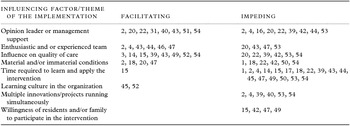
The last criterion of the research of Implementation is to which extent the consistency of implementation across staff/time/settings/subgroups (focused on the process) is described. Sixteen of the 54 papers (30%) reported facilitating factors for a successful implementation, and 20 (37%) reported about the impeding factors. In Table 4 they are described divided into categories.
Facilitating and impeding factors of the implementation of psychosocial interventions in daily dementia care

Maintenance
Eleven of the 54 included publications (20%) described the primary outcomes at six- or more-month follow-up after implementation of the intervention. Seven of these showed that the outcomes of knowledge and/or attitude maintained at minimal six-month follow up (5, 7, 22, 31, 35, 38, 40). Four of the 11 publications reported that the outcomes at six- or more-month follow up were not (or hardly) maintained (1, 7, 22, 25).
Another topic concerning the construct of maintenance is whether there are measures, discussions, or alignments to the organization mission or whether another form of sustainability is realized in the organization. In study 54 is described that four out of six experimental wards facilitated the intervention by designing and completing a long-term implementation plan. Three studies reported a form of long-term support for motivation of the caregivers, like consultation visits or a supporting program (6, 22, 50). One study indicated that monthly visits by the trainer to continue implementation of the intervention may not be sufficient (23). Another study (4), concluded that more attention should be paid to the process of change and the conditions that make the implementation of the intervention successful.
The last topic concerning the construct of maintenance is the question if and how an intervention program was adapted for long-term implementation, or which elements were retained after the implementation was completed. Two publications described how the program was adapted for long-term implementation, i.e. by offering it online via the internet (17, 35).
Conclusions and discussion
Discussion
In this review we analyzed the research literature concerning the implementation of psychosocial interventions in the daily care of people with dementia living in residential care settings using the RE-AIM model as a framework. The RE-AIM framework focuses on five aspects of implementation, i.e. Reach, Effectiveness, Adoption, Implementation, and Maintenance. From a total of 268 potentially relevant publications, 54 publications met all inclusion criteria. These publications were related to 47 individual studies/intervention programs.
To answer our question, we included effective and non-effective studies in the review. If we had excluded the ineffective trials we ran the risk of having less or no insight of the factors that may have an obstructing effect on the implementation. The focus in this review is therefore not on the effectiveness of the study, but how the intervention can be implemented in daily complex reality.
Results of this systematic review indicate that there is great heterogeneity with regard to implementation strategies in terms of duration, intensity, and guidance. Some implementation studies focused mainly on knowledge transfer, others focused on skills training and change of attitude of the caregivers as well. However, the goal of all studies and training was to teach caregivers to work in a different, more personalized way with older people with dementia, resulting in a change of the caregivers’ behavior.
Whether an intervention is implemented successfully can only be evaluated by a proper evaluation process. One way to carry out a thorough evaluation process is the use of the RE-AIM framework. In this study, we used the five constructs of the RE-AIM framework and it is striking that most implementation studies focus on the constructs Reach and Effectiveness, followed by Implementation. The constructs Adoption and Maintenance receive much less attention even though they are just as important when it comes to a successful implementation. In this review Adoption is defined as the extent to which caregivers actually adopt the intervention and/or follow the training. It was described in 20 of the 54 (37%) publications in a more or less concrete way. It is definitely questionable whether effective implementation is possible if the caregivers lack the required skills to carry out an intervention. Vernooij-Dassen and Moniz-Cook (Reference Vernooij-Dassen and Moniz-Cook2014) mention the risk of the “implementation error,” which refers to low treatment fidelity, meaning that the application of the intervention differs considerably from the original plan. Maintenance is ultimately the most decisive construct for successful – long-term – interventions: it describes the degree to which the intervention becomes a relatively stable and enduring part of the behavioral repertoire of an individual or organization. Even fewer publications, namely 15 out of 54 (28%), addressed Maintenance on an individual and/or organizational level. This is worth mentioning and confirms the expectations Glasgow et al. (Reference Glasgow, Vogt and Boles1999) expressed more than a decade ago, that adoption and maintenance will be the most understudied constructs.
From the 54 included publications in this review only five elaborated – to some degree – on all five constructs of the RE-AIM framework (Stevens et al., Reference Stevens1998; Burgio et al., Reference Burgio2001; Van Weert et al., Reference Van Weert, Kerkstra, Van Dulmen, Bensing, Peter and Ribbe2004; Visser et al., Reference Visser, McCabe, Hudgson, Buchanan, Davison and George2008; Gould and Reed, Reference Gould and Reed2009).
To get an impression of possible selection bias, it is important to know how many caregivers participated in the study. Most of the studies included in this review did not provide information about the percentage of participating caregivers based on a valid denominator, e.g. the total number of eligible caregivers who work in the participating nursing homes. In 12 studies this percentage was provided or could be derived from the reported numbers. Contrary to our expectation, the reach in these 12 studies varied and in some cases was rather low. One would expect recruitment of the eligible caregivers in the nursing homes to be easy. All in all, these nursing home care studies did not routinely provide the reach in percentages. Reach also concerns the characteristics of the participants that provide an indication of the representativeness of the participants (Glasgow et al., Reference Glasgow, Vogt and Boles1999). Most of the included studies in this review described the characteristics of the participating caregivers.
The effectiveness of knowledge transfer is usually assessed by means of a questionnaire or quiz. The studies in this review show that training often, but not always, leads to a significant increase in knowledge of the intervention. This is in line with Eggenberger et al. (Reference Eggenberger, Heimerl and Bennett2013), who concluded that caregivers who follow a communication training acquire significantly more knowledge.
The effectiveness regarding change in caregivers’ attitude or gaining more skills is more complex. Despite the fact that there is often an increase in knowledge, the results indicate that approximately half of the studies were unable to bring about a significant change in attitude and/or skills. Also, in most cases the change in attitude and/or skills is measured with a self-report questionnaire, which can lead to a more positive result compared with observational studies (Van de Mortel, Reference Van de Mortel2008). Thus, it is possible, but also difficult to change the attitude of caregivers or to gain more skills through the implementation of an intervention. This is in accordance with Eggenberger et al. (Reference Eggenberger, Heimerl and Bennett2013), who concluded that caregivers who follow a communication training not only acquire significantly more knowledge, but also acquire more skills and competencies. Our conclusion is that it is apparently easier to influence the level of knowledge than the behavior, e.g. the attitude and/or skills of the caregivers. It is likely that the used didactic methods were simply not strong enough. Not all studies described the used didactic methods of the offered training. In studies where it was, the use of varied teaching methods, in which the caregivers practiced new behavior, usually led to a positive change in behavior. This is consistent with the results of Kuske et al. (Reference Kuske, Hanns, Luck, Angermeyer, Behrens and Riedel-Heller2007), who state that the use of role-play, videos, and vignettes in training appeared to be effective teaching methods to realize a change in attitude or to gain more skills. The difficult shift from knowledge to behavior change may also be related to characteristics of the person himself. De Lange (Reference De Lange2004) stated that not every caregiver is able to learn to offer person-centered care and Lawrence et al. (Reference Lawrence, Fossey, Ballard, Moniz-Cook and Murray2012) concluded some caregivers were uncomfortable participating in the intervention.
Another important element in putting the knowledge into practice appears to be the application of a flexible and multiple implementation strategy. This means that caregivers are enabled to follow training at different times. In addition it is important that more than one implementation activity is applied, for example in the shape of additional training features, such as follow-up meetings, observations, a promotion-group, and consultations. Moyle et al. (Reference Moyle, Chi Hsu, Lieff and Vernooij-Dassen2010) and Eggenberger et al. (Reference Eggenberger, Heimerl and Bennett2013) reported that these follow-up methods proved effective to consolidate the trained skills and intervention. Making a project leader responsible for the implementation often leads to a successful implementation. Lastly, the use of an individual care plan also supports the implementation of an intervention. In this context Grol and Grimshaw (Reference Grol and Grimshaw2003) concluded that multifaceted implementation is more likely to be effective in changing behavior than single implementations.
Successful implementation of a psychosocial intervention depends on several factors that may promote or hinder implementation. Many of the interventions demanded extra work and reallocation of staff time. The caregivers were concerned about the workload and how to incorporate the psychosocial intervention in daily care. Lawrence et al. (Reference Lawrence, Fossey, Ballard, Moniz-Cook and Murray2012) also found this to be a challenge to successful implementation. Organizational support is necessary to enable caregivers to sustain good practice, for example modifying work schedules, providing practice opportunities, and changing policy of treatment guidelines (Aylward et al. Reference Aylward, Stolee, Keat and Johncox2003).
In the CFIR framework, organization-related issues that may affect its implementation in the “inner setting” are further elaborated. These include the structural characteristics of the organization, network and communication structures within the organization, organization culture, and implementation climate, and can help get insight into the “black box” of the Implementation of the RE-AIM framework (Damschroder et al., Reference Damschroder, Aron, Keith, Kirsh, Alexander and Lowery2009). This also applies to the PARIHS framework whose elements “context” and “facilitation” focus on the barriers and facilitators within the organization (Rycroft-Malone, Reference Rycroft-Malone2004).
Support of staff or administrator is often mentioned as crucial for successful implementation. This is in line with Lawrence et al. (Reference Lawrence, Fossey, Ballard, Moniz-Cook and Murray2012) who state that it is essential to obtain the full support of administrators given their role in facilitating interventions and effectuating cultural change within the nursing home. In the CFIR framework this is called “engagement,” which refers to the influence the formal and informal leaders or “first users” have on the intended users (Damschroder et al., Reference Damschroder, Aron, Keith, Kirsh, Alexander and Lowery2009).
For successful implementation it is important that no other innovation projects run simultaneously. Administrators must take this into account when implementing innovations. In addition,
the innovation process is inherently so complex that it needs expert facilitation, where trained individuals (change agents, facilitators, consultants) simultaneously work with individuals, teams and the wider system to manipulate contextual factors and support the experiential learning of individuals and teams in managing the new knowledge, attitudes and skills (Kitson, 2009).
This review was not without methodological limitations. To understand the extent to which an intervention is successfully implemented in the daily care, this review focused on reporting of the five constructs of the RE-AIM implementation framework. This is notably different from a typical efficacy-based review where quality ratings are based on factors such as adequacy of study design, sample size, validated metrics, and statistical methods. It is conceivable that the included studies would have scored differently in an efficacy-based review. This review covers very diverse studies in terms of type of intervention and methodological design. We have described this in detail in Appendix A (see Appendix A, available as supplementary material attached to the electronic version of this paper at www.journals.cambridge.org/jid_IPG). Despite this different focus, this review is based on the essential elements of a systematic review, including a comprehensive search strategy, predetermined with clear inclusion criteria and a validated data extraction tool. This review shows that the RE-AIM framework provides an excellent tool for the description and assessment of studies into the implementation of psychosocial care interventions in daily nursing care homes for people with dementia.
Based on the analysis of the 54 included publications, recommendations for future implementation studies, regarding each of the five RE-AIM aspects can be made. With regard to the range, we recommend that, for every innovation the denominator is defined. The denominator is the total number of healthcare providers who are potentially eligible for the innovation. Both for caregivers participating as well as the healthcare providers who refuse (to participate), a comparison should be made based on demographic and educational background. Regarding the effectiveness, it is important that the study is designed so that the analysis performed provides insight into the robustness of the implementation effectiveness, such as the impact on the knowledge, skills, and attitudes of healthcare providers. Researchers and innovators must also report potentially negative effects of the intervention. For a proper insight on the adoption, it is also important to report the absolute number of healthcare providers who have participated in the implementation strategy; for example the number of healthcare providers who completed the offered training. And an indication of participation rate amongst delivery agents should be provided. With respect to implementation the execution of the content, the duration, the frequency, and the cost of the intervention should be mentioned. It is also important to describe the used implementation strategy. Try describing some perfect “implementations” of the intervention, preferably in percentages. And finally, it is important that the process of implementation, including facilitating and impeding factors are reported, showing which factors under what circumstances are influential. To monitor the sustainability (maintenance) of the implemented intervention a follow-up evaluation of at least six months after implementation should take place during research. Give an account of the measures taken by the organization to implement a lasting intervention. And last but not least, report on the costs to maintain the intervention.
The strategies used to implement psychosocial interventions in daily care for people with dementia living in a residential care setting vary widely in terms of duration and intensity. Strategies range from a one-hour workshop to several days of training, under the responsibility of a project leader, with support from staff or administrator, and follow ups of coaching on the job. This review shows that to achieve a successful implementation of an intervention a multiple implementation strategy is advisable. Besides training for caregivers to learn how to use the intervention in daily care, there should be additional training features such as a follow up, on-the-job coaching or consultations to consolidate what is learned in practice. A project or opinion leader can boost the implementation, and a supporting individual care plan explaining where the intervention fits stimulates the actual application of the intervention. This is an important conclusion for innovators who want to stimulate person-centered care in nursing homes for people with dementia. Innovators as well as researchers have to keep in mind that it is of great importance to pay attention to the constructs implementation, adoption, and maintenance of the RE-AIM framework. Innovators should report structurally on the caregivers who are intended to apply the intervention, and subsequently on the number of caregivers who actually adopt the intervention in their daily practice. While planning the implementation of the new person-centered care intervention, innovators also have to think about the sustainability of the intervention in the future. Therefore, they can make an evaluation plan for minimal six months after the implementation, but they also should think about long-term sustainability on the organizational level; for example how to integrate the new intervention in the vision of the organization. The same goes for researchers: to obtain real insight into the successful implementation of a new person-centered care intervention, the evaluation should obviously focus on the effectiveness of the intervention, but also on the implementation and more specifically the adoption and maintenance of the new person-centered care intervention in the daily care of people with dementia.
Conflict of interest
None.
Description of authors’ roles
All authors contributed to the study design. P. Boersma collected the data and wrote the initial draft of the paper. J.C.M. van Weert and R.M. Dröes both participated as assessors in the review process and critically reviewed the paper. J. Lakerveld assisted with mapping the papers in the constructs of the RE-AIM framework and also critically reviewed the paper.
Acknowledgments
This study was conducted with support from Foundation Vita Valley.
Supplementary material
To view supplementary material for this article, please visit http://dx.doi.org/10.1017/S1041610214001409