Introduction
There has been a surge of interest recently in the finding of impaired ability to identify emotions from facial expressions in schizophrenia (Marwick & Hall, Reference Marwick and Hall2008; Kohler et al. Reference Kohler, Walker, Martin, Healey and Moberg2009). This deficit has been considered to be associated with aspects of the clinical picture such as positive and negative symptoms and social functioning (Mandal et al. Reference Mandal, Pandey and Prasad1998; Kohler et al. Reference Kohler, Bilker, Hagendoorn, Gur and Gur2000; Silver et al. Reference Silver, Shlomo, Turner and Gur2002; Sachs et al. Reference Sachs, Steger-Wuchse, Kryspin-Exner, Gur and Katschnig2004; Hofer et al. Reference Hofer, Benecke, Edlinger, Huber, Kemmler, Rettenbacher, Schleich and Fleischhacker2009). It has also been claimed to be a genetic vulnerability marker for the disorder (Bediou et al. Reference Bediou, Asri, Brunelin, Krolak-Salmon, D'Amato, Saoud and Tazi2007). Additionally, facial emotion tasks are being used increasingly as a tool for exploring the underlying neurobiology of schizophrenia in neuroimaging (Pinkham et al. Reference Pinkham, Penn, Perkins and Lieberman2003) and electrophysiological studies (Turetsky et al. Reference Turetsky, Kohler, Indersmitten, Bhati, Charbonnier and Gur2007; Wynn et al. Reference Wynn, Lee, Horan and Green2008).
Although many studies have examined schizophrenia patients on tests requiring judgement of facial emotion and most have found evidence of impairment (Mandal et al. Reference Mandal, Pandey and Prasad1998; Edwards et al. Reference Edwards, Jackson and Pattison2002; Pinkham et al. Reference Pinkham, Penn, Perkins and Lieberman2003), often with a large effect size (Kohler et al. Reference Kohler, Walker, Martin, Healey and Moberg2009), this does not in itself establish that facial emotion processing is an important area of deficit in the disorder. This is because patients with schizophrenia perform poorly on almost all cognitive tasks (Chapman & Chapman, Reference Chapman and Chapman1973), a finding that in turn almost certainly reflects the fact that the disorder is associated with a variable degree of general intellectual impairment (McKenna, Reference McKenna2007; Reichenberg & Harvey, Reference Reichenberg and Harvey2007). Indeed, there is an ongoing debate about whether the facial emotion recognition deficit in schizophrenia is specific, in the sense of being disproportionate to that seen in other areas of cognition, and several authors have argued that this has not been demonstrated conclusively (Archer et al. Reference Archer, Hay and Young1992; Kerr & Neale, Reference Kerr and Neale1993; Johnston et al. Reference Johnston, Katsikitis and Carr2001; Edwards et al. Reference Edwards, Jackson and Pattison2002).
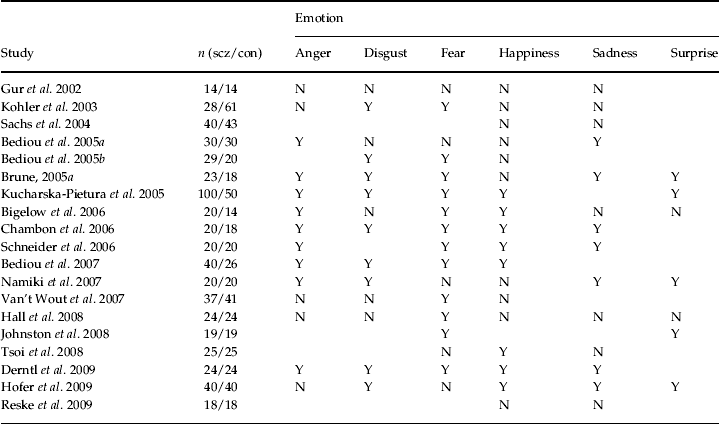
A facial emotion processing deficit in schizophrenia could also be considered specific if it affected only certain emotions. In support of this, a recurrent theme in the literature has been that patients with schizophrenia have more difficulty in recognizing negative facial expressions than positive ones (Gaebel & Wolwer, Reference Gaebel and Wolwer1992; Archer et al. Reference Archer, Hay and Young1994; Bellack et al. Reference Bellack, Blanchard and Mueser1996; Phillips et al. Reference Phillips, Williams, Senior, Bullmore, Brammer, Andrew, Williams and David1999; Edwards et al. Reference Edwards, Pattison, Jackson and Wales2001; Kohler et al. Reference Kohler, Turner, Bilker, Brensinger, Siegel, Kanes, Gur and Gur2003; Bediou et al. Reference Bediou, Franck, Saoud, Baudouin, Tiberghien, Dalery and d'Amato2005a; Van't Wout et al. Reference Van't Wout, van Dijke, Aleman, Kessels, Pijpers and Kahn2007). Some of these studies have also argued that schizophrenia patients show selective impairment in the identification of fear and/or sadness (Gaebel & Wolwer, Reference Gaebel and Wolwer1992; Archer et al. Reference Archer, Hay and Young1994; Bellack et al. Reference Bellack, Blanchard and Mueser1996). Nevertheless, perusal of recent studies that have reported performance of schizophrenia patients and controls on some or all of the six universal emotions described by Ekman & Friesen (Reference Ekman and Friesen1976) reveals that most have documented deficits that generalized across the majority of emotions (see Table 1). It is also apparent that some studies have found no impairment for the negative emotions of fear, disgust and anger. Only one study (Hall et al. Reference Hall, Whalley, McKirdy, Romaniuk, McGonigle, McIntosh, Baig, Gounto una, Job, Donaldson, Sprengelmeyer, Young, Johnstone and Lawrie2008) found evidence of a deficit affecting one specific emotion (fear).
Studies examining the ability to identify specific emotions in patients with schizophrenia (studies are those published after the review of Edwards et al. Reference Edwards, Jackson and Pattison2002)

scz, Schizophrenia; con, controls Y, identified as impaired in the study; N, identified as unimpaired in the study.
A further way of indexing neuropsychological specificity of the schizophrenic facial emotion deficit would be to demonstrate that it is dissociated from performance on tasks requiring processing of non-emotional facial information. Neuropsychological models of face processing propose that facial perceptual information is first assembled into a ‘structural encoding of the facial percept’. Thereafter, processing proceeds in separate parallel streams concerned with facial emotion, recognition of the person's identity and features such as judgement of age (Ellis & Young, Reference Ellis and Young1988); or alternatively facial expression and facial identity information is extracted differentially from a common representational system, resulting in a relative rather than an absolute dissociation between these two facial cues (Calder & Young, Reference Calder and Young2005). Neuroimaging studies also support the existence of separate systems for the analysis of face invariant (e.g. identity) and variant (e.g. emotional expression) information in the superior temporal gyrus and lateral fusiform gyrus respectively (Haxby et al. Reference Haxby, Hoffman and Gobbini2000). Studies comparing the performance of schizophrenia patients on facial emotion processing tasks to that on other aspects of face processing have had inconclusive findings (Novic et al. Reference Novic, Luchins and Perline1984; Walker et al. Reference Walker, McGuire and Bettes1984; Archer et al. Reference Archer, Hay and Young1992; Kerr & Neale, Reference Kerr and Neale1993; Laws et al. Reference Laws, McKenna and McCarthy1996; Salem et al. Reference Salem, Kring and Kerr1996). However, two recent studies have reopened the debate, arguing for greater impairment on facial emotion tasks than on structural encoding of the facial percept (Kucharska-Pietura et al. Reference Kucharska-Pietura, David, Masiak and Phillips2005) and on judging age from faces (Schneider et al. Reference Schneider, Gur, Koch, Backes, Amunts, Shah, Bilker, Gur and Habel2006).
In this study, we attempted to address some of the unresolved issues surrounding the specificity of the facial emotion processing deficit in schizophrenia. First, to minimize the confounding effects of general intellectual impairment on performance, we selected patients who met a criterion for relative intellectual intactness. Second, we examined all six universally recognized emotions. Third, we included both a task requiring identification of emotions and one requiring subjects to determine the degree to which faces express emotions. Fourth, we included two tasks requiring processing of non-emotional facial information.
Method
Participants
The sample consisted of 22 patients with schizophrenia and 20 healthy participants. The patients with schizophrenia were in-patients (n=3) and out-patients (n=19) in a rehabilitation service. They were all on treatment with antipsychotic medication (atypical 20, typical 2) and were in a stable clinical state at the time of testing. They all met DSM-IV criteria for schizophrenia, based on a structured psychiatric interview (Present State Examination, 9th edition, PSE-9; Wing et al. Reference Wing, Cooper and Sartorius1974) and a review of case-notes. All patients had chronic illnesses with a mean duration of 15.65 (s.d.=7.53, range 4–31) years.
The controls were healthy volunteers recruited by advertisement in the local community. Individuals were excluded if they reported a history of neurological illness, major psychiatric illness requiring treatment or hospitalization, or regular drug use. None of the subjects reported alcohol use beyond social drinking.
The study aimed to match patients and controls for age, sex and estimated IQ (pre-morbid IQ in the patients) using the revised National Adult Reading Test (NART-R; Nelson & Willison, Reference Nelson and Willison1991). The schizophrenia patients were also required to show relatively preserved overall current intellectual function, defined as an IQ ⩾85 on the Wechsler Adult Intelligence Scale Revised (WAIS-R), that is within one standard deviation (1 s.d.) of the population average.
All subjects gave written informed consent prior to participating and the study was conducted with local health service ethics committee approval.
Procedure
The participants performed a series of computerized tasks designed to test different aspects of face processing. These included two tests of emotional face processing, a test of familiar face recognition and the Benton Facial Recognition Test (BFRT; Benton et al. Reference Benton, Sivan and Hamsher1994), a structural encoding task.
Judgement of facial emotion
As recommended by Edwards et al. (Reference Edwards, Jackson and Pattison2002), we used all of Ekman's six basic emotions in addition to neutral faces. The task consisted of 60 black-and-white pictures of people's faces, taken from the standard set of Ekman faces (Ekman & Friesen, Reference Ekman and Friesen1976). The pictures showed the six different basic emotions (anger, disgust, fear, happiness, sadness and surprise; see Fig. 1). To avoid the task being too easy, faces were presented showing 50% intensity of the emotion. Hairstyles and clothing were occluded from the images. Ten pictures of each facial expression in different people's faces were presented in random order. The subject had to select (using a mouse click) which emotion the person was showing from seven options, the above six emotions and neutral. Both accuracy and reaction time were recorded.
Examples of the six different expressions at 50% intensity: above (left to right): anger, disgust, fear; below (left to right): happiness, sadness, surprise.

Judgement of intensity of facial emotion
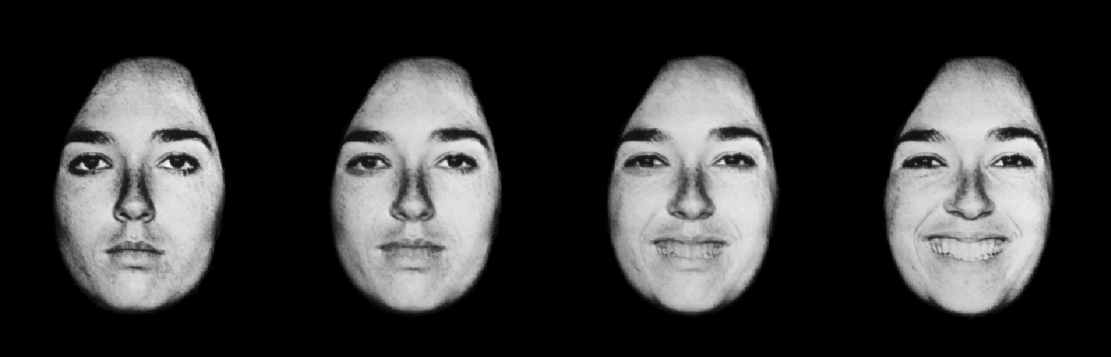
This test used 96 black-and-white photographs of people's faces showing Ekman & Friesen's (Reference Ekman and Friesen1976) six different basic emotions at four different degrees of intensity of the emotion: 0, 26, 52 and 78% (for an example of happiness, see Fig. 2). Again, hairstyles and clothing were occluded from the images. There were 16 pictures of each emotion in different faces, randomly distributed in terms of emotion and intensity. The subject was asked to judge the intensity of the emotion of the face that appeared on the screen by moving the mouse along a sliding scale from 0% to 100%. In this task, there was no requirement to identify the emotion being shown.
Examples of emotion intensity stimuli: happiness at 0, 26, 52 and 78%.

Famous people test
This was shortened from a test developed by Bernard et al. (Reference Bernard, Bullmore, Graham, Thompson, Hodges and Fletcher2004). Forty black-and-white pictures of well-known people (worldwide and in the UK) were presented individually. The participants were asked to recall their names and to state in which area of life they were famous (e.g. actor, politician).
BFRT (Benton et al. Reference Benton, Sivan and Hamsher1994)
This test requires the subject to match a photograph of a person's face to one of six others. In the first part of the test (six items), the target face is identical to one of the six faces. In the remaining part of the test (16 items), the target face has to be matched with six faces that are shown in three-quarter profile, sometimes in different lighting conditions. Here, three of the six faces are of the same person as the target face. Subjects saw the target face at the top of the screen and the six other faces were displayed below it. The subjects were told to make as many choices as they wished for each item. Performance was scored across both components of the test.
Data analysis
All latency and proportion data were log and arcsine transformed respectively. Skewness and kurtosis statistics (g 1 and g 2) were computed, as was the D'Agostino–Pearson omnibus test for normality (which uses both g 1 and g 2 as input to determine whether the distributions differed significantly from normality).
Results
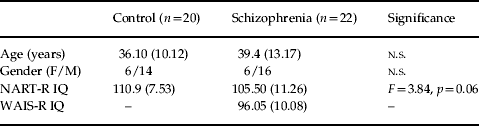
Demographic findings are shown in Table 2. The two groups did not differ in age and sex distribution. A trend-level difference in NART-estimated IQ emerged and so NART was included as a covariate in all analyses. Current WAIS-R IQ ranged from 86 to 130 in the schizophrenia patients. Mean Global Assessment Scale (GAS; Endicott et al. Reference Endicott, Spitzer, Fleiss and Cohen1976) score in the patients was 38.43 (s.d.=4.5, range 27–50), indicating moderate to severe levels of illness.
Characteristics of the sample

F, Female; M, male; NART-R, National Adult Reading Test Revised; WAIS-R, Wechsler Adult Intelligence Scale Revised; n.s., not significant.
Values are mean (s.d.).
Facial emotion processing
Analysis was by means of an ANCOVA with emotion (six levels) as a repeated measure and group (two levels) as a between-subject factor. The Greenhouse–Geisser adjustment was used to correct for violation of the assumption of sphericity for the repeated-measures factor.
Judgement of emotion
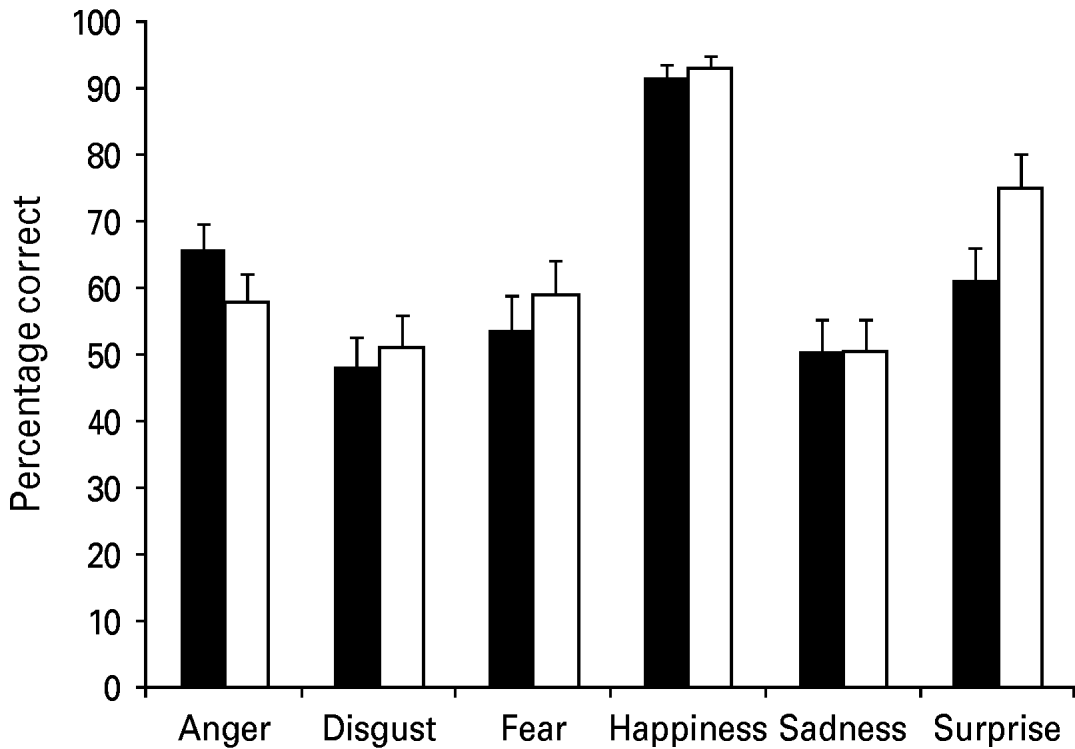
The performance of patients and controls is shown in Fig. 3. There was no main effect of emotion [F=1.97 (df=4.03, 157.0), p=0.10, ηp2=0.05], no main effect of group (F<1) and no interaction between group and emotion [F=1.46 (df=4.03, 157.0), p=0.22, ηp2=0.04]. Individual ANCOVAs for each emotion failed to find any significant difference: all F<1, except anger [F=1.9 (df=1, 39), p=0.17] and surprise, which approached significance [F=3.6 (df=1, 39), p=0.07].
Facial emotion judgement (% correct) in schizophrenia patients (▪) and healthy controls (□) task. Means adjusted for National Adult Reading Test (NART-R) IQ; error bars=standard error.

Analysis of the latency data revealed a significant main effect for group [F=9.6 (df=1, 39), p=004, ηp2=0.20] but not for emotion (F<1) or for the group×emotion interaction (F<1). The schizophrenia patients were significantly slower than the controls when making emotion judgements across all six emotions.
Judgement of intensity of emotion
Accuracy of performance on this task was assessed by measuring deviation from the correct percentage, ignoring the direction of deviation (i.e. whether the subject over- or underestimated the intensity of the emotion). The schizophrenia patients performed significantly more poorly than the controls on all six facial expressions [F=18.78 (df=1, 35), p<0.001, ηp2=0.35] but there was no main effect for emotion [F=1.22 (df=4.23, 148.13), p=0.30, ηp2=0.03] and no group×emotion interaction [F=1.3 (df=4.23, 148.14), p=0.29, ηp2=0.03].
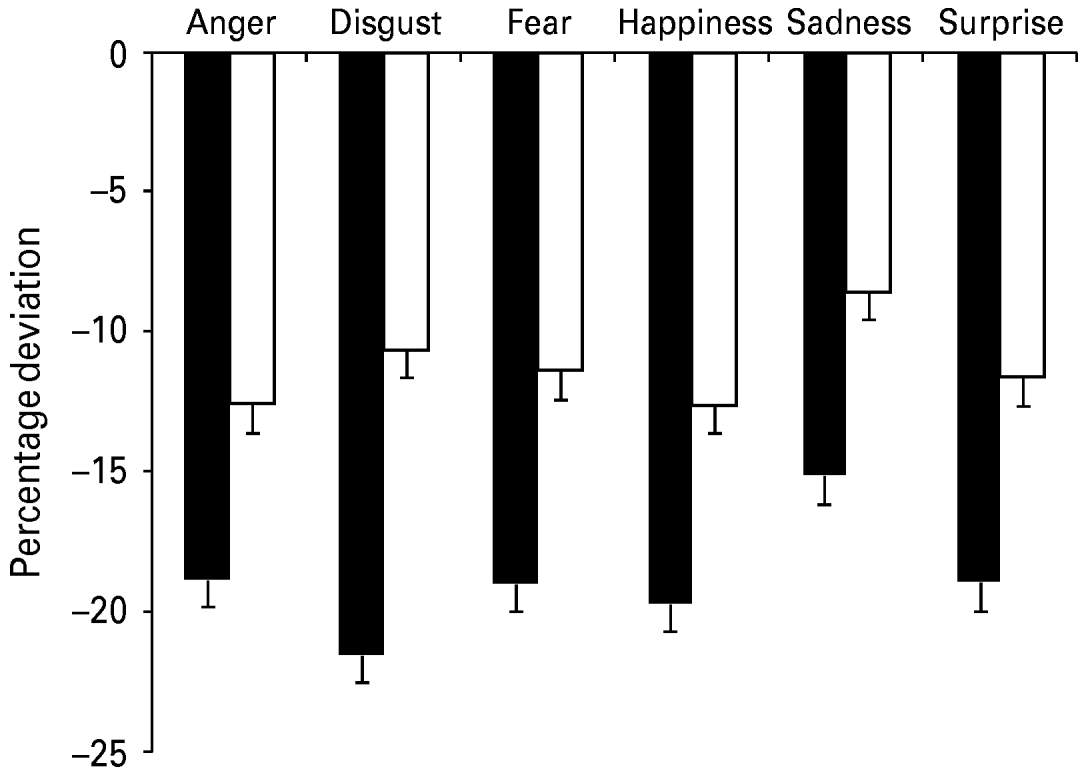
It is also possible to examine for bias to under- or overestimate the intensity of the emotion by reinstating the direction of the deviation (i.e. as a positive or negative sign). As shown in Fig. 4, the patients and the controls underestimated the intensity of emotion and this tendency was exaggerated in the schizophrenia patients. The group difference was significant [F=10.6 (df=1, 35), p=0.003, ηp2=0.23]. As before, neither the main effect for emotion nor the group×emotion interaction were significant (both F<1).
Bias in judgement of intensity of facial emotion (% deviation from correct, taking account of direction) by schizophrenia patients (▪) and healthy controls (□). Means adjusted for National Adult Reading Test (NART) IQ; error bars=standard error.

Famous faces
A one-way ANCOVA revealed that patients with schizophrenia named significantly fewer famous faces than the controls [mean=23.46 v. 28.54; F=4.30 (df=1, 39), p=0.04, ηp2=0.10]. We also used ANCOVA to examine the number of faces for which participants produced the occupation of the person; this difference was significant at trend level between patients and healthy controls [mean=29.68 v. 34.90; F=2.97 (df=1, 39), p=0.093, ηp2=0.07].
BFRT
Data were missing for three controls and two patients on this test. Although the mean for patients with schizophrenia was lower than for the controls (mean=32.44 v. 36.54), a one-way ANCOVA revealed no significant effect for group [F=2.7 (df=1, 34), p=0.11, ηp2=0.07].
Discussion
In this study, a sample of relatively intellectually preserved patients with schizophrenia did not differ significantly from healthy controls in their ability to identify Ekman's six basic facial emotions. In fact, in the case of anger, their accuracy was even marginally better than the controls. It is true that the patients were slower than the controls; however, slowing of reaction time is a general feature of schizophrenia (Schatz, Reference Schatz1998) and so this finding cannot provide support for the existence of a specific emotion processing deficit. We did find that the patients consistently underestimated the intensity of facial emotions, although in this task there was no requirement to identify the emotion displayed. Finally, the patients and controls did not differ in the structural encoding of faces, but were significantly poorer at recognizing famous faces.
Our negative findings concerning identification of facial emotions run counter to the majority of published studies. They do not seem to be readily attributable to a lack of statistical power; our sample size of 22 patients and 20 controls is close to the median sample size of 24 for patients and controls in the recent studies shown in Table 1. Nor does it seem likely that the task was too easy; we required participants to select the emotion from one of seven labels for each face presented. This is in contrast to several studies in which the schizophrenia patients only had to choose between two or three emotions (e.g. Gur et al. Reference Gur, McGrath, Chan, Schroeder, Turner, Turetsky, Kohler, Alsop, Maldjian, Ragland and Gur2002; Bigelow et al. Reference Bigelow, Paradiso, Adolphs, Moser, Arndt, Heberlein, Nopoulos and Andreasen2006; Tsoi et al. Reference Tsoi, Lee, Khokhar, Mir, Swalli, Gee, Pluck and Woodruff2008; Derntl et al. Reference Derntl, Finkelmeyer, Toygar, Hulsmann, Schneider, Falkenberg and Habel2009). Additionally, aside from happiness, no evidence of ceiling effects emerged in our data.
Alternatively, as we displayed emotions at 50% intensity, it might be argued that our task was too difficult. This latter possibility is difficult to evaluate because most studies have not specified the intensity of emotion they used. However, it seems unlikely because (a) a study by Bediou et al. (Reference Bediou, Asri, Brunelin, Krolak-Salmon, D'Amato, Saoud and Tazi2007) examining the recognition of four facial emotions morphed in 10% increments from 0% to 100% revealed significant differences between schizophrenia patients and controls from 30% upwards; and (b) Kohler et al. (Reference Kohler, Turner, Bilker, Brensinger, Siegel, Kanes, Gur and Gur2003) found that schizophrenia patients displayed greater impairment than healthy controls when identifying lower-intensity than higher-intensity emotional expressions. Moreover, the range of percentage correct for our controls (49% for sad through to 92% for happiness) recorded in our study is comparable with many other studies (e.g. Kohler et al. Reference Kohler, Turner, Bilker, Brensinger, Siegel, Kanes, Gur and Gur2003; Bediou et al. Reference Bediou, Franck, Saoud, Baudouin, Tiberghien, Dalery and d'Amato2005a, Reference Bediou, Krolak-Salmon, Saoud, Henaff, Burt, Dalery and D'Amatob; Kucharska-Pietura et al. Reference Kucharska-Pietura, David, Masiak and Phillips2005; Chambon et al. Reference Chambon, Baudouin and Frank2006; Schneider et al. Reference Schneider, Gur, Koch, Backes, Amunts, Shah, Bilker, Gur and Habel2006; Reske et al. Reference Reske, Habel, Kellermann, Backes, Jon Shah, von Wilmsdorff, Gaebel, Zilles and Schneider2009; Hofer et al. Reference Hofer, Benecke, Edlinger, Huber, Kemmler, Rettenbacher, Schleich and Fleischhacker2009).
Contrary to previous research (Gaebel & Wolwer, Reference Gaebel and Wolwer1992; Archer et al. Reference Archer, Hay and Young1994; Bellack et al. Reference Bellack, Blanchard and Mueser1996; Phillips et al. Reference Phillips, Williams, Senior, Bullmore, Brammer, Andrew, Williams and David1999; Edwards et al. Reference Edwards, Pattison, Jackson and Wales2001; Kohler et al. Reference Kohler, Turner, Bilker, Brensinger, Siegel, Kanes, Gur and Gur2003; Bediou et al. Reference Bediou, Franck, Saoud, Baudouin, Tiberghien, Dalery and d'Amato2005a, Reference Bediou, Krolak-Salmon, Saoud, Henaff, Burt, Dalery and D'Amatob; Van't Wout et al. Reference Van't Wout, van Dijke, Aleman, Kessels, Pijpers and Kahn2007), we found no evidence of impaired recognition for negative emotions such as fear, disgust and sadness. It is noteworthy, however, that in previous studies positive emotions have been confined largely to happiness, which is invariably the easiest of all face emotions to recognize, thus creating ceiling effects, or to surprise. The latter might also be important insofar as surprise was the only expression where we found that patients with schizophrenia showed a borderline trend to be impaired. Surprise has been less commonly examined than the other emotional expressions in schizophrenia (see Table 1); nevertheless, it has shown the greatest frequency of impairment in patients.
Why do our findings differ from the majority of other studies of facial emotion processing in schizophrenia? In contrast to all other studies, we adopted a strategy of testing intellectually preserved patients. As noted in the introduction, some authors (Archer et al. Reference Archer, Hay and Young1992; Kerr & Neale, Reference Kerr and Neale1993; Salem et al. Reference Salem, Kring and Kerr1996) have argued that poor facial emotion recognition in schizophrenia could simply reflect generalized intellectual impairment, and this view has also been echoed in two recent critical reviews (Johnston et al. Reference Johnston, Katsikitis and Carr2001; Edwards et al. Reference Edwards, Jackson and Pattison2002). It follows that, if steps were taken to reduce the effects of general intellectual impairment on specific test performance, the deficit in facial emotion processing might be partially or completely abolished. We did this, with results that were in line with predictions.
Although the intellectually preserved schizophrenia patients in our study showed no deficit in identifying different facial emotions, they were impaired on a task requiring estimation of the degree to which an emotion was present without identifying it. There would seem to be two possible interpretations of this finding. One is that there is a restricted form of facial emotion processing deficit in schizophrenia, albeit not the one that has preoccupied schizophrenia research in recent years, the inability to distinguish emotions from one another. Alternatively, because the intensity impairment occurred to much the same degree across all emotions and took the form of an exaggeration of the same tendency seen in the normal controls, it could be construed merely as an aspect of the general tendency to poor cognitive performance that characterizes schizophrenia. In support of this possibility, it can be noted that, although the patients in our study were selected on the basis of showing preserved general intellectual function, this was relative rather than absolute; they still showed a decline in IQ of nearly 10 points from their NART-estimated pre-morbid level. Nevertheless, at present it does not seem possible to choose between these two hypotheses.
Although, as noted in the introduction, studies comparing the performance of schizophrenia patients on facial emotion processing tasks to other aspects of face processing have produced mixed findings (Novic et al. Reference Novic, Luchins and Perline1984; Walker et al. Reference Walker, McGuire and Bettes1984; Archer et al. Reference Archer, Hay and Young1992; Kerr & Neale, Reference Kerr and Neale1993; Laws et al. Reference Laws, McKenna and McCarthy1996; Salem et al. Reference Salem, Kring and Kerr1996), two recent studies have reported greater impairment on facial emotion tasks than on structural encoding of the facial percept (Kucharska-Pietura et al. Reference Kucharska-Pietura, David, Masiak and Phillips2005) and on judging age from faces (Schneider et al. Reference Schneider, Gur, Koch, Backes, Amunts, Shah, Bilker, Gur and Habel2006). Kucharska-Pietura et al. (Reference Kucharska-Pietura, David, Masiak and Phillips2005) found that 100 patients with schizophrenia (50 chronically ill and 50 in the early stages of illness) showed impairment on both an emotional face processing task and the BFRT. However, the effect size was larger in the facial emotion task, and the difference remained significant when performance on the BFRT was entered as a covariate in the analysis. However, it should be noted that the facial emotion task that Kucharska-Pietura et al. (Reference Kucharska-Pietura, David, Masiak and Phillips2005) used consisted of a set of faces showing nine ‘fundamental emotions’ rather than the six basic emotions used by Ekman & Friesen (Reference Ekman and Friesen1976); these included interest/excitement, contempt and shame/humiliation. It is therefore possible that their task had a greater theory of mind ‘load’ than ours; in other words, the subjects had to make inferences about the mental state of the people pictured rather than just detect facial emotional signals (Brune, Reference Brune2005a). Impairment on a wide range of theory of mind tasks has been documented in schizophrenia, with effect sizes that are greater than can be accounted for by general intellectual impairment (Brune, Reference Brune2005b; Sprong et al. Reference Sprong, Schothorst, Vos, Hox and van Engeland2007). Indeed, Kucharska-Pietura et al. (Reference Kucharska-Pietura, David, Masiak and Phillips2005) found that interest and shame produced the largest effects, especially for the chronically ill patients.
Schneider et al. (Reference Schneider, Gur, Koch, Backes, Amunts, Shah, Bilker, Gur and Habel2006) found that 20 schizophrenia patients showed significantly greater impairment on a task requiring identification of four emotions, happiness, sadness, anger and fear, than on a task requiring them to judge the age of the same faces. However, other studies, including those by the same group (Schneider et al. Reference Schneider, Gur, Gur and Shtasel1995; Kohler et al. Reference Kohler, Bilker, Hagendoorn, Gur and Gur2000; Derntl et al. Reference Derntl, Finkelmeyer, Toygar, Hulsmann, Schneider, Falkenberg and Habel2009), have found that schizophrenia patients were impaired on both facial emotion identification and age discrimination with no or less obvious differences between the two.
Although our intellectually well-preserved schizophrenia patients failed to show an impairment of emotional face identification, they did show impairment on a task requiring identification of familiar faces. The combination of non-significant impairment on the BFRT with impaired recognition of familiar faces suggests that there could be a problem in facial identity processing in schizophrenia, which is carried out independently (Ellis & Young, Reference Ellis and Young1988) or partially independently (Calder & Young, Reference Calder and Young2005) of facial emotion processing. Laws et al. (Reference Laws, McKenna and McCarthy1996) reported similar findings in a study using the single case study design: 2/10 intellectually relatively well-preserved schizophrenia patients failed the BFRT; 3/10 failed tasks requiring judgement of age from faces; and 3/10 failed judgement of facial expression. By contrast, more than twice as many, 7/10, failed a test of famous face recognition. However, neither the study of Laws et al. (Reference Laws, McKenna and McCarthy1996) nor the present study used a task that required the subjects to judge face familiarity without providing identifying information about the person. In the framework of the Bruce & Young model of face processing (Ellis & Young, Reference Ellis and Young1988), therefore, it is not possible to distinguish between a problem with facial identity processing per se (i.e. impairment at the level of the so-called facial recognition units) and a problem with retrieval of semantic information about the familiar person (i.e. impairment in ‘personal identity nodes’). Whatever the location of this deficit, however, it fits broadly with the finding that schizophrenia patients show a deficit in visual object processing that affects object recognition units and semantic memory (Gabrovska et al. Reference Gabrovska, Laws, Sinclair and McKenna2003), and also with other lines of evidence pointing to semantic memory impairment in schizophrenia (McKenna et al. Reference McKenna, Ornstein, Baddeley, Baddeley, Wilson and Kopelman2002).
Acknowledgements
This work was supported by the Instituto de Salud Carlos III, Centro de Investigación en Red de Salud Mental, CIBERSAM, Spain.
Declaration of Interest
None.