Suicidal behavior is one of the most perplexing psychological problems faced by humans. Suicide currently is the 10th leading cause of death in the United States, and it is the 3rd leading cause of death among adolescents and young adults (Centers for Disease Control and Prevention, 2014). The risk of suicidal behavior is virtually absent during childhood but increases dramatically in early adolescence, with 12% of adolescents reporting that they have seriously considered killing themselves and 4% making an actual suicide attempt (Nock et al., Reference Nock, Green, Hwang, McLaughlin, Sampson, Zaslavsky and Kessler2013). Thus, there is a great need to better understand what factors lead so many adolescents to consider ending their lives.
Prior research on the risk factors for suicide ideation has highlighted the importance of demographic factors (e.g., females are at elevated risk for suicide ideation; Nock et al., Reference Nock, Green, Hwang, McLaughlin, Sampson, Zaslavsky and Kessler2013) and psychiatric risk factors (e.g., the presence and accumulation of mental disorders increase risk of suicide ideation; Bridge, Goldstein, & Brent, Reference Bridge, Goldstein and Brent2006; Hawton, Saunders, & O'Connor, Reference Hawton, Saunders and O'Connor2012). However, we do not yet have a firm understanding of why some adolescents with these risk factors go on to consider suicide, whereas others do not. Some theoretical models of suicide (e.g., escape theories of suicide) propose that suicide ideation represents an attempt to escape from extreme, aversive emotional distress, which may emerge among individuals with poor emotion regulation, especially in response to stressful events (Baumeister, Reference Baumeister1990; Linehan, Reference Linehan1993).
Empirical studies have provided some support for this perspective. For instance, emotion dysregulation has been found to predict suicide ideation during adolescence (e.g., Najmi, Wegner, & Nock, Reference Najmi, Wegner and Nock2007; Tamás et al., Reference Tamás, Kovacs, Gentzler, Tepper, Gádoros, Kiss and Vetró2007), and adolescents who consider and attempt suicide report that the primary motivation for their behavior was to escape from unbearable circumstances (Boergers, Spirito, & Donaldson, Reference Boergers, Spirito and Donaldson1998). However, whereas research has acknowledged the key role of self-regulation processes in predicting adolescent suicide ideation, the majority of existing work in this area has relied on self-report measures of emotion regulation, paying little attention to physiological self-regulation (e.g., parasympathetic regulation), particularly in response to acute stressors. More importantly, although developmental psychopathology theory and research has extensively demonstrated that the dynamic interplay of multilevel risk factors is implicated in the etiology of mental disorders (Cicchetti, Reference Cicchetti, Beauchaine and Hinshaw2008; Crowell, Derbidge, & Beauchaine, Reference Crowell, Derbidge, Beauchaine and Nock2014), suicide studies rarely have adopted such a perspective. Specifically, little is known about how individual differences in biological reactivity to the social environment (e.g., parasympathetic regulation) interact with environmental factors (e.g., external sources of regulation) to predict the occurrence of suicide ideation over time. The current study was designed to address this gap in the literature. Specifically, drawing from multilevel perspectives of psychopathology and suicide (e.g., Cicchetti, Reference Cicchetti, Beauchaine and Hinshaw2008; Derbidge & Beauchaine, Reference Derbidge, Beauchaine, Lewis and Rudolph2014), parasympathetic regulation (a physiological index of self-regulation) and its interplay with friendship support, conceptualized as an external source of regulation, were examined as longitudinal predictors of suicide ideation in a sample of high-risk adolescent females.
Parasympathetic Regulation and Adolescent Suicide Ideation
Adolescence is a crucial developmental period for studying the role of physiological stress responses in the etiology of suicide ideation. During adolescence, biological changes associated with the pubertal transition exert a strong impact on brain function, stress responses, and potentially on youth decision making and behavior. Specifically, gonadal hormones induce maturational changes in the limbic regions (e.g., amygdala and ventral striatum) that underlie social–affective processes, leading to increased social orientation and sensitivity (Blakemore, Burnett, & Dahl, Reference Blakemore, Burnett and Dahl2010; Crone & Dahl, Reference Crone and Dahl2012; Forbes & Dahl, Reference Forbes and Dahl2010). Changes in the limbic system are accompanied by more gradual changes in the cognitive control systems (e.g., prefrontal cortex), which mature throughout adolescence (Casey, Jones, & Hare, Reference Casey, Jones and Hare2008). Consequently, adolescents exhibit heightened emotional and physiological sensitivity to social cues, but relatively low self-regulation (Casey et al., Reference Casey, Jones and Hare2008; Somerville, Jones, & Casey, Reference Somerville, Jones and Casey2010). Despite the adaptive value of these normative developmental changes, they also may act as biological vulnerabilities. This may be the case especially for youth with a history of psychopathological symptoms (e.g., depressive and anxiety symptoms), who likely are exposed to greater stressors and among which these developmental processes may be particularly powerful (Forbes, Phillips, Silk, Ryan, & Dahl, Reference Forbes, Phillips, Silk, Ryan and Dahl2011; Luciana, Reference Luciana2013).
Parasympathetic nervous system (PNS) activity has been associated with self-regulatory processes (e.g., Beauchaine, Reference Beauchaine2001; Calkins & Fox, Reference Calkins and Fox2002), and therefore may be highly relevant for understanding the occurrence of adolescent suicide ideation. The PNS exerts control over heart rate via the myelinated vagus nerve originating in the nucleus ambiguus (Porges, Reference Porges2007). Specifically, cardiac vagal tone, as indexed by respiratory sinus arrhythmia (RSA), reflects the chronotropic influence of the parasympathetic vagus nerve on heart rate (Berntson, Cacioppo, & Quigley, Reference Berntson, Cacioppo and Quigley1993). The polyvagal theory provides an evolutionary-based framework for understanding how the vagus nerve evolved in mammals to regulate social behavior (Porges, Reference Porges1995, Reference Porges2003, Reference Porges2007). In environments that are perceived as safe, maintaining or increasing PNS activity (also referred to as PNS augmentation) facilitates calm social engagement by acting as a brake on the sympathetic nervous system (SNS; e.g., reducing heart rate). Situations that are novel and salient but nonthreatening evoke a mild decrease in PNS influence, which supports orienting and attending to the context. However, in response to social and emotional situations perceived as threatening or stressful, greater PNS withdrawal, indexed by strong RSA decreases (also referred to as RSA suppression), occurs within milliseconds, “releasing the brake” on SNS activation of arousal (i.e., allowing “fight or flight” responses). In this regard, Porges (Reference Porges2003) has coined the term neuroception to suggest that RSA changes in response to a stimulus can reveal how an individual has implicitly evaluated the safety or social meaning of that stimulus. Thus, neuroception, as a subconscious process through which individuals evaluate their social environment, influences autonomic nervous system responses and consequently individual behavior in terms of social engagement, emotion expression, and regulation. As such, the PNS response, as indexed by RSA changes, has been proposed as a physiological marker of self-regulation (Beauchaine, Reference Beauchaine2001, Reference Beauchaine2012; Hastings, Kahle, & Han, Reference Hastings, Kahle, Han and Lagatutta2014).
Empirical work has supported this notion in children and adolescents. Dynamic changes in RSA in response to affectively challenging events and contexts are essential for flexibly mobilizing adaptive responses (Hastings, Kahle, et al., Reference Hastings, Kahle, Han and Lagatutta2014). High levels of resting RSA and moderate decreases to stressful or emotionally evocative stimuli are indicative of adaptive physiological self-regulation (Beauchaine, Reference Beauchaine2001; Hastings, Kahle, et al., Reference Hastings, Kahle, Han and Lagatutta2014). Conversely, children and adolescents with lower levels of resting RSA and who display dysregulated RSA responses (e.g., either excessive decreases or increases) to stressful or emotional stimuli show higher levels of internalizing as well as externalizing symptoms and are at increased risk for developing symptoms of psychopathology over time (for a review, see Graziano & Derefinko, Reference Graziano and Derefinko2013). However, existing findings are inconclusive with regard to whether exaggerated decreases in RSA (and hence, increased autonomic arousal) or insufficient decreases or even increases in RSA (decreased autonomic arousal) pose risk for psychopathology. Although the results from a recent meta-analysis revealed small effects supporting a negative association between RSA decreases and psychopathological symptoms (Graziano & Derefinko, Reference Graziano and Derefinko2013), studies have shown mixed findings in relation to both externalizing (e.g., Beauchaine, Gatzke-Kopp, & Mead, Reference Beauchaine, Gatzke-Kopp and Mead2007; Fortunato, Gatzke-Kopp, & Ram, Reference Fortunato, Gatzke-Kopp and Ram2013) and especially internalizing symptoms (e.g., Gentzler, Santucci, Kovacs, & Fox, Reference Gentzler, Santucci, Kovacs and Fox2009; Shanahan, Calkins, Keane, Kelleher, & Suffness, Reference Shanahan, Calkins, Keane, Kelleher and Suffness2014). These differences might depend on several factors, including the nature of the stimulus conditions and the characteristics of the sample (e.g., community vs. clinical sample).
However, with specific regard to self-injurious thoughts and behaviors, in line with traditional theories of suicide (escape theory of suicide; Baumeister, Reference Baumeister1990; Linehan, Reference Linehan1993), recent theoretical perspectives suggest that excessive PNS withdrawal in response to emotionally evocative stimuli, indicating an overwhelming physiological state (extreme arousal), may increase risk for suicide ideation (e.g., Crowell et al., Reference Crowell, Derbidge, Beauchaine and Nock2014; Derbidge & Beauchaine, Reference Derbidge, Beauchaine, Lewis and Rudolph2014). To our knowledge, only one study examined the association between RSA and suicidal behavior among adolescents. In that study, parasuicidal adolescent females (i.e., suicidal and nonsuicidal self-injurious females) had lower resting RSA and greater RSA decreases to emotional stimuli as compared to controls (Crowell et al., Reference Crowell, Beauchaine, McCauley, Smith, Stevens and Sylvers2005). However, it remains unknown whether PNS activity could serve as physiological markers to identify adolescents who are more likely to consider suicide at a later point in time. Moreover, the extent to which individual differences in parasympathetic regulation may interact with environmental factors to predict longitudinally suicide ideation among adolescents has never been examined.
Friendship Support and Adolescent Suicide Ideation
Many theories of suicide recognize social support as a key factor that influences the occurrence of suicide ideation. For instance, according to the interpersonal theory of suicide (Van Orden et al., Reference Van Orden, Witte, Cukrowicz, Braithwaite, Selby and Joiner2010), supportive relationships contribute to satisfying the individual's innate need to belong that, if thwarted, increases risk for suicide ideation. The notion of social support as beneficial for adaptive development is not specific to theories of suicide. Traditional and more recent interpersonal theories of emotion regulation (e.g., attachment theory, Bowlby, Reference Bowlby1969; relational regulation theory, Lakey & Orehek, Reference Lakey and Orehek2011) have emphasized that supportive dyadic relationships serve as external sources of regulation. Specifically, high-quality relationships that are perceived as supportive provide an intimate environment that may facilitate regulatory processes, often via everyday interactions, eventually conferring benefits for individuals’ mental health (Diamond & Aspinwall, Reference Diamond and Aspinwall2003; Lakey & Orehek, Reference Lakey and Orehek2011; Zaki & Williams, Reference Zaki and Williams2013).
Whereas parents likely are the most relevant supportive environment throughout childhood, the role of peers, especially friends, increases during adolescence (Zeman, Cassano, & Adrian, Reference Zeman, Cassano, Adrian, Barrett, Fox, Morgan, Fidler and Daunhauer2013). Adolescents’ enhanced peer orientation and their sensitivity toward peers contribute to a gradual shift in their support networks (Crone & Dahl, Reference Crone and Dahl2012; Forbes & Dahl, Reference Forbes and Dahl2010). That is, perceived parental closeness and support decline from early adolescence, whereas friends become gradually more important (e.g., De Goede, Branje, & Meeus, Reference De Goede, Branje and Meeus2009; Laursen, DeLay, & Adams, Reference Laursen, DeLay and Adams2010). Adolescents spend increasing amounts of their time with friends but the qualitative nature of their friendships also changes. Friendship intimacy increases and friends become a crucial source of support, especially among females (e.g., Furman & Buhrmester, Reference Furman and Buhrmester1992; McNelles & Connolly, Reference McNelles and Connolly1999; Rose & Rudolph, Reference Rose and Rudolph2006). Thus, during adolescence, a high-quality and supportive friendship may provide a developmentally salient context that facilitates self-regulation (Zeman et al., Reference Zeman, Cassano, Adrian, Barrett, Fox, Morgan, Fidler and Daunhauer2013) and therefore may reduce risk for suicide ideation. Given that adolescent females tend to rely more than males on external sources of regulation and to seek social support more often in response to stress, friendship support may be a specifically relevant factor to examine in relation to female suicide ideation (Rose & Rudolph, Reference Rose and Rudolph2006; Taylor et al., Reference Taylor, Klein, Lewis, Gruenewald, Gurung and Updegraff2000). A large body of empirical research shows that supportive friendships may reduce suicide ideation during adolescence, especially among females (e.g., Prinstein, Boergers, Spirito, Little, & Grapentine, Reference Prinstein, Boergers, Spirito, Little and Grapentine2000; Sun & Hui, Reference Sun and Hui2007; for a review, see King & Merchant, Reference King and Merchant2008).
Despite evidence linking friendship support to suicide ideation, to date no study has investigated the joint effects of friendship support and parasympathetic regulation on suicide ideation. Examining the synergistic effect between physiological self-regulation and external regulation sources may better contribute to understanding youth psychological development and therefore identifying youth at risk for mental health problems, including suicide ideation (see Crowell et al., Reference Crowell, Derbidge, Beauchaine and Nock2014).
The Joint Effect of Parasympathetic Regulation and Friendship Support
Although prior work provided evidence for the main effects of RSA on youth maladjustment, these effects generally have been small in size and, as discussed earlier, inconsistent across studies (Graziano & Derefinko, Reference Graziano and Derefinko2013). These findings suggest that RSA responses may not necessarily pose a direct risk for adolescent psychopathology but may likely interact with other factors, such as environmental factors. That is, parasympathetic responses may mark individual differences in sensitivity to the social environment and therefore should be expected to differentially predict adjustment across different social contexts. This notion is consistent with multilevel perspectives of psychopathology (e.g., Cicchetti, Reference Cicchetti, Beauchaine and Hinshaw2008).
Two main hypotheses have been proposed regarding how individual biological reactivity to context may moderate the effects of the social environment on youth development. According to traditional diathesis–stress models (Monroe & Simons, Reference Monroe and Simons1991), heightened reactivity to the social context represents an individual vulnerability that predisposes youth to develop problems when exposed to social adversity (e.g., family or peer conflict). For example, diathesis–stress models would suggest that adolescents with unsupportive friendship, thus those who lack an external source of regulation, are particularly at risk for suicide ideation in the presence of atypical PNS regulation (see Hastings, Klimes-Dougan, Kendziora, Brand, & Zahn-Waxler, Reference Hastings, Klimes-Dougan, Kendziora, Brand and Zahn-Waxler2014). However, more recent plasticity models, including the biological sensitivity to context model (Boyce & Ellis, Reference Boyce and Ellis2005) and the differential susceptibility model (Belsky & Pluess, Reference Belsky and Pluess2009; Ellis, Boyce, Belsky, Bakermans-Kranenburg, & van IJzendoorn, Reference Ellis, Boyce, Belsky, Bakermans-Kranenburg and van IJzendoorn2011), posit that physiological reactivity to the social environment does not inherently represent a vulnerability factor. A unique premise of these models is that whereas more reactive individuals are at higher risk for maladjustment when exposed to adverse social experiences, the same individuals show better adjustment in the presence of adaptive and positive environments (e.g., supportive parents or peers). According to these perspectives, the same individuals are expected to be more susceptible (i.e., sensitive) to both the negative and the positive effects of their surrounding environment.
Empirical support for both hypotheses has been provided. In line with diathesis–stress models, some studies have documented that youth exposed to adverse family contexts, characterized for instance by low levels of emotional support and high levels of psychopathology, were at greater risk for psychopathological symptoms when they had dysregulated RSA activity (i.e., low resting RSA and excessive RSA decreases or increases to laboratory stimuli) than when they had typical RSA activity (e.g., Hastings, Klimes-Dougan, et al., Reference Hastings, Klimes-Dougan, Kendziora, Brand and Zahn-Waxler2014; Shanahan et al., Reference Shanahan, Calkins, Keane, Kelleher and Suffness2014). Consistent with plasticity models, other studies have shown that, among youth with dysregulated RSA activity, exposure to poor family environments was associated with increased risk for psychopathology but living in positive family contexts posed beneficial effects (e.g., Diamond, Fagundes, & Cribbet, Reference Diamond, Fagundes and Cribbet2012; Obradović, Bush, & Boyce, Reference Obradović, Bush and Boyce2011; Obradović, Bush, Stamperdahl, Adler, & Boyce, Reference Obradović, Bush, Stamperdahl, Adler and Boyce2010). However, this work almost exclusively examined various characteristics of youths’ family contexts throughout childhood, with little attention to PNS regulation as potential marker of sensitivity to the peer environment during adolescence, when peers become a primary interactional context.
Diathesis–stress models and plasticity models provide highly valuable frameworks to guide suicide research and identify individual physiological profiles that may act as vulnerability or susceptibility factors by altering the effects of social contexts on suicide ideation. Drawing from these models, the current study examined whether interindividual differences in PNS activity moderated the effects of friendship support on adolescent suicide ideation.
The Present Study
Adopting a developmental approach, this multiwave study offers the opportunity to investigate the prospective independent and joint effects of PNS responses as a physiological marker of self-regulation, and perceived friendship support as an index of external regulation, on future suicide ideation in a sample of high-risk adolescent females. PNS responses (i.e., RSA responses) were assessed at rest and during an in vivo interpersonal stressor (a speech), a powerful emotion-eliciting situation (Gruenewald, Kemeny, Aziz, & Fahey, Reference Gruenewald, Kemeny, Aziz and Fahey2004). The choice of an interpersonal stress task was driven by work suggesting that RSA responses to negative emotionally salient conditions mark individual differences in self-regulatory processes (e.g., Beauchaine, Reference Beauchaine2015), which are particularly relevant for understanding suicide ideation.
Because depressive symptoms have been identified as being one of the strongest and more consistent predictors of suicide ideation among adolescents (Bridge et al., Reference Bridge, Goldstein and Brent2006; Giletta et al., Reference Giletta, Prinstein, Abela, Gibb, Barrocas and Hankin2015; Hawton et al., Reference Hawton, Saunders and O'Connor2012; Prinstein et al., Reference Prinstein, Nock, Simon, Aikins, Cheah and Spirito2008), and given evidence supporting the link between depressive symptoms and both basal and reactive RSA (see Graziano & Derefinko, Reference Graziano and Derefinko2013), individual differences in depressive symptoms were taken into account.
Hypotheses were formulated based on prior work on self-injurious thoughts and behaviors. That is, although somewhat in contrast with research on psychopathology (see Graziano & Derefinko, Reference Graziano and Derefinko2013), based on prior suicide research (Crowell et al., Reference Crowell, Beauchaine, McCauley, Smith, Stevens and Sylvers2005, Reference Crowell, Derbidge, Beauchaine and Nock2014), it was tentatively hypothesized that lower resting RSA and greater RSA decreases to the in vivo interpersonal stressor, indicating neuroception of threat and poorer physiological self-regulation (heightened arousal), would increase females’ risk for reporting suicide ideation in the 9-month follow-up. Moreover, perceived friendship support with a close friend was expected to predict lower levels of suicide ideation. Finally, based on multilevel developmental psychopathology theories (e.g., Cicchetti, Reference Cicchetti, Beauchaine and Hinshaw2008; Crowell et al., Reference Crowell, Derbidge, Beauchaine and Nock2014), an interaction effect between RSA activity and friendship support was hypothesized on the occurrence of suicide ideation over time. Two alternative hypotheses were formulated regarding the nature of this interaction effect. If a diathesis–stress model holds, the negative effects of low friendship support would be expected to be particularly strong among adolescents with lower resting RSA and greater RSA decreases to the in vivo interpersonal stressor but not among adolescents with higher resting RSA and moderate RSA decreases, respectively. In other words, low levels of friendship support, indicating the absence of external regulation, would be expected to pose risk for suicide ideation especially in adolescents with lower resting RSA and greater RSA decreases, who therefore also lack internal self-regulation. Alternatively, if a plasticity model holds, among adolescents with lower resting RSA and greater RSA decreases to the stress task, low friendship support would be expected to confer heightened risk for suicide ideation but high friendship support would be expected to predict lower risk for suicide ideation.
Method
Participants
Participants were 132 adolescent females (M age = 14.59 years, SD = 1.39) at high risk for suicide (34.1% recruited via local psychiatric inpatient units; see Procedure section). Most participants were born in the United States (95%); the majority self-identified as Caucasian (66.7%), 22.7% as African American, 1.5% as Latina American, and 9.1% as belonging to mixed or other ethnic minorities. At baseline, approximately 40% of females reported that their parents were currently married, 44% reported that their parents were divorced or separated, and 16% that their parents never married. About half of the participants reported living in a two-adult household, with both biological parents (40%), with a biological parent and another adult (16.2%; e.g., stepmother, stepfather, or grandparent), or with two other adults (2.3%; e.g., adoptive parents); the other half of the participants reported living a single-adult household, either with one biological parent (39.2%) or another caregiver (2.3%; e.g., aunt). The education level of adolescents’ primary caregiver was diverse: 12.2% earned a high school diploma or less, 55.8% attended some undergraduate college or earned a trade or bachelor's degree, and 32% attended graduate school or obtained a master's degree or above (PhD or MD).
Based on the caregivers’ report on the Behavioral Assessment System for Children (Reynolds & Kamphaus Reference Reynolds and Kamphaus1992), a significant proportion of females (47.7%) experienced clinical levels of psychopathological symptoms (T scores ≥ 70) at baseline, including symptoms of attention deficit and hyperactivity disorder (28.8%), conduct disorder (19.7%), anxiety (16.7%), and depression (9.8%). Moreover, as indicated by the adolescents and/or their primary caregivers, about half of the adolescents (49.2%) used antidepressants.
Procedure
Participants were drawn from a larger longitudinal project investigating cognitive and physiological stress responses as risk factors for adolescent self-injurious thoughts and behaviors. Cardiovascular activity was not assessed during the first few months of data collection; thus, from the overall sample (n = 220), data were available for 78.6% (n = 173) of adolescents initially enrolled.
Participants were recruited via advertisements (e.g., flyers, e-mails, or TV commercials) in local psychiatric inpatient units and in the larger suburban and rural communities of the southeast United States. To identify a sample at high risk for suicidal thoughts and behaviors, participants were recruited according to four main criteria: (a) female gender, (b) 12 to 16 years old,Footnote 1 (c) caregiver (e.g., parent or guardian) available to take part in the study, and (d) a history of mental health concerns (e.g., affective disorders, anxiety, substance use, or disruptive behavior disorders) in the past 2 years. To evaluate adolescents’ mental health history in the prior 2 years, trained research assistants conducted telephone screening interviews with adolescents’ caregivers using items from the Schedule for Affective Disorders and Schizophrenia for School-Age Children (Kaufman et al., Reference Kaufman, Birmaher, Brent, Rao, Flynn, Moreci and Ryan1997). A positive history of mental health was defined as having (a) prior diagnosis, (b) prior treatment, or (c) prior significant psychiatric symptoms in the past 2 years. Participants with active psychosis, mental retardation, or any pervasive developmental disorder were not considered eligible for the study. Approximately 40% of the participants in the overall sample (n = 220) were recruited via local psychiatric inpatient units; these adolescents took part in the study at least 2 months after discharge.
At baseline, participants were invited to the laboratory together with a primary caregiver as well as a close same-aged female friend (for more details see the Measures section). Upon arrival to the laboratory, a trained research assistant welcomed the participants and described the content of the laboratory visit. Subsequently, before the start of any activity, the caregivers provided informed consent for their child's participation, and the adolescents also provided their assent. During the laboratory visit, participants completed a number of different tasks, including, in the following order: (a) a structured clinical interview to assess prior self-injurious thoughts and behaviors (see Measures section), (b) self-report questionnaires (e.g., depressive symptoms and friendship support), (c) basal assessment of cardiac activity, and (d) a modified Trier Social Stress Test (TSST; Kirschbaum, Pirke, & Hellhammer, Reference Kirschbaum, Pirke and Hellhammer1993).
Prespeech basal cardiac activity was recorded approximately 2 hr after arrival to the laboratory and 1 hr before the TSST. In light of the effects of body posture on cardiac activity (Brindle, Ginty, & Conklin, Reference Brindle, Ginty and Conklin2013; Houtveen, Groot, & Geus, Reference Houtveen, Groot and Geus2005) and debate about the optimal approach to assess basal measures of RSA (Burt & Obradović, Reference Burt and Obradović2013; Hastings, Kahle, et al., Reference Hastings, Kahle, Han and Lagatutta2014), prespeech basal RSA measures were recorded when participants were both sitting and standing. Specifically, participants were told to relax, and cardiac signals were recorded first while participants were seated (2 min) and subsequently while they were standing (1 min). The two prespeech basal assessments of cardiac activity (sitting and standing) occurred consecutively, with a brief pause between the change in postural position before the beginning of the recording to ensure that participants adjusted to the new position. The modified TSST began about 3 hr after arrival at the laboratory. Adolescents were asked to pretend to audition for a reality show about how adolescents make friends and interact with other teens. Specifically, after a 1-min standing preparation period, participants were asked to remain standing and give a 3-min audition speech. During the preparation and the speech, participants were oriented toward a camera connected to a closed-circuit feedback screen displaying their own live image. A young adult male “judge” was present in the room with the female adolescent during the speech task, ostensibly evaluating the quality of the performance. The presence of an adult and opposite-sex judge was intended to increase the social–evaluative nature of the task, given that laboratory tasks that elicit social evaluation and threaten an individual's social self are known to activate stress responses, including cardiovascular parasympathetic responses (e.g., McLaughlin, Alves, & Sheridan, Reference McLaughlin, Alves and Sheridan2014). The adolescent's caregiver and friend were not present during the TSST. Cardiac activity was recorded throughout the preparation and speech segments.
Follow-up assessments occurred approximately every 3 months via phone interviews, during which a trained researcher readministered a structured clinical interview to assess participants’ recent suicidal thoughts and behaviors (see Measures section). For the current study, data from three follow-up assessments (i.e., 3, 6, and 9 months postbaseline) were used. Adolescents were compensated with a $175 gift card for the laboratory visit and with up to $35 in gift cards for participate in all follow-up assessments. All procedures were approved by the university human subjects committee.
Usable data on cardiac functioning during both the prespeech and the speech segments were obtained for approximately 80% of participants from whom cardiovascular data were collected. An additional 7 participants were excluded from the final sample because of heart rate problems (n = 4; i.e., based on participants’ and/or their caregivers’ report) and missing follow-up data due to withdrawal from the study after baseline (n = 3). Thus, the final analytic sample included 132 adolescent females.Footnote 2 Adolescents included in the final sample (n = 132) did not differ from those excluded (n = 41) on any of the main study variables (i.e., RSA, suicide ideation, friendship support, depressive symptoms, and sociodemographics).
About 88.6% (n = 117) of participants in the final sample had complete data at all three follow-ups and all participants but one at two out of three follow-ups. Attrition analyses comparing participants with and without missing data at follow-up on the main study variables did not reveal any significant differences. Missing data procedures are discussed below (see Data analytic plan section).
Measures
Suicide ideation
Suicide ideation was assessed at baseline and at each follow-up assessment with the Self-Injurious Thoughts and Behaviors Interview (SITBI; Nock, Holmberg, Photos, & Michel, Reference Nock, Holmberg, Photos and Michel2007). The SITBI is a structured clinical interview designed to assess a variety of self-injurious thoughts and behaviors, including suicide ideation. At baseline, lifetime history of suicide ideation was determined by asking participants whether they ever thought about killing themselves (i.e., “Have you ever had thoughts of killing yourself?”). At each follow-up assessment, the interview was administered by phone and the presence of suicide ideation in the prior 3 months was assessed with the same item. Subsequently, at each assessment point, participants were categorized into two groups, those who reported suicide ideation (if they answered “yes” to the above-mentioned question) and those who did not (if they answered “no”). Thus, the suicide ideation variables were used as dichotomous indicators, distinguishing between adolescents who reported suicide ideation and those who did not. The SITBI has been widely used to assess self-injurious thoughts and behaviors in community and clinical samples of youth (e.g., Nock & Banaji, Reference Nock and Banaji2007), and its psychometric properties have been previously established (Nock et al. Reference Nock, Holmberg, Photos and Michel2007).
Depressive symptoms
Depressive symptoms were measured at baseline with the Mood and Feelings Questionnaire (Costello & Angold, Reference Costello and Angold1988), a self-report measure including 33 items. Participants were asked to indicate on a 3-point scale how true (0 = not true, 1= sometimes true, 2 = mostly true) each statement (e.g., “I felt miserable or unhappy” and “I did everything wrong”) describing depressive symptoms was in the prior 2 weeks. The Mood and Feelings Questionnaire is designed to assess depressive symptoms in children and adolescents aged 8–18 years old, and its psychometric properties have been shown both in nonclinical and clinical samples of youth (e.g., Daviss et al., Reference Daviss, Birmaher, Melhem, Axelson, Michaels and Brent2006). Given the focus of this study, 4 items referring to suicidal thoughts (e.g., “I thought about killing myself” and “I thought that life wasn't worth living”) were omitted. A mean score was computed across the remaining 29 items, with higher scores indicating greater depressive symptoms (Cronbach α = 0.95).
Friendship support
Perceived friendship support was assessed at baseline with eight subscales (i.e., admiration, affection, companionship, emotional support, instrumental aid, intimacy, nurturance, and reliable alliance) from the Network of Relationships Inventory (Furman, Reference Furman, Bukowski, Newcomb and Hartup1996). Adolescents were asked to rate on a 5-point scale (1 = little or none, 5 = the most) how much each of 24 items (3 for each subscale) describing a number of relational characteristics (e.g., “How much does your friend really care about you?” and “How much do you share your secrets and private feelings with this person?”) described their relationships with the friend who accompanied them to the laboratory visit. Most adolescents (78%) reported that the friend who accompanied them to the visit was their best friend, and 20.5% reported she was a close friend. Only 1.5% of the adolescents (n = 2) rated their friend as not being a very close friend.Footnote 3 Items from each subscale were averaged (Cronbach α range = 0.72–0.88; Mdn α = 0.82). Subsequently, as in prior work (e.g., Banny, Heilbron, Ames, & Prinstein, Reference Banny, Heilbron, Ames and Prinstein2011; Furman, Reference Furman, Bukowski, Newcomb and Hartup1996), subscales were averaged to create an overall measure of friendship support (intercorrelations among subscales: range r = .53–.84, ps < .001; Mdn r = .64, p < .001), with higher scores indicating higher levels of support. The psychometric properties of this scale have been reported previously (Furman, Reference Furman, Bukowski, Newcomb and Hartup1996).
RSA
During the laboratory visit, cardiac signals were recorded using an ambulatory cardiac monitor (i.e., Ambulatory Impedance Cardiograph MindWare 1000A; MindWare Technologies, Ltd., Gahanna, OH) before and during the speech task (see Procedure section). A female research assistant helped participants to place on their torso three spot electrodes to measure electrocardiography. Using wireless transmission, cardiac signals were transmitted to an ambulatory unit (i.e., BioNex 8-Slot Chassis) to be recorded and amplified. RSA was derived from electrocardiography using MindWare HRV 3.02 software (MindWare Technologies, Ltd., Gahanna, OH). This software program allowed for visual inspection of the data and manual editing of recording artifacts. RSA was computed using a moving polynomial method of time domain spectral analysis to identify components of heart rate variability within specified frequency bands corresponding to respiratory cycles, using a bandpass filter to exclude variance outside the targeted frequency range (Porges & Byrne, Reference Porges and Byrne1992). The high-frequency bandpass parameters to quantify RSA were set to 0.12 to 0.40, and sampling rate was set at 500 ms (see Berntson, Quigley, & Lozano, Reference Berntson, Quigley, Lozano, Cacioppo, Tassinary and Berntson2007). The dZ/dt signal was used as an estimate of respiration and was controlled for in the computation of RSA.
RSA was obtained for 2 min when participants were seated and 1 min when they were standing (i.e., prespeech basal RSA), as well as for 3 min of giving the speech (i.e., speech RSA), using 60-s epochs for the RSA analyses. According to the Task Force guidelines (Task Force of the European Society of Cardiology, 1996; see also Berntson et al., Reference Berntson, Bigger, Eckberg, Grossman, Kaufmann, Malik and Van Der Molen1997), 1 min is sufficient to properly assess RSA and 1-min assessments are common practice in studies with youth (e.g., Hastings, Klimes-Dougan, et al., Reference Hastings, Klimes-Dougan, Kendziora, Brand and Zahn-Waxler2014; McLaughlin et al., Reference McLaughlin, Alves and Sheridan2014). High intercorrelations were observed among the RSA 60-s epochs assessed during the 2 prespeech minutes when participants were sitting (r = .81) as well as during the 3-min speech (r = .74–.79). Thus, RSA 60-s epochs were averaged to create a prespeech (sitting) and speech RSA measure. Finally, two measures of RSA reactivity to the speech task were obtained by calculating standardized residual scores (i.e., ΔRSA). To do so, RSA during the speech was regressed on prespeech RSA (assessed while sitting or standing). Standardized residual scores indicate the distance from the regression line of prespeech RSA on speech RSA, and therefore are a measure of change relative to the sample mean. Thus, contrary to difference scores (i.e., arithmetic difference between speech RSA and prespeech RSA), which represent an absolute measure of change, positive and negative standardized residuals scores do not directly indicate PNS augmentation or withdrawal, respectively. However, standardized residual scores have the advantage of taking into account individual differences in basal RSA (see Burt & Obradović, Reference Burt and Obradović2013). Thus, as suggested by other researchers (Obradović et al., Reference Obradović, Bush and Boyce2011), they are preferable over difference scores when there are no recognized benchmarks to define high and low levels of reactivity, such as in the case of RSA. Because they are relative measures of change, lower versus higher standardized residual scores (i.e., ΔRSA) reflected greater relative RSA decreases versus RSA increases to the speech task, respectively. Three participants had extreme standardized residual scores (≤3); therefore, their values were winsorized to within 3 SD from the mean.
Data analytic plan
Descriptive analyses were conducted (i.e., paired t tests and bivariate correlations) to examine RSA changes from prespeech to speech and associations among all main study variables. To test the primary study hypotheses, a series of models was fit via generalized estimating equations (GEE). This data analytic approach extends the standard generalized linear model (e.g., logistic regression) to account for the over-time dependence in the repeated measures through the specification of a working correlation matrix for the residuals and the estimation of robust standard errors (i.e., via a Huber–White “sandwich” estimator; Zeger, Liang, & Albert, Reference Zeger, Liang and Albert1988). GEEs have been widely employed in longitudinal research, especially with categorical outcomes. In the present case, a logistic specification was used with suicide ideation reported in the three follow-up assessments (at 3, 6, and 9 months postbaseline) as a binary outcome. In addition, a first-order autoregressive structure was selected for the working correlation matrix (Wang & Carey, Reference Wang and Carey2003) in which adjacent observations are assumed to be more highly correlated than nonadjacent ones, a common pattern for repeated measures data. Thus, the occurrence of suicide ideation over the repeated observations was examined by taking into account the correlated nature of the follow-up assessments within subjects. Because GEE models allow unbalanced data (i.e., different number of repeated observations in the outcome variable), as described above, all participants with at least one follow-up assessment (n = 132) were included in the analyses under the assumption of covariate-dependent missingness (i.e., missing data depend only on covariates). GEEs yielded population average estimates and the associated odds ratios, which are interpretable as in the traditional logistic regression model.
In the first GEE model, the main effects of prespeech RSA, RSA reactivity (i.e., ΔRSA), and friendship support on suicide ideation at follow-up were examined, after accounting for a number of covariates, including a lifetime history of suicide ideation, age, and depressive symptoms. In the second model, the interaction effects between Friendship Support × Prespeech RSA and Friendship Support × RSA reactivity, respectively, were introduced. Significant interaction effects were probed by computing simple slopes and regions of significance on RSA, the latter indicating the values of RSA at which the effects of friendship support on suicide ideation were significant (Preacher, Curran, & Bauer, Reference Preacher, Curran and Bauer2006). Furthermore, regions of significance were computed for friendship support in order to differentiate between diathesis–stress effects and plasticity effects (Roisman et al., Reference Roisman, Newman, Fraley, Haltigan, Groh and Haydon2012). Using this approach, diathesis–stress effects were inferred if only at the low end of the distribution of friendship support the risk for suicide ideation differed across different patterns of RSA. In contrast, plasticity effects were inferred if both at the low and high ends of the distribution of friendship support the risk for suicide ideation differed across RSA patterns (see Roisman et al., Reference Roisman, Newman, Fraley, Haltigan, Groh and Haydon2012). All predictor variables were grand-mean centered before analysis. Because speech RSA was assessed while participants were standing in front of a judge, GEE models that utilized standing basal scores are presented as primary results, in order to take into account the effect of postural position (Houtveen et al., Reference Houtveen, Groot and Geus2005). However, the results using sitting basal measures of RSA are also presented for comparative purposes. The pattern of results was similar using the two baselines.
Results
Descriptive analyses
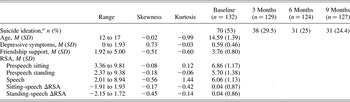
Descriptive statistics of the main study variables are presented in Table 1. About half of the adolescents reported a lifetime history of suicide ideation at baseline, and overall, approximately 42% (n = 55) reported suicide ideation at follow-up between 3 and 9 months. More specifically, at each follow-up assessment approximately one-quarter of the sample reported suicide ideation in the prior 3 months. Most adolescents who reported suicide ideation at follow-up also reported a lifetime history of ideation at baseline (85.5%, n = 47).
Descriptive statistics of the main study variables

Note: RSA, Respiratory sinus arrhythmia; ΔRSA, RSA standardized residual scores.
a Suicide ideation at baseline refers to lifetime suicide ideation.
Paired t tests revealed several differences between the RSA measures. Mean RSA was significantly higher in the prespeech sitting condition than in the prespeech standing condition, t (130) = 12.92, p < .001, and than during the speech, t (130) = 7.16, p < .001. Conversely, mean RSA was significantly lower in the prespeech standing condition than during the speech, t (131) = –3.07, p < .01. However, considerable variability was observed in RSA changes from both prespeech conditions to speech, with 75.6% of the participants showing some RSA decrease when using a sitting baseline and 31.1% when using a standing baseline.
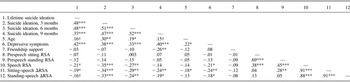
Bivariate correlations are presented in Table 2. Moderate correlations were observed between lifetime history of suicide ideation and suicide ideation assessed at each follow-up. Neither of the prespeech RSA measures correlated with suicide ideation (either lifetime or follow-up suicide ideation), but small to moderate negative correlations emerged between speech RSA, as well as RSA reactivity (i.e., ΔRSA), and suicide ideation. Finally, friendship support was negatively associated with suicide ideation at 9-month follow-up only.
Bivariate correlations among main study variables

Note: RSA, Respiratory sinus arrhythmia; ΔRSA, RSA standardized residual scores.
†p < .10. *p < .05. **p < .01. ***p < .001.
Predicting future suicide ideation: RSA and friendship support
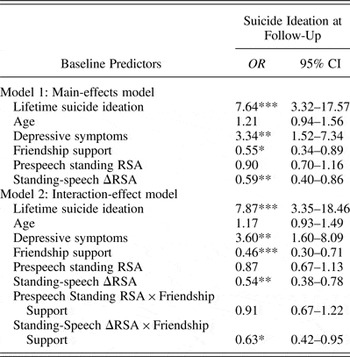
The odds ratios from the GEEs predicting suicide ideation at follow-up are presented in Table 3. The results from the main-effects model revealed that a lifetime history of suicide ideation and higher levels of depressive symptoms at baseline both increased risk for reporting suicide ideation over the 9-month follow-up period. After controlling for the effects of these covariates, a main effect of RSA reactivity (i.e., ΔRSA), but not prespeech standing RSA, on suicide ideation was found. That is, adolescent females who had greater relative RSA decreases in response to the laboratory speech task were more likely to report suicide ideation over the 9-month follow-up period. Moreover, a main effect of friendship support also was observed, indicating that adolescent females with higher levels of friendship support at baseline were less likely to report suicide ideation at follow-up.
Odds ratios from generalized estimating equations predicting follow-up suicide ideation

Note: RSA, Respiratory sinus arrhythmia; ΔRSA, RSA standardized residual scores.
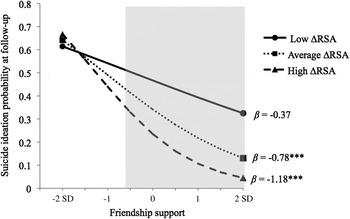
The second model yielded a significant interaction effect between RSA reactivity (i.e., ΔRSA) and friendship support.Footnote 4 To probe this interaction, simple slopes for the effect of friendship support (bounded at ±2 SD from the mean; Roisman et al., Reference Roisman, Newman, Fraley, Haltigan, Groh and Haydon2012) on suicide ideation were calculated at low, average, and high ΔRSA (i.e., –1 SD from the mean, mean, and +1 SD from the mean; see Figure 1). Simple slope analyses revealed a significant association between friendship support and the likelihood of suicide ideation among females with high, β = –1.18, t (123) = 3.73, p < .001, and average, β = –0.78, t (123) = 3.50, p < .001, but not low, β = –0.37, t (123) = 1.48, p = .14, ΔRSA. At relatively low levels of friendship support, all females had similarly highly elevated risk of reporting suicide ideation. However, as friendship support increased, only females who showed relatively stable or increasing RSA in response to the speech task (i.e., average and high ΔRSA, respectively) also had a corresponding decrease in risk for suicide ideation. Having more friendship support did not decrease the risk for suicide ideation in females with relatively decreasing RSA (i.e., low ΔRSA). More specifically, regions of significance analyses indicated that friendship support was associated with suicide ideation at values of ΔRSA above –0.78 SD from the mean, thus for all adolescents except those with greater relative decreases in RSA (lower and upper bounds on ΔRSA were –15.68 and –0.78 SD from the mean).
Interaction effect between friendship support and respiratory sinus arrhythmia (RSA) reactivity to the speech task on the probability of suicide ideation at follow-up. ΔRSA, RSA standardized residual scores. “Low” and “high” ΔRSA indicate scores 1 SD below and above the mean, respectively. Note that low and high ΔRSA reflect greater relative RSA decreases and increases to the speech task, respectively. The shaded area indicates the region of significance (lower and upper bounds are –13.80 and –0.59 SD from the mean); this indicates the values of friendship support outside which RSA reactivity significantly predicted suicide ideation (>–0.59 SD from the mean of friendship support). The interaction effect is plotted for adolescents who reported a lifetime history of suicide ideation (i.e., dummy-coded variable equal one).

The lower and upper bounds of the regions of significance on friendship support were –13.80 and –0.59 SD from the mean, respectively, indicating that simple slopes differed only at values of friendship support outside these bounds (shaded area in Figure 1). That the lower bound was far outside the range of observable values of friendship support indicates that adolescents with low levels of friendship support did not differ in their risk for suicide ideation at different patterns of RSA reactivity. This result is not consistent with plasticity models, according to which at both low and high levels of friendship support, females with different patterns of RSA reactivity would differ in their risk for suicide ideation, nor with diathesis–stress models, according to which at low, but not high, levels of friendship support, females with different RSA patterns would differ in their risk for suicide ideation. No significant interaction effect between prespeech RSA and friendship support on suicide ideation was found.
The GEEs conducted with the prespeech sitting RSA and RSA reactivity computed using the prespeech sitting, instead of standing, RSA yielded highly similar results to those reported in Table 3. Specifically, RSA reactivity, but not prespeech RSA, predicted suicide ideation at follow-up, odds ratio (OR) = 0.52, p < .01, 95% confidence interval (CI) [0.33, 0.81], and OR = 1.07, p = .64, 95% CI [0.82, 1.39], respectively. Moreover, the interaction between friendship support and RSA reactivity similarly emerged as significant, OR = 0.52, p < .01, 95% CI [0.31, 0.85]. Again, no significant interaction effect between prespeech RSA and friendship support was observed, OR = 1.21, p = .35, 95% CI [0.82, 1.78].
Additional analyses
To examine the consistency of the study findings, a series of additional analyses was performed. First, because approximately half of the adolescents reported using an antidepressant at baseline, GEE models were conducted to examine whether findings were consistent across females who used an antidepressant and those who did not. The results from these models revealed no significant moderating effects of antidepressant (dummy-coded as use vs. no use), indicating that, for females who used antidepressant and those who did not, RSA reactivity similarly predicted suicide ideation and similarly moderated the effect of friendship support on suicide ideation. Second, in light of the sociodemographic diversity of the sample, GEE models were conducted controlling for a number of additional covariates, including ethnicity (i.e., Caucasian vs. African American), family structure (i.e., household with both biological parents vs. others), and recruitment site (i.e., inpatient unit vs. community), all of which were associated with either RSA measures and/or suicide ideation. Note that these analyses were limited to Caucasian and African American adolescents, because only a minority of females belonged to other ethnic groups. These models yielded identical results to those presented in Table 3. Moreover, none of these covariates moderated the effect of RSA reactivity on suicide ideation or the interaction effect between friendship support and RSA reactivity.
Discussion
Although rates of suicide ideation are remarkably high among adolescents, especially among females, to date research has been quite unsuccessful in identifying factors that increase risk for future suicidality. In addition to mental disorders, difficulty in self-regulation has been proposed as an important vulnerability for adolescent suicidality (e.g., Najmi et al., Reference Najmi, Wegner and Nock2007); yet existing evidence mainly comes from cross-sectional studies using self-report measures. This study aimed to address the limitations of prior work by combining an in vivo interpersonal stress paradigm with a multiwave longitudinal design to examine physiological stress responses as prospective predictors of suicide ideation in a sample of high-risk adolescent females. As hypothesized, females with greater parasympathetic withdrawal in response to an interpersonal stressor were more likely to consider killing themselves over a 9-month follow-up period. Moreover, consistent with multilevel theories of developmental psychopathology and suicide (Cicchetti, Reference Cicchetti, Beauchaine and Hinshaw2008; Crowell et al., Reference Crowell, Derbidge, Beauchaine and Nock2014; Derbidge & Beauchaine, Reference Derbidge, Beauchaine, Lewis and Rudolph2014), parasympathetic stress responses moderated the effect of females’ perceived support from their close friendship on suicide ideation. As detailed below, findings from this study extend different areas of research and have a number of noteworthy theoretical and practical implications.
In this sample of high-risk adolescent females, resting RSA was not concurrently associated with, or longitudinally predictive of, suicide ideation. However, females who manifested greater relative RSA decreases from the baseline to the speech condition were significantly more likely to report suicide ideation over the ensuing 9 months. RSA reactivity predicted suicide ideation above and beyond females’ depressive symptoms and their lifetime history of suicide ideation, therefore yielding strong support for the key role of dysregulated parasympathetic stress responses as a risk factor for future suicide ideation. These findings are consistent with theoretical models of suicide (e.g., Crowell et al., Reference Crowell, Derbidge, Beauchaine and Nock2014; Derbidge & Beauchaine, Reference Derbidge, Beauchaine, Lewis and Rudolph2014) and prior work utilizing self-report measures of emotion regulation (e.g., Najmi et al., Reference Najmi, Wegner and Nock2007; Tamás et al., Reference Tamás, Kovacs, Gentzler, Tepper, Gádoros, Kiss and Vetró2007). Findings from this study also corroborate and extend the only previous study documenting the role of parasympathetic responses as relevant predictors of self-injurious behaviors in adolescent females (Crowell et al., Reference Crowell, Beauchaine, McCauley, Smith, Stevens and Sylvers2005).
According to the principle of neuroception in polyvagal theory, increases in parasympathetic activity reflect the perception of a social context as safe (Porges, Reference Porges2007) and support social engagement and approach behaviors (Hastings & Miller, Reference Hastings, Miller, Padilla-Walker and Carlo2014). Thus, females with more parasympathetic regulation of cardiac activity during the speech likely experienced this task as less threatening. They may have had stronger internal self-regulatory capacity to calmly face the social demands placed upon them. Conversely, females with withdrawal of parasympathetic activity were responding physiologically as if they felt more challenged or threatened (Hastings, Kahle, et al., Reference Hastings, Kahle, Han and Lagatutta2014). Rather than calm engagement, they may have been motivated to escape or avoid the social situation. Presuming that these patterns of parasympathetic responses were typical of the females’ reactions to socially demanding situations in other aspects of their lives, the females who had greater parasympathetic withdrawal would have recurrent experiences of distressed arousal, potentially invoking suicidal thoughts as an ultimate means of escape.
Of note, RSA reactivity moderated the effect of adolescents’ perceptions of support within their close friendship. However, in contrast to our hypotheses, at low levels of perceived friendship support, females with different patterns of RSA reactivity had a similar risk for suicide ideation at follow-up; conversely, high levels of perceived friendship support reduced the risk for suicide ideation in the presence of RSA increases, but not other RSA reactivity patterns. This finding does not conform to plasticity models (e.g., differential susceptibility model; Ellis et al., Reference Ellis, Boyce, Belsky, Bakermans-Kranenburg and van IJzendoorn2011) because females with greater physiological sensitivity (i.e., higher parasympathetic withdrawal) reported the same risk for suicide ideation regardless of their perceived friendship support. Thus, these females did not benefit more from their close friend's support, but on the contrary, showed the highest risk for suicide ideation in the context of supportive friendships. However, this finding seems also not to be consistent with diathesis–stress models (Monroe & Simons, Reference Monroe and Simons1991), given that at low levels of friendship support the risk for suicide ideation was not greater in the context of RSA decreases. Instead, in this sample, all females with low friendship support were at similarly higher risk for suicide ideation regardless of their parasympathetic regulation, and greater parasympathetic withdrawal acted as a vulnerability factor regardless of females’ perceived friendship support.
It is of interest that the nature of this interaction suggests that, at least in this high-risk group of females, parasympathetic activation in response to an emotionally salient situation may specifically serve as a vantage-sensitivity factor. The notion of vantage-sensitivity has been recently proposed by Pluess and Belsky (Reference Pluess and Belsky2013) to describe individual differences in sensitivity to positive environmental experiences. This perspective suggests that some individuals may be uniquely predisposed to benefit from positive social contexts. The concept of vantage-sensitivity mirrors the concept of vulnerability proposed by diathesis–stress models; yet the focus here is exclusively on positive experiences. In contrast with plasticity models, the vantage sensitivity to context hypothesis highlights that individuals who are sensitive to positive environments are not necessarily more sensitive to social adversity. Thus, these same individuals show more adaptive developmental outcomes or lower risk for maladjustment (e.g., suicide ideation) when in the context of supportive environments (e.g., highly supportive friendships), but are unresponsive to social adversity. According to this idea, females with greater parasympathetic activation benefitted from high levels of friendship support but were not at higher risk for suicide ideation, as compared to other females in this sample, in the context of low friendship support.
In line with interpersonal theories of emotion regulation (e.g., Lakey & Orehek, Reference Lakey and Orehek2011; Zaki & Williams, Reference Zaki and Williams2013), this interaction also suggests the intriguing possibility that supportive friendships provide a context within which internal self-regulatory capacity can be expressed. Females with more parasympathetic activation who routinely receive friendship support may be able to engage with social stress in a calm and planful manner, thereby dampening their emotional arousal and decreasing their likelihood of turning to suicidal thoughts as a means of escape. In contrast, females with more parasympathetic withdrawal appear unable to benefit from the protective effects of friendship support. These females may be prone to high levels of emotion dysregulation in the face of social stress, thereby interfering with their ability to effectively recruit external resources in the interest of alleviating distress. It is even possible that emotionally dysregulated females are more prone to destructive processes (e.g., co-rumination; Rose, Reference Rose2002) within supportive friendships, which would exacerbate rather than dampen their arousal in the face of stress. Of interest, internal physiological regulatory capacity alone was not sufficient to reduce risk for suicide ideation; under conditions of low friendship support, females who showed parasympathetic withdrawal as well as females who showed activation were more likely to experience suicide ideation over time. This finding is consistent with multiple lines of research indicating that social support plays a central role for adolescent successful regulation, whereas conditions characterized by a lack thereof (e.g., loneliness and social rejection) enhance risk for poor physical and mental health, including suicide ideation (Van Orden et al., Reference Van Orden, Witte, Cukrowicz, Braithwaite, Selby and Joiner2010). As posited by the social baseline theory (Coan & Maresh, Reference Coan, Maresh and Gross2014), social support facilitates regulatory processes because it provides individuals with additional resources that attenuate the individual's own energy required to face environmental demands. Drawing from social baseline theory, future research is warranted to examine how the availability of close friends during emotionally demanding situations may affect adolescent physiological and emotional responses. This research will contribute to a better understanding of the joint effects of interpersonal and internal regulation on adolescent suicidality.
The results from the current study have theoretical implications for future research. First, whereas suicide has been often conceptualized as the result of one or more mental disorders, our findings strongly support the notion that suicidality may be better conceptualized as the manifestation of poor physiological self-regulation (Crowell et al., Reference Crowell, Derbidge, Beauchaine and Nock2014). As such, future studies would benefit from greater attention to physiological stress responses to understand youth suicidality. Although neurobiological models of suicide have previously emphasized the importance of examining the biological underpinnings of this phenomenon (e.g., Crowell et al., Reference Crowell, Derbidge, Beauchaine and Nock2014; Mann, Reference Mann2003), most prior research failed to directly investigate biological responses to stress as potential vulnerabilities for suicidal thoughts and behaviors. Moreover, most prior neurobiological work on suicide has been conducted in suicide victims or adult inpatients, with surprisingly little attention to adolescents, despite the biological changes (e.g., heightened emotional and physiological sensitivity combined with low self-regulation) that potentially increase risk for suicidality during this developmental period (Casey et al., Reference Casey, Jones and Hare2008).
Second, this study also contributes to the broader developmental psychopathology literature examining multilevel interactions between physiological stress responses and environmental conditions. Building on evolutionary and developmental perspectives (e.g., Beauchaine, Klein, Crowell, Derbidge, & Gatzke-Kopp, Reference Beauchaine, Klein, Crowell, Derbidge and Gatzke-Kopp2009; Boyce & Ellis, Reference Boyce and Ellis2005), such as biological sensitivity to context models and differential susceptibility models, this area of research primarily has examined how interindividual differences in environmental sensitivity interact with the family context to predict children's psychosocial adjustment (e.g., El-Sheikh & Erath, Reference El-Sheikh and Erath2011; Hastings et al., Reference Hastings, Sullivan, McShane, Coplan, Utendale and Vyncke2008). Only a minority of studies have examined these processes during adolescence (e.g., Sijtsema et al., Reference Sijtsema, Nederhof, Veenstra, Ormel, Oldehinkel and Ellis2013). Even fewer studies have investigated peer relationships as potential environments interacting with biological functioning (for exceptions, see Gregson, Tu, & Erath, Reference Gregson, Tu and Erath2014; Rudolph, Troop-Gordon, & Granger, Reference Rudolph, Troop-Gordon and Granger2011), despite decades of research supporting the role of peers as a crucial context of development (Prinstein & Giletta, Reference Prinstein, Giletta and Cicchetti2016). The observed interaction between friendship support and parasympathetic stress responses provides initial support for the salience of the peer context in this regard. Given adolescents’ enhanced orientation toward, and sensitivity to, the peer context (Crone & Dahl, Reference Crone and Dahl2012; Forbes & Dahl, Reference Forbes and Dahl2010), future developmental psychopathology research would benefit from examining how individual differences in physiological functioning may alter the effects of peer and friendship relationships as developmentally salient contexts.
A few implications for clinical practice and intervention development are also noteworthy. Research has provided some support for the effectiveness of interventions based on cognitive–behavioral therapy in improving emotion regulation skills (e.g., Suveg, Kendall, Comer, & Robin, Reference Suveg, Kendall, Comer and Robin2006), reducing physiological stress responses (e.g., Hammerfald et al., Reference Hammerfald, Eberle, Grau, Kinsperger, Zimmermann, Ehlert and Gaab2006), and, in some cases, youth suicidality (Robinson, Hetrick, & Martin, Reference Robinson, Hetrick and Martin2011). Nevertheless, the current study suggests that such interventions may not be sufficient to prevent suicide ideation among high-risk adolescents. Rather, the results indicate that intervention and treatment programs also should pay attention to the friendship context to prevent and reduce adolescent suicidality. For example, interventions could integrate dyadic interpersonal skill building into more traditional cognitive–behavioral therapies programs to facilitate the formation and maintenance of supportive friendships. Accordingly, clinicians could benefit from assessing and treating both adolescents’ responses to stress as well as their friendship context. In sum, both internal and external sources of regulation should be targeted in order to increase the probability of successfully reducing suicide ideation among adolescents with a history of psychiatric symptoms.
This study offers novel findings that advance our knowledge on physiological self-regulation and adolescent suicidality by integrating work from different research areas and adopting a rigorous methodology combining a laboratory-based paradigm with a multiwave longitudinal design. Yet findings must be interpreted in light of a number of limitations. First, the generalizability of findings is limited to adolescent females with a prior history of significant psychiatric symptoms (i.e., at high risk for suicidal thoughts and behaviors). There is evidence to suspect that results may not apply to other populations. For example, adolescents without a history of psychopathology may show different parasympathetic stress responses (e.g., Graziano & Derefinko, Reference Graziano and Derefinko2013). Moreover, friendship support may be a less relevant dimension for identifying suicide ideation among male adolescents (Sun & Hui, Reference Sun and Hui2007). Second, the assessment of the friendship context was limited to adolescents’ perception of their close friend's support. Future research is needed that considers other dimensions of friendships (e.g., friends’ suicidality, friends’ depressive symptoms, and number of mutual friends), which may serve as environmental factors exacerbating or attenuating the effects of adolescent physiological dysregulation. In addition, this study built on the assumption that supportive friendships provide an external context of regulation. Although prior theoretical and empirical work has largely supported this idea (Zaki & Williams, Reference Zaki and Williams2013; Zeman et al., Reference Zeman, Cassano, Adrian, Barrett, Fox, Morgan, Fidler and Daunhauer2013), research also has suggested that high-quality and supportive friendships may act as contexts that exacerbate stress responses (Calhoun et al., Reference Calhoun, Helms, Heilbron, Rudolph, Hastings and Prinstein2014). Thus, future research is warranted to differentiate dyadic processes that promote emotion regulation from processes that, on the contrary, undermine it. Third, because this work specifically focused on PNS responses as a physiological indicator of self-regulation, SNS responses to the stress task were not examined. Nevertheless, emerging evidence highlights the importance of considering simultaneously both PNS and SNS responses to understand youth developmental outcomes (e.g., El-Sheikh et al., Reference El-Sheikh, Kouros, Erath, Cummings, Keller and Staton2009). Accordingly, future suicide research would benefit from examining physiological responses across multiple systems. Fourth and finally, limitations regarding the assessment of RSA should be acknowledged. Cardiac activity at rest was measured approximately 1 hr before the stress task rather than immediately prior to the beginning of the task. A consecutive assessment of RSA would have been preferable, especially to allow modeling changes in RSA from baseline to the stress in a more dynamic manner (e.g., using latent growth curve modeling; see Burt & Obradovic, Reference Burt and Obradović2013; Hastings, Kahle, et al., Reference Hastings, Kahle, Han and Lagatutta2014). Moreover, the basal standing measure of RSA was assessed for 1 min only, and RSA during the speech was assessed only when participants were standing, but not sitting. Although a 1-min epoch is considered sufficient to reliably measure RSA (Berntson et al., Reference Berntson, Bigger, Eckberg, Grossman, Kaufmann, Malik and Van Der Molen1997), future work would benefit from assessing longer periods of baseline functioning as well as from examining RSA reactivity across different postures. Findings from our study revealed an average RSA decrease when examining changes from basal sitting to speech standing, but an average RSA increase when comparing baseline standing to speech standing. Whereas these differences are likely due to postural effects (Houtveen et al., Reference Houtveen, Groot and Geus2005), they also suggest that the stress task may have differentially activated parasympathetic responses depending on the participants’ postural position. One prior study has supported this hypothesis (Cacioppo, Uchino, & Berntson, Reference Cacioppo, Uchino and Berntson1994), showing parasympathetic increases when RSA was measured while standing during both the basal and task assessment and parasympathetic decreases when comparing basal sitting to task sitting RSA. Given the robustness of our results across measurements, these differences do not have direct implications for our findings, yet they clearly highlight the need for future work to take postural changes into account.
To conclude, this study clearly demonstrates that parasympathetic withdrawal in response to an interpersonal stressor appears to be a biomarker of poor regulation that represents a vulnerability factor for adolescent females’ suicidality. Moreover, it appears that both internal (i.e., parasympathetic responses) and external (i.e., friendship support) sources of regulation available reduce risk for suicide ideation. As such, this study yields strong empirical support for suicide ideation as a manifestation of poor physiological regulation in response to stress and offers substantial evidence that suicide research may benefit from applying a multilevel developmental perspective to identify youth at risk for suicidal thoughts and behaviors.