1. Introduction
The International Subcommission on Cambrian Stratigraphy has been working towards the development of globally recognizable subdivisions of the Cambrian System for nearly three decades. A particularly important step has been the adoption of a chronostratigraphic framework consisting of four series and ten stages (Babcock et al. Reference Babcock, Peng, Geyer and Shergold2005; Peng, Babcock & Cooper, Reference Peng, Babcock, Cooper, Gradstein, Ogg, Schmitz and Ogg2012). Despite these developments there are as yet no formal subdivisions of the former Lower Cambrian, and global chronstratigraphic subdivisions and correlations of lower Cambrian (Terreneuvian Series and Series 2) strata continue to be problematic. Recently, the International Working groups on the lower Cambrian stages and series have concentrated on creating reliable datum planes in order to establish global boundary stratotype sections and points (GSSPs) for these units. Siberia and South China are two particularly important regions yielding abundant and diverse archaeocyath, trilobite and small shelly fossil (SSF) faunas (Zhu, Babcock & Peng, Reference Zhu, Babcock and Peng2006; Zhu et al. Reference Zhu, Pak, Babcock and Rozanov2007; Rozanov et al. Reference Rozanov, Khomentovskiy, Shabanov, Karlova, Varlamov, Luchinina, Pegel’, Demidenko, Parkhaev, Korovnikov and Skorlotova2008). Among these, archaeocyaths are of particular interest and utility for global correlations due to rapid species turnover, high diversity and global distribution. Although a number of global correlation charts based on archaeocyaths with references to trilobites and SSFs have been proposed (Debrenne, Rozanov & Zhuravlev, Reference Debrenne, Rozanov and Zhuravlev1990; Zhuravlev, Reference Zhuravlev, Geyer and Landing1995; Zhuravlev & Riding, Reference Zhuravlev, Riding, Zhuravlev and Riding2001), these charts are considered by some to be problematic due to potential archaeocyath taxonomic inconsistencies, a high level of regional endemicity, and a possible dependence on substrate control (microfacies) (e.g. Geyer & Shergold, Reference Geyer and Shergold2000; Landing et al. Reference Landing, Geyer, Brasier and Bowring2013). However, such criticism might be equally applied to any early Cambrian taxa (e.g. trilobites; Pegel’, Reference Pegel’2000; Álvaro et al. Reference Álvaro, Elicki, Geyer, Rushton and Shergold2003) while archaeocyath systematics are sophisticated and well documented (Debrenne, Zhuravlev & Kruse, Reference Debrenne, Zhuravlev, Kruse, Hooper and van Soest2002, Reference Debrenne, Zhuravlev, Kruse and Selden2015).
The first high-resolution biostratigraphic scale using archaeocyaths was established on the Siberian Platform where the Tommotian, Atdabanian, Botoman and Toyonian stages and their zonation were partly or entirely developed on the succession of archaeocyath assemblages (Zhuravleva, Reference Zhuravleva1960; Rozanov et al. Reference Rozanov, Missarzhevskiy, Volkova, Voronova, Krylov, Keller, Korolyuk, Lendzion, Mikhnyak, Pykhova and Sidorov1969; Zhuravleva, Korshunov & Rozanov, Reference Zhuravleva, Korshunov, Rozanov and Zhuravleva1969; Rozanov & Sokolov, Reference Rozanov and Sokolov1984). Local archaeocyathan zones are established in the Altay Sayan Foldbelt of southern Siberia and the Russian Far East for the Atdabanian, Botoman and Toyonian stages where the most continuous Botoman and Toyonian archaeocyath fossil record exists (Repina et al. Reference Repina, Khomentovskiy, Zhuravleva and Rozanov1964; Zhuravleva et al. Reference Zhuravleva, Zadorozhnaya, Osadchaya, Pokrovskaya, Rodionova and Fonin1967; Borodina et al. Reference Borodina, Konyushkov, Osadchaya, Belyaeva and Okuneva1973; Okuneva & Repina, Reference Okuneva and Repina1973; Belyaeva et al. Reference Belyaeva, Luchinina, Nazarov, Repina and Sobolev1975; Osadchaya et al. Reference Osadchaya, Kashina, Zhuravleva, Borodina and Boyarinov1979; Osadchaya, Reference Osadchaya and Zhuravleva1986; Belyaeva, Reference Belyaeva1988; Astashkin et al. Reference Astashkin, Belyaeva, Esakova, Osadchaya, Pakhomov, Pegel’, Repina, Rozanov and Zhuravlev1995). Subsequently, lower Cambrian archaeocyathan zonations were proposed for Spain (Perejón, Reference Perejón1984, Reference Perejón1994; Perejón & Moreno-Eiris, Reference Perejón and Moreno-Eiris2006), Canada, Greenland, Mexico and the United States (Debrenne & Peel, Reference Debrenne and Peel1986; Zhuravlev in Voronova et al. Reference Voronova, Drozdova, Esakova, Zhegallo, Zhuravlev, Rozanov, Sayutina and Ushatinskaya1987; Debrenne, Gandin & Rowland, Reference Debrenne, Gandin and Rowland1989; Mansy, Debrenne & Zhuravlev, Reference Mansy, Debrenne and Zhuravlev1993; McMenamin, Debrenne & Zhuravlev, Reference Mcmenamin, Debrenne and Zhuravlev2000), South Australia (Gravestock, Reference Gravestock1984; Zhuravlev & Gravestock, Reference Zhuravlev and Gravestock1994; Gravestock & Shergold, Reference Gravestock, Shergold, Zhuravlev and Riding2001), Morocco (Debrenne & Debrenne, Reference Debrenne, Debrenne, Geyer and Landing1995) and Mongolia (Zhuravlev, Reference Zhuravlev, Ahlberg, Eriksson and Olsson1998). These archaeocyathan zonations encompass the principal regions of archaeocyathan distribution and each regional zonation works well – at a species level of precision – within the former Cambrian palaeocontinents and adjacent terrane complexes, namely Siberia (Siberian Platform and Kolyma Basin of Russia), the Ural-Mongolian complex of terranes (the Urals, Altay Sayan Foldbelt, Transbaikalia, Russian Far East, Kazakhstan, Kirgizia, Uzbekistan, Tajikistan and Mongolia), Laurentia (Canada, Greenland, Mexico and the United States), Western Gondwana (Spain, France, Sardinia, Germany and Poland), Eastern Gondwana (Australia and Antarctica as well as allochthonous assemblages of South Africa, South America and the Falkland Islands) and South China (Yangtze Platform). Tarim and the North China Platform yield cosmopolitan assemblages of archaeocyaths only (Zhang, Reference Zhang1983) and fossils of the Hinggan (NE China) need a redescription (Guo, Reference Guo1981).
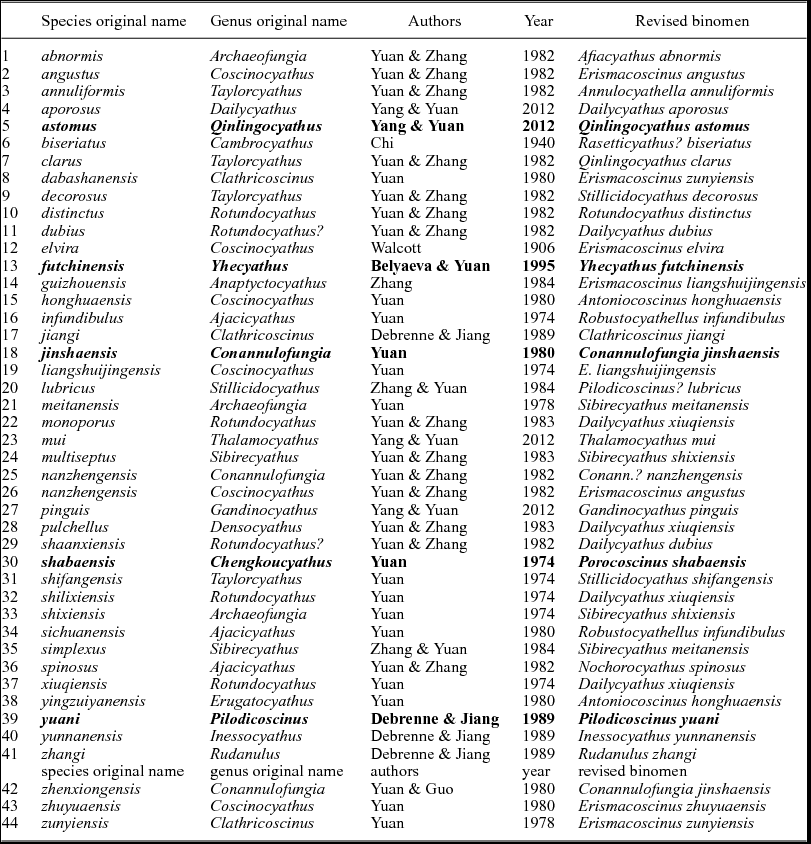
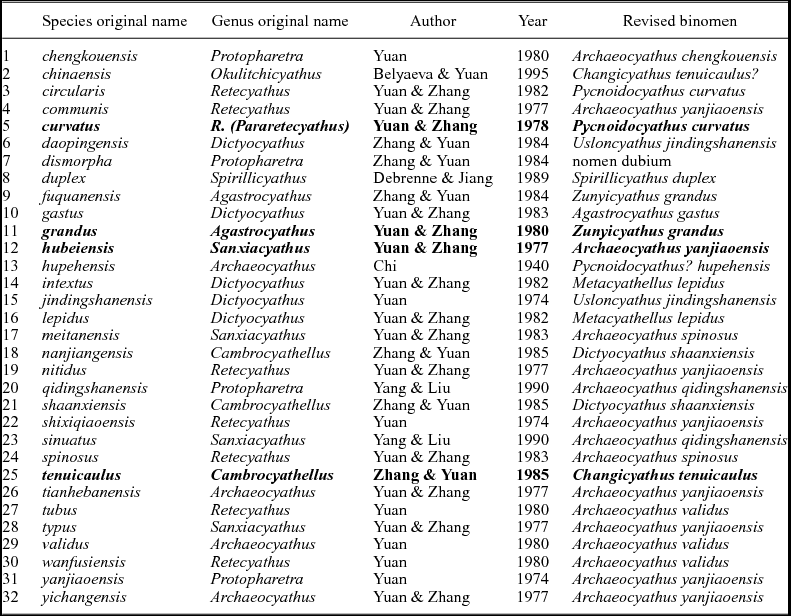
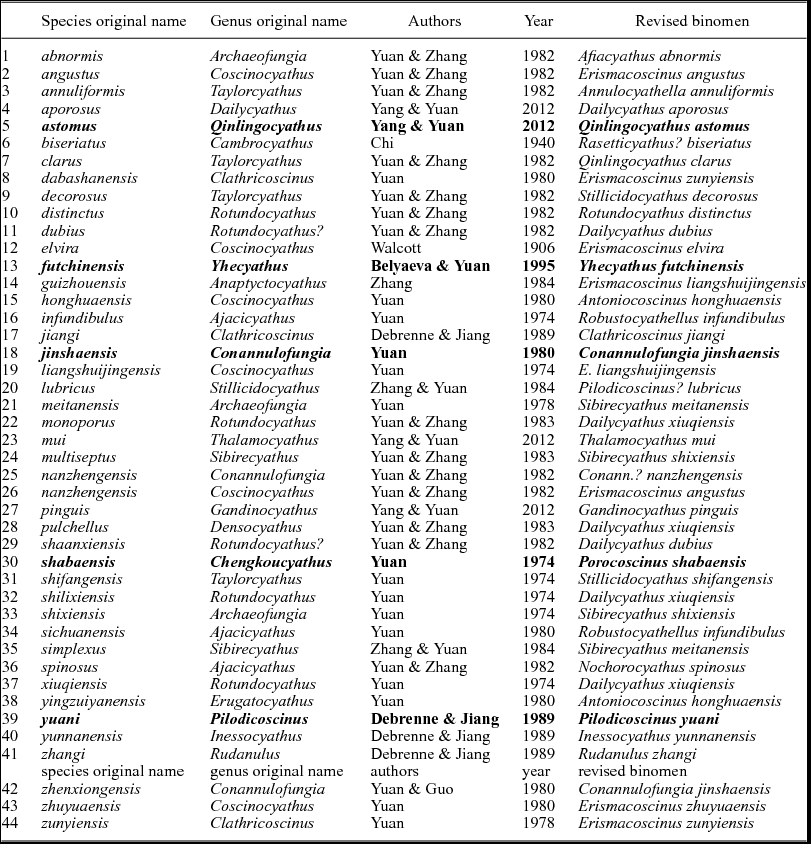
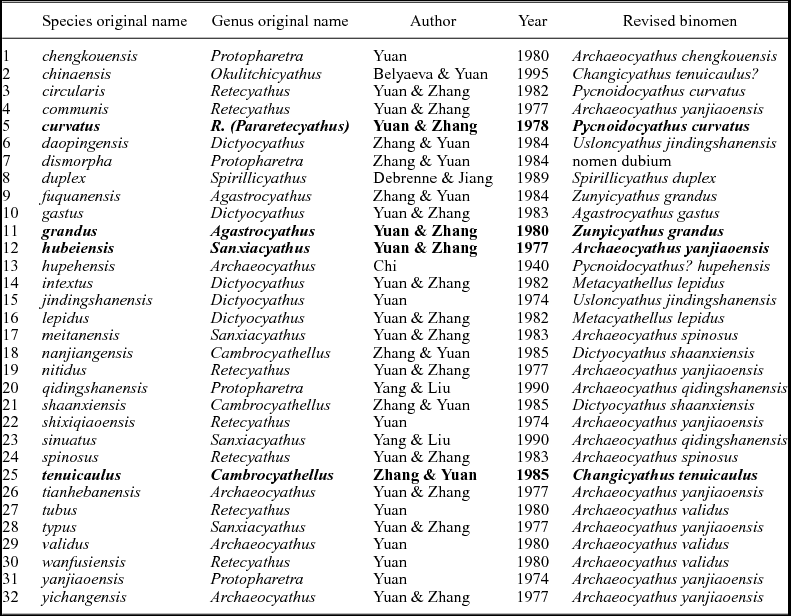
On the carbonate-dominated Yangtze Platform, archaeocyaths are a major component of early Cambrian faunas. These were first described in 1906 by the famous Cambrian researcher Charles Walcott (Reference Walcott1906) and, to date, 76 new species belonging to 32 genera (including 8 new genera and subgenera) have been described from this region (Chi, Reference Chi1940; Yuan, Reference Yuan1974, Reference Yuan1980; Yuan & Zhang, Reference Yuan and Zhang1977, Reference Yuan and Zhang1978, Reference Yuan and Zhang1980, Reference Yuan and Zhang1982, Reference Yuan and Zhang1983; Zhang & Yuan, Reference Zhang and Yuan1984, Reference Zhang and Yuan1985; Debrenne & Jiang, Reference Debrenne and Jiang1989; Belyaeva & Yuan, Reference Belyaeva and Yuan1995; Yang & Yuan, Reference Yang and Yuan2012; Tables 1 and 2). Yuan & Zhang (Reference Yuan and Zhang1980, Reference Yuan and Zhang1981, Reference Yuan and Zhang1982) and Zhang (Reference Zhang1989) recognized four successive archaeocyathan assemblages in central and southwestern areas of South China. Based in part on the archaeocyathan fossil record in the Fucheng section, Yuan et al. (Reference Yuan, Zhu, Zhang and Van Iten2001) established the Qiongzhusian, Canglangpuan and Tianheban assemblages. However, archaeocyath taxonomy used by these authors is now in need of revision, and no biozones have yet been proposed. Consequently, the evolutionary history of Chinese archaeocyaths as well as their potential for global correlation is not well understood.
Revised affinities of the Ajacyathida and the Capsulocyathida from South China (type species of genera established in South China are in bold).
Revised affinities of the Archaeocyathida from South and North China (type species of genera established in South China are in bold).
The aim of the present study is to develop a high-resolution archaeocyath zonation based on recent taxonomic revisions of previously described material and on the examination of new specimens (A. H. Yang, unpub. Ph.D. thesis, CAS, Nanjing, 2005; Yang & Yuan, Reference Yang and Yuan2012), allowing the application of these data to a reliable global correlation.
2. Materials and methods
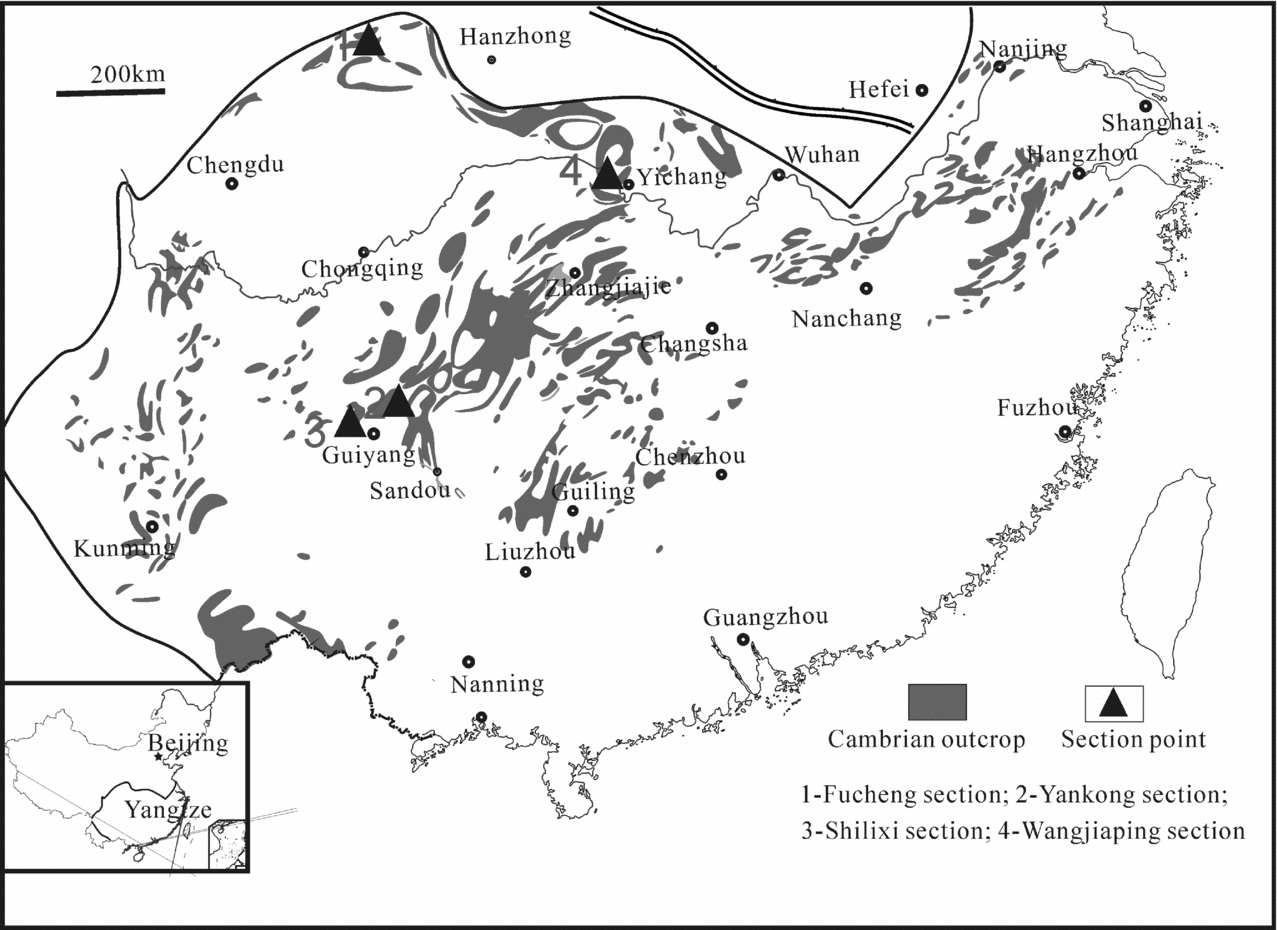
Five lower Cambrian sections on the Yangtze Platform are selected and analysed in detail, namely: (1) Fucheng near Nanzhen, Shaanxi Province; (2) Xinchao in Tongjiang County, Sichuan Province; (3) Shilixi near Meitan, Guizhou Province; (4) Yankong near Jinsha, Guizhou Province; and (5) Wangjiaping near Yichang, Hubei Province (Fig. 1). These sections are the reference sections for the lower Cambrian Qiongzhusian and Canglangpuan stages in China, which are approximate equivalents of stages 3 and 4 of the current International Chronostratigraphic Chart (Peng, Babcock & Cooper, Reference Peng, Babcock, Cooper, Gradstein, Ogg, Schmitz and Ogg2012).
Map of lower Cambrian localities of South China bearing archaeocyaths.

Most of the 1400 archaeocyath-containing samples under study were collected during field seasons of 1990, 2002 and 2003 from these sections. Of these, over 500 samples were collected from the Xiannudong Formation (Fucheng and Xinchao sections), 400 samples from the Mingxinsi Formation (Shilixi and Yankong sections) and 200 samples from the Tianheban Formation (Wangjiaping section). A preliminary analysis of some of these samples has been conducted by Yuan et al. (Reference Yuan, Zhu, Zhang and Van Iten2001) and this material is also re-examined here. All samples were processed by grinding and cut into thin-sections. Thin-sections are stored in the Nanjing Institute of Geology and Paleontology, Chinese Academy of Sciences, under collections numbers NIGPAS-ELRC-Sp. A total of 32 genera and 45 species (including two species in open nomenclature) are identified; with the exception of some nominis dubia, the majority of the remainder is synonymized with these (Tables 1 and 2).
3. Revision of South China archaeocyath taxonomy
A global revision of archaeocyath taxonomy commenced in the early 1990s by Françoise Debrenne, Andrey Zhuravlev, Aleksey Rozanov and Pierre Kruse (Debrenne, Rozanov & Zhuravlev, Reference Debrenne, Rozanov and Zhuravlev1990; Debrenne & Zhuravlev, Reference Debrenne and Zhuravlev1992; Debrenne, Zhuravlev & Kruse, Reference Debrenne, Zhuravlev, Kruse, Hooper and van Soest2002) and was finalized in a new issue of the Treatise on Invertebrate Palaeontology, Part E (Debrenne, Zhuravlev & Kruse, Reference Debrenne, Zhuravlev, Kruse and Selden2015). This established a new archaeocyath systematics, which as a group is now considered to be a class of the Porifera with close affinities to the Demospongiae.
These works necessitate a full revision of generic affinities of those archaeocyaths described from South China. Such a revision has already resulted in significant changes in taxonomy (Debrenne & Jiang, Reference Debrenne and Jiang1989; Debrenne and Zhuravlev, Reference Debrenne and Zhuravlev1990; Debrenne, Gandin & Zhuravlev, Reference Debrenne, Gandin and Zhuravlev1991; Debrenne, Kruse & Zhang, Reference Debrenne, Kruse and Zhang1991), which in turn is influential on stratigraphy. Cambrocyathellus shaanxiensis Zhang & Yuan, Reference Zhang and Yuan1985, for which a Tommotian age has been suggested (Zhang & Yuan, Reference Zhang and Yuan1985), has therefore been synonymized with C. nanjiangensis and C.tenuicaulus Zhang & Yuan, Reference Zhang and Yuan1985 and ascribed to the mostly Botoman genus ?Graphoscyphia (Debrenne & Jiang, Reference Debrenne and Jiang1989). However, this species differs from ?Graphoscyphia by a presence of an irregular single pore row (rather than regular several pore rows) per outer wall intersept, and therefore belongs to Dictyocyathus, a genus of wide stratigraphic distribution. Cambrocyathellus tenuicaulus Zhang & Yuan, Reference Zhang and Yuan1985 serves as the basis for the establishment of a separate genus Changicyathus (Debrenne & Zhuravlev, Reference Debrenne and Zhuravlev1992). Changicyathus tenuicaulus (Zhang & Yuan, Reference Zhang and Yuan1985), which is characterized by large bowl-shaped cups, is the senior synonym of another ostensibly Tommotian species Okulitchicyathus chinaensis Belyaeva & Yuan, Reference Belyaeva and Yuan1995. This revision has revealed an absence of any distinct Tommotian genus in South China (Tables 1 and 2). Of a great importance is the identification in South China of species of Robustocyathellus (former Ajacicyathus infundibulus Yuan, Reference Yuan1974), Usloncyathus (former Dictyocyathus jindingshanensis Yuan, Reference Yuan1974), Stillicidocyathus (former Taylorcyathus decorosus Yuan & Zhang, Reference Yuan and Zhang1982), Metacyathellus (former Dictyocyathus lepidus Yuan & Zhang, Reference Yuan and Zhang1982) and Agastrocyathus (former Dictyocyathus gastus Yuan & Zhang, Reference Yuan and Zhang1983). This allows direct correlations with Siberia, Eastern and Western Gondwana and Laurentia at a higher resolution level due to restricted stratigraphic distribution of these genera.
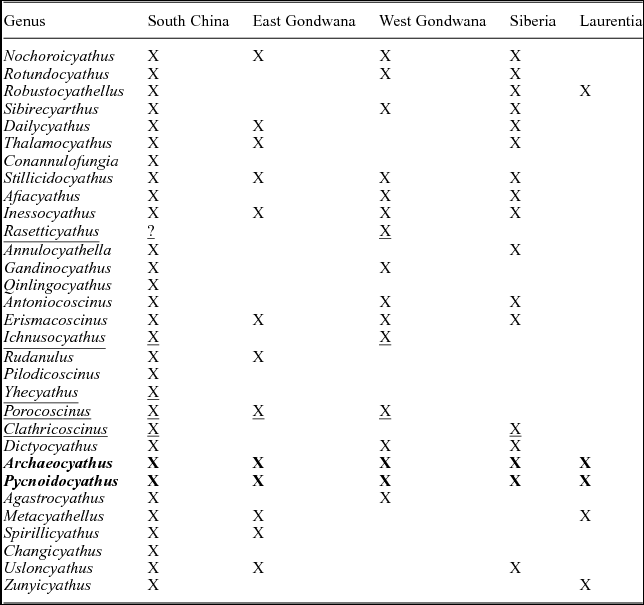
In general, South China archaeocyathan assemblages yield a few endemic genera only (Conannulofungia, Pilodicoscinus, Yhecyathus and Qinlingocyathus); a probable species of Changicyathus occurs in Tajikistan. These assemblages are characterized by a high diversity of genera belonging to the family Rudanulidae (Rudanulus, Pilodicoscinus and Yhecyathus) and the superfamily Metacyathoidea (Agastrocyathus, Metacyathellus, Spirillicyathus and Changicyathus), both of which are typical of Eastern Gondwana. Other genera are also common between South China and Eastern and Western Gondwana and only two genera, namely Clathricoscinus and Robustocyathellus, are otherwise absent from any part of this palaeocontinent; both are widespread in Siberia and a single species of Robustocyathellus occurs in Western Laurentia (Table 3).
Global distribution of archaeocyath genera of South China (early Botoman index-genera are underlined and middle Toyonian are formatted in bold).

4. Reference sections
In South China, archaeocyaths occur mostly in the lower Cambrian Xiannudong and Kongmingdong formations in the Fucheng and Xinchao sections in southern Shaanxi and northern Sichuan provinces; the upper Shuijingtuo, Shipai and Tianheban formations in the Xiaoyang section near Zhenba, Shaanxi Province; the Chengkou, Chongqing, Mingxisi and Jindingshan formations in the Yankong and Shilixi sections in northern Yunnan and central and northern Guizhou provinces; and the Tianheban Formation in the Wangjiaping section in western Hubei Province (Fig. 1). The four sections described below are well exposed and contain abundant archaeocyath fossils.
4.a. Fucheng and Xinchao sections
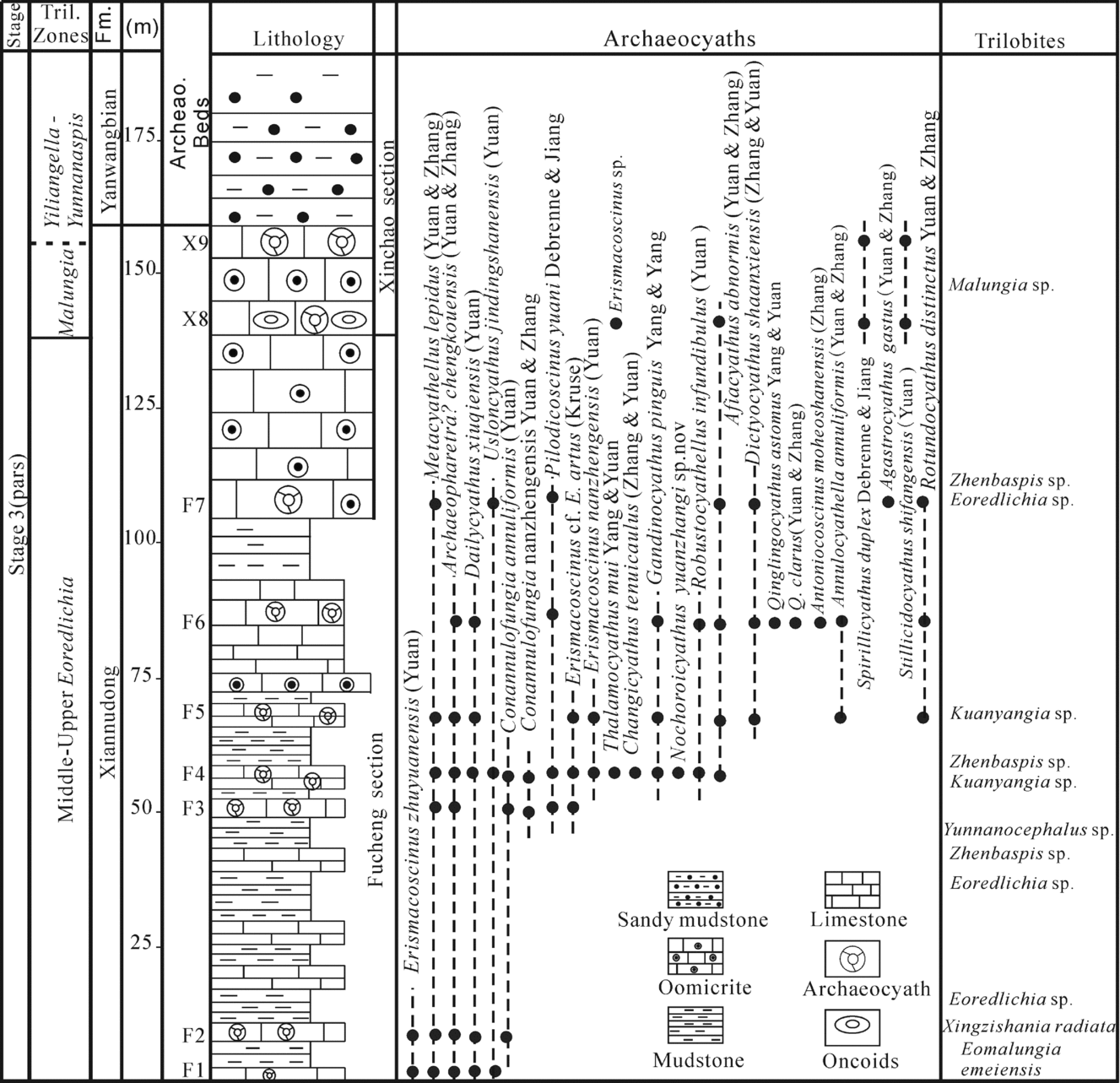
The Fucheng section is located near the village of Fucheng, Nanzheng County, Shaanxi Province, where lower Cambrian strata are well exposed along the foot and slope of an isolated hill (Fig. 2). The stratigraphic succession contains, in ascending order, the Guojiaba, Xiannudong, Yanwangbian and Kongmingdong formations. The Guojiaba Formation, 348 m thick, is composed of dark grey silty mudstone, siltstone and black shale, and disconformably overlies the Kuanchuanpu Formation. The Xiannudong Formation, 155 m thick, conformably overlies calcareous siltstone of the upper Guojiaba Formation, and is conformably overlain by dolomitic siltstone of the Yanwangbian Formation. The Xiannudong Formation consists of two units: the 46-m-thick upper unit of ooid and dolomitic limestone bearing rare fossils and the 109-m-thick lower member of bioclastic packstone and marly limestone interbedding with ooid grainstone. The bioclastic packstone is a fossiliferous interval that accommodates seven levels characterized by archaeocyaths (F1–F7), trilobites (Eoredlichia, Yunnanocephalus, Kuanyangia and Zhenbaspis), calcimicrobes of Epiphyton-, Renalcis- and Girvanella-groups and linguliformean brachiopods (Fig. 2). Otherwise, the level characterized by archaeocyaths (F1) represents the lowest archaeocyaths in South China.
The Fucheng–Xinchao section.

The Xinchao section is located near the village of Xinchao, Tongjiang County, Sichuan Province and exposes the same lithostratigraphic units as the Fucheng section. The Xiannudong Formation is 113 m thick here and includes multiple interbeds of various thinly bedded, peloidal, silty to sandy, micritic, oncoid and ooid grainstones (Hicks & Rowland, Reference Hicks and Rowland2009). The upper unit consists mostly of bioclastic packstone and ooid grainstone and embraces two archaeocyath-bearing levels (X8–X9) and the trilobite Malungia sp. The Kongmingdong Formation has a single archaeocyath unit only (X10) with Archaeocyathus yanjiaoensis (Yuan).
4.b. Yankong section
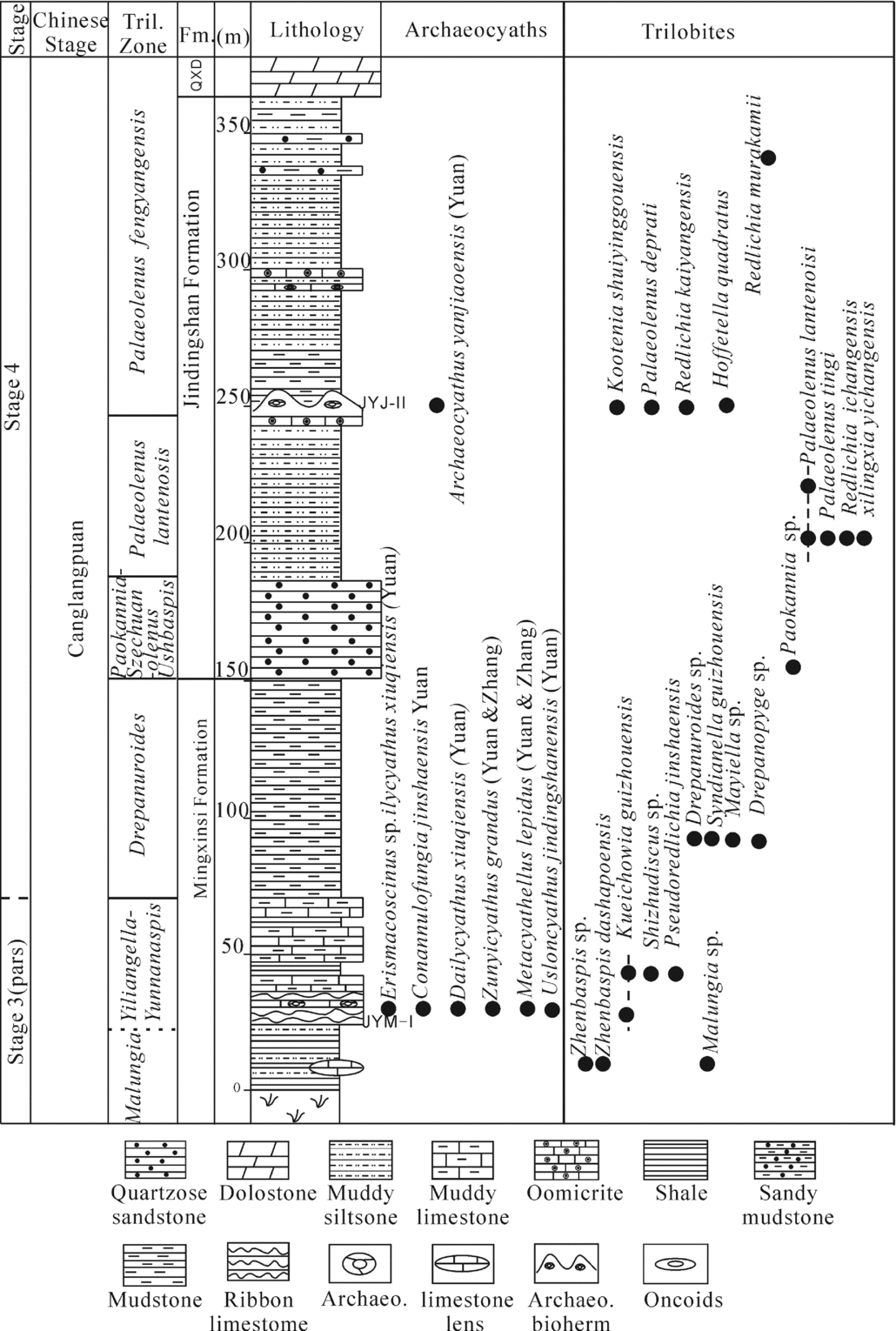
The Yankong section is located near the village of Jinsha in Guizhou Province (Fig. 3). The lower Cambrian Mingxinsi and Jindingshan formations are well exposed along a road cut. Archaeocyaths occur in the lower Mingxinsi Formation and in the upper Jindingshan Formation. The Mingxinsi Formation, 134.5 m thick, is conformably overlain by silty shale of the Jindingshan Formation and underlain by black shale of the Niutitang Formation. It is subdivided into three units. The 24-m-thick lower unit is composed of calcareous shale alternating with silty shale and siltstone. The basal part of this member includes sandy mudstone and marlstone with trilobites Zhenbaspis sp. and Malungia sp. (Fig. 3). The 42-m-thick middle unit is represented by argillaceous ribbon limestone, nodular limestone interchanging with dark shale and archaeocyath-bearing limestone containing Dailycyathus xiuqiensis (Yuan), Conannulofungia jinshaensis Yuan, Metacyathellus lepidus (Yuan & Zhang), Erismacoscinus sp., Usloncyathus jindingshanensis (Yuan) and Zunyicyathus grandus (Yuan & Zhang). In this unit the trilobites Kueichowia guizhouensis, Shizhudiscus sp. and Pseudoredlichia jinshaensis are present The 68.5-m-thick upper unit is composed of grey mudstone containing trilobites Drepanuroides sp., Syndianella guizhouensis, Mayiella sp. and Drepanopyge sp.(Fig. 3).
The Yankong section.

The Jindingshan Formation (210 m thick) is conformably overlain by the Qingxudong Formation and includes two members. The 20-m-thick lower unit is composed mostly of conglomeratic quartzose sandstone and mudstone containing trilobites Paokannia sp. The following 46-m-thick middle unit is represented by silty shale interbedding with trilobite-bearing siltstone (Palaeolenus lantenoisi, P. tingi and Xilingxia yichangensis). The 110-m-thick upper unit is composed of mudstone alternating with siltstone, oolitic and oncolitic limestone and calcimicrobial-archaeocyathan bioherms built by Archaeocyathus yanjiaoensis (Yuan), Epiphyton-, Renalcis- and Girvanella-group calcimicrobes and yielding the trilobite Palaeolenus deprati (Fig. 3).
4.c. Shilixi section
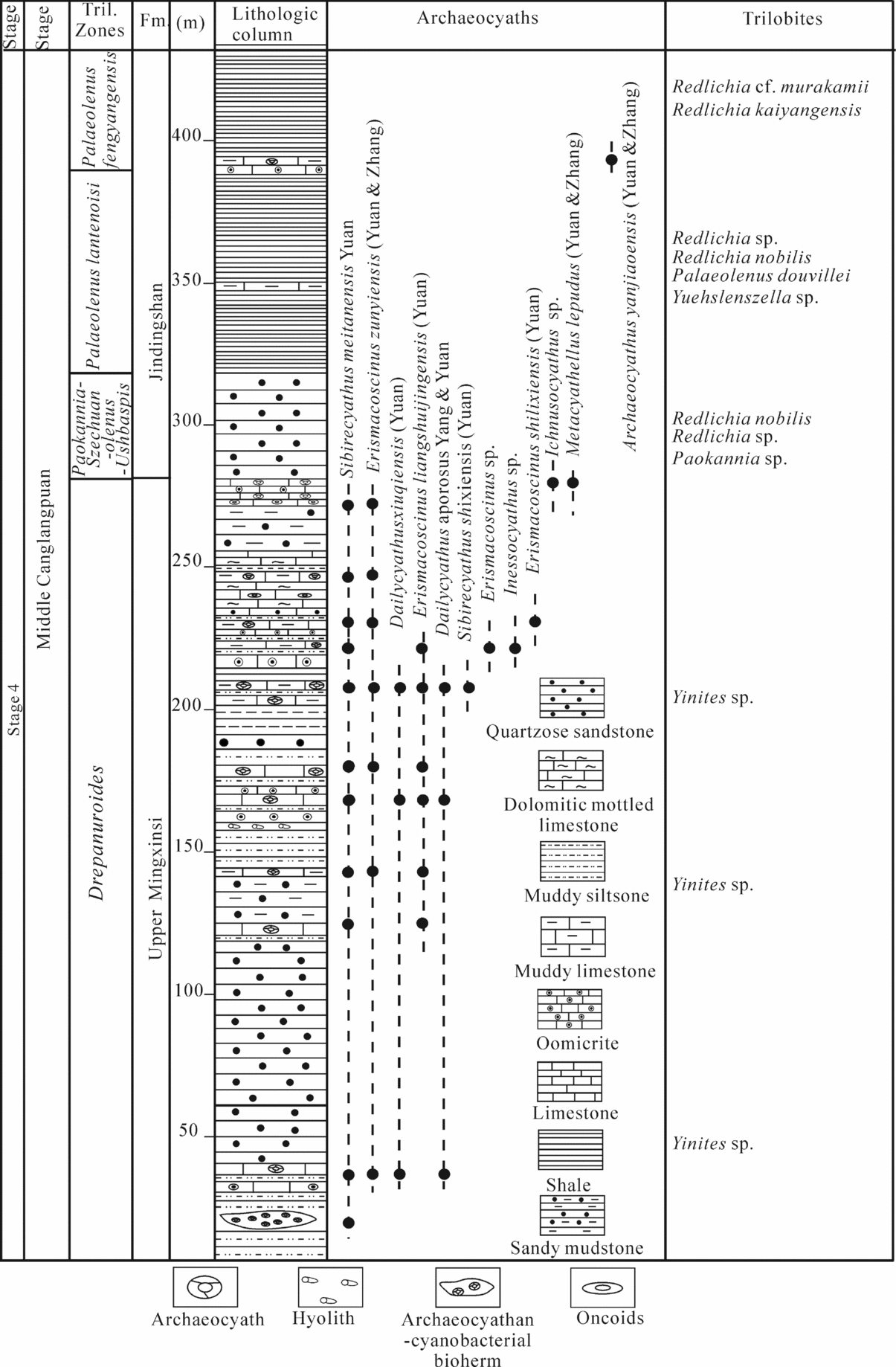
The Shilixi section is located along a small river near the village of Wangjiaba, Meitan County, Guizhou Province (Fig. 4). The lower Cambrian succession consists of, in ascending order, the upper Mingxinsi, Jindingshan and Qingxudong formations. The upper Mingxinsi Formation, c. 288 m thick, is conformably overlain by the Jindingshan Formation. It is subdivided into two parts. The 200-m-thick lower part is composed of shale and silty shale interbedding with siltstone and oolitic grainstone and includes seven levels of archaeocyathan limestone containing Sibirecyathus meitanensis (Yuan), Dailycyathus xiuqiensis (Yuan), D.aporosus Yang & Yuan, Erismacoscinus zunyiensis (Yuan) and E. liangshuijingensis (Yuan). In this unit the trilobites Yinites sp. are present (Fig. 4). The 88-m-thick upper part consists mainly of siltstones interbedded with silty shales, bioclastic limestones, ooid limestones and five beds of archaeocyathan limestones containing Sibirecyathus dissepimentalis Vologin, S. meitanensis (Yuan), S. multiseptus (Yuan), D. shilixiensis (Yuan), D. aporosus Yang & Yuan, E. liangshuijingensis (Yuan), Inessocyathus sp. Ichnusocyathus sp. and Metacyathellus lepidus (Yuan & Zhang). The trilobites Yinites sp. are also present in this interval.
The Shilixi section.
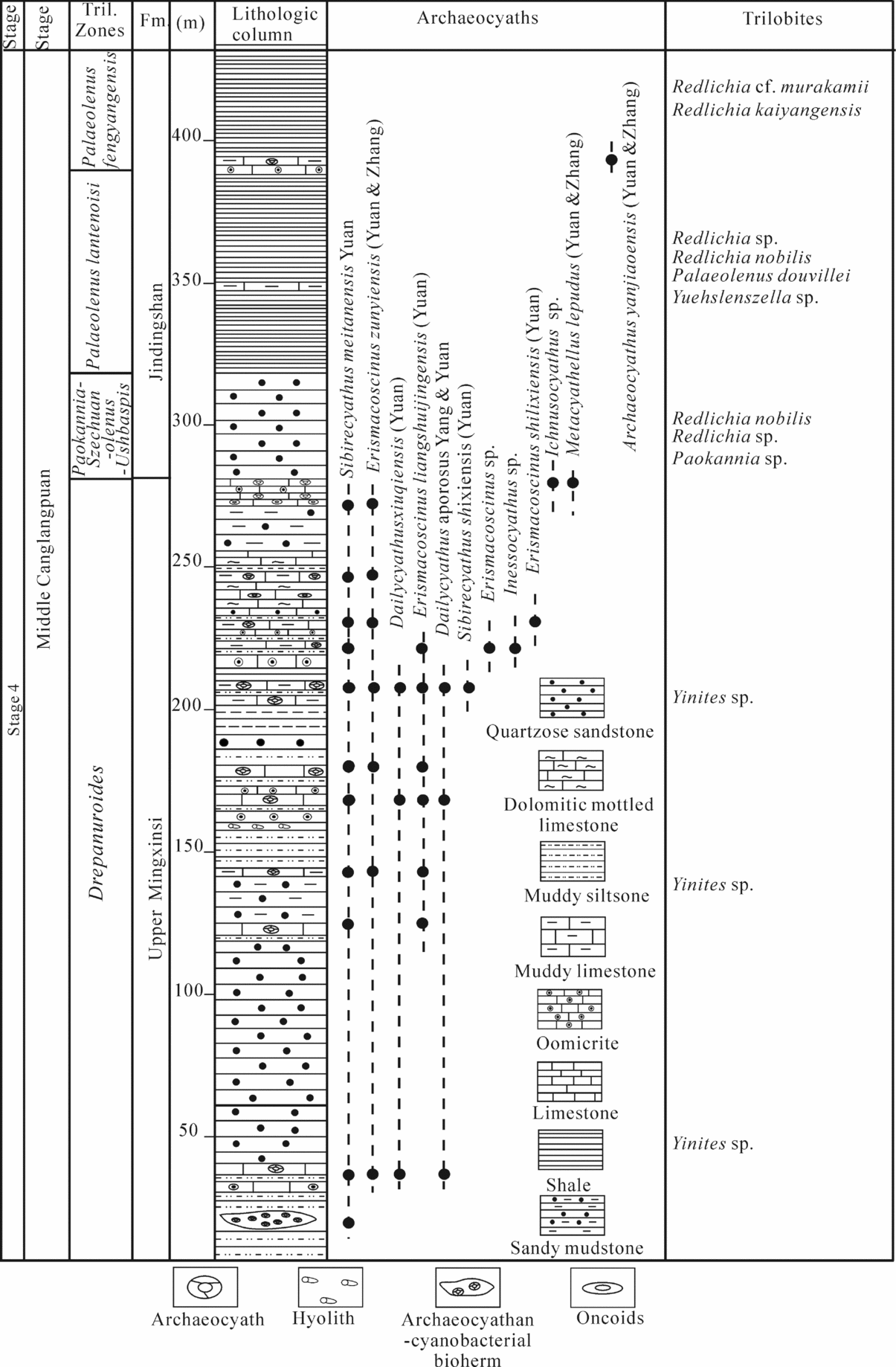
The Jindingshan Formation (188 m thick) is subdivided into three units. The 50-m-thick lower unit is composed mainly of conglomeratic quartzose sandstone containing trilobites Paokannia. The middle and upper units include siltstone, silty shale and argillaceous shale alternating with oolitic and bioclastic limestones. Archaeocyathus yanjiaoensis (Yuan) occurs in the calcareous upper part of the middle unit (Fig. 4).Three trilobite zones have been recognized within the Jindingshan Formation; in ascending order these are the Paokannia–Szechuanolenus–Ushbaspis, Palaeolenus lantenoisi and Palaeolenus fengyangensis zones (Yuan et al. Reference Yuan, Zhu, Lin and Zhu2011; Lin Reference Lin2014).
4.d. Wangjiaping section
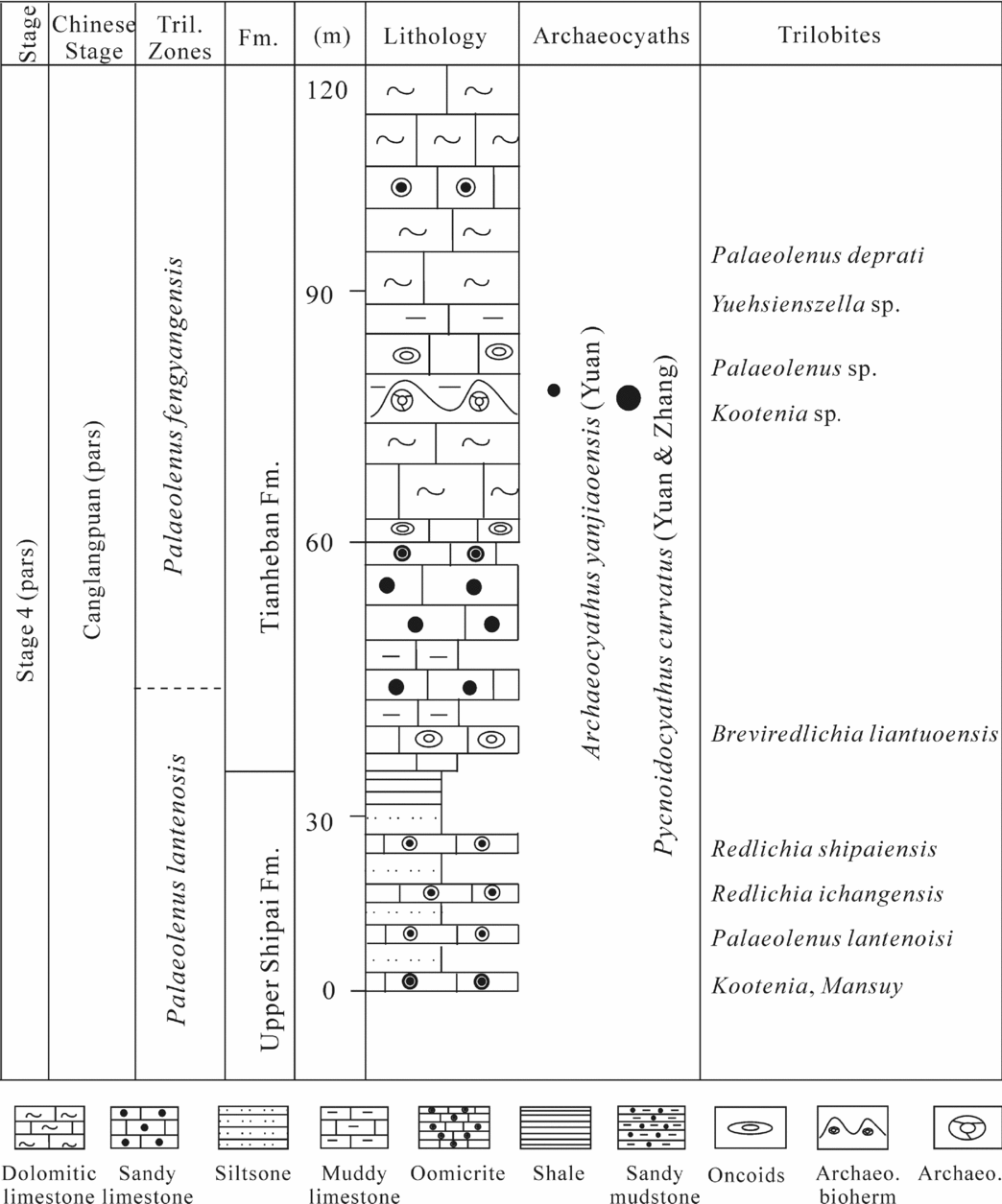
The Wangjiaping section is located near the city of Yichang, Hubei Province (Fig. 5). About 75 m of the lower Cambrian Tianheban Formation is well exposed along the paved road between Yichang and Sandouping. Here the formation is conformably overlain and underlain by the Shilongdong and Shipai formations, respectively. The Tianheban Formation is subdivided into two members. The 51.5-m-thick lower member consists mostly of dolomite-mottled, intraclast and micritic limestones interbedding with oncolitic and oolitic limestones. In the upper part of the lower member, calcimicrobial-archaeocyathan bioherms are present yielding Archaeocyathus yanjiaoensis (Yuan), Pycnoidocyathus curvatus (Yuan) and trilobites Palaeolenus sp. (Fig. 5). The 23.5-m-thick upper member consists of dolomitic mottled limestone interbedding with thin oolitic grainstones.
The Wanjiaping section.

5. Archaeocyath zonation in South China
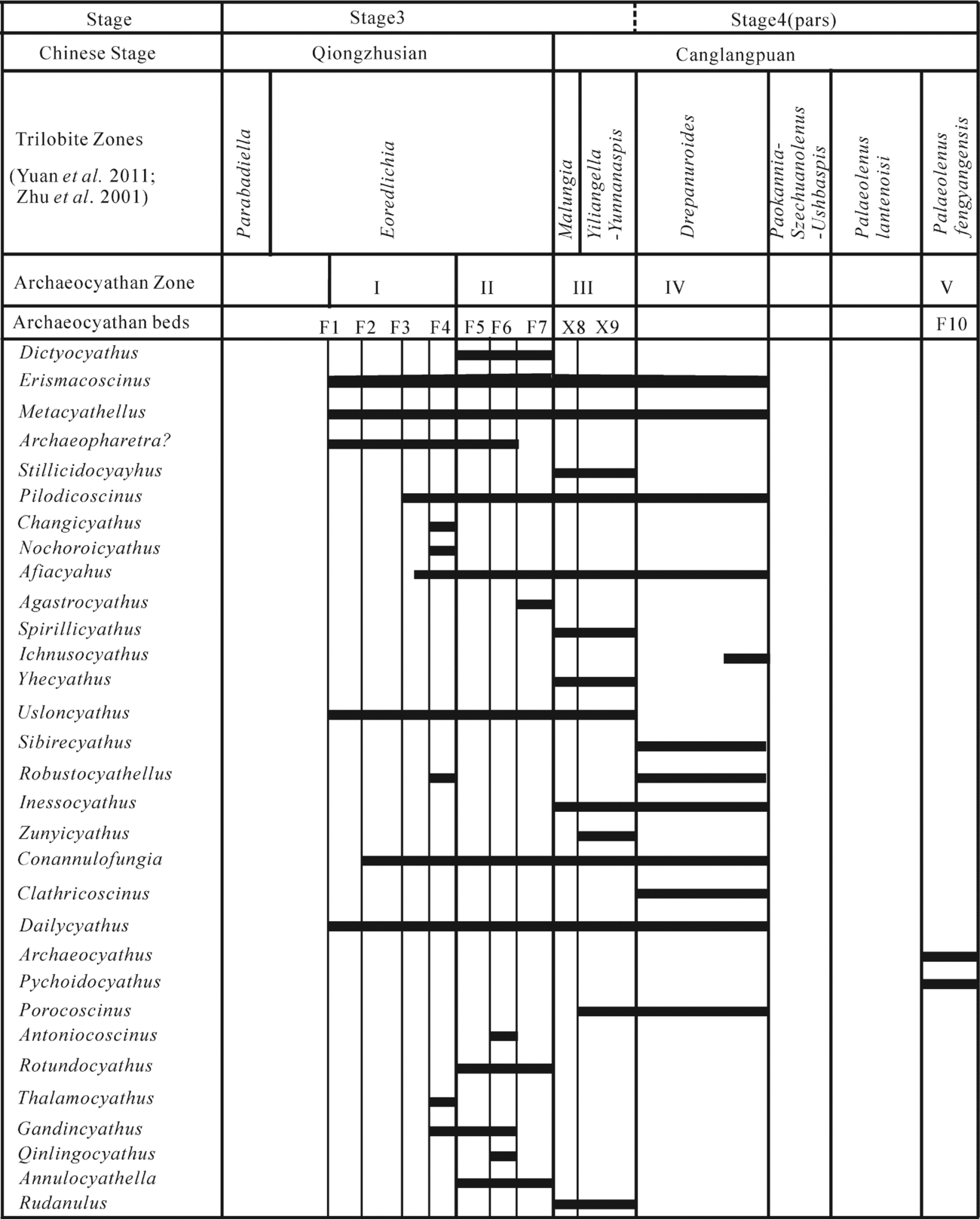
Based on the stratigraphic distribution of archaeocyaths in the Xiannudong, Mingxinsi, Jindingshan, Kongmingdong and Tianheban formations (Figs 2–5), four successive archaeocyathan zones and one informal archaeocyathan bed can be defined within the stratigraphical interval extending upwards from the middle Qiongzhusian to the upper Canglangpuan stages of the Yangtze Platform (Fig. 6). The characteristics of these biostratigraphic subdivisions are summarized in the following sections.
Distribution of archaeocyath genera in the lower Cambrian succession of South China and the archaeocyath zonation.

5.a. Dailycyathus xiuqiensis Zone
The oldest archaeocyath zone in South China is established in the lower–middle Xiannudong Formation (levels F1–F4) in the Fucheng section, Shaanxi Province (Figs 2, 6). The base of this zone is marked by the first appearance of Dailycyathus xiuqiensis (Yuan), while its top is marked by the first appearance of Dictyocyathus shaanxiensis (Yuan). As an index fossil, Dailycyathus xiuqiensis (Yuan) is more morphologically distinctive in the outer wall and inner wall than other archaeocyathides. Fossils in this zone are diverse and include 13 genera and 15 species of archaeocyaths (Fig. 2): Erismacoscinus zhuyuanensis (Yuan); Erismacoscinus cf. E. artus (Kruse); E. nanzhengensis (Yuan); Metacyathellus lepidus (Yuan & Zhang); Archaeopharetra? chengkouensis (Yuan & Zhang); Dailycyathus xiuqiensis (Yuan); Usloncyathus jindingshanensis (Yuan); Conannulofungia nanzhengensis Yuan & Zhang; Pilodicoscinus yuani Debrenne & Jiang; Thalamocyathus mui Yang & Yuan; Changicyathus tenuicaulus (Zhang & Yuan); Gandinocyathus pinguis Yang & Yuan; Robustocyathellus infundibulus (Yuan); Afiacyathus abnormis (Yuan & Zhang); and Nochoroicyathus sp. nov. These archaeocyaths are associated with trilobites Eoredlichia, Zhenbaspis and Yunnanocephalus, indicating that this archaeocyath assemblage zone is coeval with the lower part of the Yunnanocephalus–Wutingaspis trilobite Subzone, and it occurs within the middle–upper Qiongzhusian Stage.
5.b. Dictyocyathus shaanxiensis Zone
The Dictyocyathus shaanxiensis Zone embraces archaeocyath levels F5–F7 and occurs in the middle Xiannudong Formation (Fig. 2). The base is marked by the first appearance of Dictyocyathus shaanxiensis (Yuan) (level F5), the zone base is at the end of the greatest taxonomic diversification of the level of F4 and its top is marked by the first appearance of Spirillicyathus duplex Debrenne & Jiang (Fig. 6). As an index fossil, Dictyocyathus shaanxiensis (Yuan) is more geographically widespread than other archaeocyathides (Table 3). A total of 14 genera and 16 species of archaeocyaths are present here (Figs 2, 6): Afiacyathus abnormis (Yuan & Zhang); Dictyocyathus shaanxiensis (Zhang & Yuan); Erismacoscinus nanzhengensiss (Yuan); E. cf. E. artus Kruse; Antoniocoscinus mohershanensis (Zhang);, Gandinocyathus pinguis Yang & Yuan; Usloncyathus jindingshanensis (Yuan); Metacyathellus lepidus (Yuan & Zhang); Archaeopharetra? chengkouensis (Yuan & Zhang); Dailycyathus xiuqiensis (Yuan); Pilodicoscinus yuani Debrenne & Jiang; Qinlingocyathus astomus Yang & Yuan; Q. clarus (Yuan & Zhang); Robustocyathellus infundibulus (Yuan); Rotundocyathus distinctus Yuan & Zhang (Yuan & Zhang); and Agastrocyathus gastus (Yuan & Zhang). Additional fossils include trilobites Eoredlichia and Zhenbaspis, both of which are typical of the upper Qiongzhusian Stage.
5.c. Spirillicyathus duplex Range Zone
The Spirillicyathus duplex Range Zone is restricted to the upper Xiannudong Formation (levels X8, X9) in the Xinchao section (Figs 2, 6). It is defined by the first and last appearances of Spirillicyathus duplex Debrenne & Jiang, the characteristic species of the levels X8 and X9 in the Xinchao section, where it is associated with trilobites Malungia. The trilobites Malungia, Yiliangella and Metaredlichia characterized the Malungia and a part of Yiliangella–Yunnanaspis Trilobite Zone of the lower Canglangpuan Stage (Yuan & Zhao, Reference Yuan and Zhao1999; Zhu et al. Reference Zhu, Li, Zhang, Steiner, Qian and Jiang2001) occur in the adjacent Xihe section. The same trilobites characterize these same zones in the Xinchao section. The Spirillicyathus duplex Range Zone is restricted to the Malungia and a part of Yiliangella–Yunnanaspis Trilobite Zone (Fig. 2).
The lower part of middle Mingxinsi Formation in the Yankong section contains one level of the archaeocyaths and the trilobites Shizhudiscus sp., Pseudoredlichia jinshaensis are present here (Fig. 3). These trilobites are typical of the Yiliangella–Yunnanaspis Trilobite Zone (Yang et al. Reference Yang, Zhu, Zhang and Li2004; Fig. 3), and the lower part of the middle Mingxinsi Formation in the Yankong section is equivalent to the upper Xiannudong Formation (levels X8, X9) in the Xinchao section. The archaeocyaths in the lower part of the middle Mingxinsi Formation in the Yankong section are restricted to the Spirillicyathus duplex Range Zone.
The Spirillicyathus duplex Range Zone contains nine archaeocyath genera: Spirillicyathus duplex Debrenne & Jiang; Afiacyathus abnormis (Yuan & Zhang); Conannulofungia jinshaensis Yuan; Dailycyathus xiuqiensis (Yuan); Erismacoscinus sp.; Usloncyathus jindingshanensis (Yuan); Zunyicyathus grandus (Yuan et Zhang); Metacyathellus lepidus (Yuan et Zhang); and Stillicidocyathus shifangensis (Yuan) (Table 1). Of these, Zunyicyathus, Spirillicyathus and Stillicidocyathus are known only from this zone.
According to the description of the geological column in the Yang Chang section near Kunming, Yunnan Province (Debrenne & Jiang, Reference Debrenne and Jiang1989), the level 4 ‘quartz sandstone’ bed is the base of Jindingshan Formation and an index bed of the base of the Jindingshan Formation in East Yunnan and Guizhou provinces (Xiang et al. Reference Xiang, Zhu, Li and Zhou1999). The level 3 bed contains the archaeocyaths ‘Tsanglanpu’ assemblage and occurs in the upper Mingxinsi Formation. The level 2 bed, which contains the archaeocyaths ‘Qiangchussi’ assemblage, occurs in the middle Mingxinsi Formation. Otherwise, the trilobites Redlichia mansuyi and Palaeolenus douvillei, which are known only from the Palaeolenus lantenoisi Trilobite Zone, are contained in level 5 of the Jindingshan Formation. The upper Niutitang Formation contains the trilobites Zhenbaspis yunnensis and Eoredlichia (Pararedlichia) sp. in the Eoredlichia trilobite Zone, and the archaeocyaths ‘Tsanglanpu’ assemblage are restricted to the Drepanuroides Trilobite Zone. These permit assignment of the archaeocyaths ‘Qiangchussi’ assemblage to the Malungia and Yiliangella–Yunnanaspis Trilobite Zone and the Spirillicyathus duplex Range Zone. Data describing the archaeocyaths ‘Qiangchussi’ assemblage (Debrenne & Jiang, Reference Debrenne and Jiang1989) yield the Spirillicyathus duplex Range Zone list: Rudanulus zhangi Debrenne & Jiang; Inessocyathus yunnanensis Debrenne & Jiang; Erismacoscinus zhuyuaensis (Yuan); and Porocoscinus shabaensis Debrenne & Jiang (Table 1).
5.d. Sibirecyathus meitanensis Range Zone
The base of the Sibirecyathus meitanensis Range Zone is defined by the first appearance of Sibirecyathus meitanensis (Yuan & Zhang) and its top is marked by the last appearance of Erismacoscinus zunyiensis (Yuan & Zhang) (Figs 4, 6). Other archaeocyaths are Sibirecyathus shixiensis (Yuan), Dailycyathus aporosus Yang & Yuan, D. xiuqiensis (Yuan), Erismacoscinus zunyiensis (Yuan), E. liangshuijingensis (Yuan), Inessocyathus sp., Ichnusocyathus sp. and Metacyathellus Lepidus (Yuan & Zhang). The trilobite Yinites is also present here, which is typical of the Drepanuroides Trilobite Zone (Yuan & Zhao, Reference Yuan and Zhao1999; Yuan et al. Reference Yuan, Zhu, Lin and Zhu2011), indicating that this archaeocyath assemblage Zone belongs to the middle Canglangpuan Stage.
Additionally, Debrenne & Jiang (Reference Debrenne and Jiang1989) described from this level Conannulofungia jinshaensis Yuan, Afiacyathus abnormis (Yuan & Zhang), Inessocyathus yunnanensis Debrenne & Jiang, Porocoscinus shabaensis Debrenne & Jiang, Pilodicoscinus yuani Debrenne & Jiang, Rasetticyathus? shilixiensis Debrenne & Jiang and Clathricoscinus jiangi Debrenne & Jiang (Table 1).
5.e. Archaeocyathus yanjiaoensis beds
The Archaeocyathus yanjiaoensis beds correspond to the Tianheban archaeocyathan assemblage of Yuan & Zhang (Reference Yuan and Zhang1980) and Yuan et al. (Reference Yuan, Zhu, Zhang and Van Iten2001), which contains only two archaeocyathan genera and species: Archaeocyathus yanjiaoensis (Yuan) and Pycnoidocyathus curvatus (Yuan & Zhang) (Figs 5, 6). These archaeocyaths were involved in reef-building together with calcimicrobes of Epiphyton-, Renalcis- and Girvanella-groups (Debrenne, Gandin & Zhuravlev, Reference Debrenne, Gandin and Zhuravlev1991; Gandin & Luchinina, Reference Gandin, Luchinina, Barattolo, De Castro and Mucchi1993; Zhang & Yuan, Reference Zhang and Yuan1994; Adachi et al. Reference Adachi, Nakai, Ezaki and Liu2014). The Archaeocyathus yanjiaoensis beds are the uppermost archaeocyathan horizon on the Yangtze Platform and its depauperate assemblage is widely distributed in South China, namely in the lower Kongmingdong Formation of the Fucheng section (F10), in the middle Tianheban Formation of the Wangjiaping section and in the middle Jindingshan Formation of the Yankong and Shilixi sections (Figs 3–6). Associated trilobites are represented by Palaeolenus deprati, Yuehsienszella and others of the Palaeolenus fengyangensis Trilobite Zone, indicating that the Archaeocyathus yanjiaoensis beds are restricted to the upper Canglangpuan Stage (Fig. 7).
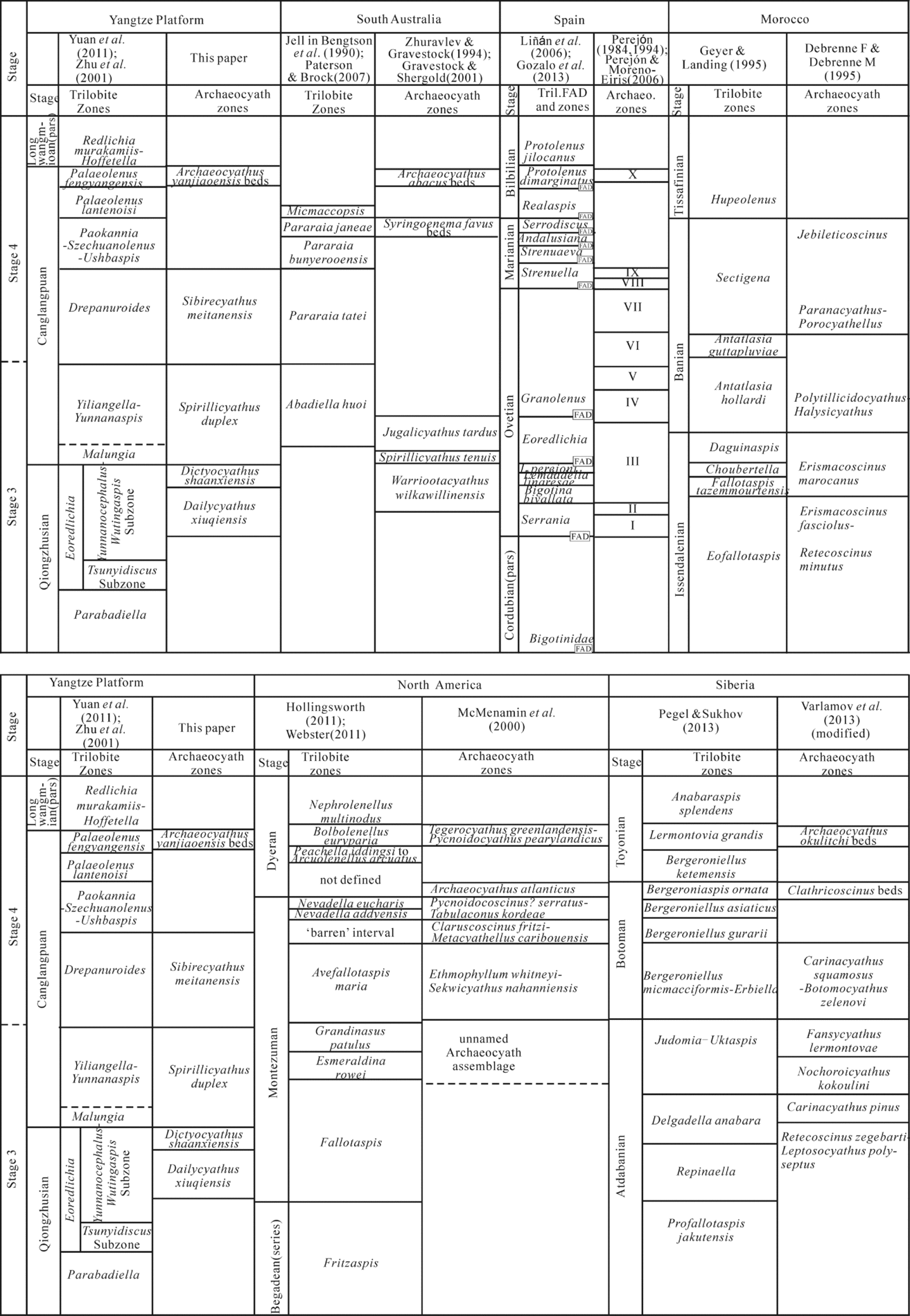
Global correlation of lower Cambrian strata based on archaeocyath zonations.

6. Global correlations
6.a. Archaeocyath and trilobite stratigraphic discrepancies
For a long time, it was suggested that correlations of lower Cambrian strata based on archaeocyath distributions and trilobite occurrences were not compatible. For example, the correlations of the Siberian Platform and Western Laurentia by Repina (Reference Repina and Zhuravleva1986) based on trilobites suggested a lower Atdabanian age (in Siberian sense) for the former Laurentian Fallotaspis Zone and late Atdabanian age for the Nevadella Zone (Repina, Reference Repina and Zhuravleva1986, table 2). Using an archaeocyath distribution, Voronova et al. (Reference Voronova, Drozdova, Esakova, Zhegallo, Zhuravlev, Rozanov, Sayutina and Ushatinskaya1987) assumed an uppermost Atdabanian level for Laurentian fallotaspidids and a higher (Botoman) position for the Nevadella trilobite assemblage. In addition, both geographically and taxonomically, strata of the Siberian Platform and Western Mongolia were correlated differently based on trilobites (Korobov, Reference Korobov, Menner and Meyen1980, Reference Korobov1989) and archaeocyaths (Rozanov & Sokolov, Reference Rozanov and Sokolov1984, fig. 33; Rozanov et al. Reference Rozanov, Khomentovskiy, Shabanov, Karlova, Varlamov, Luchinina, Pegel’, Demidenko, Parkhaev, Korovnikov and Skorlotova2008, fig. 4), with the suggestion of a Botoman age for the Soanicyathus admirandus – Dokidocyathus tuvaensis – Flindersicyathus latus archaeocyath assemblage of the well-known Salaany Gol section in the Zavkhan Microcontinent (southwestern Mongolia). As a result, global correlations based on different understandings as to which of these two ‘index-groups’ served correlation purposes better yielded drastically different results (Zhuravlev, Reference Zhuravlev, Geyer and Landing1995; Geyer & Shergold, Reference Geyer and Shergold2000; Zhuravlev & Riding, Reference Zhuravlev, Riding, Zhuravlev and Riding2001; Shergold & Geyer, Reference Shergold and Geyer2003; Babcock & Peng, Reference Babcock and Peng2007; Peng, Babcock & Cooper, Reference Peng, Babcock, Cooper, Gradstein, Ogg, Schmitz and Ogg2012; Landing et al. Reference Landing, Geyer, Brasier and Bowring2013). A similar problem existed in comparisons of South Chinese and South Australian trilobite and archaeocyath assemblages. For instance, the Pararaia tatei trilobite zone is thought to be of an Atdabanian age due to the presence of the genera Prouktaspis and Egyngolia (Jell in Bengtson et al. Reference Bengtson, Morris, Cooper, Jell and Runnegar1990). By contrast, even the underlying Abadiella huoi trilobite zone is considered to be partly of Botoman age due to finds in possibly coeval strata of archaeocyath genera such as Robertocyathus and ?Inacyathella (Debrenne & Gravestock, Reference Debrenne, Gravestock, Jago and Moore1990; Zhuravlev & Gravestock, Reference Zhuravlev and Gravestock1994; Gravestock et al. Reference Gravestock, Alexander, Demidenko, Esakova, Holmer, Jago, Lin, Melnikova, Parkhaev, Rozanov, Ushatinskaya, Zang, Zhegallo and Zhuravlev2001). Such conclusions influence correlations of both Australian and Siberian sections with South China depending on an interpretation of Australian trilobite genera and species as direct equivalents of South Chinese species, namely, if Abadiella, Pararaia and Hsuaspis are senior synonyms of Parabadiella, Proichangia and Estaingia, respectively (Jell in Bengtson et al. Reference Bengtson, Morris, Cooper, Jell and Runnegar1990; Jago, Lin & Dunster, Reference Jago, Lin and Dunster2002; Jago et al. Reference Jago, Zang, Sun, Brock, Paterson and Skovsted2006; Paterson & Brock, Reference Paterson and Brock2007; Landing et al. Reference Landing, Geyer, Brasier and Bowring2013) or based on the Abadiella as a new species of Wutingaspis (named W. jelli; Chang, Reference Chang, Chang, Chen and Palmer2003). These authors suggested that the Abadiella huoi Zone is equivalent to the Yunnnanocephalus–Wutingaspis Subzone of China (Chang et al. Reference Chang, Babcock, Xiang, Sun, Luo and Jiang2001; Steiner, Weber & Geyer, Reference Steiner, Weber and Geyer2001; Chang, Reference Chang, Chang, Chen and Palmer2003)
It is now clear that some of these contradictions originated from different environmental requirements of reef-dwelling archaeocyaths and mostly muddy level-bottom-dwelling trilobites. If facies representing strictly the same environments were widespread to support the same archaeocyathan species palaeocommunities, species were indeed the same and even occurred in the same relative proportions despite a distance between these palaeocommunities of hundreds of kilometres. However, even slight differences in microfacies lead to highly variable palaeocommunity compositions at distances of only a few tens of metres (Zhuravlev & Naimark, Reference Zhuravlev and Naimark2005). In turn, the presence of such similarity in species composition of archaeocyath palaeocommunities in Western and Eastern Laurentia or in Antarctica and Australia (Debrenne & Gravestock, Reference Debrenne, Gravestock, Jago and Moore1990) has resulted in better correlations between sections within each of these two pairs. In addition, even within a single basin such as the Stansbury Basin of South Australia, the White Point Conglomerate underlying the famous Emu Bay Shale is variously treated as either upper Atdabanian or middle–upper Botoman in age (Debrenne & Kruse, Reference Debrenne and Kruse1986; Zhuravlev & Gravestock, Reference Zhuravlev and Gravestock1994; Gravestock & Gatehouse, Reference Gravestock, Gatehouse, Drexel and Preiss1995; Wrona & Zhuravlev, Reference Wrona, Zhuravlev and Gaździcki1996; Kruse & Moreno-Eiris, Reference Kruse and Moreno-Eiris2013) rather than attempting to find a general similarity between the very different assemblages of trilobite genera (Theokritoff, Reference Theokritoff1982; Cooper & Shergold, Reference Cooper, Shergold and Tingey1991; Palmer & Repina, Reference Palmer and Repina1993; Palmer & Rowell, Reference Palmer and Rowell1995; Gehling et al. Reference Gehling, Jago, Paterson, García-Bellido and Edgecombe2011).
The major sources of contradictions in such correlations are, however, the incomplete documentation of local archaeocyath and trilobite faunas themselves. For example, the ‘Botoman’ Soanicyathus admirandus – Dokidocyathus tuvaensis – Flindersicyathus latus archaeocyath assemblage, including Irinaecyathus, Ladaecyathus and Altaicyathus, of the Salaany Gol section in fact proved to be an earliest Atdabanian Subtilocyathus emendates – Dokidocyathus bogradiensis – Archaeopharetra smolianinovae assemblage, including Formosocyathus, Milaecyathus and Tabulaecyathellus, based on both a revision of archaeocyathan systematics (Debrenne & Zhuravlev, Reference Debrenne and Zhuravlev1992; Debrenne, Zhuravlev & Kruse, Reference Debrenne, Zhuravlev, Kruse, Hooper and van Soest2002) and on archaeocyath distributions in other areas of the Altay Sayan Foldbelt and Mongolia where more continuous sections are present (Zhuravleva et al. Reference Zhuravleva, Konyaeva, Osadchaya and Boyarinov1997a , b; Osadchaya & Kotel’nikov, Reference Osadchaya and Kotel’nikov1998; Zhuravlev, Reference Zhuravlev, Ahlberg, Eriksson and Olsson1998; Dyatlova & Sycheva, Reference Dyatlova and Sycheva1999). In the South Australian case, Prouktaspis and Egyngolia from the Pararaia tatei Zone are not exclusively Atdabanian genera as both occur in Atdabanian and Botoman (Prouktaspis) or, indeed, only Botoman strata (Egyngolia) (Khomentovskiy & Repina, Reference Khomentovskiy and Repina1965; Korobov, Reference Korobov, Menner and Meyen1980; Zhuravlev, Reference Zhuravlev, Geyer and Landing1995); further, Robertocyathus and ?Inacyathella are not strict indicators of a Botoman age (Debrenne, Zhuravlev & Kruse, Reference Debrenne, Zhuravlev, Kruse and Selden2015). In turn, further studies of Western Laurentian and Siberian earliest trilobites led to the conclusion that the former ‘Fallotaspis’ and ‘Nevadella’ zones contain a number of fallotaspidoid and holmiid trilobites (e.g. in ascending order, Profallotaspis?, Repinaella, Archaeaspis, Selindella?, Paranevadella, Nevadella and Judomia) in common and in the same successive order, allowing a much better correlation of local sections with the Siberian Platform at almost zone-level precision (Palmer & Repina, Reference Palmer and Repina1993; Geyer, Reference Geyer1998; Hollingsworth, Reference Hollingsworth2006, Reference Hollingsworth2007, Reference Hollingsworth, Rábano, Gozalo and García-Bellido2008, Reference Hollingsworth, Hollingsworth, Sundberg and Foster2011). It should also be noted that, on the Siberian Platform, the first Profallotaspis occurs 2.6 m above the lower Atdabanian boundary in the Zhurinskiy Mys section where it is defined officially (Rozanov & Sokolov, Reference Rozanov and Sokolov1984, p. 40), and not 10 m above its base as is quoted elsewhere (Peng, Babcock & Cooper, Reference Peng, Babcock, Cooper, Gradstein, Ogg, Schmitz and Ogg2012, p. 446). What is noteworthy is that this new trilobite correlation fits the entire archaeocyath scheme (Fig. 7).
Some difficulties in global correlations are derived from misconceptions of trilobite occurrences in their original description locations. For instance, eodiscoids Hebediscus attleborensis, Calodiscus lobatus, Serrodiscus bellimarginatus and Triangulaspis annio never co-occur in the Atdabanian strata of the Siberian Platform or even of Siberia as a whole as including the Altay Sayan Foldbelt, although these eodiscoids are widely quoted (Geyer & Palmer, Reference Geyer and Palmer1995; Geyer, Reference Geyer1998; Geyer & Shergold, Reference Geyer and Shergold2000; Peng, Babcock & Cooper, Reference Peng, Babcock, Cooper, Gradstein, Ogg, Schmitz and Ogg2012). Geyer & Palmer (Reference Geyer and Palmer1995) mistook the boundary of the former Aldanian and Lenian stages for that of the Atdabanian and Botoman stages, which is one zone older (Rozanov & Sokolov, Reference Rozanov and Sokolov1984, table 1), while Geyer & Shergold (Reference Geyer and Shergold2000) further restricted the first appearance datum of this assemblage on the Siberian Platform (which they named the Hebediscus attleborensi – Calodiscus – Serrodiscus – Triangulaspis band) to the Botoman lower boundary level, although Hebediscus attleborensis and Triangulaspis annio (and only these two fossils) are present as early as in the middle Atdabanian (Khomentovskiy & Repina, Reference Khomentovskiy and Repina1965; Robison et al. Reference Robison, Rosova, Rowell and Fletcher1977; Rozanov & Sokolov, Reference Rozanov and Sokolov1984, p. 60; Astashkin et al. Reference Astashkin, Pegel, Repina, Rozanov, Shabanov, Zhuravlev, Sukhov and Sundukov1991, p. 55). In fact, Calodiscus lobatus and Serrodiscus bellimarginatus are strictly lower Botoman species and co-occur with Botoman archaeocyaths (Astashkin et al. Reference Astashkin, Pegel, Repina, Rozanov, Shabanov, Zhuravlev, Sukhov and Sundukov1991, Reference Astashkin, Belyaeva, Esakova, Osadchaya, Pakhomov, Pegel’, Repina, Rozanov and Zhuravlev1995; Zhuravlev, Reference Zhuravlev, Geyer and Landing1995). An old misconception of the position of the Atdabanian–Botoman boundary in its type area rooted in the work of Geyer & Palmer (Reference Geyer and Palmer1995) is still influential in lower Cambrian correlations, and wrongly excludes one of the best and most clear correlative levels from being introduced into international practice. Instead, the widely distributed eodiscoid Calodiscus–Serrodiscus species, the polymerans Olenellus (sensu lato), Redlichia (sensu lato), Judomia or Bergeroniellus, are favoured for the provisional Cambrian Stage 4 base (Peng, Babcock & Cooper, Reference Peng, Babcock, Cooper, Gradstein, Ogg, Schmitz and Ogg2012), even though these only occur in two regions and sometimes in just a single region.
An additional problem of using the first trilobite assemblages arises from the relatively late trilobite biomineralization event. These arthropods achieved calcareous (low magnesium-calcitic) skeletons during the onset of the Calcitic Sea, when groups such as archaeocyaths and molluscs were already at the peak of their diversity (Zhuravlev & Wood, Reference Zhuravlev and Wood2008). As a result, different types of trilobites were skeletonized within more or less the same interval in different regions. Furthermore, some evolutionary events within this group, such as appearance of circumocular sutures facilitating the moulting of rigid exoskeletons, appeared in parallel independently in different primitive trilobite branches imparting a similar appearance; for instance, bigotinids may represent a polyphyletric group, representatives of which originated independently from early olenellins in Siberia, Eastern Gondwana and Laurentia (Jell, Reference Jell, Lane, Siveter and Fortey2002; Hollingsworth, Reference Hollingsworth, Hollingsworth, Sundberg and Foster2011).
Despite the extremely high ‘provinciality’ of early Cambrian faunas, a reliable correlation is possible based on a better understanding of the systematics of ‘index-fossils’ and a better knowledge of their distribution in regional sections. In application to early Cambrian faunas, this provinciality is a result of two different phenomena, namely the provinciality itself as a faunal differentiation between provinces and a highly expressed restriction of palaeocommunities to certain facies within the same province (Zhuravlev & Naimark, Reference Zhuravlev and Naimark2005).
A correlation based on a reappriasal of South China archaeocyaths is presented in the following sections.
6.b. Archaeocyath-based correlation
As already emphasized, there are no archaeocyathan species in common between the major regions of their distribution. Indeed, this is true for all early Cambrian faunas including trilobites, brachiopods, molluscs and small shelly fossils with few exceptions. Such exceptions represent species of wide geographic as well as stratigraphic distribution however, making them inappropriate for use as precise global correlation tools. At generic level, archaeocyaths and trilobites provide a better opportunity than other fossils due to their rich assemblages (Kerner & Debrenne, Reference Kerner, Debrenne, Harper and Servais2013) and high rates of turnover of genera in time.
The oldest archaeocyathan assemblage in South China – Dailycyathus xiuqiensis Zone – is restricted to the lower Yunnanocephalus–Wutingaspis Trilobite Subzone of the Eoredlichia Zone (Zhu et al. Reference Zhu, Li, Zhang, Steiner, Qian and Jiang2001) of the middle–upper Qiongzhusian Stage, and yields a simple set of genera including widely geographically and stratigraphically distributed forms. Nonetheless, the presence of Robustocyathellus and Thalamocyathus is indicative of a middle Atdabanian or younger age; furthermore, an absence of any distinct Botoman genera and the presence of Usloncyathus, which is common in the lower and middle Atdabanian strata of the Altay Sayan Foldbelt, Mongolia and Transbaikalia, reveals a middle Atdabanian age in terms of Siberian archaeocyathan biostratigraphy. The same genus (former Dictyovafus Gravestock, Reference Gravestock1984) crosses through the two lowest archaeocyath zones of Australia (Zhuravlev & Gravestock, Reference Zhuravlev and Gravestock1994).
The following Dictyocyathus shaanxiensis Zone, which is coeval with the upper Yunnanocephalus–Wutingaspis Trilobite Subzone, is characterized by the first appearance (in the upper part of the assemblage zone) of its epongmous taxon. The genus is also common in the Erismacoscinus fasciolus – Retecoscinus minutus and Erismacoscinus marocanus zones of Morocco and the archaeocyath zones II and III of Spain (Debrenne & Debrenne, Reference Debrenne, Debrenne, Geyer and Landing1995; Perejón & Moreno-Eiris, Reference Perejón and Moreno-Eiris2006). All three regions yield multiple forms with simple walls such as Nochoroicyathus, Erismacoscinus and Dictyocyathus and rare examples with complicated walls which can be explained either by hostile environmental conditions for archaeocyath proliferation or by middle Atdabanian age of these assemblages. The composition of the succeeding Spirillicyathus duplex Range Zone reveals that these factors may work in parallel. The archaeocyathan Zone III of Spain is coeval with the Lemdadella trilobite zones (Liñán et al. Reference Liñán, Gámez Vintaned, Gozalo, Álvarez and Mayoral2006; Gozalo et al. Reference Gozalo, Dies Álvarez, Gámez Vintaned, Zhuravlev, Bauluz, Subías, Chirivella Martorell, Mayoral, Gursky, Andrés and Liñán2013), and such a correlation is supported by a co-occurrence of Lemdadella and Yunnanocephalus in Antarctica (Palmer & Rowell, Reference Palmer and Rowell1995).
The Spirillicyathus duplex Range Zone, which is an equivalent of the Malungia and Yunnanaspis–Yiliangella Trilobite Zones of the lower Canglangpuan Stage, in addition to the nominative genus contains Dailycyathus and Metacyathellus (both continuting from lower zones) as well as the first representatives of Stillicidocyathus, Rudanulus and Porocoscinus. Of these, Spirillicyathus is otherwise restricted to the Spirillicyathus tenuis Zone of South Australia where the first Australian Dailycyathus and Metacyathellus species also occur (Gravestock, Reference Gravestock1984; Zhuravlev & Gravestock, Reference Zhuravlev and Gravestock1994; Gravestock & Shergold, Reference Gravestock, Shergold, Zhuravlev and Riding2001; Gravestock et al. Reference Gravestock, Alexander, Demidenko, Esakova, Holmer, Jago, Lin, Melnikova, Parkhaev, Rozanov, Ushatinskaya, Zang, Zhegallo and Zhuravlev2001), while the three other abovementioned genera appear in different regions about the Atdabanian–Botoman boundary (Zhuravlev, Reference Zhuravlev, Ahlberg, Eriksson and Olsson1998; Perejón & Moreno-Eiris, Reference Perejón and Moreno-Eiris2006). Both the Jugalicyathus tardus Zone and the coeval lower Abadiella huoi Trilobite Zone in South Australia (Zhuravlev & Gravestock, Reference Zhuravlev and Gravestock1994; Paterson & Brock, Reference Paterson and Brock2007) are therefore much younger than the Parabadiella Trilobite Zone of South China; perhaps the Australian Abadiella huoi is still in need of revision (Chang et al. Reference Chang, Babcock, Xiang, Sun, Luo and Jiang2001; Steiner, Weber & Geyer, Reference Steiner, Weber and Geyer2001; Chang, Reference Chang, Chang, Chen and Palmer2003).
In the succeeding Sibirecyathus meitanensis Range Zone, which stratigraphically coincides with the Drepanuroides Trilobite Zone of the Canglangpuan Stage, the first representatives of Ichnusocyathus and Clathricoscinus appear. Clathricoscinus is widespread in lower Botoman strata of the Altay Sayan Foldbelt and Mongolia (Osadchaya et al. Reference Osadchaya, Kashina, Zhuravleva, Borodina and Boyarinov1979; Zhuravlev, Reference Zhuravlev, Ahlberg, Eriksson and Olsson1998) and is found in the lower Botoman of the Kolyma Block of the Siberian Platform (Zhuravlev, Reference Zhuravlev, Zhuravleva and Repina1988). In both regions, Clathricoscinus co-occurs with a large number of archaeocyath genera appearing at this level (Kyarocyathus, Mackenziecyathus, Ladaecyathus, Tegerocyathus, Krasnopeevaecyathus, Sekwicyathus, Polythalamia, Aptocyathus, Tollicyathus, Claruscoscinus, Pseudosyringocnema and Altaicyathus) and lower Botoman trilobites typical of the reference sections of the Botoman Stage on the Siberian Platform such as Neocobboldia, Redlichina, Poliellina, Erbiopsis and Erbia (Korobov, Reference Korobov, Menner and Meyen1980, Reference Korobov1989; Astashkin et al. Reference Astashkin, Pegel, Repina, Rozanov, Shabanov, Zhuravlev, Sukhov and Sundukov1991, Reference Astashkin, Belyaeva, Esakova, Osadchaya, Pakhomov, Pegel’, Repina, Rozanov and Zhuravlev1995). Ichnusocyathus occurs in the Paranacyathus–Porocyathellus Zone of Morocco, which is coeval with the Sectigena Trilobite Zone (Debrenne & Debrenne, Reference Debrenne, Debrenne, Geyer and Landing1995; Geyer & Landing, Reference Geyer, Landing, Geyer and Landing1995), and in the Punta Manna Formation of Sardinia together with Anthomorpha, Ladaecyathus (listed as Fallocyathus? in Perejón et al. Reference Perejón, Fröhler, Bechstädt, Moreno-Eiris and Boni2000), Aptocyathus (listed as Tabulacyathus in Debrenne, Gandin & Debrenne Reference Debrenne, Gandin and Debrenne1993) and Porocoscinus which appears in the Matoppa Formation slightly earlier as in South China sections (Debrenne, Gandin & Debrenne, Reference Debrenne, Gandin and Debrenne1993; Perejón et al. Reference Perejón, Fröhler, Bechstädt, Moreno-Eiris and Boni2000). In Morocco, the uppermost strata of the preceding Polystillicidocyathus–Halysicyathus Zone at the Antatlasia guttapluviae Trilobite Zone level yield Anthomorpha which also occurs in zone VI of Spain, sandwiched between the Granolenus and Strenuella trilobite first appearance data (FADs; Debrenne & Debrenne, Reference Debrenne, Debrenne, Geyer and Landing1995; Liñán et al. Reference Liñán, Gámez Vintaned, Gozalo, Álvarez and Mayoral2006; Perejón & Moreno-Eiris, Reference Perejón and Moreno-Eiris2006). The latter zone in turn contains Porocoscinus, Sekwicyathus and Aptocyathus (listed as Tabulacyathus in Perejón & Moreno-Eiris, Reference Perejón and Moreno-Eiris2006). Aptocyathus (listed as Tabulacyathus in Kruse, Reference Kruse1982) and Kyarocyathus are defined in the Fauna 1 of the Cymbric Vale Formation of New South Wales, Australia (Kruse, Reference Kruse1982). This lower Botoman level in both the Altay Sayan Foldbelt and Mongolia as well as in Laurentia possesses Mackenziecyathus, Tegerocyathus, Krasnopeevaecyathus, Sekwicyathus, Polythalamia, Claruscoscinus, Pseudosyringocnema and Altaicyathus (Debrenne & Wood, Reference Debrenne and Wood1990; Mansy et al. Reference Mansy, Debrenne and Zhuravlev1993). It is noteworthy that adult cups of Anthomorpha, common in West Gondwana, and Tollicyathus, typical of the Altay Sayan Foldbelt and Mongolia, are identical. These genera differ only in early ontogeny; Anthomorpha could have originated from Tollicyathus by heterochronic displacement of adult features to the early stages of an individual development (Debrenne & Zhuravlev, Reference Debrenne and Zhuravlev1992).
Isolated from the previous sequence, the Archaeocyathus yanjiaoensis beds include two archaeocyath genera only, namely Archaeocyathus and Pycnoidocyathus. This simple assemblage is characterized by a set of very similar species and is the most widespread archaeocyath assemblage. In addition to the lower Kongmingdong, middle Tianheban and the middle Jindingshan formations in South China, it occurs in: the Jianchang Formation of North China (Hong, Yang & Liu, Reference Hong, Yang and Liu1990); the Wirrealpa Limestone of the Arrowie Basin in South Australia (Kruse, Reference Kruse1991); the lower Lancara Formation of the Cantabrian tectonostratigraphic zone in Spain (zone X in Perejón & Moreno-Eiris Reference Perejón and Moreno-Eiris2006, corresponding to the Protolenus dimarginatus Trilobite Zone; Gozalo et al. Reference Gozalo, Dies Álvarez, Gámez Vintaned, Zhuravlev, Bauluz, Subías, Chirivella Martorell, Mayoral, Gursky, Andrés and Liñán2013); the uppermost San Giovanni Formation of the Gonnesa Group in Sardinia (Debrenne & Gandin, Reference Debrenne and Gandin1985); the middle Elanka Formation and its middle Toyonian equivalents of the Siberian Platform (Astashkin et al. Reference Astashkin, Pegel, Repina, Rozanov, Shabanov, Zhuravlev, Sukhov and Sundukov1991; Pegel’ & Sukhov, Reference Pegel’, Sukhov, Lindskog and Mehlqvist2013); a number of formations of the Altay Sayan Foldbelt (Osadchaya et al. Reference Osadchaya, Kashina, Zhuravleva, Borodina and Boyarinov1979; Astashkin et al. Reference Astashkin, Belyaeva, Esakova, Osadchaya, Pakhomov, Pegel’, Repina, Rozanov and Zhuravlev1995); the upper Alakit Formation and the upper Ust’toka Unit of the Russian Far East (Belyaeva, Reference Belyaeva1988); the Kacha Horizon of Transbaikalia (Yazmir, Dalmatov & Yazmir, Reference Yazmir, Dalmatov and Yazmir1975); the Yamatulin-Gol Formation of northern Mongolia (Marinov, Zonenshain & Blagonravov, Reference Marinov, Zonenshain and Blagonravov1973); the Alty-Kol’ Formation of Uzbekistan (Zhuravleva et al. Reference Zhuravleva, Repina, Yaskovich, Khayrullina, Poniklenko and Luchinina1970); the lower Paralleldal Formation of Greenland (Debrenne & Peel, Reference Debrenne and Peel1986); the lower Buelna Formation of Sonora, Mexico (Debrenne, Gandin & Rowland, Reference Debrenne, Gandin and Rowland1989); and the Gold Ace Limestone Member of the Carrara Formation in the United States Great Basin (Palmer & Halley, Reference Palmer and Halley1979) at the Bolbolenellus euryparia Trilobite Zone level (Webster, Reference Webster, Hollingsworth, Sundberg and Foster2011).
It should be noted that it has been suggested that the name of the former middle Toyonian Irinaecyathus grandiperforatus beds of the Siberian Platform should be replaced with the Irinaecyathus schabanovi – Archaeocyathus okulitchi beds due to an absence of Irinaecyathus grandiperforatus from both the Siberian Platform and the Toyonian level (Zhuravlev, Reference Zhuravlev, Geyer and Landing1995; Varlamov et al. Reference Varlamov, Rozanov, Demidenko, Karlova, Pak, Parkhaev, Skorlotova, Khomentovsky, Shabanov and Fedonkin2013).
The Archaeocyathus–Pycnoidocyathus level therefore allows us to tie together trilobite subdivisions such as the upper Canglangpuan Palaeolenus fengyangensis Zone in South China, the Redlichia guizhouensis level in South Australia, the middle Bilbilian Prololenus dimarginatus Zone in Spain, the middle Toyonian Lermontovia grandis Zone on the Siberian Platform and the upper Dyeran Bolbolenellus euryparia Zone of North America, truly embracing all the early Cambrian faunal realms.
7. Conclusions
Lower Cambrian archaeocyath-bearing strata of the Yangtze Platform contain five archaeocyath subdivisions (in ascending order): the Dailycyathus xiuqiensis and Dictyocyathus shaanxiensis zones; the Spirillicyathus duplex Range Zone; the Sibirecyathus meitanensis Range Zone; and the isolated Archaeocyathus yanjiaoensis beds. On the basis of these subdivisions, lower Cambrian strata of different areas of the Yangtze Platform, represented by different formations, can be correlated within the platform.
Global correlations based on archaeocyath assemblage zones allow us to present the following suggestions (Fig. 7).
(1) The middle–upper Qiongzhusian archaeocyath zones of South China (the Dailycyathus xiuqiensis and Dictyocyathus shaanxiensis zones = the Yunnanocephalus–Wutingaspis Subzone of the middle–upper Eoredlichia Trilobite Zone) correlate with the middle Atdabanian Stage of the Siberian Platform (the Repinaella and the lower Delgadella anabara Trilobite zones), the Warriootacyathus wilkawillinensis Archaeocyath Zone in South Australia, the middle Issendalenian Stage of Morocco (the upper Eofallotaspis, Fallotaspis tazemmourtensis and Choubertella trilobite zones) and the lower Ovetian Stage in Spain (from the Serrania FAD to the Lemdadella perejoni trilobite zone).
(2) The lowermost Canglangpuan Stage of South China (the Spirillicyathus duplex Range Zone = the Malungia and Yiliangella–Yunnanaspis Trilobite Zones) correlates with the uppermost Atdabanian of the Siberian Platform (the Judomia–Uktaspis Trilobite Zone and the upper Delgadella anabara Trilobite zones), the Spirillicyathus tenuis – Jugalicyathus tardus archaeocyath zones in South Australia (the Abadiella huoi Trilobite Zone), the uppermost Issendalenian – lower Banian stages of Morocco (the Daguinaspis and Antatlasia hollardi trilobite zones), the middle Ovetian Stage of Spain (the Eoredlichia Trilobite Zone and the Granolenus FAD level) and the middle Montezuman Stage of North America (the uppermost Fallotaspis, Esmeraldina rowei and Grandinaspis patulus trilobite zones).
(3) The middle Canglangpuan Stage (the Sibirecyathus meitanensis Range Zone = the Drepanuroides Trilobite Zone) approximates the lowermost Botoman Stage of the Siberian Platform (the Bergeroniellus micmacciformis – Erbiella Trilobite Zone), middle Banian Stage of Morocco (the Antatlasia guttapluviae and lower Sectigena trilobite zones), the uppermost Ovetian – lowermost Marianian stages of Spain (the Strenuella FAD level) and the upper Montezuman Stage of North America (the Avefallotaspis maria Trilobite Zone).
(4) The uppermost Canglangpuan Stage (the Archaeocyathus yanjiaoensis beds = the Palaeolenus fengyangensis Trilobite Zone) is equivalent to the middle Toyonian Stage of the Siberian Platform (the Lermontovia grandis Trilobite Zone), Archaeocyathus abacus beds in Australia, the middle Bilbilian Stage in Spain (the Protolenus dimarginatus Trilobite Zone) and the middle Dyeran Stage (the Bolbolenellus euryparia Trilobite Zone) in North America.
The Sibirecyathus meitanensis Range Zone and the Archaeocyathus yanjiaoensis beds in South China and their equivalents in other regions are recommended to the working groups of the International Subcommission on Cambrian Stratigraphy as reliable, well-recognizable levels with a high correlative potential for the establishment of GSSPs for the Series 2 stages.
Acknowledgements
This study was supported by the National Basic Research Program of China (973 Program) 2013CB835004, the Natural Science Foundation of China (41230208, 41372018) and the Funding of the China Scholarship Council. We would like to thank Dr Françoise Debrenne for supervising Aihua Yang's doctoral thesis on which this paper is partly based. We wish to express our sincere thanks to Dr Peter Kruse, Professor Qian Yi and Professor Li Guoxiang for their valuable comments which improved the manuscript. We are grateful to Professor Rachel A. Wood and Professor Heyo Van Iten for their revision of the English grammar. We thank Professor Zhao Yuanlong of the Guizhou University, He Hongwei of the Nanjing Institute of Geology and Paleontology, Chinese Academy of Sciences and Qi Dunlun for the field assistance.