Advances in our understanding of how individual domains related to successful aging and psychopathology (e.g. cognition, negative emotional traits, physical and emotional function) (Vahia et al., Reference Vahia, Thompson, Depp, Allison and Jeste2012) may be interdependent have led to a rapidly growing body of literature assessing whether and how cognitive processes may serve as markers of psychopathology. Simultaneously, newer approaches to data collection over the life span (Thomas et al., Reference Thomas2016) and analytics that allow mapping trajectories of cognition and emotion (Thompson et al., Reference Thompson2013) are expanding our understanding of changes in specific cognitive markers and how they predict vulnerability to certain stressors. One such prominent cognitive marker—variability in attention and cognitive/executive control within an individual, particularly with respect to reaction time (RT)—has been widely studied in the literature on cognitive aging (Hultsch et al., Reference Hultsch, MacDonald and Dixon2002; MacDonald et al., Reference MacDonald, Karlsson, Fratiglioni and Bäckman2011). In these studies, intraindividual cognitive variability is often conceptualized in terms of trial-to-trial variability in RTs and is associated with cognitive instability (Fjell et al., Reference Fjell, Westlye, Amlien and Walhovd2011), executive dysfunction (Chuah et al., Reference Chuah, Venkatraman, Dinges and Chee2006), and mental noise (Ode et al., Reference Ode, Robinson and Hanson2011). In the broader neuropsychological literature, cognitive variability has also been examined in reference to variability in performance across a large test battery (dispersion), either by tests or by factor domains. Additional sources of variability include between-session variability (inconsistency), which can be calculated in alternative designs such as ecological momentary assessment or measurement bursts, and between-persons variability (diversity), which is not the primary focus of this review (cf. Stawski et al., Reference Stawski, MacDonald, Brewster, Munoz, Cerino and Halliday2019).
Here, we review the literature on cognitive variability based on RT tasks, believing that RT variability is a low-cost, low-burden measurement that can be readily calculated based on existing data, allowing rapid progress in evaluating the connection between this metric and outcomes based on existing data. We use the terms “intraindividual cognitive variability” or “cognitive variability” interchangeably when referring to the more general umbrella construct of variability in cognitive performance across seconds, minutes, or hours, and “intraindividual RT variability” or “RT variability” interchangeably when referring to the more specific metric that can be derived from a single session of a reaction time-based test.
RT variability has been linked to poorer cognitive control, which is associated with impairments in areas such as memory, attention, and emotional processes. As individuals age, they tend to demonstrate more variability in their cognitive performance. While it is widely accepted that intraindividual cognitive variability is related to the development of dementia (e.g. Rubin et al., Reference Rubin1998), research has also suggested that cognitive variability is related to the development of posttraumatic stress disorder (PTSD) (e.g. Elwood et al., Reference Elwood, Hahn, Olatunji and Williams2009). Following traumatic experiences, there is some evidence that individuals show increased cognitive variability, as well as reduced attention and reduced cognitive control (Bomyea et al., Reference Bomyea, Amir and Lang2012). Greater RT variability is common following trauma exposure and may be a risk factor for PTSD (e.g. Swick et al., Reference Swick, Honzel, Larsen and Ashley2013). RT variability has only more recently been examined in the context of trauma, but may play a role in trauma and PTSD symptomatology.
The intersection of cognitive aging and PTSD has been scarcely discussed in the literature to date. This specific gap is noteworthy, given the connection between PTSD symptoms and premature senescence (Lohr et al., Reference Lohr2015), as well as the societal cost and prevalence of advanced cognitive aging (e.g. Hurd et al., Reference Hurd, Martorell, Delavande, Mullen and Langa2013). One study showed through Cox proportional hazard models that patients with PTSD are more than twice as likely to develop dementia than those without PTSD (Yaffe et al., Reference Yaffe2010). Here, through our investigation of the cognitive aging and cognitive components of the PTSD literature, we synthesized the two fields of study and argue that these fields can inform each other—intraindividual cognitive variability may be the key.
In order to determine the importance of intraindividual cognitive variability as a mechanism of risk, we evaluated the existing literature on variability in performance on objective measures of attention and cognitive control in cognitive aging and PTSD. We searched PubMed (1995–July 2019) using the following search terms: PTSD, trauma, aging, cognitive aging, variability, cognitive control, executive control, intraindividual coefficient of variation (ICV), dementia, stability, RT, processing speed, response time, cognition, neurocognition, cognit*, neurocog*, neuropsych*, and combinations of these terms. We limited our search to include only studies with human subjects, written in English. We excluded studies that focused on head trauma, concussions, and traumatic brain injury, as we wanted to focus on psychological trauma more specifically. Searches of “aging” and “variability” returned approximately 1500 results, while searches of “trauma” and “variability” retuned roughly 640. When the search required aging, trauma, and variability, 17 results were returned, only one of which were relevant to the topic of the paper, Fortenbaugh et al. (Reference Fortenbaugh2017). Because the literature in this area was small, we broadened our search, incorporating articles from areas that represented intersection from across fields of study. We included all studies that look at cognitive variability based on RT measures in aging and psychiatric samples of interest. Ultimately, we identified 62 papers that we closely reviewed.
Hypothesis
While the current literature in the field is limited, our hypothesis is that intraindividual RT variability can provide a simple, scalable measurement across diagnoses where cognition is impaired. RT variability is less invasive, less costly, and less time-intensive since it can be calculated using existing test data.
Based on our research, we propose that intraindividual RT variability could be related to PTSD symptom trajectories in four distinct ways (see Fig. 1) that each require further testing. Thus, after our review of the literature on cognitive variability in PTSD and aging, we present four potential models for how trauma and PTSD might be associated with changes in RT variability, along with questions and future directions for this literature. Should future research determine that the intraindividual RT variability metric is differentially related to symptoms of PTSD, it could be used to serve several purposes: (1) as a low-cost, low-burden screen for military, police, or first responder recruits in regard to risk for developing PTSD in response to subsequent trauma, (2) as a low-cost, low-burden screen among individuals diagnosed with PTSD for risk of progressive cognitive decline/dementia, (3) as biomarker that tracks with subjective symptoms, and/or (4) to assist in treatment planning for individuals at various cognitive levels or to guide treatment approach (e.g. cognitive processing therapy vs. prolonged exposure vs. a depression- or anxiety-focused therapy).
(A) Vulnerability hypothesis: y = f(x) (without PTSD), y = f(x) + C (with PTSD); (B) Scar hypothesis: y = f(x) (without PTSD),  $y = \left\{ {\matrix{{\hskip-1ptf\left( x \right)\;\;\;\;\;\;\hskip15ptx \lt \ t} \cr {\hskip-10ptf\left( x \right) + C\;\;\hskip6ptx \ge t} \cr } } \right.$ (with PTSD); (C) Arousal hypothesis: y = f(x, a), where a = current arousal (with and without PTSD); (D) Arousal hypothesis: y = f(x, a), where a = current arousal (with and without PTSD).

RT variability across the life span
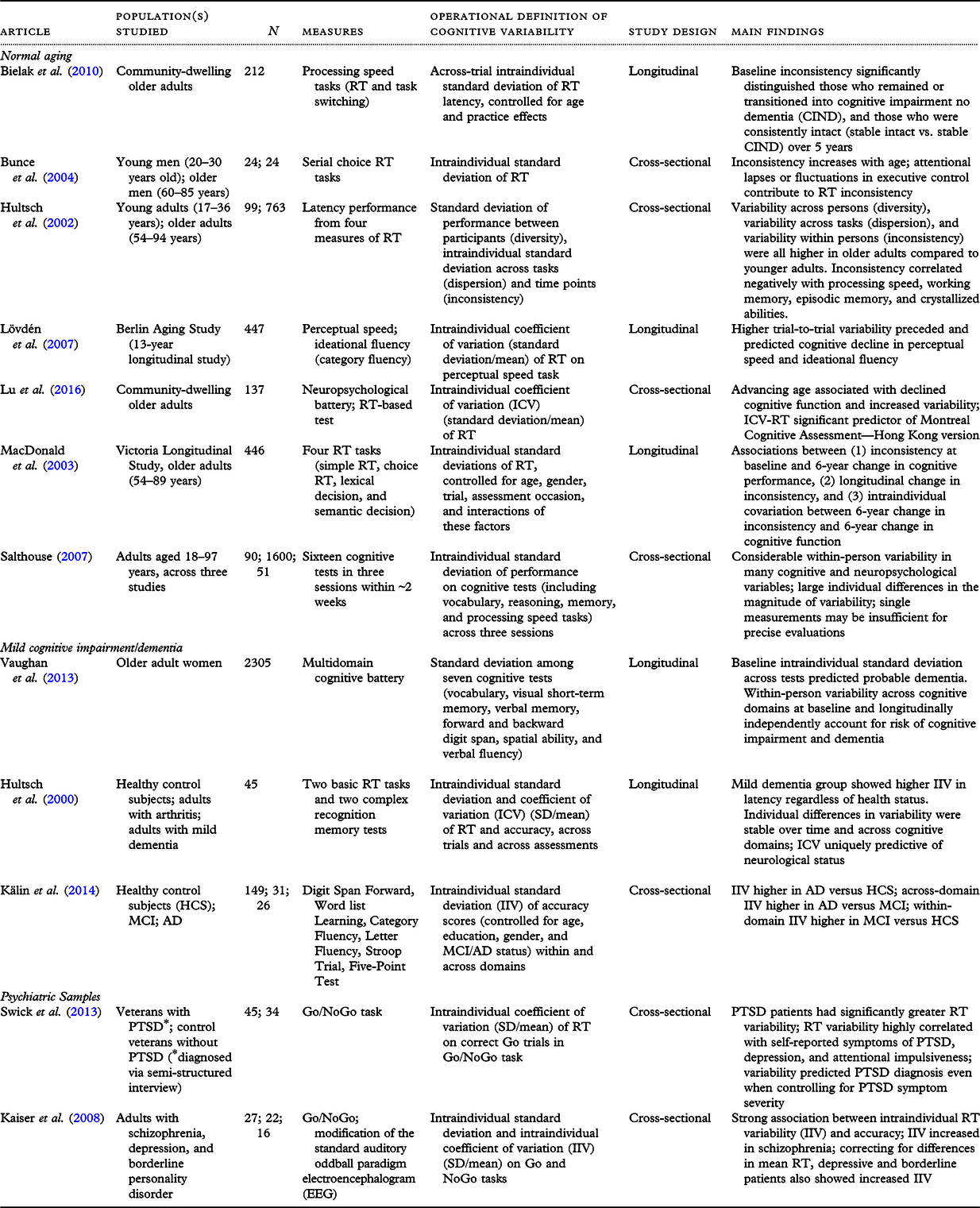
There is a normative and steep increase in mean RT with age starting in young to middle adulthood. Therefore, measuring changes in average or mean RT alone (without considering intraindividual RT variability) may not provide enough information about risk for psychological disorders (see Salthouse, Reference Salthouse2007). Intraindividual RT variability has been proposed as a measure that is sensitive to an individual’s neurological integrity, as increased fluctuations in performance (higher variability) may be indicative of brain disturbance/dysfunction (e.g. Bielak et al., Reference Bielak, Hultsch, Strauss, MacDonald and Hunter2010; Hultsch et al., Reference Hultsch, MacDonald and Dixon2002; Li and Lindenberger, Reference Li, Lindenberger, Nilsson, Markowitsch, Nilsson and Markowitsch1999).
While RT variability occurs at all ages, it tends to increase with age, especially in older adulthood. Using cross-sectional data, researchers have determined that RT variability follows a U-shaped curve, with highest RT variability in childhood and older adulthood (Williams et al., Reference Williams, Hultsch, Strauss, Hunter and Tannock2005). Thus, the slope of changes in RT variability becomes flat in middle adulthood relative to RT variability increases that do not arise until later adulthood, when other cognitive performance issues emerge. Using longitudinal data, researchers have shown that RT variability continues to increase linearly from early adulthood into late older adulthood, with one study showing an increase from ages 70 to 102 years (Lövdén et al., Reference Lövdén, Li, Shing and Lindenberger2007), and another showing increases from ages 75 to 89 years (MacDonald et al., Reference MacDonald, Hultsch and Dixon2003). Table 1 presents highlights of the main RT variability papers reviewed, beginning with studies on RT variability in normal aging, progressing to studies of RT variability and pathological cognitive aging, and ending with RT variability in psychiatric samples. Of note, all but two of the studies (Vaughan et al. [Reference Vaughan2013] and Kälin et al. [Reference Kälin2014]) reviewed in Table 1 examined RT variability specifically. Vaughan et al. (Reference Vaughan2013) used a multidomain cognitive battery and calculated intraindividual standard deviations across seven tasks at baseline as their metric of variability. Kälin et al. (Reference Kälin2014) calculated the intraindividual standard deviation of accuracy scores within and across cognitive domains, controlling for age, education, cognitive impairment (mild cognitive impairment [MCI] and Alzheimer’s disease [AD]) status.
Overview of key cognitive variability studies

Dementia is associated with poorer cognitive performance and high cognitive variability
High cognitive variability may predict onset of dementia, especially when considering the type of cognitive task that is used to calculate it. A study from Bielak and colleagues (Reference Bielak, Hultsch, Strauss, MacDonald and Hunter2010) posits that RT variability is higher when an individual is performing tasks with high cognitive demand compared to when performing simple cognitive tasks, and thus, those high-demand cognitive tasks may be most sensitive to differences in the integrity of the neurological system and subtle age-related changes (see also Strauss et al., Reference Strauss, MacDonald, Hunter, Moll and Hultsch2002). Inconsistency, which these authors defined as across-trial intraindividual standard deviation of RT latency, is related to longitudinal cognitive performance and may be a stronger statistical predictor of domains that rely on fluid abilities compared to those relying on crystalized abilities (Bielak et al., Reference Bielak, Hultsch, Strauss, MacDonald and Hunter2010; Bunce et al., Reference Bunce, MacDonald and Hultsch2004).
High RT variability is a behavioral manifestation of degree of neurological integrity and may be an early marker of changes in cognitive performance (Hultsch et al., Reference Hultsch, MacDonald, Hunter, Levy-Bencheton and Strauss2000; Lövdén et al., Reference Lövdén, Li, Shing and Lindenberger2007). In a cross-sectional study by Lu and colleagues (Reference Lu, Chan and Lam2016), intraindividual RT variability across three types of Flanker tasks was negatively correlated with Montreal Cognitive Assessment (MoCA)—Hong Kong version scores. Additionally, increased RT variability was a significant statistical predictor of MoCA score and was consistently associated with age-related decline (Lu et al., Reference Lu, Chan and Lam2016). Intraindividual variability (IIV) across cognitive tasks may be a potential marker for prodromal AD (Kälin et al., Reference Kälin2014) or at least MCI (MacDonald et al., Reference MacDonald, Li and Bäckman2009). Across domains of cognitive functioning, cognitive variability within an individual was higher in AD patients compared to those with MCI, and only within-domain cognitive variability was higher in MCI compared to healthy control subjects (Kälin et al., Reference Kälin2014). Kälin and colleagues (Reference Kälin2014) suggest that within-domain IIV may constitute a cognitive marker for detecting prodromal AD at the MCI stage, while across-domain cognitive variability may detect beginning AD in the MCI stage. In other words, within-domain cognitive variability taps into cognitive control functions more closely and was increased in both AD and MCI compared to health control subjects, appearing to constitute a marker for detection of prodromal AD at the MCI stage. Across-domain cognitive variability, tapping less into cognitive control functions, was increased in AD compared to MCI and healthy control subjects, indicating incipient dementia and distinguishing AD from the MCI stage (Kälin et al., Reference Kälin2014). Indeed, other research has also suggested that high cognitive variability in domain-specific cognition is related to risk of MCI and dementia (Vaughan et al., Reference Vaughan2013), offering additional support to the idea that variability within a person has predictive utility.
Another cross-sectional study from Troyer and colleagues (Reference Troyer, Vandermorris and Murphy2016) compared IIV on memory tasks in a group of 24 individuals with mild amnestic MCI and 21 matched controls and found elevations in IIV in the MCI group. Elevated IIV was a unique statistical predictor of group membership when examining other variables including speed and accuracy, congruent with the idea that cognitive variability may reflect disturbance in neural networks such as medial temporal regions and frontal systems (e.g. MacDonald et al., Reference MacDonald, Li and Bäckman2009; Troyer et al., Reference Troyer, Vandermorris and Murphy2016). The difficulty in discriminating dementia from normative cognitive aging and the notion that preclinical markers of AD can be present long before appearance of clinical symptoms (e.g. Bäckman et al., Reference Bäckman, Jones, Berger, Laukka and Small2005; Grober et al., Reference Grober, Hall, Lipton, Zonderman, Resnick and Kawas2008) suggest the need for further research on RT variability as a potential indicator for pathological aging.
PTSD is associated with poorer cognitive performance and high cognitive variability
While studies on cognitive aging and investigations of cognitive performance in individuals with PTSD are typically not connected in the literature, these populations show similar deficits in cognitive variability. In addition to the normative increase in RT variability that occurs with age and the amplified variability in MCI and AD, research has begun to investigate variability as a marker for PTSD. For many years, clinicians and researchers have known that cognitive deficits are both a risk factor and a consequence for PTSD (Vasterling and Brailey, Reference Vasterling, Brailey, Vasterling, Brewin, Vasterling and Brewin2005). In military samples, even after accounting for traumatic brain injuries during deployment, declines in speed of information processing, sustained attention, and episodic memory are significantly associated with PTSD symptoms (Vasterling et al., Reference Vasterling2006, Reference Vasterling, Brailey, Proctor, Kane, Heeren and Franz2012). Some cognitive models of PTSD propose that an individual exposed to trauma develops PTSD because they have inadequate cognitive resources to manage the trauma and engage in maladaptive cognitive strategies to cope (Ehlers & Clark, Reference Ehlers and Clark2000). Indeed, other studies have demonstrated specific cognitive deficits in PTSD, including deficits in inhibitory control (Aupperle et al., Reference Aupperle, Melrose, Stein and Paulus2012). Cognitive variability may be of particular importance in PTSD, where certain aspects of cognitive functioning are impacted by traumatic memories.
A high level of RT variability has been linked with more severe self-reported PTSD and depression symptoms (Swick et al., Reference Swick, Honzel, Larsen and Ashley2013). Multiple theories have been proposed for why PTSD is associated with higher RT variability. More frequent “mind wandering” during cognitive tasks has been connected with dysphoria and worry in undergraduate samples (Smallwood et al., 2009). Furthermore, the deficits in top-down cognitive processes that result in higher RT variability may contribute to the maintenance of PTSD symptomatology (Swick et al., Reference Swick, Honzel, Larsen and Ashley2013), including reexperiencing symptoms (Vasterling et al., Reference Vasterling, Verfaellie and Sullivan2009).
In a study of cognition in veterans, Swick et al. (Reference Swick, Honzel, Larsen and Ashley2013) compared 45 veterans with PTSD to 34 control veterans on a Go/NoGo motor inhibition task. They found that combat veterans with PTSD had more variable RTs, and RT variability was correlated with more severe self-reported PTSD and depression symptoms. Interestingly, higher RT variability was not significantly connected to higher levels of impulsivity (Swick et al., Reference Swick, Honzel, Larsen and Ashley2013). Moreover, while prior studies have shown that patients with depression, borderline personality disorder, and schizophrenia all have greater cognitive variability than healthy controls (van den Bosch et al.,Reference van den Bosch, Rombouts and van Asma1996; Vinogradov et al., Reference Vinogradov, Poole, Willis-Shore, Ober and Shenaut1998; Kaiser et al., Reference Kaiser, Roth, Rentrop, Friederich, Bender and Weisbrod2008); this study was the first to show that PTSD patients showed significantly greater RT variability than control veterans on both easy and difficult tasks of cognitive control, although they showed relatively greater impairment on the harder tasks, where cognitive control is particularly important (Swick et al., Reference Swick, Honzel, Larsen and Ashley2013). Variability in cognitive control may be especially predictive of PTSD, as it engages multiple brain systems related to PTSD symptomatology. These results support a more general cognitive control disruption in PTSD, consistent with the notion of Vasterling and Verfallie (Reference Vasterling, Verfaellie and Sullivan2009) that top-down cognitive control processes are needed to maintain consistent performance, which may contribute to high presence of PTSD.
In a review of attentional processes in PTSD, Block and Liberzon (Reference Block and Liberzon2016) discuss how measures of within-individual cognitive variability may be a more distinguishing marker of attentional impairment than measures of central tendency, consistent with other newer research (Coghill et al., Reference Coghill, Seth and Matthews2014; Vaurio et al., Reference Vaurio, Simmonds and Mostofsky2009). These authors also note that failure to suppress task-irrelevant distractors (e.g. external—loud noise, or internal—intrusive thought) could result in higher cognitive variability due to taxing and alerting the orienting systems and conflict monitoring system. Cognitive variability has already been established as a marker of attention-deficit hyperactivity disorder (ADHD) (Vaurio et al., Reference Vaurio, Simmonds and Mostofsky2009). A recent meta-analysis determined that the relative risk of PTSD in ADHD was 2.9, and the relative risk for ADHD in PTSD was 1.7, suggesting a bidirectional association between ADHD and PTSD (Spencer et al., Reference Spencer2016). This work supports the movement toward examining cognitive variability as an endophenotype (Block and Liberzon Reference Block and Liberzon2016; Vaurio et al., Reference Vaurio, Simmonds and Mostofsky2009).
PTSD is associated with increased risk for dementia
In addition to the increased RT variability that comes with age and increased RT variability that has been demonstrated in PTSD, there is likely an interaction between aging and trauma, which was of particular interest for this review. While more cognitive variability in older adults’ performance compared to younger adults’ performance has been repeatedly demonstrated (Christensen, Reference Christensen2001; Lupien et al., Reference Lupien, Maheu, Tu, Fiocco and Schramek2007), without age-corrected norms, it is challenging to separate normal cognitive aging versus PTSD.
There is notable overlap between late-life cognitive disorders and PTSD: PTSD is associated with increased risk for dementia (Yaffe et al., Reference Yaffe2010) and accelerated cognitive aging (Golier et al., Reference Golier, Harvey, Legge, Yehuda, Yehuda and Yehuda2006; Lapp et al., Reference Lapp, Agbokou and Ferreri2011). A review by Lohr and colleagues’ suggests that PTSD is associated with premature senescence. Moreover, based on this review, 7 of 10 studies indicated that PTSD is associated with earlier mortality and increased medical comorbidity (Lohr et al., Reference Lohr2015), which highlights the importance of early detection and intervention. Early detection is a key component of receiving treatment at pivotal times over the course of illness, both for dementia and PTSD.
In a published case series of three patients aged 57 to 70 years old, PTSD was associated with cognitive decline, suggesting that neurodegeneration of memory pathways may be related to worsening of PTSD symptoms (Mittal et al., Reference Mittal, Torres, Abashidze and Jimerson2001). Based on a meta-analysis of cognitive functioning in older adults with PTSD (Schuitevoeder et al., Reference Schuitevoerder2013), those with PTSD perform worse across cognitive measures relative to older samples without PTSD. The strongest effects have been demonstrated in the domain of memory, and these authors recommend further evaluation of older adults with PTSD in the domains of processing speed, learning, and executive functioning (Schuitevoeder et al., Reference Schuitevoerder2013). A more recent study demonstrated a connection between age and performance on an Emotional Stroop Task in adults diagnosed with PTSD (Bielecki et al., Reference Bielecki, Popiel, Zawadzki and Sedek2017). Based on this study, age served as a moderator for performance such that the older group showed no increase in RTs compared to the younger group. To our knowledge, no studies have directly compared RT variability scores in older and younger adults with PTSD. As suggested by Schuitevoeder and colleagues (Reference Schuitevoerder2013), there is a need to compare age-matched younger samples to older samples with PTSD to identify the unique contributions of age on PTSD. Comparisons with younger samples may be confounded by chronicity of PTSD. Another problem with the literature to date is that women and racial minorities are underrepresented (Schuitevoeder et al., Reference Schuitevoerder2013; Weintraub and Ruskin, Reference Weintraub and Ruskin1999).
Unanswered questions
Currently, there are no specific cognitive biomarkers of PTSD that can be extracted from the literature. PTSD disease biomarkers, as outlined by Schmidt et al. (Reference Schmidt2015), include hypothalamic pituitary adrenal axis dysregulation, hyperdrive of sympathetic adrenomedullary system, exaggerated startle response, and impaired cognitive function. Variability (or stability) of cognitive performance has not been explicitly tested in many studies and may be a tool that saves time, effort, and money, as it provides almost immediate results with a brief RT task, does not require brain imaging data, and can be calculated based on existing data and cognitive tasks that are already being used.
As summarized here, previous literature has suggested that PTSD is related to greater intraindividual cognitive variability. In Fig. 1, we present four potential models for how trauma and PTSD might be associated with changes in intraindividual RT variability. Each model has distinct implications for understanding the pathophysiological mechanisms of cognitive dysfunction in PTSD. First (a), the “vulnerability hypothesis” suggests that intraindividual RT variability is higher in individuals who are at risk of developing PTSD and experiencing a traumatic event does not uniquely enhance that risk. Confirmation of such a hypothesis would indicate that higher variability is a contributing cause of PTSD and therefore might be used to identify individuals at risk of developing PTSD after trauma exposure. Second (b), the “scar hypothesis” states that experiencing a traumatic event(s) can cause neurological or psychological changes that increase intraindividual RT variability. In this case, higher intraindividual RT variability is an effect of trauma exposure, and differences in cognitive variability might be used an indicator of the impact of trauma on cognitive information processing. Third (c), the “arousal hypothesis” posits that intraindividual RT variability is a side effect of increases in affective and psychological arousal, which occur after trauma. In other words, heightened arousal might increase cognitive variability and further contribute to cognitive dysfunction. If this were the case, we would expect intraindividual RT variability to be higher among individuals with PTSD at testing time points when arousal is heightened and change over time with arousal. Interventions that address hyperarousal in PTSD would then also be expected to reduce intraindividual RT variability. Lastly (d), the “neurodegeneration hypothesis” posits that experiencing trauma might lead to a neurodegenerative process that increases intraindividual RT variability over time, putting the individual at greater risk for accelerated aging and related problems as a result of their trauma. Here, one would expect increases in intraindividual RT variability that emerges over time following the experience of trauma, with minimal differences immediately following trauma. Indeed, intraindividual RT variability might provide a longitudinal indicator for trauma-related dementia risk. However, the specificity, positive predictive value, and negative predictive value of RT variability as a metric of trauma-related dementia are untested. Distinguishing between these hypotheses would require careful prospective study designs and provide potentially important insights into the mechanisms that underlie cognitive dysfunction and pathological aging in PTSD. Of note, a significant limitation of our proposed hypotheses is our failure to account for psychiatric and medical comorbidities, which are common in PTSD (Brady et al., Reference Brady, Killeen, Brewerton and Lucerini2000). Additionally, we did not review the literature on traumatic brain injury in our study, despite its known association with PTSD and increased neuropsychological intraindividual variability (Merritt et al., Reference Merritt2018), as we wanted to focus on psychological trauma and not traumatic brain injury (TBI). Despite these limitations, the notion of determining the mechanisms that connect trauma, cognitive variability, and PTSD could eventually contribute to improvements in the treatment of this disorder and its cognitive consequences over the life span.
Conclusions and recommendations
Based on our review of the literature, given that: (1) dementia is associated with poorer cognitive performance and higher cognitive variability, which predicts cognitive decline (e.g. Lövdén et al., Reference Lövdén, Li, Shing and Lindenberger2007), (2) PTSD is associated with poorer cognitive performance and high RT variability (Swick et al., Reference Swick, Honzel, Larsen and Ashley2013), and (3) PTSD is associated with increased risk for dementia (e.g. Yaffe et al., Reference Yaffe2010), we recommend that future studies examine intraindividual RT variability as a potential cognitive biomarker for both PTSD and dementia. Prior studies have shown that scores on executive functioning tests can be used as a predictor over the course of treatment and can help providers identify those with delayed response or higher risk of relapse (Polak et al., Reference Polak, Witteveen, Reitsma and Olff2012). Early detection of executive dysfunction via a short test of processing speed and calculation of RT variability may allow for more specific and early treatment and prevention of adverse outcomes, such as cognitive and functional decline.
Identifying individuals who are at the highest risk for subsequent dementia after trauma is challenging. Using intraindividual RT variability measures may be an inexpensive and rapid method for identification of those at highest risk. If high RT variability is indeed an indicator of risk for PTSD and cognitive decline, this would help with developing prophylactic interventions, via identifying those who have the highest need of therapeutic intervention post-trauma exposure (see Bomyea et al., Reference Bomyea, Amir and Lang2012). Thus, RT variability may be especially important given the push toward more individualized care through using basic and clinical science (Stuss, Reference Stuss2017). Given the ease of measurement of RT variability, with frequent and rapid assessments, testing this hypothesis is feasible for future researchers and may yield important results with the potential to change the way we view the connection between cognition and psychiatric symptoms.
Conflicts of interest
None.
Description of authors’ roles
LR, IV, and LG developed the idea for the paper. LR and LG developed the conceptual idea for figures and EP created the figures. All authors read all drafts and provided edits.