Implications
Weaning induces digestive disorders in piglets that cause economic losses and lead to high antibiotic use in pig farms. The use of antibiotics favours the development of bacterial resistance, which is of major concern for human health. New alternatives to enhance digestive health are necessary to reduce antibiotic use in weaned piglets. Dietary supplementation of Spirulina and Chlorella microalgae may contribute to digestive health thanks to their antioxidant and immunomodulatory properties.
Introduction
Weaning is a critical step in pig farms where the piglets are separated from the sow, mixed with pigs from other litters, and exposed to an abrupt transition from maternal milk to solid feed. Weaning stress leads to alterations in the structure and function of the intestine (Boudry et al., Reference Boudry, Peron, Le Huerou-Luron, Lalles and Sève2004), resulting in the activation of a local inflammatory response (Pié et al., Reference Pié, Lallès, Blazy, Laffitte, Sève and Oswald2004), and a change in microbial balance that contributes to diarrhoea and growth retardation (Lallès et al., Reference Lallès, Boudry, Favier, Le Floc’h, Luron, Montagne, Oswald, Pié, Piel and Sève2004). Post-weaning diarrhoea leads to high antibiotic use to counteract bacterial infections and mortality. The use of antibiotics is of major concern nowadays as it is responsible of bacterial resistance (Barton, Reference Barton2000). New alternatives to promote digestive health around weaning are necessary. Spirulina platensis (SP) and Chlorella vulgaris (CV) are two microalgae that possess antioxidant and immunostimulatory activities with benefits for health (Yaakob et al., Reference Yaakob, Ali, Zainal, Mohamad and Takriff2014). In our first study (Furbeyre et al., Reference Furbeyre, van Milgen, Mener, Gloaguen and Labussière2017), 1% Chlorella supplementation in the piglet diet reduced diarrhoea incidence after weaning and 1% Chlorella or Spirulina supplementation in diet enhanced jejunal morphology after weaning. We hypothesize that Spirulina and Chlorella may contribute to intestinal integrity and function by modulating intestinal immune and inflammatory responses to weaning. The objective of this study is to evaluate the effects of Spirulina and Chlorella supplementation around weaning on local inflammatory response to weaning, intestinal integrity, diarrhoea incidence and growth performance.
Material and methods
This experiment was conducted in the experimental facilities from the INRA under the ethical guidelines for use of animals for scientific purposes and was approved by the French Ministry of Education and Research (authorization no. 2015120718489537).
Microalgae and processing
Spirulina platensis and CV were provided and processed by Algosource Technologies, Saint-Nazaire, France. Fresh Spirulina and Chlorella were bead-milled under a process temperature below 20°C using Zirmil® beads (0.6 mm diameter), and then freeze-dried during 72-h (temperature range: from −35 during the freezing period to 17°C during the heating period).
Experimental design
The experiment was conducted with 108 crossbred suckling piglets ((Large White×Landrace)×Piétrain) of 14 days old with an initial BW of 4.9±0.7 kg, from the experimental herd of INRA, Saint-Gilles, France. A total of 36 blocks of three littermates from the same gender and of similar BW were created. Half blocks of males and half blocks of females were selected. The number of blocks varied between one to four blocks under each sow. Piglets from each block were allocated to one of the three following groups: I. Negative control (NC); II. SP; III. CV. Piglets did not receive a creep feed during the suckling period. Piglets were weaned at 28 days of age (day 0 of the experiment) in individual cages with slatted floor and received a standard weaner diet ad libitum until day 14 of experiment (Table 1). From day −14 until day 14, piglets received daily an oral dose of a solution of water for the NC group, freeze-dried SP dissolved in water (385 mg/kg BW) for the SP group, or freeze-dried CV dissolved in water (385 mg/kg BW) for the CV group. Six, ten and six blocks of three piglets (balanced per gender) were slaughtered the day before weaning (day −1), 2 days after weaning (day 2), and 14 days after weaning (day 14) respectively for blood and tissue sampling. Among all 22 blocks, 18 blocks consisted in six replicates of three blocks from the same litter, each of these latter blocks being slaughtered at each date (day −1, day 2 or day 14) in order to avoid a litter effect. Four supplementary blocks of non-littermates were additionally selected for day 2. Selected piglets were stunned electrically and then killed by exsanguination before sampling.
Composition of standard weaner diet

1 Supplied the following per kilogram of diet: vitamin A, 10 000 IU; vitamin D3, 2000 IU; vitamin E, 20 mg; vitamin C, 40 mg; vitamin B1, 2 mg; vitamin B2, 5 mg; calcium panthothenate, 10.85 mg; niacin, 20 mg; vitamin B12, 0.03 mg; vitamin B6, 5 mg; vitamin K3, 2 mg; folic acid, 1 mg; biotin, 0.2 mg; choline chloride, 600 mg; Fe, 103.75 mg; Cu, 20 mg; Zn, 99.3 mg; Mn, 40 mg; I, 0.6 mg; Co, 1 mg; Se, 0.3 mg.
2 Calculations for digestible energy (DE), metabolizable energy (ME) and net energy (NE) have been performed using EvaPig® software (http://www.evapig.com).
3 Standardized ileal digestible values.
Measurements and sampling
Piglets were weighed individually daily without fasting from day −15 to day 14. The required quantities of Spirulina and Chlorella supplementation were calculated according to the mean BW of all piglets the day before preparation. Freeze-dried Spirulina and Chlorella were dissolved in water (microalgae/water ratio ~30%) and conditioned in individual syringes. Syringes were prolonged with 3-cm plastic cannula to make sure that piglets ingested the entire solution. Syringes of water for NC piglets were prepared with the same volume as that of the Spirulina and Chlorella solutions. A supplementary syringe was loaded daily for Spirulina and Chlorella preparations and stored at −20°C for further dose assessment on a DM basis. Solutions were administered to the piglets immediately after preparation syringes.
Offered feed from day 0 to day 13 was weighed daily for each piglet and a sample of feed was collected daily and stored at 4°C to determine its DM content (after drying at 103°C during 24-h). Daily feed samples were then pooled for the entire experiment, ground in a hammer mill equipped with a 1-mm grid for further laboratory analyses. Feed refusals were collected daily for each piglet and dried at 103°C during 24-h before weighing. Diarrhoea score of each piglet was assessed visually each day after treatment administration from day 0 to day 14 according to the description of Whelan et al. (Reference Whelan, Judd and Taylor2004): 0=hard and formed or normal faeces, 1=soft and formed or moist faeces, 2=loose and unformed or mild diarrhoea, and 3=liquid or severe diarrhoea.
At slaughter, blood samples were collected during exsanguination in 10 ml heparinized tubes, stored on ice, and centrifuged during 15 min at 3000×g at 4°C for plasma collection. Plasma samples were stored at −20°C for further analysis of haptoglobin concentration; 3 cm segments of the jejunum (middle of the small intestine) and ileum (10-cm from the ileo-cecal junction) were cut transversally and flushed through with a 0.9% NaCl solution. A subsegment of 2 cm was then cut and fixed with a 4% formaldehyde-phosphate buffer, and stored at 4°C for 3 days for histological measurements. The last 1 cm subsegments of jejunum and ileum were cut longitudinally. Jejunal mucosa and ileal Peyer’s patch were identified, then cut in pieces of 1 to 2 mm using a sterile blade and immediately snap-frozen in liquid nitrogen. Samples were then stored at −80°C for further analysis of gene expression by real-time quantitative PCR.
Laboratory analyses
Chemical composition of standard diet
Pooled samples of offered feed were analysed for DM, ash, gross energy (GE), nitrogen (N), crude fibre and NDF, ADF and ADL fractions. The DM was measured after drying during 24-h at 103°C. Ash was determined after ignition at 550°C during 6-h according to the method described by AOAC (1990) and organic matter was calculated as the difference between DM and ash. The GE content was measured using an adiabatic bomb calorimeter (IKA, Staufen, Germany) using the method described by the International Organization for Standardization (ISO 9831:1998; ISO methods, http://www.iso.org). The N content was determined using a Rapid N analyser (Elementar, France) according to the Dumas method (AOAC, 1990). The crude fibre content was determined after digestion with 1.25% H2SO4 and 1.25% NaOH solutions according to the AOAC (1990) in an automatic Fibersac apparatus (ANKOM, New York, USA). The NDF, ADF and ADL fractions were determined according to the sequential method of Van Soest et al. (Reference van Soest, Robertson and Lewis1991) using an automatic Fibersac apparatus (ANKOM).
Haptoglobin in plasma
Haptoglobin concentration in plasma was analysed using a colorimetric method (Phase Haptoglobin Assay T801; Tridelta Ltd, Maynooth, Ireland) with an automatic analyser (Konelab 20i; Thermo Scientific, Courtaboeuf, France).
Intestinal measurements
Small intestine morphology
The jejunum and ileum segments were removed from the formaldehyde-phosphate buffer after 72-h and washed in three consecutive solutions of ethanol : water (75 : 25, v : v). Fixed intestinal tissues were embedded in paraffin, sectioned at a 7 µm thickness, mounted on SuperFrost Plus slides (Labo-Moderne, Paris, France), and stained with haematoxylin and eosin. Slides were scanned using the NanoZoomer Digital Pathology (Hamamatsu, Kitsa, Sweden). Villus height (VH) and crypt depth (CD) were measured using the NDP View software (Version 1.2.2.5). A total of 15 straight and complete villi and 10 crypts were selected from the mucosal site of each sample for the measurement of VH and CD.
Quantification of mRNA expression by real-time polymerase chain reaction
Total RNA from samples of jejunal mucosa and ileal Peyer’s patch was extracted using the TRIzol® Reagent (Invitrogen, Cergy-Pontoise, France) and Precellys® homogenizer (Bertin Instruments, Montigny-le-Bretonneux, France), then suspended in RNase-free water. Concentration and purity were assessed using a spectrophotometer (Denovix Inc., Wilmington, DE, USA). The integrity of extracted RNA was assessed using the lab-on-chip capillary gel-electrophoresis (2100 Bioanalyzer; Agilent, Les Ulis, France). Reverse transcription of total RNA to complementary DNA was performed using high capacity cDNA Reverse Transcription Kit (Applied Biosystems, Foster City, CA, USA). Primers for tumour necrosis factor-α (TNFα), interleukin-1β (IL-1β), interleukin-8 (IL-8), interleukin-10 (IL-10), transforming growth factor-β1 (TGF-β1), zonula occludens-1 (ZO-1), occludin and two housekeeping genes cyclophylin A (PPIA) and ribosomal protein large P0 (RPLP0) were designed using the Primer Express software (Applied Biosystems), based on recorded nucleotide sequences for Sus scrofa (Supplementary Material Table S1). Samples of cDNA (5 ng) were disposed in duplicates in a 96-well plate in presence of primer probes (200 nM each) and PCR buffer (Fast SYBR® Green Master Mix; Applied Biosystems). Amplification cycles were performed using the StepOnePlusTM real-time PCR system (Applied Biosystems), with the following thermal cycling conditions: 50°C during two minutes, 95°C during 20 s, followed by 40 cycles of denaturation at 95°C during 3 s, and annealing at 60°C during 30 s. Melt curve specificity was validated for all samples. Data for mRNA expression were calculated using the improved ΔΔCT method (Rao et al., Reference Rao, Huang, Zhou and Lin2013). The housekeeping genes PPIA and RPLP0 were selected for the normalization of gene expression in jejunal mucosa and in ileal Peyer’s patch, respectively, according to the following selection criteria: high stability across samples, no significant changes in gene expression between day −1 and day 2, no significant changes in gene expression between experimental groups in each day. Results were normalized to PPIA mRNA levels for jejunal mucosa and RPLP0 mRNA levels for ileal Peyer’s patch.
Statistical methods
Data for growth performance (i.e. BW, ADG, ADFI and G : F ratio) were analysed separately for the suckling period and the post-weaning period. One piglet from SP group was excluded from the analyses for growth performance and diarrhoea incidence during the post-weaning period because of severe diarrhoea and loss of vitality. Data for growth performance were analysed using MIXED procedure of SAS (SAS Institute Inc., Cary, NC, USA) and included treatment as fixed effect, block as random effect, and initial BW as a covariate. Growth retardation during the post-weaning period was calculated as the difference between potential growth (based on individual ADG during the suckling period) and effective growth. Growth retardation was analysed using MIXED procedure of SAS, including treatment, block, age, and the interaction between treatment and age as fixed effects. Diarrhoea incidence was analysed by χ 2 contingency test using the FREQ procedure of SAS. A survival time to diarrhoea event was defined individually as the number of days between day 0 and the first observation of diarrhoea. For piglets that did not exhibit diarrhoea within the 14 days post-weaning, survival time was censored (i.e. the survival time is considered higher than 14). The method of Kaplan–Meier (Goel et al., Reference Goel, Khanna and Kishore2010) was used to assess survival probability to ‘diarrhoea’ event using the LIFETEST procedure of SAS. Pairwise comparisons of survival probabilities were performed using Wilcoxon test.
Data for plasma concentration of haptoglobin and intestinal morphology (VH, CD, VH : CD ratio) were analysed using the GLM procedure of SAS including treatment, day, and the interaction between treatment and day as fixed effects. Intestinal gene expressions were analysed using GLM procedure of SAS. Data for gene expressions at day 14 were analysed separately from data for gene expressions at day −1 and day 2 because of significant change in housekeeping gene expression between the two stages. Data analysis for gene expression included treatment, day and the interaction between treatment and day as fixed effects for day −1 and day 2 and treatment as fixed effect for day 14.
Results
Growth performance
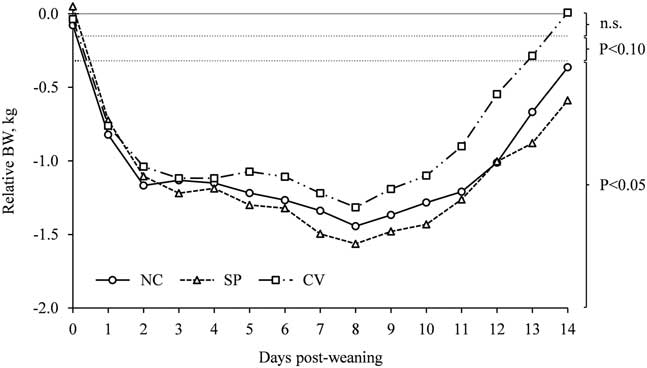
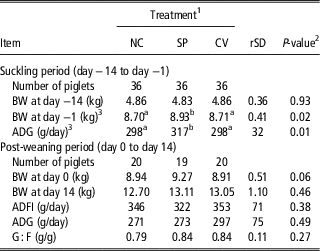
During the suckling period, SP piglets had a higher ADG (+6%), resulting in a higher BW (+3%) at weaning than NC and CV piglets (P<0.05; Table 2). The ADFI averaged 340±40 g/day from day 0 to day 14 and did not differ between treatments (P>0.10; Table 2). Feed intake averaged 103±114 g during the first 48-h post-weaning with no difference between treatments (P>0.10; data not shown). From day 0 to day 14, BW increased from 9.04±1.37 to 12.93±1.73 kg, resulting in an ADG of 280±42 g/day and a G : F ratio of 0.82±0.04, with no effect of treatment (P>0.10; Table 2). For all pigs, independently of treatment (P>0.10), BW decreased by 455±132 g during the first day. Growth retardation (difference between potential BW and effective BW) after weaning was maximal at day 8, then decreased until day 14 (P<0.01; Figure 1). Actual BW at day 14 remained lower than potential BW for NC and SP piglets (P<0.05), but was similar to potential BW in CV piglets (P>0.10).
Change in BW relative to the potential BW during the 14 days after weaning. Treatments: NC=water; SP=freeze-dried Spirulina platensis; CV=freeze-dried Chlorella vulgaris, orally administered daily. Potential BW corresponds to zero value. Potential BW was calculated from BW at weaning (8.7, 8.9 and 8.7 kg, respectively, in NC, SP and CV piglets) and ADG during the suckling period (298, 317 and 298 g/day, respectively, in NC, SP and CV piglets). Analysis of variance performed using the MIXED procedure of SAS (SAS Institute Inc., Cary, NC, USA) with repeated measurements; rSD=0.64 kg.

Effects of oral administration of Spirulina and Chlorella on growth performance in piglets around weaning

Values are presented as means and rSD of the back-transformed estimated data from the MIXED model.
a,bMeans within a row with different superscripts differ significantly at P<0.05.
1 Treatments: NC=water; SP=freeze-dried Spirulina platensis; CV=freeze-dried Chlorella vulgaris, orally administered to each piglet daily.
2 ANOVA performed on BW, ADFI, ADG, and G : F using MIXED model (SAS Institute Inc., Cary, NC, USA) including treatment as fixed effect, block as random effect and initial BW as a covariate.
3 Square transformations were performed on final BW and ADG data for the suckling period before the statistical analysis.
Clinical signs of diarrhoea
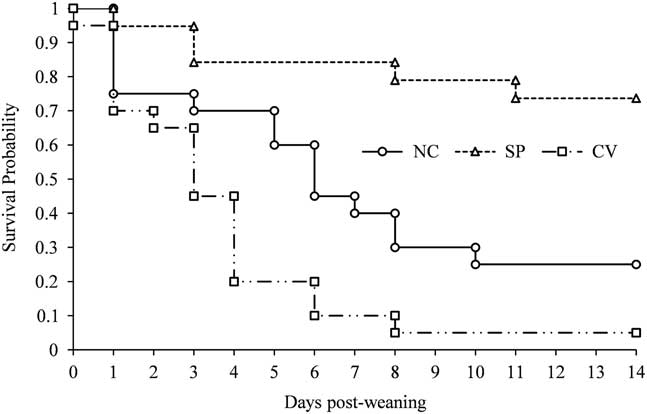
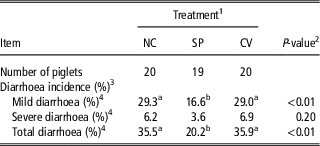
During the post-weaning period, diarrhoea was observed in 66% of piglets (75%, 26% and 95% in NC, SP and CV groups, respectively). At least 1 day of liquid or severe diarrhoea was recorded in 36% of all piglets (35%, 10% and 60% in NC, SP and CV groups, respectively; data not shown). Moderate and total diarrhoea incidences were lower in SP piglets than in NC and CV piglets (P<0.01; Table 3). The survival rate to a ‘diarrhoea’ event (percentage of piglets without diarrhoea recorded) from day 0 to day 14 is presented in Figure 2. Survival rate was higher (P=0.02) in SP piglets (74%) than in NC piglets (25%) and CV piglets (5%). The survival rate was lower in CV piglets than in NC piglets (5% v. 25%, respectively; P=0.04).
Survival probability to diarrhoea outcome within the 14 days post-weaning. Treatments: NC=water; SP=freeze-dried Spirulina platensis; CV=freeze-dried Chlorella vulgaris. Survival analysis was performed by the method of Kaplan–Meier.

Effects of oral administration of Spirulina and Chlorella on diarrhoea incidence in weaned piglets

a,bMeans within a row with different superscripts differ significantly at P<0.05.
1 Treatments: NC=water; SP=freeze-dried Spirulina platensis; CV=freeze-dried Chlorella vulgaris, orally administered to each piglet daily.
² Effect of treatment.
3 Incidence (%) was calculated by treatment as (number of diarrhoea recorded)/(number of piglets by treatment×total experimental days)×100, where the number of diarrhoea recorded was the sum of the number of piglets with diarrhoea observed each day for the experimental period. Statistical analysis was conducted by a χ 2 test.
4 Diarrhoea score=0, normal faeces; 1, moist faeces; 2, mild diarrhoea; 3, severe diarrhoea. Mild diarrhoea=number of piglet days with diarrhoea score of 2. Severe diarrhoea=number of piglet days with diarrhoea score of 3. Total diarrhoea=number of piglet days with diarrhoea score equal or higher than 2.
Haptoglobin in plasma
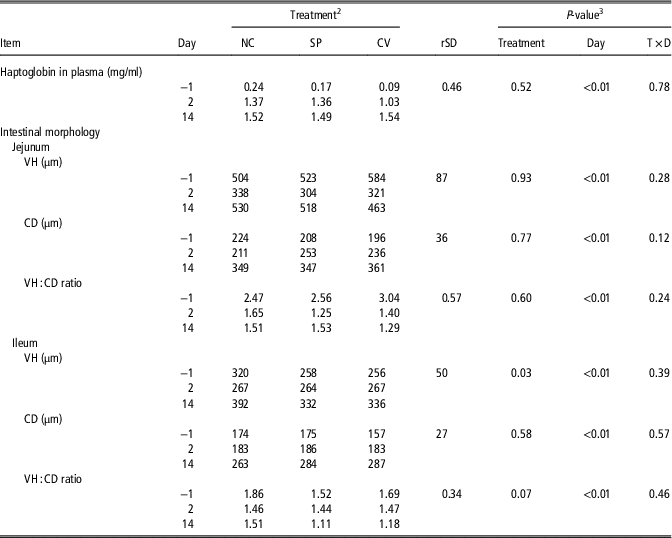
The plasma concentration of haptoglobin increased after weaning from 0.17±0.11 mg/ml at day −1 to 1.52±0.11 mg/ml at day 14 (P<0.01; Table 4) and did not differ between treatments (P>0.10).
Effects of oral administration of Spirulina and Chlorella on plasma haptoglobin concentration and intestinal morphology in piglets around weaningFootnote 1

Values are means and rSD of the back-transformed estimated data from the GLM procedure.
a,bMeans within a row with different superscripts differ significantly at P<0.05.
1 Day 0=weaning; n=6 piglets/treatment on day −1; n=10 piglets/treatment on day 2; n=6 piglets/treatment on day 14.
² Treatments: NC=water; SP=freeze-dried Spirulina platensis; CV=freeze-dried Chlorella vulgaris, orally administered to each piglet daily.
3 ANOVA performed on items data using the GLM procedure (SAS Institute Inc., Cary, NC, USA) including the effects of treatment, day, and interaction between treatment and day (T×D). Logarithmic and inverse transformations were performed on data for VH and CD at ileum site, respectively, before statistical analysis.
Intestinal morphology
At the jejunum site, VH did not differ between treatments, whatever the age (P>0.10; Table 4). For all treatments, VH at the jejunum was 40% lower on day 2 after weaning than before weaning (day −1) (P<0.01) and returned to a value similar to that before weaning at day 14 (P>0.10). At the jejunum site, CD increased gradually from day −1 to day 14 reaching 168% of the preweaning depth at day 14 (P<0.01) without any effect of microalgae supplementation. Irrespective of dietary treatment, the jejunal VH : CD ratio decreased from 2.7±0.1 at day −1 to 1.4±0.1 at day 2 (P<0.01) and then remained stable until day 14. Ileal VH was lower in SP and CV piglets than in NC piglets whatever the age (P<0.05; Table 4). Ileal VH did not differ between day −1 and day 2 but increased by 32% between day 2 and day 14 (P<0.01), corresponding to 127% of preweaning value (P<0.01). Ileal CD was not affected by dietary treatment but increased with age (P<0.01). Ileal VH : CD ratio decreased from 1.7±0.1 at day −1 to 1.3±0.1 at day 14 (P<0.10). The VH : CD ratio tended to be lower in SP and CV piglets than in NC piglets (P=0.07).
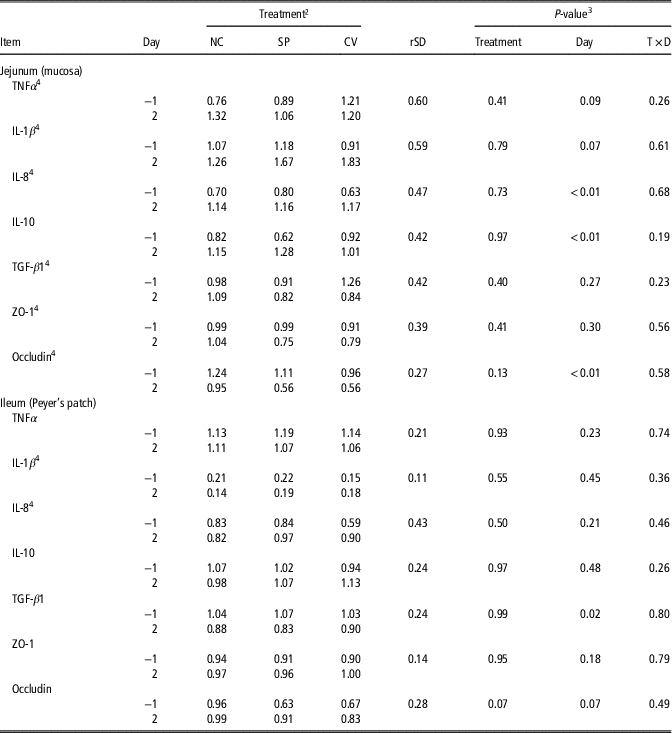
Intestinal cytokine and tight junction mRNA expression
Cytokine and tight junction expressions in NC, SP and CV piglets around weaning are presented in Table 5. In jejunal mucosa, relative expressions of cytokines and tight junctions did not differ between treatments (P>0.10). Independently of the treatment, relative expressions of IL-8 and IL-10 increased (P<0.01), and TNFα and IL-1β expressions tended to increase (P<0.10) at the jejunum between day −1 and day 2. Jejunal TGF-β1 and ZO-1 expressions did not differ between day −1 and day 2 (P>0.10). Occludin expression decreased between day −1 and day 2 (P<0.01). No direct effect of weaning or treatment was observed on TNFα, IL-1β, IL-8, IL-10, and ZO-1 expressions in ileal Peyer’s patch (P>0.10), but TGF-β1 expression was lower at day 2 compared with day −1 (P<0.01). Relative expression of occludin in Peyer’s patch tended to be lower in SP and CV piglets than in NC piglets (P<0.10).
Effects of oral administration of Spirulina and Chlorella on intestinal expression of cytokines in piglets around weaningFootnote 1

Values are means and rSD of the back-transformed estimated data from the GLM procedure.
a,bMeans within a row with different superscripts differ significantly at P<0.05.
1 Day 0=weaning; n=6 piglets/treatment on day −1; n=10 piglets/treatment on day 2.
² Treatments: NC=water; SP=freeze-dried Spirulina platensis; CV=freeze-dried Chlorella vulgaris, orally administered to each piglet daily.
3 ANOVA performed on items data using GLM model (SAS Institute Inc., Cary, NC, USA) including the effects of treatment, day, and interaction between treatment and day (T×D).
4 Logarithmic transformations were performed on data for TNFα, IL-1β, IL-8, TGF-β1, ZO-1, and occludin at the jejunum and for IL-1β and IL-8 at the ileum before statistical analysis.
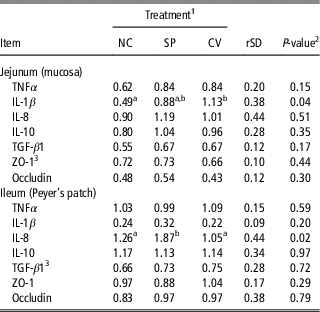
Cytokine and tight junction expressions in NC, SP and CV piglets in the late stage (day 14) after weaning are presented in Table 6. In jejunal mucosa, relative expressions of TNFα, IL-8, TGF-β1, ZO-1, and occludin did not differ between treatments (P>0.10). The expression of IL-1β gene in the jejunum of CV piglets was 2.3-fold that of NC piglets (P<0.05). In ileal Peyer’s patch, TNFα, IL-1β, TGF-β1, IL-10, ZO-1 and occludin expressions did not differ between treatments (P>0.10). Relative expression of IL-8 in SP piglets was 1.5-fold that of NC and CV piglets (P<0.05).
Effects of oral administration of Spirulina and Chlorella on intestinal expression of cytokines in piglets 14 days after weaning

Values are means and rSD of the back-transformed estimated data from the GLM procedure.
a,bMeans within a row with different superscripts differ significantly at P<0.05.
1 Treatments: NC=water; SP=freeze-dried Spirulina platensis; CV=freeze-dried Chlorella vulgaris, orally administered to each piglet daily.
2 ANOVA performed using the GLM procedure (SAS Institute Inc., Cary, NC, USA) including the treatment as fixed effect.
3 Inverse transformations were performed on data for ZO-1 at the jejunum and TGF-β1 at the ileum before statistical analysis.
Discussion
Experimental validation
In agreement with previous reports (Campbell et al., Reference Campbell, Crenshaw and Polo2013), our results showed that weaning induces transient anorexia and negative weight gain during the first 24 h after weaning. Growth returned positive from the second day post-weaning onwards and piglets recovered to their preweaning BW after 4 days. Weaning results in growth retardation and NC piglets did not recover their potential growth, even after 14 days. However, feed intake and BW gain recorded during the post-weaning period were higher than in other studies with similar weaning weight and age (Le Floc’h et al., Reference Le Floc’h, Jondreville, Matte and Sève2006; Montagne et al., Reference Montagne, Le Floc’h, Arturo-Schaan, Foret, Urdaci and Le Gall2012; Furbeyre et al., Reference Furbeyre, van Milgen, Mener, Gloaguen and Labussière2017). During the first 2 weeks after weaning, 66% of piglets had at least 1 day of diarrhoea, which is higher than that reported by Montagne et al. (Reference Montagne, Le Floc’h, Arturo-Schaan, Foret, Urdaci and Le Gall2012); (29% of piglets with diarrhoea), but lower than that in our previous study, where piglets were exposed to a cold stress after weaning (Furbeyre et al., Reference Furbeyre, van Milgen, Mener, Gloaguen and Labussière2017; 90% of piglets with diarrhoea). The implication of pathogens such as enterotoxigenic Escherichia coli in diarrhoea cannot be excluded but most cases of diarrhoea were moderate and severe episodes generally lasted for 1 day only. Furthermore, piglets did not exhibit clinical signs of enteric infections such as loss of vitality or acute secretory diarrhoea (Fairbrother et al., Reference Fairbrother, Nadeau and Gyles2005).
In line with observations of others (Pluske et al., Reference Pluske, Hampson and Williams1997), our results showed a decrease in jejunal VH 2 days after weaning and a recovery to preweaning values after 2 weeks, while intestinal crypt elongation appeared in both jejunum and ileum. The gene expression of the tight junction occludin decreased in the jejunum 2 days after weaning, supporting the idea that an increase in paracellular permeability occurs in the jejunum (Boudry et al., Reference Boudry, Peron, Le Huerou-Luron, Lalles and Sève2004). Jejunal expressions of TNFα, IL-1β, IL-8, and IL-10 were higher 2 days after weaning, suggesting an early immune and inflammatory response to weaning (Pié et al., Reference Pié, Lallès, Blazy, Laffitte, Sève and Oswald2004). Generally, our results confirm that weaning leads to transient anorexia, early local immune response, and loss of intestinal integrity.
Effects of Spirulina and Chlorella on growth performance and post-weaning diarrhoea
Piglets supplemented with Spirulina had a higher BW gain during the suckling period (+19 g/day), resulting in increased BW at weaning (+0.22 kg) compared with the other two treatments. The level of supplementation with microalgae during the suckling period was low (maximum 3.5 g/day per piglet from day −14 to weaning) and, according to calculations from Noblet and Etienne (Reference Noblet and Etienne1989), microalgae supplementation contributed to <5% of the protein intake from milk. Consequently, the beneficial effect of Spirulina on growth during the suckling period may not be attributed only to its nutritional value. Piglets receiving Spirulina had a higher BW at weaning compared with NC and CV pigs, but the BW was similar for all treatments at 2 days post-weaning. Despite their higher BW at weaning, feed intake in SP piglets was numerically lower than in NC and CV piglets. Higher BW at weaning in SP piglets may be responsible of delayed increase in feed intake after weaning because of higher fat reserves to deal with thermoregulation activity.
Diarrhoea incidence and the number of pigs that exhibited diarrhoea during the first 2 weeks post-weaning in SP piglets was almost half of that of CV and NC piglets. To our knowledge, this is the first report of a beneficial effect from Spirulina on digestive health in weaned piglets. In our previous study (Furbeyre et al., Reference Furbeyre, van Milgen, Mener, Gloaguen and Labussière2017), 1% spray-dried Spirulina in diet did not affect diarrhoea incidence after weaning. In the present study, attention was paid to avoid thermal processes (e.g. spray-drying and pelleting) that may alter thermosensitive molecules from Spirulina with antioxidant and antiinflammatory properties (Sarada et al., Reference Sarada, Pillai and Ravishankar1999). However, cytokine expression and jejunum morphology in SP piglets after weaning were similar to that of NC and CV piglets. Thus, the reduced diarrhoea occurrence in SP piglets may not result from a modulation of local inflammation at weaning. Piglets receiving Spirulina showed shorter villi in the ileal mucosa at the end of the suckling period than NC piglets and villi remained shorter 2 weeks after weaning. In the present study, piglets were supplemented with Spirulina during suckling, when the intestine is still developing through maternal factors and microbial colonization (Stokes et al., Reference Stokes2017). The ileal mucosa interacts with commensal bacteria that shape the mucosal architecture (Syed et al., Reference Syed, Abrams and Freter1970; Stokes et al., Reference Stokes2017). Little has been reported on the effect of Spirulina on commensal microbiota. However, complex oligo- or polysaccharides from algae could serve as a substrate for specific bacteria in the intestine (Sweeney and Doherty, Reference Sweeney and O’Doherty2016). Weaning disrupts the microbial equilibrium that contributes to pathogen colonization and digestive disorders (Chen et al., Reference Chen, Xu, Chen, Fang, Zhao and Chen2017). Taken together, the mucosal architecture in ileum and the reduced diarrhoea occurrence in piglets receiving Spirulina could result from selective growth of commensal microbial colonies, with benefits for intestinal homeostasis. As the commensal microbiota was not measured in this trial, this hypothesis remains to be tested.
Administration of Chlorella did not affect growth before weaning. After weaning, diarrhoea in CV piglets tended to occur earlier and at a higher rate than in NC piglets. However, CV piglets recovered faster after weaning than NC and SP piglets. The earlier and higher occurrence of diarrhoea in piglets receiving Chlorella contradict with our earlier results (Furbeyre et al., Reference Furbeyre, van Milgen, Mener, Gloaguen and Labussière2017). As for SP piglets, ileal villi were shorter in CV piglets than in NC piglets before and after weaning. Janczyk et al. (Reference Janczyk, Halle and Souffrant2009) showed that Chlorella supplementation promotes growth of Lactobacilli, which may enhance VH (Kang et al., Reference Kang, Salim, Akter, Kim, Kim, Bang, Kim, Na, Hwangbo and Choi2013). A higher diarrhoea occurrence and shorter ileal villi are therefore unexpected and difficult to explain. In our study, bead-milling was used to disrupt the cell walls of the microalgae and to ensure the release of intracellular molecules (Safi et al., Reference Safi, Zebib, Merah, Pontalier and Vaca-Garcia2014), but it may also result in an increased viscosity (Postma et al., Reference Postma, Miron, Olivieri, Barbosa, Wijffels and Eppink2015). Although viscosity was not measured in our experiment, it has been reported to contribute to loose faeces and E. coli proliferation in the intestinal tract (McDonald et al., Reference McDonald, Pethick, Mullan and Hampson2001). We hypothesize that processing may have impacted the physical properties of Chlorella with subsequent negative effects on intestinal health that remain to be determined.
Long-term effects of Spirulina and Chlorella on local inflammation and gut integrity in weaned piglets
Our results showed a late and differential expression of pro-inflammatory cytokines in piglets receiving microalgae after 2 weeks post-weaning. Piglets supplemented with Spirulina showed a higher IL-8 expression in ileal Peyer’s patch, without changes in TNF-α, IL-1β, IL-10 and TGF-β1. Piglets receiving Chlorella had a higher IL-1β expression at the jejunum, with no effect on other cytokines measured. The mechanisms of these very specific changes are unclear. The synthesis of IL-8, TNFα and IL-1β increases in immune and epithelial cells in response to PAMPs (Pathogen-Associated Molecular Patterns), including LPS (Agarwal et al., Reference Agarwal, Piesco, Johns and Riccelli1995). However, inflammation and infection also result in reduced feed intake and weight loss (Baumann and Gauldie, Reference Baumann and Gauldie1994; Exton, Reference Exton1997). In our study, piglets supplemented with Spirulina or Chlorella did not suffer from diarrhoea, low ADG or low ADFI during the last 48-h before tissue sampling (data not shown). Thus, this increase in pro-inflammatory cytokines in our study cannot be attributed to inflammation or infection. Polysaccharides from Spirulina and Chlorella have been recognized to activate immune responses from intestinal epithelial and immune cells through Toll-Like receptors recognition (Pugh et al., Reference Pugh, Ross, ElSohly, ElSohly and Pasco2001; Balachandran et al., Reference Balachandran, Pugh, Ma and Pasco2006). In mice, oral administration of polysaccharides from Spirulina increased IL-6 and IgA synthesis in Peyer’s patches (Balachandran et al., Reference Balachandran, Pugh, Ma and Pasco2006). Thus, specific constituents such as polysaccharides in Spirulina and Chlorella may stimulate specific immune responses in the intestine of weaned piglets.
In conclusion, Spirulina supplementation during the suckling period increased weaning weight and reduced the occurrence of diarrhoea in piglets during the first 2 weeks post-weaning. Spirulina and Chlorella supplementation did not enhance digestive health in weaned piglets through a modulation of early immune responses to weaning stress. However, results from our study do not exclude that both Spirulina and Chlorella may stimulate late specific immune responses in the intestinal mucosa. Further studies are necessary to determine whether the modulation of the microbial community in suckling piglets supplemented with Spirulina is involved in maintaining digestive health at weaning. Studies under challenged conditions are necessary to determine their implication in the enhancement of digestive defence to pathogen colonization after weaning.
Acknowledgements
This work was financially supported by Cooperl Arc Atlantique (Lamballe, France). The authors thank M. Alix, D. Boutin, F. Guérin, G. Guillemois, Y. Jaguelin-Peyraud, J. Liger, A. Marchais, H. Renoult, J.F. Rouaud, Y. Surel, P. Touanel and A. Vincent for skillful technical assistance in animal care and laboratory analyses.
Declaration of interest
None.
Ethics statement
This experiment was conducted in the experimental facilities from the INRA under the ethical guidelines for use of animals for scientific purposes and was approved by the French Ministry of Education and Research (authorization no. 2015120718489537).
Software and data repository resources
None.
Supplementary material
To view supplementary material for this article, please visit https://doi.org/10.1017/S1751731118000125.