Introduction
Sesame (Sesamum indicum L.; 2n = 26) belongs to the Pedaliaceae family and is one of the major oil-seed crops in India, which is highly susceptible to waterlogging (WL) stress. Owing to its versatility in enriched seed oil, high levels of antioxidants, carbohydrates, vitamins, protein, unsaturated fatty acids, and nutrient content, sesame is known as the ‘queen of oilseeds’ (Moazzami and Kamal-Eldin, Reference Moazzami and Kamal-Eldin2009). These properties make sesame highly resistant to rancidity. Hence, it is extensively grown in India and many countries for nutritional applications and industrial and healthcare perspectives. Sesame is very sensitive to WL stress at the seedling stage, and in India, sowing is done during the rainy season (July to September). During this period, if heavy rainfall occurs, the plant experiences WL stress or hypoxia conditions because continuous rain floods the field, which takes time to drain the excess water. Therefore, sesame crops, which were in the seedling stage are critically affected during rainy season.
Sesame growth and productivity are severely impacted when WL stress persists beyond 36 hours (Dossa et al., Reference Dossa, You, Wang, Zhang, Li, Zhou, Yu, Wei, Zhu, Jiang and Gao2019). WL disrupts aerobic respiration, leading to an energy crisis as plants shift to anaerobic metabolism. This hampers critical oxygen-dependent processes such as electron transport, photosynthesis and mitochondrial functions. Short-term flooding induces hypoxia, while prolonged WL results in anoxic conditions, triggering metabolic shifts that can be fatal. Additionally, WL stress elevates reactive oxygen species (ROS), causing protein degradation, enzyme inactivation and membrane damage (Desoky et al., Reference Desoky, Mansour, El-Sobky, Abdul-Hamid, Taha, Elakkad, Arnaout, Eid, EI-Tarabily and Yasin2021). Oxygen deprivation also restricts root respiration, increases toxic metabolite accumulation and reduces hydraulic conductivity, compromising sesame tolerance to WL (Else et al., Reference Else, Coupland, Dutton and Jackson2001). Moreover, stress duration varies from crop to crop, and the proximate time points were not defined in the previous studies. Considering these crucial factors, the study initially aimed to understand and characterize the genetic variability of sesame seedlings under stress conditions, as little effort has been made to screen tolerant genotypes that can survive under WL stress.
In the recent decades, several studies have been conducted to develop screening methods and identify tolerant genotypes in maize, pigeonpea, sesame and soybean (Liu et al., Reference Liu, Bin, Zheng, Sz and Qiu2010; Sathi et al., Reference Sathi, Masud, Falguni, Ahmed, Rahman and Hasanuzzaman2022; Basavaraj et al., Reference Basavaraj, Rane, Boraiah, Gangashetty and Harisha2023; Ahsan et al., Reference Ahsan, Alam, Ahmed, Akter and Khan2024) crops for the identification of tolerant sources. Since the present study is exploratory, we solely aimed to identify the appropriate time point, which has been a significant gap in conducting mechanistic research and its critical effects after exposing the sesame crop to WL stress treatment at the seedling stage. Therefore, rather than focusing on specific mechanisms, we emphasized morphological traits (particularly root and shoot) and chlorophyll measurement using SPAD units as the critical parameter at the seedling stage to characterize and identify the tolerant genotype. Our study aimed to screen 139 sesame accessions to identify contrasting genotypes to enable future studies on the mechanisms of WL in sesame. To do so, five morphological traits, including leaf chlorosis, root length (RL), shoot height (SH), branches per plant (BPP) and SPAD. were considered for the phenotypic classification of genotypes, which is a prime choice for breeders to conduct further traits-associated studies. The present investigation is designed to observe whether there is sufficient genetic variability in the accessions to identify material to use for a more in-depth analysis of the mechanism of waterlogging resistance.
Materials and methods
Seed materials and seedling screening
A total of 148 sesame accessions were selected, including four national checks, PB Til2, Shwetha, GT10 and TMV7. These genotypes were selected for their adaptation to different agroecological zones in India. Accessions were collected from the National Gene Bank (NGB) facility in New Delhi in the National Bureau of Plant Genetic Resources (NBPGR). The screening was performed at the phenotyping facility at the National Institute for Plant Biotechnology (ICAR-NIPB, New Delhi), located at a latitude of 31°59′S and longitude of 115°49′E.
Experimental design
The current investigation was conducted in May 2022 to June 2022 and May 2023 to June 2023 and was repeated twice. The temperature conditions were monitored and controlled by maintaining the day and night temperatures at 30 ± 2°C and 25 ± 2°C, respectively. Genotypes were cultivated in 8-inch pots containing a loam mixture of soil and sand (2:1) and an additional 5% compound fertilizer. The experimental conditions were set following a wholly randomized designed (CRD) approach.
Among these accessions, three pots were designated as control, and the three were allocated for WL treatment. Each pot, equipped with a drainage hole of 10 mm, accommodated eight seeds sown at a depth of 20 mm. This methodology was applied across 792 pots, contributing to a comprehensive and robust experimental setup. The data were combined for better data reproducibility for each pot containing three plants, and the mean was considered a single replicate. Water-logging stress was induced at the seedling stage on the 20th day after sowing, once the first trifoliate leaf had completely unfolded, to observe morphological and physiological changes in sesame genotypes under stress conditions. The plants were challenged with WL stress for up to 48 hours. Stress treatment uniformity was maintained by placing individual genotypes in plastic containers filled with tap water up to 3 cm above the soil surface (Fig. 1).
Experimental design for WL stress in sesame accessions. (A) strategy to challenge WL stress in sesame accessions. (B) genotypes characterization comparison with respect to control and 48 h of WL stress. Where HT is highly tolerant, T is tolerant, MT is moderately tolerant and S is a susceptible genotype.

Measurements of morphological and physiological characteristics
Morphological parameters were recorded at the end of the stress treatment, alongside measurements from control plants at a comparable growth stage. The following parameters, including RL, leaf chlorosis, SH, SPAD, BPP and adventitious roots, were recorded in the control and stressed conditions. Based on leaf chlorosis, the genotypes were scored as described by Shah et al. (Reference Shah, Gadol, Priya, Mishra, Rao, Singh, Kumar, Kalia and Rai2024) and characterized as highly tolerant (HT), tolerant (T), moderately tolerant (MT) and susceptible. In addition to morphological and physiological traits, we recorded yield-related characteristics such as seed weight and seed coat color (Fig. 6) to assess their potential impact on WL tolerance.
Statistical analysis
Among the 148 accessions, 139 sesame accessions were used because 9 accessions failed to germinate. Hence, statistical analysis was done for RL, SH, BPP and SPAD for 139 accessions to the robust understanding of individual traits during WL stress conditions. The experimental data underwent statistical analysis using GraphPad Prism and R Studio software. The GxE interaction for the morphological traits was performed using Two-way ANOVA (P ≤ 0.05), followed by Tukey’s test using GraphPad Prism. (Version 10.0.0, Boston, MA, USA, www.graphpad.com). On the other hand, variable PCA was performed using the ‘factoextra’ package in R (Kassambara and Mundt, Reference Kassambara and Mundt2020). For instance, Pearson’s correlation study was conducted using “corrplot” in the R package. Besides, a hierarchical cluster analysis followed by the UPGMA method was designed using the “dendextend” and “factoextra” packages in R to determine the accessions’ grouping based on their morphological characters. In addition, a box plot for individual traits was constructed with the help of the ‘ggplot2’ package in R language programming (Wickham and Sievert, Reference Wickham and Sievert2009).
Results
Characterization of sesame genotypes
Determining the optimal time for sesame seedlings to survive under WL stress was a critical challenge for screening many accessions. Since the WL stress experiment was conducted on 20-day-old plants, it was essential to assess contrasting morphological changes while maintaining genotype survival rates. To establish an appropriate stress duration, an initial 72 hour WL treatment was executed; however, the high-mortality rate rendered it unsuitable. Conversely, a 24-hour WL treatment was too brief to induce significant morphological and physiological changes. Therefore, a 48-hour WL stress treatment was selected, as it demonstrated sufficient time to observe plant responses without excessive mortality. All plants subjected to 72 h of WL stress is critical for sesame survival, leading to increased mortality rates beyond this threshold. Our study advanced these previous investigations of Habibullah et al. (Reference Habibullah, Sarkar, Islam, Ahmed, Rahman, Awad, ElSayed, Mansour and Hossain2021) by including morphological characteristics such as RL, SH.
Out of 139 screened accessions, four accessions were observed as HT, 17 were grouped as T, 66 were characterized as MT, and 52 accessions were identified as S. Hence, further study was conducted with 139 genotypes. HT genotypes exhibited minimal morphological changes upon WL stress treatment, indicating their growth was unaffected during stress conditions. In contrast, S accessions experienced significant morphological alterations, followed by reduced growth and failed to survive under WL stress conditions.
Shoot height and root length
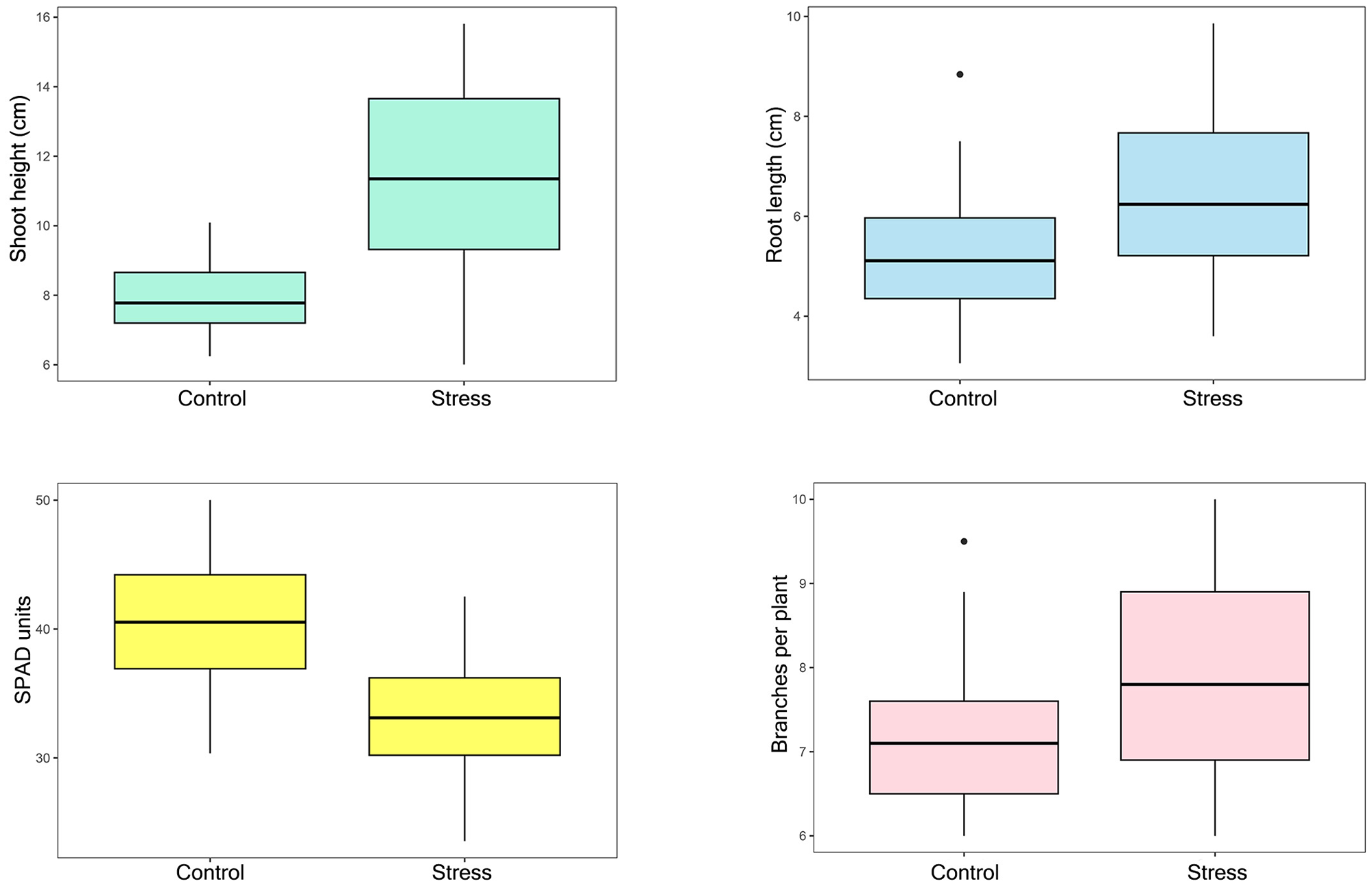
SH and RL showed dynamic morphological responses to WL stress among the selected accessions. The present finding indicates that under WL stress of 48 h, the same accessions displayed 42% as compared with control conditions (Fig. 2). Besides, HT and T accessions, including EC377024 and IC397886, showed variation in SH percentage, ranging from 8.02% to 32.47% and 2.01% to 22.55%, respectively. Further, MT (IC204160 and IC204749) and S (IC129289 and Swetha) accessions exhibited SH percentage ranges between 5.12% and 36.07% and 3.9% and 20%, respectively.
Box-plot represents the 143 accessions of the selected traits which were affected during waterlogging stress, including SH in cm, RL in cm, BPP and SPAD units with respect to their control conditions.

The SH was maximum in HT genotypes, followed by T, MT, and susceptible accessions. The stress-escaping characteristics were found in the tolerant accessions. A similar trend was observed in RL, showing the dynamic alterations during WL conditions. Mean RL was 21% higher under WL stress conditions than in controlled conditions. RL was the most extended and dense in HT accessions compared to T and MT accessions, followed by S accessions. Although SH and RL were measured for all genotypes, four accessions were identified as HT based on their morphological characteristics under WL stress. Adventitious roots (ARs) played a crucial role in enhancing sesame’s resilience to WL stress. In this study, HT and T genotypes exhibited a higher frequency of adventitious root (Supplementary Table 1) formation, which indicates the escape mechanism to sense oxygen under WL stress conditions. ARs enable plants to access oxygen from above the soil surface, enhancing regulatory metabolic processes when the oxygen level gets dropped in the root zone under hypoxia/WL stress conditions. This adaptive response highlights the significance of adventitious roots as a vital trait for improving waterlogging tolerance in sesame breeding programs (Chugh et al., Reference Chugh, Mishra, Sharma, Kumar, Ghorbel, Kumar, Rai and Kumar2024).
Branches per plant
The number of BPP exhibited dynamic alterations under stress conditions, and the findings indicate that BPP under stress conditions was slightly increased in comparison to control conditions (Fig. 2). In HT genotypes, accessions EC377024 and IC204848 showed increased BPP by 25.31% and 40.4%, respectively. Conversely, accession IC129289, classified as an S genotype, exhibited a reduced BPP of 5.33%. The genotype-based BPP comparison is provided in Supplementary Table 1.
Chlorophyll estimation using SPAD meter
The chlorophyll content was assessed using a SPAD meter (502 plus-Konica Minolta, Japan) to examine the impact of WL stress on the leaf tissue of sesame. Under controlled conditions, the mean SPAD value of leaf chlorophyll content was identified as 38.05 ± 3.22 SPAD units. However, WL stress consistently reduced chlorophyll content except for a few accessions. (Fig. 1). Short-term WL (up to 24 hours) did not significantly change chlorophyll content. In contrast, after 48 hours, chlorophyll content significantly decreased compared to their respective control of all the accessions. After imposing WL stress for 48 h, leaves turned green to pale yellow. In HT (IC204848) and T (IC511050) accessions, chlorophyll content was slightly increased by 18.44 % and 1.14 %, respectively, and nearly no chlorosis was observed in the classified accessions. On the other hand, MT accession (IC205411 and IC204160) showed a reduction in chlorophyll content by 6.19% to 13.14%. Conversely, S accessions IC129289 and IC52645 indicated significant decreases in chlorophyll content, ranging from 2.26% to 15.12%, indicating pale yellow, leaf browning and eventual death.
The overall G × E interaction of the individual morphological traits and the estimation of chlorophyll content was observed to be significant (P ≤ 0.05), which indicates the accessions have a substantial effect on the WL stress condition (Supplementary Table 1).
Exploring four clusters in sesame genotypes
Hierarchical cluster analysis (HCA) grouped 139 accessions into four distinct clusters, each represented by a different colour. Red indicates the HT group, green indicates the T group, violet marks the MT group and purple highlights the S group. While cluster-2 comprises 17 sesame genotypes (12.23%). Moreover, cluster-3 represents the maximum accessions, encompassing 66 genotypes (47.48 %). Moreover, cluster-4 encompassed 52 genotypes, contributing 37.41% among the selected accessions (Fig. 3). While cluster-1 formed the smallest group with only four genotypes, which contributed only 2.7%. Among these, accessions EC377024 and IC204848 showed the morphological traits which marked these accessions as HT due to their increased SH and RL under WL stress conditions, making them promising candidates for further investigation in future studies.
Hierarchical cluster representation of 143 sesame accessions using the unweighted pair group method (UPGMA) with arithmetic mean values of the phenotypic traits. The dendrogram represents the four groups and each group indicates the genotype behaviour. Red, green, blue and purple colour indicates highly tolerant, tolerant, moderately tolerant and susceptible genotypes.

Principal component analysis and correlation
A principal component analysis (PCA) was conducted to identify the principal components of the morphological parameters of different sesame genotypes in response to WL stress. The analysis revealed that PC1 accounted for an Eigenvalue exceeding 1.31, contributing to 32.9% of the variation, followed by PC2, which accounted for 24.5% of the total variation among the sesame genotypes. Both PCs explained 57.4% of the total variance of the analysed parameters (Fig. 4). The PCA biplot representing the results is scattered in four quadrants based on their significant values. It was observed that PC1 (Dimension 1) had the highest eigenvalue and variance percentage. Among all the traits, two traits, RL (0.59) and SL (0.54), showed the highest positive eigenvalues (Supplementary Table 1), significantly contributing to the WL stress condition. As we further narrowed down the dimensions, the eigenvalues and variance percentage decreased. In the PCA circle, the SPAD vector length is represented in red, while the BPP vector length is in blue, forming a nearly 90° angle, demonstrating the weak contribution of BPP between these two traits. A shorter vector length indicates less contribution in PCA, whereas a longer vector length indicates a better representation of the traits on the component. In PC1, RL, followed by SL, showed the maximum eigenvalue. In contrast, PC2 represents the maximum SPAD eigenvalue.
Correlation circle of PCA. PCA indicates the four different variables, including SPAD, RL, SH and BPP. PC1 and PC2 represent 30.5% and 26% of the variance. Cos 2 value indicates the good quality demonstration of the individual traits in the plot. The plot explained the relationship between the variables and PC using length and vector direction. The vector direction illustrates the strength and the correlation’s nature between a specific PC and the original variable. A stronger correlation is indicated by measuring proximity to the components. Besides, the higher the vector length, the stronger the correlation, i.e., variables (traits) with longer vectors are significantly contributing to the variability indicated by PC. (A) Individual-PCA; (B) Variable-PCA.

Moreover, the PCA results demonstrated that RL and SL made the maximum contributions during WL stress conditions, positively impacting PC1 and increasing PC1 percentage (32.9%). Additionally, SPAD and BPP contributed less to PC1. Furthermore, in PCA 2, SPAD and BPP showed the maximum (0.87) and minimum (−0.16) eigenvalue under WL stress conditions, respectively.
To observe the genotype behaviour under waterlogged conditions, percentage variations across the diverse sesame genotypes were examined concerning G × E interactions (Fig. 5A). RL and BPP showed the maximum variations in the genotypes. At the same time, SH exhibited fewer variations across the genotypes, respectively. Pearson’s correlation coefficient was conducted for the selected morphological traits (Fig. 5B). Among these, RL and SPAD units, SH and RL were found to be significantly correlated (P ≤ 0.05).
Genotype × environment interaction. (A) percentage variations among the genotypes, environment and interactions of the SPAD, BPP, SH and RL. The graph indicates the variations observed during WL stress treatment in the sesame accessions. (B) Pearson’s correlation heatmap of diverse sesame accessions. The traits were calculated after challenging the plants to 48 hours of WL stress. The blue colour represents the positive correlation, and the red colour represents the negative correlation for the selected traits.

Discussion
The present study identified four WL-tolerant sesame accessions based on key morphological and physiological traits, providing valuable resources for breeding programmes. Unlike previous studies that focused on a limited number of accessions, this investigation examines a broader range of sesame germplasm. In addition, the experimental design specifically focused on the seedling-stage responses, encompassing key traits such as RL, SH, BPP, chlorophyll content measured using a SPAD metre, and leaf chlorosis, which are significantly affected during WL stress conditions. Furthermore, this study advances knowledge on adventitious roots (Supplementary Table 1), seed coat colour (Fig. 6) and additional traits such as leaf chlorosis across a broader range of accessions not previously reported for WL stress.
Diversity in the seed coat colour of sesame genotypes.

The results confirmed that chlorophyll content was significantly influenced by stress conditions. It was observed that HT genotypes exhibited an increase in chlorophyll content, while a decline was noted in S genotypes. This pattern aligns with previous studies in crops such as sorghum, poplar and pumpkin (Zhongcheng et al., Reference Zhongcheng, Gang, Wei, Feng, Xiaomei and Zexiong2019; Zhang et al., Reference Zhang, Yue, Chen, Huang, Zhou and Cao2023; Liu et al., Reference Liu, Liu, Wang, Guo, Sun, Chen and Li2024), where stress duration reduced chlorophyll content in susceptible genotypes. The increase in chlorophyll content under stress conditions suggests enhanced energy generation and carbohydrate-related pathways (Shah et al., Reference Shah, Gadol, Priya, Mishra, Rao, Singh, Kumar, Kalia and Rai2024). Consequently, genotype screening based on chlorophyll content may provide valuable insights for understanding WL-associated genes and can be integrated into breeding programs to develop WL-tolerant sesame varieties.
Additionally, our results showed that BPP increased in HT accessions but significantly decreased in the remaining accessions under WL stress conditions. A similar trend has been reported in rapeseed, soybean, and cotton (Nabloussi et al., Reference Nabloussi, Bahri, Lakbir, Moukane, Kajji and El Fechtali2019; Sathi et al., Reference Sathi, Masud, Falguni, Ahmed, Rahman and Hasanuzzaman2022). Therefore, for a comprehensive study, HT accessions can be selected for a detailed investigation to better understand the WL tolerance mechanism in sesame.
SPAD units, RL and SH emerged as key traits for identifying WL-tolerant genotypes. These parameters will be valuable for breeders seeking to incorporate waterlogging tolerance into sesame breeding programs. Moreover, the identified tolerant genotypes provide an excellent resource for integrated omics studies to map and characterize genes associated with waterlogging stress tolerance. Given the critical role of root traits in promoting tolerance, further exploration of specific traits such as root diameter, root hair density, lateral root proliferation and root anatomy and root system architecture is recommended to improve understanding of oxygen transport mechanisms during hypoxia conditions caused by WL stress.
Conclusion
This study identified four WL-tolerant sesame accessions (EC377024, IC205253, IC14117 and IC204848) demonstrating superior RL, SH, SPAD values and BPP under stress conditions. Besides, IC129289 and IC384399 were classified as susceptible due to their poor performance. Identifying key traits such as RL, SH and SPAD units offers a practical and efficient approach for screening WL-tolerant genotypes. These traits can be strategically integrated into breeding programs to develop climate-resilient sesame varieties. Furthermore, the findings highlight the significance of ARs in enhancing tolerance by improving oxygen uptake under hypoxic conditions. Future research should explore additional root traits, such as diameter, hair density, and lateral root proliferation, to better understand oxygen transport mechanisms and enhance sesame’s resilience to WL stress.
Supplementary material
The supplementary material for this article can be found at https://doi.org/10.1017/S1479262125000139.
Acknowledgements
We acknowledge funding support from the Department of Biotechnology (Grant No. BT/Ag/Network/Sesame/2019-2020), Ministry of Science and Technology, Govt. of India.