INTRODUCTION
Tens of thousands of prisoners in California file grievances with the California Department of Corrections (CDCR) every year, contesting such things as lack of medical care, unwarranted disciplinary actions, detestable physical conditions, and officer misconduct. The prison grievance system is the legally sanctioned internal mechanism for prisoners to contest the conditions of their confinement, and federal law requires a prisoner to exhaust this administrative process before gaining access to the courts. This internal grievance process is time-consuming and challenging to navigate; further, the vast majority of grievancesFootnote 1 are denied by the CDCR.
An extensive body of procedural justice literature suggests that people will be satisfied with the outcome of a dispute, whether or not the outcome goes their way, if they perceive that the processing of the dispute was fair (Hollander-Blumoff and Tyler, Reference Hollander-Blumoff and Tyler2008; Levi et al., Reference Levi, Sacks and Tyler2009; Thibaut and Walker, Reference Thibaut and Walker1975; Tyler Reference Tyler1984, Reference Tyler1988, Reference Tyler1994, Reference Tyler2003). A separate stream of literature reveals a wide racial divide in experiences of the criminal justice system and in related perceptions of justice (Alexander Reference Alexander2010; Fagan and Geller, Reference Fagan and Geller2015; Harris Reference Harris1999; Meares Reference Meares2014; Peffley and Hurwitz, Reference Peffley and Hurwitz2010; Rios Reference Rios2011; Travis and Western, Reference Travis and Western2014). These two lines of inquiry have yet to be brought together to interrogate whether prisoners’ race is consequential for how they perceive both process and outcome in adjudication of grievances.
Prisoners are, quite literally, residents of the criminal justice system and they are directly subjected to the harsh consequences of state power. Prison populations are disproportionately comprised of people of color (Alexander Reference Alexander2010; Travis and Western, Reference Travis and Western2014). Further, prisoners live in a highly racialized environment, where prison policies and prisoner codes of conduct alike dictate an abundance of race-based practices, identities, and allegiances (Goodman Reference Goodman2008, Reference Goodman2014; Hunt et al., Reference Hunt, Riegel, Morales and Waldorf1993; Skarbek Reference Skarbek2014; Trammel Reference Trammell2012). In brief, race is a central organizing feature of prison life.
The extensive procedural justice scholarship, the well-documented race gap in perceptions of fairness, and the heavily racialized space that prisoners occupy in the criminal justice system provoke a heretofore unanswered question: how does race structure the way incarcerated men experience and think about fairness in the criminal justice system in general, and with regard to the prisoner grievance system in particular? We examine this question by drawing on original data collected as part of a larger study of the prisoner grievance system in California (Calavita and Jenness, Reference Calavita and Jenness2015), including interviews with 120 randomly selected prisoners in three California prisons for men.
The prisoner grievance system was established in 1973 in California, and it became a prominent feature of prison life after the federal Prison Litigation Reform Act (PLRA) was enacted in 1996. Congress passed the PLRA for the explicit purpose of restricting prisoners’ access to court, at a time when the prison population was soaring and courts were flooded with prisoner lawsuits (Schlanger Reference Schlanger2003). Among other provisions, the PLRA mandates that “no action shall be brought with respect to prison conditions . . . by a prisoner confined in any jail, prison, or other correctional facility until such administrative remedies as are available are exhausted” (42 U.S.C. Section 1997e[a]; emphasis added). The law thus requires all prisoners in the United States who desire access to court first to file a grievance inside their correctional facility and to complete all steps of that administrative process, exhausting all possibilities for internal remedy. The courts have given states free rein to design grievance systems that in action are cumbersome and difficult to navigate (Schlanger Reference Schlanger2003; Schlanger and Shay, Reference Schlanger and Shay2008) and that rarely result in granting prisoners’ requested remedies.
In California, the grievance form—colloquially referred to as a “602,” for the government-assigned form number—provides a space for the appellant to describe his/her complaint and request a specific remedy. The Inmate Appeals Coordinator sends the grievance to the lowest level prison official most relevant to the issue, who responds in writing beneath the prisoner’s written complaint and requested remedy. If the grievance is denied, the prisoner may write a second level appeal to the prison warden, and ultimately a third level appeal to the Office of Inmate Appeals in Sacramento. Tens of thousands of prisoner grievances are filed and responded to annually in California. Grievances are managed solely by officials within the CDCR, who simultaneously serve as defendant, judge, and jury in adjudicating outcomes (for more on this grievance process, see Calavita and Jenness, Reference Calavita and Jenness2015).
Elsewhere, we address how prisoners perceive justice in the criminal justice system in general and the grievance process specifically (see Jenness and Calavita, Reference Jenness and Calavita2018). Here, we focus on whether those perceptions vary by race, as the prevailing literature on race and procedural justice would predict. The following section provides a short review of the literatures that inform our analysis. First, we discuss relevant literature on the race gap in criminal justice, including in attitudes about the criminal justice system. Second, we examine the procedural justice scholarship. After setting our analysis in the context of existing literature, we discuss our methodology and sources of data, and then turn to our findings and analysis.
THE RACE GAP, PROCEDURAL JUSTICE, AND BEYOND
Racialization of the Criminal Justice System
An extensive body of sociological and criminological scholarship documents significant gaps in how Whites and people of color are treated by the criminal justice system, and their related perceptions of that system. There is now overwhelming evidence that African Americans and other minorities are more likely than Whites to be pulled over while driving, stopped and frisked, arrested for drug possession and other minor offenses, subjected to lethal force by the police, prosecuted, adjudicated through plea bargaining, incarcerated, and given long sentences (Alexander Reference Alexander2010; Beckett and Herbert, Reference Beckett and Herbert2010; Epp et al., Reference Epp, Maynard-Moody and Haider-Markel2014; Fagan and Geller, Reference Fagan and Geller2015; Harris Reference Harris1999; Levine and Small, Reference Levine and Small2008; Meares Reference Meares2014; Peffley and Hurwitz, Reference Peffley and Hurwitz2010; Rios Reference Rios2011; Travis and Western, Reference Travis and Western2014; Western Reference Western2006). Such scholarly works reveal a painful truth: the criminal justice system is structured around race and is racialized in its routine operation. As Ruth Peterson (Reference Peterson2017) said in her recent Presidential Address to the American Society of Criminology: “Race and ethnic disparities in crime and justice are long standing” (p. 253).
The mass incarceration of the past several decades—what Michelle Alexander (Reference Alexander2010) has famously called “the new Jim Crow”—is the most visible and dramatic component of this racialized system. Loïc Wacquant (Reference Wacquant2010) describes “mass incarceration” as “more accurately the “hyperincarceration of (sub)proletarian African American men from the imploding ghetto” (p. 74). And Reuben Miller (Reference Miller2014) observes that this hyperincarceration is not new: “Black men have long been viewed as the most ‘suitable targets’ for criminal justice intervention, and punishment and welfare institutions have worked in tandem to manage Black criminality, dependence, and deviance together since at least the post bellum period” (p. 310).
Not surprisingly, disparate treatment of people with different racial identities in the criminal justice system is echoed in disparate attitudes about that system. A recent survey of Californians by the Public Policy Institute of California confirms the race gap in attitudes. When asked “Do you think blacks and other minorities receive equal treatment as whites in the criminal justice system or not?” overall 61% responded that they did not (Baldassare et al., Reference Baldassare, Bonner, Kordus and Lopes2016, p. 23). The differences by race were pronounced, with 92% of Blacks and only 55% of Whites saying that minorities do not get equal treatment with Whites (64% of Latinos and 60% of Asians answered this way).
Additional studies document this pattern and delineate its complexities (Epp et al., Reference Epp, Maynard-Moody and Haider-Markel2014; Hurwitz and Peffley, Reference Hurwitz and Peffley2005; Meares Reference Meares1997; Peffley and Hurwitz, Reference Peffley and Hurwitz2010). For example, Tracey Meares (Reference Meares1997), reveals the “dual frustration” of African Americans with drug enforcement. African Americans in her analysis were less likely than Whites to support “get tough” drug enforcement policies and were keenly aware of racially discrepant enforcement. However, they were also more likely to reside in areas with high crime rates and drug sales, and therefore reported a greater need for enforcement. African American men were more likely than any other group to support greater leniency for drug violations. Meares concludes that their attitudes probably “reflect the unique experience of African American men with an institution that looms large in their lives—the criminal justice system” (p. 156).
In their book on police stops of motorists, Charles Epp and colleagues (2014) show that African Americans not only perceive racial discrimination in such stops but they also view investigatory stops as inherently unfair regardless of the demeanor of the officer, whether the officer followed procedural protocol, or even whether the stop resulted in an arrest or ticket. They conclude that “[t]he stop narratives underscore how much African Americans, in comparison to whites, fear and mistrust the police. This is a well-established finding” (Epp et al., Reference Epp, Maynard-Moody and Haider-Markel2014, p. 139).
Mark Peffley and Jon Hurwitz (2010) summarize the media and scholarly reports on the attitude gap between Blacks and Whites: “It has been documented that at the heart of this ‘race gap’ lays the profound belief of many African Americans that the criminal justice system is, to its core, profoundly unfair—a belief that is, to say the least, not shared by many Whites” (p. 6). Elsewhere, they write succinctly, “Quite simply, most whites believe the CJS [criminal justice system] is fundamentally fair, and most African Americans do not” (p. 763).
The Procedural Justice Scholarship
Many scholars have examined the psychological, social, cultural, and political dimensions of perceptions of justice. Empirical findings in the sociolegal field document the relationship between people’s perceptions of fair legal processes and their satisfaction with legal outcomes (Carman Reference Carman2010; Casper et al., Reference Casper, Tyler and Fisher1988; Hasisi and Weisburd, Reference Hasisi and Weisburd2011; Hollander-Blumoff and Tyler, Reference Hollander-Blumoff and Tyler2008; Jackson et al., Reference Jackson, Bradford, Hough, Myhill, Quinton and Tyler2012; Johnson et al., Reference Johnson, Maguire and Kuhns2014; Levi et al., Reference Levi, Sacks and Tyler2009; Lind and Tyler, Reference Lind and Tyler1988; Thibaut and Walker, Reference Thibaut and Walker1975; Tyler Reference Tyler1984, Reference Tyler1988, Reference Tyler1994, Reference Tyler1997, Reference Tyler2003; Vidmar Reference Vidmar1990). According to this literature, people are likely to be satisfied with the outcome of a dispute even when it does not favor them if they believe the process itself was fair.
A number of criticisms have been launched against this body of research. Some have argued that the simulations, vignettes, and experiments with college students on which many of these studies are based do not mimic real life (Anderson and Hayden, 1980–Reference Anderson and Hayden81; Heinz Reference Heinz and Talarico1985; but see Vidmar Reference Vidmar1990). More relevant to this article, in a study of felony plea bargaining cases, Anne Heinz (Reference Heinz and Talarico1985) found that “outcome and procedural measures formed a single factor” for defendants; she argued that this may be the case for people facing high, real-life stakes (p. 30). Clearly, prisons are “high stakes” environments and prisoners are people with high stakes when it comes to disputes with the state.
Ellen Berrey and colleagues (2012) have also argued that one’s location in a dispute is critical. In a study of plaintiffs, lawyers, and defendants’ representatives in employment discrimination cases, they found that participants entertain an abstract notion of fairness, but in concrete cases their assessments are “relational.” They explain, “From a situated perspective, what each side wants in a fair legal system is not an unbiased process … but one that benefits their own side” (Berrey et al., Reference Berrey, Hoffman and Nielsen2012, p. 4; see also Hickman and Simpson, Reference Hickman and Simpson2003). While procedural justice literature is mostly based on individual encounters, Berrey and colleagues (2012) argue that when participants are ensconced in institutional contexts and are advantaged or disadvantaged by resource imbalances and historical experiences, the abstract concept of fairness breaks down.
The importance of situating perceptions of justice in social context is starkly revealed in studies of how such perceptions vary by race. As noted above, Epp and colleagues (2014) show that African American motorists perceive racial discrimination in police investigatory stops regardless of the procedures followed and officer behavior. Even when police were fastidiously polite and behaviorally respectful during an investigatory stop, African Americans reported being far less satisfied with the stop and attributed far less legitimacy to the police than did Whites. Epp and colleagues (2014) therefore “emphatically depart” from psychological procedural justice theories that place primary importance on officers appearing to act fairly (p. 4). They argue instead that for African Americans, “official politeness could not convert an otherwise offensive police stop into a fair and legitimate one” (p. 5). In effect, social context—in this case a highly racialized one—reigns powerful in evaluations of fairness and justice.
This article integrates and elaborates on these two bodies of scholarship—the literature on racial disparities in perceptions of justice and the procedural justice literature. Specifically, we investigate whether prisoners’ satisfaction with the grievance process—and the relative importance of outcomes and process—as well as their perceptions of how they have been treated by the criminal justice system more generally vary by race. Doing so extends and deepens our previous work in which we report empirical findings that are contrary to what would be expected from much of the procedural justice literature: prisoners’ satisfaction with the results of their grievances varies less with measures of procedural justice than with what the actual outcome is (Jenness and Calavita, Reference Jenness and Calavita2018). Our data reveal that prisoners make little distinction between the outcome of a grievance and how fairly they think it was managed, with the former largely driving the latter (Jenness and Calavita, Reference Jenness and Calavita2018).
In the empirical analyses presented here, we demonstrate that California prisoners’ focus on outcomes as the barometer of justice holds across racial groups. The finding of an absence of race effects makes sense when one considers the institutional context of the prison, and the powerful quality of the prison experience, with its potential to degrade and stigmatize all prisoners, trumping attitudinal distinctions usually associated with race. We conclude by suggesting that our findings may contribute to an understanding of the contextual nature of race and the attitudes usually linked to it.
DATA AND METHODOLOGY
The findings reported in this article derive from a larger study of the structure, workings, and consequences of a large-scale prisoner grievance system (Calavita and Jenness, Reference Calavita and Jenness2013, Reference Calavita and Jenness2015). That study was based on years of research and drew from multiple sources of data, including official grievance files, interviews with corrections officials and prisoners, official reports, and facts from the historical record. Our larger work revealed the many challenges prisoners face when activating the grievance system, the difficult dilemmas staff confront when processing grievances, and the complicated way in which both prisoners and staff proceed in light of the larger legal environment in which they operate. Most relevant here, an article drawn from that previous work reveals how prisoners who file grievances think about and orient to procedural and substantive justice (Jenness and Calavita, Reference Jenness and Calavita2018); however, that work does not interrogate whether those attitudes vary by race.
When we collected the interview data on which the present article is based in 2009, California was home to one of the largest correctional systems in the western world, surpassed only by the U.S. federal system. In 2006, U.S. District Court Judge Thelton Henderson had put the California prison health care system in receivership, having found that its conditions violated the Eighth Amendment’s prohibition against cruel and unusual punishment. At the time, few experts contested that California prison conditions were problematic and many had declared the CDCR a dysfunctional system. In 2011, the U.S. Supreme Court found that California prisoners’ physical and mental healthcare was so deficient that it violated the Eighth Amendment (Brown v. Plata, 563 U.S. 493 [2011]). In this context (i.e., harsh and “unlawful” settings), it is important to understand how prisoners contest their conditions of confinement, and how and why their grievances have failed to produce constitutional conditions.
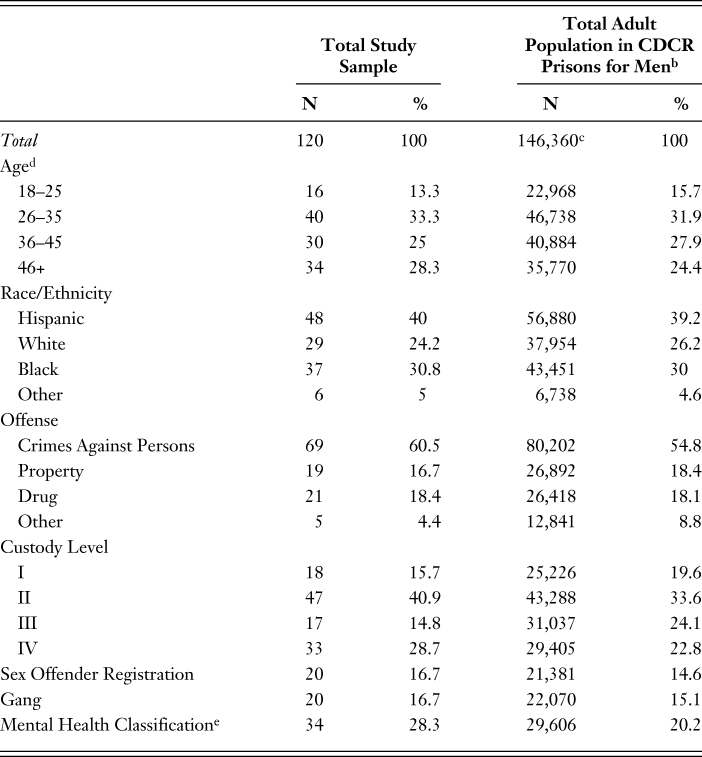
To understand the grievance system prisoners must use, we collected multiple types of data (Calavita and Jenness, Reference Calavita and Jenness2015). We collected a random sample of 292 grievances from the 15,836 grievances that came from all men’s prisons in California in 2005–2006 and that reached the third level of review. We conducted face-to-face interviews with both prisoners and CDCR staff, interviewing a random sample of forty men from each of three prisons that together approximate the characteristics of the larger CDCR male population on several important dimensions (Table 1). We also interviewed twenty-three CDCR personnel, including wardens, deputy wardens, captains, appeals coordinators, and grievance examiners and supervisors. All of the interviews were done in prisons (with the exception of those conducted at the Inmate Appeals Office in Sacramento where the final grievance reviews are performed). They included both closed and open-ended questions, and allowed for follow-up questions and spontaneous exchanges. As Principal Investigators, we conducted all of the staff interviews and the vast majority of interviews with prisoners; three advanced graduate students conducted the remaining prisoner interviews.
A Comparison of Select Characteristics of the Study Sample and the Total Population in CDCR Prisons for Mena

Source: CDCR’s Offender-Based Information System, March 2009.
a Based on official CDCR records and attendant classification schemes, including their terms for race.
b Figures exclude prisoners in fire camps.
c The total used to compute percentages varies depending on missing data. For example, the percentages for custody level are based on a total of 128,956 prisoners with official classification scores.
d Sample mean=38.3 years; Population mean=37.4 years
e Correctional Clinical Case Management System (CCMS) and Enhanced Out-Patient Program (EOP) prisoners, referring to those with chronic or acute mental health disorders.
Most relevant here, we asked prisoners a series of questions about prison life. For example, we asked about housing arrangements, daily life, programming, problematic or bothersome conditions, perceptions of and experience with the prisoner grievance process, and how fairly they thought they had been treated. While responding to these questions, prisoners frequently offered unsolicited commentary on an array of issues. Some of their comments elaborated further on their thinking about and orientation to fairness in the criminal justice system in general and the grievance system in particular.
If a prisoner reported filing any grievances, we asked him a series of questions about the specific grievances he had filed. An incident form was used to collect systematic information on 217 of the grievances the set of prisoners reported filing. To ensure that a range of types of grievances was included in our incident data, we asked each interviewee to provide details on different types of grievances he had filed, including: 1) a grievance filing that ended at the informal level; 2) the most recent grievance filed; 3) the second most recent grievance filed; 4) the most important/memorable grievance filed; 5) a grievance that was granted, if any; and 6) a grievance that was filed with other prisoners as a group appeal, if any.
After each specific incident was reported, we asked questions that allowed us to capture key elements of procedural justice, including: 1) “How satisfied are you with the way it was managed” and “why;” and 2) “How satisfied are you with the outcome” and “why.” Prisoners were asked to indicate whether they were “very satisfied,” “satisfied,” “neither satisfied nor dissatisfied,” “dissatisfied,” or “very dissatisfied.” We also asked “how fair would you say they [CDCR officials] were” in the grievance process, “very fair,” “fair,” “neither fair nor unfair,” “unfair,” and “very unfair.” Finally, we inquired about three specific aspects of procedure, variations of which are discussed in the procedural justice literature: whether there was a hearing; whether the prisoner was interviewed; and, whether he was informed of the outcome. These elements of procedure approximate the “voice,” “participation,” and respect for rights that typically stand for procedural justice in prior literature.
We also asked a series of questions related to demography and personal experiences. For example, we asked them how many years of formal schooling they had, at what age they were first arrested, and what race or ethnicity they self-identified with. Our focus is on the vast majority of prisoners who identified as Black, White, or Latino. Many of those the CDCR officially classified as “Hispanic” referred to themselves as “Mexican” even if their families had been in the United States for generations. Some who were identified as Black by the CDCR referred to themselves as African American. For simplicity’s sake and to facilitate undertaking statistical tests of hypothesized race effects, we classified those who called themselves “Hispanic,” “Latino,” “Salvadoran,” or “Mexican,” as Latino; those who referred to themselves as “Black” or “African American” as Black; and those who identified as “Caucasian” or “White” as White. We coded the few remaining prisoners—who identified as “Samoan,” “American Indian,” and “Asian”— as “Other.” As reported in Table 1, the sample distribution is as follows: Latino (40%), Black (30.8%), White (24.2%), and Other (5%).
FINDINGS
General Perceptions of Fairness
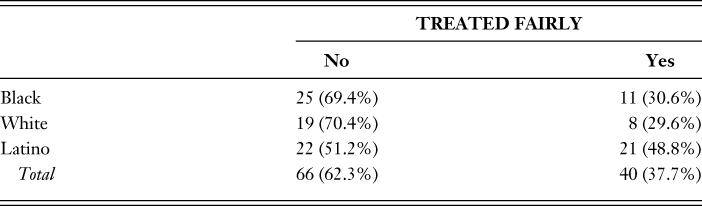
To begin, we focus on the general question: “Looking back over your experiences in life and things you’ve done, do you think you’ve been treated fairly by the criminal justice system?” Surprisingly, prisoners’ responses to this question did not reveal a statistically significant association between race and perceptions of fair treatment. A majority of Black, White, and Latino prisoners answered “no,” even as a sizable minority in each group said “yes” (Table 2). While Latinos were somewhat less likely than Blacks or Whites to say the system had treated them unfairly, Black and White prisoners were almost identical in this respect: 70.4% of Whites and 69.4% of Blacks reported unfair treatment.
Perceptions of Fair Treatment by the CJS (n=106)

Note: Pearson chi-square=3.8, p=.15. Percentages reflect row percentages.
Perceptions of Justice in the Grievance System
Almost three-quarters of the men in our study (74.2%) told us they had filed at least one grievance while in a California prison. More than three-quarters of these had filed more than once, some had filed dozens of claims, and two said they had filed “hundreds” of times. Further, a majority of men in every demographic and racial group had filed a grievance. Yet, there were a few differences across racial groups. Blacks reported having filed a grievance slightly more often than Whites did (86.5% and 79.3%, respectively), while Latinos were the least likely to have filed (60.4%).
Jorge Bermudez (all prisoners’ names used here are pseudonyms), who self identifies as “Mexican,” spoke to his perception of these differences. He spontaneously offered, when asked his racial identification, “We’re a hush-hush type of people. We don’t complain . . . I mean we complain emotionally, but as far as ‘Man, I got a case and I need to fight this case. I’ll do it tomorrow.’ It’s not gonna happen. And that’s the type people we are.” When the interviewer asked, “And which group in prison do you think is not the hush-hush people,” he responded, “The Blacks.” While our data show that Blacks in our sample were slightly more likely to have filed a grievance than Whites, the difference is not statistically significant.
Chi-square tests reveal that the relationship between race and filing a grievance is statistically significant when comparing Blacks, Whites, and Latinos (χ 2 (2) = 7.9, p = < 0.019), but not when comparing Blacks and Whites (χ 2 (1) = 0.603, p = 0.438). Furthermore, the relationship between race and the actual outcome of a grievance—whether it was granted or not—is not statistically significant when comparing Blacks, Whites, and Latinos (χ 2 (2) = 5.344, p = < 0.069) or when comparing Blacks and Whites (χ 2 (1) = 0.166, p = < 0.684).
In contrast to findings of many procedural justice studies, in our earlier work the relative presence of the three procedural measures—whether there was a hearing, whether the grievant was interviewed, and whether he was notified of the outcome—was not statistically significantly associated with prisoners’ satisfaction with the outcome(s) of their grievance(s) (Jenness and Calavita, Reference Jenness and Calavita2018). Also in contradiction to a central tenet advanced in procedural justice theory, whether the grievance was granted (i.e., the actual outcome) is significantly associated with prisoners’ satisfaction (Jenness and Calavita, Reference Jenness and Calavita2018). In other words, we found that outcomes matter significantly in determining California prisoners’ satisfaction, while specific indicators of procedure do not (Jenness and Calavita, Reference Jenness and Calavita2018).
Here we revisit this central finding about the privileging of outcomes over procedure with an eye toward discerning race effects. To begin, the relative presence of our three measures of procedure—where zero indicates the absence of all three of these elements and three indicates the presence of all three elements—does not vary by race (χ 2 (6) = 8.127, p = < 0.229). Second, the relative presence of these three measures of procedure is not significantly associated with satisfaction with outcomes for Blacks (χ 2 (3) = 5.835, p = < 0.120), Whites (χ 2 (3) = 4.865, p = < 0.182), or Latinos (χ 2 (3) = 1.331, p = < 0.722); by contrast, actual outcome is significantly associated with satisfaction for all three groups (Blacks: χ 2 (1) = 30.627, p = < 0.000; Whites: χ 2 (1) = 14.786, p = < 0.000; and Latinos: χ 2 (1) = 9.956, p = < 0.002).
Further, prisoners’ responses to “How satisfied are you with how this grievance was managed?” do not vary in statistically significant ways by race when comparing Black, Whites, and Latinos (χ 2 (2) = 0.220, p = 0.896). Black, White, and Latino prisoners alike report being dissatisfied the majority of the time they have filed a grievance. Nor are there statistically significant race effects in how satisfied they say they are with the outcomes of their grievances (χ 2 (2) = 2.23, p = 0.328). Our work also demonstrates an absence of race effects in response to the question, “How fair would you say they were”? (χ 2 (2) = 1.69, p = 0.429).
Examining granted grievances and denied grievances separately is telling. When a grievance is granted, the modal pattern overall is satisfaction with both management and outcome (69.2%) (χ 2 (1) = 4.74, p = 0.029); however, when a grievance is denied the modal pattern is dissatisfaction with both outcome and management (60%) (χ 2 (1) = 63.76, p = 0.000) (for a more lengthy discussion of these key findings, see Jenness and Calavita, Reference Jenness and Calavita2018). This general pattern is consistent across racial groups. For Blacks, Whites, and Latinos alike, when the grievance is granted, the modal pattern is satisfaction with management and outcome (70%, 66.7%, and 71.4%, respectively), but when the grievance is denied, the modal pattern is dissatisfaction with management and outcome (56.2% for Blacks, 61.3% for Whites, and 63.8% for Latinos). Thus further suggesting that outcome drives satisfaction with process, when a grievance is granted, satisfaction with how it was managed is high for each group; conversely, when a grievance is denied satisfaction with its management is consistently low.
Our qualitative interview data also suggest that for all racial groups satisfaction with the process is driven by the outcome. As James Little, a Black man in his forties, said emphatically and with a tinge of impatience, their satisfaction “depends on the outcome.” Likewise, when we asked Harold Steele, a White Vietnam War Veteran, how satisfied he was with how his medical grievance had been managed, he reminded us that it had been denied and so he was dissatisfied “all the way around.” These voices capture the essence of our dual argument: satisfaction depends on outcome, and that applies across racial groups.
DISCUSSION AND CONCLUSION
The empirical findings presented in this article reveal the absence of a “race gap” in prisoners’ views of whether they had been treated fairly by the criminal justice system, their views on how prisoner grievances are managed and the outcomes they receive, and the relationship between procedural and substantive justice behind bars. The deviation in this study from the race gap that is usually reported in the literature is striking, and we can only speculate here on what might explain it.
We know that a disproportionate number of prisoners in the United States are people of color. They are also disproportionately people from disadvantaged socioeconomic backgrounds, with lower than average levels of literacy, education, and income. In other words, prisoners are for the most part the have-nots of American society. The disadvantaged social status that prisoners share may reduce somewhat the usual racial gap. In addition, the incarceration experience itself may be powerful enough to impact attitudes about fairness and justice, further leveling the usual racial gap among those who share this transformative experience.
A study published by the National Academy of Sciences reveals the potentially powerful effects of poverty on racial identity. That study found that in contemporary America people who are perceived to be White, and self-identify as White, can fall out of that status if they become poor (Penner and Saperstein, Reference Penner and Saperstein2008). In another study, Aliya Saperstein and Andrew Penner (2010) found that the experience of incarceration may impact people’s racial identity. It is beyond the scope of this paper to enter the debate over whether and how poverty, incarceration, and other social status markers affect actual racial identity. However, we speculate here that poverty and incarceration may be profound enough experiences to alter perceptions and attitudes generally associated with those identities.Footnote 2 Specifically, the incarceration experience of stigmatization and degradation may alter Whites’ perceptions of criminal justice in ways that bring their attitudes more in line with that of African Americans regarding fairness and justice. This interpretation parallels the findings reported and interpreted by Penner and Saperstein (Reference Penner and Saperstein2008) regarding the racial shifting that prison can trigger. Namely, imprisonment changes subjectivities, including those most intimately associated with the self and one’s relationship to the larger social order.
This article and our other work (Jenness and Calavita, Reference Jenness and Calavita2018) report that, in contrast to much of the procedural justice literature, for California prisoners the outcome of a grievance—not its procedural elements—is the more important ingredient in their satisfaction and in their perception that it had been fairly managed. With rare exceptions (see, for example, recent work by Baker et al., Reference Baker, Pickett, Amin, Golden, Dhungana, Gertz and Bedard2015), the procedural justice literature has been relatively silent on the question of race differences. We offer our findings—that race effects are absent—as a provocative installment in the procedural justice field. Perhaps more relevant here, it is a testament to the contextual nature of the attitudes associated with racial identity, and the awesome power of the carceral experience where autonomy and dignity are so stringently curtailed by the state.
The importance of these findings extends beyond any one discipline or field of study. They confirm once again the contextual quality of race and its cultural and attitudinal boundaries. And, it reminds us to be wary of unilateral distinctions or assumptions, whether in reference to perceptions of procedural versus substantive justice, or to race-related attitudes about fairness. This is not to say that we should disregard patterns uncovered in previous research. Instead, it is to make the case for the primacy of context and how context configures observed patterns. While the prison environment is admittedly unique, its extreme quality is perhaps of heuristic value, exposing the contextual quality of social reality that remains mostly hidden in ordinary daily life.
We hope that future research will explore the racial composition of perceptions of procedural and substantive justice in other settings—particularly total institutions (Goffman Reference Goffman1961)—that to some degree share with prison an extreme hierarchical structure and a relative absence of autonomy, such as the military, mental hospitals, and boarding schools. The core point is that context matters and it matters not only on the fringes; it must be at the center of our analyses. We are not the first to call for a more sociological or contextual approach to procedural justice—or what Berrey and colleagues (2012) call a “situated justice” perspective—such as Epp and colleagues (2014) have demonstrated in the racialized terrain of police stops. Our hope is that this study of evaluations of justice behind prison walls will contribute to the effort to advance our sociological understanding of the broadly human principle of justice as well as of the contingent construction of race and the attitudes associated with it.
ACKNOWLEDGMENT
This research was funded by the Law and Social Science Program and the Sociology Program, National Science Foundation (SES-0849731). The authors want to thank the California Department of Corrections and Rehabilitation for granting permission to conduct this research and for providing access to prisoners, CDCR staff, and official documents. We are especially grateful to the California prisoners who agreed to share with us their experiences and perceptions. Finally, this article has benefitted from the capable research assistance of Julie Gerlinger, Lori Sexton, and Sarah Smith.