INTRODUCTION
After many years of apparent neglect, there is growing attention to the prevention, control and ultimate elimination of neglected tropical diseases (NTDs) (Hotez et al. Reference Hotez, Molyneux, Fenwick, Kumaresan, Ehrlich Sachs, Sachs and Savioli2007; WHO, 2010; NTD Partner Website, 2012; Utzinger et al. Reference Utzinger, Becker, Knopp, Blum, Neumayr, Keiser and Hatz2012). The global strategy for the control of NTDs due to helminth infections (e.g. lymphatic filariasis, onchocerciasis, schistosomiasis and soil-transmitted helminthiasis) is preventive chemotherapy (PC) whereby anthelmintic drugs are administered to at-risk populations, usually without prior diagnosis (WHO, 2006, 2010, 2011). Although this strategy reduces the immediate need for an accurate diagnosis at the individual level, considerable progress has been made in recent years in innovating, validating and applying novel diagnostic tools and strategies at the community level (Cringoli et al. Reference Cringoli, Rinaldi, Maurelli and Utzinger2010; Knopp et al. Reference Knopp, Steinmann, Keiser and Utzinger2012; Colley et al. Reference Colley, Binder, Campbell, King, Tchuem Tchuenté, N'Goran, Erko, Karanja, Kabatereine, van Lieshout and Rathbun2013; Mekonnen et al. Reference Mekonnen, Meka, Ayana, Bogers, Vercruysse and Levecke2013). Indeed, the topic of diagnosis is now a firm priority on the research agenda pertaining to the control and elimination of helminthiases (Bergquist et al. Reference Bergquist, Johansen and Utzinger2009; McCarthy et al. Reference McCarthy, Lustigman, Yang, Barakat, Garcia, Sripa, Willingham, Prichard and Basáñez2012; Rollinson et al. Reference Rollinson, Knopp, Levitz, Stothard, Tchuem Tchuenté, Garba, Mohammed, Schur, Person, Colley and Utzinger2013).
The current standard means to diagnose Schistosoma mansoni and common soil-transmitted helminth (STH) infections (Ascaris lumbricoides, hookworm (Necator americanus and Ancylostoma duodenale) and Trichuris trichiura) is to demonstrate parasite eggs in stool samples using the Kato-Katz technique (Katz et al. Reference Katz, Chaves and Pellegrino1972; WHO, 1991). However, the diagnosis of these helminths is complicated by variations in day-to-day egg excretion, the heterogeneous distribution of the eggs within stool samples and the relatively low diagnostic sensitivity of a single Kato-Katz thick smear due to the limited amount of faecal material examined (41·7 mg) (Sinniah, Reference Sinniah1982; Engels et al. Reference Engels, Sinzinkayo and Gryseels1996, Reference Engels, Sinzinkayo, de Vlas and Gryseels1997; Ye et al. Reference Ye, Donnelly, Fu and Wu1997; Krauth et al. Reference Krauth, Coulibaly, Knopp, Traoré, N'Goran and Utzinger2012). To overcome these inherent shortcomings of the Kato-Katz technique, increased sampling and diagnostic efforts have been suggested as a way to improve the diagnostic sensitivity and accuracy. To increase the sampling effort, one can examine several samples per subject, collected over consecutive days (Booth et al. Reference Booth, Vounatsou, N'Goran, Tanner and Utzinger2003; Knopp et al. Reference Knopp, Mgeni, Khamis, Steinmann, Stothard, Rollinson, Marti and Utzinger2008). To increase the diagnostic effort one can either examine multiple Kato-Katz thick smears per stool sample, use a diagnostic technique that allows examining a larger amount of stool such as the FLOTAC technique (up to 1 g) (Knopp et al. Reference Knopp, Glinz, Rinaldi, Mohammed, N'Goran, Stothard, Marti, Cringoli, Rollinson and Utzinger2009; Cringoli et al. Reference Cringoli, Rinaldi, Maurelli and Utzinger2010) or combine the test results of different diagnostic techniques (Glinz et al. Reference Glinz, Silué, Knopp, Lohourignon, Yao, Steinmann, Rinaldi, Cringoli, N'Goran and Utzinger2010; Jeandron et al. Reference Jeandron, Abdyldaieva, Usubalieva, Ensink, Cox, Matthys, Rinaldi, Cringoli and Utzinger2010).
Both efforts increase technical, financial and human resources requirements, potentially leading to a non-optimal use of funds allocated for PC (Levecke et al. Reference Levecke, De Wilde, Vandenhoute and Vercruysse2009; Speich et al. Reference Speich, Knopp, Mohammed, Khamis, Rinaldi, Cringoli, Rollinson and Utzinger2010), and hence making them less feasible to implement in resource-constrained settings in which large-scale helminthiases PC programmes typically operate. However, it remains unclear whether these efforts are indeed required as the effect of stool sampling and diagnostic efforts may depend on the metric applied to summarize helminth infection and the efficacy of the drugs administered.
Helminth infection and drug efficacy can be summarized either qualitatively or quantitatively. Qualitative metrics are based on the absence or presence of helminth eggs in stool, and result in prevalence and cure rate (CR) estimates, respectively, whereas quantitative metrics are based on the enumeration of helminth eggs in stool, and include infection intensity measured by faecal egg counts (FECs) and egg reduction rate (ERR) estimates, respectively. Although increased sampling and diagnostic efforts will increase diagnostic sensitivity, and hence result in more accurate estimates of prevalence and CR (Knopp et al. Reference Knopp, Speich, Hattendorf, Rinaldi, Mohammed, Khamis, Mohamemed, Albonico, Rollinson, Marti, Cringoli and Utzinger2011; Utzinger et al. Reference Utzinger, N'Goran, Caffrey and Keiser2011), it remains unclear whether this increased accuracy also translates into improved FECs and ERR estimates. Recent studies in both veterinary and human public health suggest that FECs and ERR are less influenced by diagnostic sensitivity. For example, in cattle, comparable FECs and ERR estimates were obtained by two techniques differing in diagnostic sensitivity (McMaster vs FLOTAC) (Levecke et al. Reference Levecke, Rinaldi, Charlier, Maurelli, Morgoglione, Vercruysse and Cringoli2011, Reference Levecke, Rinaldi, Charlier, Maurelli, Bosco, Vercruysse and Cringoli2012). Three studies comparing drug efficacy results against human STH infection between techniques (duplicate Kato-Katz thick smears vs single FLOTAC (Knopp et al. Reference Knopp, Speich, Hattendorf, Rinaldi, Mohammed, Khamis, Mohamemed, Albonico, Rollinson, Marti, Cringoli and Utzinger2011); single McMaster vs single Kato-Katz thick smear (Albonico et al. Reference Albonico, Ame, Vercruysse and Levecke2012); and triplicate Kato-Katz thick smears vs triplicate McMaster vs single FLOTAC (Albonico et al. Reference Albonico, Rinaldi, Sciascia, Morgoglione, Piemonte, Maurelli, Musella, Utzinger, Ali and Cringoli2013)) also indicated that significant differences in diagnostic sensitivity between techniques may not always translate into significant differences in ERR results. These findings, however, are contrary to the reported differences in FECs of human STH between Kato-Katz thick smear and FLOTAC (higher FECs using Kato-Katz thick smear compared with FLOTAC) (Utzinger et al. Reference Utzinger, Rinaldi, Lohourignon, Rohner, Zimmermann, Tschannen, N'Goran and Cringoli2008; Cringoli et al. Reference Cringoli, Rinaldi, Maurelli and Utzinger2010; Knopp et al. Reference Knopp, Speich, Hattendorf, Rinaldi, Mohammed, Khamis, Mohamemed, Albonico, Rollinson, Marti, Cringoli and Utzinger2011; Albonico et al. Reference Albonico, Rinaldi, Sciascia, Morgoglione, Piemonte, Maurelli, Musella, Utzinger, Ali and Cringoli2013).
There is ongoing debate whether prevalence and CR are appropriate metrics to monitor the long-term impact of helminthiases control programmes, as opposed to infection intensity and ERR, respectively (Humphries et al. Reference Humphries, Mosites, Otchere, Twum, Woo, Jones-Sanpei, Harrison, Bungiro, Benham-Pyle, Bimi, Edoh, Bosompem, Wilson and Cappello2011; Montresor, Reference Montresor2011; Montresor et al. Reference Montresor, Engels, Chitsulo, Gabrielli, Albonico, Savioli and Lammie2011). Anderson and colleagues highlighted that a drop in FEC may not always be reflected in a drop in prevalence, leading to an under-estimation of the impact of control interventions (Anderson et al. Reference Anderson, Hollingsworth, Truscott and Brooker2012). Analogously, a drug may fail to cure helminth infections (CR = 0%) but result in an ERR of 99%, which is satisfactory. Additionally, Vercruysse and colleagues highlighted that drug efficacy, summarized as CR, increases in function of decreasing FECs at baseline (Vercruysse et al. Reference Vercruysse, Behnke, Albonico, Ame, Angebault, Bethony, Engels, Guillard, Nguyen, Kang, Katulla, Kotze, McCarthy, Mekonnen, Montresor, Periago, Tchuem Tchuenté, Dang, Zeynudin and Levecke2011). As a result, comparisons between populations differing in FEC at baseline are biased to provide different conclusions about drug efficacy. Although the aforementioned arguments suggest that an increase in both stool sampling and diagnostic effort may not be required as long as helminth infection and drug efficacy are characterized by quantitative metrics, there is a paucity of studies supporting this hypothesis.
In our present study, we investigated to what extent published helminth infection and drug efficacy results, as summarized by qualitative and quantitative measures, vary across different stool sampling and diagnostic effort scenarios. To this end, we performed a meta-analysis on available data of six clinical drug efficacy trials targeting S. mansoni (n = 4) and STH infection (n = 2) to compare prevalence, FEC, CR and ERR results obtained by analysing duplicate Kato-Katz thick smears on two consecutive stool samples (2×2 KK) with data from a single Kato-Katz thick smear on one stool sample (1×1 KK), a duplicate Kato-Katz thick smear on one stool sample (1×2 KK) and a single Kato-Katz thick-smear on two consecutive stool samples (2×1 KK). In addition, we assessed whether the effect of diagnostic effort on the assessment of helminth infection changes over the level of endemicity. For this, we performed a meta-analysis on available data of one epidemiological survey to compare prevalence and FEC results obtained by analysing 1×2 KK with data from 1×1 KK across three levels of endemicity of S. mansoni and STH infections.
MATERIALS AND METHODS
Available data
Drug efficacy trials
In our analyses we used data on six drug efficacy trials (trials I–VI) conducted in different geographical settings, including four targeting S. mansoni (trials I–IV) and two targeting STH infections (trials V and VI). The four trials aimed at S. mansoni were designed to assess anthelmintic drug efficacy of praziquantel (PZQ) in Uganda (trials I–IV). The two trials targeting STH infection assessed the efficacy of albendazole (ALB) and mebendazole (MEB) alone or in combination with ivermectin (IVM) in Zanzibar (trial V), and single-dose vs triple-dose of ALB and MEB in the People's Republic of China (trial VI). For further details of these drug intervention trials, including field and laboratory procedures, the reader is referred to Sousa-Figueiredo et al. (Reference Sousa-Figueiredo, Betson, Atuhaire, Arinaitwe, Navaratnam, Kabatereine, Bickle and Stothard2012) (trials I–III), Knopp et al. (Reference Knopp, Mohammed, Speich, Hattendorf, Khamis, Khamis, Stothard, Rollinson, Marti and Utzinger2010) (trial V) and Steinmann et al. (Reference Steinmann, Utzinger, Du, Jiang, Chen, Hattendorf, Zhou and Zhou2011) (trial VI). The results of trial IV are not yet published.
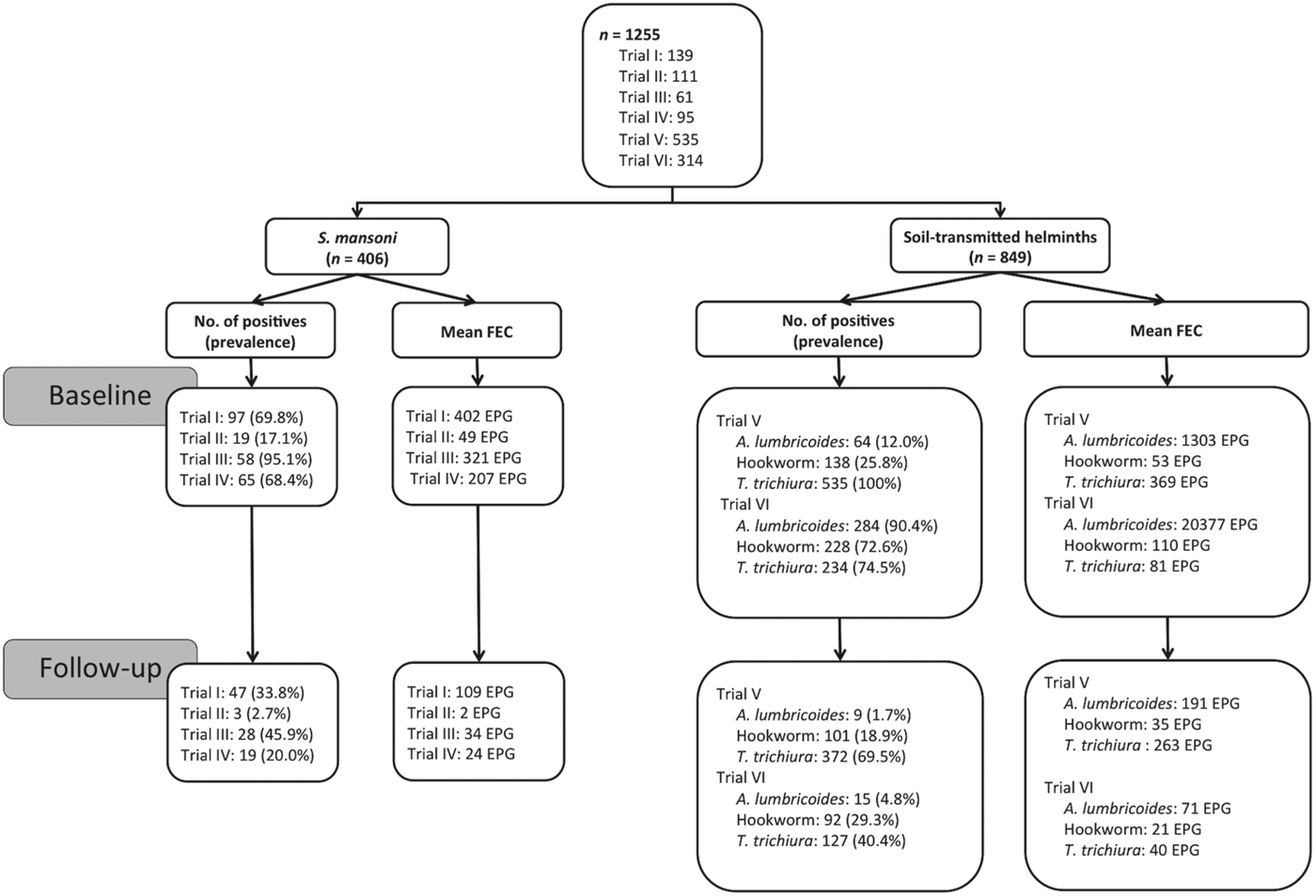
In each trial, the sampling and diagnostic efforts were maximized by examining duplicate Kato-Katz thick smears from each of two consecutive stool samples, at both baseline and treatment follow-up, resulting in eight Kato-Katz thick smears per subject. The number of subjects for whom complete datasets were available, the prevalence and mean FECs both at baseline and treatment follow-up for each of the six trials are summarized in Fig. 1.
Sample size, prevalence and faecal egg counts (FECs) of helminth infections assessed in six drug efficacy trials. The number of schoolchildren, the prevalence and FECs are based on duplicate Kato-Katz thick smears from two consecutive stool samples, both at baseline and treatment follow-up in six drug efficacy trials conducted in Uganda, Unguja island (United Republic of Tanzania) and the People's Republic of China.

Epidemiological survey
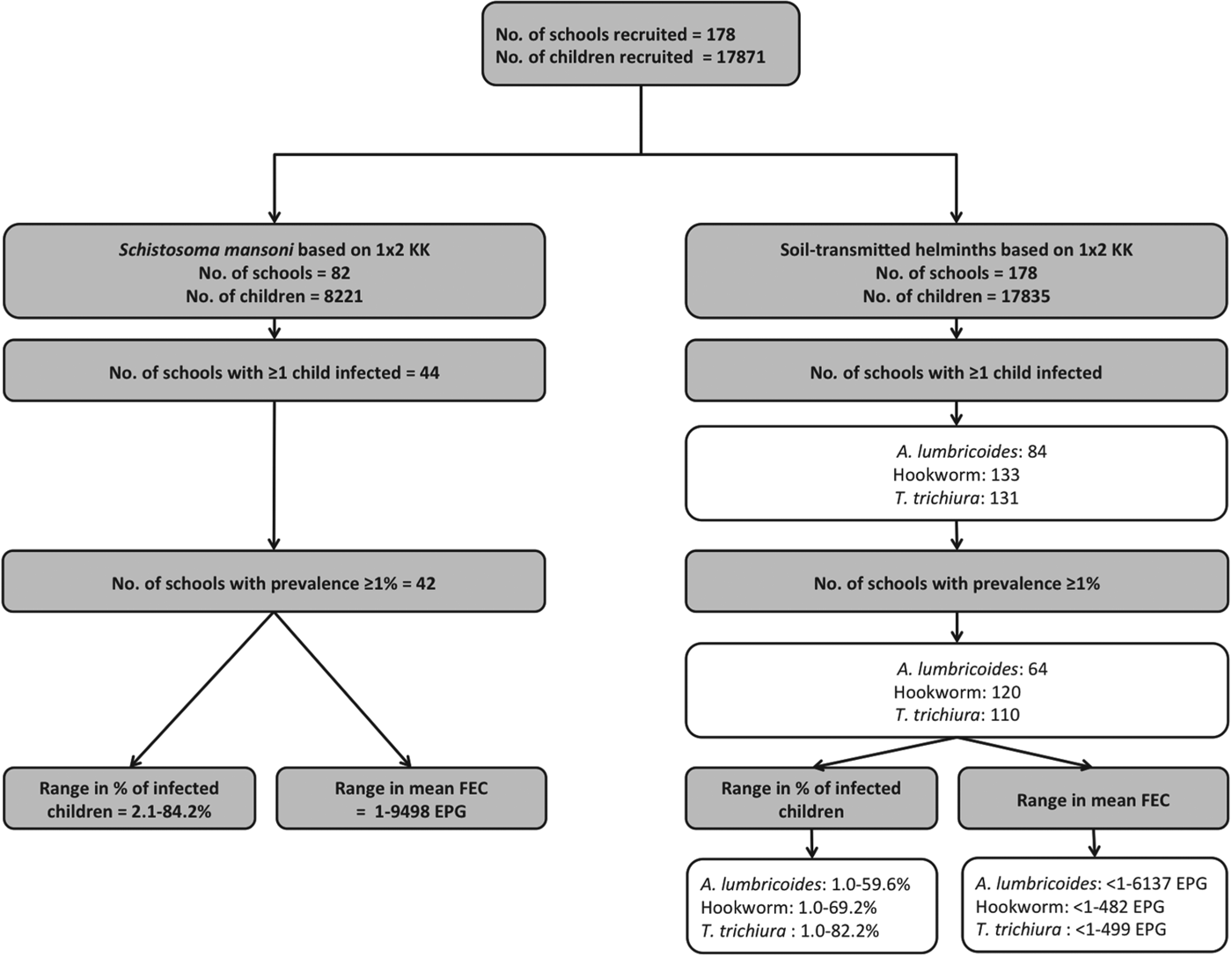
The epidemiological survey included in our analyses was conducted in three countries in East Africa (Ethiopia, Kenya and Uganda). The main objective of this survey was to investigate the distribution and heterogeneity of co-infection with Plasmodium falciparum and helminth species, including S. mansoni and the three STH species. The presence and intensity of these helminth infections were determined by examination of one stool sample per child with duplicate Kato-Katz thick smears. Brooker et al. (Reference Brooker, Pullan, Gitonga, Ashton, Kolaczinski, Kabatereine and Snow2012) describes this epidemiological survey in more detail. We re-analysed the data obtained in Kenya. This dataset has been made publicly available at http://www.thiswormyworld.org and comprises of 17 871 children across 178 schools (median number of children per school; n = 104). Figure 2 summarizes the number of children and schools, and the ranges of prevalence and FEC based on duplicate Kato-Katz thick smears across these schools for each of the four helminth species separately.
Sample size, prevalence and faecal egg counts (FECs) of helminth infections assessed in 178 schools in Kenya. The number of children and schools, and the prevalence and FECs are based on duplicate Kato-Katz thick smears from one stool sample (1×2 KK).
Statistical analysis
Assessment of helminth infection and drug efficacy
First, we performed a meta-analysis to compare prevalence and FEC results according to duplicate Kato-Katz thick smears on two consecutive stool samples (2×2 KK) with those after a single Kato-Katz thick smear on one stool sample (1×1 KK), duplicate Kato-Katz thick smears on one sample (1×2 KK) and a single Kato-Katz thick smear on two consecutive stool samples (2×1 KK). To this end, differences in prevalence and FECs were calculated for each of the three pairwise comparisons (1×1 KK vs 2×2 KK; 1×2 KK vs 2×2 KK; and 2×1 KK vs 2×2 KK) across the six trials (trials I–VI), two time points (baseline and treatment follow-up) and four helminth species (S. mansoni, A. lumbricoides, hookworm and T. trichiura), resulting in 48 estimates for S. mansoni infections (2 metrics×3 comparisons×4 trials×2 time points), and 72 for STH infections (2 metrics×3 comparisons×2 trials×2 time points×3 helminth species).
A 95% confidence interval (CI) taking into account the correlation between the results was calculated for each estimate. For difference in prevalence results, the corresponding 95% CI was determined by a bootstrap analysis (10 000 iterations), as there is no standard formula to calculate the variance of a difference between two dependent proportions. For the difference in FECs, 95% CIs were based on the standard formula for variance of a variable, in casu difference in FEC at the subject level. Finally, two random effect models were built for each metric with the difference in metric as outcome and pairwise comparisons as factor (three levels; 1×1 KK vs 2×2 KK; 1×2 vs 2×2 KK; and 2×1 KK vs 2×2 KK), for S. mansoni and each of the three STH infections.
Second, we performed a meta-analysis to compare CR and ERR between 2×2 KK and 1×1 KK, 1×2 KK, 2×1 KK among subjects who were excreting helminth eggs at baseline based on a single Kato-Katz thick smear. The difference in CR and ERR were calculated for each of the three pairwise comparisons (1×1 KK vs 2×2 KK; 1×2 KK vs 2×2 KK; and 2×1 KK vs 2×2 KK) across the six trials (trials I–VI), and four helminth species (S. mansoni, A. lumbricoides, hookworm and T. trichiura), resulting in 60 estimates (2 metrics×3 comparisons×(4 trials×1 helminth species+2 trials×3 helminth species)). The ERR was calculated based on the formula below (Vercruysse et al. Reference Vercruysse, Behnke, Albonico, Ame, Angebault, Bethony, Engels, Guillard, Nguyen, Kang, Katulla, Kotze, McCarthy, Mekonnen, Montresor, Periago, Tchuem Tchuenté, Dang, Zeynudin and Levecke2011).
 $${\rm ERR =} \displaystyle{\eqalign{&{\rm arithmetic}\,{\rm mean}\ \cr &({\rm baseline}\,{\rm FEC})} - \eqalign {&{\rm arithmetic}\,{\rm mean}\ \cr &({\rm follow \hbox{\mbox-} up}\,{\rm FEC})} \over {{\rm arithmetic}\,{\rm mean\ }({\rm baseline}\,{\rm FEC})}}$$
A 95% CI taking into account the correlation between results was calculated for each estimate based on bootstrap analysis (10 000 iterations), because analogously to prevalence there is no standard formula to calculate the variance of a difference in two dependent CR and ERR results. Finally, one random effect model was built for each drug efficacy metric with the difference in the metric as outcome and the pairwise comparisons (three levels: 1×1 KK vs 2×2 KK; 1×2 KK vs 2×2 KK; and 2×1 KK vs 2×2 KK) as factor. Due to the limited number of trials, the drug efficacy results of S. mansoni and STH infections were combined. The level of significance was set at P<0·05. The meta-analysis was performed using the statistical software R ‘metafor’ package (Viechtbauer, Reference Viechtbauer2010).
Assessment of helminth infection across three levels of endemicity
We performed a meta-analysis to compare prevalence and FEC results according to 1×2 KK with those after 1×1 KK. To this end, differences in prevalence and FEC were calculated across the different schools and four helminth species (S. mansoni, A. lumbricoides, hookworm and T. trichiura). However, we only included schools for which the prevalence was at least 1%, resulting in 84 estimates for S. mansoni, 128 for A. lumbricoides, 240 for hookworm and 220 for T. trichiura infections. A 95% CI taking into account the correlation between the results was calculated for each estimate as described above.
To assess the impact of diagnostic effort across varying levels of endemicity, we classified the schools into three levels of endemicity based on the helminth prevalence obtained by 2×1 KK. For each of the four helminths, schools were classified into ‘low endemic’ when prevalence ranged from ⩾1 to <10%, into ‘moderate endemic’ when prevalence ranged from ⩾10 to <20% and into ‘high endemic’ when the prevalence was ⩾20%. These thresholds defining endemicity are largely based on the prevalence values applied to determine the frequency of PC recommended by WHO, including 1, 10, 20 and 50% (WHO, 2011). However, we did not use the 50% threshold, as only a few schools had a prevalence that exceeded 50%. Finally, two random effect models were built for prevalence and FEC with the difference in these metrics at the school level as outcome and the level of endemicity as factor (three levels: low, moderate and high), for S. mansoni and the three STH species separately. The level of significance was set at P<0·05. The meta-analysis was performed using the statistical software R ‘metafor’ package (Viechtbauer, Reference Viechtbauer2010).
Ethical approval
The four trials assessing the efficacy of PZQ against S. mansoni were approved by the London School of Hygiene and Tropical Medicine (London, UK; application no. LSHTM 5538.09) and the Ugandan National Council of Science and Technology. The trial assessing the efficacy of ALB and MEB alone or in combination with IVM against STH infections in Zanzibar was approved by the ‘Ethikkommission beider Basel’ (EKBB, Basel, Switzerland; reference no. 13/09) and the Zanzibar Medical Research Ethical Committee of the Ministry of Health (ZAMEC/0001/09). This trial is registered with Current Controlled Trials (ISRCTN08336605). The trial comparing the efficacy of single-dose and triple-dose ALB and MEB against STH infections in the People's Republic of China was approved by EKBB (reference no. 294/08) and the Academic Board of the National Institute of Parasitic Diseases, Chinese Center for Disease Control and Prevention in Shanghai (reference no. 2008091701). This trial is registered with Current Controlled Trials (ISRCTN47375023). The epidemiological survey conducted in Kenya received ethical approval from the ethics review committees of Kenya Medical Research Institute.
RESULTS
Assessment of helminth infection and drug efficacy
Helminth infection
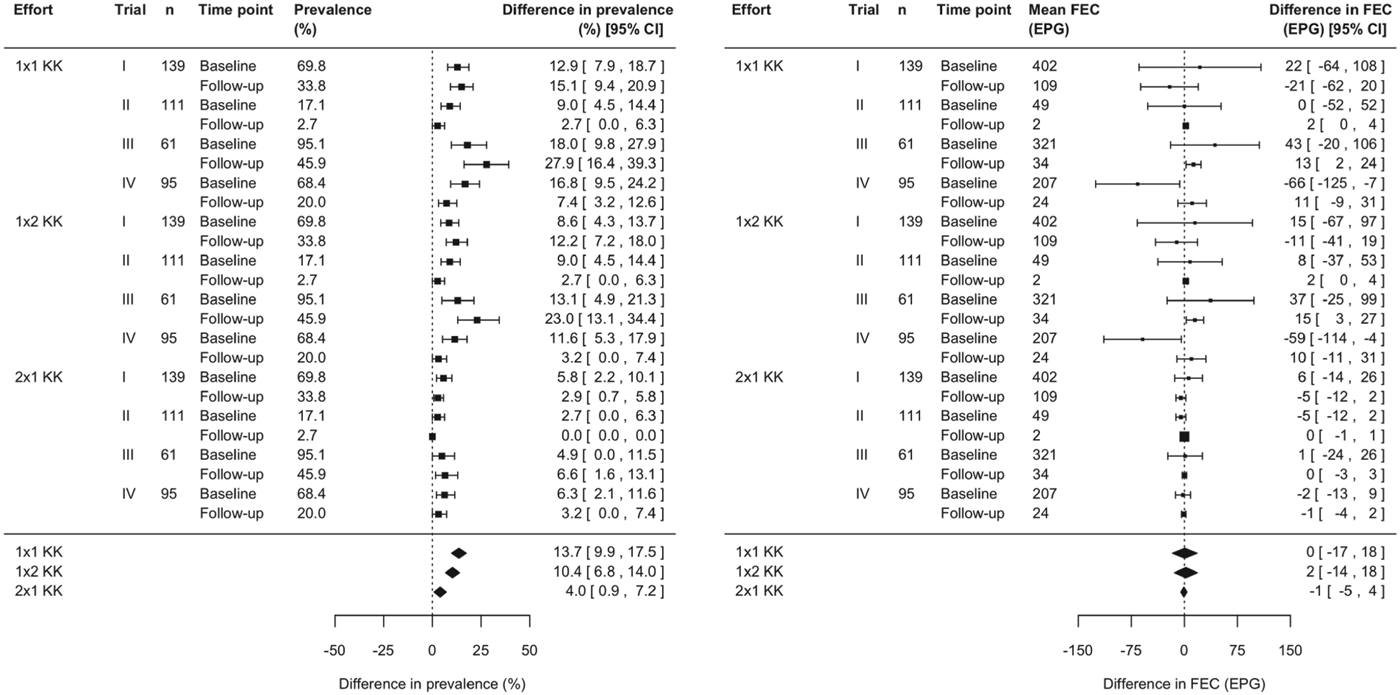
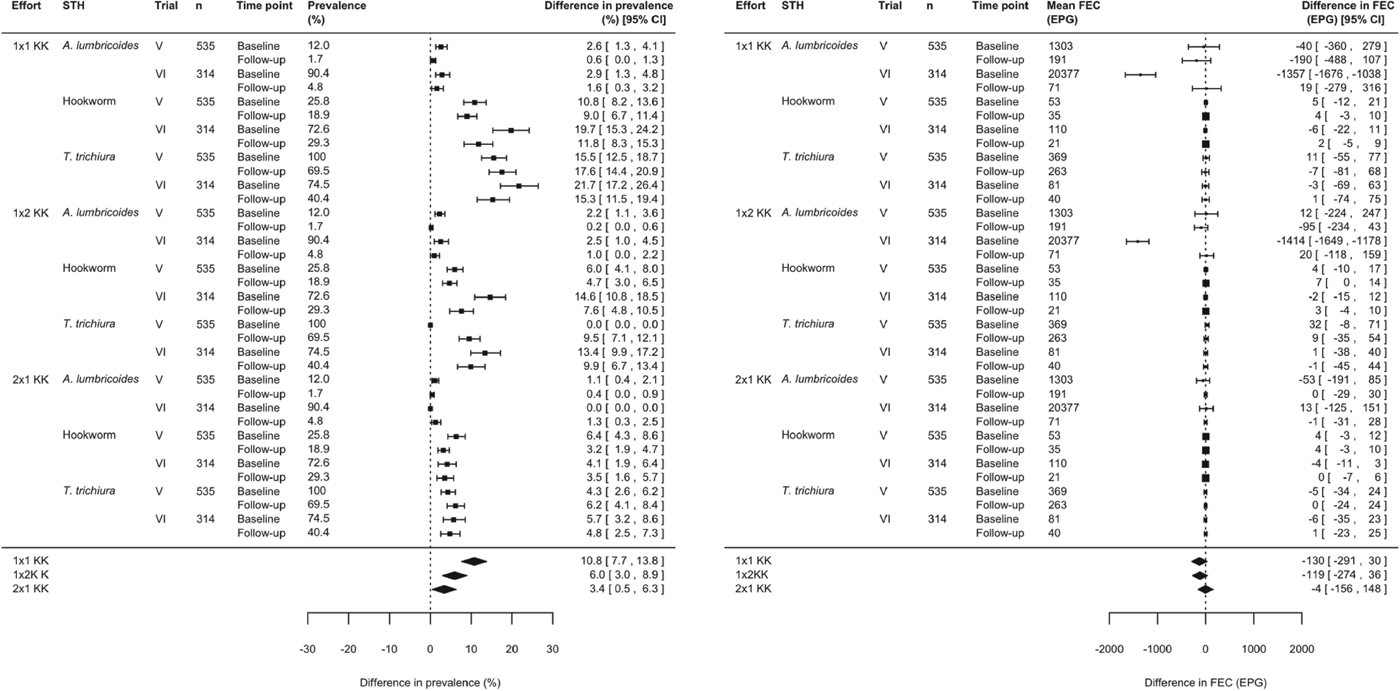
Figures 3 and 4 summarize the results of the meta-analysis of differences in prevalence and FECs across the three pairwise comparisons for S. mansoni and STH infections, respectively. When referring to prevalence, there was a significant under-estimation (lower limit of 95% CI>0) of both S. mansoni and STH prevalence between 2×2 KK and 1×1 KK, 1×2 KK or 2×1 KK, respectively. This difference in prevalence compared with 2×2 KK increased as a function of reduced sampling and diagnostic efforts for both S. mansoni and STH infections. For S. mansoni infections, the respective difference was 4·0% (95% CI: 0·9; 7·2%, P = 0·014) for 2×1 KK, 10·4% (95% CI: 6·8; 14·0%, P<0·001) for 1×2 KK and 13·7% (95% CI: 9·9; 17·5%, P<0·001) for 1×1 KK. For STH infections, the difference was 3·4% (95% CI: 0·5; 6·3%, P = 0·002), 6·0% (95% CI: 3·0; 8·9%, P<0·001) and 10·8% (95% CI: 7·7; 13·8%, P<0·001) for 2×1 KK, 1×2 KK and 1×1 KK, respectively.
The effect of sampling and diagnostic efforts on the assessment of Schistosoma mansoni infection. Forest plots comparing the prevalence and faecal egg count (FEC) results for S. mansoni between a single Kato-Katz thick smear from one stool sample (1×1 KK), duplicate Kato-Katz thick smears from one sample (1×2 KK) and a single Kato-Katz thick smear from two consecutive stool samples (2×1 KK) with those based on duplicate Kato-Katz thick smears from two consecutive stool samples (2×2 KK) on all subjects both at baseline and treatment follow-up (n = 406).
The effect of sampling and diagnostic efforts on the assessment of soil-transmitted helminth infection. Forest plots comparing the prevalence and faecal egg count (FEC) results for soil-transmitted helminth infections (Ascaris lumbricoides, hookworm and Trichuris trichiura) between a single Kato-Katz thick smear from one stool sample (1×1 KK), duplicate Kato-Katz thick smears from one sample (1×2 KK), and a single Kato-Katz thick smear from two consecutive stool samples (2×1 KK) with those based on duplicate Kato-Katz thick smears from two consecutive stool samples (2×2 KK) on all subjects both at baseline and treatment follow-up (n = 849).
When summarizing infection intensity as FEC, there was no significant difference in FEC for 1×1 KK, 1×2 KK and 2×1 KK compared with 2×2 KK for both S. mansoni and STH infections. For S. mansoni infection, the difference was 0 eggs per 1 g of stool (EPG) (95% CI: −17; 18 EPG, P = 0·96) for 1×1 KK, 2 EPG (95% CI: −14; 18 EPG, P = 0·80) for 1×2 KK and −1 EPG (95% CI: −5; 4 EPG, P = 0·74) for 2×1 KK. For STH infections, the difference was −130 EPG (95% CI: −291; 30 EPG, P = 0·11) for 1×1 KK, −119 EPG (95% CI: −274; 36 EPG, P = 0·13) for 1×2 KK and −4 EPG (95% CI: −156; 148 EPG, P = 0·95) for 2×1 KK.
Drug efficacy
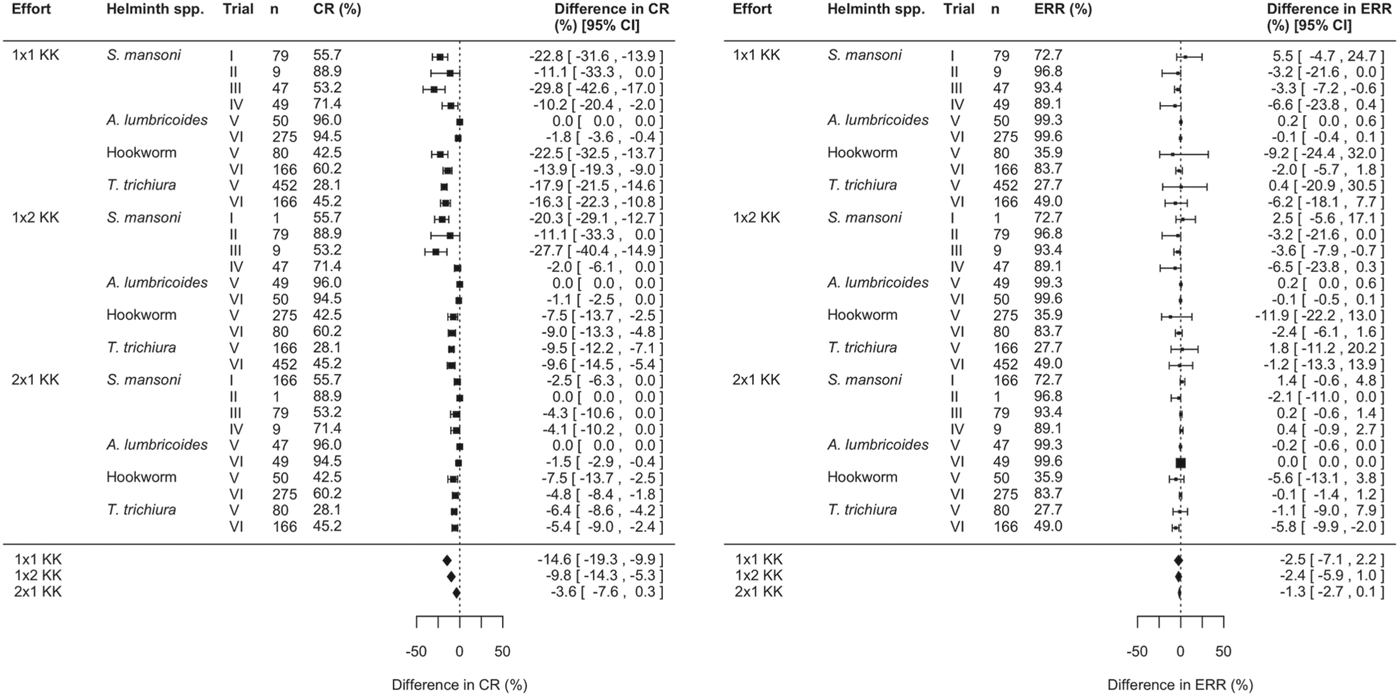
Figure 5 summarizes the differences in CR and ERR for the three pairwise comparisons for S. mansoni and STH infections combined. When referring to drug efficacy by CR, there was an overall over-estimation (difference<0) of CR between 2×2 KK and 1×1 KK, 1×2 KK, or 2×1 KK. However, the difference in CR compared with 2×2 KK decreased in function of reduced sampling and diagnostic effort, ranging from a marginal non-significant difference of −3·6% (95% CI: −7·6; 0·3%, P = 0·069) for 2×1 KK, over an already significant difference of −9·8% (95% CI: −14·3; −5·3%, P<0·001) for 1×2 KK to a highly significant difference of −14·6% (95% CI: −19·3; −9·9%, P<0·001) for 1×1 KK. When summarizing changes in infection as ERR, there was no significant difference in ERR compared to 2×2 KK for 1×1 KK (−2·5 [95% CI: −7·1; 2·2], P = 0·31), 1×2 KK (−2·4 [95% CI: −5·9; 1·0], P = 0·17), and 2×1 KK (−1·3 [95% CI: −2·7; 0·1], P = 0·077).
The effect of sampling and diagnostic efforts on the reported drug efficacy against helminth infections. Forest plot comparing the cure rate (CR) and egg reduction rate (ERR) results against Schistosoma mansoni and soil-transmitted helminth infections (Ascaris lumbricoides, hookworm and Trichuris trichiura) between a single Kato-Katz thick smear on one stool sample (1×1 KK), duplicate Kato-Katz thick smears on one sample (1×2 KK), and a single Kato-Katz thick smear on two consecutive stool samples (2×1 KK) with those based on duplicate Kato-Katz thick smears on two consecutive stool samples (2×2 KK) on all subjects found to excrete eggs using a single Kato-Katz thick smear (n = 939).
Assessment of helminth infection across three levels of endemicity
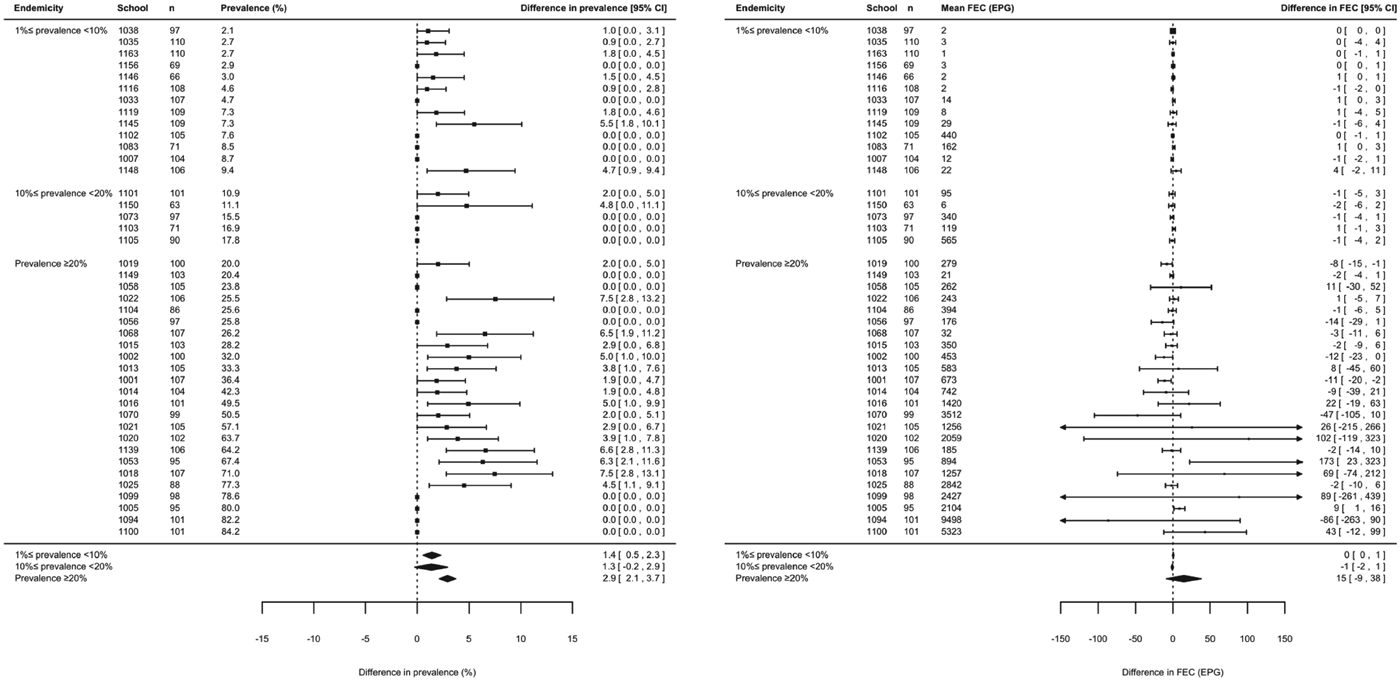
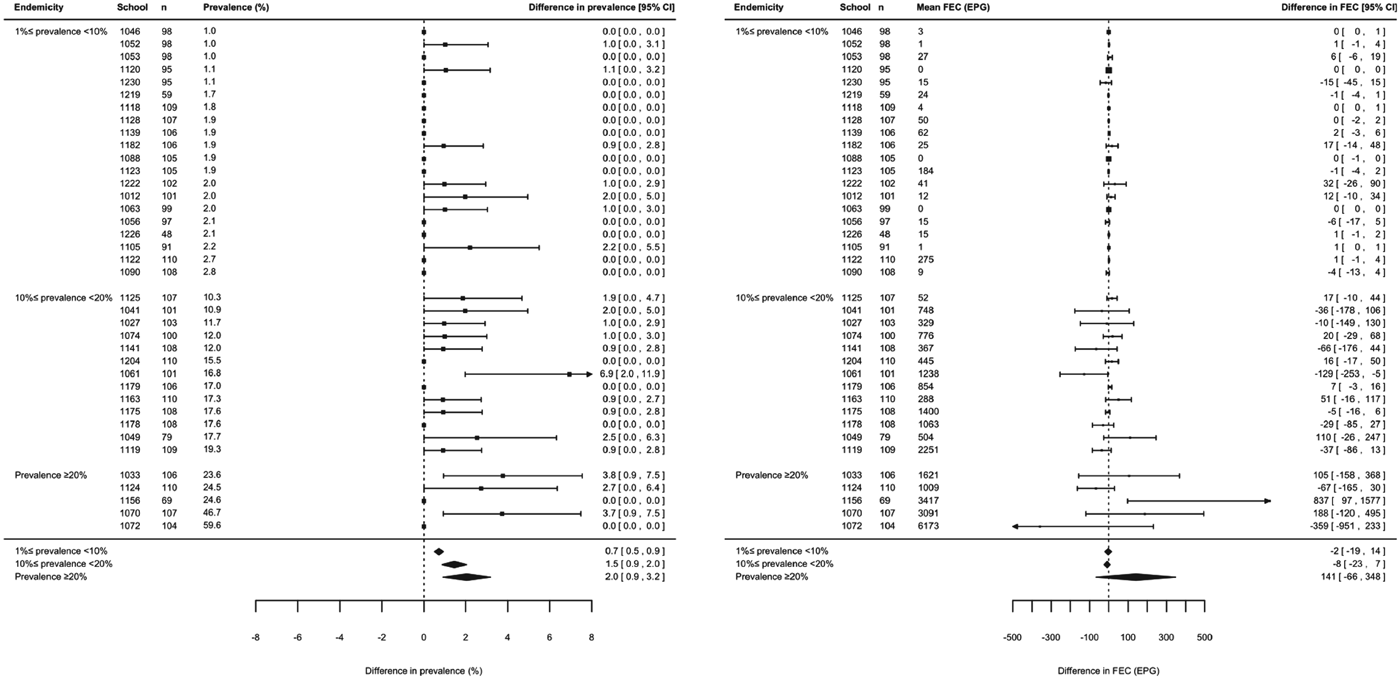
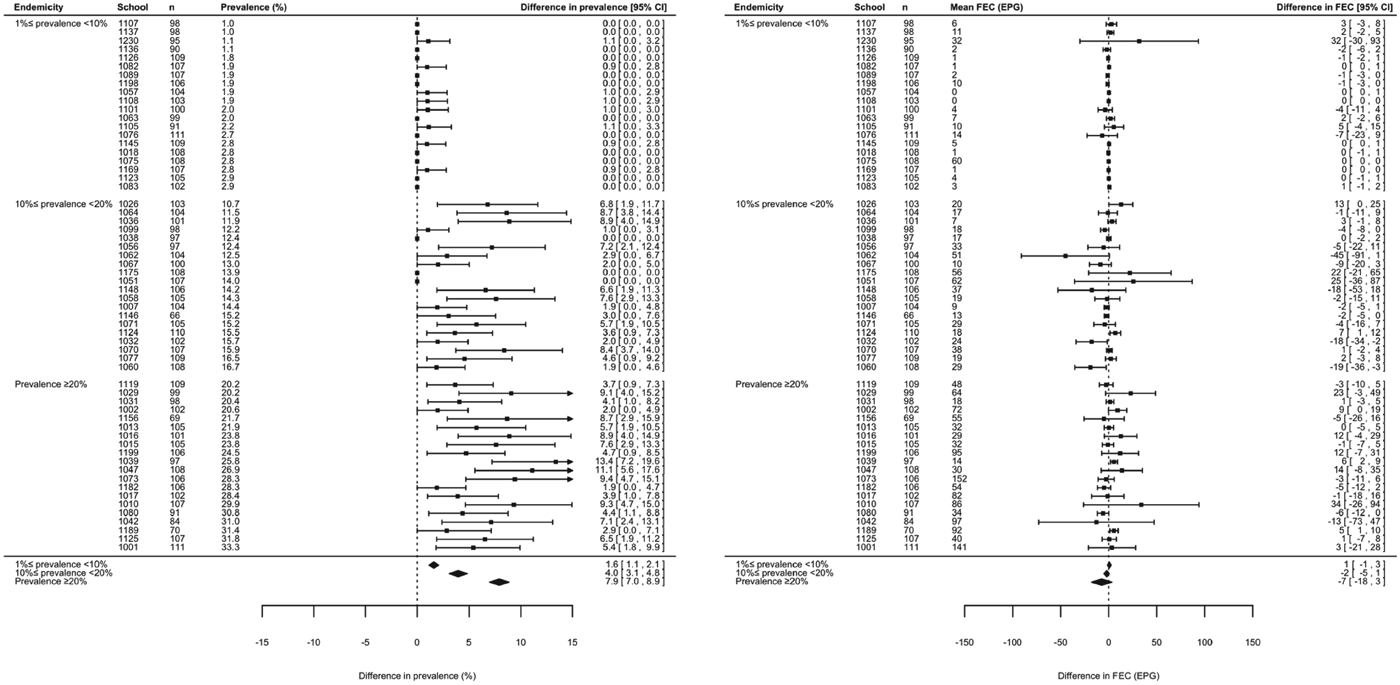
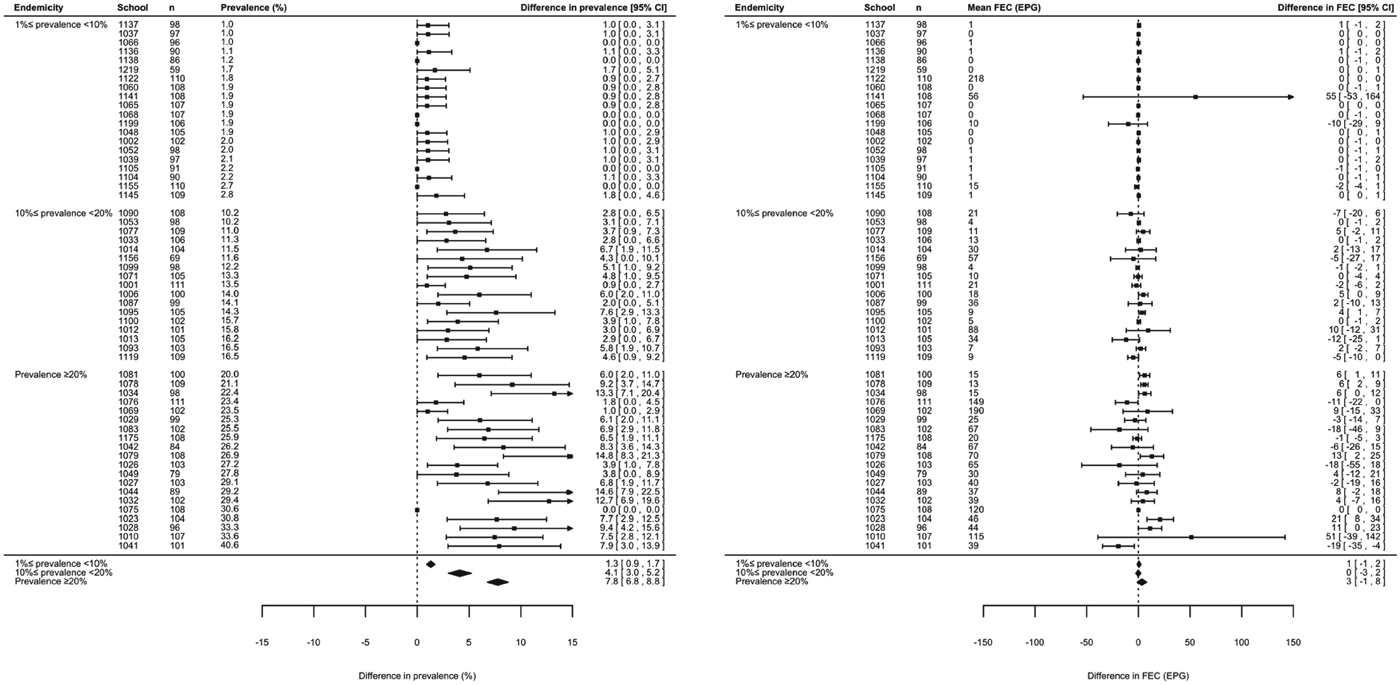
Figures 6 to 9 summarize the results of the meta-analysis of differences in prevalence and FECs across the three levels of endemicity for S. mansoni, A. lumbricoides, hookworm and T. trichiura infections, respectively. When referring to prevalence, there was significant under-estimation for S. mansoni infections in low (+1·4% [95% CI: +0·5; +2·3%], P = 0·001) and high endemic schools (+2·9% [95% CI: +2·1; +3·7%], P<0·001), but not in the moderate endemic schools (+1·3% [95% CI: −0·2; +2·9%], P = 0·096). For the STH species there was a significant under-estimation (lower limit of 95% CI>0) at the three levels of endemicity for each of the three STH species. For these helminth species the difference in prevalence compared with 1×2 KK also increased as a function of increasing levels of endemicity. For A. lumbricoides infections, the difference was +0·7% (95% CI: +0·5; +0·9%, P<0·001) for low endemic schools, +1·5% (95% CI: +0·9; +2·0%, P<0·001) for moderate endemic schools and +2·0% (95% CI: +0·9; +3·2%, P<0·001) for high endemic schools. For hookworm and T. trichiura, this difference was +1·3% (95% CI: +0·9; +1·7%, T. trichiura, P<0·001) and +1·6% (95% CI: +1·1; +2·1%, hookworm, P<0·001) for low endemic schools, +4·0% (95% CI: +3·1; +4·8%, hookworm, P<0·001) and +4·1% (95% CI: +3·0; +5·2%, T. trichiura, P<0·001) for moderate endemic schools, and +7·8% (95% CI: +6·8; +8·8%, T. trichiura, P<0·001) and +7·9% (95% CI: +7·0; +8·9%, hookworm, P<0·001) for high endemic schools.
The effect of diagnostic efforts on the assessment of three levels of Schistosoma mansoni infection. Forest plots comparing the prevalence and faecal egg count (FEC) results for S. mansoni between a single Kato-Katz thick smear from one stool sample (1×1 KK) with those obtained by duplicate Kato-Katz thick smears from one sample (1×2 KK) across three levels of endemicity (low: 1% ⩽ prevalence <10%, moderate: 10% ⩽ prevalence <20%, high: prevalence ⩾20%) (n = 4114).
The effect of diagnostic efforts on the assessment of three levels of Ascaris lumbricoides infection. Forest plots comparing the prevalence and faecal egg count (FEC) results for A. lumbricoides between a single Kato-Katz thick smear from one stool sample (1×1 KK) with those obtained by duplicate Kato-Katz thick smears from one sample (1×2 KK) across three levels of endemicity (low: 1% ⩽ prevalence <10%, moderate: 10% ⩽ prevalence <20%, high: prevalence ⩾20%). Due to the high number of schools for which prevalence ⩾1% (n = 64), we only present 20 out of 46 schools classified as low endemic, all 13 schools classified as moderate and all five schools classified as high endemic. The estimated difference in prevalence and infection intensity for each level of endemicity, however are based on all 64 schools (n = 6372).
The effect of diagnostic efforts on the assessment of three levels of hookworm infection. Forest plots comparing the prevalence and faecal egg count (FEC) results for hookworm between a single Kato-Katz thick smear from one stool sample (1×1 KK) with those obtained by duplicate Kato-Katz thick smears from one sample (1×2 KK) across three levels of endemicity (low: 1% ⩽ prevalence <10%, moderate: 10% ⩽ prevalence <20%, high: prevalence ⩾20%). Due to the high number of schools for which prevalence ⩾1% (n = 120), we only present 20 out of 56 schools classified as low endemic, 20 out of 27 schools classified as moderate and 20 out of 37 schools classified as high endemic. The estimated difference in prevalence and infection intensity for each level of endemicity, however are based on all 120 schools (n = 12 217).
The effect of diagnostic efforts on the assessment of three levels of Trichuris trichiura infection. Forest plots comparing the prevalence and faecal egg count (FEC) results for T. trichiura between a single Kato-Katz thick smear from one stool sample (1×1 KK) with those obtained by duplicate Kato-Katz thick smears from one sample (1×2 KK) across three levels of endemicity (low: 1% ⩽ prevalence <10%, moderate: 10% ⩽ prevalence <20%, high: prevalence ⩾20%). Due to the high number of schools for which prevalence ⩾1% (n = 110), we only present 20 out of 62 schools classified as low endemic, all 17 schools classified as moderate and 20 out of 31 schools classified as high endemic. The estimated difference in prevalence and infection intensity for each level of endemicity, however are based on all 110 schools (n = 11 067).
When summarizing infection intensity as mean FEC at the school level, there was no significant difference in FEC for 1×1 KK compared with 1×2 KK at the three levels of endemicity for each of the four helminth species (95% CI includes zero). There was no increase in difference as a function of increasing level of endemicity. For S. mansoni the difference varied from −1 EPG (95% CI: −2; +1 EPG, P = 0·30) for moderate endemic schools to 15 EPG (95% CI: −9; +38 EPG, P = 0·22) for high endemic schools. For A. lumbricoides infection the difference in FEC ranged from −8 EPG (95% CI: −23; +7 EPG, P = 0·30) for moderate endemic schools to 141 EPG (95% CI: −66; +348 EPG, P = 0·18) for high endemic schools. For hookworm the difference in FEC varied from −7 EPG (95% CI: −18; +3 EPG, P = 0·18) for high endemic schools to 1 EPG (95% CI: −1; +3 EPG, P = 0·54) for low endemic schools. For T. trichiura this difference ranged from 0 EPG (95% CI: −3; +2 EPG, P = 0·55) for moderate endemic schools to 3 EPG (95% CI: −1; +8 EPG, P = 0·14) for high endemic schools.
DISCUSSION
In the present study we determined the effect of sampling and diagnostic efforts on qualitative (prevalence and CR) and quantitative (FEC and ERR) metrics applied to characterize outcomes of anthelmintic drug administration targeting S. mansoni and STH infections. Our results support a prior hypothesis that maximizing stool sampling and diagnostic effort increases the accuracy of qualitative metrics (Knopp et al. Reference Knopp, Speich, Hattendorf, Rinaldi, Mohammed, Khamis, Mohamemed, Albonico, Rollinson, Marti, Cringoli and Utzinger2011; Utzinger et al. Reference Utzinger, N'Goran, Caffrey and Keiser2011), but does not influence the accuracy of quantitative metrics.
Our findings therefore indicate that summarizing helminth infection intensity and drug efficacy by means of FEC and ERR based on a single Kato-Katz thick smear before and after treatment, rather than by prevalence and CR, is as reliable as a more rigorous diagnostic approach. This observation has important ramifications and could translate into substantial cost savings. For example, Speich and colleagues estimated the total cost to perform single or duplicate Kato-Katz thick smears in the frame of an epidemiological study to be US$ 1·73 and 2·06, respectively (Speich et al. Reference Speich, Knopp, Mohammed, Khamis, Rinaldi, Cringoli, Rollinson and Utzinger2010). By extrapolation one can deduce that maximizing sampling and diagnostic efforts (in casu quadruplicate Kato-Katz thick smears based on two stool samples) would cost US$ 4·12 (2×US$ 2·06). To assess helminth infection in 100 subjects in one school by an experienced team, one would thus need to allocate US$ 173 when summarizing infection intensity by means of FEC (single Kato-Katz thick smear), whereas US$ 412 would be needed for a more rigorous sampling and diagnostic work-up with quadruplicate Kato-Katz thick smears to more accurately determine the local prevalence. In other words, the same funds would support the screening of 2·38 (=412/173) times more subjects when summarizing infection intensity by FEC rather than CR. Also, note that these estimates do not include the additional time required for data entry, and hence are likely to be under-estimated. Screening a larger number of subjects without compromising diagnostic accuracy would allow the inclusion of more schools across different geographical locations, and hence improve the precision of helminth disease mapping and prediction. This is particularly important given the large endemic areas and the focal distribution of these diseases (Brooker et al. Reference Brooker, Hotez and Bundy2010; Hürlimann et al. Reference Hürlimann, Schur, Boutsika, Stensgaard, Laserna de Himpsl, Ziegelbauer, Laizer, Camenzind, Di Pasquale, Ekpo, Simoonga, Mushinge, Saamak, Utzinger, Kristensen and Vounatsou2011; Pullan and Brooker, Reference Pullan and Brooker2012). Our data also indicate that minimizing sampling and diagnostic effort is justified even in low-endemicity settings. Together with the fact that qualitative metrics impede interpretation of the long-term impact of PC and drug efficacy (Vercruysse et al. Reference Vercruysse, Behnke, Albonico, Ame, Angebault, Bethony, Engels, Guillard, Nguyen, Kang, Katulla, Kotze, McCarthy, Mekonnen, Montresor, Periago, Tchuem Tchuenté, Dang, Zeynudin and Levecke2011; Anderson et al. Reference Anderson, Hollingsworth, Truscott and Brooker2012), we would like to encourage reporting of FEC and ERR in investigations describing the long-term impact of PC campaigns. Current WHO guidelines on the control of schistosomiasis and soil-transmitted helminthiasis are primarily based on prevalence, and hence FEC thresholds corresponding to the set prevalence thresholds will need to be developed if reporting should shift from infections towards FEC (WHO, 2011). Moreover, such FEC thresholds corresponding to prevalence will need to be developed for each of the three STH species separately (current thresholds are based on the prevalence of any STH) as fecundity of adult worms varies considerably from one species to another (A. lumbricoides >> hookworm > T. trichiura; Bethony et al. Reference Bethony, Brooker, Albonico, Geiger, Loukas, Diemert and Hotez2006). Hence, a fixed FEC threshold for all STH is inappropriate. For drug efficacy monitoring, CR remains the most reported metric (Keiser and Utzinger, Reference Keiser and Utzinger2008; Danso-Appiah et al. Reference Danso-Appiah, Olliaro, Donegan, Sinclair and Utzinger2013), but the WHO recently published new guidelines on how to assess and interpret anthelmintic drug efficacy based on ERR (WHO, 2013).
CONCLUSIONS
This study indicates that sampling and diagnostic efforts can be minimized to a single Kato-Katz thick smear if, and only if, helminth infection and drug efficacy are reported by means of both FEC and ERR. This however, implies a need for species-specific thresholds based on FEC corresponding to prevalence to determine the frequency of drug administration as outlined in WHO guidelines to control schistosomiasis and soil-transmitted helminthiasis.
ACKNOWLEDGEMENTS
We would like to thank the Neglected Tropical Diseases Control team of the Helminth Control Laboratory Unguja for their excellent and dedicated work in the field and laboratory in Zanzibar. We would also like to thank the team from the Vector Control Disease, Ministry of Health of Uganda, as well as Dr Martha Betson for their invaluable efforts during the field surveys in Uganda.
FINANCIAL SUPPORT
B.L. is a postdoctoral fellow of the Fund for Scientific Research-Flanders (Belgium) (F.W.O.-Vlaanderen, grant no. FWO12/PDO/099). S.J.B. is supported by a Wellcome Trust Senior Fellowship in Basic Biomedical Science (098045). S.K. acknowledges financial support from the Schistosomiasis Consortium for Operational Research and Evaluation (SCORE; sub-award no. RR374-053/4893196). S.K. and J.U. are grateful for partial financial support by the NIDIAG network (collaborative project; www.NIDIAG.org) supported by the European Commission under the Health Cooperation Work Programme of the 7th Framework Programme (grant agreement no. 260260). J.R.S. and S.C.S.-F. acknowledge financial support from the Wellcome Trust (grant no. 085440 entitled ‘SIMI: schistosomiasis in mothers and infants’).