

I. CONVERGENCE IN TAKEOVER REGULATION
There has been a significant focus by corporate law scholars on seeking to explain the substantial differences in corporate takeover regulation around the world.Footnote 1 This work is important as it facilitates better understanding of this regulation and its underlying principles. It highlights different regulatory choices and challenges the idea that there is a single best practice. Such analysis is also of importance because the prevalence of cross-border transactions suggests the harmonization of regulatory systems to reduce transaction costs.
Under conventional corporate governance theory, the primary role of takeovers is to provide a mechanism for a change in control of a company to allow the target company to be operated by the acquirer (or bidder) more efficiently.Footnote 2 Accordingly, the threat of takeover is believed to create an incentive for company directors and management to maximize the share price to avoid becoming a takeover target, given that they are likely to lose their positions if a takeover proceeds.Footnote 3 This creates a conflict of interest, given that the target company's directors will be in the best position to advise target shareholders on the merits of a takeover bid.Footnote 4 The other key conflict arises from the opposing aims of the bidder and target company's shareholders with respect to the price paid for the shares, and the amount of information provided. Corporate takeover regulatory regimes typically focus on balancing these conflicting interests.Footnote 5
Around the world, the starkest disparities arise in the takeover regulatory regimes in the United States and the United Kingdom, and consequently other jurisdictions that have adopted elements of these systems. The US regulatory system relies primarily on courts to ensure that the target company's directors comply with their duties to the company.Footnote 6 This approach generally involves acquirers negotiating with the target company's directors to remove the operation of takeover defences, so that the takeover can proceed.Footnote 7 In contrast, the UK has a self-regulatory system centred upon its Panel on Takeovers and Mergers (‘the UK Panel’).Footnote 8 The UK system has a clear focus on investor protection, which is reflected in the detailed rules and underlying General Principles in The City Code on Takeovers and Mergers (‘the UK Code’).Footnote 9 Both Hong Kong and Singapore have implemented a Takeover Code similar to the UK Code.Footnote 10 They have similarly set up a Takeover Panel to enforce these Codes, namely the Takeovers and Mergers Panel in Hong Kong (‘the Hong Kong Panel’)Footnote 11 and the Securities Industry Council in Singapore (‘the Singapore Panel’).Footnote 12
Armour and Skeel have focused on the influence of particular interest groups in their examination of the development of the divergent US and UK takeover regulatory systems.Footnote 13 This scholarship, based on the political economies in those jurisdictions, identified the crucial role of company management in the US, and institutional shareholders in the UK, in shaping their respective regulatory regimes.Footnote 14 This analysis was further developed by Armour, Skeel, and Milhaupt to inform understanding of developments in other jurisdictions, particularly Japan, China, India, and Brazil.Footnote 15 The authors concluded that ‘that many countries around the world have arrived at a rough form of functional convergence on takeover rules, although by highly divergent paths’.Footnote 16
Recent scholarship has examined the distinctive regulatory approaches to takeover regulation adopted in key Asian jurisdictions.Footnote 17 In a further development, Varottil and Wan have applied Armour and Skeel's analysis in a study of six significant economies in Asia, namely China, Hong Kong, Japan, India, Korea, and Singapore.Footnote 18 This study found that the takeover regulatory regimes in those jurisdictions had features from the UK, the US, or both,Footnote 19 which had been adapted in light of local conditions.Footnote 20 Varottil and Wan expanded upon Armour and Skeel's analysis in the Asian context through their identification of the impact of the significant roles played by controlling shareholders in each of those jurisdictions (except Japan) and the state.Footnote 21 They found that the influence of these interest groups has led to different regulatory outcomes in jurisdictions following similar approaches,Footnote 22 resulting in ‘the existence of formal convergence of regulation without necessarily extending to functional convergence’.Footnote 23
The distinction between formal and functional convergence in corporate regulation was first developed by Gilson, who examined the difference between these concepts in the context of the adaptivity of corporate governance systems.Footnote 24 Gilson's conception of formal and functional convergence focuses on the ways in which systems achieve convergence over time.Footnote 25 Formal convergence is consequently defined in terms of structural changes to systems, in contrast to functional convergence, where existing institutions adapt to circumstances without such changes.Footnote 26 Functional convergence has also been defined as involving ‘similar outcomes irrespective of institutional differences’.Footnote 27 Gilson noted in his analysis that functional convergence is likely to be the first response, given the costs of structural changes.Footnote 28
There has been considerable debate concerning the extent of convergence in corporate law generally. On the one hand, it has been argued that corporate governance regimes would, over time, converge along the lines of the Anglo-American models (the pro-convergence argument).Footnote 29 Countervailing arguments, on the other hand, have focused on the extent to which variations in corporate law regimes are driven primarily by a jurisdiction's common law or civil law origins (the ‘law matters’ argument),Footnote 30 or whether there are other structural or rule-based factors that place a jurisdiction on a particular regulatory path (the ‘path dependence’ argument).Footnote 31 This debate has continued with a subsequent focus on the extent to which differences in corporate law regimes have persisted notwithstanding the pro-convergence argument.Footnote 32 Takeover regulation poses a significant challenge to this argument, given that there is significant divergence in the approaches between the Anglo-American models themselves.Footnote 33 Notwithstanding this, Davies has pointed out similarities in the practical operation of the rules affecting the role of the target company's management in the face of a hostile bid in these jurisdictions.Footnote 34 The scholarship on convergence is also important in understanding the development of takeover regulation, particularly in circumstances where there has been transplantation of models into other jurisdictions.Footnote 35
The existing scholarship on takeover regulation in Asian jurisdictions has not assessed levels of convergence in relation to the Hong Kong and Singapore Panels. As discussed above, Varottil and Wan have drawn conclusions in relation to the levels of convergence in takeover regulation generally across key jurisdictions, including Hong Kong and Singapore.Footnote 36 Other comparative research has examined the divergent approaches in Hong Kong and Singapore in relation to the squeeze-out mechanisms allowing controlling shareholders to obtain 100 per cent control of the company.Footnote 37 On the other hand, the important work to date examining the development of takeover regulation in Hong Kong and Singapore since its transplantation from the UK has not focused on the issue of convergence.Footnote 38 Similarly, there has been comparative research providing a methodology for assessing the performance of Takeover Panels,Footnote 39 as well as research focusing on issues arising from the overlapping jurisdiction between the courts and the Takeover Panels in Hong Kong, Singapore, and the UK.Footnote 40
This article further develops the existing literature by examining the extent to which the transplantation of the UK Panel model into the Hong Kong and Singapore regulatory systems has resulted in formal and/or functional convergence between these systems. The article draws conclusions based on the current approaches in the regulatory systems,Footnote 41 rather than focusing on the changes that have occurred over time. The latter approach is beyond the scope of this article but would be a useful extension of existing research, by focusing on the extent to which regulation in these systems converged over time. In relation to formal convergence, the article assesses the differences in the structure of the Panels, with particular emphasis on their independence, role, and powers, and the systems of review of decision-making. On the other hand, functional convergence is examined both in the context of the Panels’ decisions and the processes used to make these decisions. It can be difficult to draw a bright line between formal and functional convergence in relation to the Panels’ procedures. This article categorizes as functional those procedures relating to the way in which the Panels operate in practice (in particular, the procedures relating to hearings and those dealing with conflicts of interest).
The analysis in this article raises significant questions in light of Varottil and Wan's observation that there has been formal convergence, but not functional convergence, in relation to takeover regulation in these jurisdictions generally.Footnote 42 This research is, therefore, important for two reasons. First, it deepens understanding of the differences between the regulatory systems that have been transplanted in these two Asian jurisdictions. The regulatory approaches adopted in Hong Kong and Singapore are particularly significant for takeover regulation, given that they are the leading financial centres in Asia.Footnote 43 Secondly, the article provides criteria for determining formal convergence that can be used in relation to other Takeover Panels around the world that are based on the UK model.Footnote 44
Part II of this article provides the foundation for the analysis by setting out the key features of the Takeover Panels operating in Hong Kong, Singapore, and the UK. In Part III, the level of formal convergence achieved between the Hong Kong and Singapore Panels with the UK Panel is assessed based on four criteria relating to the institutional elements of the Panels. These criteria relate to the independence of the Panels, the Panels’ roles, the powers of the Panels and their Executives, and review of their decisions. The examination of functional convergence in Part IV focuses on how the Panels operate in practice, namely in relation to their procedures, processes, and decision-making. Regarding the latter, there is a study of all the decisions of the Hong Kong and Singapore Panels analyzing the extent to which they explicitly refer to and follow the UK Code, the UK Panel's decisions, and/or practice in the UK. Part V concludes with final observations concerning the levels of convergence between the UK Panel and the Hong Kong and Singapore Panels.
II. KEY FEATURES OF TAKEOVER PANELS
This Part provides an overview of the way in which the Hong Kong, Singapore, and UK Panels operate, in order to provide a foundation for examining convergence between these bodies. Each of the Panels comprises members with commercial and takeover expertise who are appointed on a part-time basis.Footnote 45 In contrast to courts applying prescribed legislative provisions, the Panels make decisions based on broad-based principles and policy considerations. The key features of the UK Panel are discussed first below, in order to facilitate a comparison with the models transplanted in Hong Kong and Singapore.
A. The UK Panel
The UK Panel was the first of its kind, and was established in 1968.Footnote 46 It has a broad role in setting, administering, monitoring compliance with, and enforcing the detailed rules contained in the UK Code, as well as its ‘spirit’ and General Principles.Footnote 47 The Code has two central rules. The first is the requirement to make a mandatory takeover bid once an acquirer and associated persons have obtained control, or reached a threshold of 30 per cent of voting rights.Footnote 48 This is supplemented by detailed rules implementing the General Principles, which require that target shareholders receive equivalent treatment, as well as sufficient time and information.Footnote 49 Secondly, the Code requires target shareholders to approve actions that may frustrate a takeover bid or otherwise deny them the opportunity to decide its merits.Footnote 50
Most decisions are made by the Executive of the UK Panel (‘UK Executive’), which currently comprises thirty staff members.Footnote 51 The UK Executive supports the UK Panel and its committees by administering and monitoring compliance with the UK Code, issuing Practice Statements,Footnote 52 and granting dispensations from the Code's operation, among other roles.Footnote 53 It also provides advice on the Code's operation and has the power to make binding rulings in relation to the conduct of market participants.Footnote 54 Disciplinary matters may be referred to the Hearings Committee of the Panel (‘the UK Hearings Committee’) by the UK Executive.Footnote 55 Parties may appeal from UK Executive decisions to the Hearings Committee, and there is a right to appeal to a separately constituted Takeover Appeal Board in relation to Hearings Committee rulings.Footnote 56
The UK Panel currently has thirty-two members with expertise in commerce, industry, the securities market, and takeovers.Footnote 57 In order to separate its rule-making and adjudicative functions, Panel members are either in the Code Committee (currently comprising eleven members) or the Hearings Committee (twenty-one members) respectively.Footnote 58 Where it finds a breach of the Code or of an Executive, Panel, or Takeover Appeal Board ruling, the Hearings Committee may respond by issuing a private or public censure, suspending an exemption or approval, reporting conduct to another person (such as a regulator or certain professional bodies), or taking action to trigger the ‘cold shouldering’ arrangements that would require members of professional bodies not to act for the person in breach.Footnote 59
B. The Hong Kong Panel
Hong Kong adopted a takeover regulatory framework modelled closely on the UK system when it implemented the Hong Kong Takeover Code in 1992.Footnote 60 Indeed, it has been observed that Hong Kong ‘has adopted this UK framework essentially without change’.Footnote 61 Like its UK counterpart, the Hong Kong Panel has an Executive that administers, monitors, and investigates compliance with the Takeover Code.Footnote 62 Similarly, the Hong Kong Panel reviews Executive rulings and any issues referred to it by the Executive.Footnote 63 The Hong Kong Panel also conducts disciplinary proceedings where there is a suspected breach of the Takeover Code, or of an Executive or Panel ruling.Footnote 64 Similar sanctions are available to both the Hong Kong and UK Panels, which include public censure and requiring market participants not to act for persons failing to comply (cold-shouldering).Footnote 65 In addition, the Takeovers Appeal Committee has been set up to review disciplinary rulings of the Hong Kong Panel.Footnote 66 As is the case in the UK, procedural rules and terms of reference have been also been published for the Hong Kong Panel and its appeal body.Footnote 67
However, there are some important differences in the institutional arrangements for the Hong Kong Panel. First, it is the Hong Kong securities regulator (the Securities and Futures Commission, or SFC) rather than the Hong Kong Panel that is responsible for issuing the Hong Kong Takeover Code.Footnote 68 Secondly, the Hong Kong Panel Executive comprises the Executive Director of the Corporate Finance Division of the SFC, together with their delegates.Footnote 69 This can be contrasted with the UK Panel Executive, which has separate staff from the securities regulators and includes secondees from the private sector.Footnote 70 Thirdly, both the Hong Kong Panel and the Takeovers Appeal Committee have been constituted as committees of the SFC.Footnote 71 Finally, the Takeovers Appeal Committee draws from the same pool of members as the Panel, with different members chosen for the subsequent decision.Footnote 72 In contrast, the Takeover Appeal Board in the UK is separately constituted.Footnote 73
The Hong Kong Panel currently has thirty part-time members, who are predominantly from law firms, investments advisors, or bankers.Footnote 74 To date, its published decisions have been mainly on whether persons have acted in concert and consequently are required to make a mandatory offer under the Takeover Code.Footnote 75 Indeed, over half of the published decisions by the Hong Kong Panel relate to the definition of ‘acting in concert’ and/or the application of the mandatory offer requirement.Footnote 76 There have also been multiple decisions relating to the independence (from the offeror) of the independent financial advisor for the offeree company,Footnote 77 the Takeover Code implications of share buy-backs,Footnote 78 and rulings on the definition of ‘public company in Hong Kong’ for the application of the Code.Footnote 79 This specific focus on only some of the rules in the Hong Kong Code resulted from the relatively small number of hostile takeovers, which can be explained by the high level of concentration in the Hong Kong market.Footnote 80
C. The Singapore Panel
The Singapore Panel was established in 1973 and is similarly modelled on the UK Panel.Footnote 81 Like the Hong Kong and UK Panels, the Singapore Panel administers and enforces the Takeover Code, has an Executive (known as the Secretariat) that performs its day-to-day responsibilities, conducts hearings into alleged breaches of the Code, and can issue sanctions including public censure and cold-shouldering.Footnote 82 Unlike the Hong Kong Panel, the Singapore Panel is constituted as a separate body from the securities regulator (the Monetary Authority of Singapore, or MAS).Footnote 83 However, both the Hong Kong and Singapore Panels are responsible for takeover regulation, have members appointed from the private sector, and are supported by an Executive staffed by officers from the securities regulator.Footnote 84
There are a number of other features of the Singapore Panel that distinguish it from the UK Panel. First, similar to its Hong Kong counterpart, the Singapore Code is issued by the securities regulator on the advice of the Singapore Panel.Footnote 85 Secondly, although the Singapore Panel's members are predominantly from the private sector, there are also public sector representatives.Footnote 86 Thirdly, unlike the Hong Kong and UK models, there is no specially constituted takeover appeals body that reviews the Singapore Panel's decisions, as discussed in Section D of Part III below. Finally, the Singapore Panel does not have separate rules for its processes but instead adopts the approach to enforcing the Singapore Code set out in the Introduction to the Code.Footnote 87
As in Hong Kong, there are high levels of concentration in shareholdings in listed companies in Singapore.Footnote 88 Consequently, it has been observed that ‘hostile takeovers are non-existent’, with unsolicited bids ‘rare’.Footnote 89 However, as in the case with the UK system, it has been noted that the successful operation of the Singapore Panel has pre-empted calls for other forms of regulatory intervention in relation to takeovers.Footnote 90 This is consistent with the view that the Panel's authority has been ‘largely accepted’ by Singaporean market participants.Footnote 91 Interestingly, notwithstanding the similar levels of concentration in shareholdings, the decisions of the Singapore Panel are less focused on the definition of ‘acting in concert’ and the mandatory offer rule compared to its Hong Kong counterpart. That is, only a quarter of the Singapore Panel decisions relate to these issues, compared to over half of the decisions in Hong Kong.Footnote 92 Instead, half of the Singapore Panel decisions relate to disclosure issues (the majority of these relating to the announcement of intentions).Footnote 93 This raises important questions relating to the different operation of the Hong Kong and Singapore Panels in practice.
III. ASSESSMENT OF FORMAL CONVERGENCE
Formal convergence is examined in this Part in light of the current institutional elements of the Hong Kong, Singapore, and UK Panels.Footnote 94 This is based on Gilson's conception of formal convergence relating to the ‘basic structure of existing governance institutions’.Footnote 95 There are four criteria in relation to the structure of a Takeover Panel that can be used to measure the current levels of formal convergence between the UK Panel and the transplanted versions in Hong Kong and Singapore. The first criterion relates to the Panel's independence, in terms of the way in which the Panel is constituted (including the members of the Panel and its Executive). The second criterion focuses on the role of the Panel, which is analyzed with respect to the underlying regulatory principles that are applied by each Panel. Under the third criterion, the respective powers of each Panel and its Executive are examined. These powers can be contrasted with the procedures relating to the way in which the Panels operate in practice (in particular, the procedures relating to hearings and conflicts of interest), which are examined in the context of functional convergence in Part IV below. The fourth criterion relates to the appeal process applicable in relation to the decisions made by the takeover bodies in the three jurisdictions.
In this article, the assessment of both formal and functional convergence is conducted in light of what are considered to be strong, medium, and weak forms of convergence.Footnote 96 These assessments necessarily involve value judgements in relation to the differences between the Panels’ structural elements in the discussion on formal convergence, and the way in which the Panels operate in practice when considering functional convergence. A strong form of convergence would result where there is a high level of consistency in relation to each of the criteria identified. The medium form would provide consistency as a general rule, with deviation in a limited number of matters. For the weak form, there would need to be either significant variations in the structural elements of the Panels (formal convergence), or in their procedures and/or approach to decision-making (functional convergence).
A. Panel Independence
The UK Panel is a self-regulatory body with its members appointed predominantly by its constituent bodies.Footnote 97 Both the Panel and its constituent members can appoint an alternative Panel member for the purposes of the Hearing Committee.Footnote 98 It was observed previously that the UK Panel operated ‘without visible means of legal support’.Footnote 99 This changed when the UK Panel was given a legislative basis in 2006.Footnote 100 However, the Panel has retained its independence in relation to its operations, and the appointment of Panel members and the Executive staff supporting the Panel. The UK Panel is funded through the application of a user-pays fees model, which is based on document charges, a levy on securities traded on a regulated market, and charges relating to certain concessions reviewed by the Panel.Footnote 101
The Hong Kong Panel is a statutory body that has been set up as a committee of the securities regulator, which also appoints its members.Footnote 102 As with the UK Panel, there is a Nomination Committee to make recommendations concerning the appointment of members to the Hong Kong Panel.Footnote 103 The Hong Kong Panel has also set up a Disciplinary Chair Committee (DCC), which comprises eight legal practitioners among whom the chairman of the disciplinary proceedings and Takeovers Appeal Committee proceedings are chosen.Footnote 104 In addition, it is possible for ‘suitably qualified’ persons to be co-opted to participate in certain roles in the Hong Kong takeover bodies.Footnote 105 Such a person can be co-opted ‘as necessary’ by the chairman of the hearing and another Panel member to participate as a member of the Hong Kong Panel or the Takeovers Appeal Committee.Footnote 106 Where no member of the DCC is available, at least two DCC members can co-opt ‘any duly experienced and legally qualified person’ considered appropriate to be the chairman of disciplinary proceedings or Takeovers Appeal Committee proceedings.Footnote 107 In each case, this is subject to the approval of the Chief Executive Officer of the securities regulator.Footnote 108
Although it charges document fees and other fees, the Hong Kong Panel is largely funded by the Government through the Panel's Executive staff being employed by the securities regulator.Footnote 109 The Introduction to the Hong Kong Code states that ‘[a]s a matter of general policy, the SFC will not normally review or otherwise involve itself in a ruling of the Panel or the Takeovers Appeal Committee’.Footnote 110 As a result, the Hong Kong Panel ordinarily makes its decisions independently of the Government. In light of each of these factors, the Hong Kong Panel has a medium level of convergence with the UK Panel with respect to its independence.
Like its Hong Kong counterpart, the Singapore Panel is funded by the Government through its Executive being staffed by employees of the securities regulator.Footnote 111 Its members are appointed by the Government.Footnote 112 Although the Singapore Panel has been constituted as an independent body, a representative from the securities regulator is appointed to the Panel (with an alternate member).Footnote 113 As a result, the Singapore Panel similarly has a medium level of convergence with the UK Panel relating to its independence.
B. Role of the Panel
The central role of each of the Hong Kong, Singapore, and UK Panels is to apply the Code and its General Principles ‘in accordance with their spirit’.Footnote 114 Accordingly, the underlying purposes of the takeover regulation set out in the General Principles are crucial to determining the role of the Panel. There are high levels of consistency in relation to the General Principles underpinning the Panel's role in each jurisdiction. First, each of the three Panels is concerned to ensure that the target's shareholders are given equal treatment.Footnote 115 Secondly, the Panels ensure that shareholders are given sufficient time and information to reach a properly informed decision.Footnote 116 Thirdly, the systems operate on the basis that a target's board requires shareholder approval for action that would frustrate a bona fide offer.Footnote 117 This is consistent with general principles establishing that the target's board must act in the interests of the company.Footnote 118 Finally, the Panels in all three jurisdictions are concerned to ensure that there is no false market in the securities of a company in relation to a takeover bid.Footnote 119 This means that there is a strong form of convergence with the UK Panel in relation to the role of the Hong Kong and Singapore Panels.
C. Panel and Executive Powers
There are five central elements to the powers exercised by the UK Panel and its Executive. With only a few exceptions, there is a high degree of correlation between these powers and those exercised by the corresponding Panel and its Executive in Hong Kong and Singapore. First, each of the Panel Executives monitor takeovers for compliance with their respective Code.Footnote 120 Secondly, the Hong Kong and UK Panel Executives respond to queries from market participants, including determining requests for waivers from the Code rules.Footnote 121 In Singapore, it is the Panel rather than the Executive that makes these rulings.Footnote 122 Thirdly, enforcement decisions are made in all three systems by the Executive in referring breaches of the Code to the Panel, as well as by the Panel in deciding these disciplinary matters.Footnote 123 Parties are encouraged to consult the relevant Executive in advance to ensure that they act consistently with the Code.Footnote 124 However, only the UK Panel has the power to determine the content of the Code (through its Code Committee).Footnote 125 In contrast, the Hong Kong and Singapore Codes are issued by the securities regulators in those jurisdictions, namely the SFC and the MAS respectively.Footnote 126 Fourthly, the bodies in each jurisdiction can direct parties to give evidence, submit statements, and produce documents for the purposes of its hearings.Footnote 127 These elements have been categorized as formal, given that they grant powers to the respective Panels (rather than involving the procedures adopted by the Panels in making their decisions, which have been categorized as functional).Footnote 128 Similarly, under the fifth element, each Panel has the power to make compensation rulings and to impose a range of sanctions, including public censure and ‘cold shouldering’.Footnote 129 The Hong Kong and UK Panels can also give compliance rulings restraining a person from acting or continuing to act in breach of the Code.Footnote 130
There are also powers unique to the UK system. Significantly, the Panel Executive can take disciplinary action if the person agrees to the facts and the proposed action.Footnote 131 The UK Hearings Committee also has the broadest powers of all the takeover bodies across the three systems. Its terms of reference include the ability to ‘do anything that it considers necessary or expedient for the purposes of, or in connection with, its functions’.Footnote 132 Similarly, there is a broad power for a UK Hearings Committee hearing to be convened where the Panel Executive or the Committee ‘considers it appropriate’.Footnote 133 Overall, this means that the Hong Kong Panel has a medium form of convergence (at the high end) with the UK Panel in relation to the powers held by their Panels and Executives, with a medium form of convergence in the case of the Singapore Panel.
D. Review of Decisions
The review of decision-making within the Panel has two elements. The first element is the appeal process that has been set up within the takeover regulatory system for decisions made by the Panel and its Executive (the internal appeal process). This typically involves review of decisions in two stages. The first stage relates to the review of Executive decisions, with the second stage concerning review of the Panel's decisions. In the UK, the first stage allows parties to appeal from Executive decisions to the Panel, which is decided by its Hearings Committee.Footnote 134 This process is replicated in Hong Kong, where its Panel decides appeals from Executive decisions.Footnote 135 As rulings are made by the Singapore Panel rather than its Executive,Footnote 136 the first stage of the internal appeal process that occurs in Hong Kong and the UK does not apply there.
There is also divergence in relation to the second stage of the internal appeal processes with respect to Panel decisions. In the UK, an appeal can be made from any ruling of the UK Hearings Committee or the chairman of its hearings to the Takeover Appeal Board, which is a body with a different pool of members, constituted separately from the UK Panel.Footnote 137 This appeal constitutes a rehearing of the matters in the appeal.Footnote 138 Although there is an internal appeal process in relation to Hong Kong Panel decisions, this is decided by the Takeovers Appeal Committee, which is constituted by a different set of members of the Hong Kong Panel.Footnote 139 In addition, the Takeovers Appeal Committee only has a limited power to determine ‘whether any sanction imposed by the [Hong Kong] Panel is unfair or excessive based upon the Panel's finding of facts’, with no new evidence admissible.Footnote 140 There is no internal appeal process against decisions of the Singapore Panel. Accordingly, there is only a medium form of convergence with the UK Panel for the internal appeal process for the Hong Kong Panel, and no convergence in relation to the Singapore Panel.
The second element is the appeal process, operating externally to the takeover regulatory regime through judicial review of Panel decisions. In the UK, the availability of judicial review of UK Panel decisions was confirmed by the Court of Appeal in R v Panel on Take-overs and Mergers, Ex parte Datafin Plc & Anor (Datafin).Footnote 141 The Hong Kong High Court has similarly confirmed the availability of judicial review of Hong Kong Panel decisions.Footnote 142 Although the Singapore courts have not heard any judicial review matters in relation to the Singapore Panel to date, it has been argued that the Singapore Panel's decisions are subject to judicial review given that its powers have a legislative basis and it is performing a public duty consistent with the Datafin decision.Footnote 143 Consistent with the general approach of judicial restraint in relation to review of Panel decisions advocated in Datafin,Footnote 144 there have been relatively few judicial review matters in relation to UK and Hong Kong Panel decisions.Footnote 145 On this basis, it is concluded that there is a strong form of convergence in relation to the external appeal processes for the Hong Kong, Singapore, and UK Panels. In light of this and the findings above regarding the internal processes, there is a medium form of convergence (at the high end) in relation to review of the Hong Kong Panel's decisions, and a medium form in relation to the Singapore Panel.
E. Overall Assessment
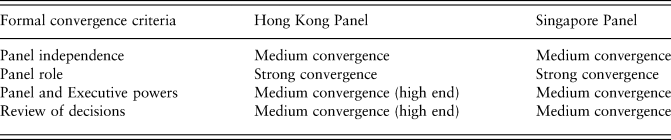
As set out in the table above, the analysis in this Part demonstrates that the Hong Kong and Singapore Panels have similar levels of formal convergence with the UK Panel in relation to all of the key criteria, with two exceptions. That is, there is a strong form of convergence in relation to the role of the Panel, and a medium form in relation to their independence. In relation to the powers of the Panel and the Executive, and review of their decisions, there is a medium form of convergence (at the high end) with the UK Panel for the Hong Kong Panel, and a medium form for the Singapore Panel. This leads to the conclusion that there are medium levels of formal convergence (at the high end) overall between the UK Panel and its Hong Kong and Singapore counterparts, with the Singapore Panel having a slightly lower level of convergence due to the fact that its Executive does not make rulings, and the absence of an internal review process for Panel decisions.
Formal Convergence Comparison

IV. FUNCTIONAL CONVERGENCE
Compared to formal convergence, functional convergence is more difficult to identify and measure. Gilson refers to functional convergence as being the flexibility of institutions ‘to respond to the demands of changed circumstances without altering the institutions’ formal characteristics’.Footnote 146 This definition arose from Gilson's analysis of formal and functional convergence as alternative approaches to achieving global standards in corporate governance.Footnote 147 As the UK Panel model has already been transplanted into Hong Kong and Singapore, functional convergence in this context reflects the extent to which the Hong Kong and Singapore Panels operate similarly to the UK Panel in practice.
A comprehensive assessment of the functional convergence of the Hong Kong and Singapore Panels with their UK counterpart would involve a detailed examination of each of the Panels’ decisions in light of the differences between the Takeover Codes operating in these jurisdictions. This requires a larger study to provide the opportunity for a proper analysis of all the issues involved. Instead, this Part examines the Panels’ processes and conducts a study of all of the decisions of the Hong Kong and Singapore Panels to provide an indication of the levels of functional convergence of these Panels in relation to the UK Panel. As discussed in Part III above, both of these elements are assessed in light of weak, medium, and strong forms of functional convergence.Footnote 148
Accordingly, the first section in this Part examines the way in which the Panels perform their functions, based on an examination of the procedures and processes that have been implemented in relation to the Hong Kong, Singapore, and UK Panels. It can be difficult to draw the dividing line between formal and functional convergence in this context. Where the procedures or processes relate to issues such as the appointment of members and the ability to use alternate members in decisions, these have already been discussed in the context of the first criterion for formal convergence in Section A of Part III above. On the other hand, where the procedures relate to how the hearings are conducted (including the circumstances in which members are chosen to decide matters), these are discussed below.Footnote 149 This section consequently focuses on the procedures that are used by the Panels in reaching their outcomes. The analysis is more detailed in relation to the Hong Kong and UK takeover bodies as, unlike in Singapore, procedural rules and terms of reference have been published for the Panels and their appeal bodies in Hong KongFootnote 150 and the UK.Footnote 151 In contrast, the approach taken by the Singapore Panel to enforcing the Code is set out in the Introduction to the Singapore Code.Footnote 152
The second section in this Part conducts a study of decision-making by the Hong Kong and Singapore Panels. That is, it analyzes the circumstances in which the Hong Kong and Singapore Panels have referred to the UK Panel, the UK Code, and/or the UK's practice in all of their published decisions in relation to their respective Codes.Footnote 153 This involves an examination of functional convergence based on the express statements of the Hong Kong and Singapore Panels concerning the extent to which their decisions are in line with the UK approach. Although it does not involve a comprehensive examination of functional convergence in relation to their decision-making, this limited study is valuable in identifying the approach that the Hong Kong and Singapore Panels have taken when making explicit reference to the UK model in their decisions.
A. Panel Processes
There are a number of similarities in the way in which the Hong Kong, Singapore, and UK Panels and their appeal bodies conduct their hearings. Significantly, hearings are generally conducted in private,Footnote 154 with matters decided on an informal basis.Footnote 155 The quorum for the Hong Kong Panel, the Singapore Panel, and the UK Hearings Committee hearings is five members, and three members for the appeal proceedings conducted by the Takeovers Appeal Committee in Hong Kong and the Takeover Appeal Board in the UK.Footnote 156 Each body allows parties to be legally represented, although this is unusual in the UK and in non-disciplinary matters in Hong Kong.Footnote 157 In addition to decisions being conveyed to the parties, the bodies usually publish a statement setting out their reasons on their respective websites.Footnote 158
The procedures of the Hong Kong and UK Panels (as well as their appeal bodies, the Takeovers Appeal Committee, and the Takeover Appeal Board, respectively) also share many features. For example, each of these procedures allows the body to conduct a hearing in the absence of a party if they fail to attend.Footnote 159 Similarly, there are provisions allowing the body to draw adverse inferences if a person does not comply with its directions fully and on time.Footnote 160 It is made clear that the evidentiary rules do not apply in relation to hearings conducted by the Hong Kong Panel and the UK Hearings Committee.Footnote 161 However, there is no equivalent statement in relation to their respective appeal bodies (the Takeovers Appeal Committee and the Takeover Appeal Board).Footnote 162 Hearings conducted by the Hong Kong and UK bodies are usually recorded, and transcripts can be made available to parties, subject to confidentiality restrictions.Footnote 163 Each of these bodies makes its deliberations in relation to the matter separately from the parties.Footnote 164 There are also published guidelines concerning conflicts of interest affecting members of the Hong Kong and UK takeover bodies.Footnote 165
There are certain procedures that apply in relation to some, but not all, of the takeover bodies in Hong Kong and the UK. For example, a hearing conducted by the UK Hearings Committee, the Takeover Appeal Board, and the Hong Kong Panel (but not disciplinary matters heard by the Hong Kong Panel and its appeal body, the Takeovers Appeal Committee) can be convened at short notice.Footnote 166 The hearing chairman for these bodies can also deal with the matter without convening the hearing.Footnote 167 On the other hand, an external legal advisor can be appointed for a hearing by the chairman of a hearing for the Hong Kong Panel, Takeovers Appeal Committee, and Takeover Appeal Board.Footnote 168 Although there is no equivalent provision in relation to the UK Hearings Committee, it is arguable that it would be able to do this if it was considered ‘necessary or expedient for the purposes of … its functions’.Footnote 169 It is possible for one or more parties to be excluded on grounds of confidentiality from a hearing conducted by the UK Hearings Committee, Takeover Appeal Board, and Hong Kong Panel (but not the Takeovers Appeal Committee).Footnote 170 The chairman of these hearings can also require witnesses to provide statements for the hearing.Footnote 171
In addition, the UK takeover bodies adopt a different approach to their Hong Kong and Singapore counterparts in relation to the appointment of a Secretary to the hearing. The Secretary acts as the conduit for communications between the takeover body and the parties.Footnote 172 In the case of both the UK Hearings Committee and the Takeover Appeal Board, the hearing chairman appoints a third party (usually a law firm partner) to be the Secretary to the hearing.Footnote 173 This role is undertaken in Hong Kong by the Secretary to the Panel, who is usually a staff member of its securities regulator.Footnote 174 The Singapore Panel is similarly supported by its Secretariat, which also comprises officers from its regulator.Footnote 175 The Hong Kong and Singapore systems also differ from the UK in limiting the involvement of lawyers and advisors in the hearings. Participants in Hong Kong Panel proceedings (whether or not these are disciplinary) are required to answer questions directly without recourse to their legal or professional advisors.Footnote 176 The Singapore Panel prevents legal advisors from answering questions for their clients and examining witnesses.Footnote 177
There are also features unique to the operation of the UK and Hong Kong Panels. In the UK, the procedures for the UK Hearings Committee and the Takeover Appeal Board give the hearing chairman a casting vote.Footnote 178 The Hong Kong Panel has a distinctive approach in relation to two other key matters. First, it has a separate set of hearing procedures relating to disciplinary matters.Footnote 179 The procedures for disciplinary hearings include provisions giving respondents twenty-eight days to respond to the Executive's paper initiating the proceedings, and applying a civil standard of proof on persons making an allegation.Footnote 180 Secondly, questions of law are decided by the chairman of a disciplinary hearing, in contrast to such questions being decided by the Hong Kong Panel members in the hearing collectively in non-disciplinary proceedings.Footnote 181
B. Panel Decision-Making
1. Hong Kong
Over a fifth of all of the Hong Kong Panel's published decisions relating to the Hong Kong Code have referred to the UK Code, the UK Panel decisions, and/or UK practice.Footnote 182 Four of these twelve decisions emphasized that the approach of the UK Panel provides either ‘useful guidance’Footnote 183 or ‘useful insight’Footnote 184 in relation to the interpretation of the Hong Kong Code. The most frequently cited UK Panel decisions relate to Guinness Plc and The Distillers Company Plc (Guinness),Footnote 185 which has been applied by the Hong Kong Panel in three of its decisions. In the first decision, the Hong Kong Panel noted that Guinness provided the closest precedent, and similarly adopted the civil standard of proof and a general approach of determining the remedy for a breach of the Hong Kong Code.Footnote 186 The second decision referred to Guinness in the context of applying the ‘nod or a wink’ test in establishing whether a person is ‘acting in concert’.Footnote 187 In the most recent decision, the Hong Kong Panel endorsed statements in Guinness relating to the definition of ‘acting in concert’, as well as reviewing its non-exhaustive list of factors from Guinness in making its decision.Footnote 188
The other topic on which the Hong Kong Panel has referred to the UK Panel's approach on multiple occasions is the chain principle.Footnote 189 One of the bases on which this principle would require a general offer is where ‘the holding in the second company is significant in relation to the first company’.Footnote 190 Two Hong Kong Panel decisions have cited a decision by its predecessor that took into account a 70 per cent guideline used by the UK Panel in determining this issue.Footnote 191 In one of these decisions, the Hong Kong Panel Executive sought the views of the UK Executive in the absence of a ‘direct precedent in Hong Kong’, and given that a percentage guideline had not been adopted by either ‘the Panel or its predecessor’.Footnote 192 However, the Hong Kong Panel did not end up deciding the matter based on this test.Footnote 193 The Hong Kong Code has also since adopted a 60 per cent guideline, with the UK percentage now lower at 50 per cent.Footnote 194
Three of the twelve Hong Kong Panel decisions cautioned that UK precedents will not necessarily be followed,Footnote 195 although it was noted in those three decisions that there was consistency in the Hong Kong and UK approaches notwithstanding the differences in the applicable Code rules.Footnote 196 In one of these decisions, the Hong Kong Panel emphasized that ‘application of a Rule can differ due to differences and different concerns in each market’ and noted that ‘most [Hong Kong] listed companies are controlled by their board members, unlike London’.Footnote 197 There are two other Hong Kong Panel decisions demonstrating this by applying a rule originating from the UK Code differently in light of local circumstances. The first decision related to the rule concerning the offeror and persons ‘acting in concert’ by selling shares during the offer period.Footnote 198 In that decision, the Hong Kong Panel noted that the UK rule did not envisage sales under underwriting agreements maintaining a 25 per cent public float, as was required for Hong Kong listed companies.Footnote 199 The Hong Kong rule was subsequently amended to set out the requirements for Executive consent for such arrangements.Footnote 200 In the second decision, the Hong Kong Panel was even more explicit about the need to decide matters consistently with local conditions when applying a rule relating to partial offers.Footnote 201 It stated the following in applying a test adopted by its predecessor and rejecting a submission that it should follow the UK Panel approach, given that the applicable Hong Kong rule was modelled on the UK Code:
The [UK] City Panel's approach has evolved over a long period in a different market environment … The [Hong Kong] Panel considered that it should use the discretion conferred upon it under the Code so as to evolve its own body of precedent and practice in a manner appropriate to the Hong Kong market and in accordance with the ‘consensus of opinion of those who participate in Hong Kong's financial markets and the SFC [securities regulator] regarding standards of commercial conduct and behaviour considered acceptable for takeover transactions in Hong Kong’.Footnote 202
2. Singapore
There are fewer decisions published by the Singapore Panel relating to its Code (totalling just over a fifth of those in Hong Kong).Footnote 203 Of these Singapore Panel decisions, only one has referred to the UK Code, the UK Panel decisions, and/or UK practice.Footnote 204 This decision involved a person who had failed to make a mandatory offer and was seeking to make a voluntary offer instead without giving shareholders the option to be paid in cash.Footnote 205 Rejecting this submission, the Singapore Panel emphasized that not only had it ‘not waived such a fundamental requirement of the Take-over Code before’, but that ‘[i]t would appear that the Take-over Panels in the United Kingdom and Hong Kong have not done so either’.Footnote 206
The Singapore Panel has also issued guidance relating to the exercise of its discretion under the Code (including in Practice or Guidance Notes and Practice Statements).Footnote 207 The UK Code, the UK Panel decisions, and/or UK practice are only referred to in the context of the Singapore Panel's press release relating to the Practice Note on partial offers.Footnote 208 This release notes the introduction of partial offer rules that were ‘permitted in the UK and Hong Kong on similar conditions’.Footnote 209 There are also multiple references to the UK Code, the UK Panel decisions, and/or UK practice in both the Consultation Papers on Code revisions issued by the Singapore Panel and the Consultation Conclusions from the consultation processes conducted by it.Footnote 210 These references provide examples of where the Singapore Panel has recommended Code revisions in line with the UK (and Hong Kong) approaches,Footnote 211 as well as where the Panel has declined to follow the UK approach in light of concerns that it would not be appropriate in the Singapore context.Footnote 212 However, a detailed examination of these consultation documents is beyond the scope of this article, which is instead focused on the decisions made by the Hong Kong and Singapore Panels in enforcing the Codes. In addition, amendments to the Code are issued by the securities regulators in each of these jurisdictions,Footnote 213 with the Hong Kong regulator also conducting the consultation processes for its Code revisions.Footnote 214
C. Assessment
The study above demonstrates differing levels of functional convergence with the UK Panel in relation to processes and procedures for the Hong Kong and Singapore Panels. Overall, the procedures for the UK Panel provide it with the greatest flexibility. In particular, only the UK Panel Executive can deal with disciplinary matters, with the agreement of the affected party. Similarly, the UK Hearings Committee is alone in having a broad power to do whatever is considered necessary for the purposes of its functions. There are also other differences in relation to the approach taken by the UK Panel compared with the Hong Kong and Singapore Panels in relation to the Secretary for the hearings, limitations placed on lawyers and other professional advisors, and the use of alternate Panel members.
On the other hand, the Hong Kong, Singapore, and UK Panels have many common features with respect to the key processes underlying their decision-making. These include the use of informal hearings, the ability to make directions and rulings, and the quorum for hearings. As the Hong Kong Panel has procedures modelled on those in the UK, it is the closest model to the UK Panel in this respect. For example, both the Hong Kong and UK Panels have published procedures relating to conducting hearings in the absence of a party, drawing adverse inferences from a party's failure to comply with rulings, and making compliance rulings to restrain a person from breaching the Code. However, the Hong Kong Panel processes also include unique features providing separate procedures for disciplinary proceedings, a special Committee of legal practitioners to chair these proceedings, and the ability for persons to be co-opted into roles for this Committee and the Hong Kong Panel. In light of this, it is concluded that there is a medium form of functional convergence with the UK Panel with respect to the procedures for the Hong Kong Panel.
There is a lower level of functional convergence between the Singapore and UK Panels in relation to their processes. This is primarily due to the absence of published procedures relating to the operation of the Singapore Panel. The Introduction to the Singapore Code sets out the framework for the hearings process, which is supplemented with information provided in public statements on Panel decisions and other releases by the Panel Executive.Footnote 215 However, given that this provides a significantly lower level of detail on the Panel's procedures, it is concluded that there is only a weak form of functional convergence with the UK Panel in relation to the procedures for the Singapore Panel.
A study of functional convergence in relation to Panel decision-making has been conducted based on the extent to which the Hong Kong and Singapore Panels have stated in all of their decisions that they have followed or deviated from the UK approach. The review of the Hong Kong decisions suggests a medium level of convergence in relation to the Hong Kong and UK Panels, with just over a fifth of all of the Hong Kong decisions referring to the UK Code, the UK Panel decisions, and/or UK practice. There are a number of examples where the Hong Kong Panel has stated that it has followed the UK Panel's approach, particularly in relation to Guinness in determining when persons are ‘acting in concert’ and the remedy for breaches. On the other hand, the Hong Kong Panel has declined to follow the UK approach in relation to rules restricting sales during the offer period and relating to partial offers. In this context, the Hong Kong Panel has made it clear that it will follow the approach that is appropriate for the Hong Kong market. In contrast, it is difficult to draw definitive conclusions based on the study of the Singapore Panel decisions, given that it only referred to the UK approach in one of its decisions. However, this decision was in line with UK (and Hong Kong) practice in relation to what was considered a fundamental requirement in the Singapore Code.
V. CONCLUSION
In their study of Asian takeover regulation, Varottil and Wan identified formal, but not functional, convergence in relation to the transplanted systems studied (which included Hong Kong and Singapore).Footnote 216 This article builds on this study through a detailed assessment of the extent to which there is formal convergence between the UK Panel and the transplanted versions in Hong Kong and Singapore. Formal convergence is assessed in terms of the current institutional structures of the Hong Kong, Singapore, and UK Panels based on four elements. These elements are the independence of the Panels, their roles based on the underlying purposes of the takeover regulation, the powers of the Panels and their Executives, and the availability of review over their decisions. In light of these elements, this article concludes that there are medium levels of formal convergence (at the high end) overall between the UK Panel and both its Hong Kong and Singapore counterparts. However, the Singapore Panel has a slightly lower level of convergence due to the fact that its Executive does not make rulings, and the absence of an internal review process for Panel decisions.
The article also focuses on the extent to which there is functional convergence between the UK Panel and the Hong Kong and Singapore Panels respectively. Functional convergence reflects the extent to which the Panels operate similarly in practice. This is examined both in relation to the processes and procedures for the Panels, as well as in a study of all of the decisions of the Hong Kong and Singapore Panels. In relation to the Panels’ procedural rules and processes, it is concluded that there is a medium form of functional convergence between the UK and Hong Kong Panels, and a weak form in relation to the UK and Singapore Panels. The study of the references to the UK Code, the UK Panel decisions, and/or the UK's practice in all the Hong Kong Panel and the Singapore Panel decisions only allows tentative conclusions to be made concerning the levels of functional convergence with the UK Panel in relation to their decision-making. In relation to the Hong Kong Panel, there is a medium level of functional convergence suggested by the references that occur in over a fifth of its decisions. On the other hand, it is difficult to draw any definitive conclusions based on the study of the Singapore Panel decisions, given that there is only one decision that refers to the UK approach. However, this decision was consistent with the UK approach not to waive a fundamental obligation in the Singapore Code.
These conclusions reinforce Varottil and Wan's findings that, although there are high levels of convergence at the formal level, the transplanted regulation has been adapted ‘to suit local circumstances’.Footnote 217 This is reflected in the establishment and operations of the Hong Kong and Singapore Panels compared to the UK Panel model, providing an example of ‘divergence within convergence’.Footnote 218 On the one hand, there are strong similarities in the regulatory aims of the three Panels, as reflected in their respective Takeover Codes. However, there are disparities in the Panels’ powers and institutional settings. One of the most significant differences involves the extent to which the Panels are independent. In particular, the securities regulator in Hong Kong and Singapore staffs the Panel Executive and sets the Code rules, unlike the practice as regards the UK Panel. This article has also provided examples of how there is functional divergence between the UK Panel and its Hong Kong and Singapore counterparts based on their procedures and processes, as well as in relation to decisions of the UK Panel. Further research needs to be conducted to provide a detailed assessment of the extent to which there is functional convergence in relation to the operation of the Hong Kong and Singapore Panels, both compared to the UK Panel and between the two Panels themselves.