Introduction
HIV/AIDS poses a significant threat to adolescents' health and life prospects in sub-Saharan Africa, where AIDS remains the single largest cause of death, accounting for three-quarters of the estimated 1.6 million global deaths from HIV/AIDS in 2012 (UNAIDS, 2013). It is estimated that sub-Saharan Africa is home to 80% of all children in the developing world who have lost a parent to AIDS, and even where HIV prevalence has stabilized or begun to decline, the number of orphans is expected to remain high or continue to grow for years, given the time lag between HIV infection and death (UNICEF, 2006). The problem of orphanhood extends well beyond childhood and available data suggest that adolescents make up the majority of orphans in all countries (UNAIDS, UNICEF & USAID, 2004). The number of orphans represent only a fraction of the number of children adversely affected by HIV/AIDS, with millions of other children, especially adolescents, facing various psychological and economic problems, including responsibilities of caring for ailing parents and siblings when the HIV-infected parents are still alive (UNICEF, 2006; Abebe & Skovdal, Reference Abebe and Skovdal2010).
The mechanisms through which HIV/AIDS can have devastating effects on adolescents' prospects are multiple and complex, including the effects of orphanhood and residence in households impoverished by AIDS-related illnesses and opportunistic infections. When parents fall sick, particularly in poor families, adolescents tend to drop out of school and end up in income-generating activities (Funkquist et al., Reference Funkquist, Eriksson and Muula2007; Abebe & Skovdal, Reference Abebe and Skovdal2010). Many adolescents orphaned by AIDS lose their childhood and are forced by circumstances to become producers of income or food, or caregivers for sick family members. In many cases, they become increasingly vulnerable to abuse, exploitation and ill-health, including high-risk sexual activity (Mmari, Reference Mmari2011; Operario et al., Reference Operario, Underhill, Chuong and Cluver2011). Although many children in sub-Sahara Africa live in impoverished households due to reasons other than HIV/AIDS and are similarly vulnerable as those in HIV/AIDS-impacted households, HIV/AIDS vulnerability is characterized by unique factors and circumstances (e.g. stigma and prolonged AIDS-related illness and opportunistic infections), and occurs at a scale that separates its impact from that of other impoverishing conditions in sub-Sahara African countries.
A number of recent studies in various sub-Saharan African settings have observed greater sexual risk among orphans than non-orphans (Gregson et al., Reference Gregson, Nyamukapa, Garnett, Wamba, Lewis and Mason2005; Thurman, et al., Reference Thurman, Brown, Richter, Maharaj and Magnani2006; Juma et al., Reference Juma, Askew and Ferguson2007; Operario et al., Reference Operario, Pettifor, Cluver, MacPhail and Rees2007, Reference Operario, Underhill, Chuong and Cluver2011; Nyamukapa et al., Reference Nyamukapa, Gregson, Lopman, Saito, Watts and Monasch2008; Birdthistle et al., Reference Birdthistle, Floyd, Machingura, Mudziwapasi, Gregson and Glynn2008, Reference Birdthistle, Floyd, Nyagadza, Mudziwapasi, Gregson and Glynn2009). In particular, studies in southern and eastern Africa have observed higher risks of having ever had sex among female orphans than non-orphans (Gregson et al., Reference Gregson, Nyamukapa, Garnett, Wamba, Lewis and Mason2005; Birdthistle et al., Reference Birdthistle, Floyd, Machingura, Mudziwapasi, Gregson and Glynn2008). Findings from recent qualitative research in Tanzania revealed three important caregiving roles that contributed to adolescent health: the provision of basic needs, advising and monitoring adolescent behaviours and assigning household chores. Adolescent participants believed that when these roles are compromised, female orphans' sexual behaviours are impacted (Mmari, Reference Mmari2011). In general, these studies suggest an elevated risk for involvement in high-risk sexual activities, especially among female orphans. Although there has been considerable attention to vulnerability of children orphaned by AIDS, few studies have examined sexual risk among other adolescents adversely affected by HIV/AIDS, such as those whose parents (or other adult household members) are living with HIV/AIDS. This study adds to an existing body of literature by (i) extending work on orphanhood conducted in selected settings of sub-Saharan Africa to examine the wider patterns for the region; and (ii) focusing attention on adolescents whose parents (or other adults in household) are infected with HIV.
This study focuses on adolescent sexual debut as a key determinant of adolescent sexual and reproductive health. Adolescent sexual onset is of public health importance because it contributes to ill sexual/reproductive health among adolescents by elevating the risk of unintended pregnancies and sexually transmitted diseases (STDs), including HIV/AIDS. This is particularly so in sub-Saharan Africa where condom use, although steadily rising in recent years, has remained very low over the years (Maticka-Tyndale, Reference Maticka-Tyndale2012). Sexual debut increases adolescents' risk of infection with HIV and other STIs because youth who initiate sexual activity at a young age are more likely to have multiple sexual partners when they are older and less likely to use condoms than their counterparts who initiate sexual activity at a later age (Harrison et al., Reference Harrison, Cleland, Gouws and Frohlich2005; Uchudi et al., Reference Uchudi, Magadi and Mostazir2012). Consequently, delaying the onset of sexual activity has been a key feature of a number of adolescent sexual health interventions in sub-Sahara Africa (WHO, 2008; Doyle et al., Reference Doyle, Weiss, Maganja, Kapiga and McCormack2011).
Household context, individual attributes and adolescent sexual behaviour
Factors that are likely to place adolescents at risk for sexual debut include individual attributes (i.e. lack of relevant human capital attributes) and household context (i.e., HIV/AIDS-related vulnerabilities), in addition to the effects of the societal conditions in which young people and their families live. In particular, adolescent girls' vulnerability to initiation of sexual activity may be determined by lack of socioeconomic attributes that are empowering at the individual level (i.e. education) and by poverty (deprivation of basic needs) in societies in which gaps between the rich and the poor continue to widen, where young women and girls have limited options for economic empowerment and financial autonomy, and where long-standing cultural norms legitimize cross-generational and transactional sexual activities (Collins & Rau, Reference Collins and Rau2000; Nkosana & Rosenthal, Reference Nkosana and Rosenthal2007; Leclerc-Madlala, Reference Leclerc-Madlala2009). In economically desperate circumstances, unmarried young women and girls are likely to exchange sex for money, food or other favours (Meekers & Calvès, Reference Meekers and Calvès1997).
In this paper, it is argued that residence in a household destabilized and/or impoverished by HIV/AIDS (either indirectly or directly through the illness of a household member or through the death of at least one parent) is likely to be a risk factor for sexual debut. It is assumed that adolescents from intact family structures are less likely to engage in high-risk sexual behaviours (sexual onset and transactional sex) than their peers from non-intact family backgrounds (i.e. homes destabilized and/or impoverished by HIV/AIDS processes) (Enaik et al., Reference Enaik, Patel, Persad, Westhoff and Galwankar2002; Oman et al., Reference Oman, Vesely and Aspy2005). The argument here is that the HIV/AIDS pandemic is likely to translate into poor/unfavourable adolescent sexual outcomes through the effects of either lack of significant parental monitoring or lack of perception of parental affection and support (Lammers et al., Reference Lammers, Resnick and Blum2000; Oman et al., Reference Oman, Vesely and Aspy2005). A study in Kenya found that orphans reported less supervision by adults at home, and perceived that they were less loved at home than non-orphans (Juma et al., Reference Juma, Askew and Ferguson2007). Psychological and emotional problems of this nature are likely to lead to onset of sexual activity.
It is further hypothesized that adolescent sexual onset is triggered by adolescents' and households' lack of the human capital and social status attributes that support healthy choices. According to Coleman (Reference Coleman1988, p. S100), ‘human capital is created by changes in persons that bring about skills and capabilities that make them able to act in more responsible and efficient ways’. Hence, the human capital argument runs as follows: the likelihood of adolescent sexual debut is smallest among adolescents who have advanced human capital skills (e.g. education, household socioeconomic status) and more modern social status attributes (e.g. urban residence, media exposure). The modernization literature holds the belief that formal education is the key to human capital development by transforming people's attitudes and values from traditional to more modern, and their behaviour from constrained to more emancipated (i.e. modern thinking and greater decision-making autonomy). The human capital skills that individuals acquire in school, or from media exposure, are likely to translate into aspirations for a healthier life. For example, education can provide protection against risky sexual behaviours by providing young men and women with a sense of self-confidence and authority that can allow them to choose healthier behaviours, including delayed sexual debut.
Aims and objectives
The main hypothesis that guides this study is that adolescent children in sub-Saharan Africa who live in households affected by HIV/AIDS are more likely to experience sexual debut than their peers who live in non-affected households. Specifically, the effect of orphanhood and parents' HIV status on adolescent sexual/reproductive health, determined using sexual debut, is examined. The specific objectives are to: (1) compare adolescents from HIV/AIDS-affected households with those in households not affected by HIV/AIDS with respect to onset of sexual activity; and (2) establish the role of background individual attributes and household context in explaining the associations between household HIV/AIDS status and sexual debut among adolescents in sub-Saharan Africa. Throughout the analysis, emphasis is placed on gender disparities and on national/sub-national variations in the link between household HIV/AIDS status and adolescent sexual debut. This paper aims to provide a general picture of patterns among adolescents across countries in sub-Saharan Africa, useful for relevant international policy and programmes across countries in the region. More targeted studies focusing on individual countries would be required to guide national policy and programme efforts to address relevant issues in specific countries.
Methods
Data
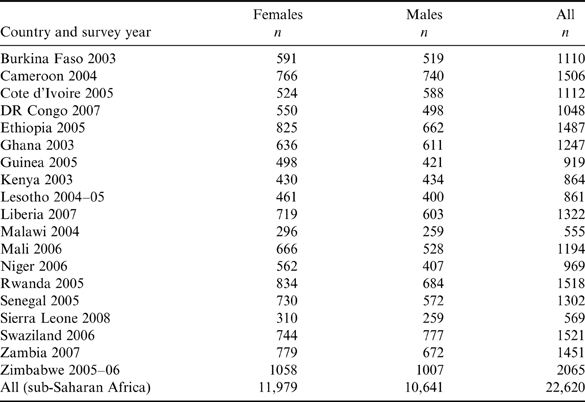
The data used in this study came from population-based sample surveys that were conducted in the mid-2000s (between 2003 and 2008) in nineteen countries in sub-Saharan Africa as part of the Demographic and Health Surveys (DHS) programme. The study sample comprised all sub-Saharan Africa countries where DHS HIV test data were available at the time of the study, except Uganda 2005 and Tanzania 2004 AIDS Indicator Surveys (AIS), which were excluded for technical reasons. In addition to nationally representative samples of women and men of reproductive age (women aged 15–49 and men aged 15–49/54), the DHS and AIS collected detailed data on children and adolescents, including maternal/paternal orphanhood status. The present analysis focuses on the sample of adolescents aged 15–17 years. A summary of the analysis sample, disaggregated by sex, is presented in Table 1.
Sample of adolescents aged 15–17 years included in the analysis, by country

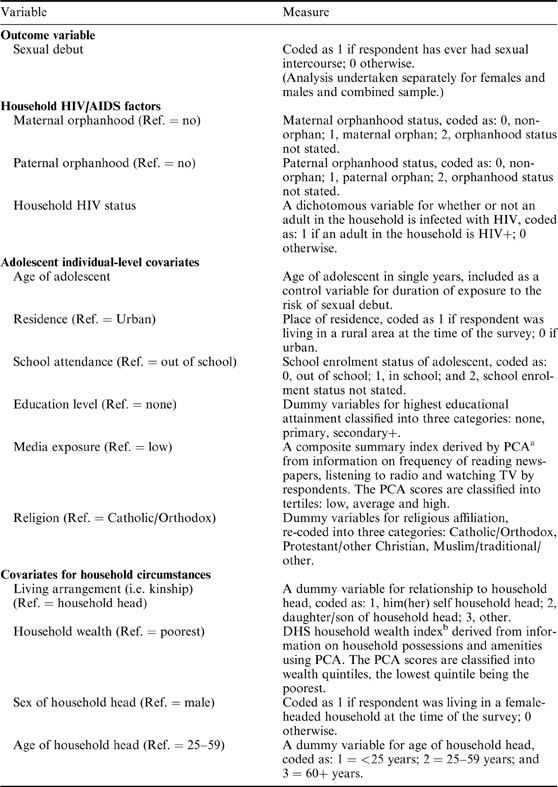
In addition to detailed information about basic individual and household socioeconomic and demographic characteristics, the DHS and AIS surveys collected data on age at which adolescents first engaged in sexual activity and whether or not the respondents ever had sex. These data are crucial to this study because they provide information used to construct the study's outcome variable. The key study variables are household HIV/AIDS status based on orphanhood status of adolescents and HIV status of adults in the household, while other covariates include a range of individual/household level socioeconomic and demographic characteristics. A summary description of the study variables is provided in Table 2.
Description of study variables
a PCA: Principal Components Analysis.
b Rutstein & Johnston (Reference Rutstein and Johnston2004).
Dependent variable
The dependent variable measures initiation of sexual activity among adolescents. Preliminary analysis was undertaken to assess appropriateness of the two measures of sexual debut available in the data: retrospective reports on ‘age at first sex’; and current status data on ‘whether ever had sex’. Based on results of the preliminary analysis, the study adopted a dichotomous measure of the dependent variable coded as ‘1’ if an adolescent aged 15–17 years has ever had sexual intercourse and ‘0’ otherwise. Thus, the measure of sexual debut is based on current status data on ‘ever had sex’ (adjusting for current age), rather than recall data on ‘age at first sex’ (AFS) since the latter is subject to more serious misreporting errors due to recall bias, besides deliberate misreporting among young people who may wish to conceal (especially girls) or exaggerate (especially boys) their sexual activity. Preliminary analysis suggested inconsistent reporting of AFS, with some adolescents reporting AFS that was higher that their current age. Indeed, previous research in sub-Saharan Africa suggests that inconsistent reporting of AFS is not uncommon (Wringe et al., Reference Wringe, Cremin, Todd, McGrath, Kasamba and Herbst2009).
Key independent variables
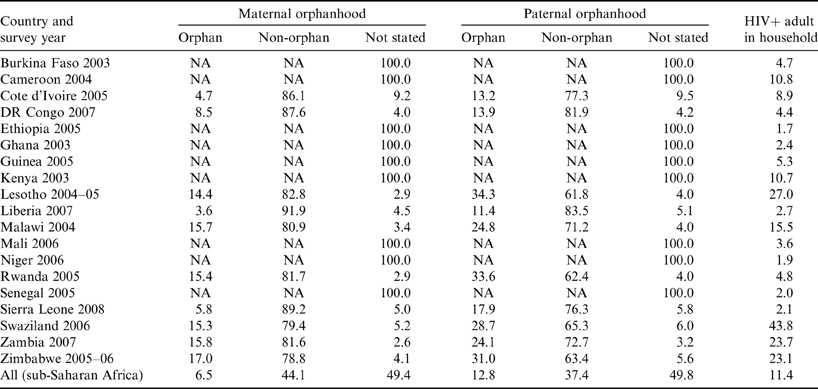
The key explanatory variables are presence of HIV-positive adult in household and parental survival (maternal or paternal orphanhood). The background distribution of the proportion of adolescents in each country who are maternal/paternal orphans, or live in households where there is an adult who is infected with HIV, is given in Table 3.
Percentage of adolescents aged 15–17 in each country who are maternal/paternal orphans or in households with HIV-positive adults
NA: orphanhood information is not available.
HIV testing in the DHS is based on a standard procedure and strictly adheres to international ethical guidelines:
The DHS HIV testing protocol provides for informed, anonymous, and voluntary testing of women and men interviewed. The testing protocol undergoes a host country ethical review as well as an ethical review at ICF Macro. In countries with CDC involvement, the testing protocol is also reviewed by CDC. The testing is simple; in most cases, the interviewer collects dried blood spots (DBS) on filter paper from a finger prick and the filter paper is transported to a laboratory for testing. The laboratory protocol includes an initial ELISA test, and then retesting of all positive tests and 5% to 10% of the negative tests with a second ELISA. For those tests with discordant results on the two ELISA tests, another test, usually a Western blot, is used to determine the result.
(ICF Macro, 2010, p. 4)It is important to note that orphanhood data for adolescents aged 15–17 years were only available for nine of the nineteen countries and the potential implications of missing data are discussed later in the paper. The higher orphanhood rates in most countries in southern Africa may be largely attributable to the high adult HIV prevalence in these countries. However, higher orphanhood rates (especially paternal orphanhood) in countries of lower HIV prevalence such as Rwanda are mainly attributable to other factors such as civil strife in these countries.
In addition to the key explanatory variables, a number of individual human capital and household attributes are included in the analysis as covariates. These include adolescent's school attendance/enrolment, adolescent's educational attainment level, adolescent's media exposure, adolescent's urban/rural residence, religious affiliation, relationship to household head (kinship), household wealth index, household head's age and household head's sex. The goal here is to identify potential pathways through which household HIV/AIDS status may be linked to adolescent sexual debut. It is postulated that the covariates included in the model can help explain the sexual risk associated with orphanhood or presence of HIV-infected adults in households. For instance, it is possible that expected greater sexual risk among orphaned adolescents may be partly explained by the impoverishing impact of HIV/AIDS on households.
Methods of analysis
Multilevel logistic regression models are applied to explore the association between household HIV/AIDS status (orphanhood and presence of HIV-positive adults in the household) and onset of sexual activity among 15- to 17-year-old adolescents in sub-Saharan Africa, adjusting for current age. The covariates are introduced to the models in successive stages to establish potential pathways of the determinants, starting with the household HIV/AIDS status before introducing background individual-level characteristics, followed with household contextual factors.
The analysis places particular emphasis on country and regional variations in factors associated with adolescent sexual debut, and the extent of clustering of sexual risk within countries and regions in sub-Saharan Africa. The multilevel analysis is applied to pooled DHS data from nineteen countries in sub-Saharan Africa. The pooled data have a hierarchical structure with individuals nested within regions, which are in turn nested within countries. Preliminary analysis was first undertaken to assess appropriate multilevel units to be incorporated in the analysis, recognizing the hierarchical data structure arising from the multi-stage cluster sampling design of the DHS and pooling of data across countries. The data comprise individuals/households nested within clusters, which are in turn nested within districts/regions and countries. Preliminary analysis based on variance components models revealed significant clustering of the outcome (i.e. sexual debut) at region and country level, but there was no evidence of significant clustering at lower-level units (i.e. at cluster or district levels). The analysis therefore adopted three-level models with individuals at level 1, region at level 2 and country at level 3.
Thus, in the multilevel analysis applied in this paper, countries constitute the highest (third) level (n=19), while regions within countries constitute the second level. The general form of the three-level logistic regression model used may be expressed as:
 $$Logit \pi_{ijk}=X^\prime _{ijk}{\beta} +Y^\prime _{ijk}u_{jk}+Z^\prime _{ijk}v_k$$
, where πijk is the probability of sexual risk (ever had sex) for an individual i, in the j th region in the k th country; X′ijk is the vector of covariates, which may be defined at the individual/household, region or country level; β is the associated vector of usual regression parameter estimates; Y′ijk is a vector of covariates (usually a subset of X′ijk), which vary randomly at region level; Z′ijk is a vector of covariates (usually a subset of X′ijk), which vary randomly at country level; and the quantities vk and ujk are the residuals at the country and region level, respectively. These are assumed to have a normal distribution with a mean of zero and variances of σ2v and σ2u (Goldstein, Reference Goldstein2003).
The analysis is based on multilevel random coefficient models, allowing for potential variation in the effect of household HIV factors across countries and across regions within countries. The modelling is carried out separately for males and for females, as well as for the combined sample to assess significance of sex differences. The analysis is undertaken using MLwiN multilevel software with calculation of parameter estimates based on second-order PQL procedure (Rasbash et al., Reference Rasbash, Steele, Browne and Prosser2005).
The analysis starts with an examination of the bivariate distribution of the proportion of adolescent boys and girls aged 15–17 who have ever had sex (i.e. the outcome variable) by age and country of residence. This is followed with an examination of the association between household HIV/AIDS factors and sexual debut across countries of sub-Saharan Africa in a multivariate multilevel analysis, progressively controlling for country and regional random effects, and other important factors. All the models adjusted for current age.
It is important to note that the analyses presented here are based on unweighted data. It is recognized that the appropriateness of using sample weights in multivariate analysis is debatable (see, for example, Winship & Radbill, Reference Winship and Radbill1994). In this case, weighting is not desirable for various reasons. First, the multivariate models controlled for key factors that relate to varying sample weights such as urban/rural residence, region and random country effect. In fact, the random country effect in the multilevel analysis represents unobserved country-level factors, which include any variations in sample design across countries. Second, although it was possible to derive the probability weights for individual survey samples based on the DHS samples and overall population size for respective countries, this was deemed unnecessary since the data included in the analysis do not cover all countries in the sub-Saharan Africa region. Despite constituting a fair representation of countries across sub-Saharan Africa, the data included in the analysis are not representative of all countries in the region
Data limitations
Important data limitations and their potential implications on the findings are acknowledged. The first relates to the cross-sectional nature of the DHS data analysed, which does not permit temporal ordering of the events of interest. For example, it was not possible to establish whether the current household HIV/AIDS status preceded reported adolescent sexual debut or vice versa. Therefore, the observed relationships reflect mere associations rather than infer precise causal links. Nevertheless, restricting the analysis to 15- to 17-year-old adolescents helps minimize the problem since sexual activity would have been initiated in the recent period – preliminary analysis suggests that the median gap between age of sexual debut and current age among those who ever had sex was 1 year (mean of 1.8 years due to a positive skew).
The second limitation relates to missing data for one of the key explanatory variables: orphanhood status. The fact that data on orphanhood were only available for nine of the nineteen countries included in the analysis limits the extent to which the results relating to orphanhood status and adolescent sexual debut may be generalized across countries in sub-Saharan Africa. Nevertheless, it was worthwhile to include the variable on orphanhood status in the analysis by including a dummy for the ‘not stated’ category. This enabled estimation of the orphanhood effect for cases where data were available, while at the same time controlling for potential bias that may result from exclusion of some countries from the analysis. Preliminary analysis established that whether or not the variable on orphanhood was included in the model did not significantly affect estimates of the other parameters.
Finally, although it would have been useful to explore contextual regional/country HIV/AIDS effects on adolescent sexual risk, this was not possible due to data limitations. The DHS surveys used here are limited on contextual data at community/regional level and the number of countries included in the analysis (n=19) is too few to permit meaningful analysis of contextual country-level factors. In multilevel analysis, power for higher level estimates depends on the number of groups (Snijders, Reference Snijders, Everitt and Howell2005), implying that the relatively small number of countries in the analysis sample limits our statistical power to detect significant country-level effects.
Results
Patterns of sexual debut across countries
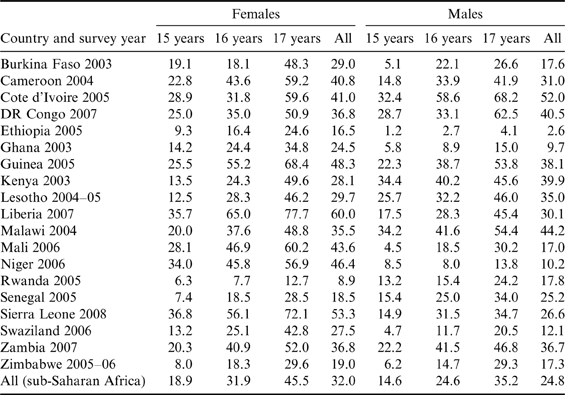
The bivariate distributions of onset of sexual activity by age presented in Table 4 suggest that there are considerable variations in the timing of sexual debut across countries in sub-Saharan Africa. The proportion of adolescent girls who have initiated sexual activity is lowest in Rwanda, where the proportion who have initiated sexual activity ranges from 6% at age 15 to 13% by age 17 years. These proportions are considerably lower than those in other countries such as Liberia or Sierra Leone, where more than 70% of the 17-year-old adolescent girls have initiated sexual activity.
Percentage of 15- to 17-year-old adolescent in each country who have ever had sex by age in completed years
For adolescent boys, the proportion who have initiated sexual activity is particularly low in Ethiopia, where this ranges from only 1% among 15-year-olds to less than 5% among the 17-year-olds. This is in sharp contrast to countries such as Cote d'Ivoire, Democratic Republic of the Congo and Malawi where more than 40% of the 15- to 17-year-olds have initiated sexual activity. The proportion of 17-year-old boys who have initiated sexual activity is particularly high in Cote d'Ivoire with almost 70% (68%) having initiated sexual activity.
Association between household HIV/AIDS status and sexual debut
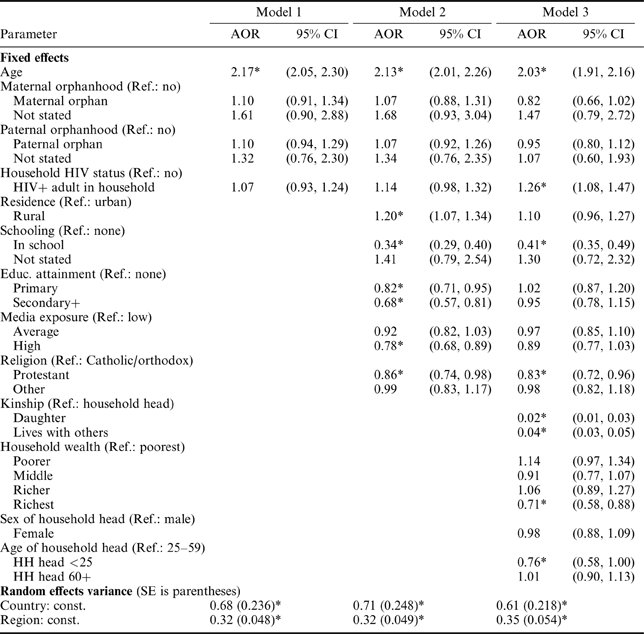
The results of the multilevel logistic regression analysis of the association between orphanhood or household HIV status and sexual debut are presented in Tables 5 and 6 for adolescent females and males, respectively. This is followed with an analysis based on a combined sample of females and males in Table 7. All models adjusted for current age of adolescents. The results in Table 5 suggest that maternal and/or paternal orphanhood status is not significantly associated with sexual debut among adolescent girls in sub-Saharan Africa. However, presence of an adult who is HIV-positive in the household is associated with an increased risk of sexual debut when household circumstances such as kinship, household wealth and age of household head are controlled for. On average, adolescent girls living in households with an HIV-positive adult have a 26% higher odds of having initiated sexual activity than their counterparts of similar characteristics living in households with no infected adults. The vulnerability of adolescents living in households with HIV-infected adults only becomes apparent when living arrangement (kinship) is controlled for. This suggests that adolescents living in households with HIV-infected adults, whether living with parents or others, are more likely to have initiated sexual activity compared with their counterparts with similar living arrangements. Thus, having an HIV-infected adult in the home increases risk irrespective of relationship of the adolescent to the household head.
Multilevel logistic regression average odds ratios (AOR) and 95% confidence intervals of AOR for sexual debut among female adolescents aged 15–17 in sub-Saharan Africa
Ref.: reference category.
* p<0.05.
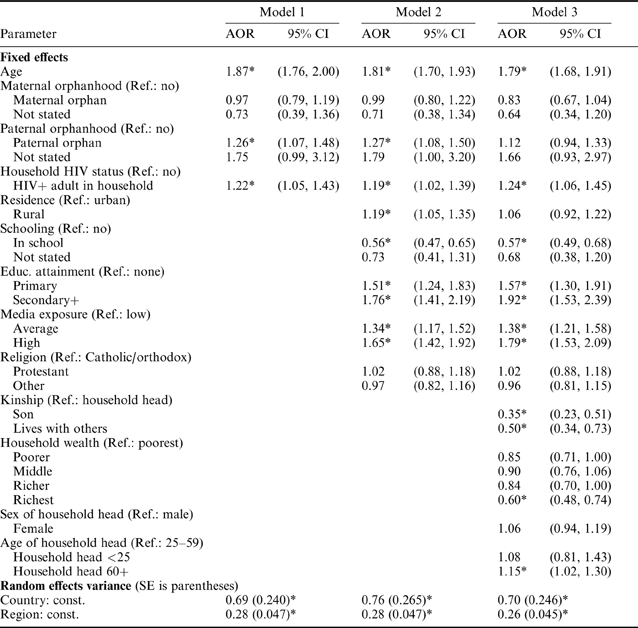
Multilevel logistic regression average odds ratios (AOR) and 95% confidence intervals of AOR for sexual debut among male adolescents aged 15–17 in sub-Saharan Africa
Ref.: reference category.
* p<0.05.
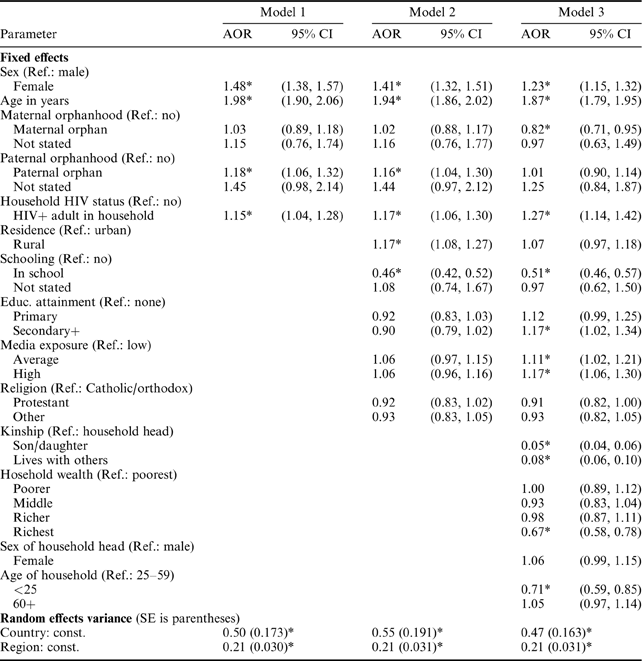
Multilevel logistic regression average odds ratios (AOR) and 95% confidence intervals of AOR for sexual debut among female and male adolescents aged 15–17 in sub-Saharan Africa
Ref.: reference category.
* p<0.05.
The association between sexual debut and individual demographic and socio-cultural characteristics suggests a higher risk of sexual debut among adolescent girls who are older, living in rural areas, out of school, have lower educational attainment and with lower media exposure. However, the associations with rural/urban residence, educational attainment and media exposure cease to be significant when household circumstances are controlled for (Model 3) suggesting that the observed associations are mainly explained by household circumstances. Household circumstances associated with increased odds of sexual debut include living in independent households where the adolescent is the household head or spouse to the head, and poorer households. It is probable that the observed higher risk of sexual debut among adolescent girls who live in rural areas, or who have low educational attainment or low media exposure, is mainly attributable to poverty, since these characteristics are associated with higher poverty – a factor associated with increased risk of sexual debut.
The results for male adolescents presented in Table 6 provide no evidence of a significant difference between maternal orphans and non-orphans among adolescent boys, similar to patterns observed for adolescent girls. However, adolescent boys who are paternal orphans are significantly more likely to have initiated sexual activity than their non-orphan counterparts of similar characteristics. On average, paternal orphans have about 25% higher odds of having initiated sexual activity than their non-orphan counterparts of similar individual characteristics. This orphan vulnerability is explained by differences in household circumstances with respect to living arrangements and household wealth – the association ceases to be significant when these factors are controlled for in the model.
Besides paternal orphanhood, the presence of HIV-positive adults in a household is also associated with increased vulnerability for adolescent boys. On average, adolescent boys living in households where at least one adult is infected with HIV have about 20–25% higher odds of having had sex compared with their counterparts of similar characteristics and household circumstances in households where no adult is HIV-positive. Unlike paternal orphanhood, where the higher risk of sexual debut is largely explained by household circumstances, the higher risk among those in households with adults living with HIV is exacerbated when household circumstances are controlled for. As in the case of adolescent girls, it is likely that those living in households with HIV-infected adults are more likely to be living with parents – a factor associated with reduced odds of sexual debut. Consequently, the vulnerability of adolescent boys living in households with HIV-infected adults is concealed when living arrangement (kinship) is not controlled for.
As in the case of adolescent girls, there are significant differences in adolescent boys' sexual debut by individual characteristics, including age, urban/rural residence, school attendance, educational attainment and media exposure. However, while the observed patterns with respect to age, urban/rural residence and school attendance are similar to those observed for female adolescents, the patterns relating to educational attainment and media exposure are in the reverse direction. For adolescent boys, higher educational attainment and higher media exposure are both associated with increased odds of sexual debut. Furthermore, while the higher risk of sexual debut among rural residents is largely explained by household circumstances, as in the case of girls, this is not so for educational attainment or media exposure. The patterns with respect to household circumstances are similar to those observed for females, albeit the effect sizes differ. Overall, those who are themselves household heads, or live in household headed by the elderly, or in poorer households are significantly more likely to have initiated sexual activity than their counterparts of similar characteristics who are living with parents, or in households headed by 25- to 59-year-olds, or in the richest households.
Consistent with patterns observed in the bivariate analysis, the results presented in Table 7 confirm that adolescent girls aged 15–17 are significantly more likely to have initiated sexual activity than their male counterparts of similar age. On average across countries in sub-Saharan Africa, the odds of having initiated sexual activity are about 40–50% higher for girls than boys of similar household HIV/AIDS status and individual demographic and socioeconomic characteristics. The higher odds among girls is partly explained by household socioeconomic and demographic circumstances.
An examination of the association between household HIV/AIDS factors and sexual debut based on a combined sample of adolescent females and males (Table 7) shows patterns generally consistent with those observed in separate analyses for females or males in Tables 5 and 6. In particular, the results confirm increased vulnerability for adolescents living in households where an adult is living with HIV – a risk that is exacerbated when household circumstances are controlled for. Also, the findings confirm increased vulnerability among paternal orphans that is largely explained by household circumstances. However, an interesting pattern emerges in relation to maternal orphanhood, suggesting a reduced risk of sexual debut among maternal orphans when household circumstances are controlled for. Further investigation reveals that the reduced risk of sexual debut among maternal orphans becomes evident when living arrangement is controlled for. On average, maternal orphans have about 20% lower odds of having initiated sexual activity than non-maternal orphans in similar household circumstances. The effects of maternal/paternal orphanhood and presence of an HIV-positive adult in the household on sexual debut were allowed to vary by sex but none of the interactions was significant, suggesting that these associations did not vary significantly between adolescent girls and boys.
The patterns for the other individual and household socioeconomic and background characteristics also conform to earlier observed patterns for females and males. In particular, the analysis for the combined sample confirms the protective role of being enrolled in school and living with parents or in wealthier households.
Variations in sexual debut across regions and countries
Besides the individual-level and household-level factors associated with adolescent sexual debut, there are significant variations in the odds of initiating sexual activity across countries in sub-Saharan Africa, and to a lesser extent across regions within countries. The intra-unit correlation coefficients suggest that about 15–20% of the total unexplained variation in sexual debut among adolescent girls or boys is attributable to unobserved country-level factors. However, there is no evidence that the effect of orphanhood or presence of an HIV-positive adult in a household on sexual debut varies significantly across countries or across regions within countries. For both adolescent girls and boys, random coefficient models allowed for the effects of these factors to vary across countries and regions but there was no evidence of significance.
Discussion
This study uses data from population-based sample surveys to establish household HIV/AIDS factors that place adolescents at risk of sexual onset in sub-Saharan Africa. The results provide support for the argument that the propensity to initiate sexual activity among adolescents is determined by household HIV status. In particular, they suggest increased vulnerability among adolescent boys and girls living in households where an adult is infected with HIV and among adolescent boys who are paternal orphans. The observed increased vulnerability among adolescents living in households where an adult is infected with HIV seems to be consistent with findings from previous studies that have focused on other aspects of adolescent vulnerability such as mental health. In a recent study in Uganda, lower parent/guardian connectedness, and having a chronically ill adult in the household were found to be associated with a higher level of depression, especially among male adolescents (Kaggwa & Hindin, Reference Kaggwa and Hindin2010).
Although some of the previous studies in selected settings in sub-Saharan Africa have identified maternal orphanhood as a risk factor for sexual debut among adolescent girls (Gregson et al., Reference Gregson, Nyamukapa, Garnett, Wamba, Lewis and Mason2005; Birdthistle et al., Reference Birdthistle, Floyd, Machingura, Mudziwapasi, Gregson and Glynn2008), this study provides no such evidence. Indeed, there is no evidence of increased vulnerability among adolescent girls who are maternal or paternal orphans, despite an earlier observation from qualitative research that female orphans' sexual behaviours are impacted when parental caregiving roles are compromised (Mmari, Reference Mmari2011). Lack of evidence of increased vulnerability (or indeed more favourable outcomes) for orphans compared with non-orphans in previous studies had mainly been attributed to the fact that orphans were more likely to be taken in by wealthier households (Zidron et al., Reference Zidron, Juma and Ice2009). However, this is unlikely to be the main explanation here since the relationship remains unchanged even after household wealth is controlled for. Nevertheless, the non-significant association between maternal orphanhood and sexual debut among adolescent girls observed here seems consistent with patterns observed in previous research based on comparable populations. For example, the study by Palermo & Peterman (Reference Palermo and Peterman2009), based on nationally representative DHS samples of 15- to 17-year-olds, found no evidence of a significant relationship in eight of the ten countries included in their analysis (although it is important to note that only four surveys were used in both studies and that our analysis omitted the two countries (Uganda and Tanzania) in which Palermo and Peterman (Reference Palermo and Peterman2009) found an association).
For boys, there is no significant difference between maternal orphans and non-orphans, but paternal orphans are significantly more likely to have initiated sexual activity than their non-orphan counterparts of similar individual characteristics. The increased vulnerability among adolescent boys who are paternal orphans is consistent with findings from a number of recent studies in various southern Africa settings that observed greater sexual risk (including ever had sex) among orphans than non-orphans (Thurman et al., Reference Thurman, Brown, Richter, Maharaj and Magnani2006; Operario et al., Reference Operario, Pettifor, Cluver, MacPhail and Rees2007; Nyamukapa et al., Reference Nyamukapa, Gregson, Lopman, Saito, Watts and Monasch2008; Birdthistle et al., Reference Birdthistle, Floyd, Nyagadza, Mudziwapasi, Gregson and Glynn2009). The observed higher sexual risk among adolescent boys (but not girls) who were paternal orphans observed in this study is consistent with findings from a recent study in Uganda where the cause and timing of parental death were important only among the males, and loss of a parent to HIV was associated with worse psychological outcomes among the males and not the females (Kaggwa & Hindin, Reference Kaggwa and Hindin2010).
One of the main objectives of this study was to identify potential pathways through which household HIV/AIDS factors may be linked to adolescent sexual debut. The findings suggest that household circumstances relating to living arrangements and wealth are key factors through which household HIV/AIDS status may be linked to adolescent sexual debut. In particular, the reduced risk of sexual debut among adolescent boys who are paternal orphans when these factors are controlled for in the model may be explained by the fact that paternal orphanhood is likely to lead to increased vulnerability for adolescent boys by increasing their likelihood of living in independent or poor households – factors associated with increased risk of sexual debut. These findings support the argument of increased adolescent vulnerability through the HIV/AIDS-impoverishing impact on households (Enaik et al., Reference Enaik, Patel, Persad, Westhoff and Galwankar2002; Oman et al., Reference Oman, Vesely and Aspy2005). While previous studies have focused on young women's susceptibility to sexual risk resulting from poor socioeconomic circumstances (Meekers & Calvès Reference Meekers and Calvès1997; Swidler & Watkins, Reference Swidler and Watkins2007; Operario et al., Reference Operario, Underhill, Chuong and Cluver2011), our findings draw attention to the vulnerability of adolescent boys. On the other hand, the increased vulnerability of adolescents (especially girls) who live in households where an adult is infected with HIV when living arrangement is controlled for may be explained by the fact that those living in households with HIV-infected adults are more likely to be living with parents (rather than in independent households), a factor associated with a reduced risk of sexual debut. Thus, the increased risk among adolescents in households where an adult is infected with HIV is partly concealed when living arrangement is not controlled for.
Findings from the multilevel random effects estimates suggest that there are significant variations in the proportion of 15- to 17-year-olds who have initiated sexual activity across countries in sub-Saharan Africa, consistent with patterns observed in the bivariate analysis. However, there is no evidence that the effect of orphanhood or presence of an HIV-positive adult in a household on sexual debut varies significantly across countries or across regions within countries, suggesting that the observed patterns may be generalized across countries in the region.
This paper aimed at providing a general picture of patterns among adolescents across countries in sub-Saharan Africa, useful for informing relevant international policy and programmes across countries in the region. The fact that the patterns observed are consistent across countries in the region highlights the relevance of findings for international cross-national policy. In particular, a key finding relating to vulnerability of adolescents in households with HIV-infected adults underscores the importance of extending current efforts in the region to address the plight of other children in HIV/AIDS-affected households, beyond orphans.
Acknowledgments
This study was part of a secondary data analysis project on HIV/AIDS and the well-being of children in sub-Saharan Africa, sponsored by the UK Medical Research Council (MRC). The data analysed were provided by the Demographic and Health Surveys (DHS) programme, ICF Macro, Calverton, MD, USA.