Cardiopulmonary bypass is often used for surgical repair of congenital cardiac diseases. Post-operative infection is a serious complication for children who have undergone cardiopulmonary bypass and may involve different organs and areas such as the lungs, wounds, the mediastinum, or urinary tract. Despite the prompt commencement of an antibiotic therapy being crucial to contain the infectious process, diagnosis is often very difficult because the usual clinical and biological symptoms are modified during the post-operative period. Systemic inflammatory response syndrome occurs frequently after cardiopulmonary bypass.Reference Cremer, Martin and Redl1 This inflammation also results from the contact of blood cells with artificial surfaces – oxygenator, pumps – of the circuit, as well as from tissue ischaemia or low splanchnic blood circulation flow. It has been shown that procalcitonin is a specific marker of bacterial infection both in adults and children, including newborns.Reference Ferrière2–Reference Gendrel and Bohuon9 In children, procalcitonin may be particularly useful when systemic inflammatory response syndrome disturbs the interpretation of the usual clinical and biological markers, thus making difficult the diagnosis of bacterial infection. Few studies have described the normal post-operative procalcitonin serum-level kinetics after cardiopulmonary bypass in children.Reference Hammer, Loeff and Reichenspurner10–Reference Arkader, Troster and Lopes17 According to these studies, the rate of procalcitonin rises to a maximum peak of 24–48 hours after the surgery and then decreases to a normal value after the third post-operative day. The purpose of this study was to evaluate the diagnostic value of procalcitonin as a marker of infection after cardiopulmonary bypass in children.
Materials and methods
Patients
Children were included from April, 2006 to December, 2007 in this retrospective study. After operation, they were admitted to the Pediatric Intensive Care Unit and in the Pediatric Cardiology Unit of the University Hospital of Nantes.
The inclusion criteria were age between day 0 and 15 years, cardiac surgery under cardiopulmonary bypass, and suspected post-operative infection until day 21 after operation.
The exclusion criteria included the presence of a pre-operative infection, use of antibiotic treatment excluding antibiotic prophylaxis, and use of immunosuppressive treatment, including corticosteroids, within 7 days before surgery.
Owing to the physiological peak of procalcitonin occurring in the first days of life, no newborn before the third day of life suspected of infection after cardiopulmonary bypass was included in order to avoid interference with our results.
Cardiopulmonary bypass management
Antibiotic prophylaxis started with cefuroxime at a dose of 30 milligrams per kilogram at induction and was repeated every 2 hours during surgery, and then three times per day during the first 48 hours after operation. Normothermia was used during cardiopulmonary bypass except in cases of circulatory arrest. Then, hypothermia at 20°C rectal temperature was used. The priming solution comprised Ringer's lactate, heparin, mannitol, and hydroxyethyl starch solution to achieve a haematocrit level of 32–34%. Use of human albumin was sometimes necessary to obtain a minimal protein serum level of 60 grams per litre. This priming solution did not contain any steroids. The rinsing solution for capillary ultrafiltration was Hemosol.
Collection of blood samples
Venous blood samples were collected as soon as infection was clinically suspected until day 21 after operation. A second assay was performed 24 hours later. No measurements were made when infection was not clinically suspected. Venous blood samples were collected in standard vacuum blood collection tubes (Venosafe®, TERUMO Europe, Leuven, Belgium) containing lithium heparin.
Serum analysis
After collection, samples were stored at ambient temperature and were delivered to the laboratory within 1 hour. The samples were centrifuged at 3000g for 10 minutes before analysis, requiring 50 microlitres of plasma. Procalcitonin was measured using a time-resolved amplified cryptate emission technology assay with the KRYPTOR® automated analyzer (Brahms, Neuendorfstrasse 25, D-16761 Hennigsdorf DE, Germany). The assay has a very low detection limit – 0.02 nanograms per millilitre – and a functional sensitivity of 0.06 nanograms per millilitre.
Definitions of infection
Children were classified into two groups: infected and non-infected. Systemic inflammatory response syndrome, infection, sepsis, and septic shock were defined according to the classification of the International Consensus Conference on Sepsis in children using clinical and biological criteria with adjustments for age.Reference Goldstein, Giroir and Randolph18 Definitions were also updated for pneumonia,Reference Langley and Bradley19 wound infection,Reference Upperman, Sheridan and Marshall20 and urinary tract infection.Reference Langley21 Mediastinitis was defined by Oakley and WrightReference El Oakley and Wright22 as the presence of fever, hyperleukocytosis, and a retrosternal positive bacterial test obtained at drainage or debridement.
Each case was retrospectively reviewed, without the procalcitonin value, separately by a physician from a paediatric intensive care unit and by a paediatric infectious diseases physician to determine the infectious status.
Owing to the normal rise of the procalcitonin level after cardiopulmonary bypass, we chose to distinguish a group comprising early infections, occurring during the first 72 hours following cardiac surgery, from a group comprising late infections, occurring after the third post-operative day.
Statistical analysis
The level of procalcitonin was expressed as the median and first and third quartiles. We used a Mann–Whitney U-test to compare values. Statistical significance was accepted when the p-value was less than 0.05. Receiver operating characteristic curves were used to determine the best threshold values for sensitivity and specificity. Software used for analysis was SPSS 15.0 for Windows.
Results
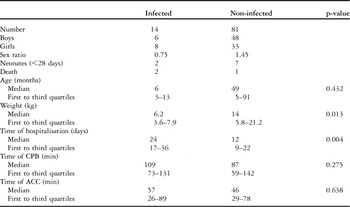
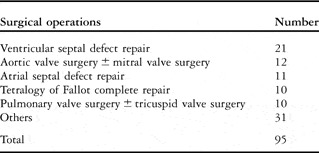
A total of 95 children were included in the study, representing 59% of the children who underwent cardiac surgery with cardiopulmonary bypass during the study period (n = 161). Table 1 shows the characteristics of this population. The sex ratio was 1.3 (54 boys and 41 girls). The different interventions used are shown in Table 2. Details of cardiopulmonary bypass time, aortic cross-clamping time, and duration of hospitalisation were collected for each child (Table 1). The median time of cardiopulmonary bypass was 90 minutes ranging from 62 to 140 minutes. There were two children who had a cardiac arrest during their intervention, 22 and 29 minutes, respectively; they were not considered infected and had a simple post-operative follow-up.
Characteristics of children.

ACC = aortic cross-clamping; CPB = cardiopulmonary bypass
Operative procedures.

Infection status
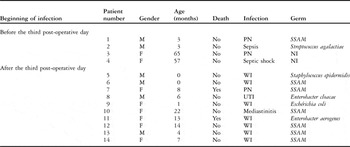
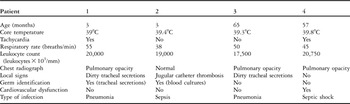
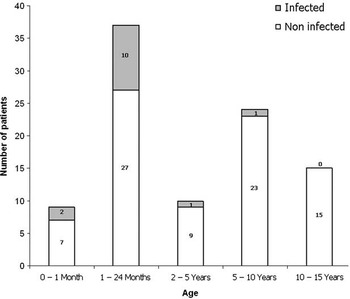
Our experts categorised 14 children with an infection; four before the third post-operative day. Thus, in our cohort of suspected infected children, the prevalence of infection before the third post-operative day was 7% in 56 children who had a procalcitonin measurement before the third post-operative day; four were deemed infected. After the third post-operative day, the prevalence of infection was 25% in 39 children tested during this period; 10 were classified as infected. The different types of infection encountered are reported in Table 3. In two cases, no germ was found, but clinical, biological, and radiological signs allowed the diagnosis of bacterial infection. Clinical, laboratory, and imaging details relating to early infections – before the third post-operative day – are reported in Table 4. The majority of infected children were aged less than 2 years (Fig 1). Out of the 81 uninfected children, eight developed systemic inflammatory response syndrome, six before and two after the third post-operative day.
Types of infection encountered.

F = female; M = male; NI = non-identified; PN = pneumonia; SSAM = sensitive Staphylococcus aureus to Méticillin; UTI = urinary tract infection; WI = wound infection
Clinical, biological, and imaging details of infections encountered before the third post-operative day.

Core temperature was measured by rectal probe. Tachycardia was defined as a mean heart rate above 2 standard deviations for age in the absence of external stimulus, painful stimuli, or chronotropic drugs. Cardiovascular dysfunction was defined as the persistence of signs of decreased perfusion despite administration of isotonic intravenous fluid bolus more than 40 millilitres per kilogram in 1 hour.
Infection status by age for children undergoing cardiac surgery with cardiopulmonary bypass. Despite children in our cohort being mostly aged above 2 years – 49 versus 46 – infected children were mainly aged below 24 months – 12 versus 2.

Procalcitonin level
Comparison of medians
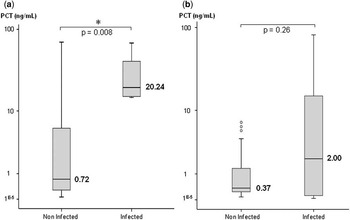
Before the third post-operative day, the median procalcitonin level was 20.24 nanograms per millilitre with a 25th and 75th interquartile of 15.52–35.71 in the infected group versus 0.72 nanograms per millilitre with a 25th and 75th interquartile of 0.28 to 5.44 in the non-infected group. The difference between the two groups was significant (p = 0.008; Fig 2). After the third post-operative day, the median rate of procalcitonin was 2 nanograms per millilitre with a 25th and 75th interquartile of 0.18–12.42 for the infected group versus 0.37 nanograms per millilitre with a 25th and 75th interquartile of 0.24–1.32 for the non-infected group. The difference between the two groups was not significant (p = 0.26).
Procalcitonin concentration after cardiopulmonary bypass in children according to infectious status. (a) Before the third post-operative day, the difference between the two groups was significant (p = 0.008). (b) After the third post-operative day, the difference was not significant (p = 0.26). The procalcitonin level is expressed in nanograms per millilitre. Boxes represent the first and third quartiles, horizontal lines represent medians, and whiskers indicate 10–90 percentiles. Open circles represent outliers. A Mann–Whitney U-test was used to compare the medians.

Receiver operating characteristic curves
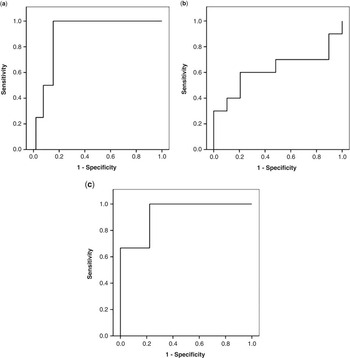
Before the third post-operative day, the procalcitonin value that gave the best compromise between sensitivity (100%) and specificity (85%) was 13 nanograms per millilitre with 95% confidence intervals from 51 to 100 and from 72 to 91, respectively (Fig 3).
Receiver operating characteristic curves for the diagnosis of infection after cardiopulmonary bypass in children. (a) Procalcitonin measurement made before the third post-operative day, as soon as infection was suspected. Area under the curve is 0.89 with 95% confidence intervals from 0.80 to 0.97. (b) Procalcitonin measurement made after the third post-operative day, as soon as infection was suspected; area under the curve is 0.62 with 95% confidence intervals from 0.47 to 0.77. (c) After the third post-operative day, a second procalcitonin measurement performed with an interval of 24 hours yielded an area under the curve of O.92 with 95% confidence intervals from 0.83 to 1.00.

After the third post-operative day, a procalcitonin value of 0.38 nanograms per millilitre provided a sensitivity of 70% with 95% confidence intervals from 39 to 89 and a specificity of 52% with 95% confidence intervals from 34 to 68. A second assay performed within an interval of 24 hours improved the sensitivity of the test – 100% with 95% confidence intervals from 72 to 100 – with no effect on specificity – 52% with 95% confidence intervals from 34 to 68.
Sensitivity, specificity, predictive values, and likelihood ratios
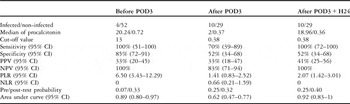
Before the third post-operative day, the positive predictive value was 33% with 95% confidence intervals from 20 to 45 for a negative predictive value of 100%. When the test was positive, the post-test probability (0.33) was 4.7 times the pre-test probability (0.07). All children with an early post-operative infection had increased procalcitonin values that were over 13 nanograms per millilitre.
After the third post-operative day, the positive predictive value was 33% with 95% confidence intervals from 18 to 47 and the negative predictive value was 83% with 95% confidence intervals from 71 to 94. For a positive test, the post-test probability (0.32) was 1.3 times the pre-test probability (0.25). A second procalcitonin measurement performed 24 hours after the beginning of suspected infection improved both the positive predictive value – 41% with 95% confidence intervals from 25 to 56 – and the negative predictive value (100%). In this case, when the test was positive, the post-test probability (0.40) was 1.6 times the pre-test probability (0.25). Results are reported in Table 5.
Procalcitonin cut-off value, according to the post-operative day, for the diagnosis of bacterial infection after cardiopulmonary bypass in children.

H24 = 24 hours after the beginning of suspected infection; NLR = negative likelihood ratio; NPV = predictive negative value; PLR = positive likelihood ratio; POD = post-operative day; PPV = predictive positive value
Procalcitonin is expressed in nanograms per millilitre
Discussion
Procalcitonin seems to be a discriminative marker of bacterial infection following cardiac surgery with cardiopulmonary bypass in children. Before the third day, a cut-off of 13 nanograms per millilitre resulted in sensitivity, specificity, and positive and negative likelihood ratio values of 100%, 85%, 6.5%, and 0%, respectively. The area under the curve was 0.89%. This initial post-operative period is critical for physicians who require an early diagnosis of an infection because of a high lethal risk for children. False positives are represented by children who develop systemic inflammatory response syndrome without any infection, and paradoxically, their procalcitonin level is higher than that of infected children. The usefulness of procalcitonin as a diagnostic tool is especially illustrated by the post-test probability: if the test is positive – procalcitonin level above 13 nanograms per millilitre – children have a 33% risk of being infected, whereas this risk is almost null if the test is negative – procalcitonin level below 13 nanograms per millilitre – avoiding unnecessary treatments, non-initiation, or early termination.
In contrast, after the third post-operative day, the procalcitonin value appears less discriminative because a cut-off of 0.38 nanograms per millilitre resulted in sensitivity, specificity, and positive and negative likelihood ratios of 70%, 52%, 1.41%, and 0.66%, respectively. However, this diagnostic value is really improved by a second dosage performed 24 hours later using the same cut-off values of sensitivity, specificity, and positive and negative likelihood ratios of 100%, 52%, 2.07%, and 0%, respectively. This is in agreement with previous studies, which hypothesised that a double peak of procalcitonin or high values after the third post-operative day could signal infection.Reference Beghetti, Rimensberger, Kalangos, Habre and Gervaix11
Threshold values that were previously identified as defining normality ranged from 1.1 to 2.2 nanograms per millilitre for the first post-operative days.Reference Hammer, Loeff and Reichenspurner10–Reference McMaster, Park and Shann15 This difference is probably explained by the use of new definitions of paediatric infection,Reference Goldstein, Giroir and Randolph18–Reference Langley21 whereas previous studies were based on older adult infection definitions (1992).Reference Bone, Balk and Cerra23 The distinction of several age groups with regard to clinical and constant biological values allows us more precision, whereas previous misclassification might have concerned cases of systemic inflammatory response syndrome. Moreover, in this population of children who underwent cardiac surgery with cardiopulmonary bypass (n = 161) the prevalence of infection was low (8.7%), whereas in other studies the prevalence usually ranged from 16% to 38%.Reference Mehta, Cunningham, Colella, Alferis and Weiner24–Reference Grisaru-Soen, Paret, Yahav, Boyko and Lerner-Geva28. The early post-operative infections are represented by deep infections such as pneumonia and sepsis, whereas late infections are more frequently superficial. In their previous study, which compared the procalcitonin level in infected versus non-infected children, McMaster et alReference McMaster, Park and Shann15 were interested only in procalcitonin values until the fifth post-operative day. No distinction was made according to the normal procalcitonin rise in the immediate 2–3 days after cardiopulmonary bypass. Consequently, high values of the first post-operative days, before the third day, might have been reduced.
The main limitation of our study lies in its retrospective and observational aspect. The distinction between infection and systemic inflammatory response syndrome is a crucial point of the study design. However, it is not possible to formally exclude misclassification, even if diagnosis, based on the international paediatric sepsis consensus recommendations using clinical and biological criteria with adjustments for age, was determined by two experimented physicians blind to each other. In addition, we do not have data for all of the children who underwent cardiopulmonary bypass, but only for those suspected of post-operative infection, which represented 59% of the population. Moreover, the small number of infected children explains why the confidence intervals for sensitivity and specificity were relatively wide.
Using clinical symptoms or the usual biological tests, it is really difficult to make a distinction between cardiopulmonary bypass consequences – capillary leak syndrome, pulmonary oedema, transient congestive cardiac failure, etc. – and infection, even for the most experienced clinicians. Use of antibiotics is very common and is often based on clinical impression because the results of bacteriological samples are available a few days after their collection. On the basis of such results, it should now be possible to consider, in combination with the usual clinical and biological tools, indications for antibiotics prescription when procalcitonin is below 13 nanograms per millilitre before the third post-operative day. In every instance, the kinetics of procalcitonin can help the clinician to decide whether to continue the antibiotic therapy. Therefore, the procalcitonin measurement must be repeated during the post-operative period.