Chi jiu zhi ji Tang zhi wu 赤
 之集湯之屋 [When red pigeons gathered on Tang's House] is a bamboo-slip manuscript of the Warring States period (475–222 bce) written in the script of the southern state of Chu 楚, now in the Tsinghua University collection.Footnote
1
It concerns figures that are well known in early Chinese literature: Tang 湯, the founder of the Shang dynasty; his wife; his minister Yi Yin 伊尹, here called by the title xiaochen 小臣 (“minor servitor”); and the last king of the Xia dynasty, here called simply the Xia Lord (xia hou 夏后). The main part of the manuscript is a tale in which Xiaochen (Yi Yin) is possessed by a spirit medium in the form of a raven and cures the illness of the Xia Lord. This account of spirit possession is unique in pre-Han literature. Moreover, although the actors are frequently found in accounts of early Chinese history, the story has no apparent political or philosophical import and concludes as an explanation about an architectural feature on houses. I will argue below that it is similar to “historiolae” that construct narratives based upon known mythical figures to legitimise and give power to ritual acts – in this case, a rite associated with house construction.
In the following, I will first discuss some physical aspects of this bamboo-slip manuscript and its relationship to two other manuscripts in the Tsinghua collection with which it was bound, Yin zhi 尹至 and Yin gao 尹誥.Footnote 2 I will then translate Chi jiu zhi ji Tang zhi wu (hereafter abbreviated as Chi jiu) into English. This will be followed by a review of Yi Yin's conventional role in early texts as a founding minister and an explication of the text of the manuscript.
The Manuscript
The Warring States’ period manuscripts in the Tsinghua collection were not archaeologically excavated but looted by tomb robbers and recovered after they had been smuggled to Hong Kong. Comparison of the script forms with that on the bamboo-slip manuscripts excavated from Tomb One at Guodian in Hubei Province and radio-carbon dating suggest that they were buried around 300 bce.Footnote 3 The tale recounted in Chi jiu is set some 1,300 years earlier, but the language of the manuscript is that of the period in which it was buried and there is no internal evidence for earlier origin.
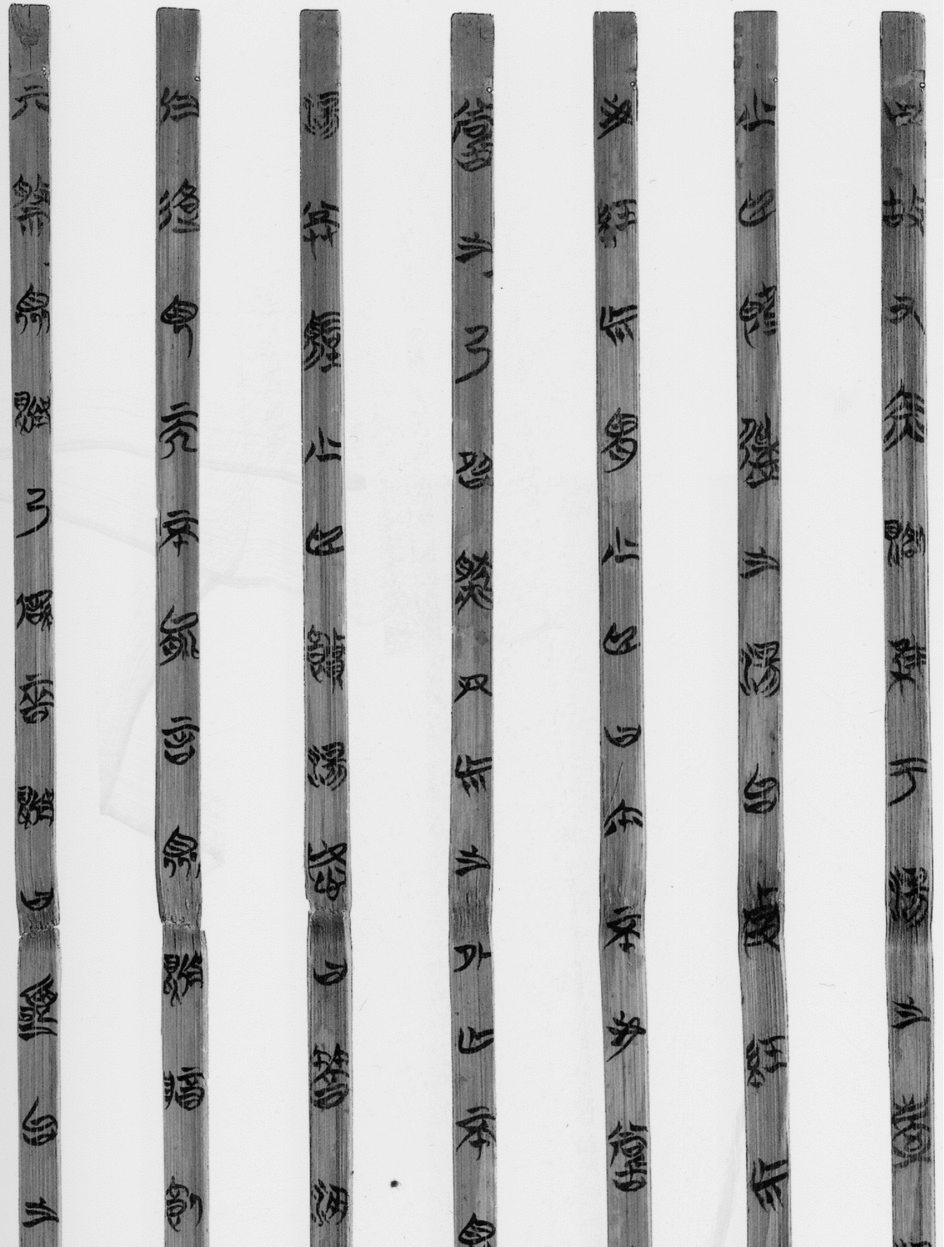
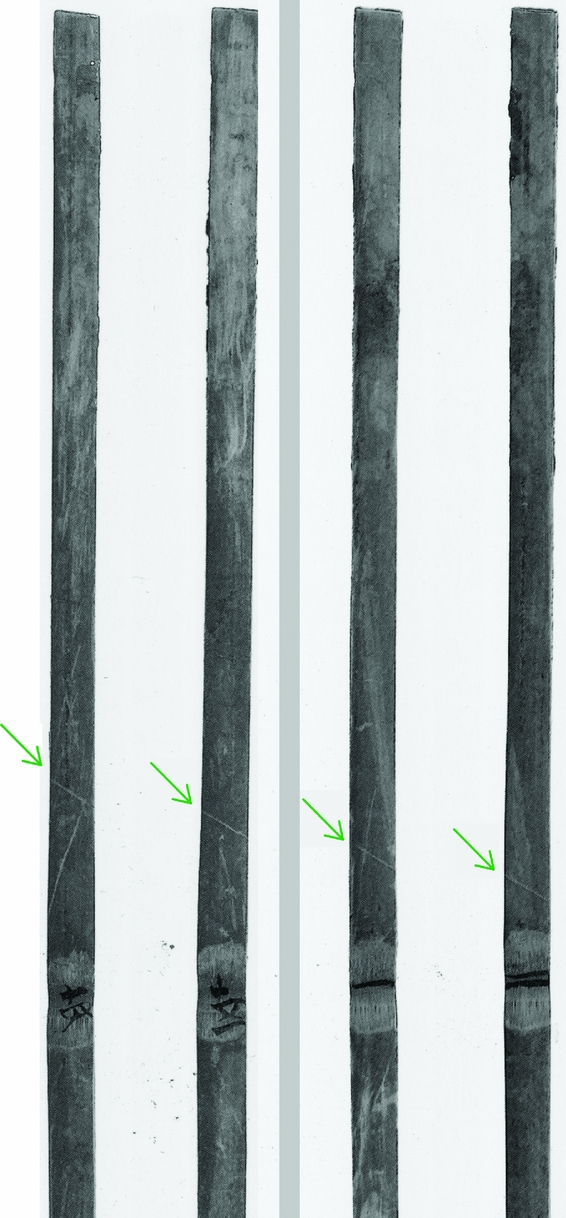
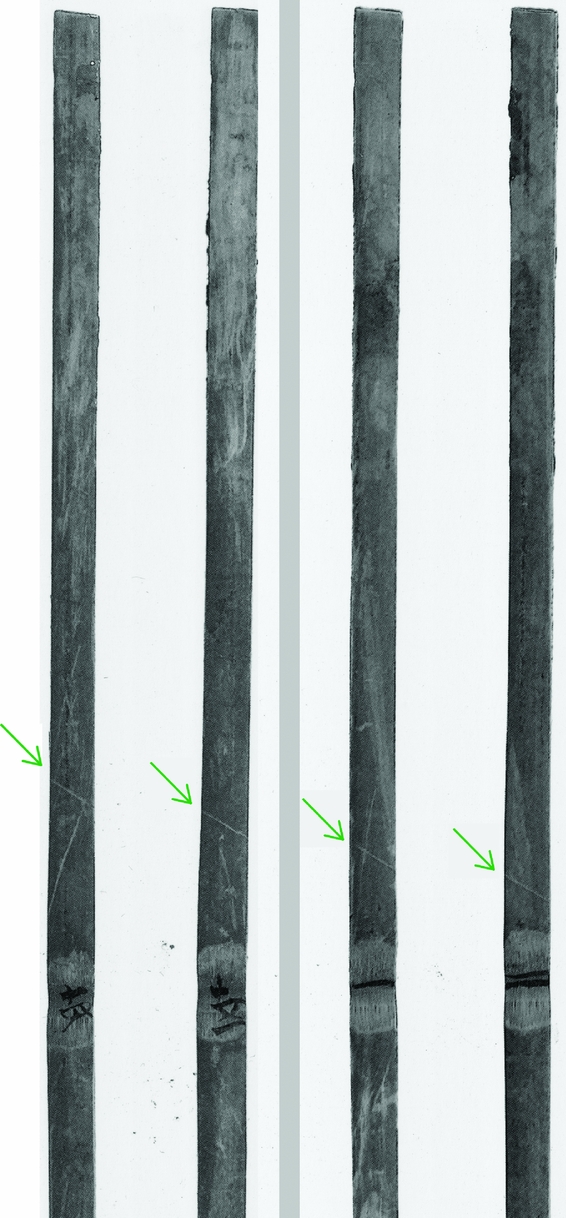
Chi jiu has fifteen slips. The slips are numbered on the reverse side. The manuscript is self-named: the title, Chi jiu zhi ji Tang zhi wu is written on the reverse of Slip 15. It is taken from the first line (see Fig. 1, Slip 1, Graphs 3–10, you chi jiu ji yu Tang zhi wu 有赤鳩集于湯之屋, “there were red pigeons gathering on Tang's house”). The slips are 45 cm. in length and there were originally three cords. The slips are intact except for Slips 1 and 2, which are broken at the bottom end and missing one graph each. Like many of the manuscripts in the Tsinghua collection, the bamboo slips are marked by a faint line that runs at an angle from upper left to lower right across the reverse side (originally the inside of the bamboo stalk). In the case of Chi jiu, the slip sequence indicated by the numbering on the reverse side and that indicated by this oblique line correspond to one another. However, this is not always the case. In some manuscripts, individual slips appear to have been replaced or the slips mixed up before binding, so that the line does not correspond to the narrative. Thus, the lines were not cut after the manuscript was bound and probably resulted from some process used in cutting the bamboo stalk or in preparing the slips for writing. They were not deliberately cut in order to preserve the sequence of the manuscript should the cords break.Footnote 4
Top of Chi jiu zhi ji Tang zhi wu, Slips 1–7. After Li Xueqin 李學勤, (ed.), Qinghua Daxue cang Zhanguo zhujian, Vol. 3 清華大學藏戰國竹簡 (Shanghai, 2012), part 1, p. 20.

As noted above, Yi Yin is the main figure in two other manuscripts in the Tsinghua collection, Yin zhi and Yin gao. Yin zhi has five slips and Yin gao has four. They are numbered separately on the reverse sides of the slips. Judging from slip length, the number of cords and the distance between them, the three manuscripts were bound together as a single scroll.Footnote 5 Moreover, the oblique line on the reverse of the Chi jiu continues onto the first three slips of Yin zhi. A line on Yin zhi also continues onto Yin Gao.Footnote 6 (See Fig. 2.) Xiao Yunxiao has observed that the sequence of the manuscripts in the scroll reflects a historical progression. In Chi jiu, Xiaochen goes from the court of Tang to the Xia. Yin zhi begins with the line, “It was when Yin went to Bo 白 (亳) from Xia and reached Tang”. Yin gao begins with, “It was when Yin had already reached Tang and they were entirely united in their virtue”.Footnote 7 However, the language and style of Chi jiu is very different from Yin zhi and Yin gao.
Reverse of Chi jiu zhi ji Tang zhi Wu, Slips 14 and 15, and reverse of Yin Zhi, Slips 1 and 2, showing oblique line cut across back. After Qinghua Daxue cang Zhanguo zhujian, Vol. 3, part 1, p. 22 and vol. 1, part 1, p. 3.
Chi jiu is written in a lively style that suggests a folktale and its language has no archaistic features, whereas the literary form and language of Yin zhi and Yin gao are readily identified with the Shang shu 尚書.Footnote 8 Indeed, the editors of Qinghua Daxue cang Zhanguo zhujian have speculated that Yin gao might be the lost chapter mentioned in the “Preface” to the Shang shu, where it is called “Xian you yi de” 咸有一德.Footnote 9 Thus, the three manuscripts were probably placed in chronological order and bound together because they all concerned Yi Yin. This type of loose grouping is also found among other Chu-script bamboo-slip manuscripts; for example in the Shanghai Museum collection, Zigao 子羔, Kongzi shi lun 孔子詩論 and Lubang da han 魯邦大旱 appear to have been bound together because they all concern Confucius. I have proposed elsewhere that these loose groupings reflect a transitional stage in Chinese textual history. Such scrolls are not ‘texts’ in the sense that the manuscripts bound in the same scroll were repeatedly transmitted as a unit, but they were deliberately bound together.Footnote 10
Translation and Text of Chi jiu zhi ji Tang zhi wu
The translation of Chi jiu below is based upon the modern-character readings that follow it. There are some paleographic problems in the manuscript, but the sense is generally clear. My readings agree with those given in Qinghua Daxue cang Zhanguo zhujian unless otherwise noted. I only provide images or direct transcriptions of the Chu graphs where the decision about what word is represented is problematic. For ease of cross reference, I have provided the slip number in subscript in both the modern-character text and the translation. These are given at the beginning of each slip. For convenience of discussion, I have divided the text into five sections marked with Roman numerals.
I
1It is said: in ancient times, there were red pigeons gathering on Tang's house. Tang shot at them (with bow and arrow), got one, and then commanded Xiaochen: “Make a fine thick soup and I will eat it.” Tang went to [place name]. 2When Xiaochen had made the soup, Tang's wife, Ren Huang, said to Xiaochen: “Let me taste your soup.” Xiaochen did not dare to let her taste it, saying, “The lord will kill me.” Ren Huang said to Xiaochen, “If you do not let me taste it, will I not also kill you?”
Xiaochen presented the soup to Ren Huang from below the hall. Ren Huang received it from Xiaochen and tasted it; then, in a flash, there was nothing she could not see [as far as] beyond the four wildernesses. When Xiaochen received what she had left over and tasted it, in a flash, there was nothing he could not see [as far as] beyond the four seas.
1曰古有赤鳩(
),Footnote
11
集于湯之屋, 湯射之,Footnote
12
獲之, 乃命小臣曰:「旨羹之, 我其亯之。」湯往□Footnote
13
。2小臣旣羹之, 湯后妻紝巟Footnote
14
謂小臣曰:「嘗我於尓羹。」小臣弗敢嘗, 曰:「后其殺 3我。」紝巟謂小臣曰:「尓不我嘗, 吾不亦殺尓?」
小臣自堂下授紝巟羹。紝巟受小臣而4嘗之, 乃昭然, 四荒之外, 無不見也; 小臣受其餘而嘗之, 亦昭然, 四海之外, 無不見也。
II
5When Tang returned from [place name], Xiaochen served him. Tang became angry and said, “Who has been taking my soup?” Xiaochen was afraid and fled to Xia. Tang then [put a spell on] him, whereupon Xiaochen felt sleepy and lay down on the road. He saw, but he could not speak.
A flock of ravens were about to eat him, [but] a spirit-medium raven said: “This is Xiaochen. He cannot be eaten. The Xia Lord has an illness and is about to perform a rite to ease the pain; go and eat his offerings.”
5湯返
 Footnote
15
, 小臣饋。湯怒曰:「孰調Footnote
16
吾羹?」小臣懼, 乃逃于夏。湯乃□Footnote
17
之, 小臣乃寐Footnote
18
而寢6於路, 視而不能言。
眾烏將食之。巫烏曰:「是小臣也, 不可食也。夏后有疾, 將撫楚Footnote 19 , 於食7其祭。」
III
The many ravens then questioned the spirit-medium raven, saying: “The Xia Lord's illness – what is the reason for it?” Then the spirit-medium raven said, “The Thearch ordered two yellow snakes and two white rabbits to live in the beams of the bedroom of the Lord, who was dwelling below and became ill. This caused the Lord's heart disease to become so acute that he did not recognize people. The Thearch ordered the Lord of Earth (Hou Tu 后土) to make two mounds and they lived together beneath the Lord's bed and infected the Lord's body above. This caused the Lord's body to have sores and he cannot rest (comfortably) on his mat.”
眾烏乃訊巫烏曰:「夏后之疾如何?」
巫烏乃言曰:「帝命二黃蛇與二白兔居后之寢8之棟, 其下舍后疾, 是使后
 Footnote
20
疾而不知人。帝命后土爲二陵屯, 共居后之牀下, 其9上
 (刺)Footnote
21
后之體, 是使后之身屙
 Footnote
22
, 不可及于席。」
IV
The many ravens then left. Thereupon, the spirit-raven occupied Xiaochen's throat and digestive tract, and Xiaochen arose and went ahead.
When he reached the Xia Lord, the Xia Lord said: “Who are you?”
Xiaochen said: “I am a celestial spirit-medium.”
The Xia Lord then asked Xiaochen: “If you are a celestial spirit-medium, then you should know the reason for my illness.”
Xiaochen said, “I [do] know.”
The Xia Lord said, “What is it?”
Xiaochen said: “The Thearch ordered two yellow snakes and two white rabbits to live in the beams of the bedroom of my lord; my lord was dwelling below and became ill. This caused my lord to become so dim and confused that he did not recognise people. The Thearch ordered the Lord of Earth to make two mounds and [the snakes and rabbits] lived together beneath your bed and infected my lord's body above. This caused your good mind/heart to become confused and disordered. If you demolish the house and kill the yellow snakes and white rabbits, dig the ground and raze the mounds, your illness will recover.”
眾烏乃往。巫烏乃歝小臣之喉胃,10 小臣乃起而行, 至於夏后。夏后曰:「尓惟
 ??」
小臣曰:「我天巫。」
夏后乃訊小臣曰:「如尓天巫,11 而知朕疾?」
小臣曰:「我知之。」
夏后曰:「朕疾如何?」
小臣曰:「帝命二黃蛇與二白兔, 居后之寢12室之棟, 其下舍后疾, 是使后棼棼眩眩而不知人。帝命后土爲二陵屯, 共居后之牀下,13 其上刺Footnote 23 后之身, 是使后昏亂甘心。后如撤屋, 殺黃蛇與白兔, 發地斬陵。后之疾其瘳。」
V
The Xia Lord then did as Xiaochen told him and demolished the house. He killed the two yellow snakes and one white rabbit. He then excavated the ground. There were two mounds and he razed them. One of the two rabbits was not caught. This is why they began to make parapets on houses; they were for keeping out the white rabbit.
14夏后乃從小臣之言, 撤屋, 殺二黃蛇與一白兔;乃發地, 有二陵屯Footnote
24
, 乃斬之。其一白兔15不得, 是始爲陴Footnote
25
 Footnote
26
諸屋, 以禦白兔。
Historiolae
The characters in Chi jiu are familiar from transmitted literature, but the tale does not function within the historical and political discourse in which they usually appear. A possible explanation is that the story functioned as an historiola: that is, it was a mythical narration that made use of well-known figures from historical legend to provide justification for rites associated with house building. I take the term ‘historiola’ from David Frankfurter's classic article, “Narrating Power”, in which he defines such texts as a form of narration in which a mythical paradigm is used to render power to magical rites, particularly healing rites, in the ancient Near East (Babylonia, Egypt), the Classical world of Greece and Rome, and later Christian Europe. Gil Raz has also used this concept to understand stories associated with later Daoist ritual magic.Footnote 27 Told in a ritual context, the power of the oral narration lent authority to rites. According to Frankfurter, historiolae involve “performative transmission of power from a mythic realm articulated in narrative to the human present”.
An important aspect of such historiolae – also useful in understanding the bamboo manuscript – is that they are not variations of other myths, even though classicists frequently attempt to analyse them in relationship to myths with which they share actors and sometimes regard them as ad-hoc inventions when they do not agree with the accounts found in the related mythology. Instead, such stories make use of the power of mythical prototypes for their own purposes. They thus “formulate rules that exert authority of their own on the events to follow”.Footnote 28 We have no means of determining whether Chi jiu was technically a historiola: that is, we do not know whether it was narrated aloud to give power to a ritual act. Nevertheless, we can make sense of it by reading it as a tale told in association with a rite of exorcism conducted upon the placement of a parapet on the roof in order to prevent illness among the occupants.
Yi Yin as a Founding Minister
The name Yi Yin appears in the earliest written materials in China – the divination inscriptions of the late Shang dynasty (c. 1600–1050 bce), popularly called oracle bone inscriptions. In these inscriptions, he receives sacrifices and exercises powers in a similar manner to powerful ancestral spirits of the Shang royal house. Oracle bone scholars have generally assumed that he was the minister of the Shang founder, Tang, mentioned in later texts, but, to my knowledge, there is no direct evidence of an association with Tang in the inscriptions. K. C. Chang, who hypothesised that the Shang royal lineage was divided into moieties, theorised that Yi Yin was the ancestor of one of them, but there is also no direct evidence in oracle bone inscriptions that might confirm this.Footnote 29
In Warring States period texts, Yi Yin most commonly takes the role of a ‘founding minister’ who assists in establishing the Shang dynasty. In pre-Han political philosophy, such ministers play a critical role in establishing the legitimacy of a non-hereditary ruler. By attracting men of worth [xian 賢] to their service and appointing them in spite of their low social position, the future rulers demonstrate the power of their own virtue (de 德). This appointment of a man of worth, who was labouring in a menial capacity when he met the future king, is critical to the idea of a dynastic cycle. In this role, Yi Yin is most often classed with Taigong Wang 太公望, who assisted Kings Wen 文 and Wu 武 in founding the Zhou dynasty. Taigong Wang is variously described as fishing, chopping meat in a market or working as a boatman when he met King Wen. Footnote 30 Similarly, Yi Yin was a ‘cook’ or ‘preparer of meat’ [pao 庖, zai ren 宰人], or a “carrier of the ding-tripod and sacrificial stand” [fu ding zu 負鼎俎] in the service of Tang's wife.Footnote 31 The prototype for Yi Yin and Taigong Wang in the pre-dynastic era is Shun 舜, who was labouring in the fields when he was raised up by Yao 堯. Some ministers of the Warring States period hegemons are given similar roles, as is Fu Yue 傅說, who aided Wu Ding in restoring the Shang dynasty.
In the following passage from the Mozi, we find Yi Yin (here called Yi Zhi 伊摯) described as the personal servant [si chen 私臣] of a woman of the Youxin 有莘 family. As I shall discuss below, this name is that commonly found in transmitted texts for Tang's wife.
In former times, Shun plowed at Mount Li, potted on the bank of the [Yellow] River, and fished at Lei Marsh. Yao got him on the south side of Fu Marsh and raised him up as Son of Heaven. He gave the government of all-under-heaven over to him to rule its people. Yi Zhi [i.e. Yi Yin] was the personal servant of the woman of the Youxin family and was himself a kitchen worker. Tang got him and raised him up as prime minister. He gave the government of all-under-heaven over to him to rule its people. Fu Yue wore hemp clothing and a rope girdle; he worked as a forced laborer at Fu Yan; Wu Ding got him and raised him up as [one of the] Three Dukes. He gave the government of all-under-heaven over to him to rule its people.
古者舜耕歷山, 陶河瀕, 漁雷澤。堯得之服澤之陽, 舉以為天子, 與接天下之政, 治天下之民。伊摯, 有莘氏女之私臣, 親為庖人, 湯得之, 舉以為己相, 接天下之政, 治天下之民。傅說被褐帶索, 庸築乎傅巖, 武丁得之, 舉以為三公, 與接天下之政, 治天下之民。Footnote 32
Just as Yao plowed in the fields, Yi Yin was the personal servant and a cook, and Fu Yue was a forced labourer. The point of these encapsulated tales here is that the wise rulers nevertheless raised them up and gave them power (as future ruler, minister, or one of the three lords); thus they were able to rule the people.
The Lüshi chunqiu 呂氏春秋, completed c. 239 bce, is the richest pre-Han source for myth and legend concerning Yi Yin. In this passage, it reflects a very different political philosophy from that of the Mozi passage translated above, but it also stresses the ruler's necessity of having a worthy minister if one is to achieve hegemony or kingship.
To cross a river, one depends upon a boat; to go far, one depends upon a thoroughbred; to be a hegemon or king, one depends upon a man of worth. Yi Yin, Lü Shang (i.e., Taigong Wang 太公望), Guan Yiwu, Boli Xi, were the boats and thoroughbreds of the hegemons and kings. To let go of one's fathers, elder brothers, sons and younger brothers is not (because one wants) to alienate them. To employ kitchen workers and fishermen or enemies and captive servants is not [because one wants] to elevate them. The way of holding onto the altars of earth and grain and establishing a meritorious name cannot be achieved without obtaining them. . . . Therefore, Xiaochen and Lü Shang obeyed and all under the sky recognsed the kings of Yin and Zhou; Guan Yiwu and Boli Xi obeyed and all under the sky recognized the hegemony of Qi and Qin.
絕江者託於船, 致遠者託於驥, 霸王者託於賢。伊尹、呂尚、管夷吾、百里奚, 此霸王者之船驥也。釋父兄與子弟, 非疏之也;任庖人釣者與仇人僕虜, 非阿之也;持社稷立功名之道, 不得不然也。猶大匠之為宮室也, 量小大而知材木矣, 訾功丈而知人數矣。故小臣、呂尚聽, 而天下知殷、周之王也;管夷吾、百里奚聽, 而天下知齊、秦之霸也;豈特驥遠哉?Footnote 33
Significantly, Yi Yin is called “Xiaochen” in this passage, as he is in Chi jiu, thus confirming that this term was used as a name for Yi Yin in the third century bce. Its inference here is unclear. Chen means ‘servant’ or ‘subject’ and also ‘minister’ (similarly, in the British tradition, ministers are ‘servants’ to the king). Xiao chen 小臣 is also used as an official title in both Shang oracle bone and Western Zhou bronze inscriptions. However, Yi Yin's role in Chi jiu is that of a cook rather than a minister, and in the Mozi passage translated above, he was a called the personal servant [si chen] of Tang's wife. So, Xiaochen in Chi jiu is more likely to refer to Yi Yin's role as a ‘little servant’ cooking for Tang's wife rather than to an official rank.
The Mozi, which advocates raising up men of worth [shang xian 尚賢], stresses the low position of the founding ministers. In some transmitted texts, however, the men of worth are recluses and deliberately take humble roles. This tradition is found in the Shi ji 史記 account in which Yi Yin deliberately became a cook in order to meet Cheng Tang and convince him to follow the path of a true king:
Yi Yin's personal name was E Heng. E Heng wished to importune Tang, but had no means. Therefore he became a servant of the Lady of the Youxin clan. He carried the ding-tripod and sacrificial stand on his back and persuaded Tang to follow the way of kings by [discussing] the flavors.
伊尹名阿衡, 阿衡欲奸湯而無由, 乃為有莘氏媵臣負鼎俎, 以滋味說湯致于王道。Footnote 34
Whether such men are described as of lower social class or as gentlemen in seclusion during the rule of a bad king depends upon the ideology of the writer. Nevertheless, in all such references to founding ministers, their low status is a trope that functions to allow a sage ruler to demonstrate his insight into human character and humility. By raising up Yi Yin and Taigong Wang, Tang and King Wen established their own worthiness to rule, as well as gaining the services of a sage who is capable of assisting them in establishing new rule.Footnote 35
Chi jiu does not discuss these historical models as a means of articulating a political or philosophical stance; instead, it takes these personages with their well-known attributes and makes them into characters in a tale which functions in a different context. Yi Yin's role as a cook in the entourage of Tang's wife in the historical and philosophical tradition is his best-known feature, so we may reasonably assume that it is the source of Xiaochen's role as a cook for Tang's wife in Chi jiu. Cooking has a further dimension within a discourse of the late Warring States period, well explored by Roel Sterckx in Food, Sacrifice, and Sagehood in Early China. In this discourse, cooking serves as a metaphor for government or, more broadly, for self-cultivation and/or cosmic harmony. Moreover, the five flavours [wu wei 五味] become part of a developing correlative system.Footnote 36 Thus, in the founding minister legend discussed above, Yi Yin convinced Tang of his worthiness by discussing harmonization of the flavours. However, in Chi jiu, the flavours are not mentioned and the only soup ingredient given in the text is red birds. Furthermore, after making the soup, Xiaochen fled to the Xia Lord. He did not impress Tang with his sagacity by a discussion of the flavours. Thus, this discourse is not an aspect of the tale recorded in the manuscript.
Tang's Wife and the Myth of Yi Yin's Birth
In Chi jiu, Tang's wife is called Ren Huang, but in transmitted texts she is called by the clan name Youxin 有辛 [varied as Youxin 有莘 or Youshen 有侁]. If, as Wang Ning 王寧 has suggested, Ren 紝 is her given name and huang 巟 should be read as huang 媓, a title for wives of rulers, there is no conflict between the name in the bamboo manuscript and that in transmitted literature.Footnote 37 The association of Yi Yin with Tang's wife is intertwined with a myth in which his pregnant mother turned into a hollow mulberry tree.
The earliest reference to this myth is found in the “Tian Wen” 天問 chapter of the Chu ci 楚辭, a text associated with the state of Chu and traditionally dated to the late fourth century bce, not long before the Tsinghua manuscripts were buried:
From the tree by the water's edge, they got that small child. Why was he hated and the woman of Youxin sent off in marriage.
水濱之木, 得彼小子, 夫何惡之, 媵有莘之婦?
The second-century commentator, Wang Yi 王逸, explains:
When Yi Yin's mother was pregnant, she dreamed that a spirit girl told her, “When the mortar and stove produce frogs, leave quickly and don't look back. Not a long while later, the mortar and stove produced frogs and his mother left, going eastwards. When she looked back towards her city, it was completely flooded. The mother drowned and turned into a hollow mulberry tree. After the water dried up, a small child was crying by the river and someone took him and brought him up. When he grew up, he had unusual talents. Youxin was repelled that Yi Yin came from the tree, so he sent off his daughter [in marriage].
伊尹母姙身, 夢神女告之曰:「臼竈生蛙, 亟去無顧」。居無幾何, 臼竈中生蛙, 母去東走, 顧視其邑, 盡為大水。母因溺死, 化為空桑之木。水乾之後, 有小兒啼水涯, 人取養之。既長大, 有殊才。有莘惡伊尹從木中出, 因以送女也。Footnote 38
Although Wang Yi's commentary is relatively late, the Lüshi chunqiu provides a similar account and makes it clear that this myth is the source of Yi Yin's relationship with Tang's wife:
A girl of the Youshen (clan) was picking mulberries, found an infant in the middle of a hollow mulberry and presented it to her lord. Her lord ordered a servant to care for it. He investigated how it came about, and was told, “His mother lived by the Yi River. When she was pregnant, she dreamed that a spirit said to her, ‘When the mortar emits water, go eastwards and do not look back.” The next day, she saw water come out of the mortar and told the neighbours. Having gone east for ten li, she looked back and saw that her city was completely flooded. Consequently her body turned into a mulberry tree. . . .
有侁氏女子採桑, 得嬰兒于空桑之中, 獻之其君。其君令烰人養之。察其所以然, 曰:『其母居伊水之上, 孕, 夢有神告之曰:「臼出水而東走, 毋顧。」明日, 視臼出水, 告其鄰, 東走十裡, 而顧其邑盡為水, 身因化為空桑』。Footnote 39
The passage goes on to say that Tang asked for Yi Yin, who had grown up to become a worthy, and when he could not obtain him, Tang married the Lady of Youshen, thus placing him once again within the context of obtaining men of worth as a means of establishing rule.
The story that Yi Yin's pregnant mother turned into a hollow mulberry tree is reminiscent of the stories found in the Shi jing 詩經 and other early texts about the birth of the Shang ancestor Xie 契, who was born after his mother swallowed the egg of a black bird. That the tree was a – or the – hollow mulberry (kong sang 空桑) is especially significant, since the Hollow Mulberry is often mentioned in early texts as a dwelling place of the gods or as a cosmic tree that served as an axis mundi between heaven and Earth. As I have discussed previously, Yi Yin's miraculous birth, the Hollow Mulberry and the flooding water are aspects of a complex of myths found in early texts that are associated with the Shang people that also includes the ten suns, who were dark birds and identified with the Shang royal ancestors. These dark [xuan 玄] birds are sometimes identified as swallows, but they also appear as ravens or crows [wu 烏]. Particularly noteworthy in this regard are the silk banners found in Mangwangdui Tombs 1 and 3 in which a raven or crow is depicted in a red sun.Footnote 40
Yi Yin as a Shaman
‘Shamans’, as I understand the term herein, are people with the ability to enter into a trance and communicate with spirits, either by travelling to the other world or through being possessed by a spirit. The Chinese term wu 巫 is often translated as ‘shaman’. However, as the Chinese term wu has a broader meaning, including diviners, conjurers, magicians and healers who do not enter an altered state of consciousness, this translation often causes confusion. As used in this manuscript, wu first refers to the raven that possesses Xiaochen and then to Xiaochen himself who speaks with the raven's voice. Thus, I have translated it as ‘spirit medium’.
In Inside the Neolithic Mind, David Pearce and David Lewis-Williams argue that shamanic activities are rooted in hypnagogic experiences – visions or hallucinations, which range from vivid mental imagery in a state of semi-wakefulness to altered states of consciousness induced by such means as alcohol, rhythmic music and dancing, or psychotropic drugs – that are neurologically engendered and thus common among people of all cultures.Footnote 41 Specialist shamans are simply people who have an innate or specially cultivated ability to enter such states. Because these experiences are commonly associated with unusual visions, shamans are often called ‘seers’. Another common experience is the sensation of flight, which may be why shamans are often associated with birds.
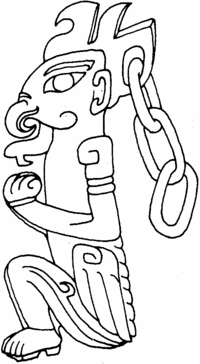
In China, there is evidence of specialist shamans from as early as Erlitou 二裡頭 culture (ca. 2100–1600 bce). This evidence comes from tombs in which the deceased were buried with turquoise plaques decorated with two-eyed motifs placed on their chests, probably indicating their special powers of vision, and with wine vessels made of bronze and jade implements.Footnote 42 In the Shang dynasty (ca. 1600–1050 bce), this two-eyed motif was developed into the taotie 饕餮 motif conventionally found on Shang ritual bronzes.Footnote 43 Moreover, figures that are part-man and part-bird are found on a number of Shang jades. The example illustrated below (Fig. 3), shows a barefoot, crested figure with wings on his thighs and a bracelet on his upper arm. It is from the southern site of the Xin’gan site in Jiangxi Province but related bird-human images are also found at Yinxu.Footnote 44
Jade figure excavated at Xin’gan Dayangzhou. From Jiangxisheng bowuguan 江西省博物館, Jiangxisheng Wenwu Kaogu Yanjiusuo 江西省文物考古研究所, and Xin’ganxian Bowuguan 新干博物館, Xin’gan Shangdai da mu 新干商代大墓 (Beijing: Wenwu, 1997), p. 158.
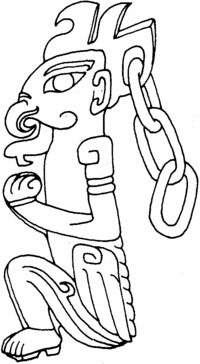
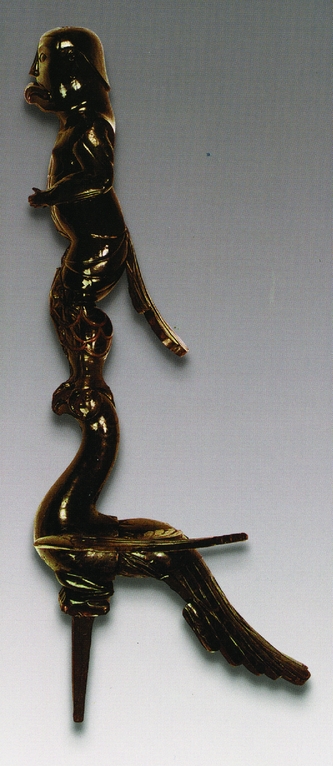
Lacquer figurine of a person with a bird beak, feathered tail and clawed feet standing on the head of a bird. From Tomb 2, Jingzhou Tianxingguan. After Jingzhou Bowuguan 湖北省荊州博物館, Jingzhou zhongyao faxian (Beijing, 2009), p. 94.

The role of shamanism in the Shang dynasty has been much debated since Chen Mengjia proposed an association between kingship and shamans almost eighty years ago.Footnote 45 It is beyond the scope of this paper to review this debate here, especially since the manuscript is in all likelihood a Warring States period composition and cannot be taken as having any historical validity for the Shang period. More relevant are the the Jiu ge 九歌 and Li sao 離騷 of the Chu ci, which have long been recognized as drawing on a shamanic tradition, and artifacts found in contemporaneous burials. In his insightful book, The Shaman and the Heresiarch, Gopal Sukhu argues that these works were not simply inspired by shamanic activities, but draw directly on a tradition of spirit possession. Moreover, this tradition was associated with the wu of the state of Chu.Footnote 46 Thus, although Chi jiu is unique as the earliest direct description of spirit possession in the Chinese tradition, it is consistent with what we already know about Chu culture in this period. Chu tombs have also yielded numerous lacquer artifacts which are difficult to interpret because of the lack of related literary evidence. Of particular interest to us here is the beaked man with a feathered tail and bird feet standing on the head of a long-necked bird from Tomb 2 at Tianxingguan 天星觀 in Jingzhou 荊州. (Guodian is also in Jingzhou.) The tomb is dated to approximately 350–330 bce, so it is a little earlier, but roughly contemporaneous with the presumed burial date of the Tsinghua manuscripts.Footnote 47 While the meaning of the figure cannot be determined with certainty, it could well refer to shamanic flight.
The Soup of Red Pigeons
Chi jiu begins with red birds gathering on Tang's house. I assume that there is more than one bird because the verb is ji 集, to gather. The species of bird is uncertain. The Chu-script graph is made up of niao 鳥 and jiu 咎 and is not known elsewhere. Jiu 鳩 (*ku; phonetic is 九 *kɯɯw), a term which includes smaller birds such as pigeons and doves, is a precise homophone for jiu 咎 and the most obvious loanword, especially since pigeons and doves flock and are commonly eaten as game birds.Footnote 48 The editors of Qinghua zhujian suggest it be read as hu 鵠, a category of long-necked bird that includes cranes and swans. This reading takes the phonetic elements, 告 (*kuugs) and 咎 (*kɯɯw) as interchangeable.Footnote 49 It is based on the following line from the “Tian wen” 天問 chapter of the Chu ci 楚辭 and, especially, the note by the Han Dynasty commentator, Wang Yi 王逸:
Using jade decorated with a border of swans, the lord and Thearch were feasted.
縁鵠飾玉, 后帝是饗。
Wang Yi comments:
This refers to when Yi Yin was first in service, because he boiled a thick soup of cranes and used a jade ornamented ding-tripod to serve Tang. Tang took him as a worthy and made him his minister.
言伊尹始仕, 因緣烹鵠鳥之羹, 修玉鼎, 以事於湯。湯賢之, 遂以為相也。
This comment is suggestive because it mentions a soup of birds. However, as Hou Naifeng 侯乃峰 has argued, Wang Yi could also have used the character for hu as a loan for jiu. Footnote 50 Moreover, Wang Yi's commentary corresponds to the portrayal of Yi Yin as a worthy who persuaded him to follow the Way by his discussion of flavours found in the Shi ji passage translated above, whereas in Chi jiu, Xiaochen flees after Tang notices that his soup has been interfered with, so Tang could not recognise his worthiness by his discussion of the flavours in this tale.
Both pigeons/doves and cranes/swans have symbolic associations in transmitted literature. Cranes (hu), which are migratory, were eaten and associated with renewal and immortality.Footnote 51 Because pigeons (jiu) suck rather than sip liquids, they were considered a good omen for the elderly, who are vulnerable to choking, and were also an omen associated with longevity.Footnote 52 I have not found any references to either chi jiu or chi hu in pre-Han texts, so this bird is not a conventional trope. That it is red is undoubtedly significant. Correlative cosmologies were being developed in this period and since the tale is set at the turn of the Xia and Shang dynasties, we might expect it to be an omen that foretold the establishment of the Shang dynasty. However, the colour does not match the correlative cosmologies for dynasties found in later transmitted texts. Indeed, the Shang were normally associated with white and the Zhou with red. Accordingly, in the Lüshi chunqiu, a red raven [chi wu 赤烏] with a cinnabar document in its beak perched on the Zhou altar in the time of Wen Wang 文王, whose son went on to overthrow the last Shang king and establish the Zhou dynasty.Footnote 53
The narrative function of the soup in Chi jiu is to give Tang's wife and, more importantly, Xiaochen the power to see to the ends of the Earth. Later in the manuscript, Xiaochen, possessed by the raven-spirit is able to heal the Xia Lord. Both suggest shamanic powers. These same motifs of clairvoyance and healing occur in the biography of Bianque 扁鵲 in the Shi ji. Bianque is described as a person from Zheng 鄭, but que 鵲 is a type of bird. According to the biography:
[Zhang Sangjun] took a medicine from his breast and gave it to Bianque, saying, “Drink this with water from the pond above [i.e., dew and mist]; in thirty days, you will have knowledge of sentient things.” Then he took his books of medical prescriptions and gave them all to Bianque. Suddenly, he disappeared; it seems he was not human. Bianque drank the mediciine for thirty days as instructed, and he was able to see people [on the other side of] the wall. Using this [ability] to observe illness, he could see the five organs and obstructions of the bowel completely, and he became especially famous for his diagnoses of veins.
(長桑君)乃出其懷中藥予扁鵲:「飲是以上池之水, 三十日當知物矣。」 乃悉取其禁方書盡與扁鵲。忽然不見, 殆非人也。扁鵲以其言飲藥三十日, 視見垣一方人。以此視病, 盡見五藏癥結, 特以診脈為名耳。Footnote 54
Like Xiaochen, after ingesting a medicine, he can see beyond physical barriers.
The Possession of Yi Yin
After Xiaochen and Ren Huang gained the power to see everything to the ends of the world by drinking the magic soup, Tang returns. He becomes angry when he finds out that they have tasted his soup and Xiaochen then flees to Xia in the face of his wrath. In some transmitted texts, after Yi Yin met Tang, he went to the Xia and acted as Tang's spy, but in this story Yi Yin is fleeing from, rather than going on behalf of, Tang.Footnote 55 After he flees, Tang curses or puts a spell on him – the Chu graph is partially illegible. This makes him feel so poorly that he has to lie down beside the road.
When Xiaochen lies down on the road, a flock of ravens or crows (wu 烏), anticipating his death, begin to circle, but a spirit-medium raven (wu wu 巫烏) identifies him as Xiaochen and says that he is not to be eaten. This implies that Xiaochen was not an ordinary person and the other ravens would recognize who he was. Thus, although the manuscript does not refer to the myth of Yi Yin's birth, it is likely that this is implicit in his identity. The ravens ask the spirit-medium raven (wu wu 巫烏) about the illness of the Xia Lord which he explains in terms of two yellow snakes and two white rabbits that were sent by the Thearch (di 帝) to inhabit his house. Then, after they have left, the spirit-medium raven possesses the body of Xiaochen, dwelling in his throat and digestive tract (wei 胃). That Xiaochen is physically possessed by the raven-spirit is clear because, afterwards, Xiaochen goes to the Xia Lord and speaks in almost the same words used earlier by the spirit-medium raven. He also identifies himself as a celestial spirit medium (tian wu 天巫).
The Yellow Snakes and White Rabbits
The raven and later Xiaochen, who has been possessed by the raven, state that the Xia Lord became ill because the Thearch sent the two yellow snakes and two white rabbits to inhabit his house.
The snakes and rabbits first live in the beams of the house, causing the Lord to become befuddled. Then the Lord of the Earth (Hou tu 后土) makes two mounds beneath the Xia Lord's bed for them to live in. They infect his body [or possibly simply prevent him from sleeping] to the extent that his illness becomes so acute that he is confused and does not recognize people. Although the Xia Lord is conventionally an archetype of evil, there is no indication in the manuscript that this is the reason for his illness. Moreover, Xiaochen aids him by advising him to move house, and dig up the mounds where the snakes and rabbits have burrowed, so that he can recover.
Yellow snakes and white rabbits are also not conventional tropes in Warring States literature. The colours are surely significant and might be correlated with that of the pigeons, but I have not been able to establish a framework for interpretation. The only reference to “yellow snakes” that I have found in early texts is from the Shi ji:
. . .Duke Wen of Qin hunted in the East, between the Qian and Wei Rivers. He divined about dwelling there and it was auspicious. Duke Wen dreamed that a yellow snake fell to the ground from the sky above. Its mouth stopped when it reached Li Yan. Duke Wen asked the Scribe Dun (about this). Dun said, “This is evidence from the Supreme Thearch. Your lordship should make a sacrifice to him.” Thereupon, he made the Li Altar and offered the suburban sacrifice to the White Thearch with three animals.
秦文公東獵汧渭之閒, 卜居之而吉。文公夢黃蛇自天下屬地, 其口止於鄜衍。文公問史敦, 敦曰:「此上帝之徵, 君其祠之。」於是作鄜畤, 用三牲郊祭白帝。Footnote 56
This passage links yellow snakes to the Supreme Thearch and includes both the colour white, but it has no direct relationship to the story in Chi jiu.
Putting Parapets on Houses
The manuscript concludes with the Xia Lord taking Yi Yin's advice, demolishing the house, excavating the ground and killing the yellow snakes and one of the white rabbits. The other rabbit escaped, so since that time people have made parapets. Pi 陴 are defined by the Shuowen as: cheng shang nü qiang 城上女牆: that is, a parapet or low undulating wall on top of a city wall. The next graph is unknown and not easily deciphered. It is written in the manuscript as:
. The Tsinghua editors transcribe it as ding 鼎 and cite a gloss in the Mao commentary to the Shi jing 詩經 to interpret it as dang 當. Thus, the line would mean that they built a small wall on the building to protect it. In any case, the line clearly means that after the escape of the white rabbit, parapets began to be put on houses to protect people from the return of the escaped rabbit. ‘Rabbit’ might be plural, ‘rabbits’, but it was the escape of one white rabbit that caused the feature to be put on houses, so the line probably refers to that rabbit. The white rabbit's identity is uncertain, but the obvious candidate is the white rabbit in the moon: that is, the rabbit may have fled from the Xia Lord's house to the moon.
The earliest textual reference is probably from the “Tian wen” in the Chuci. The transmitted text includes the line:
What is the power of the night light, that it dies and then grows again? For what benefit is it, that the rabbit in its belly is seen?
夜光何德, 死則又育?厥利維何, 而顧菟(兔)在腹?Footnote 57
An image of the white rabbit in the moon can be found on the silk banners laid over the corpses in Tombs One and Three at Changsha Mawangdui 長沙馬王堆, so we know that the idea of a rabbit in the moon was extant at the turn of the beginning of the second century bce.Footnote 58 These banners also show the toad associated with the moon and a white rabbit leaping above him.Footnote 59 Why the white rabbit of the moon should be guarded against is unclear, but the moon is the supreme yin 陰 symbol and shines at night, so perhaps the rabbit was associated with the baleful influences of the night. More practically, such parapets may have functioned to block undesirable animals that cause illness from entering the house. It is difficult, however, to understand how they could have prevented the entry of burrowing animals, such as ordinary rabbits and snakes.
Conclusion
Yi Yin, Tang, Tang's wife, and the last Xia king are well-known ‘historical’ figures who are used in Warring States literature to discuss political theory and cosmology. Chi jiu zhi ji Tang zhi wu draws upon their identities to craft a different tale. In this tale, Xiaochen (that is, Yi Yin) is associated with a nexus of motifs associated with shamans – he acquires clairvoyance after eating a soup of magic red birds, is possessed by a spirit-medium raven and speaks in his name, and knows that the Xia Lord's illness is caused by two white rabbits and two yellow snakes. The tale concludes that the escape of one white rabbit is the reason that parapets are still built on houses. This suggests that the context of the story was the construction of a building. Possibly, it was narrated in a ritual to sanctify houses upon completion and the placement of the last architectural feature, thus preventing illness among the inhabitants.