Introduction
Aphids are important insect pests which cause significant yield losses to crops globally (Blackman, Reference Blackman and Eastop2000). There are approximately 5000 aphid species described and around 250 of these are important agricultural and horticultural pests which vary in their host range. Host range can be broadly defined as the range of plant species an aphid is able to successfully infest, feed on, and reproduce on. Whilst the majority of aphid species exhibit a limited host range, restricted to few closely related plant species, some aphid species, like Myzus persicae Sulzer (the green peach aphid), have an exceptionally broad host range which includes representatives from more than 40 plant families (Blackman, Reference Blackman and Eastop2000; Powell et al., Reference Powell, Tosh and Hardie2006).
A myriad of plant-derived factors influence aphid host range. These factors can be broadly categorized into those which influence host plant selection and those which influence plant suitability (Powell et al., Reference Powell, Tosh and Hardie2006). Host plant selection is determined by factors that reside on the plant surface and affect aphid behaviour, including pre-alighting behaviour (Powell et al., Reference Powell, Tosh and Hardie2006). Factors that can influence host plant selection include leaf colour, emitted volatile organic compounds and leaf surface components, such as epicuticular waxes or trichomes (Neal et al., Reference Neal, Tingey and Steffens1990; Doring and Chittka, Reference Doring and Chittka2007; Doring, Reference Doring2014). Once aphids start probing the plant tissues quality and accessibility of plant nutritional resources influence the suitability of the plant as a viable host (Powell et al., Reference Powell, Tosh and Hardie2006). This probing can take place regardless of whether an aphid encounters a host or non-host plant species (Powell et al., Reference Powell, Tosh and Hardie2006; Jaouannet et al., Reference Jaouannet, Morris, Hedley and Bos2015; Escudero-Martinez et al., Reference Escudero-Martinez, Morris, Hedley and Bos2017), and is associated with the transmission of important plant viruses during both host and non-host interactions (Katis and Gibson, Reference Katis and Gibson1985; Debokx and Piron, Reference Debokx and Piron1990; Powell et al., Reference Powell, Tosh and Hardie2006; Verbeek et al., Reference Verbeek, Piron, Dullemans, Cuperus and Van Der Vlugt2010). During interactions with susceptible (host) plant species, the aphid stylets penetrate the plant epidermis and move through the plant tissue towards the vascular bundle. During this process, the stylet probes into adjacent plant cells, and saliva is secreted into the apoplast and the cells probed along the stylet-pathway (Tjallingii and Esch, Reference Tjallingii and Esch1993; Tjallingii, Reference Tjallingii2006). In compatible interactions, the aphid stylet is able to successfully puncture the sieve-tube element to facilitate ingestion of phloem sap (Tjallingii, Reference Tjallingii1995; Tjallingii, Reference Tjallingii2006). During incompatible interactions with (partially) resistant host genotypes, the plant responds to aphid probing by hindering the stylet progression along the stylet pathway and/or by sealing the phloem, preventing phloem sap uptake (Züst and Agrawal, Reference Züst and Agrawal2016).
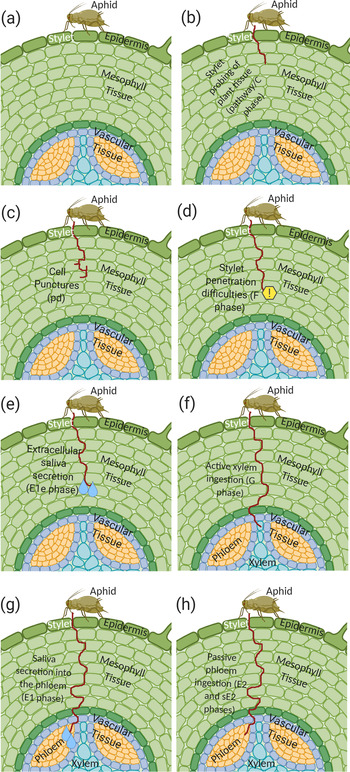
The aphid stylet pathway through the plant tissue has been well-characterized during interactions with susceptible plants using the electrical penetration graph (EPG) technique, and a graphical representation of examples of these waveforms, alongside the stylet activity during each, is shown in fig. 1. The biological relevance of the different waveforms detected by the EPG technique have been extensively analysed (Tjallingii, Reference Tjallingii1978; Tjallingii, Reference Tjallingii1985a, Reference Tjallingiib; Prado and Tjallingii, Reference Prado and Tjallingii1994) and although this technique has mainly been used to study aphid interactions with susceptible and (partially-)resistant genotypes of host plant species (Alvarez et al., Reference Alvarez, Tjallingii, Garzo, Vleeshouwers, Dicke and Vosman2006), it also represents a suitable tool to explore how aphids interact with non-natural hosts (here defined as non-host and poor-host plant species). Indeed, EPG analyses of Brevicoryne brassicae Linnaeus (cabbage aphid) on the host from the Brassicaceae and non-host Vicia faba showed that this aphid species was unable to reach the phloem when feeding on the non-host V. faba, despite probing the leaf surface (Garbys and Pawluk, Reference Garbys and Pawluk1999). Furthermore, epidermis and phloem factors contributed to resistance in different legume species to different pea aphid biotypes (Schwarzkopf et al., Reference Schwarzkopf, Rosenberger, Niebergall, Gershenzon and Kunert2013) and differential feeding profiles have been observed from pea aphid biotypes feeding on a range of host plant species (Hopkins et al., Reference Hopkins, Cameron and Butlin2017). By characterizing aphid probing and feeding behaviour across different aphid interactions with non-/poor-host species we aim to generate a better understanding of where associated resistance mechanisms reside. This in turn will facilitate important mechanistic studies to reveal the molecular determinants of plant immunity to aphids.
Graphical representation of aphid/stylet activities associated with each EPG waveform. (a) Example of aphid activity during np (non-probing) period, stylet is not in contact with leaf tissue, (b) Initiation of pathway (C) phase – aphid stylet pierces leaf epidermis, (c) Potential drop (pd) – aphid stylet penetrates adjacent plant cell, (d) Stylet penetration difficulties (F phase), (e) Extracellular saliva secretion (E1e) phase – salivation into extracellular space, (f) Xylem ingestion (G phase) – stylet penetrates vascular xylem cells to initiate xylem drinking, (g) Salivation into phloem (E1 phase) – stylet penetrates sieve tube element and aphid initiates salivation into phloem sap, (h) Phloem ingestion (E2 phase) – aphid begins passive ingestion of phloem sap. Also includes sustained phloem ingestion (sE2 phase) – a period of phloem sap ingestion lasting >10 min. Image made in © BioRender – biorender.com.

We previously showed that M. persicae, which is not a pest of barley, is able to feed and reproduce on this crop under controlled environment conditions, but to a lower extent than on a host species such as oilseed rape or Arabidopsis, constituting a poor-host plant-aphid interaction (Escudero-Martinez et al., Reference Escudero-Martinez, Morris, Hedley and Bos2017). On the contrary, R. padi is a pest of barley but is unable to survive on Arabidopsis, constituting a non-host pant-aphid interaction (Jaouannet et al., Reference Jaouannet, Morris, Hedley and Bos2015). However, in both the M. persicae-barley poor-host interaction and the R. padi-Arabidopsis non-host interaction probing of the leaf surface occurs (Jaouannet et al., Reference Jaouannet, Morris, Hedley and Bos2015; Escudero-Martinez et al., Reference Escudero-Martinez, Morris, Hedley and Bos2017). In this current study, we assess the feeding and probing behaviour of these different aphid-plant interactions directly. We examine the behaviour of M. persicae when probing and/or feeding on either a host plant (Arabidopsis) or poor-host plant (barley) and of R. padi on a host plant (barley) or a non-host plant (Arabidopsis). We compare and contrast the host interactions with the respective non-/poor-host interaction in order to identify the plant cell layers which likely contribute to non-host and poor-host resistance against aphids. We show that resistance in the non-/poor-host interactions can reside in different plant cell layers, suggesting complex mechanisms may underlie plant resistance to aphids.
Materials and methods
Aphid rearing
R. padi (JHI-JB, genotype G) (Leybourne et al., Reference Leybourne, Bos, Valentine and Karley2020; Thorpe et al., Reference Thorpe, Escudero-Martinez, Cock, Laetsch, Eves-Van Den Akker and Bos2018) was maintained on Hordeum vulgare cv Optic and M. persicae (JHI_genotype O) was maintained on Brassica napus (oilseed rape). All aphid species used in the experiments were maintained in growth chambers under controlled conditions (18°C ± 2°C, 16 h of light).
Plant growth
Barley plants (cv. Golden Promise) were pre-germinated in Petri dishes with wet filter paper for 3 days in the dark. Then, they were moved to a plant growth cabinet under controlled conditions and grown for 7 days (growth stage 1.10, determined using the staging key (Zadoks et al., Reference Zadoks, Chang and Konzak1974)) until the EPG experiments. Arabidopsis thaliana Col-0 plants were sown directly in soil; the seeds were stratified for 3 days at 4°C and placed in the growth cabinet for 4–5 weeks before use in experiments (growth stage 1.10–3.90, determined using the Boyes growth key (Boyes et al., Reference Boyes, Zayed, Ascenzi, Mccaskill, Hoffman, Davis and Gorlach2001)). The cabinet conditions for Arabidopsis were 8 h of light (125 μmol photons/m2.s), at 22°C and 70% humidity. The cabinet conditions for barley were 8 h of light (150 μmol photons/m2.s), at 20°C (±2°C).
Aphid choice experiment
Aphid choice tests were devised to investigate the host plant preference of R. padi and M. persicae. Three choice test assays were developed: one using 50 R. padi aphids, a second using 50 M. persicae aphids, and a third using a mixed-species population (25 R. padi, 25 M. persicae). For each assay, 50 aphids (mixed aged: 2nd instar – apterous adult) were placed on a sheet of tissue paper and were placed in the centre of a Perspex cage halfway between two plants (one Arabidopsis, one barley). Aphids were 90 mm away from both plants and the two plants were 180 mm apart. Bamboo sticks served as bridges from the cage bottom (where the aphids were placed) to each plant, with additional bamboo sticks acting as bridges between the two plants, similar to the set-up used by Nowak and Komor (Nowak and Komor, Reference Nowak and Komor2010). Once the aphids were placed between the plants and the bridges were positioned, the cages were closed and the proportion of aphids present on the host, non-/poor-host, or which had not settled were scored 3 and 24 hours later. Choice assays were carried out in growth chambers under controlled conditions (18°C ± 2°C, 16 h of light).
Choice tests were carried out simultaneously in separate Perspex cages (440 mm × 340 mm × 390 mm). For each replicates the assignment of aphid mixture (R. padi, M. persicae, or mixed) to the cage (1, 2, or 3) and the position (1 or 2) of Arabidopsis and barley within each cage was randomly assigned. Seven replicates were collected for each aphid mixture. The proportion of aphids detected on each plant were modelled in response to plant type (Host, non-/poor-host, or not settled), aphid mixture (R. padi, M. persicae, mixed species), time-point (3 and 24 h) and all interactions using a linear mixed effects model. Cage and block were included as random factors, the model was simplified using manual backward stepwise model selection, and fitted-residual plots were observed at each stage to assess model suitability. Models were analysed using a χ2 Analysis of Deviance Test. Differences in the Least Squares Mean with Tukey correction for multiple comparison was used as a post-hoc test. Data were analysed in R Studio v. 1.0.143 running R v. 3.4.3 (R Core Team, 2017) with additional packages car v.2.1-4 (Weisberg and Fox, Reference Weisberg and Fox2011), lme4 v.1.1-13, and lsmeans v.2.27-62 (Lenth, Reference Lenth2016).
EPG analyses
The probing and feeding behaviour of R. padi and M. persicae was assessed using the EPG technique (Tjallingii, Reference Tjallingii1995) on a Giga-4 DC-EPG device with 1 Giga Ω resistance (EPG Systems, The Netherlands). We used a randomized block design for all EPG experiments performed. Aphids were connected to a copper electrode with a golden wire (20 μm diameter), attached at the aphid dorsum and connected to the electrode with water-based silver glue. Aphids were lowered onto either an Arabidopsis or barley leaf approximately 1–1.5 h after being removed from culture, and feeding behaviour was recorded over a 6 h period. Three recordings were taken simultaneously. Each experiment was initiated between 10 am and 12 pm and the experiment was performed over a 6-month period, with 18 host and 17 non-host replicates for R. padi and 23 host and 28 poor-host replicates for M. persicae. Data were acquired using the Stylet+ D software package version v.01.28 and annotated manually using the Stylet+ A v.01.30 software (EPG-Systems, The Netherlands). Obtained waveforms were annotated with one of the following signals: no penetration (np), stylet penetration into the epidermal and mesophyll tissue (pathway/C phase), cellular punctures during the C phase (pd), watery salivation into sieve elements (E1), ingestion of phloem sap (E2), derailed stylet mechanics/stylet penetration difficulties (waveform F), xylem ingestion (waveform G), or extracellular saliva secretion into mesophyll (E1e) (Tjallingii, Reference Tjallingii1995; Alvarez et al., Reference Alvarez, Tjallingii, Garzo, Vleeshouwers, Dicke and Vosman2006). Waveforms were categorized into either probing parameters, consisting of: waveform np; waveform C; waveform pd; waveform F and waveform E1e. Or vascular parameters, consisting of: waveform G; waveform E1; and waveform E2 (Alvarez et al., Reference Alvarez, Tjallingii, Garzo, Vleeshouwers, Dicke and Vosman2006).
Annotated waveforms were converted into time-series data using the excel macro developed by Dr Schliephake (Julius Kühn-Institut); these converted parameters were used for statistical analysis. Parameters used for comparisons in these experiments are described by Giordanengo (Reference Giordanengo2014), and include the total time of probing, number of probes, duration of phloem sap ingestion, and duration of xylem sap ingestion, a total of 97 parameters were measured. Statistical analyses were performed in R Studio running R v. 3.2.3. (R Core Team, 2017) using the Wilcoxon rank test, a significance threshold of 0.05 was used.
Results
Aphids preferentially select their host plant in choice assays
The majority of aphids preferentially selected the host plant, with c. 50% of aphids settling on the host plant within 3 h (table 1; fig. 2). The number of aphids that settled on the host plant increased to around 80% after 24 h for all aphid populations assessed (t = −9.48; P = <0.001) with the number of unsettled aphids decreasing (t = 8.30; P = <0.001). However, approximately 10% of aphids were found on either the non-host or the poor-host plant at both time-points. No effect of aphid mixture was observed (table 1), indicating that the presence of additional aphid species did not influence aphid behaviour.
Stacked bar charts showing the settling behaviour of aphids in the choice experiment. (a) Aphid settling after 3 h. (b) Aphid settling after 24 h. Graphs show the mean proportion of aphids from the R. padi (Rp), M. persicae (Mp), and the mixed-species population (Mix) which had settled on the host plant (H; green), the non-host plant (NH; red), the poor-host plant (PH; yellow), the non/poor-host plant (NH.PH; orange) or which has not settled (NS; grey). Letter at the top of each bar indicate differences based on Least Squares Mean post-hoc analysis with Tukey correction, comparisons are across all treatment groups.

Statistical results of the choice test assay.

The Arabidopsis-R. padi non-host interaction is characterized by long no-probing periods and difficulties in locating the vascular tissues
We assessed 97 feeding parameters in total, 71 of these were altered during R. padi feeding on non/poor-host plants compared with feeding patterns on host plants (Supplementary table S1) with 26 parameters remaining unaffected (Supplementary table S2).
The majority of feeding parameters that differed between R. padi feeding on host compared with non-host plants were related to stylet probing of the plant tissue and interactions with the plant vascular system (fig. 3). In general, probing parameters that differed for R. padi when interacting with non-host vs host plants were non-probing periods, number of stylet probes into plant tissue, and time spent in the epidermal/mesophyll cells (C phase) (fig. 3; Supplementary table S1).
Box plots showing different EPG parameters associated with Rhopalosiphum padi-barley (host) and Rhopalosiphum padi-Arabidopsis (non-host) interactions. Probing-related parameters: total number of probing events, total length of no probing time, total number of pathway (C) phase events, total length of pathway (C) phase time. Vascular-related parameters: number of xylem ingestion (G phase) events, total length of xylem ingestion, number of salivation (E1 phase) events where aphid saliva is secreted into phloem sap, total length of salivation (E1 phase), number of phloem sap ingestion (E2 phase) events and total length of phloem sap ingestion (E2 phase). Green boxes indicate the host (H) interaction and red boxes represent the non-host (NH) interaction. R. padi on host plants was replicated 18 times and R. padi on non-host plants was replicated 17 times. Significant differences between interactions with plants were assessed by Wilcoxon non-parametric t-test (* = P ≤ 0.05 and *** = P ≤ 0.01).

During non-host interactions with Arabidopsis, the total time the aphids were not probing plant tissue during the 6 h recording was 2.5 times greater (4889 s) than the host interactions (1767 s) (fig. 3A; Supplementary table S1; W = 33.00; P = <0.001). However, the overall number of stylet probes into plant tissue was higher on non-host plants (18) than host plants (8) (fig. 3; Supplementary table S1; W = 52.50, P = <0.001). Although the total number of C phases (stylet activity at the epidermis/mesophyll, including a return to C phase following stylet interactions in the vasculature) was not significantly different between non-host and host interactions, the overall time spent in the epidermis/mesophyll (C phase) was over two times longer for the non-host (14128s) compared with host interactions (6237s) (fig. 3; Supplementary table S1; W = 37.00; P = <0.001).
All the vascular-related parameters (G, E1 salivation and E2 ingestion phases) measured for R. padi were significantly reduced during non-host interactions compared with host interactions (fig. 3; Supplementary table S1). This included a twofold reduction in the number of xylem ingestion (G phase) events during the non-host interaction (0.24 times) compared with the host interaction (0.50 times) (fig. 3; Supplementary table S1; W = 2.28.50; P = <0.001) alongside a significant decrease in the total length of xylem ingestion, 1021 s for non-host compared with 1483 s for host plants (fig. 3; Supplementary table S1; W = 221.50; P = <0.003). We also observed significantly fewer salivation events (E1 phase) during the non-host interaction (0.18 events) compared with the host interaction (3.67 events; W = 282.00; P = <0.001), with salivation events fivefold shorter during the non-host interaction (18 s) compared with the host interaction (93 s) (fig. 3; Supplementary table S1; W = 278.00; P = <0.001). Ingestion of phloem sap (E2 phase) was rarely observed during the non-host interaction (0.06 times) compared with the host interaction (3 times; W = 285.00; P = <0.001), and the total duration of this ingestion period was greatly reduced on non-host plants (19 s) compared with host plants (10030 s, or 2.78 h) (fig. 3; Supplementary table S1; W = 288.00; P = <0.001).
The barley-M. persicae poor-host interaction is characterized by a lack of sustained phloem ingestion
The majority of feeding parameters that differed between M. persicae feeding on host compared with poor-host plants were primarily related to interactions within the plant vasculature, specifically a decrease in interactions with the phloem and an increase in interactions with the xylem (fig. 4; Supplementary table S1). In general, this involved a decrease in the ability to locate the phloem and initiate ingestion of phloem sap. When feeding on poor-host plants there was a significant increase in the number of probes made into the plant tissue by aphids (19) compared with the number of probes made into host plants (16) (fig. 3; Supplementary table S1; W = 186.00; P = <0.024). However, the total length of time aphids probed into plant tissue, the number of pathway (C) phase events and the total time spent within the pathway (C) phase was similar for the host and poor-host interactions (fig. 4)
Box plots showing different EPG parameters in Myzus persicae interaction with a host (Arabidopsis) and a poor-host plant (barley). Probing-related parameters: total number of probing events, total length of no probing time, total number of pathway (C) phase events, total length of pathway (C) phase time. Vascular-related parameters: number of xylem ingestion (G phase) events, total length of xylem ingestion, number of salivation (E1 phase) events where aphid saliva is secreted into phloem sap, total length of salivation (E1 phase), total length of phloem sap ingestion (E2 phase) and total length of sustained phloem sap ingestion (sE2 phase). Green boxes indicate the host (H) interaction and yellow boxes represent the poor-host (PH)interaction. M. persicae on host plants was replicated 23 times and M. persicae on poor-host plants was replicated 28 times. Significant differences between interactions with plants were assessed statistically by Wilcoxon non-parametric t-test (* = P ≤ 0.05 and *** = P ≤ 0.01).

Aphid stylet activities related to the vascular parameters (G – xylem, E1 – phloem salivation, and E2 – phloem ingestion) were different between host and poor-host interactions (fig. 4; Supplementary table S1). The number of times that M. persicae reached the xylem (G phase) during the poor-host interaction was higher (1.33 times; W = 133.50; P = <0.001) and the total time of xylem ingestion was longer (2321 s; W = 142.50; P = <0.001) than during the host interaction, where aphids reached the xylem 0.30 times and spent a total of 691 s ingesting xylem sap (fig. 4; Supplementary table S1). For the E1 salivation phase the number and duration of events were reduced during the poor-host interaction, 1.73 events (W = 5.28; P = <0.001) with a reduced total length of time spent salivating into the phloem of 562 s (W = 500.00; P = <0.001), compared with the host interaction on (seven events with a time length of 652 s) (fig. 4; Supplementary table S1).
M. persicae showed limited ingestion periods during the poor-host compared with host interactions. The number of E2 phases and their length was greatly reduced on poor-host plants, 0.53 events (W = 552.50; P = <0.001) with a 40-fold decrease in the total time spent ingesting phloem (126 s; W = 573.50; P = <0.001), compared with host plants (5.7 events with a total length of 5064 s) (fig. 4; Supplementary table S1). Moreover, on the poor-host sustained phloem ingestion was severely lacking, and aphids spent only 49 s in the E2 ingestion phase on poor-host plants (W = 520.00; P = <0.001) with events being nearly absent, 0.07 events (W = 515.00; P = <0.001). In contrast, aphids spent longer (4322 s) in the E2 sustained ingestion phase on host plants over 2.1 events during the 6 h recording (fig. 4; Supplementary table 1). Therefore, the M. persicae poor-host interaction features substantially reduced phloem ingestion.
Discussion
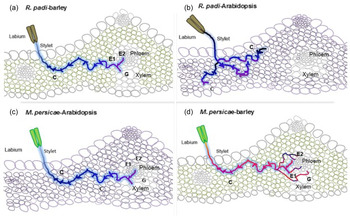
The overall aim of this study was to compare and contrast aphid interactions on host-plants with non-host and poor-host interactions in order to identify where in which plant cell layers non-host and poor-host resistance factors may reside. We showed that when provided with a binary choice, aphids interact with both the non-host and poor-host plants under controlled conditions, but preferentially select the host plant species. We explored these interactions further using the EPG technique. Common features of the non-host and poor-host interactions were an increased number of probes and longer no-probing periods. Importantly, our data showed differences between R. padi and M. persicae probing and feeding behaviour on the non-host and poor-host plants. During the R. padi-Arabidopsis (non-host) interaction the aphids only occasionally reached the vascular tissues. On the contrary, during the M. persicae–barley interaction (poor-host) aphids successfully reached the vascular tissue where xylem and phloem sap were ingested, however, prolonged periods of phloem ingestion were inhibited. Based on the data generated, we propose two models wherein poor- and non-host plant resistances against these aphid species may reside within the phloem and mesophyll cell layers, respectively (fig. 5).
Model showing R. padi and M. persicae probing and feeding during host, poor-host and non-host plant interactions. (a) During the host interaction (R. padi-barley), the aphids will probe the epidermal and mesophyll cells (pathway C phase), then will drink from the xylem or salivate and feed on the phloem, with feeding lasting for hours, (b) During the non-host interaction (R. padi-Arabidopsis), the aphids will spend a long time not probing, and when probing eventually occurs the aphids remain in stylet pathway phase (in epidermis and mesophyll cell layers) most of the time and only occasionally will reach the vascular tissue, either xylem or phloem. No sustained ingestion of phloem sap takes place, (c) During the host interaction (M. persicae-Arabidopsis), the aphids will probe the epidermal and mesophyll cells (pathway C phase), then will drink from the xylem or salivate and feed on the phloem, with feeding taking place for hours, (d) During the poor-host interaction (M. persicae-barley), the aphids show increased probing compared to the host interaction, while the stylet pathway phase (in epidermis and mesophyll cell layers) is similar to the interaction with the host plant. At the vascular level, long periods of time will be spent in the xylem, and eventually aphid will reach the phloem, salivate and ingest phloem sap. However, contrary to the host interaction, no sustained (>10 min) ingestion of phloem sap takes place.

During the R. padi–barley interaction (host interaction) aphids spend less time probing into the epidermal and mesophyll tissue compared to the R. padi-Arabidopsis interaction and readily reach the phloem where salivation into and ingestion of the phloem sap occurs for several hours (fig. 5A). Occasionally, aphids ingest xylem, which is hypothesized to be a mechanism through which aphids are able to cope with the osmotic effects associated with ingestion of large amounts of phloem sap (Spiller et al., Reference Spiller, Koenders and Tjallingii1990; Pompon et al., Reference Pompon, Quiring, Giordanengo and Pelletier2010). In contrast, during the R. padi – Arabidopsis interaction (non-host interaction) aphids exhibit altered probing behaviour, including an increase in the number of plant probes alongside a decrease in the total time probing into plant tissue. Additionally, R. padi shows an extended stylet pathway phase, and only rarely does the aphid reach the Arabidopsis phloem or xylem (fig. 5B). On the occasions where the R. padi stylet reaches the vascular tissue ingestion of phloem and xylem sap is ineffective, in line with this aphid being unable to survive on Arabidopsis (Jaouannet et al., Reference Jaouannet, Morris, Hedley and Bos2015).
Interestingly, R. padi spent less time probing into plant tissue during the non-host interaction compared with R. padi interactions with the host plant. However, during these probes, aphids spent an increased time interacting with the mesophyll tissue during the non-host interaction than the host interaction. These observations are indicative of mesophyll-associated plant resistance factors (Alvarez et al., Reference Alvarez, Tjallingii, Garzo, Vleeshouwers, Dicke and Vosman2006), which is further evidenced by our observation that aphids struggled to probe beyond this layer and were unable to access to the vascular tissue (fig. 5B). Further research will be needed to further understand the mechanisms underlying Arabidopsis non-host resistance to R. padi, and to investigate the potential involvement of specific recognition receptors within the mesophyll cell layer. Interestingly, the NADPH oxidase AtRbohF, involved in ROS (reactive oxygen species) production, a member of the LEA (Late Embryogenesis Abundant) family, implicated in abiotic and biotic stress, as well as the VSP1 (Vegetative Storage Protein 1), which is activated by jasmonate signalling, contribute to Arabidopsis non-host resistance against R. padi (Jaouannet et al., Reference Jaouannet, Morris, Hedley and Bos2015). Whether these genes act within the mesophyll cell layer to activate defences against aphids remains to be determined.
The M. persicae–Arabidopsis (host) interaction features prolonged salivation and ingestion once the phloem is reached, as well as occasional xylem drinking (fig. 5C). In contrast, the M. persicae–barley interaction (poor-host interaction) is represented by a higher number of plant tissue probes, but a similar overall time spent interacting with the mesophyll cells during stylet probing in the pathway phase. The main differences detected between M. persicae interactions with Arabidopsis (host) and barley (poor-host) are reduced salivation into and ingestion of the phloem in the poor-host interactions, including a restriction in sustained phloem ingestion on the poor-host (fig. 5C and D). It is likely that this reduced phloem sap ingestion is responsible for the observed reduction in M. persicae performance on the poor-host plant (Ramirez and Niemeyer, Reference Ramirez and Niemeyer2000; Escudero-Martinez et al., Reference Escudero-Martinez, Morris, Hedley and Bos2017). The poor-host interactions are also characterized by an increase in xylem ingestion, compared with the host interaction. It is possible that M. persicae attempts to compensate for reduced phloem ingestion by increasing xylem ingestion, as previous work has indicated that aphid starvation increases the xylem phase (fig. 5D) (Ramirez and Niemeyer, Reference Ramirez and Niemeyer2000).
Phloem resistance factors are associated with decreased salivation into the phloem and a reduction in phloem ingestion, in particular, decreased periods of sustained phloem ingestion contribute significantly to phloem-based resistance against aphids (Prado and Tjallingii, Reference Prado and Tjallingii1997; Alvarez et al., Reference Alvarez, Tjallingii, Garzo, Vleeshouwers, Dicke and Vosman2006). Phloem-mediated defences against aphids include the occlusion of sieve elements, which prevents aphids from ingesting phloem sap (Dreyer and Campbell, Reference Dreyer and Campbell1987; Will and van Bel, Reference Will and Van Bel2006; Medina-Ortega and Walker, Reference Medina-Ortega and Walker2015). This phloem occlusion occurs upon callose deposition and formation of P-protein plugs. The latter is thought to seal off the phloem upon damage and/or to block the aphid food canal (Tjallingii, Reference Tjallingii2006; Will and van Bel, Reference Will and Van Bel2006). Interestingly, PAD4 was found to be a component of phloem-based immunity against M. persicae in Arabidopsis (Pegadaraju et al., Reference Pegadaraju, Louis, Singh, Reese, Bautor, Feys, Cook, Parker and Shah2007). However, no barley PAD4 (MLOC_1340) or PAD4-related genes were up-regulated during the barley-M. persicae interaction (Escudero-Martinez et al., Reference Escudero-Martinez, Morris, Hedley and Bos2017). However, our previous transcriptome analyses showed induction of a barley gene encoding Phloem Protein 2-like (PP2), which is a phloem specific lectin, with the induction being most pronounced during the barley-M. persicae interaction (Escudero-Martinez et al., Reference Escudero-Martinez, Morris, Hedley and Bos2017). Lectins have carbohydrate-binding properties and function in cell communication, development, and plant defence (Bellande et al., Reference Bellande, Bono, Savelli, Jamet and Canut2017). PP2 is a lectin highly abundant in the phloem and accumulates in damaged phloem sieve pores to form protective plugs (Read and Northcote, Reference Read and Northcote1983). Overexpression of AtPP2 in Arabidopsis leads to reduced M. persicae feeding suggesting PP2 may contribute to defences against aphids (Zhang et al., Reference Zhang, Shi, Chen, Wang, Lu, Zhang, Liang, Liu, Qian, Sun, You and Dong2011), possibly by interfering with aphid digestion in the midgut (Kehr, Reference Kehr2006). The very infrequent phloem sap ingestion we observed during the poor-host interaction might reflect a rejection of the sieve element, possibly due to the presence of a deterrent factor in the phloem sap (Mayoral et al., Reference Mayoral, Tjallingii and Castanera1996). Indeed, lectins, including PP2-like proteins, have been shown to have deterrent activities and insecticidal activities against M. persicae (Sauvion et al., Reference Sauvion, Rahbe, Peumans, Vandamme, Gatehouse and Gatehouse1996; Jaber et al., Reference Jaber, Haubruge and Francis2010; Zhang et al., Reference Zhang, Shi, Chen, Wang, Lu, Zhang, Liang, Liu, Qian, Sun, You and Dong2011). Whether barley phloem-lectins like PP2 indeed contribute to phloem-based defences of barley against M. persicae needs to be further tested.
It is important to note that the EPG experimental set-up was of a no-choice nature (i.e. aphids were placed on the plants) and that additional plant resistance components that affect aphid choice may play a role in the interactions studied here (Powell et al., Reference Powell, Tosh and Hardie2006; Escudero-Martinez et al., Reference Escudero-Martinez, Morris, Hedley and Bos2017). For example, we previously showed that the black cherry aphid (Myzus cerasi Fabricius), which infests cherry trees as well as several herbaceous plants, displays only limited probing on non-host barley plants, and does not settle on barley leaves (Escudero-Martinez et al., Reference Escudero-Martinez, Morris, Hedley and Bos2017), pointing to a potential role of barley defences that act at the pre-probing level against this aphid species (Nottingham et al., Reference Nottingham, Hardie, Dawson, Hick, Pickett, Wadhams and Woodcock1991). In addition, some plant induced volatile compounds have been reported to be repellent to aphid pests and attractants of their natural enemies (Dreyer and Jones, Reference Dreyer and Jones1981; Turlings and Ton, Reference Turlings and Ton2006; Mallinger et al., Reference Mallinger, Hogg and Gratton2011). However, as aphid probing of plant tissue occurs naturally during host, non-host, and poor-host interactions as a component of aphid host plant selection (Powell et al., Reference Powell, Tosh and Hardie2006), it is important to explore these contrasting behaviours and examine the underlying mechanisms.
With limited genetic crop resistance available against aphids, identifying the determinants of non/poor-host resistance is an important area of research that may help the development of novel crop protection strategies. Using a detailed assessment of aphid probing and feeding behaviour on the different natural host and non-host species we show that resistances may reside in different cell layers depending on the plant species-aphid species interaction.
Supplementary material
The supplementary material for this article can be found at https://doi.org/10.1017/S0007485320000231.
Acknowledgements
The authors thank Dr Freddy Tjallingii (EPG Systems, The Netherlands), Professor Alberto Fereres (CSIC, Spain) and Professor Gregory Walker (University of California, Riverside, USA) for providing EPG training, and additional thanks to Dr Tjallingii for helpful comments on non-host EPG waveforms. They also thank Dr A. Nicholas E. Birch (The James Hutton Institute) for allowing us to use the EPG equipment. This work was supported by the European Research Council (310190-APHIDHOST to JIBB), and the James Hutton Institute and Universities of Aberdeen and Dundee through a Scottish Food Security Alliance (Crops) PhD studentship to DJL.
Author contributions
JIBB, CEM and DJL conceived and designed the experiments, CEM and DJL performed the experiments, JIBB, CEM and DJL analysed the data, JIBB and CEM wrote the manuscript with input from DJL. All authors read and approved the final manuscript.