Over the past three decades, researchers have devoted increasing attention to the notion of party institutionalization (PI hereafter). PI is viewed as important, because it may help explain why some parties become stable political forces, whereas others have much more transitory lives (Dix Reference Dix1992; Gherghina et al. Reference Gherghina, Iancu and Soare2018; Harmel et al. Reference Harmel, Svåsand, Mjelde, Harmel and Svåsand2019; van Dyck Reference Van Dyck2017). When individual parties are more highly institutionalized, or when they have higher organizational capacities, voting patterns tend to be more stable, and thus party systems become more institutionalized (Harmel et al. Reference Harmel, Svåsand, Mjelde, Harmel and Svåsand2019; Mainwaring and Scully Reference Mainwaring and Scully1995; Mainwaring et al. Reference Mainwaring, Bizzarro, Petrova and Scott2018; Tavits Reference Tavits2013). At the same time, very high PI may be a mixed blessing for democratic responsiveness, because highly institutionalized parties may have more capacity to block the emergence of challenger parties, though in other circumstances they may find it difficult to adapt rapidly to changing social pressures (Levitsky Reference Levitsky1998). PI may also shape presidential success (Martinez Reference Martinez2020), economic growth (Bizarro et al. Reference Bizarro, Gerring, Knutsen, Hicken, Bernhard, Skaaning, Coppedge and Lindberg2018) and the policy outputs that parties deliver, in that more institutionalized parties have longer time horizons and organizational mechanisms that keep party elites attentive to the demands of ordinary voters (Rasmussen and Knutsen Reference Rasmussen and Knutsen2020).
On the other hand, some research has questioned the supposed influence of PI. It either finds no electoral impact for PI (Bolleyer and Ruth Reference Bolleyer and Ruth2018) or asks whether correlations that exist are truly indicative of causal relations (e.g. Casal-Bertoa Reference Casal Bértoa2017; Wilkinson Reference Wilkinson2015). Such questions arise in part because relatively little is known about how PI may affect individual-level behaviour and attitudes. Most prior research on PI impact has used aggregate- or party-level data and has paid relatively little attention to the mass-level underpinnings of such relationships. As a result, large questions remain about the individual-level mechanisms through which higher levels of PI could affect outcomes such as the stability of electoral competition, political mobilization and party electoral success.
This article aims to help fill this gap by investigating the micro-foundations of possible relations between party system institutionalization and partisan mobilization. We hypothesize that PI levels could affect how, and how much, party supporters participate in political life. If so, their behaviour may affect parties' ability to project the viability and appeal of their brand. In particular, we examine whether two central dimensions of PI – routinization and value infusion – shape the composition and strength of partisan mobilization.
In keeping with previous research on PI, we use routinization to describe the extent to which party activity at the local level is rule-guided and regularized (Bolleyer and Ruth Reference Bolleyer and Ruth2018; Kitschelt and Kselman Reference Kitschelt and Kselman2010; Levitsky Reference Levitsky1998; Panebianco Reference Panebianco1988). Value infusion denotes the extent to which a party invokes non-material collective incentives such as political goals shared by supporters (Bolleyer and Ruth Reference Bolleyer and Ruth2018; Janda Reference Janda1980). We analyse how these two PI dimensions are connected with partisan mobilization, looking specifically at partisans' attendance at political rallies and meetings. Because meetings and rallies are visible and often well publicized, they constitute important instruments parties use to build and cement partisan ties (Green and Gerber Reference Green and Gerber2008; Szwarcberg Reference Szwarcberg2012, Reference Szwarcberg2014). Understanding which parties are more effective in mobilizing supporters in these ways may illuminate mechanisms through which PI generates the kind of individual-level behaviour that enhances party system stability.
To investigate whether and how these two aspects of PI affect partisans' behaviour, we combine cross-sectional party-level data from the Democratic Accountability and Linkages Project (DALP) with individual data from the 2014 International Social Survey Programme (ISSP). These data enable us to study the impact of PI on political behaviour in countries across multiple regions and regime types. We examine the behaviour of self-identified party members, and of self-identified party supporters more generally, reasoning that PI levels could have differential effects on these groups.
Our results tell a complex story. As expected, greater party routinization, measured by greater local party capacity, appears to be associated with party members' increasing participation in political events, but it seems to drive out participation by unaffiliated partisans. More surprisingly, greater value infusion is associated with more participation by unaffiliated supporters but shows the opposite relation with party members, thus reducing the gap between the political activity levels of member and non-member supporters. In our analysis we probe these results and suggest possible explanations. More generally, these results suggest that there may be different underlying mechanisms through which the two PI dimensions can help stabilize support for individual parties, thereby stabilizing party systems. They also suggest that how a party institutionalizes is as important as how much it does so, at least in terms of how institutionalization shapes citizens' political participation patterns.
Party institutionalization and political linkage
Party institutionalization is a party-level property related to the operations of a party as an organization or network. PI has been associated with the stabilization of support for individual parties (Dix Reference Dix1992; Gherghina et al. Reference Gherghina, Iancu and Soare2018; van Dyck Reference Van Dyck2017) and, therefore, with the stabilization of party systems more generally (Harmel et al. Reference Harmel, Svåsand, Mjelde, Harmel and Svåsand2019; Mainwaring and Scully Reference Mainwaring and Scully1995; Mainwaring et al. Reference Mainwaring, Bizzarro, Petrova and Scott2018). Yet it is not entirely clear what factors are driving such possible relationships.
On the one hand, it could be primarily or exclusively an elite-level phenomenon, with PI shaping incentives which encourage politicians to stick with, and invest in, existing parties. This side of the relationship has received relatively more attention. For instance, if more institutionalized parties have stronger brands, and more defined political career ladders, this would encourage ambitious politicians to make their careers within established parties rather than defecting to other parties or founding new ones (Lupu Reference Lupu2016; Rosenblatt Reference Rosenblatt2018). Higher PI might also reduce intra-party factionalism and dissent, producing more homogenous candidate slates (Mader and Steiner Reference Mader and Steiner2019). PI has also been associated with greater legislative cohesion (Alemán et al. Reference Alemán, Sagarzazu and Ponce2011). These elite-level mechanisms could reduce electoral volatility by stabilizing the party choices which are offered to voters.
On the other hand, or in addition, PI could foster party stabilization through its effects on mass-level preferences and behaviours. For instance, more institutionalized parties may be better at cultivating party loyalty. They also could be better at mobilizing their supporters, thus increasing their electoral chances and leaving less space for new parties. It is the latter scenario that we investigate in this article.
As conceived by Vicky Randall and Lars Svåsand (Reference Randall and Svåsand2002), PI encompasses party operations at both the elite and grassroots levels. It is a property that is manifest in parties' internal operations, although Randall and Svåsand stress that their dimension of ‘systemness’ is not synonymous with party organizational strength. They argue that systemness is higher where a party has access to widespread and locally anchored organizational support, but such support does not have to come from the party's own organization; it also could be provided by party branches as well as allies such as trade unions.
Whereas some researchers have seen citizen behaviour and attitudes as integral to the measurement of PI (for instance, Arter and Kestilä-Kekkonen Reference Arter and Kestilä-Kekkonen2014; Yardımcı-Geyikçi Reference Yardımcı-Geyikçi2015), others have proposed measures (including Levitsky Reference Levitsky1988; Bolleyer and Ruth Reference Bolleyer and Ruth2019; Harmel et al. Reference Harmel, Svåsand, Mjelde, Harmel and Svåsand2019) that are based exclusively on two dimensions that are internal to parties: routinization and value infusion. One relevant advantage of definitions of PI that focus on party-internal aspects is that they conceive of the party-level dimensions of institutionalization as being distinct from the behaviour and attributes of party supporters, thus making it possible to investigate the relationship between the two. Defining PI in terms of two dimensions, rather than as a single property, further allows for the possibility that the dimensions have different effects on participation. For this reason, we follow the lead of past authors in viewing PI in terms of these two dimensions (Bolleyer and Ruth Reference Bolleyer and Ruth2019; Randall and Svåsand Reference Randall and Svåsand2002).
Routinization refers to the extent to which parties develop and employ administrative capacities, which may be embodied in ‘rule-based intra-organizational processes’ (Mader and Steiner Reference Mader and Steiner2019) or in informal practices that become broadly accepted (Levitsky Reference Levitsky1998). It is associated with the depersonalization of operations in favour of rule-based decision-making (Harmel et al. Reference Harmel, Svåsand and Mjelde2018). Parties on the low end of the routinization spectrum function as loose networks or alliances. For our research, we follow operationalizations of routinization that focus on party development at the local level, from where parties may most easily mobilize their followers (for instance, Dix Reference Dix1992 and Bolleyer and Ruth Reference Bolleyer and Ruth2019). In this conception, one way to achieve high levels of routinization is to cultivate the local party branches characteristic of the ideal-type mass party (Katz and Mair Reference Katz, Mair, Gunther, Montero and Linz2002; Krouwel Reference Krouwel2012), but it could also be achieved in other ways, such as by local parties having good access to public financing, or by piggy-backing on the resources of sympathetic non-party groups.
Value infusion is a concept which goes back to Samuel Huntington's original idea of institutionalization (Reference Huntington1968). It refers to the extent to which an entity has become an end in itself, rather than a means to an end. In the PI literature value infusion usually describes the extent to which party supporters believe that the party stands for something, and thus support the party for more than instrumental reasons (Randall and Svåsand Reference Randall and Svåsand2002: 13). Value infusion affects how supporters relate to ‘their’ party, and also how parties try to connect with their potential voters. The more that a party is associated with a set of identities or ideals, the less it will make electoral appeals that are primarily personalistic (elevating a charismatic leader) or clientelistic (appealing to individual self-interest) (Bolleyer and Ruth Reference Bolleyer and Ruth2019).
We thus frame our hypotheses about the mobilization impact of PI in terms of these two separate dimensions.
Party institutionalization and individual-level behaviour: hypotheses
Expectations about how PI might affect mass behaviour have not been well specified in the literature, but past research supplies some hints about how this might work, particularly with regards to routinization. For instance, Robert Dix (Reference Dix1992: 499) associated one aspect of PI with party organizational complexity, arguing that parties with more local branches and with subunits such as women's sections were better able to channel political activism. David Samuels and Cesar Zucco (Reference Samuels and Zucco2015) focus on party organizational efforts to cultivate partisanship, showing that all parties boosted their electoral support where they had more local organization, but that parties that also worked with local civil society organizations did the best job of converting voters into loyalists. For Magnus Rasmussen and Carl Henrik Knutsen (Reference Rasmussen and Knutsen2020: 7), the density and activity of local party organizations are important for keeping parties attentive to grassroots demands, in part because ‘Local party meetings allow party representatives to hear the preferences of their constituents, discuss the party line and inform voters how the party understands various issues.’
These studies all suggest that as party routinization increases, parties show greater ability to mobilize citizens.Footnote 1 This could happen because party leaders and intermediaries organize and encourage followers to attend party rallies or serve as campaign volunteers. Denser networks of local party branches and local intermediaries should increase the frequency of such opportunities. The relationship between routinization and mobilization might also reflect the impact of party routines in cultivating a sense of belonging among supporters, making them more interested in the social benefits that accrue from participation in party activities. We thus conceive of routinization as likely to increase partisan participation primarily because there are increasing opportunities for (and awareness about) participatory channels.
These arguments lead to our first hypothesis:
Hypothesis 1A: Parties with higher levels of routinization will show greater ability to mobilize their supporters.
Regarding event participation, we expect that routinization increases a party's overall ability to mobilize; however, we also expect that these effects should be more pronounced for party members than for non-member supporters. Party members are the most likely to gain social rewards from party life. In addition, local party offices are more likely to be in contact with party members, and therefore may be most effective in communicating about party events to members as compared to other supporters. Moreover, members may be more likely to benefit if participation leads to selective benefits such as economic rewards or employment opportunities. Therefore, these core supporters are more likely to respond to parties' campaign appeals. These arguments support the second hypothesis, which distinguishes the effect of routinization between groups of supporters:
Hypothesis 1B: Higher levels of routinization will enhance event participation by party members more than by supporters who are not members.
Value infusion could also encourage partisan participation by associating the party with broad goals that make participation more meaningful. Sociological approaches to participation state that citizens act in the political realm due to concerns for their community or in order to express their feelings or communicate their standpoint on a matter (Gurr Reference Gurr1970; Hardin Reference Hardin1982). Thus, citizens who support parties with strong ideological or historically rooted brands may be more motivated to express their views by participating in political events. We thus regard value infusion as a property that may motivate partisan participation. These arguments lead to the following hypothesis:
Hypothesis 2A: Parties with higher levels of value infusion will show greater ability to mobilize their supporters.
In terms of mobilizing supporters to participate in political events, levels of value infusion should also affect all supporters. However, we argue that the effect is likely to be more evident among non-member supporters than among members, because meeting attendance by members may be overdetermined by other factors affecting their incentives to participate. For instance, the engagement of some portion of self-identified party members may be primarily inspired by selective benefits or individual duties that correspond with holding local party or government offices, meaning that there is less scope for value infusion to have an impact. More generally, through the act of joining, party members have already shown themselves to be more inclined to partisan participation. In short, if value infusion is about providing motivation to participate in politics, it should show a greater impact on those who do not already have sufficient reasons to participate:
Hypothesis 2B: Higher levels of value infusion will enhance event participation by non-member supporters more than by party members.
In what follows we test each of these hypotheses separately.
Data and empirical analysis
To test our hypotheses, we employ two main data sources, the 2014 International Social Survey Project (ISSP) and the 2009 Democratic Accountability and Linkages Project (DALP). We employ survey data from the 2014 ISSP to construct our dependent variables that describe individual-level political behaviour. The 2014 ISSP survey includes questions on modes of participation for partisan supporters that could help parties connect with society, and eventually achieve greater electoral success. For this purpose, we select one mode of participation that is present in the 2014 ISSP survey: whether or not the supporter attended a political meeting or rally in the past year.Footnote 2 This mode of political participation – attending meetings or rallies – is a common party activity, though political meetings and rallies are also organized by other groups, so we cannot be sure whether the attended events were actually organized by parties. However, we assume that at least some were. Furthermore, even if organized by parties, we cannot be certain whether respondents attended an event organized by their preferred party, although it seems reasonable to assume this would be more likely. We acknowledge up front that this limits how much we can probe the mechanisms that may connect PI with political behaviour that might contribute to party system stability. Nevertheless, even with this limit we are able to tell how a party's PI levels are related to its voters' political activity levels (partisan or otherwise); these relationships can potentially provide valuable insights into how levels of PI may affect a country's political dynamics.
Our hierarchical models include three levels of analysis (supporters, parties and countries). Such hierarchical models take account of the possible lack of statistical independence across observations within contextual units (in this case, among supporters from each country). Institutional or cultural contexts might vary across countries due to unobserved characteristics, such as institutional rules, ideology or socialization, and these differences could invalidate the assumption of statistical independence across observations (Raudenbusch and Bryk Reference Raudenbusch and Bryk2002). We employ random intercepts at the country and party levels in our hierarchical models. To account for these variations, the variance is divided into a between-country component (the variance of the country-level residuals) and a within-country component (the variance of the supporters-level residuals). Failure to cluster these supporters may cause underestimated standard errors, and thus, errors in our inference analysis (Steenbergen and Jones Reference Steenbergen and Jones2002). Since the dependent variable is binary (whether or not the respondent participated in rallies or political meetings), we employ hierarchical logistic regressions in our empirical analyses.Footnote 3
Our key party-level variables are taken from DALP, based on expert assessments of the characteristics of individual parties. They describe conditions in parties for 2009, and consequently, precede the ISSP individual data. This lag allows us to ensure that the PI conditions were in place prior to the actions taken by supporters. Furthermore, it is suitable for judging the relation between these variables as we do not expect levels of PI to fluctuate greatly on an annual basis. To trace the effects of PI on individual-level behaviour, we match supporters with their preferred parties by linking them with the party for which they claim to have voted. This matching strategy allows us to assess the relationship between party characteristics with those who are most likely to have been affected by, or attentive to, the organization or values of a specific party. This is a minimalist strategy that aims to include the maximum number of party supporters in our analysis. Our question thus is about the association between the two dimensions of PI and the political behaviour of their self-identified followers: given that individuals are attached enough to a party to claim to have voted for it, what is the likelihood that they engage in politics in other ways?
We measure our two PI dimensions in two ways. Following the strategy of Nicole Bolleyer and Saskia Ruth (Reference Bolleyer and Ruth2018), our routinization measure is based on item A1 of the DALP database, which asks about the establishment of permanent local party offices. The presence of such offices makes it more likely that parties possess organizational capacities at the local level to mobilize supporters, but there is no guarantee that parties use their offices in this way. We use this single measure of routinization to better understand the possible causal mechanisms.Footnote 4 We normalize this item from 0 to 1, with higher values showing higher degrees of routinization. Examples of parties which score in the top quartile on this measure include Social Democracy (in Slovakia), the Kuomintang (in Taiwan), the Justice and Development Party (AKP) (in Turkey) and the Communist Party of Bohemia and Moravia (in the Czech Republic).
Second, to measure value infusion, we employ a DALP variable (item E4) measuring the extent to which parties draw on and appeal to voters' long-term partisan loyalty. In particular, we focus on the appeal of party elites to partisan loyalty by invoking their historical origins or the achievements of historical leaders. This indicator assesses the role of party leaders in boosting party identification, attachments to the party, and solidarity among supporters (Bolleyer and Ruth Reference Bolleyer and Ruth2018; Rosenblatt Reference Rosenblatt2013). We normalize the item from 0 to 1, with higher values showing higher degrees of value infusion. Examples of parties that score high on this measure include the Democratic Union (in Croatia), the African National Congress (in South Africa) and the Independence Party (in Iceland).
In order to test our ‘A’ hypotheses, our models first consider the effects of the routinization and value infusion employing a three-level hierarchical model. To test our ‘B’ hypotheses, we multiply each of the PI variables with a dichotomous variable indicating whether or not the supporter is a party member. We employ a three-level model to test our ‘B’ hypotheses.Footnote 5 In addition to this three-level model, we implement a three-level model that includes a random slope for party membership variable at the party level as a first robustness check. The inclusion of a random slope for party membership at the party level aims to take into account variations across parties regarding the marginal impacts of membership on political participation.
The hypothesized mechanisms whereby PI affects individual behaviour would not occur in a vacuum. Thus, our analysis controls for country-level and party-level contextual factors, and for individual-level resources that are generally associated with political participation. At the individual level, the likelihood that an individual participates in political activities is strongly determined by individual resources such as age, education (which allows for more leisure time) and gender (with women being generally much less likely to join political parties) (Benson and Rochon Reference Benson and Rochon2004; Inglehart Reference Inglehart1981; Strate et al. Reference Strate, Parrish, Elder and Ford1989; Verba et al. Reference Verba, Schlozman and Brady1995). Trade union membership also tends to spur individuals to higher levels of political activity. We take account of these factors, as well as ideological extremeness, because studies report that this diminishes the cognitive costs of protest participation and thus makes this type of political participation more attractive (Benson and Rochon Reference Benson and Rochon2004; Bernhagen and Marsh Reference Bernhagen and Marsh2007; Machado et al. Reference Machado, Scartascini and Tommasi2011; Marwell and Oliver Reference Marwell and Oliver1993; Putnam et al. Reference Putnam, Leonardi and Nanetti1993; Smith Reference Smith2009). We also include a variable that indicates the degree of religious attendance, because participation in civil society organizations helps citizens develop skills and attitudes that can boost political participation (Putnam Reference Putnam1995; Verba et al. Reference Verba, Schlozman and Brady1995). At the party level, we control for the ideological orientation of the party. In particular, leftist parties, some of them heirs of mass parties, might encourage partisan participation.
Results
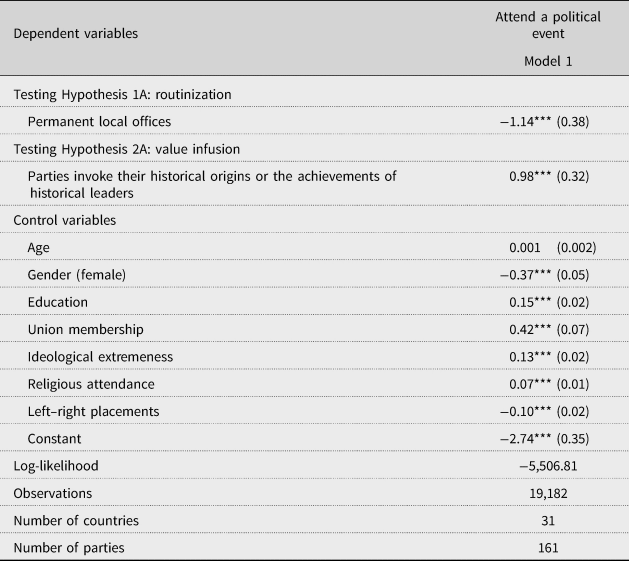
Table 1 presents the test of our ‘A’ hypotheses, asking whether each of the two dimensions of PI is associated with participation in political events by supporters of specific parties. Surprisingly, we note a negative and statistically significant association between routinization and participation in meetings and rallies. Thus, we do not find support for Hypothesis 1A. However, we do find evidence supporting the validity of Hypothesis 2A: value infusion is associated with greater political mobilization.
Routinization, Value Infusion and Attending Political Events

Notes: Standard errors in parentheses; *** p < 0.01, ** p < 0.05, * p < 0.1. Model 1: three-level hierarchical model.
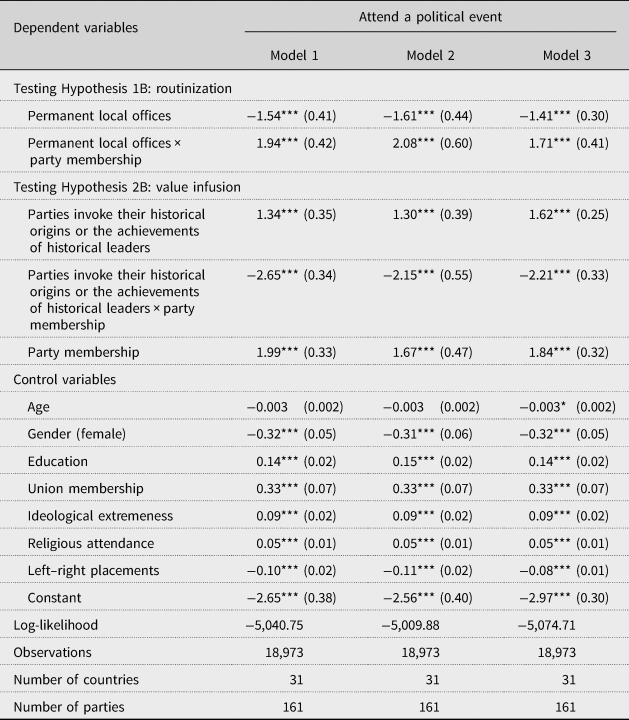
To better understand these findings, and the mechanisms that may make PI important for electoral stability, we turn to our ‘B’ hypotheses. These ask whether the two dimensions of PI have the same effects on the event participation of self-identified members (those most closely associated with a party) and on non-member supporters. To evaluate these hypotheses, we incorporate a binary variable to indicate whether the respondent is a party member.Footnote 6 As noted above, we test these with a three-level model, and a three-level model including a random slope for party membership at the party level; these are presented in the first two columns in Table 2.
Routinization, Value Infusion and Attending Political Events: Party Members and Party Supporters

Notes: Standard errors in parentheses; *** p < 0.01, ** p < 0.05, * p < 0.1. Model 1: three-level hierarchical model. In this model, while 4.75% of the variance of the dependent variable is explained by the third level (country level), 9.7% of it is explained by the second level (party level). Model 2: three-level hierarchical model with the random slope for party membership. Model 3: two-level hierarchical model.
The results suggest that the two dimensions have different effects on the two different subgroups of party supporters, and thus help to explain the unexpected routinization result shown in Table 1. The models in Table 2 still show a negative relation between routinization and non-members, but the relationship with members seems to be different. The positive coefficient of the interaction variable (multiplication of party membership and routinization variables) suggests that higher routinization of party life is associated with greater event participation by party members, but we need to be cautious in evaluating the conditional effect for party members (party membership and routinization) because it falls well short of conventional thresholds for statistical significance. Nevertheless, as we explain below, there are some other reasons to think that routinization affects members and non-members significantly differently. In either case, Table 2 suggests that routinization has divergent effects on party members and non-members.Footnote 7 As a possible explanation for these divergent trends, we note that other research shows that parties target their core supporters to attend rallies (Brierley and Kramon Reference Brierley and Kramon2020; Rauschenbach Reference Rauschenbach2015); it could be that more routinized parties are better able to target their mobilization efforts, and therefore may see less need to rally non-member supporters to ‘fill the square’, thus reducing participation by the non-affiliated. Additionally, well-organized local parties might crowd out political mobilizing conducted by non-party groups, events that might be more appealing to those who have not chosen to affiliate to a party. Finally, parties possessing relatively high levels of routinization may have less need for mobilizing potential non-member supporters via rallies since such parties are most likely to have additional tools for contacting voters, including by employing volunteer-intensive strategies such as doorstep canvassing. For these reasons, as local partisan activity becomes better organized, there could be a reduced supply of participation opportunities that target unaffiliated citizens.
Second, and as expected for reasons explained above, we find that increased value infusion shows a greater positive impact on participation by non-members than by members. As we show in Table 1, higher value infusion is associated with a higher tendency of party supporters to attend meetings and rallies. While we expected that the partisan participation impact of value infusion would be greater on unaffiliated supporters than on party members, we did not expect to see the negative coefficient of our interaction term, which indicates that party members' event attendance diminishes as value infusion increases. Thus, the associated narrowing of the behavioural differences between members and other supporters is not due solely to the greater mobilization of non-party supporters, as we predicted in Hypothesis 2B; it also reflects a reduction in party members' mobilization levels.
We offer several possible explanations for this unexpected impact on members' behaviour. First, this could reflect the outcome of parties moving from clientelistic strategies of mobilizing at low levels of value infusion (offering selective incentives to participating party members) towards appeals based on party aims and values (offering collective incentives). Members' reduced activity levels could be a sign that they become less motivated to participate as parties decrease their reliance on selective incentives. Second, because increases in value infusion boost participation by non-members (who are generally more numerous than members), it may be that higher value infusion corresponds with party organizations reducing their efforts to encourage members' participation in rallies and meetings, because such events are at any rate well attended by non-members. While our current data do not allow us to test for any of these speculative explanations of these unexpected findings, these results are robust to multiple additional specifications, as we report below.
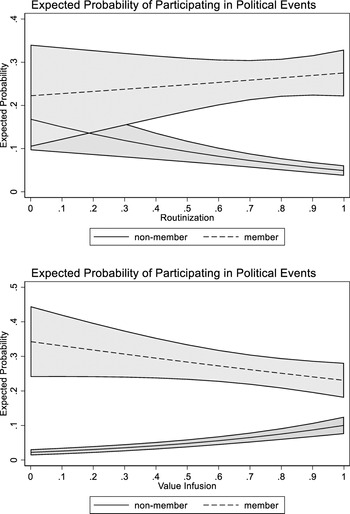
We return here to the uncertainty regarding the conditional effect of routinization on members' participation, and to whether the evidence suggests that higher routinization increases member participation (as opposed to having no clear effect). Although the statistical significance of the conditional effect of routinization is below conventional levels,Footnote 8 the magnitude (and the statistical significance) of the coefficient of the interaction variable (the slope) that multiplies the variables reflecting routinization levels and membership consistently reveals an increasing gap in participation between members and other supporters as routinization increases.Footnote 9 To probe this result, we assess whether the effect of this statistically significant slope translates into different predictions. Thus, we calculate the expected probabilities of participating between members compared to other supporters.Footnote 10 Figure 1 displays the predicted probabilities (from 0 to 1) in two different panels as the scores of the routinization and value infusion variables change. These results show that the gap between the groups widens significantly as routinization grows, an effect that is mostly driven by the negative effect on non-member participation. Nevertheless, this figure also shows a positive marginal effect for members' participation as routinization grows. Given that the confidence intervals for the two groups overlap in the lower range, it is worth noting that for 96.05% of our sample, routinization values are above the level where the confidence intervals overlap.Footnote 11
Predicted Probabilities: Routinization, Value Infusion and Participation in Political Meetings and Rallies

In contrast, Figure 1 makes clear that the effect of value infusion is the opposite of that for routinization. The difference in event participation between party members and non-member supporters decreases as the score of value infusion increases. Importantly, despite this trend towards convergence, at higher levels of value infusion, party members are still more likely to participate than non-member supporters; it is just that the gap between these two groups has narrowed. Nevertheless, this figure makes clear that the participation bonus that parties accrue from higher value infusion is a result of their greater ability to inspire engagement by their less committed supporters.
We note that in all our models our individual-level control variables largely have the expected effects. Also, the positive coefficient for party members shows that, as expected, members are more likely than other supporters to attend meetings and rallies. The only exception is for respondents’ age, which does not produce an effect. At the party level, as expected, leftist parties tend to mobilize greater participation. The fact that our control variables show the expected relations further increases our confidence in the findings.Footnote 12
Robustness checks
We implement various tests to assess the robustness of our findings. First, Table D in the Online Appendix displays two-level and three-level hierarchical models without control variables. While the first model focuses on testing our ‘A’ hypotheses, the second one does so with our ‘B’ hypotheses. Neither of these models alters our key findings. The rest of the tables displaying robustness checks also follow this dual configuration.
Second, Tables E1 and E2 in the Online Appendix present eight models that control for GDP per capita, a factor which might affect how parties and other groups approach political mobilization (while Table E1 shows results of regressions employing two-level hierarchical models, Table E2 does so using three-level hierarchical models). This national-level covariate is not statistically significant, and its inclusion does not change previous findings. We also control for regime type.Footnote 13 Parties in different political systems might employ different approaches to mobilizing and engaging with supporters and potential supporters. This might impact individual mobilization, not least because parties in presidential systems have more elections to contest (legislative and presidential). We find that party supporters in presidential systems are less likely to attend political meetings or rallies, but this does not affect the relationships between the main variables of interest. Although this political system result is not robust across all models, the relationship may deserve further scrutiny in future research.
In the models in Tables E1 and E2, we also control for party characteristics that might be associated with different propensities for attending rallies and political meetings. In the first two models in each table, we control for the age of the party (number of years passed since the foundation of the party). Party age does not seem to matter when explaining event participation. Then, we control for characteristics about parties' relative importance in the political system. The third and fourth models in each table incorporate a measure of electoral performance (percentage of votes obtained) in elections of the national legislative body (or the lower chamber in bicameral systems) before the ISSP survey was collected. The fifth and sixth models in each table consider instead the percentage of seats in parliament or congress after the DALP data were collected. These additional party-level characteristics do not seem to be correlated with attendance at political meetings. The remaining two models on Table E1 and E2 in the Online Appendix test all these additional party-level covariates at the same time; none of these models alters our key findings.
Third, we run two-level and three-level hierarchical models excluding outliers from the estimation (parties whose values of routinization and value infusion are lower than 0.1 or exceed 0.9) to see whether these observations might be distorting the results previously reported by Tables 1 and 2 (see Table F in the Online Appendix). Fourth, we run two-level and three-level hierarchical models excluding data from those respondents residing in Russia and Venezuela. Including these non-democratic regimes in the analysis might distort the apparent effects of the PI dimensions on political participation due to restrictions on parties' or citizens' activities. Table G in the Online Appendix shows these results. Fifth, we run two-level and three-level hierarchical models with country fixed effects (Table H in the Online Appendix) and region fixed effects (Table I in the Online Appendix) to account for potential unobserved factors at the national or regional level. Our key findings remain robust across all these different model specifications, giving us confidence in our findings, including the unexpected findings.
Furthermore, we evaluate whether our findings about member participation might be driven by differences among members, taking advantage of the fact that the 2014 ISSP survey allows respondents to classify themselves as active or inactive members.Footnote 14 We thus test whether the effect of routinization and value infusion is driven by just one subgroup of members. While in the first and fourth models shown in Table J.1 in the Online Appendix we employ active membership, we include inactive membership in the second and fifth models. In the third and sixth models, we incorporate both subgroups of members. Once again, we confirm the robustness of the relationships we have found, regardless of the membership subgroup included in the analyses.
However, disaggregating self-described ‘active’ and ‘inactive’ members does shed further light on what is driving the effects reported above. These results suggest that if there is an effect of routinization on member participation in the binary sense that we study here (do/do not attend political events), it concentrates on those members who do not perceive themselves as ‘active’ party members, perhaps because more routinized parties have greater capacity to contact those who show up infrequently. These are supporters who are likely to be contacted by the party to participate in internal meetings. Surprisingly, we find that the negative effect of value infusion on attendance at political events concentrates on those who self-identify as active members. Figure J.2 in the Online Appendix displays the expected probabilities of attending rallies and political events as the scopes of routinization and value infusion vary for active members, inactive members and non-member supporters. We do not have data that allow us to explain this negative effect, but this is congruent with our speculation above, that there may be an inverse relation in the extent to which parties (increasingly) rely on the collective incentives associated with value infusion – ones that motivate all supporters – and the extent to which they (decreasingly) rely on the selective incentives that most likely accrue to, and motivate, the visibly active party members.Footnote 15
Implications
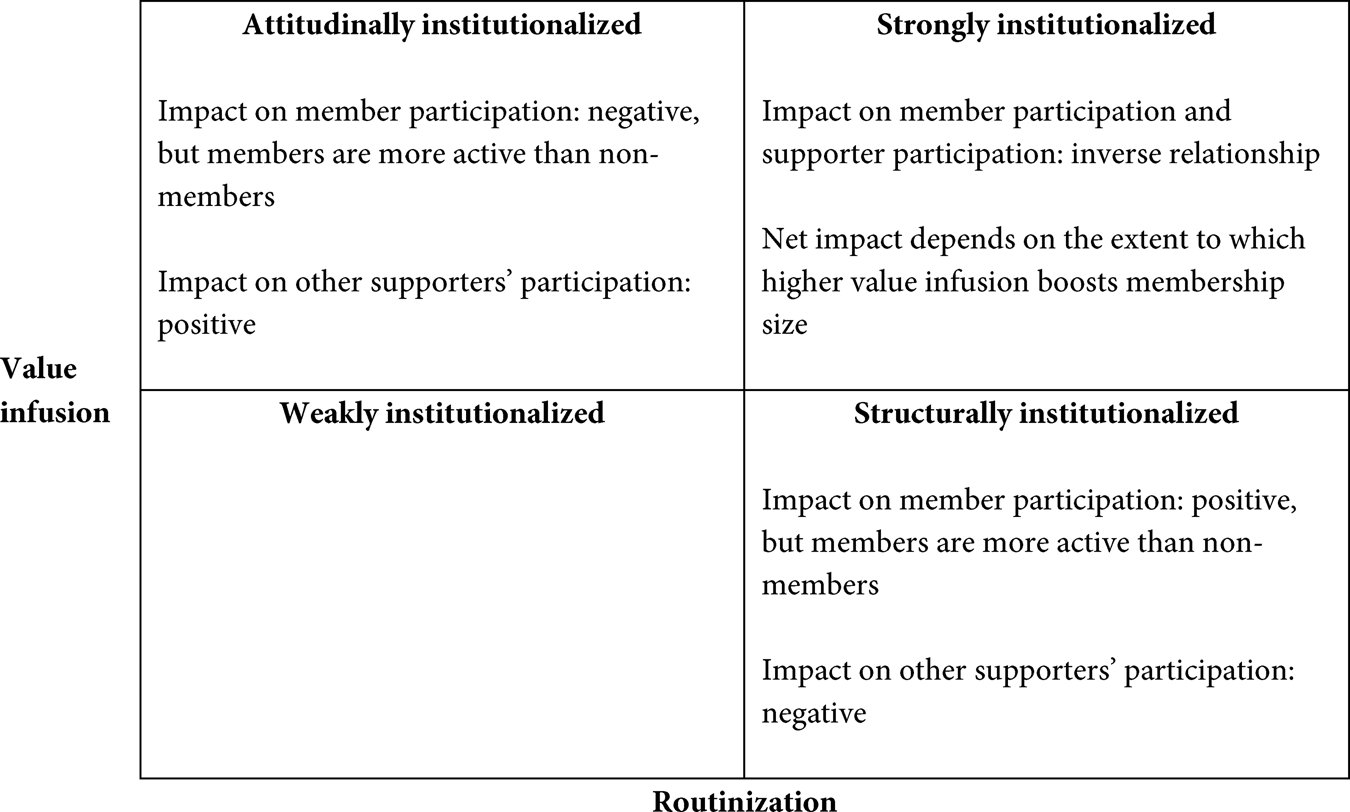
We can summarize these results in a different way, using Bolleyer and Ruth's (Reference Bolleyer and Ruth2018) classification of parties based on their levels of value infusion and routinization: (1) strongly institutionalized (high scores for both value infusion and routinization); (2) attitudinally institutionalized (high scores for value infusion only); (3) structurally institutionalized (high scores for routinization only); and (4) weakly institutionalized (low scores for routinization and value infusion). This classification helps to make clear that there are trade-offs in who gets mobilized. Our models suggest that structurally institutionalized parties will be the most effective in boosting partisan participation in political events from party members, whereas attitudinally institutionalized parties will do the best at boosting event participation by non-member supporters (see Figure 2).Footnote 16 The finding that the different dimensions of PI impact differently on various groups of party supporters is one of the most interesting results of this attempt to uncover the mechanisms whereby PI might contribute to stabilizing patterns of political competition. It provides further support for the intuition of previous authors that PI is characterized by these two distinct dimensions.
Net Impact of Levels of Routinization and Value Infusion on Political Event Participation
Note: Original classification of parties based on their degree of institutionalization taken from Bolleyer and Ruth (Reference Bolleyer and Ruth2018). If the marginal impacts of routinization and value infusion on participation are similar, the effects for ‘other supporters’ will dominate as long as this group is more numerous than ‘party members’.

Conclusions
Our question in this research is whether PI is related to individual participation patterns in ways that might explain how higher levels of PI could lead to more stable parties and party systems. Our findings illuminate some possible individual-level mechanisms that could link PI with electoral outcomes. The results tell a story of more institutionalized parties having more capacity to mobilize their supporters to engage publicly with politics, be that in partisan arenas or otherwise. In terms of routinization, this may work through boosting engagement levels of people who self-identify as party members but are weakly affiliated, while dampening rally participation by the non-affiliated. In terms of the other PI dimension, higher value infusion does most to motivate participation by those with looser ties to ‘their’ party. Parties with a message seem better able to inspire and mobilize non-members who are sympathetic to their message. Given our research strategy that matched respondents with parties based on their past electoral support, we are unable to test whether this also translates into an enhanced ability for parties to mobilize voting by their less attached supporters, but that is a plausible hypothesis to draw from these results: parties that emphasize their goals and values might be more successful at electoral mobilization.
To be clear, we are not arguing that one type of PI might be more desirable than the other, but merely showing that they may have different effects in terms of whose participation they mobilize. What we are asserting, based on our investigation showing the different effects of the two dimensions of PI on individual-level political mobilization, is that if we want to understand the effects of PI on a macro-level phenomenon such as electoral volatility, it may be necessary to take account of how parties institutionalize (along which dimension), rather than just asking how much they institutionalize.
Our purpose in this article has been to begin to identify possible mechanisms that would explain the association between how parties institutionalize and how citizens participate in the political lives of their countries. In the past two decades, party institutionalization has become a well-established concept in party scholarship, and it is increasingly used in party-level analyses as either a dependent or independent variable. Despite this, comparatively little is known or even speculated about the individual-level mechanisms whereby such institutionalization might produce the observed effects. Lacking such insights, researchers will be unable to make effective policy recommendations as to how and what to cultivate if the different aspects of party institutionalization contribute differently to the operations of democracies. Our efforts in this article are a modest first step in the direction of uncovering these micro-foundations, but they are constrained by the scarcity of appropriate longitudinal data on citizens' partisan participation behaviours.
Further research is needed to understand the underpinnings of these complex relations. In particular, it would be helpful to be able to determine whether it is true, as we speculate, that increased organizing by more institutionalized parties has the effect of crowding out mobilization by non-party organizations – including by movements with the potential to evolve into challengers that could destabilize the party system. We would also like to better understand the nature of the events in which the activated non-members are engaging, be these events partisan or otherwise. Nevertheless, while our research has raised new questions, it still substantially advances understanding of the individual-level relations that motivate the effects attributed to the property known as party institutionalization. Our findings thereby contribute to the growing weight of research demonstrating how parties' organizational choices and resources can influence citizens' participation in partisan politics.
Supplementary material
The supplementary material for this article can be found at https://doi.org/10.1017/gov.2021.67.
Acknowledgements
We would like to thank Karina Kosiara-Pedersen and the anonymous reviewers at Government and Opposition for their helpful comments and suggestions.