Introduction
The increase in natural and man-made disasters occurring worldwide, along with the associated widespread destruction, places Emergency Medicine (EM) physicians at the forefront of the response to these crises. While there have been data published on the status of Emergency Medical Services (EMS) education in residencies in the United States (US),Reference Sarin, Cattamanchi, Alqahtani, Aljohani, Keim and Ciottone 1 no data specifically address education in Disaster Medicine. Recent data indicate disaster preparedness is one of the most frequently listed component Program Directors want to add to their curricula.Reference Sarin, Cattamanchi, Alqahtani, Aljohani, Keim and Ciottone 1 While the Accreditation Council for Graduate Medical Education (ACGME; Chicago, Illinois USA) residency program requirements for EM has some baseline recommendations for education in Disaster Medicine, there are no clear standardized requirements or guidelines for training programs on how to address the topic.Reference Katzer, Cabanas and Martin-Gill 2 In a study published in 2012, a consensus document addressed the need for basic educational competencies in Disaster Medicine across all fields and produced a list of core competencies for medical personnel. 3 Despite this growing political and educational interest in Disaster Medicine, there is no evidence that these educational goals are being uniformly met.
This study clarifies what actual training in Disaster Medicine occurs on an EM residency level based on consensus identified competencies. This study will define if an educational gap exists in EM training programs across the US and how Program Directors view the current status of Disaster Medicine training within EM. This information is critical to target future specific Disaster Medicine training objectives for EM residencies by clarifying what is already being taught in residencies and what gaps may require more focused guidance.
This study surveyed residencies in the US to assess the level of education in Disaster Medicine in EM residencies. This survey specifically identified the competencies least and most addressed in residency programs, reported the level of perceived time spent on disaster training, compared training opportunities available in three- versus four-year programs, and highlighted self-reported effective educational models already in place. The authors hypothesized that there would be a variety of competencies taught across residency programs with no universal focus on any particular core competency.
Methods
Study Design and Setting
An electronic survey using a commercial online survey program (SurveyMonkey; San Mateo, California USA) was distributed to Program Directors of accredited EM residency programs in the US. The online survey tool of multiple-choice and free-response questions was distributed from February 7 through September 24, 2014. This study received approval from the Beth Israel Deaconess Medical Center (Boston, Massachusetts USA) Institutional Review Board. Program Directors were contacted for participation by distributing the survey using the Council of Emergency Medicine Residency Directors (CORD; Irving, Texas USA) listserv and asked if they would participate. The e-mail message did not provide any incentive for participation. The introductory e-mail message included an electronic link as well as an opt-out option. Follow-up e-mails were distributed using the contact information maintained by the Society for Academic Emergency Medicine (SAEM; Des Plaines, Illinois USA) database to non-responders three times over the course of six months. If there was no response to the survey after three follow-up e-mails to the Program Director, the program was considered a non-responder. The survey measured demographic information including name of program, location of program, role of survey responder, type of hospital, duration of program, as well as questions specific to Disaster Medicine competencies addressed and what teaching methodologies were used during training. The Disaster Medicine core competencies assessed were those recommended by the National Standardized All-Hazard Disaster Core Competencies Task Force as published in 2012. 3 For a copy of the survey utilized, please see the Appendix (available online only).
Selection of Participants
The survey was emailed to the Program Directors of accredited EM residency programs in the US based on the CORD database. No programs from the CORD database were excluded. No non-accredited programs were included.
Methods and Measurements
Data were collected using the online survey tool SurveyMonkey when participants accessed the emailed survey link. Study participants entered their information in response to the questions, and the data were then housed in the SurveyMonkey online database.
Outcomes
Primary outcomes assessed were: self-reporting of programs of teaching any Disaster Medicine concepts during residency, identifying competencies taught in over 90% of residency programs, and identifying competencies taught in less than 50% of programs. Secondary outcomes assessed included trends in commonly used teaching methods, Program Directors’ perception of appropriateness of time spent on Disaster Medicine concepts, difference in training available based on three- versus four-year training programs, and details of self-reported effective educational models in use.
Analysis
Data were compiled using the SurveyMonkey software and analyzed by descriptive statistics using a commercially available Microsoft Excel 2013 spreadsheet program (Microsoft Corp.; Redmond, Washington USA). Further analysis with Chi-square testing was performed using commercially available IBM SPSS Statistics software (IBM Corp.; Armonk, New York USA).
Results
Characteristics of Study Subjects
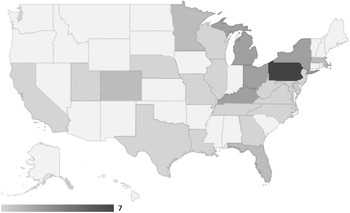
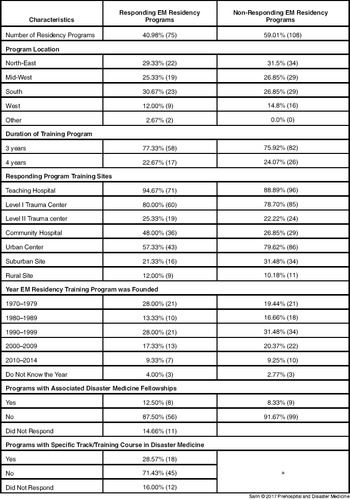
Out of 183 programs, 75 (41%) responded to the survey and completed all required questions. Of the respondents, 75.32% represented three-year training programs and 24.68% were from four-year programs. There were associated Disaster Medicine fellowships with 12.5% of the responding programs and 28.57% of responding residency programs had a specific track or specialty course in Disaster Medicine for the residents. Of the respondents, 25.33% of responses were from the Midwest (19), 29.33% from the Northeast (22), 30.67% from the South (23), 12.0% from the West (9), and 2.67% from Puerto Rico (2). Of the respondents, 94.67% (71) were from teaching hospitals, among which 80.0% were Level I trauma centers (60) and 20.0% were Level II trauma centers (15). Of the programs, 48.0% were community health centers (36), 57.33% were located in urban centers (43), 21.33% in semi-urban (16), and 12.0% in rural centers (9). Twenty-eight percent of the respondents started their EM programs in the 1970s (21), 13.33% in the 1980s (10), 28.0% in the 1990s (21), 17.33% in the 2000s (13), 9.33% in the 2010s (7), and 4.0% of programs didn’t know which year the program was started (3). The estimated non-response error was -19.47%. See Table 1 and Figure 1 for further breakdown and a comparison of participating and non-participating programs.
Location of Responding Emergency Medicine Residency Programs.

Characteristics of Participating and Non-Participating EM Residency Programs

Abbreviation: EM, Emergency Medicine.
a Cannot assess due to not participating in survey.
Main Results
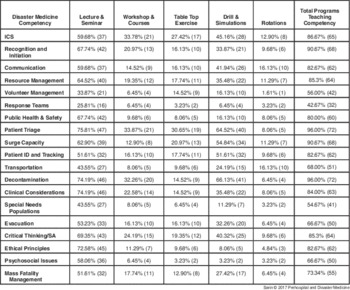
Almost all programs (94.81%) self-identified as having some component of Disaster Medicine training in their residency. The core Disaster Medicine competencies assessed by percentage of programs that provided education in each category are listed in Table 2. The most common Disaster Medicine educational competencies taught were patient triage and decontamination, both of which were addressed by 96.0% of responding programs. The only competency taught in less than 50.0% of programs was working with response teams. However, the competencies taught in less than 60.0% of programs included volunteer management and special needs populations.
Reported Training Provided in Disaster Medicine Competencies in EM Residencies

Abbreviations: EM, Emergency Medicine; ICS, Incident Command System; SA, Situational Awareness.
Program Directors reported the time spent on Disaster Medicine training was “too little” as per 51.56% of respondents, “just right” as per 45.31% of respondents, and “too much” as per 3.13% of respondents. Commonly identified limitations to providing disaster education were “limited time” (35.94%) and “limited resources” (18.7%), though many programs (48.4%) indicated they were “not limited” in the amount of education they provide. Based on Pearson Chi-square testing, there was no statistically significant difference between three- and four-year programs in reported level of disaster education provided.
The most commonly used teaching methods were drills/simulations and lectures/seminars, as compared to workshops, courses, tabletop exercises, and rotations. Additional educational methods self-reported as used by residencies specifically included enrolling residents in Basic Disaster Life Support and Advance Disaster Life Support courses, having residents join the local Medical Reserve Corps, having residents involved with the local Disaster Medical Assistance Team, having residents sit on the hospital and regional Disaster Management committees, and incorporating associated training with their EMS rotations.
Discussion
Data from this study indicate that almost all responding EM residencies provide some education in Disaster Medicine. However, the only competencies that are almost universally covered are triage and decontamination. Topics such as volunteer management, working with response teams, and special populations are covered the least across US programs, and there is an apparent inconsistency in how many programs include other competencies. More than one-half of the programs indicated that there is not enough Disaster Medicine taught in their EM residency. However, almost 45% of programs felt the amount they teach is “just right.” While prior studies have indicated that Program Directors list disaster preparedness as one of the most frequently listed components Program Directors want to add to their curricula,Reference Sarin, Cattamanchi, Alqahtani, Aljohani, Keim and Ciottone 1 it may be that what Program Directors are truly seeking is a better definition of the content to be covered under disaster preparedness.
Prior surveys comparing EM and Surgery residents have indicated that EM residents have more emergency preparedness training than their colleagues; however, there are no indicators of specifically what that training encompasses.Reference Schultz, Koenig and Whiteside 4 Data from over a decade ago surveying US EM residencies had indicated inconsistent and inadequate training, specifically in the area of bioterrorism, which is still consistent with the data from this survey when assessing across-broader Disaster Medicine competencies.Reference Dennis, Brandt and Steinberg 5 The current requirement in place by the ACGME for EM residencies is both broad and vague, stating only that “residents must have experience in Emergency Medical Services (EMS), emergency preparedness, and disaster management” and “this should include participation in multi-casualty incident drills.”Reference Katzer, Cabanas and Martin-Gill 2 The 2013 Model of Clinical Practice of Emergency Medicine specifically addresses “Mass casualty/Disaster management” in the matrix of physician tasks that are part of EM practice, and further defines this task as “Understand and apply the principles of disaster and mass casualty management, including preparedness, triage, mitigation, response, and recovery,” which while more specific is still a very broad guideline.Reference Pesik, Keim and Sampson 6
There have been numerous studies assessing Disaster Medicine educational needs and curricula amongst medical student populations, which reaches a broad audience of future practitioners.Reference Counselman, Borenstein and Chisholm 7 - Reference Smith, Levy and Hsu 9 However, it cannot be denied that EM trainees have a higher likelihood of needing to use these skill sets in their careers. Events as varied as the 2011 tornadoes in Joplin, Missouri (USA), Hurricanes Katrina (2005) and Sandy (2012), and the 2013 Boston Marathon Bombings (Massachusetts USA) have clearly demonstrated this need. Interviews of staff at training hospitals after the Boston Marathon Bombings in 2013 cite preparedness and training in Disaster Medicine as critical to their effective response.Reference Jasper, Berg and Reid 10 - Reference Greenberg 12
Limitations
A major limitation of this study was the relatively low response rate from programs, as only 41% responded at the time of publication. This inherently makes it difficult to generalize the data to all programs.
Given that this is a self-selecting response group, there may be a bias in the data in that the responding programs may be representative of those with the most comfort and interest in Disaster Medicine education. It is possible that non-responding programs have even less content directed to Disaster Medicine education. There is, however, no data to verify or validate this viewpoint.
The data may be further limited by a lack of familiarity with the Disaster Medicine competencies by survey responders. Not all Program Directors necessarily have a good working knowledge of all Disaster Medicine terminology, which could lead to under-reporting of educational competencies that are actually addressed by programs.
Conclusion
There are a variety of educational tools used to teach Disaster Medicine in US residencies today, with a larger focus on the use of lectures and hospital drills. However, there is no indication that there is a similar educational approach across all residencies. The better training and background EM-trained physicians have, the higher chance of success of an emergency department, hospital, and community when faced with any level of disaster. This survey highlights the opportunity for the creation of a model for EM resident education in Disaster Medicine.
Acknowledgements
The authors would like to acknowledge Ali Ardalan, MD, PhD; and Prasit Wuthisuthimetawee, MD, FRSCT. This study is part of the completion of thesis work for the European Masters in Disaster Medicine by Dr. Ritu Sarin.
Author Contributions
RS, SC, AA, and MA conceived the study, designed and built the survey, and obtained IRB approval. MK and GC supervised the study design and development. RS undertook data collection and contacting participants. MK, SC, and GC provided statistical advice on study design and SC analyzed the data. RS and SC drafted the manuscript, and all authors contributed substantially to its revision. RS takes responsibility for the paper as a whole.
Supplementary Material
To view supplementary material for this article, please visit https://doi.org/10.1017/S1049023X17000267