Each year, more than half a million foster youth in the United States navigate a system of care that is ill-equipped to manage so many young lives (Child Welfare Information Gateway, 2011). For youth who never attain a permanent adoptive or kin placement, the risks are especially pronounced. Youth who “age out” or “emancipate” from foster care at 18 years of age face the challenges of adulthood with few educational, material, and socioemotional resources (Casey Family Programs, 1999, 2003; Courtney, Reference Courtney2009). Cut from the moorings of state care, these youth are often brought down by the currents of adulthood.
Young adulthood constitutes a period of major transition, challenge, and opportunity (Arnett, Reference Arnett2000, Reference Arnett2004; Schulenberg, Sameroff, & Cicchetti, Reference Schulenberg, Sameroff and Cicchetti2004a). Yet former foster youth arrive at the shores of adulthood on waves of disrupted family backgrounds, disjointed foster care experiences, and marked vulnerabilities that undermine their adaptive negotiation of age-salient challenges (Havighurst, Reference Havighurst1972; McCormick, Kuo, & Masten, Reference McCormick, Kuo, Masten, Fingerman, Berg, Smith and Antonucci2011; Roisman, Masten, Coatsworth, & Tellegen, Reference Roisman, Masten, Coatsworth and Tellegen2004). Joining the extensive literature documenting negative developmental outcomes among formerly fostered youth (Mendes & Moslehuddin, Reference Mendes and Moslehuddin2006; Pecora et al., Reference Pecora, Kessler, O'Brien, White, Williams and Hiripi2006), emerging research points to especially pronounced vulnerabilities among the 5% to 10% of fostered youth who are not adopted or returned to kin, but instead emancipate from foster care at the age of majority with few resources despite disproportionate needs.
Emancipated foster youth evidence significant difficulties negotiating the developmental challenges of young adulthood across varied domains, such as education, employment, community engagement, relational well-being, and psychological health. Fewer than 50% of youth aging out of care graduate from high school and, whereas 30% enroll in higher education, fewer than 5% successfully complete a 4-year degree (Burley & Halpern, Reference Burley and Halpern2001; Casey Family Programs, 2003; Zetlin & Weinberg, Reference Zetlin and Weinberg2004). These rates are well below the 2010 national high school graduation and college attendance rates of 89.9% and 68.1%, respectively (Chapman, Laird, & KewalRamani, Reference Chapman, Laird and KewalRamani2010; US Department of Education, 2011). Occupational outcomes are similarly grim, with two-thirds of emancipated foster youth struggling to maintain employment in early adulthood (Blome, Reference Blome1997; Casey Family Programs, 1999; McMillen & Tucker, Reference McMillen and Tucker1999). Disconnected from their community and care networks, up to 50% of emancipated foster youth report periods of homelessness and/or incarceration during the transition to adulthood (Courtney et al., Reference Courtney, Dworsky, Ruth, Keller, Havlicek and Bost2005; Mangine, Royse, Wiehe, & Nietzel, Reference Mangine, Royse, Wiehe and Nietzel1990; Pecora et al., Reference Pecora, Kessler, O'Brien, White, Williams and Hiripi2006), which is dramatically higher than national rates of homelessness (2.5%–6.5%; Ammerman et al., Reference Ammerman, Ensign, Krizner, Meininger, Tornabene and Warf2004) and incarceration (1%–1.5%; Glaze, Reference Glaze2011) among youth 18–24 years of age. Rates of interpersonal and emotional problems are similarly elevated among emancipated youth (Benedict, Zuravin, & Stallings, Reference Benedict, Zuravin and Stallings1996; Brandford & English, Reference Brandford and English2004; Courtney, Piliavin, Grogan-Kaylor, & Nesmith, Reference Courtney, Piliavin, Grogan-Kaylor and Nesmith2001; English, Morreale, & Larsen, Reference English, Morreale and Larsen2003), which is particularly concerning given evidence that former foster youth may be less able (Courtney & Dworsky, Reference Courtney and Dworsky2006) or willing (Samuels & Pryce, Reference Samuels and Pryce2008) to seek and engage support services than other transition-aged youth. Extant research paints a dark picture of adjustment outcomes among emancipated foster youth in young adulthood, yet resilience theory may cast this image in a new light.
Resilience Among Emancipated Foster Youth
Resilience reflects a developmental process wherein the individual is able to utilize resources in and outside the self to negotiate current challenges adaptively and, by extension, to develop a foundation on which to rely when future challenges occur (Egeland, Carlson, & Sroufe, Reference Egeland, Carlson and Sroufe1993; Yates, Egeland, & Sroufe, Reference Yates, Egeland, Sroufe and Luthar2003). In contexts of prior or current adversity, resilience reflects multiform competence characterized by both the absence of psychopathology and the presence of adaptive capacities to negotiate age-salient issues effectively (Garmezy & Masten, Reference Garmezy and Masten1986; Luthar, Cicchetti, & Becker, Reference Luthar, Cicchetti and Becker2000; Masten, Reference Masten2001). In this view, resilience (and competence more broadly) develops via the operation of normal developmental processes despite extraordinary circumstance, rather than from exceptional individual capacities (Garmezy, Reference Garmezy and Stevenson1985; Masten, Reference Masten2001).
Few studies of emancipated foster youth have examined the better than expected developmental outcomes that typify resilience processes among adversity-exposed youth. This deficit bias persists despite “the obvious reality that variability [in adaptation] must be equally characteristic of the impoverished as it is of the affluent” (Garmezy & Neuchterlein, Reference Garmezy and Neuchterlein1972, p. 229). Although reflecting on the marked variability in adaptive organizations among children in poverty, Garmezy's observation is no less applicable to youth reared in foster care. Indeed, more than 25 years ago, Festinger (Reference Festinger1983) documented notable areas of vulnerability and competence in a large sample of men who had been reared in foster care, yet few heeded her calls to abandon our “singular emphasis on vulnerability” (p. 253) in the study of fostered youth.
The current investigation extends recent efforts to examine resilience among emancipated foster youth by using latent profile analysis (LPA) to elucidate meaningful patterns of vulnerability and strength across behavioral and psychological domains of adjustment in this highly disadvantaged population. In a study of 100 emancipated youth, Daining and DePanfilis (Reference Daining and DePanfilis2007) examined factors associated with a composite of developmental competence indicators across six external adjustment domains, including educational participation, employment history, avoidance of homelessness, early parenthood, drug use, and criminal activity. Although Daining and DePanfilis (Reference Daining and DePanfilis2007) incorporated multiple dimensions of adaptive functioning in their measure of resilience, their exclusive emphasis on external markers of adjustment as composited in a single index yielded a functionally unidimensional measure of behavioral resilience. Relative to the research on behavioral resilience among emancipated foster youth, far fewer studies have attended to internal adjustment indicators, such as self-concept and mental health. Moreoever, studies that have employed broader conceptualizations of resilience beyond the behavioral domain to include interpersonal relationships and personal characteristics, such as humor and self-esteem (Drapeau, Saint-Jacque, Lepine, Begin, & Bernard, Reference Drapeau, Saint-Jacque, Lepine, Begin and Bernard2007; Jones, Reference Jones2011), have been limited by small samples (e.g., 12–16 participants) and categorical adjustment criteria wherein, for example, emancipated youth were labeled resilient if they achieved above average adjustment in three of five measured domains (Drapeau et al., Reference Drapeau, Saint-Jacque, Lepine, Begin and Bernard2007). This behavioral bias mirrors trends in the broader field, yet there is reason to think that internal adjustment may be of interest in its own right.
Prior research suggests that youth may evidence meaningful discordance across external/behavioral and internal/psychological adjustment domains. In both cross-sectional and prospective investigations of high-risk adolescents, a subset of youth appeared to be functioning well with respect to age salient issues, but nevertheless endorsed significant levels of intrapsychic distress that were more characteristic of their maladapted peers (i.e., youth exposed to high levels of adversity who were struggling in relevant behavioral domains) than their competent peers (i.e., youth who were adapting well in the context of relatively low levels of adversity; Luthar, Reference Luthar1991; Luthar, Doernberger, & Zigler, Reference Luthar, Doernberger and Zigler1993). These data are consistent with Garmezy's (Reference Garmezy1993) observation that the capacity “‘to spring back’ does not suggest that one is incapable of being wounded or injured” (p. 129) and “signs of emotional distress do not necessarily suggest a breakdown in resilient behavior” (p. 130, emphasis added).
Some evidence points to discordant patterns between internal and external adjustment outcomes among fostered youth. In a study of current foster youth who were 17 years of age and likely to emancipate from care, Farruggia, Greenberger, Chuansheng, and Heckhausen (Reference Farruggia, Greenberger, Chuansheng and Heckhausen2006) found that fostered youth were surprisingly similar to their nonfostered peers with respect to self-esteem and depressive symptoms, despite notable decrements in other adaptive domains, such as educational achievements and aspirations. In contrast to this internally resilient pattern, however, other evidence points to externally resilient adaptive profiles wherein youth who appear to be faring well on observable adjustment indices nevertheless endorse significant intrapsychic distress. For example, in a study of 14 former foster youth who were attending a 4-year university and evidenced marked educational resilience, Hines, Merdigner, and Wyatt (Reference Hines, Merdigner and Wyatt2005) found that these same youth expressed recurrent themes of stress, sadness, and guilt. Together, these findings support the universality of adaptive variability across the continuum of risk (Garmezy & Neuchterlein, Reference Garmezy and Neuchterlein1972), and further suggest that there may be meaningful subtypes of resilience among adversity-exposed youth who evidence competence in one or more, but not necessarily all, adaptive domains (Garmezy, Reference Garmezy1993; Luthar et al., Reference Luthar, Doernberger and Zigler1993).
Resilient strivings and successes among emancipated foster youth reveal significant heterogeneity in the adaptive profiles of a population that has too long been discounted as lost or beyond saving. However, there remains a pressing need for research to elucidate meaningful patterns of multidimensional competence across manifest and intrapsychic indices of adjustment in adequately sized samples of emancipated foster youth. Adopting a dynamic model of resilience wherein each aspect of adaptation takes its meaning in the context of the broader developing system (Cicchetti & Curtis, Reference Cicchetti and Curtis2007; Gottlieb & Halpern, Reference Gottlieb and Halpern2002), the current study employed a person-centered analytic paradigm to examine the form and meaning of differential constellations of specific competencies and vulnerabilities among emancipated foster youth.
Finding the Person in the Process
Garmezy (Reference Garmezy1982) observed that “the starting point for the scientific study of human behavior, normal and disordered, is the single case” (p. 5). Nowhere has this been truer than in the case of resilience research. Initially inspired by the individual narratives of persons who overcame tremendous odds, the study of resilience has flourished over the past 50 years (Hauser & Allen, Reference Hauser and Allen2006; Luthar, Reference Luthar, Cicchetti and Cohen2006; Masten, in press; Masten & Garmezy, Reference Masten, Garmezy, Lahey and Kadin1985). Although variable-centered techniques have clarified core developmental processes that account for individual differences in adaptive trajectories amidst adversity, it is only in the relatively recent past that analytic advances have brought the field of resilience research back to its person-level origins, to a place that can empirically acknowledge and evaluate individual patterns of adjustment.
As discussed earlier, the majority of resilience research on fostered youth (e.g., Daining & DePanfilis, Reference Daining and DePanfilis2007; Drapeau et al., Reference Drapeau, Saint-Jacque, Lepine, Begin and Bernard2007) has followed the broader field in attending to specific, often behavioral, domains of adjustment and employing cumulative models of resilience to yield a single quantitative measure of multiform competence (Cicchetti & Rogosch, Reference Cicchetti and Rogosch1997; Luthar & Cushing, Reference Luthar and Cushing1999b; Masten et al., Reference Masten, Burt, Roisman, Obradović, Long and Tellegen2004; McGloin & Widom, Reference McGloin and Widom2001). Masten and colleagues (Masten, Reference Masten2001; Masten et al., Reference Masten, Hubbard, Gest, Tellegen, Garmezy and Ramirez1999) suggested that person-oriented analyses complement traditional variable-centered models of resilience because they capture the holistic expression of resilient adaptations as patterned over time and through lived experience (see for discussion, Bergman & Magnusson, Reference Bergman and Magnusson1997; Magnusson, Reference Magnusson, Moen, Elder and Luscher1995). Person-oriented studies employing a priori classifications of youth across combined indices of adversity and competence have advanced our understanding of resilience dynamics across domains and over time (Luthar et al., Reference Luthar, Doernberger and Zigler1993; Masten et al., Reference Masten, Burt, Roisman, Obradović, Long and Tellegen2004). However, a priori classification approaches may not fully realize the strength of person-oriented analyses, which lies in their ability to elucidate underlying or latent constellations of adaptation in dynamic systems.
Dynamic systems consist of hierarchically nested organizations that take their meaning, at least in part, from relations with other aspects of the developing system (Bergman & Trost, Reference Bergman and Trost2006; Gottlieb & Halpern, Reference Gottlieb and Halpern2002). This investigation adopted a dynamic, developmental process perspective on risk and resilience, and employed LPA as a person-oriented method for understanding resilience to (a) evaluate competing models of adaptive heterogeneity in a relatively large sample of 164 emancipated foster youth, (b) validate obtained adjustment profiles across independent measures of adaptation, and (c) explore child welfare experiences that may contribute to specific profiles of risk and resilience among emancipated youth.
There is considerable debate about how researchers should define and evaluate resilience (Kaplan, Reference Kaplan, Glantz and Johnson1999; Kaufman, Cook, Arny, Jones, & Pittinsky, Reference Kaufman, Cook, Arny, Jones and Pittinsky1994; Luthar et al., Reference Luthar, Cicchetti and Becker2000), particularly among youth in care (Rutter, Reference Rutter2000). The current study employed both external and internal measures of adjustment as identified by developmental task theory and informed by a systems perspective. Developmental tasks “are those things a person must learn if he is to be judged or to judge himself to be a reasonably happy and successful person” (Havighurst, Reference Havighurst1972, p. 2). The capacity to effectively negotiate these age-salient issues is central to contemporary definitions of competence (Masten, Burt, & Coatsworth, Reference Masten, Burt, Coatsworth, Cicchetti and Cohen2006), and serves as a foundation upon which subsequent competence may be built, both in contexts of typical development (Sroufe, Reference Sroufe1979; Waters & Sroufe, Reference Waters and Sroufe1983) and in adversity (Yates et al., Reference Yates, Egeland, Sroufe and Luthar2003). Despite the behavioral emphasis of developmental task theory, however, previously described studies suggest that internal indices of adjustment are also important (Farruggia et al., Reference Farruggia, Greenberger, Chuansheng and Heckhausen2006; Hines et al., Reference Hines, Merdigner and Wyatt2005; Luthar et al., Reference Luthar, Doernberger and Zigler1993). Education, employment, community connections, relationships, self-esteem, and emotional well-being are of continued or increasing salience during the young adult period (McCormick et al., Reference McCormick, Kuo, Masten, Fingerman, Berg, Smith and Antonucci2011; Roisman et al., Reference Roisman, Masten, Coatsworth and Tellegen2004; Schulenberg, Bryant, & O'Malley, Reference Schulenberg, Bryant and O'Malley2004). Foster youth experience tangible threats to well-being in each of these areas because of educational disruptions (Blome, Reference Blome1997; Pecora et al., Reference Pecora, Kessler, O'Brien, White, Williams and Hiripi2006; Zetlin & Weinberg, Reference Zetlin and Weinberg2004), reduced abilities to engage in formal employment (Massinga & Pecora, Reference Massinga and Pecora2004; Stein, Reference Stein1994), constrained community ties and extracurricular activities (Collins, Reference Collins2001), barriers to peer connections (e.g., required security screening of friends' parents; Farrugia et al., 2006), and enduring emotional legacies of loss, disruption, and rejection that are associated with reduced self-esteem (Kools, Reference Kools1997) and increased depressive symptoms (Harman, Childs, & Kelleher, Reference Harman, Childs and Kelleher2000). Thus, emancipated youth who evidence competence in one or more of these domains also exhibit resilient adaptation.
Identifying profiles of psychosocial adjustment among emancipated youth may reveal meaningful adaptive heterogeneity that can inform efforts to foster positive youth development in this vulnerable population while furthering our conceptual understanding of resilience as a multifaceted developmental process. Latent profile identification procedures were expected to yield multiple competence profiles among emancipated foster youth. First, consistent with the dominant literature (see Courtney, Reference Courtney2009, for review), a sizable group of youth was expected to evidence compromised adaptation across the external and internal domains examined here (i.e., maladaptive profile). However, as observed in varied populations of adversity-exposed youth, we expected to find a second group of youth who evidenced competent adjustment despite exposure to the incontrovertible adversity of extended foster care placement (i.e., resilient profile). Further, based on prior research with high-risk adolescents (Luthar et al., Reference Luthar, Doernberger and Zigler1993), survivors of political trauma (Wright, Masten, Northwood, & Hubbard, Reference Wright, Masten, Northwood, Hubbard, Cicchetti and Toth1997), and older foster youth (Farruggia et al., Reference Farruggia, Greenberger, Chuansheng and Heckhausen2006; Hines et al., Reference Hines, Merdigner and Wyatt2005), we expected to find discordant profiles consisting of youth who endorsed positive internal adjustment, despite faltering in external adaptive domains (i.e., internally resilient profile), and youth who were faring well on overt adaptive indices, despite pronounced internal distress (i.e., externally resilient profile).
Validation analyses were expected to support the integrity of one or more adaptive profiles across concurrent measures of behavioral and socioemotional adjustment. In addition, we tested for potential sociodemographic differences across groups as a function of participant age, gender, race, and verbal ability. Although females are overrepresented among youth evidencing resilient adaptation in prior research (Daining & DePanfilis, Reference Daining and DePanfilis2007; Jackson & Martin, Reference Jackson and Martin1998), these differences may reflect the disproportionate emphasis on external indices of adjustment in the extant literature. Thus, we did not expect to find robust gender differences in this investigation, which included both external and internal adjustment indicators. Consistent with prior research, we expected that members of the resilient subgroups would evidence higher intelligence than youth exhibiting a maladapted adjustment pattern (Masten et al., Reference Masten, Garmezy, Tellegen, Pellegrini, Larkin and Larsen1988). Finally, responding to calls for greater attention to relations between child welfare experiences and young adult adjustment (Daining & DePanfilis, Reference Daining and DePanfilis2007), we explored patterns of placement and emancipation characteristics, as well as experiences of maltreatment across the adjustment groups with the expectation that greater disruption and maltreatment would be associated with maladapted profiles in young adulthood.
Methods
Participants
Participants were 164 youth (64% female) who emancipated from the California foster care system and were between the ages of 17 and 21 years at the time of assessment (M age = 19.67 years, SD = 1.12). The youth were 34.1% Hispanic, 31.1% African American, 15.9% White European American, and 18.9% Multiracial/other. On average, participants had emancipated from foster care at 18.14 years of age (SD = .50) and had been on their own 18.06 months (SD = 13.73) prior to the face-to-face interview.
Procedures
Youth were invited to participate in a longitudinal study of adaptation among youth aging out of foster care via social service workers, independent living program providers, and flyers, which were widely distributed to agencies serving emancipated youth (e.g., homeless shelters, transitional living facilities, social service offices). Youth completed a brief intake screening by phone before scheduling a face-to-face interview. Exclusionary criteria included youth who entered foster care after age 16 (n = 6), youth who entered foster care because of juvenile delinquency in isolation from other factors (n = 4), youth who were older than 21 years of age (n = 9), and youth who were not conversant in English (n = 0). Current foster youth were eligible to participate if their formal date of emancipation fell within the 2-year data collection period. In those cases, initial interviews were scheduled for a date after the court emancipation proceeding. Youth who were incarcerated or hospitalized during the Wave 1 data collection period were not made aware of this research opportunity.
Face-to-face interviews were conducted by advanced research assistants who had at least a bachelor's degree in psychology (21.7% of interviews) and doctoral students in developmental psychology (79.3% of interviews). Interviews were conducted in our laboratory (84.1%) or in a private setting in the participant's community (i.e., agency offices, libraries; 15.9%). Interviews were conducted in English and audio recorded for later transcription. Youth completed four interview segments, each lasting about 45 min, with breaks between them. First, following an extensive informed consent process, youth were interviewed about their residential, educational, occupational, and relational functioning since emancipation. Second, youth completed a series of computer-administered questionnaires, which focused on their relationship beliefs and experiences. Third, youth completed a semistructured life history interview, in which we obtained detailed information about their placement history prior to emancipation, and behavioral data regarding abuse, neglect, and other trauma exposure. Fourth, youth completed another set of computer-administered surveys, which focused on their mental health and socioemotional well-being. Interviews concluded with a brief series of questions regarding the youth's future goals and a series of consents to follow up with the youth, as well as with a friend, worker, partner, or other outside informant. Youth who reported having one or more live-born children (n = 42; 25.6%) were invited to complete a 1-hr supplemental interview regarding their first-born child (five youth declined this portion of the study). Participants were compensated with $75 and parents who completed the supplemental interview received an additional $25. All procedures were approved by the Human Research Review Board of the participating university.
Measures
Competence profile indicators
Age-salient dimensions of adaptive functioning were assessed via semistructured interviews and questionnaires across both external and internal domains, as described below. Independent raters evaluated each youth's adjustment in the domains of education, employment, civic engagement, and relational well-being using 7-point rating scales. Reliability was indicated by intraclass correlations (ICC) across 33% of the sample (n = 52). Questionnaires evaluated youth-reported self-esteem and depressive symptoms. Rating schemes were guided by extant research on development and competence during the transition to young adulthood (Arnett, Reference Arnett2004, Reference Arnett, Grusec and Hastings2007; Berlin, Furstenberg, & Waters, Reference Berlin, Furstenberg and Waters2010; Burt & Masten, Reference Burt, Masten, Grant and Potenza2009; Flanagan & Levin, Reference Flanagan and Levin2010; Masten et al., Reference Masten, Burt, Roisman, Obradović, Long and Tellegen2004; Osgood, Foster, Flanagan, & Ruth, Reference Osgood, Foster, Flanagan and Ruth2005; Roisman et al., Reference Roisman, Masten, Coatsworth and Tellegen2004; Rutter, Reference Rutter1996; Schulenberg, Bryant, et al., 2004; Schulenberg, Sameroff, & Cicchetti, Reference Schulenberg, Sameroff and Cicchetti2004b).
Educational competence
Two independent raters evaluated participant's current educational competence based on their attained level of education, educational achievement (i.e., average grades received if attending school since emancipation), school-related conduct (e.g., class attendance, conflict with teachers), and educational values and aspirations (ICC = 0.91). At the low end of the continuum, youth evidenced poor educational attainment (e.g., high school dropout) and expressed negative educational values and aspirations (e.g., do not regret leaving school early, have no plans to pursue further education, and do not believe education is important for broader well-being). Moderate educational competence characterized youth who had graduated high school or obtained a GED, had plans to pursue some kind of postsecondary training and/or had attended some kind of training for a short period, but were not attending school at the time of the interview. High levels of educational competence were assigned to participants who were currently attending junior or 4-year college, were passing their classes, and articulated a belief in the value of education for their future success and happiness.
Occupational competence
Ratings of occupational competence were based on the stability and quality of participants' formal work experience since emancipation, their satisfaction with work, and their conduct and success in the workplace (ICC = 0.89; see Hyson, Reference Hyson, Settersten and Owens2002, and Roisman et al., Reference Roisman, Masten, Coatsworth and Tellegen2004, for relevant discussions). At the low end of the scale, participants had never worked, had no interest in working, and were not currently looking for employment. Youth who had participated in some kind of prior formal employment, but were not working currently because of misconduct on the job also earned low scores on this scale. Participants with moderate occupational competence had held jobs in the past and seemed to fair reasonably well. These participants were employed with modest satisfaction or were unemployed through no fault of their own (e.g., participant moved to a new location, business closed a given branch) and were proactively seeking work. Participants who were rated as occupationally competent were currently working with success and at least some satisfaction.
Civic engagement
Independent raters evaluated the degree to which each participant engaged with her/his community based on interview responses to questions regarding voting, volunteering, and organizational membership (ICC = 0.90; Duke, Skay, Pettingell, & Borowsky, Reference Duke, Skay, Pettingell and Borowsky2009; Obradović & Masten, Reference Obradović and Masten2007). In addition to structured questions regarding voter registration, voting activity, volunteering, and organization membership, participants were also asked about their motivations for engagement. At the low end of the continuum, the participant endorsed active resistance to community engagement or minimal engagement such that s/he may have been registered to vote, but did not actively vote, volunteer, or belong to any kind of group or organization. Moderate levels of civic engagement captured youth who were actively engaged through voting or intermittent volunteering or organizational activity, but these individuals rarely evidenced more than one form of engagement and/or were generally extrinsically motivated (e.g., “I volunteer once a month because my counselor told me it would look good for school”). The highest ratings of civic engagement were reserved for youth who evidenced consistent and multifaceted community engagement, and expressed an intrinsic sense of commitment, obligation, or fulfillment in so doing.
Relational competence
Each youth completed a semistructured relationship interview that began with questions about the important people in her/his life followed by in-depth questions about her/his primary dating relationship of 2 months or longer if present (53.7%), or a close platonic relationship (46.3%). Youth were asked a series of 15–20 questions with follow-up probes to assess the core features of their primary relationship in terms of contact, consistency, intimacy, conflict, and relational expectations. Independent ratings of relational competence were based on the relationship's (a) intimacy and reciprocity in terms of mutual disclosure and experiential sharing, (b) predictability and reliability, and (c) safety and security (ICC = 0.87). Interview-based assessments of relationships are uniquely valuable (Collins & Sroufe, Reference Collins, Sroufe, Furman, Brown and Feiring1999), particularly in the current study where several participants endorsed extremely high levels of relational violence, but also expressed a strong desire to remain in the relationship and great satisfaction with the level of respect provided by their partner. Relationship quality was evaluated in consideration of all available information using a 7-point scale. Low relationship scores characterized relationships with infrequent contact, high levels of conflict, and/or low intimacy. High-quality relationships were indicated by complex and well-supported descriptions of relational security and reciprocity using several specific examples. Interview items and coding parameters were based on existing measures and coding schemes for both friendships and dating relationships (Egeland, Lehn, Ostoja, Williams, & Kalkoske, Reference Egeland, Lehn, Ostoja, Williams and Kalkoske1994).
Self-esteem
The Rosenberg Self-Esteem Scale (Rosenberg, Reference Rosenberg1965, Reference Rosenberg1989) is a 10-item, self-report, unidimensional, measure of global self-esteem. Respondents indicated their level of agreement with 10 items assessing overall feelings of self-acceptance and self-worth (e.g., “At times I think I am no good at all,” “I am able to do things as well as most other people”) on a 4-point Likert scale from strongly agree (1) to strongly disagree (4). Rosenberg Self-Esteem Scale items were summed to yield a global measure of self-esteem ranging from 10 to 40 with higher scores connoting higher self-esteem. The Rosenberg Self-Esteem Scale evidenced acceptable reliability in varied samples (test–retest rs = .82–.88; αs = 0.77–0.88; Blascovitch & Tomaka, Reference Blascovich, Tomaka, Robinson, Shaver and Wrightsman1993), as well as in the current study (α = 0.86).
Depressive symptoms
The Depression subscale of the Brief Symptom Inventory (BSI; Derogatis, Reference Derogatis1993) evaluated the severity of participants' depressive symptoms during the week preceding the Wave 1 assessment. Participants indicated how much each of six depressive symptoms (e.g., “thoughts of ending your life,” “feeling blue,” “feeling no interest in things”) bothered them during the preceding week on a 5-point Likert scale from not at all (0) to extremely (4). The BSI is an abbreviated form of the Symptom Checklist 90—Revised (Derogatis, Reference Derogatis1983) that has acceptable reliability in both clinical and community populations (Boulet & Boss, Reference Boulet and Boss1991; Derogatis & Melisaratos, Reference Derogatis and Melisaratos1983), as well as in the current sample of emancipated foster youth (α = 0.90). BSI T scores of 63 or above identify potentially clinically depressed individuals and were used in these analyses.
Validation measures
As described previously, data-driven, exploratory techniques, such as LPA, may yield statistical profiles that do not translate to meaningful differences beyond the indicator variables (Bergman & Trost, Reference Bergman and Trost2006; Hagenaars & McCutcheon, Reference Hagenaars and McCutcheon2002; von Eye & Bergman, Reference von Eye and Bergman2003). Therefore, the obtained profiles were examined to test for differences as a function of participants' age, gender, race, verbal ability, and across scores on the independent validation measures described below
Verbal ability
The vocabulary subtest of the Shipley Hartford Institute of Living Scale (SILS; Shipley, Reference Shipley1940) was used to assess receptive vocabulary. The SILS is a widely used brief assessment of intellectual ability and impairment (Stevens, Kaplan, & Bauer, Reference Stevens, Kaplan and Bauer2001), which has been employed in multiethnic (Bowers & Pantle, Reference Bowers and Pantle1998) and adolescent samples (Camp & Morgan, Reference Camp and Morgan1984). The verbal subtest of the SILS consists of 40 vocabulary items to be completed within 10 min. For each item, participants were asked to circle the word with the same meaning as the target word from four possible options. Correct answers were summed, so that higher scores reflected greater receptive vocabulary. The SILS is strongly correlated with other standardized IQ tests and was used in this study as a brief measure of verbal ability in consideration of time constraints (Bowers & Pantle, Reference Bowers and Pantle1998; Zachary, Paulson, & Gorsuch, Reference Zachary, Paulson and Gorsuch1985).
Behavioral adjustment
Externalizing behavior was assessed using Achenbach's (Reference Achenbach1990, 1997) Young Adult Self-Report (YASR). The YASR is a self-report measure designed to assess emotional and behavioral problems for individuals between the ages of 18 and 30 years old. The externalizing subscale of the YASR includes items pertaining to aggressive, delinquent, and intrusive behaviors, which are rated as not at all true (0), somewhat true (1), or very true (2). YASR T scores of 63 or above identify clinical symptom elevations and were used in these analyses. Alcohol and drug use were assessed using a modified version of the Adolescent Health Survey (Blum, Harris, Resnick, & Rosenwinkle, Reference Blum, Harris, Resnick and Rosenwinkle1989), which has demonstrated adequate reliability and internal consistency in adolescent and young adult samples (Blum, Resnick, & Bergeisen, Reference Blum, Resnick and Bergeisen1989; Resnick, Harris, & Blum, Reference Resnick, Harris and Blum1993). Participants endorsed the frequency with which they used two categories of alcohol (i.e., beer/wine and hard liquor) and 11 illicit drugs during the past year across six response options from never (0) to five or more times per week (5). Youth and peer criminality were assessed using the Adolescent Health Survey (Blum, Harris, et al., 1989). Participants were asked whether or not they had ever engaged in 14 different criminal activities, regardless of arrest or conviction, such as shoplifting, vandalism, robbery, assault and battery, arson, drug possession or distribution, and attempted homicide or homicide. Participants were then asked whether any of their friends had participated in these same categories of criminal activity. Participant and peer criminality scores reflect a composite of affirmative responses across the 14 probed criminal activities. Participants provided information about additional behavioral variables during the course of their assessment, including (a) whether they had ever been pregnant or gotten someone else pregnant, (b) whether they had ever dropped out of secondary school, (c) whether they were currently attending school, (d) whether they were currently employed, and (e) whether they had been homeless since emancipation.
Socioemotional adjustment
Ego resilience was assessed using concordance values derived from the California Adult Q-Set (Block, Reference Block1961/1978). At the conclusion of the Wave 1 interview and based on their interaction with the participant across the preceding 3–4 hr, examiners rated the participant on 100 personality descriptors using a 9-point scale from extremely uncharacteristic (1) to extremely characteristic (9) in a forced distribution. Ratings were made using the computerized Riverside Accuracy Project Q-Sorter Program (2010), which was developed by Funder and colleagues (for a program description, see Furr, Wagerman, & Funder, Reference Furr, Wagerman, Funder, Agnew, Carlston, Graziano and Kelly2010). Youth personality profiles were correlated with Block's (Reference Block1991, 2008) prototype for ego resilience. The ego-resilient prototype reflects the average of scores assigned by nine expert raters who were asked to create a Q-sort of an ego-resilient individual. Each youth's ratings across the 100 items were correlated with the ego-resilient prototype to yield a single concordance score with positive values reflecting higher ego resilience (i.e., the global capacity to negotiate challenges in a way that is flexible, resourceful, and adaptive by effectively modulating one's expression and inhibition of emotions and impulses) and lower scores reflecting poorer concordance with the prototype, or ego brittleness. High levels of ego resilience characterize a person who “can bounce back or recover after a stressful experience,” while ego brittleness describes a person who “tends to go to pieces under stress” (Block & Block, Reference Block, Block and Collins1980). Prior research has demonstrated the validity of the California Adult Q-Set profiles (see Block, Reference Block2008, for review). Internalizing symptoms were assessed using Achenbach's (Reference Achenbach1990, 1997) YASR as described previously. The internalizing subscale of the YASR includes items pertaining to withdrawn, anxious, and depressed behaviors with T scores of 63 or higher connoting clinically significant distress. Life satisfaction was evaluated with the Satisfaction With Life Scale (Diener, Emmons, Larsen, & Griffin, Reference Diener, Emmons, Larsen and Griffin1985). The Satisfaction With Life Scale is a five-item self-report instrument that measures an individual's overall satisfaction with life. Items include statements such as, “In most ways my life is close to my ideal” and “I am satisfied with my life,” which are rated on a 5-point Likert scale ranging from strongly disagree (1) to strongly agree (5). The Satisfaction With Life Scale evidenced strong test–retest reliability (r = .82) and internal consistency (α = 0.87; Diener et al., Reference Diener, Emmons, Larsen and Griffin1985) in both prior research and in the current sample (α = 0.89). Social support was assessed with the Multidimensional Scale of Perceived Social Support (Zimet, Dahlem, Zimet, & Farley, Reference Zimet, Dahlem, Zimet and Farley1988) from family, friends, and significant others (i.e., a special person or friend). Participants endorsed their level of agreement with 12 items pertaining to perceived support from family (e.g., “My family really tries to help me”), friends (e.g., “I can count on my friends when things go wrong”), and significant others (e.g., “There is a special person in my life who cares about my feelings”) using a 7-point Likert scale from strongly disagree (1) to strongly agree (7). The Multidimensional Scale of Perceived Social Support has demonstrated reliability in varied populations, including emancipated foster youth (Courtney et al., Reference Courtney, Piliavin, Grogan-Kaylor and Nesmith2001), as well as in this sample (α = 0.93). Peer relationship quality was evaluated using the peer subscale of the Inventory of Peer and Parent Attachment (Armsden & Greenberg, Reference Armsden and Greenberg1987). The Inventory of Peer and Parent Attachment assesses three dimensions of relationship quality, including the extent to which the relationship is characterized by mutual trust, high-quality communication, and/or alienation and anger. Participants indicated their agreement with 25 statements pertaining to peer relationship quality (e.g., “My friends understand me,” “I trust my friends”) using a 5-point Likert scale from almost never or never true (1) to almost always or always true (5). The Inventory of Peer and Parent Attachment evidenced strong test–retest reliability in prior research (Armsden & Greenberg, Reference Armsden and Greenberg1988), and was internally reliable in this sample (α = 0.92)
Child welfare history
Youth completed a structured interview to obtain data pertaining to their age at first placement in foster care, the reason for their initial placement, and the sequence of placements thereafter. Each placement was probed for the participant's age at time of placement, the type of placement, the reason for placement, and the level of kin contact attendant with each placement (including whether the youth was placed with one or more siblings) up to the time of emancipation. In addition to the structured data, a written summary of each case was prepared by the interviewer to clarify the complexity of each youth's child welfare experience. Cases where youth were uncertain of placement features for 20% or more moves were coded as missing for both individual and cumulative variables (n = 9). These cases did not differ from the rest of the sample on the variables examined here.
Placement data were compiled to yield quantitative measures of (a) age at first placement, (b) total number of placements, (c) proportion of placements with one or more siblings, (d) total duration in care, and (e) age at emancipation. In addition, categorical ratings were used to describe the reason for placement (i.e., child abuse, parental drug use, child neglect or parental incapacity, and other) and the type of placement at the time of emancipation (i.e., foster home, group home, kin, or other).
Child maltreatment
Participants provided behaviorally specific information regarding experiences of child maltreatment during verbal administration of the Early Trauma Inventory (Bremner, Vermetten, & Mazure, Reference Bremner, Vermetten and Mazure2000). In the context of this structured interview, participants were asked a series of increasingly specific questions regarding their maltreatment in childhood (i.e., prior to age 17), including ages of onset and offset, perpetrator identity, behavioral specifics of each incident, resulting injuries or interventions (e.g., legal, medical), and frequency of maltreatment.
Two independent raters evaluated the severity of each form of maltreatment across four levels, including no abuse (0), mild abuse (1), moderate abuse (2), and severe abuse (3), using the criteria set forth by McGee and colleagues (McGee, Wolfe, Yuen, & Wilson, Reference McGee, Wolfe, Yuen and Wilson1995). Severity ratings were established based on both the intensity and frequency of abuse with mild ratings assigned to cases of low/moderate intensity and low frequency, moderate ratings reflecting experiences of high intensity and low frequency or low intensity and high frequency, and severe ratings reserved for cases when the maltreatment was both high intensity and high frequency. Intraclass correlations were calculated across all cases to assess reliability.
Child sexual abuse was evaluated with questions probing for experiences of unwelcome sexual contact or exposure by a person 5 or more years older than the child. Mild intensity was indicated by groping or touching over clothes. Moderate intensity characterized contact experiences that did not involve penetration or force (i.e., fondling under clothes, kissing). High intensity involved any type of penetration (e.g., digital, oral, anal, vaginal). As described above, severity ratings accounted for both child sexual abuse intensity and frequency (ICC = 0.91).
Child physical abuse was evaluated with questions probing for experiences of physical harm inflicted by adult caregivers. Mild intensity was reserved for corporal punishment experiences (i.e., physical contact in the context of caregiver discipline with minimal harm to the child), which was not included in calculations of child physical abuse severity. Moderate intensity was indicated by contacts that caused marks or injuries, and went beyond the accepted norm for disciplinary method or force (e.g., punching, kicking, hitting with extension cord). High intensity captured experiences that had the potential for severe injury (e.g., beating, shaking an infant, burning and/or use of weapons). As described above, severity ratings took into account both the intensity and frequency of child physical abuse (ICC = 0.84).
Child emotional abuse was assessed with questions inquiring about experiences in which caretakers attacked the child's sense of self-worth or safety. Mild intensity was indicated by direct or indirect communications representing inadequate parenting without direct physical insult (e.g., comparing the child unfavorably to others, hostile communication toward the child, swearing or cursing at the child). Moderate intensity experiences threatened the child's sense of self-worth (e.g., denigrating, ridiculing, or blaming the child, exposure to criminal influences, threatening suicide). High intensity was indicated when the participant endorsed experiences that jeopardized their sense of self or safety (e.g., telling the child that s/he is unwanted, threatening to kill or abandon the child, using extreme and humiliating nonphysical punishment). Here again, severity ratings accounted for both the intensity and frequency of child emotional abuse (ICC = 0.79).
Child neglect was evaluated with items tapping experiences of caregiving omissions. Neglect was coded separately in physical (e.g., food/shelter needs), emotional, and supervisory domains, and an overall rating was assigned to capture global neglect across these domains. Mild intensity was indicated by parental lapses that failed to meet minimum care standards (e.g., food not available for regular meals, disregarding child's feelings, allowing child to miss school when not ill). Moderate intensity acts put the child at risk for improper development (e.g., leaving the child unsupervised for an extended or indefinite period of time, failure to consistently provide food, prenatal drug exposure). High intensity was indicated by experiences that put the child at risk for physical harm (e.g., failure to provide food to sustain development, inattention to medical needs, lack of cleanliness to the point of fostering disease, failure to protect from ongoing abuse). Severity ratings took into account both the intensity and frequency of neglect (ICC = 0.81).
Domestic violence exposure was assessed with items that probed for experiences seeing or hearing caregivers physically fighting. Mild intensity was indicated by witnessing violence between caregivers that lacked potential for injury (i.e., noncontact or low contact experiences, such as throwing things). Moderate intensity was indicated by nonlethal experiences (e.g., punching, hitting). High intensity experiences were potentially lethal or involved injury or weapons. Severity ratings reflected both the intensity and frequency of domestic violence exposure (ICC = 0.87).
Analytic plan
LPA is an extension of latent class analysis wherein continuous, ordinal, and/or categorical indicators are presumed to occur in meaningful constellations that can be explained by an unspecified number of mutually exclusive response profiles (or classes in the case of dichotomous indicators; Hagenaars & McCutcheon, Reference Hagenaars and McCutcheon2002). Successive profile models are compared to arrive at the best fitting latent categorical variable, which represents the mixture of unique subpopulations within the data. Well suited to consider multiple facets of adjustment simultaneously, LPA is superior to traditional cluster analytic methods of group identification because of available model fit statistics. Relative model fit was captured by multiple quantitative indices, including the Akaike information criterion (AIC; Akaike, Reference Akaike1974), the Bayesian information criterion (BIC; Schwartz, Reference Schwartz1978), the sample size adjusted BIC (SSABIC; Sclove, Reference Sclove1987), and the Lo–Mendell–Rubin (LMR) adjusted likelihood ratio test (Lo, Mendell, & Rubin, Reference Lo, Mendell and Rubin2001), which evaluates the comparative fit between the specified model and a model with one fewer profile/class. The classification quality of each model was evaluated based on the entropy index with values closer to 1 connoting optimal classification (Ramaswamy, Desarbo, Reibstein, & Robinson, Reference Ramaswamy, Desarbo, Reibstein and Robinson1993). In accordance with recent simulation studies, relatively smaller BIC and SSABIC values were taken to be the most robust indicator of model fit and weighted accordingly in the model selection process (Nylund, Asparouhov, & Muthén, Reference Nylund, Asparouhov and Muthén2007).
Advancing beyond rational grouping or cluster-based analyses, LPA employs maximum likelihood estimation using the expectation maximum algorithm to enable the use of all available indicator information under the presumption that data are missing at random (Little & Rubin, Reference Little and Rubin1987; Schafer, Reference Schafer1997; Schafer & Graham, Reference Schafer and Graham2002). Covariance coverage across the competence indicators examined here ranged from 96.3% for self-esteem to 99.4% for employment. Profile membership probabilities are calculated concurrently with profile estimation to yield posterior probabilities of profile membership and minimize the risk of misclassification because of absolute profile assignment. Profile identification was determined based on the pattern with the highest posterior probability for each participant. All analyses were performed using Mplus 6.1 (Muthén & Muthén, Reference Muthén and Muthén1998–2010).
Results
Sample description
The current sample was predominantly female (64%), non-White (84.1%), and representative of the broader population of youth who emancipated from care in southern California during the period of data collection, which was 56% female and 80.3% non-White (California Child Welfare Performance Indicators Project, 2011). Participants endorsed extensive histories of child welfare involvement entering the system at 8.89 years on average (SD = 5.61; range = infancy to 16) and traversing an average of seven placements before emancipation (M = 6.94, SD = 4.63; range = 1–23). Rates of maltreatment were high with 48.4% of youth endorsing a history of sexual abuse, 68.5% physical abuse, 81.7% emotional abuse, 89.6% neglect, and 58.4% domestic violence exposure. On average, youth emancipated from care at 18.14 years of age (SD = 0.50) and were interviewed 18.06 months postemancipation (SD = 13.73).
Although positively biased because of the absence of institutionalized participants at the initial interview, the current sample evidenced higher levels of vulnerability than many other studies of this population. For example, 57.1% of our participants entered care prior to age 12, versus 10% in a review of older youth in care (Wulczyn & Brunner, Reference Wulczyn and Brunner2001). Rates of high school dropout (40.9%), homelessness (40.5%), unemployment (74.8%), and parenthood (25.6%) were equal to or greater than those observed in prior samples of emancipated foster youth (for reviews, see Courtney, Reference Courtney2009; Havlicek, Reference Havlicek2011; Stein, Reference Stein2006).
Profile identification
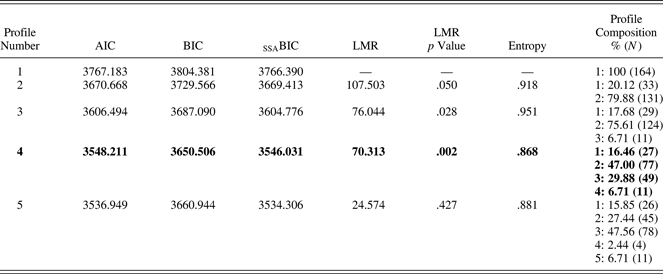
Quantitative LPA fit indices converged on a four-class profile solution, which was characterized by relatively low AIC, BIC, and SSABIC values, a significant LMR test, and a high entropy value (see Table 1 for fit indices of models with one to five profile solutions). The four-profile model fit the data significantly better than the three-profile solution (LMR = 70.31, p = .002). The addition of a fifth profile increased the magnitude of the AIC and BIC values, which suggests a reduction in model fit. Although the SSABIC value decreased slightly in the five-profile solution, the LMR test indicated a nonsignificant improvement in model fit over the more parsimonious four-class solution.
Fit indices for latent profile analyses of competence among emancipated foster youth
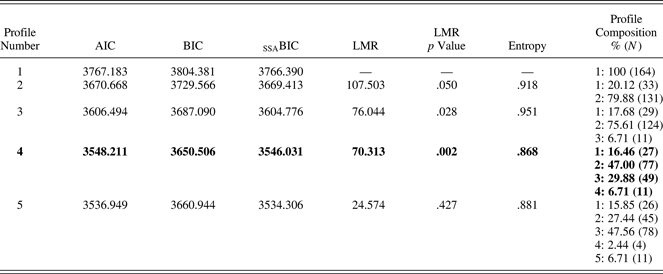
Note: The bold four-profile solution represents the best fit to the data. Profile composition reflects the proportion of participants assigned to each profile in the model. AIC, Akaike information criterion; BIC, Bayesian information criterion; SSABIC, sample-size adjusted BIC; LMR, Lo–Mendell–Rubin adjusted likelihood ratio test.
Profile description
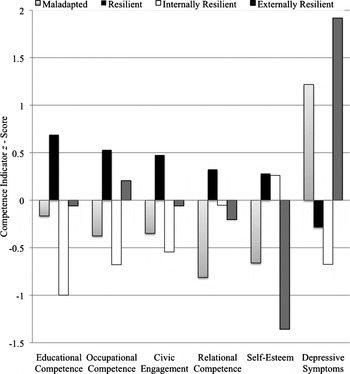
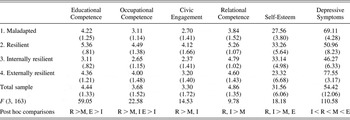
As a logical extension of LPA, the obtained profiles evidenced significant differences in conditional means across each adjustment indicator (see Table 2). Bonferonni-corrected post hoc comparisons evaluated specific differences between adjustment profiles. The profiles are described below, and they are graphically represented across standardized competence scores in Figure 1.
Patterns of competence across adjustment profiles.

Latent profile means (standard deviations) on competence indicators (N=164)

Note: Conditional means (and standard deviations) with Bonferroni-corrected post hoc comparisons are shown for the maladapted (M) profile (16.5%; N = 27), the resilient (R) profile (47%; N = 77), the internally (I) resilient profile (30%; N = 49), and the externally (E) resilient profile (6.7%; N = 11). These patterns are depicted graphically across standardized z scores of competence in Figure 1.
Profile 1: Maladapted
Latent Profile 1 consisted of 16.5% of the sample (n = 27), and was characterized by adjustment difficulties in both external and internal domains of adaptation, with particularly notable difficulties in relationships. Although these young people were struggling in all domains to varying degrees, their relational vulnerability was most apparent.
Profile 2: Resilient
Latent Profile 2 was the most common adjustment pattern, comprising 47% of the sample (n = 77). As can be seen in Figure 1, these youth were navigating the age-salient demands of young adulthood well relative to other emancipated youth in the current sample. Moreover, both independent competence ratings and standardized adjustment measures suggested that these adversity-exposed youth were doing well relative to nonfostered young adults in the broader population. By and large, individuals with this resilient adaptive profile were pursuing educational and/or occupational opportunities with considerable success, were moderately involved in their communities, and were able to describe intimate and reciprocal relationships with partners and friends. Patterns of internal adjustment were similarly positive with relatively high levels of self-esteem and low levels of depressive symptoms compared to the other emancipated youth examined here and to a broader nonpatient sample of young adults (i.e., their mean BSI depressive symptom score fell squarely in the average range at 50.96, SD = 8.23; Derogatis, Reference Derogatis1993).
Profile 3: Internally resilient
Latent Profile 3 accounted for 30% of the sample (n = 49). Individuals with this profile evidenced significant deficits in competence across multiple external adaptive domains, but nevertheless fared reasonably well in relationships and endorsed higher levels of self-esteem and lower levels of depressive symptoms relative to the other adjustment groups. These adaptive organizations were described as internally resilient because these high-adversity youth appeared to be doing well with respect to intrapsychic indices of adjustment and evidenced moderately secure intimate relationships with partners and friends, despite being the least well adapted in the domains of education, employment, and civic engagement.
Profile 4: Externally resilient
Latent Profile 4 was the smallest of the obtained groups, accounting for 6.7% of the current sample (n = 11). Although this group appeared to be reasonably well adjusted in the areas of education, employment, and civic engagement, they endorsed lower levels of relational well-being, notable decrements in self-esteem, and clinically significant levels of depressive symptoms. Hence, we described their adaptive profiles as externally resilient.
Profile validation
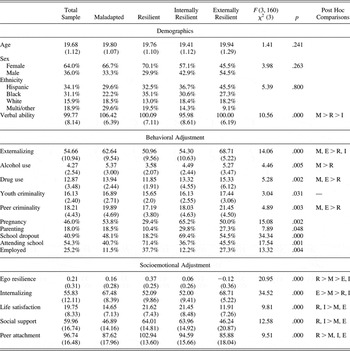
Person-oriented analytic models, including LPA, may be unduly informed by idiosyncratic patterns within the indicator data (Bergman & Trost, Reference Bergman and Trost2006; Hagenaars & McCutcheon, Reference Hagenaars and McCutcheon2002; von Eye & Bergman, Reference von Eye and Bergman2003). Therefore, we evaluated the four-factor profile solution with respect to a set of independent measures, which we selected a priori to evaluate differences in demographic, verbal, behavioral, and socioemotional adjustment measures across the profiles (see Table 3). Chi-square analyses evaluated group differences across categorical adaptive indices, univariate analyses of variance evaluated profile patterns across continuous variables, and post hoc Bonferroni-corrected comparisons evaluated mean differences between each pair of adjustment profiles.
Patterns of demographic, behavioral, and socioemotional adjustment across adaptive profiles

Note: Means (standard deviations) with Bonferroni-corrected post hoc comparisons are shown for continuous validation measures. Percentiles and chi-square values are shown for categorical measures. M, maladapted profile; R, resilient profile; I, internally resilient profile; E, externally resilient profile.
Demographic descriptives
Chi-square analyses revealed no significant differences in age, gender, or ethnic composition across adjustment profiles (see Table 3). Given largely consistent associations between increased intellectual capacity and resilient adaptation (Masten & Coatsworth, Reference Masten and Coatsworth1998; Masten et al., Reference Masten, Garmezy, Tellegen, Pellegrini, Larkin and Larsen1988), we were surprised to find that individuals in the maladapted profile group (rather than those in the resilient profile group) evidenced the highest levels of verbal ability in this sample.
Behavioral adjustment
As expected, youth with maladaptive profiles evidenced relatively high levels of difficulties across a wide range of behavior problems, including externalizing behavior, alcohol and drug use, and peer criminality. In contrast, youth with resilient adaptation profiles evidenced significantly fewer behavioral difficulties. Patterns among the internally and externally resilient profiles were less consistent. Youth who evidenced internally resilient profiles were reasonably well adjusted across measures of externalizing behavior. However, these youth endorsed the highest rates of prior pregnancy (65.2%) and were the most likely to report actively raising a child at the time of the initial interview (29.8%). Youth with internally resilient profiles were also the most likely to have dropped out of high school (69.4%) and the least likely to be attending school currently (36.7%). Among youth with externally resilient profiles, rates of behavioral problems were surprisingly high in the areas of externalizing behavior, substance use, and criminality.
Socioemotional adjustment
Patterns of psychological adjustment differed in largely expected ways across profiles. Youth evidencing resilient adaptive profiles were rated by interviewers as significantly more ego resilient than all other groups. Although youth in the resilient subgroup also endorsed the highest levels of social support, peer attachment, and life satisfaction, the examiner ratings of ego resilience lend important validity to the integrity of the resilient profile because they were not self-reported. Much like their resilient peers, youth evidencing profiles of internal resilience endorsed significantly lower levels of internalizing and higher levels of life satisfaction and social support than both the maladapted and externally resilient groups.
Child welfare history
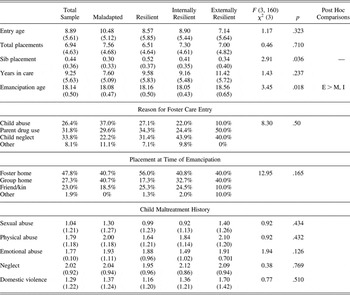
There were surprisingly few significant differences in child welfare experiences across adaptive profiles (see Table 4). Youth who appeared to be faring well despite notable levels of internal distress (i.e., the externally resilient profile) were somewhat older at the time they emancipated from foster care. Although the groups differed with respect to the proportion of placements they had with one or more siblings, post hoc comparisons failed to reach significance beyond a trend for higher rates of sibling placement among youth with a resilient adaptive profile. Beyond these differences, however, the groups were largely comparable in terms of reasons for entry into foster care, placement type at time of emancipation, number of placements, and other features of their care experience. Perhaps most surprisingly, there were no differences in the severity of maltreatment across adjustment groups.
Patterns of child welfare experiences across adaptive profiles

Note: Means (standard deviations) with Bonferroni-corrected post hoc comparisons are shown for continuous validation measures. Percentiles and chi-square values are shown for categorical measures. M, maladapted profile; R, resilient profile; I, internally resilient profile; E, externally resilient profile.
Discussion
This investigation examined the form and meaning of heterogeneous adaptive profiles in a large sample of emancipated foster youth. LPA analyses revealed four distinct profiles of adaptive organization across external and internal domains of salient adjustment challenges in young adulthood. Moreover, the obtained profiles evidenced both statistical and conceptual integrity with respect to contemporaneous measures of behavioral and socioemotional adjustment.
Our findings revealed robust patterns of both maladaptation and resilience among emancipated foster youth, which are consistent with research on other high-risk youth populations. In contrast to prior depictions of near universal maladjustment among emancipated foster youth, however, the most common adjustment profile in this sample was characterized by resilience. Nearly half the youth in this sample (47%) were effectively negotiating age salient issues pertinent to education, employment, civic engagement, relationships, self-esteem, and mental health, despite their exposure to the incontrovertible adversities of caregiving vulnerability and loss, prolonged foster care, and emancipation. Moreover, although 16.5% of the youth evidenced notable difficulties across all measures of adaptation in this study, the remaining 36.7% exhibited circumscribed resilience across either internal (30%) or external (6.7%) adjustment domains.
These data confirm that youth can be resilient in one domain but not in others (Garmezy, Reference Garmezy1993) and replicate prior research with high-risk adolescents (Luthar, Reference Luthar1991; Luthar et al., Reference Luthar, Doernberger and Zigler1993), trauma survivors (Wright et al., Reference Wright, Masten, Northwood, Hubbard, Cicchetti and Toth1997), and other vulnerable youth (Farber & Egeland, Reference Farber, Egeland, Anthony and Cohler1987; Parker, Cowen, Work, & Wyman, Reference Parker, Cowen, Work and Wyman1990; Werner, Reference Werner, Brambring, Sel and Skowronek1989). Although the majority of prior evidence suggests the presence of behavioral manifestations of resilience amidst deeper intrapsychic vulnerabilities, only a small subset of the current sample evidenced this externally resilient pattern. A striking proportion of the current sample (30%) exhibited an internally resilient profile, which was characterized by marked intrapsychic well-being despite adaptive vulnerabilities in manifest competence domains.
Validation analyses across independent measures of behavioral and socioemotional adjustment largely supported the practical significance of these adjustment profiles. Youth evidencing maladaptive profiles endorsed higher levels of externalizing behavior problems, substance use, and peer deviance, and lower levels of internal well-being and social support relative to their peers with resilient adjustment profiles. Independent adjustment measures also varied significantly, although less consistently, across the internally and externally resilient profile groups. Joining prior investigations documenting behavioral or external resilience, the current investigation is among the first to suggest a complementary and compelling profile of internal resilience. In their study of high-risk adolescents, Luthar and colleagues (1993) made brief mention of “surprisingly low levels of self-reported symptoms among the low social competence children at high stress” (p. 714) and interpreted this pattern as a potential manifestation of defensive coping (e.g., denial, avoidance). However, the current data suggest that patterns of internal resilience may be more common than previously recognized, at least among emancipated foster youth, and warrant further consideration.
Internally resilient adaptive profiles may be especially salient among emancipated foster youth for a number of reasons. First, foster youth who evidence externally resilient adaptive profiles may be selected out of the emancipating population for adoption because they appear to be higher functioning. Second, paralleling emerging research on disidentification among immigrant and minority youth (Major, Spencer, Schmader, Wolfe, & Crocker, Reference Major, Spencer, Schmader, Wolfe and Crocker1998; Steele, Reference Steele1997), foster youth may not identify with traditional markers of competence because they feel excluded from or marginalized in these domains. It is interesting that youth with internally resilient profiles endorsed high rates of parenting, which may in part account for their intrapsychic competence relative to their manifest difficulties. As noted by Biehal and Wade (Reference Biehal and Wade1996), the accelerated and unsupported transition to adulthood for emancipated youth may engender early parenting among youth who seek to establish a sense of family and parental identity when access to traditional student and worker identities is thwarted. Thus, patterns of internal resilience may reflect a combination of selection bias and youths' preferential identification with nontraditional markers of identity and status that contribute to subjective well-being.
The current study counters the dominant deficit discourse in research on high-risk youth generally, and particularly on emancipated foster youth, by demonstrating robust strength in this sample where more than 80% of these adversity-exposed youth nevertheless evidenced competence across one or more domains of adaptation. In so doing, this work replicates prior research showing that, even among the most vulnerable populations, a majority of youth retain or recover strength in one or more domains across the transition to adulthood (Festinger, Reference Festinger1983; Gralinski-Bakker, Hauser, Stott, Billings, & Allen, Reference Gralinski-Bakker, Hauser, Stott, Billings and Allen2004; Hauser, Reference Hauser1999). These youth are standing strong despite powerful undertows toward dysfunction during the transition to adulthood, yet ongoing work is needed to understand these heterogeneous adaptive outcomes.
Individual demographics, such as age, gender, and race, did not differ across adaptaive profiles. Moreover, despite robust adaptive differences across adjustment profiles, youth endorsed relatively comparable experiences of child welfare involvement. These data were surprising given prior relations between child welfare experiences and young adult adjustment (Courtney et al., Reference Courtney, Dworsky, Cusick, Havlicek, Perez and Keller2007; Leathers, Reference Leathers2006; Rubin, O'Reillu, Luan, & Localio, Reference Rubin, O'Reillu, Luan and Localio2007; Stein, Reference Stein2006), but are consistent with other data showing similar care experiences among groups of high and low achieving emancipated foster youth (Jackson & Martin, Reference Jackson and Martin1998). The apparent similarity in maltreatment and placement histories across diverse adjustment profiles points to the need for increased attention to protective (or differential susceptibility) processes that may explain variation in adjustment among emancipated foster youth (Belsky, Bakermans-Kranenburg, & van IJzendoorn, Reference Belsky, Bakermans-Kranenburg and van IJzendoorn2007; Rutter, Reference Rutter, Rolf, Masten, Cicchetti, Nuechterlein and Weintraub1990). Candidate processes include executive function and self-regulatory skills (Dishion & Connell, Reference Dishion and Connell2006; Lengua, Reference Lengua2002), systemic features pertaining to placement quality and support (Dozier, Lindheim, & Ackerman, Reference Dozier, Lindheim, Ackerman, Berlin, Ziv, Amaya-Jackson and Greenberg2005; Oosterman, De Schipper, Fisher, Dozier, & Schuengel, Reference Oosterman, De Schipper, Fisher, Dozier and Schuengel2010), and/or epigenetic mechanisms that confer resistance to adversity and/or recovery capacity (Dudley, Li, Kobor, Kippin, & Bredy, Reference Dudley, Li, Kobor, Kippin and Bredy2011; Feder, Nestler, & Charney, Reference Feder, Nestler and Charney2009).
The search for processes underlying the observed adjustment variability must entail prospective, multidomain, and multilevel investigations. Just as resilience is configural, so, too, are risk and protection, such that it is not any one feature of prior experience, but rather the constellation of features that is most strongly related to adaptive organizations in young adulthood. Future research with this sample will investigate these possibilities by attending to protective processes among emancipated foster youth, and evaluating profiles of child welfare experience to further examine whether prior patterns of child welfare experience may be more or less strongly related to particular adaptive organizations in young adulthood. Such studies will maximize the potential for this investigation to have etiologic utility by uncovering salient patterns of prior experience that eventuate in particular adjustment profiles. However, the potential strengths of this investigation must be evaluated in consideration of its limitations.
Strengths and limitations
Person-oriented analytic paradigms draw their strength and vulnerability from the same source, their capacity to reveal meaningful configurations of characteristics among individuals in a population. Although well suited to the study of holistic patterns of adaptation in developing systems (Magnusson, Reference Magnusson1999), LPA analyses may be unduly influenced by the nature of the selected indicators and/or features of the sample. Thus, data-driven, inductive findings, such as those derived in the current LPA analyses, warrant replication in new samples of emancipated and other high-risk youth (Bergman & Trost, Reference Bergman and Trost2006; Duncan, Reference Duncan2008; von Eye & Bergman, Reference von Eye and Bergman2003), and across varied measures of multiform competence.
Amidst criticisms that the extant literature on resilience as a whole, and particularly that among older youth, has relied on overly narrow and behaviorally biased measures of adjustment (Olsson, Bond, Burns, Vella-Brodrick, & Sawyer, Reference Olsson, Bond, Burns, Vella-Brodrick and Sawyer2003), we explored patterns of multiform competence among adversity-exposed youth as informed by developmental task and dynamic systems theories of development (Cicchetti & Valentino, Reference Cicchetti, Valentino and Masten2007; Havighurst, Reference Havighurst1972; McCormick et al., Reference McCormick, Kuo, Masten, Fingerman, Berg, Smith and Antonucci2011). However, just as the obtained profiles may not replicate in novel samples, so, too, may they differ across different measures of adjustment. The quality of research on risk and resilience is constrained by that of the measures used to assess each (Luthar & Cushing, Reference Luthar, Cushing, Glantz and Johnson1999a; Windle, Bennett, & Laor, Reference Windle, Bennett and Noyes2011). Although several of the measures used here were evaluated by independent raters, the predominance of behavioral and emotional self-reports necessarily inflated the apparent concordance across adjustment domains and rendered them more subject to systematic method bias.
Concerns regarding the generalizability and replicability of these findings are particularly salient given known bias in the current sample as a function of nonrandom recruitment. As discussed previously, the current sample was positively biased, geographically constrained, and not entirely representative of the broader population of youth emancipating from foster care. Consistent with previous studies of emancipated foster youth, our sample was disproportionately female (Courtney & Dworsky, Reference Courtney and Dworsky2006; Daining & DePanfilis, Reference Daining and DePanfilis2007; Pecora et al., Reference Pecora, Kessler, O'Brien, White, Williams and Hiripi2006), which may reflect, at least in part, the absence of (predominantly male) incarcerated participants from our initial wave of data collection. The sample was also predominantly minority, which is consistent with broader evidence that minority youth are over-represented in the child welfare population (Roberts, Reference Roberts2002). Although the current measures of risk and resilience did not differ individually or configurally by participant gender or race, the unique features of this sample nevertheless warrant consideration.
Finally, these findings reflect acute adaptive organizations that may or may not generalize over time. Resilience is multidimensional and dynamic; it emerges over time as an outgrowth of normative developmental processes operating under extraordinary conditions (Masten, Reference Masten2001). Rather than static adaptive achievements, the obtained profile probabilities constitute waypoints on a presumed journey to and through a range of adaptive resolutions of age-salient issues. As such, a fully developmental model of resilience requires a longitudinal and multilevel analytic lens to trace the emergence and maintenance of competence within and across transacting domains of adjustment (Cicchetti & Blender, Reference Cicchetti and Blender2004; Cicchetti & Curtis, Reference Cicchetti and Curtis2007).
Conclusion
For the duration of his career, Norman Garmezy noticed and rendered meaningful the heterogeneity in adaptive outcomes among risk-exposed youth. This investigation built on his enduring legacy to elucidate statistically and practically meaningful profiles of adjustment in a large sample of emancipated foster youth. Our findings support Norm's (1993) observation that domains of adaptation may be relatively independent of one another, and adjustment in each may correspond to unique processes of vulnerability and protection. In this view, resilience embodies heterogeneous adaptive constellations that take their true meaning from the developmental processes that engender them and, in turn, the adaptive organizations that they enable.
As more and more young people turn to their families and communities for support during the period aptly labeled “emerging adulthood” (Arnett, Reference Arnett2000), there are also increasing numbers negotiating these challenges on their own. Emancipated foster youth, whose numbers are on the rise (e.g., from 7% in 2000 to 11% in 2009; Child Welfare Information Gateway, 2011); unaccompanied refugees; youth exiting correctional facilities; and countless other young people have much to teach us about risk and resilience. This investigation constitutes an important step in our ongoing education, as we look for patterns in the life stories of young people to understand how so many of them retain or recover strength amidst sacrifice and suffering and, in turn, how these adaptive strengths and vulnerabilities influence future competence.