Introduction
Rhinitis is characterised by one or more of the following nasal symptoms: congestion, rhinorrhoea (anterior and posterior), sneezing and itching. Symptoms may significantly affect a patient's quality of life (QoL), and can be associated with conditions such as fatigue, headache, cognitive impairment and sleep disturbance.Reference Wallace, Dykewicz, Bernstein, Blessing-Moore, Cox and Khan 1 Rhinitis can be classified as allergic or non-allergic (formerly known as vasomotor rhinitis),Reference Kaliner 2 based on clinical history, skin prick test results and serum-specific immunoglobulin E (IgE) to aeroallergens test findings.Reference Rondon, Campo, Galindo, Blanca-Lopez, Cassinello and Rodriguez-Bada 3 In a study that included 452 adult rhinitis patients, 11.2 per cent were diagnosed with non-allergic rhinitis.Reference Rondon, Campo, Galindo, Blanca-Lopez, Cassinello and Rodriguez-Bada 3 These patients had more severe rhinorrhoea and nasal obstruction, were older and had less chance of concomitant asthma.
The treatment of non-allergic rhinitis includes stimulant avoidance and medication, principally anticholinergic nasal sprays.Reference Robinson and Wormald 4 Vidian neurectomy is usually offered as a last resort to non-allergic rhinitis patients with persistent and disabling symptoms refractory to maximal medical therapy.Reference Scarupa and Kaliner 5 , Reference Van Rijswijk, Boeke, Keizer, Mulder, Blom and Fokkens 6
The vidian nerve is formed by the union of the preganglionic parasympathetic fibres of the greater petrosal nerve and the postganglionic sympathetic fibres of the deep petrosal nerve. The greater petrosal nerve synapses at the pterygopalatine ganglion. Efferent fibres from the ganglion provide secretomotor stimulus to the lacrimal gland and the nasal mucosa.Reference Osawa, Rhoton, Seker, Shimizu, Fujii and Kassam 7 Non-allergic rhinitis represents a state of imbalance between the parasympathetic and sympathetic nasal innervation. This results in over-activity of the mucosal secretions, causing intractable watery rhinorrhoea. Vidian neurectomy aims to disrupt this autonomic supply with a reduction in nasal secretions.Reference Robinson and Wormald 4
Vidian neurectomy was first described in the early 1960s using a transantral approach.Reference Golding-Wood 8 Since then, other surgical techniques have been implemented, including transpalatal, transseptal and transnasal approaches.Reference Osawa, Rhoton, Seker, Shimizu, Fujii and Kassam 7 Despite its original popularity, vidian neurectomy was almost completely abandoned because of side effects and the lack of long-term effectiveness.Reference Tan, Ma, Li, Li and Wang 9 Recently published studies have demonstrated the efficacy of vidian neurectomy in treating patients with persistent non-allergic rhinitis and allergic rhinitis.Reference Tan, Ma, Li, Li and Wang 9 – Reference Liu, Wang and Su 12 Improved endoscopic visualisation and a better comprehension of the anatomy has significantly improved the capability of the surgeon to locate and precisely resect the vidian nerve.Reference Lee, Kao, Hsu and Lin 13 , Reference Georgalas and Jovancevic 14
This systematic review was performed using pooled data from published studies. It specifically addresses the effect of vidian neurectomy on patient-reported outcome measures and describes vidian neurectomy associated post-operative co-morbidities.
Materials and methods
A systematic review of the published literature was undertaken to collate studies providing original data on rhinitis patients who underwent vidian neurectomy. The Preferred Reporting Items for Systematic Reviews and Meta-Analyses (‘PRISMA’) statementReference Moher, Liberati, Tetzlaff, Altman and Group 15 and the Cochrane Handbook for Systematic Reviews of Interventions Reference Higgins and Green 16 were followed where applicable.
Inclusion criteria
Types of studies
Studies reporting original patient data after vidian neurectomy were included. All review articles, case reports or any other types of studies not reporting original patient data were excluded.
Types of participants
Both adult and paediatric patients who underwent vidian neurectomy or posterior nasal neurectomy for persistent allergic rhinitis or non-allergic rhinitis were considered. Allergic rhinitis was diagnosed by either radioallergosorbent test, skin prick test or classically described symptomatology (in older studies). Non-allergic rhinitis was diagnosed in those patients who had negative allergy screening results or who were positive for cold air provocation.
Types of interventions
Studies in which all types of vidian neurectomy were performed were considered. This included transnasal, transpalatal and trans-sphenoidal approaches, and posterior nasal neurectomy.
Types of outcome measures
The primary outcomes were patient-reported outcome measures that included visual analogue scales (VASs) and multiple-point Likert severity categories. Validated disease-specific QoL questionnaires such as the Rhinoconjunctivitis Quality of Life Questionnaire, and general QoL questionnaires, were included.
The secondary outcomes assessed were: specific peri-operative morbidity including dry eyes, sensory and motor cranial nerve deficits such as palatal numbness and eye movement impairment, and post-operative epistaxis. Other secondary outcomes that were considered included author-reported outcomes.
Data collection and analysis
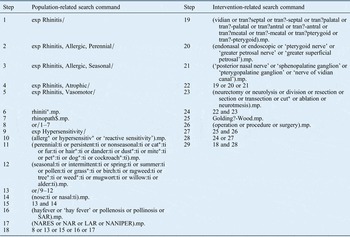
An electronic systematic search strategy was employed, with a combination of Medical Subject Heading terms and key words. Both Medline (1946 to 16th December 2013) and Embase (1974 to 3rd August 2015) were searched for published studies. Studies were limited to the English language. The detailed Medline and Embase search strategy is provided in Table I. The reference lists of included publications were assessed for additional studies not identified within the original search strategy.
Search strategy

One author (WY) reviewed and selected trials, and evaluated them against the inclusion criteria. In cases where article eligibility was unclear, a second review author (TM) was consulted. A structured data collection form was used. Raw data were extracted from graphs and tables. The review authors (WY and TM) conducted the data extraction and summarised the characteristics of each study. Any discrepancies were resolved by discussion among the reviewing authors. Variables considered included study design, population number, patient age, follow-up duration, indications for vidian neurectomy, unilateral or bilateral approach, and outcomes (patient-reported outcome measures, objective findings and peri-operative complications).
Risk of bias assessment
Assessment of risk of bias was conducted in accordance with the Cochrane Collaboration's tool for assessing risk of bias.Reference Higgins and Green 16 The Newcastle–Ottawa Scale was chosen for the purpose of evaluating and analysing each study for methodological validity. 17
The Newcastle–Ottawa Scale consists of three categories: ‘selection’, ‘comparability’ and ‘outcome’. In the selection section, four variables are examined: the extent to which the exposed cohort and the non-exposed cohort represent the studied population; the ascertainment of exposure; and whether the outcome of interest was present at the beginning of the study. In the comparability section, the way the outcomes are compared between the study and the control group before and after the intervention is assessed. In the outcome section, the way the outcome was assessed, whether the follow-up time was long enough, and the adequacy of follow up are checked. We defined three months as the minimum follow-up time.
A ‘star system’ is used to evaluate each variable in the Newcastle–Ottawa Scale. A study can receive a maximum total of nine stars. For each variable, degree of bias is determined as follows: ‘low risk’ in cases when all requirements mentioned in the Newcastle–Ottawa Scale are fulfilled; ‘high risk’, if the study does not meet the criteria; and ‘unclear risk’ in cases where there is insufficient information to permit judgement of low risk or high risk.Reference Higgins and Green 16
Two reviewers (TM and CH) independently completed Newcastle–Ottawa Scale checklists. The assessments were then compared. When the two reviewers disagreed, a discussion ensued until a consensus was reached.
Results
Results of search
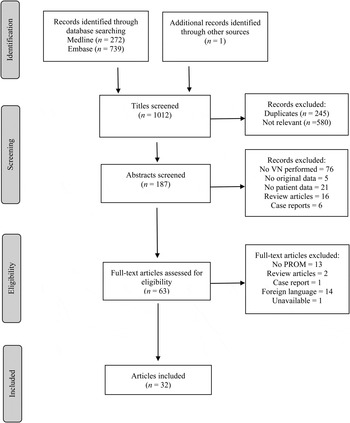
A total of 1012 references were generated from the search. Of these, 825 were removed in first-level screening (i.e. the removal of duplicate data and of clearly irrelevant references). Another 124 studies that did not meet the inclusion criteria were removed after reviewing their abstracts. Sixty-three full-text articles were assessed for eligibility. Of these, 16 studies did not meet the inclusion criteria and another 15 articles were unavailable in English, leaving a total of 32 studies for qualitative synthesis. A flow chart of study selection is provided in Figure 1.
Preferred Reporting Items for Systematic Reviews and Meta-Analyses flow chart of the study selection. VN = vidian neurectomy; PROM = patient-reported outcome measures

Included studies
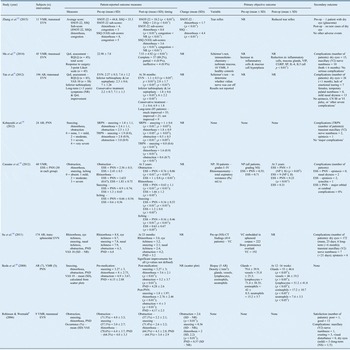
Characteristics of the included studies (32 studies) are detailed in Table II.
Characteristics of included studies*

* A total of 32 studies. FU durn = follow-up duration; mth = months; PROM = patient-reported outcome measures; VMR = vasomotor rhinitis; SPT = skin prick test; –ve = negative; NS = not specified; QoL = quality of life; CT = computed tomography; CSF = cerebrospinal fluid; NR = not reported; EVN = endoscopic vidian neurectomy; SNOT-22 = 22-item Sino-Nasal Outcome Test; SSQ = Sinus Symptom Questionnaire; pre-op = pre-operatively; post-op = post-operatively; wk = weeks; y = years; RQLQ = Rhinoconjunctivitis Quality of Life Questionnaire; d = days; H&E = haematoxylin and eosin stain; VIP = vasoactive intestinal peptide; IL = interleukin; AR = allergic rhinitis; +ve = positive; INCS = intranasal corticosteroids; ARIA = Allergic Rhinitis and its Impact on Asthma; VAS 10 = visual analogue scale (10 cm); CN = cranial nerve; PNN = posterior nasal neurectomy; NP = nasal polyps; FESS = functional endoscopic sinus surgery; PND = postnasal drip; VC = vidian canal; IgE = immunoglobulin E; RAST = radioallergosorbent test; SMR = submucous resection; VN = vidian neurectomy; NMCC = nasal mucociliary clearance; OAF = oroantral fistula; FVC = forced vital capacity; %VC = percentage vital capacity; %FEV 1 = forced expiratory volume in 1 second; MEFR = maximal expiratory flow rate
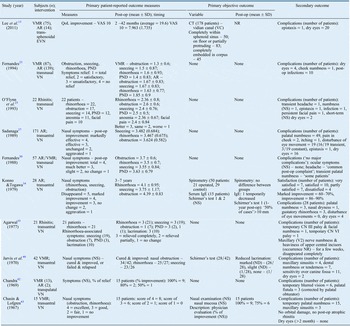
The studies included were divided into four categories based on the way their primary results were reported. The categories were: studies that included pre- and post-surgery patient-reported outcome measures (Table III); studies that included only post-surgery patient-reported outcome measures (Table IV); studies which reported mainly on objective findings (Table V); and studies in which results were reported by the surgeon (Table VI).
Results of studies in which patient-reported outcome measures were reported before and after surgery*

* A total of eight studies. †Compared to baseline; ‡compared to control group. Pre-op = pre-operatively; SD = standard deviation; post-op = post-operatively; VMR = vasomotor rhinitis; EVN = endoscopic vidian neurectomy; SNOT-22 = 22-item Sino-Nasal Outcome Test; SSQ = Sinus Symptom Questionnaire; VAS 10 = visual analogue scale (10 cm); NR = not reported; QoL = quality of life; RQLQ = Rhinoconjunctivitis Quality of Life Questionnaire; VIP = vasoactive intestinal peptide; CGRP = calcitonin gene-related peptide; SP = substance P; IL = interleukin; AR = allergic rhinitis; VN = vidian neurectomy; CN = cranial nerve; PNN = posterior nasal neurectomy; SRPN = selective resection of posterior nasal nerve; TRPN = transnasal resection of posterior nasal nerve; ESS = endoscopic sinus surgery; NP = nasal polyps; NS = not specified; PND = postnasal drip; CT = computed tomography; VC = vidian canal
Results of studies in which patient-reported outcome measures were reported only after surgery

*Ten studies. Post-op = post-operatively; SD = standard deviation; VMR = vasomotor rhinitis; AR = allergic rhinitis; EVN = endoscopic vidian neurectomy; QoL = quality of life; VAS 10 = visual analogue scale (10 cm); CT = computed tomography; VC = vidian canal; NR = not reported; VN = vidian neurectomy; PND = postnasal drip; NS = not specified; IgE = immunoglobulin E; CN = cranial nerve; ND = not defined
Results of studies in which primary outcomes were objective findings*

* Nine studies. Pre-op = pre-operative; SD = standard deviation; post-op = post-operative; VMR = vasomotor rhinitis; EVN = endoscopic vidian neurectomy; CT = computed tomography; N/A = not applicable; PND = postnasal drip; VN = vidian neurectomy; NS = not specified; NR = not reported; AR = allergic rhinitis; H&E = haematoxylin and eosin
Results of studies in which outcomes were reported by surgeon*

* Five studies. Post-op = post-operative; VMR = vasomotor rhinitis; VN = vidian neurectomy; NS = not specified; CN = cranial nerve
Ten studies were published between 2006 and 2015,Reference Robinson and Wormald 4 , Reference Tan, Ma, Li, Li and Wang 9 , Reference Su, Liu, Chiu and Lee 10 , Reference Liu, Wang and Su 12 , Reference Lee, Kao, Hsu and Lin 13 , Reference Kobayashi, Hyodo, Nakamura, Komobuchi and Honda 18 – Reference Zhang, Micomonaco, Dziegielewski, Sowerby, Weis and Wright 22 and 22 studies (73.33 per cent) were published between 1966 and 1994.Reference Fernandes 23 – Reference Hiranandani 44 Case series accounted for 84.38 per cent (27 out of 32) of all included studies. The rest were: three case–control studies,Reference Kobayashi, Hyodo, Nakamura, Komobuchi and Honda 18 , Reference Greenstone, Stanley, Mackay and Cole 29 , Reference Williams 32 one cohort trialReference Tan, Ma, Li, Li and Wang 9 and one randomised, controlled trial.Reference Cassano, Marioni, Russo and Cassano 19
In total, 2185 patients were included: 1291 (59 per cent) were diagnosed with vasomotor rhinitis, 790 (36.15 per cent) with allergic rhinitis and 104 (4.75 per cent) with rhinitis. The average number of participants in a study was 60.69 ± 70.08 standard deviation (SD).
The average minimal follow-up time, according to the 16 studies (1319 patients) that reported it,Reference Robinson and Wormald 4 , Reference Tan, Ma, Li, Li and Wang 9 , Reference Su, Liu, Chiu and Lee 10 , Reference Lee, Kao, Hsu and Lin 13 , Reference Kobayashi, Hyodo, Nakamura, Komobuchi and Honda 18 , Reference Zhang, Micomonaco, Dziegielewski, Sowerby, Weis and Wright 22 – Reference O'Flynn, Cumberworth, Milford and Mackay 25 , Reference Sadanaga 27 , Reference Greenstone, Stanley, Mackay and Cole 29 , Reference Krant, Wildervanck de Blecourt, Dieges and de Heer 33 , Reference Mostafa, Abdel-Latif and el-Din 37 , Reference Golding-Wood 38 , Reference Jarvis, Marais and Milner 40 , Reference Chandra 42 was 18.53 months (SD = 16.69). The average maximal follow-up time, according to the 18 studies (1622 patients) that reported it,Reference Robinson and Wormald 4 , Reference Su, Liu, Chiu and Lee 10 , Reference Lee, Kao, Hsu and Lin 13 , Reference Kobayashi, Hyodo, Nakamura, Komobuchi and Honda 18 , Reference Zhang, Micomonaco, Dziegielewski, Sowerby, Weis and Wright 22 – Reference O'Flynn, Cumberworth, Milford and Mackay 25 , Reference Ogale, Shah, Rao and Shah 28 , Reference Greenstone, Stanley, Mackay and Cole 29 , Reference Kirtane, Prabhu and Karnik 31 , Reference Krant, Wildervanck de Blecourt, Dieges and de Heer 33 , Reference Konno and Togawa 34 , Reference Mostafa, Abdel-Latif and el-Din 37 , Reference Golding-Wood 38 , Reference Jarvis, Marais and Milner 40 , Reference Chandra 42 , Reference Chasin and Lofgren 43 was 65.17 months (SD = 47.23). Ten studies (470 patients) reported a mean follow-up time of 33.59 months (SD = 31.78).Reference Robinson and Wormald 4 , Reference Su, Liu, Chiu and Lee 10 , Reference Lee, Kao, Hsu and Lin 13 , Reference Kobayashi, Hyodo, Nakamura, Komobuchi and Honda 18 , Reference Cassano, Marioni, Russo and Cassano 19 , Reference Zhang, Micomonaco, Dziegielewski, Sowerby, Weis and Wright 22 , Reference El Shazly 26 , Reference Minnis and Morrison 39 , Reference Jarvis, Marais and Milner 40 , Reference Hiranandani 44 Seven studies did not report follow-up time.
Allergy status was reported in 10 studies (31.25 per cent).Reference Tan, Ma, Li, Li and Wang 9 , Reference Kobayashi, Hyodo, Nakamura, Komobuchi and Honda 18 , Reference Ikeda, Yokoi, Saito, Kawano, Yao and Furukawa 20 – Reference Zhang, Micomonaco, Dziegielewski, Sowerby, Weis and Wright 22 , Reference El-Guindy 24 , Reference Greenstone, Stanley, Mackay and Cole 29 , Reference Konno and Togawa 34 , Reference Minnis and Morrison 39 , Reference Gregson 41 Nasal symptoms on which diagnoses were based were detailed in 13 studies (40.63 per cent).Reference Lee, Kao, Hsu and Lin 13 , Reference Cassano, Marioni, Russo and Cassano 19 , Reference El-Guindy 24 , Reference O'Flynn, Cumberworth, Milford and Mackay 25 , Reference Ogale, Shah, Rao and Shah 28 – Reference Fernandes 30 , Reference Agarwal 35 , Reference Montserrat 36 , Reference Minnis and Morrison 39 , Reference Chandra 42 – Reference Hiranandani 44 Eight studies (25 per cent) reported on poor response to pre-operative treatment: intranasal corticosteroids or oral antihistamines (six studies),Reference Tan, Ma, Li, Li and Wang 9 , Reference Su, Liu, Chiu and Lee 10 , Reference Liu, Wang and Su 12 , Reference Lee, Kao, Hsu and Lin 13 , Reference Fernandes 23 , Reference O'Flynn, Cumberworth, Milford and Mackay 25 immunotherapy (one study),Reference Fernandes 23 and septoplasty or inferior turbinate surgery (one study).Reference Chasin and Lofgren 43 A good response to anticholinergic nasal spray was reported in one study, and served as an indication for surgery (vidian neurectomy).Reference Robinson and Wormald 4 Only one study reported on using guidelines for diagnosis (Allergic Rhinitis and its Impact on Asthma 2008 guidelines).Reference Tan, Ma, Li, Li and Wang 9
Vidian neurectomy was performed using different endoscopic approaches in 12 studies (37.5 per cent): transnasal (6 studies),Reference Robinson and Wormald 4 , Reference Tan, Ma, Li, Li and Wang 9 , Reference Liu, Wang and Su 12 , Reference Ma, Tan, Zhao, Li, Huang and Liu 21 , Reference Zhang, Micomonaco, Dziegielewski, Sowerby, Weis and Wright 22 , Reference El Shazly 26 posterior nasal neurectomy (3 studies),Reference Kobayashi, Hyodo, Nakamura, Komobuchi and Honda 18 – Reference Ikeda, Yokoi, Saito, Kawano, Yao and Furukawa 20 trans-sphenoidal (3 studies)Reference Su, Liu, Chiu and Lee 10 , Reference Liu, Wang and Su 12 , Reference Lee, Kao, Hsu and Lin 13 and transseptal (1 study).Reference El-Guindy 24 Liu et al.Reference Liu, Wang and Su 12 performed endoscopic vidian neurectomy using transnasal and trans-sphenoidal approaches. In 20 studies, surgery was performed under direct vision or with the assistance of a microscope using different approaches: transantral (12 studies),Reference Sadanaga 27 , Reference Greenstone, Stanley, Mackay and Cole 29 , Reference Williams 32 – Reference Montserrat 36 , Reference Golding-Wood 38 , Reference Jarvis, Marais and Milner 40 , Reference Gregson 41 , Reference Chasin and Lofgren 43 , Reference Hiranandani 44 transnasal (5 studies),Reference Fernandes 23 , Reference O'Flynn, Cumberworth, Milford and Mackay 25 , Reference Ogale, Shah, Rao and Shah 28 , Reference Fernandes 30 , Reference Kirtane, Prabhu and Karnik 31 transpalatal (2 studies)Reference Mostafa, Abdel-Latif and el-Din 37 , Reference Chandra 42 and transseptal (1 study).Reference Minnis and Morrison 39
Fernandes published two articles on vidian neurectomy using a transnasal approach in the years 1988 and 1994.Reference Fernandes 23 , Reference Fernandes 30 The last study contained patients that were included in the first study.
Patient-reported outcome measures
Patient-reported outcome measures were compared before and after surgery in eight studies. All studies were published in the last decade. In five studies, endoscopic vidian neurectomy was performed.Reference Robinson and Wormald 4 , Reference Tan, Ma, Li, Li and Wang 9 , Reference Su, Liu, Chiu and Lee 10 , Reference Ma, Tan, Zhao, Li, Huang and Liu 21 , Reference Zhang, Micomonaco, Dziegielewski, Sowerby, Weis and Wright 22 In another three studies, posterior nasal neurectomy was performed.Reference Kobayashi, Hyodo, Nakamura, Komobuchi and Honda 18 – Reference Ikeda, Yokoi, Saito, Kawano, Yao and Furukawa 20 There were 529 patients represented in these studies.
One study used surveys to assess sinonasal symptom outcomes.Reference Zhang, Micomonaco, Dziegielewski, Sowerby, Weis and Wright 22 The surveys used were the 22-item Sino-Nasal Outcome Test and the Sinus Symptom Questionnaire. Both surveys showed a significant overall benefit, which lasted two years after surgery.
Two studies used the Rhinoconjunctivitis Quality of Life Questionnaire to examine post-operative improvement in QoL. One study reported a significant long-term (more than 36 months) improvement in QoL after endoscopic vidian neurectomy when compared to both baseline scoring and conservative treatment.Reference Tan, Ma, Li, Li and Wang 9 The second study reported a significant reduction in the post-operative total score of the Rhinoconjunctivitis Quality of Life Questionnaire;Reference Ma, Tan, Zhao, Li, Huang and Liu 21 however, the duration of follow up was unclear. The first study also reported an improvement in symptoms in 89.4 per cent of the included patients,Reference Tan, Ma, Li, Li and Wang 9 but no information was provided about the type of symptoms.
Seven studies reported on each nasal symptom separately as follows. A significant improvement in rhinorrhoea was observed in all studies.Reference Robinson and Wormald 4 , Reference Su, Liu, Chiu and Lee 10 , Reference Kobayashi, Hyodo, Nakamura, Komobuchi and Honda 18 – Reference Zhang, Micomonaco, Dziegielewski, Sowerby, Weis and Wright 22 Nasal obstruction was also examined in all studies, yet significant improvement was reported in only five studies.Reference Robinson and Wormald 4 , Reference Su, Liu, Chiu and Lee 10 , Reference Kobayashi, Hyodo, Nakamura, Komobuchi and Honda 18 – Reference Ikeda, Yokoi, Saito, Kawano, Yao and Furukawa 20 Sneezing improved significantly in fourReference Su, Liu, Chiu and Lee 10 , Reference Kobayashi, Hyodo, Nakamura, Komobuchi and Honda 18 , Reference Cassano, Marioni, Russo and Cassano 19 , Reference Ma, Tan, Zhao, Li, Huang and Liu 21 out of six studies.Reference Robinson and Wormald 4 , Reference Su, Liu, Chiu and Lee 10 , Reference Kobayashi, Hyodo, Nakamura, Komobuchi and Honda 18 – Reference Ma, Tan, Zhao, Li, Huang and Liu 21 Improvement in itching in the eyes or nose was found in twoReference Su, Liu, Chiu and Lee 10 , Reference Cassano, Marioni, Russo and Cassano 19 out of three studies;Reference Su, Liu, Chiu and Lee 10 , Reference Cassano, Marioni, Russo and Cassano 19 , Reference Ma, Tan, Zhao, Li, Huang and Liu 21 however, in one study the p-value was not specified.Reference Su, Liu, Chiu and Lee 10 Postnasal drip improved significantly only in one studyReference Su, Liu, Chiu and Lee 10 out of four.Reference Robinson and Wormald 4 , Reference Su, Liu, Chiu and Lee 10 , Reference Ikeda, Yokoi, Saito, Kawano, Yao and Furukawa 20 , Reference Zhang, Micomonaco, Dziegielewski, Sowerby, Weis and Wright 22
Kobayashi et al.Reference Kobayashi, Hyodo, Nakamura, Komobuchi and Honda 18 compared symptom improvement (rhinorrhoea, obstruction and sneezing) after posterior nasal neurectomy in patients who underwent selective resection versus those who underwent total resection. No significant difference was observed between these two approaches. Cassano et al.Reference Cassano, Marioni, Russo and Cassano 19 compared symptom improvement in patients who underwent posterior nasal neurectomy and functional endoscopic sinus surgery (FESS) with patients who underwent FESS alone. Improvement in nasal obstruction was observed in both groups; however, significant improvement in rhinorrhoea, sneezing and itching was only reported in those who underwent posterior nasal neurectomy and FESS. No difference in nasal obstruction was observed between the groups (Table III).
Risk of bias in studies
Of the eight studies that compared patient-reported outcome measures before and after surgery, only two had a study group and a control group;Reference Tan, Ma, Li, Li and Wang 9 , Reference Cassano, Marioni, Russo and Cassano 19 hence, only these two studies could be evaluated for risk of bias using the Newcastle–Ottawa scale. 17 In one study, the description of the operation was not fully detailed,Reference Cassano, Marioni, Russo and Cassano 19 and in the other it was not clear who performed the surgery.Reference Tan, Ma, Li, Li and Wang 9 Both studies did not report whether a baseline comparison between the study group and control group was performed. The two studies met the requirements of the Newcastle–Ottawa Scale's other categories, and, accordingly, both studies received seven out of nine stars.
Ten studies reported only on post-operative primary patient-reported outcome measures (n = 686).Reference Lee, Kao, Hsu and Lin 13 , Reference Fernandes 23 , Reference O'Flynn, Cumberworth, Milford and Mackay 25 , Reference Sadanaga 27 , Reference Fernandes 30 , Reference Konno and Togawa 34 , Reference Agarwal 35 , Reference Jarvis, Marais and Milner 40 , Reference Chandra 42 , Reference Chasin and Lofgren 43 Only in one study was vidian neurectomy performed using an endoscopic approach.Reference Lee, Kao, Hsu and Lin 13 This study was published in 2011; the rest were published before 1994.
Fernandes published two articles on vidian neurectomy in the years 1988 and 1994.Reference Fernandes 23 , Reference Fernandes 30 The last study included patients from the first study. To mitigate this, only the results from the later study were detailed.Reference Fernandes 23
Lee et al.Reference Lee, Kao, Hsu and Lin 13 reported on a significant improvement in QoL after endoscopic vidian neurectomy, with a mean VAS score of 7.963, 19.6 months post-operation on average.
Seven studies used different Likert scales to assess each symptom separately. In general, all studies reported improvement or relief in all symptoms examined in the majority of patients.Reference Fernandes 23 , Reference O'Flynn, Cumberworth, Milford and Mackay 25 , Reference Sadanaga 27 , Reference Konno and Togawa 34 , Reference Agarwal 35 , Reference Jarvis, Marais and Milner 40 , Reference Chasin and Lofgren 43 All studies reported improvements in nasal obstruction and rhinorrhoea. Six studies reported an improvement in sneezing.Reference Fernandes 23 , Reference O'Flynn, Cumberworth, Milford and Mackay 25 , Reference Sadanaga 27 , Reference Konno and Togawa 34 , Reference Agarwal 35 , Reference Jarvis, Marais and Milner 40 Two studies reported an improvement in postnasal dripReference Fernandes 23 , Reference O'Flynn, Cumberworth, Milford and Mackay 25 and one study reported a partial improvement.Reference Agarwal 35 One study also reported improvements in facial pain and anosmia.Reference O'Flynn, Cumberworth, Milford and Mackay 25 Chandra,Reference Chandra 42 who did not detail which symptoms were examined, reported good to excellent symptom improvement in the majority of patients (Table IV).
Objective findings
Seventeen studies reported on objective findings (n = 748).Reference Tan, Ma, Li, Li and Wang 9 , Reference Su, Liu, Chiu and Lee 10 , Reference Liu, Wang and Su 12 , Reference Lee, Kao, Hsu and Lin 13 , Reference Cassano, Marioni, Russo and Cassano 19 – Reference Ma, Tan, Zhao, Li, Huang and Liu 21 , Reference El-Guindy 24 , Reference El Shazly 26 , Reference Greenstone, Stanley, Mackay and Cole 29 , Reference Krant, Wildervanck de Blecourt, Dieges and de Heer 33 , Reference Konno and Togawa 34 , Reference Mostafa, Abdel-Latif and el-Din 37 , Reference Minnis and Morrison 39 – Reference Gregson 41 , Reference Hiranandani 44 In nine studies, objective findings were the primary outcome (Table V).Reference Liu, Wang and Su 12 , Reference El-Guindy 24 , Reference El Shazly 26 , Reference Greenstone, Stanley, Mackay and Cole 29 , Reference Krant, Wildervanck de Blecourt, Dieges and de Heer 33 , Reference Mostafa, Abdel-Latif and el-Din 37 , Reference Minnis and Morrison 39 , Reference Gregson 41 , Reference Hiranandani 44
Schirmer's test was performed in 11 studies (n = 595). Six studies reported a post-operative decrease in lacrimal function in most patients.Reference El-Guindy 24 , Reference El Shazly 26 , Reference Greenstone, Stanley, Mackay and Cole 29 , Reference Krant, Wildervanck de Blecourt, Dieges and de Heer 33 , Reference Jarvis, Marais and Milner 40 , Reference Gregson 41 One study reported a decrease in about half of the patients.Reference Konno and Togawa 34 Four studies did not detail the results.Reference Tan, Ma, Li, Li and Wang 9 , Reference Ma, Tan, Zhao, Li, Huang and Liu 21 , Reference Minnis and Morrison 39 , Reference Hiranandani 44
Three studies (n = 255) described the position of the vidian canal relative to the sphenoid sinus, according to computed tomography findings (n = 1274).Reference Su, Liu, Chiu and Lee 10 , Reference Liu, Wang and Su 12 , Reference Lee, Kao, Hsu and Lin 13 The vidian canal was embedded inside the sphenoid corpus in 49.5 per cent of all cases, partially protruding in 39.87 per cent and completely within the sphenoid sinus in 10.59 per cent.
Histological changes in the nasal mucosa were examined in four studies (n = 210).Reference Ikeda, Yokoi, Saito, Kawano, Yao and Furukawa 20 , Reference Ma, Tan, Zhao, Li, Huang and Liu 21 , Reference Mostafa, Abdel-Latif and el-Din 37 , Reference Hiranandani 44 All four studies reported post-operative decreases in cellular infiltration and in the number of glands in the nasal mucosa. Two studies reported a decrease in mucosal oedema.Reference Mostafa, Abdel-Latif and el-Din 37 , Reference Hiranandani 44 In one study, there was no significant change in the density of the vessels in the nasal mucosa,Reference Ikeda, Yokoi, Saito, Kawano, Yao and Furukawa 20 and in another study the density of the blood vessels increased after surgery.Reference Mostafa, Abdel-Latif and el-Din 37 One study, which examined the immunohistochemical changes in the nasal mucosa, reported a post-operative decrease in the expression of different cytokines, including vasoactive intestinal polypeptide, calcitonin gene-related peptide, substance P, and interleukins 4 and 5.Reference Ma, Tan, Zhao, Li, Huang and Liu 21
One study reported a significant reduction in post-operative total expiratory resistance in rhinomanometry, in patients who underwent FESS and posterior nasal neurectomy, compared to patients who underwent FESS alone.Reference Cassano, Marioni, Russo and Cassano 19
No significant changes were observed in terms of: recurrence of nasal polyps,Reference Cassano, Marioni, Russo and Cassano 19 mucus ciliary clearance (saccharin test),Reference Greenstone, Stanley, Mackay and Cole 29 blood IgE levels or spirometry results.Reference Konno and Togawa 34
Complications
Thirty studies (93.75 per cent) reported on post-operative complications (n = 2134).
The number of patients who had dry eyes was detailed in 16 studies.Reference Robinson and Wormald 4 , Reference Tan, Ma, Li, Li and Wang 9 , Reference Su, Liu, Chiu and Lee 10 , Reference Liu, Wang and Su 12 , Reference Lee, Kao, Hsu and Lin 13 , Reference Ma, Tan, Zhao, Li, Huang and Liu 21 – Reference O'Flynn, Cumberworth, Milford and Mackay 25 , Reference Sadanaga 27 , Reference Williams 32 , Reference Konno and Togawa 34 , Reference Montserrat 36 , Reference Jarvis, Marais and Milner 40 , Reference Chasin and Lofgren 43 Of the patients included in these studies, 23.96 per cent (276 out of 1152) had dry eyes.
Eight studies also addressed the duration of the dry eye symptoms.Reference Robinson and Wormald 4 , Reference Tan, Ma, Li, Li and Wang 9 , Reference Su, Liu, Chiu and Lee 10 , Reference Liu, Wang and Su 12 , Reference Ma, Tan, Zhao, Li, Huang and Liu 21 , Reference Zhang, Micomonaco, Dziegielewski, Sowerby, Weis and Wright 22 , Reference O'Flynn, Cumberworth, Milford and Mackay 25 , Reference Chasin and Lofgren 43 According to these studies, symptoms of dry eye were temporary in 96.46 per cent of cases (218 out of 226), with symptoms resolving by themselves within six months in most cases.
Paraesthesia in the maxillary cranial (V2) nerve, the next most common adverse event, was reported in 13 studies.Reference Robinson and Wormald 4 , Reference Tan, Ma, Li, Li and Wang 9 , Reference Su, Liu, Chiu and Lee 10 , Reference Kobayashi, Hyodo, Nakamura, Komobuchi and Honda 18 , Reference Ma, Tan, Zhao, Li, Huang and Liu 21 , Reference Fernandes 23 , Reference O'Flynn, Cumberworth, Milford and Mackay 25 , Reference Sadanaga 27 , Reference Krant, Wildervanck de Blecourt, Dieges and de Heer 33 , Reference Jarvis, Marais and Milner 40 , Reference Gregson 41 , Reference Chasin and Lofgren 43 , Reference Hiranandani 44 This side effect was observed in 8.2 per cent of the patients (93 out of 1133). Seven of these studies also referred to duration,Reference Tan, Ma, Li, Li and Wang 9 , Reference Su, Liu, Chiu and Lee 10 , Reference Kobayashi, Hyodo, Nakamura, Komobuchi and Honda 18 , Reference Ma, Tan, Zhao, Li, Huang and Liu 21 , Reference O'Flynn, Cumberworth, Milford and Mackay 25 , Reference Chasin and Lofgren 43 , Reference Hiranandani 44 and reported that the numbness was transient and resolved in all cases.
Other complications included: post-operative infection, in 5.34 per cent of patients (18 out of 337);Reference Fernandes 23 , Reference O'Flynn, Cumberworth, Milford and Mackay 25 , Reference Jarvis, Marais and Milner 40 , Reference Gregson 41 , Reference Chasin and Lofgren 43 palatal fistula, in 4.85 per cent (5 out of 103);Reference Krant, Wildervanck de Blecourt, Dieges and de Heer 33 , Reference Mostafa, Abdel-Latif and el-Din 37 , Reference Chandra 42 and epistaxis, in 1.75 per cent (8 out of 457).Reference Tan, Ma, Li, Li and Wang 9 , Reference Su, Liu, Chiu and Lee 10 , Reference Lee, Kao, Hsu and Lin 13 , Reference Cassano, Marioni, Russo and Cassano 19 , Reference O'Flynn, Cumberworth, Milford and Mackay 25
Major complications, including cranial nerve deficit (IIIrd, IVth or VIth cranial nerves) or disturbance of eye movement, were reported in 11 studies.Reference Robinson and Wormald 4 , Reference Tan, Ma, Li, Li and Wang 9 , Reference Liu, Wang and Su 12 , Reference Kobayashi, Hyodo, Nakamura, Komobuchi and Honda 18 , Reference Cassano, Marioni, Russo and Cassano 19 , Reference El Shazly 26 , Reference Sadanaga 27 , Reference Konno and Togawa 34 , Reference Agarwal 35 , Reference Golding-Wood 38 , Reference Chasin and Lofgren 43 Of the patients included in these studies, 2.42 per cent (25 out of 1029) experienced major adverse effects. All of these patients underwent vidian neurectomy via the traditional non-endoscopic approach.
Discussion
This systematic review provides data on the therapeutic effect of vidian neurectomy in treating patients with recalcitrant rhinitis. Most of the patients included in this review experienced a post-operative improvement of nasal symptoms. Of these symptoms, an improvement in rhinorrhoea was the most prominent. Dry eye and palatal numbness, although relatively common, were transient in the majority of cases. There were no reports of major adverse events, including cranial nerve deficits or eye movement disturbance, in patients who underwent vidian neurectomy or posterior nasal neurectomy via an endoscopic approach.
Halderman and SindwaniReference Halderman and Sindwani 45 recently published a systematic review on vidian neurectomy, and discussed patients diagnosed with vasomotor rhinitis who were operated on using an endoscopic approach. Their conclusion, similar to our own, was that vidian neurectomy is well tolerated, safe and effective in the majority of patients.
Allergic rhinitis affects between 10 and 30 per cent of all adults, and as many as 40 per cent of children. The ratio of allergic to pure non-allergic rhinitis is three to one. However, many individuals suffer from mixed rhinitis. According to Wallace et al.,Reference Wallace, Dykewicz, Bernstein, Blessing-Moore, Cox and Khan 1 44–87 per cent of patients with rhinitis may have mixed rhinitis, a combination of allergic and non-allergic rhinitis with neural hypersensitivity being common. These patients were, in the past, considered to have difficult-to-treat allergic rhinitis, with a diminished response to medications.Reference Bernstein, Levin, Al-Shuik and Martin 46
In this review, we included all patients diagnosed with chronic rhinitis of any type. Although the majority of included patients were diagnosed with vasomotor rhinitis (n = 1291, 59.1 per cent), 790 patients (36.15 per cent) had allergic rhinitis and 104 (4.75 per cent) had a diagnosis of rhinitis. The diagnosis of mixed rhinitis was not mentioned in any of the included studies. Furthermore, details regarding the allergy status of patients were reported in only 10 studies.Reference Tan, Ma, Li, Li and Wang 9 , Reference Kobayashi, Hyodo, Nakamura, Komobuchi and Honda 18 , Reference Ikeda, Yokoi, Saito, Kawano, Yao and Furukawa 20 – Reference Zhang, Micomonaco, Dziegielewski, Sowerby, Weis and Wright 22 , Reference El-Guindy 24 , Reference Greenstone, Stanley, Mackay and Cole 29 , Reference Konno and Togawa 34 , Reference Minnis and Morrison 39 , Reference Gregson 41
Non-allergic rhinitis is common, affecting millions of people.Reference Scarupa and Kaliner 5 There are different specific syndromes that are classified as non-allergic rhinitis. Non-allergic rhinopathy, formerly known as vasomotor rhinitis, is the most common of these.Reference Kaliner 2 Affected patients tend to develop chronic rhinitis later in life (over 35 years old); their nasal symptoms are induced by exposure to different environmental triggers and they have negative skin prick test results.Reference Brandt and Bernstein 47 , Reference Bernstein 48
The pathophysiology of non-allergic rhinitis is less understood. An imbalance between the nasal sympathetic and parasympathetic intervention and C-fibre hyperactivity, which leads to increased neuropeptide (substance P and neurokinins) release, may cause glandular hyperactivity, and hence hypernasal secretion and congestion.Reference Van Rijswijk, Boeke, Keizer, Mulder, Blom and Fokkens 6 , Reference Nozad, Michael, Betty Lew and Michael 49 , Reference Salib, Harries, Nair and Howarth 50
The medications used for treating non-allergic rhinitis have been studied less extensively than those for allergic rhinitis.Reference Kaliner 2 Although a large number of different pharmacological agents have shown clinical efficacy and safety for the treatment of allergic rhinitis, there are fewer well-designed, double-blind, placebo-controlled trials providing evidence for the treatment options of non-allergic rhinitis.Reference Greiner and Meltzer 51 Intranasal steroids and intranasal ipratropium are recommended as first-line treatments. Intranasal capsaicin, when offered to patients poorly responsive to intranasal steroids, targets the afferent limb of the non-allergic rhinitis response, specifically the C-fibre sensory input. Vidian neurectomy targets the efferent limb of the non-allergic rhinitis response.Reference Van Gerven, Alpizar, Wouters, Hox, Hauben and Jorissen 52
The Allergic Rhinitis and its Impact on Asthma workshop group published its position regarding surgical treatment for patients with chronic rhinitis in 2008.Reference Bousquet, Khaltaev, Cruz, Denburg, Fokkens and Togias 53 They concluded that, in patients who have been suffering from perennial allergic or non-allergic rhinitis for many years, a severe drug-resistant hypertrophy of the inferior turbinates may develop, which leads to constant nasal obstruction and watery secretion due to an increase in glandular structures. Consequently, the surgical reduction of the inferior turbinate body and mucosal surface reduces nasal obstruction and secretion. However, the Allergic Rhinitis and its Impact on Asthma guidelines conclude that vidian neurectomy is not indicated for rhinitis because of the side effects and the availability of medical treatment.Reference Bousquet, Khaltaev, Cruz, Denburg, Fokkens and Togias 53 Most patients with chronic rhinitis, both allergic and non-allergic, will improve under non-surgical treatment. Physicians hesitate to recommend surgical treatments such as vidian neurectomy mostly because of related side effects and the perceived lack of evidence-based results.Reference Tan, Ma, Li, Li and Wang 9
Most studies that assessed vidian neurectomy, according to our data search, were carried out in the 1970s and 1980s. In almost all of these, vidian neurectomy was performed via the traditional approach, without endoscopic assistance. All were case series and, although they reported on surgical success, only a few included primary patient-reported outcome measures, and in none of these were patient-reported outcome measures compared before and after surgery. Additionally, a number of studies also reported major adverse events, including cranial nerve deficits and eye movement disturbance. These facts may explain the decrease in the popularity of vidian neurectomy in later years. Between the years 1994 and 2006, there were no publications of studies on vidian neurectomy that reported on patient-reported outcome measures.
In this era of endoscopic surgery, the use of endoscopy in vidian neurectomy appears to achieve better surgical outcomes with fewer complications.Reference Ma, Tan, Zhao, Li, Huang and Liu 21
In 2006, Robinson and WormaldReference Robinson and Wormald 4 published their results on endoscopic vidian neurectomy. They reported a significant improvement in the symptoms of rhinorrhoea and nasal obstruction in 9 patients with vasomotor rhinitis who underwent 14 endoscopic vidian neurectomy procedures. They were also the first to compare primary patient-reported outcome measures before and after vidian neurectomy.
Between 2006 and 3rd August 2015, the day we concluded our data search, nine additional studies were published in which all procedures were performed using an endoscopic approach. Seven of these also compared their pre- and post-operative results. All the studies reported a significant improvement in rhinorrhoea and most of them also observed an improvement in nasal obstruction.Reference Robinson and Wormald 4 , Reference Su, Liu, Chiu and Lee 10 , Reference Kobayashi, Hyodo, Nakamura, Komobuchi and Honda 18 – Reference Ikeda, Yokoi, Saito, Kawano, Yao and Furukawa 20 Neither cranial nerve injury nor eye movement disturbance were reported in any of these studies. Dry eyes and palatal numbness were the most common adverse events, but, as mentioned earlier, they resolved on their own in almost all patients.
Zhang et al.Reference Zhang, Micomonaco, Dziegielewski, Sowerby, Weis and Wright 22 recently published a prospective case series study on endoscopic vidian neurectomy. Patients in this study were followed up after surgery, by otolaryngologists and by an ophthalmologist. None of these patients had permanent dry eye. In a small unpublished series, the patients had good ocular outcomes, despite marked objective measures of reduced tear production on Schirmer's test; the impact of dry eye disease on these patients' QoL was mild to moderate at worst, and resolved after three months in all patients (R Sacks, personal correspondence). According to Su et al., after vidian neurectomy, a new neural electrical conducting pathway is formed, with signal input from the trigeminal nerve and output to the postganglionic parasympathetic fibres. This might explain the disappearance of patients' dry eye symptoms a few months after surgery.Reference Su, Liu, Hsu and Chen 54
A limitation of this systematic review involves the included studies' designs, as case series accounted for the majority of the included studies, and all trials, except one,Reference Cassano, Marioni, Russo and Cassano 19 were non-randomised. In addition, only in eight studies were patient-reported outcome measures compared before and after surgery. In the rest of the included studies, the primary outcomes were: reported by the surgeon, objective findings or not compared to baseline. Another limitation relates to the fact that the patient populations, surgical approaches used, indications and inclusions for enrolment, and outcome definitions were different across studies. This heterogeneity prevented the possibility of combining data and performing a meta-analysis. It also made it difficult to draw conclusions about the most appropriate indication and preferred surgical approach.
Conclusion
Vidian neurectomy remains a viable option for rhinitis refractory to medical treatment. The results of the included studies indicate that endoscopic vidian neurectomy is an effective and relatively safe surgical intervention when compared to vidian neurectomy performed using a traditional approach. Endoscopic vidian neurectomy does have a role in the surgical management of refractory rhinitis, particularly in patients with non-allergic rhinitis or mixed rhinitis. Nevertheless, a well-designed cohort trial would be advantageous to clarify long-term outcomes.