Implications
Addition of conjugated linoleic acid (CLA), and especially betaine + CLA, to the diet of young pigs induced changes in biochemical parameters and hormones that may partially explain the nutrient partitioning effect, and increased lean deposition previously observed, with favourable consequences for the consumers because of the production of pork meat with low fat content. In contrast, although livers of young pigs fed betaine + CLA diet were chemically and histologically normal, a weak detrimental effect on blood lipids was observed. Furthermore, pigs fed CLA diet had higher serum glucose than controls when challenged with a glucose load.
Introduction
Betaine and conjugated linoleic acid (CLA) have the potential to alter growth and body composition in swine. Betaine is an amino acid derivative (trimethylglycine or glycine betaine) present in most organisms and is distributed widely in nature. It is an obligatory intermediate in the catabolism of choline that accumulates in tissues under water or salt stress (Petronini et al., Reference Petronini, de Angelis, Borghetti, Borghetti and Wheelers1992), and it has potential lipotropic effects (Barak et al., Reference Barak, Beckenhauer, Junnila and Tuma1993). In addition, as a methyl donor, via S-adenosyl-methionine, betaine may partially reduce the requirements for methionine and participate in protein and lipid metabolism (Kidd et al., Reference Kidd, Ferket and Garlich1997). Most studies with betaine in pigs focus on the effect of betaine on growth performance, carcass characteristics and pork quality. Several reports have indicated that betaine could decrease carcass fat deposition and increase carcass lean in pigs (Matthews et al., Reference Matthews, Southern, Higbie, Persica and Bidner2001; Fernández-Fígares et al., Reference Fernández-Fígares, Wray-Cahen, Steele, Campbell, Hall, Virtanen and Caperna2002), especially under restricted energy intake (Suster et al., Reference Suster, Leury, King, Mottram and Dunshea2004) conditions. In contrast, CLA is a collective name that refers to a mixture of positional and geometric conjugated isomers of linoleic acid. Interest in feeding CLA to pigs has increased in the last decade as a result of its potential to increase rate of gain (Thiel-Cooper et al., Reference Thiel-Cooper, Parrish, Sparks, Wiegand and Ewan2001), improve feed efficiency, protein accretion rate (Ostrowska et al., Reference Ostrowska, Muralitharan, Cross, Baumann and Dunshea1999) and reduce body fat (Dugan et al., Reference Dugan, Aalhus, Schaefer and Kramer1997; Thiel-Cooper et al., Reference Thiel-Cooper, Parrish, Sparks, Wiegand and Ewan2001), although the results have not been consistent. Most of the studies investigating the effects of betaine or CLA have been made with finishing lean pigs; interestingly, a most pronounced effect of CLA on back fat depth was found in fatter pigs (Dunshea et al., Reference Dunshea, D'Souza, Pethick, Harper and Warner2005). In a recent study, a synergistic effect of dietary betaine and CLA on the growth of young growing Iberian pigs and carcass composition was found (Fernández-Fígares et al., Reference Fernández-Fígares, Conde-Aguilera, Nieto, Lachica and Aguilera2008), with betaine or CLA alone showing intermediate values. Nevertheless, little research has been conducted to investigate the pathways through which they might mediate their effect on growth and carcass traits. Furthermore, there is little information on how betaine and CLA affect serum hormone and metabolite profile. In addition, some deleterious effects have been reported when CLA was fed to laboratory animals, such as insulin resistance, liver enlargement and hepatic steatosis (Larsen et al., Reference Larsen, Toubro and Astrup2003). Thus, the effect of dietary CLA on liver function needs to be researched in non-rodent models. In this paper, the effect of dietary CLA on liver fat content and morphology of young obese pigs was studied. In addition, the possibility of CLA-induced insulin resistance was addressed. Furthermore, we have evaluated changes in metabolic hormones and biochemical profile of young growing Iberian pigs fed betaine, CLA- or betaine + CLA-supplemented diets, with the final aim of providing information about their possible mechanisms of action in nutrient partitioning.
Material and methods
Animals and dietary treatments
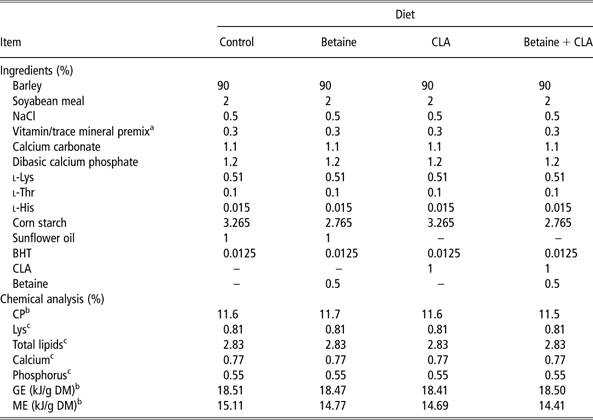
A total of 20 purebred Iberian (Silvela strain) gilts from the same farrowing group were used in the study. Before the beginning of the trial, all pigs were group-housed and given ad libitum access to the Control diet between 16 and 20 kg BW. Further, they were housed in individual 2 m2 pens located in a controlled-environment room (20 ± 1.5°C) and were randomly assigned to each dietary treatment. Diets were barley and soybean meal based and formulated to contain 12.0% crude protein (CP), 0.81% lysine and 14.8 MJ of metabolizable energy per kg of dry matter (DM) (Table 1). The Control diet was not supplemented with betaine or CLA. Betaine diet was supplemented with 0.5% betaine (Betafin S1, crystalline, 96% purity; Danisco, Copenhagen, Denmark) at the expense of cornstarch. CLA diet was supplemented with 1% CLA (60% CLA isomers, half cis-9, trans-11 and half trans-10, cis-12 in methyl esther form; BASF, Ludwigshafen, Germany) at the expense of sunflower oil. CLA plus betaine diet was supplemented with 1% CLA and 0.5% betaine at the expense of sunflower oil and cornstarch, respectively. CP concentration was fixed to match the low potential for protein deposition of the growing Iberian pig, as determined previously by our group (Nieto et al., Reference Nieto, Miranda, García and Aguilera2002), and the remaining nutrients met or exceeded (National Research Council (NRC), 1998) requirements. Lysine, threonine and histidine were included in the crystalline form. Pigs were fed at 95% of ad libitum intake, calculated as a function of BW following the linear regression model described by Nieto et al. (Reference Nieto, Lara, García, Gómez, Zalvide, Cruz, Pariente, Moreno and Aguilera2001) for Iberian pigs, and feed was distributed in two equal meals at 0900 and 1400 h. Daily allowance was calculated on the basis of the pig's BW, measured once per week. Refusals were collected on a daily basis and quantified, and pigs had free access to water throughout the experiment. Chemical analyses of the basal diet were carried out according to the methods of Association of Official Analytical Chemists (AOAC, 1990). The experimental protocol was reviewed and approved by the Bioethics Committee of the Spanish National Research Council (CSIC), and piglets were cared following the Spanish Ministry of Agriculture's guidelines (Boletín Oficial del Estado, 2005).
Ingredients and chemical composition of the experimental diets (as-fed basis)
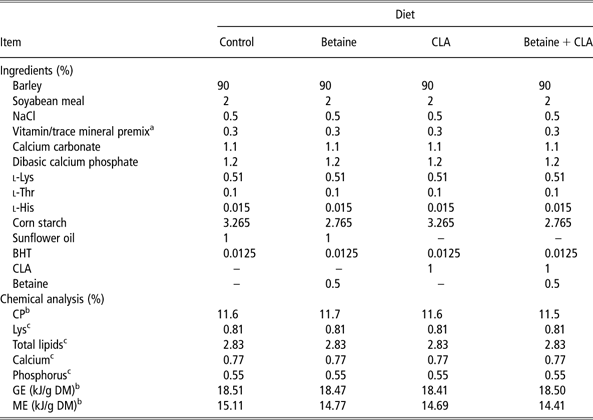
CLA = conjugated linoleic acid; BHT = butylated hydroxytoluene; GE = gross energy; ME = metabolizable energy; DM = dry matter.
aProvided per kg of complete diet: retinol, 3.38 mg as retinyl acetate; cholecalciferol, 56.3 μg; dl-α-tocopherol, 25.2 mg as dl-α-tocopheryl acetate; menadione, 1.5 mg as menadione sodium bisulfite; thiamine, 0.15 mg; riboflavin, 3 mg; pyridoxine, 0.15 mg; cyanocobalamin, 15 μg; folic acid, 15 μg; nicotinic acid, 22.5 mg; D-pantothenic acid, 15 mg as calcium pantothenate; Mn, 15 mg as MnSO4.4H2O; Fe, 75 mg as FeSO4.7H2O; Zn, 120 mg as ZnO; I, 450 μg as KI; Cu, 60 mg as CuSO4.5H2O; Co, 300 μg as CoSO4.7H2O.
bDetermined.
cEstimated values (FEDNA, 2003).
Experimental procedure
At 30 kg BW, pigs were fitted with jugular catheters. Pigs were fasted overnight before surgery and had free access to water. General anaesthesia was induced using an i.m. combination of Ketamine (15 mg/kg BW; Imalgene 1000, Merial, Barcelona, Spain)/Azaperone (2 mg/kg BW; Stresnil, Esteve Laboratories, Barcelona, Spain) and maintained throughout the preparation and surgical procedure by administering halothane (2%) and oxygen. Strict aseptic and sterile conditions were maintained along the whole procedure. An incision was made along the jugular furrow and the jugular vein was located and exposed. Catheter was inserted towards the auricular direction and sutured and secured to the vein. The catheter was exteriorized through the neck wall down and caudal from the ear. After patency was confirmed, the catheter was filled with physiological saline containing 250 IU heparin/ml and locked. Pigs were moved to metabolic cages and they resumed their normal eating habits the day after surgery. After recovery, on day 11, pigs were bled frequently (0, 2, 4, 6, 8, 12, 16, 20 h) and the blood samples were allowed to clot in ice for 3 h, centrifuged at 1000 × g for 15 min and the serum samples were stored in different aliquots at −80°C until analysis of serum metabolites and hormones.
An oral glucose tolerance test was performed on pigs fed Control and CLA diets the day before slaughter. Glucose tolerance test consisted of measuring serum glucose concentration after ingestion of 1 g glucose/kg BW in pigs fasting overnight at 0, 5, 10, 20, 30, 40, 60 120 and 180 min. At 50 kg BW, pigs were slaughtered, and immediately after slaughter, a sample of the liver was snap-frozen in liquid nitrogen and stored at −80°C until chemical and histological analysis.
Analyses
All samples were assayed in duplicate except hormones that were assayed in triplicate. Chemical analyses of the basal diet were carried out according to the methods of AOAC (1990), as described by Fernández-Fígares et al. (Reference Fernández-Fígares, Conde-Aguilera, Nieto, Lachica and Aguilera2008). Hormones were measured using commercially available radio-immuno assay (RIA) or immuno-radiometric assay (IRMA) kits following the directions of the manufacturer, and the assays were validated for use in porcine serum in our laboratory (Fernández-Fígares et al., Reference Fernández-Fígares, Lachica, Nieto, Rivera-Ferre and Aguilera2007). Radioactivity in samples was measured using a gamma counter (Behring 1612; Nuclear Enterprises Ltd, Edinburgh, Scotland).
Growth hormone was analysed using a Linco porcine/canine RIA kit (catalogue no. PGH-46HK; Linco, St. Louis, MO, USA). The intra- and inter-assay coefficients of variation were 11.7% and 15.5%, respectively.
Leptin was analysed using a two-site IRMA (catalogue no. DSL-82100; Diagnostic Systems Laboratories, Webster, TX, USA). The intra- and inter-assay average coefficients of variation of concentrations were 3.7% and 4.0%, respectively.
Insulin was analysed using a Linco porcine insulin RIA kit (catalogue no. PI-12K; Linco, St. Louis, MO, USA). Human insulin was used as standard. The intra- and inter-assay coefficients of variation were 7.5% and 11.3%, respectively.
Insulin sensitivity was calculated using two indices:
• Test 1: Quantitative insulin sensitivity check index (QUICKI; Katz et al., Reference Katz, Nambi, Mather, Baron, Follmann, Sullivan and Quon2000) using the following formula:

• Test 2: Homeostasis model assessment (HOMA; Matthews et al., Reference Matthews, Hosker, Rudenki, Naylor, Treacher and Turner1985) using the following formula:

IGF-1 was analysed using a two-site IRMA (catalogue no. DSL-5600; Diagnostic Systems Laboratories). The analytical procedure included an extraction step in which IGF-1 was separated from its binding proteins in serum for the detection of total IGF-1. The assay used antibodies against human IGF-1, and used human IGF-1 as the standard. The intra- and inter-assay coefficients of variation were 2.3% and 3.3%, respectively. Intra-assay coefficients of variation were calculated by analysing three serum pools of low, medium and high concentration of each hormone, assayed in triplicate. The same serum pools assayed for intra-assay coefficient of variation were analysed in two different assays to estimate inter-assay coefficient of variation.
Serum creatinine, urea, total cholesterol, high-density lipoprotein (HDL) cholesterol, low-density lipoprotein (LDL) cholesterol and triglycerides (TG) were determined colorimetrically using an automated Advia 1650 apparatus (Siemens Healthcare Diagnostics Inc., Deerfield, IL, USA).
Serum non-esterified fatty acid (NEFA) concentration was assayed using the enzymatic spectrophotometric NEFA C ACS–ACOD (acyl-CoA synthetase–acyl-CoA oxidase) method (Wako Chemicals GmbH, Neuss, Germany).
Serum glucose was determined using Precision PCx Blood Glucose Test Strips (Abbott Laboratories, MediSense Products; Bedford, MA, USA).
Responses of serum glucose to the oral glucose challenge test was evaluated by computing areas under the response curves (AUC), determined using trapezoidal geometry for the 3-h period following glucose administration.
For histological analysis, the livers were thawed and cross-sections of liver from each pig were excised and fixed in 10% buffered formalin fixative. After routine processing, livers were embedded in paraffin, sectioned at 5 μm and stained with haematoxylin–eosin and reticulin stain for optical examination. Micrographs of liver were taken at a final magnification of 40× or 200× using an optical microscope (Olympus BX40-F3; Olympus Optical Co., Ltd, Tokyo, Japan) and a camera (Olympus SC30, Olympus Optical Co., Ltd). In the histological study, we assessed the presence of steatosis, cytoplasmic vacuolization (glycogen or other causes) and architectural changes: fibrosis (increase in conjunctive tissue), inflammation (portal and/or lobular), necrotic or neoplastic changes and deposits (iron, bilirubin, glycogen).
Liver lipid content was determined by chloroform–methanol 2 : 1 extraction of the freeze-dried sample using a Soxhlet apparatus (Selecta, Barcelona, Spain).
Statistical analyses
Data were evaluated using a mixed ANOVA with repeated measures (PROC MIXED, SAS Institute Inc., Cary, NC, USA), with treatment, time of sampling and their interaction in the model statement. Concentration at time zero of the analyte was included as a covariate in the statistical analysis.
For glucose tolerance test, area under the curve corrected for baseline (AUC, 0 to 180 min or fractions) was analysed using the GLM procedure of SAS. Significant differences among treatments were assessed using the Duncan multiple-range test (Duncan, Reference Duncan1955).
Least square means and pooled standard error of the means (s.e.m.) are presented. Differences were considered significant at P < 0.05 and trends were considered for P < 0.10.
Results
Growth and carcass composition parameters have been reported elsewhere (Fernández-Fígares et al., Reference Fernández-Fígares, Conde-Aguilera, Nieto, Lachica and Aguilera2008). In brief, pigs fed betaine + CLA diets had increased average daily gain and carcass protein deposition, and carcass fat content tended to decrease compared with Control pigs, with intermediate values for pigs fed betaine and CLA diets, indicating synergistic action.
Biochemical serum variables
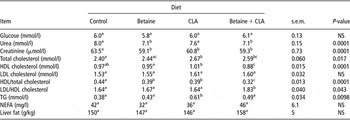
Biochemical serum parameters are shown in Table 2. Pigs fed betaine-supplemented diets had significantly (P < 0.05) lower serum urea, creatinine and HDL cholesterol/total cholesterol (11.1%, 7.0% and 10.9%, respectively) compared with Control pigs. Addition of CLA to the diet decreased (P < 0.05) serum creatinine and HDL cholesterol/total cholesterol (4.2% and 11.1%, respectively), tended (P = 0.090) to decrease serum urea (4.5%), increased (P < 0.05) total cholesterol and TG (11.1% and 58.1%, respectively) and tended to increase (P = 0.052) HDL cholesterol (4.3%) compared with Control pigs. Finally, compared with Control pigs, animals fed diets supplemented with both metabolic modifiers had reduced (P < 0.05) urea, creatinine, HDL cholesterol and HDL cholesterol/total cholesterol (10.7%, 6.5%, 9.0% and 9.6%, respectively), increased total cholesterol (P < 0.05; 8.0%), LDL/HDL cholesterol (P < 0.05; 11.6%) and a trend to increased TG (P = 0.054; 27.9%).
Biochemical serum variables and liver fat of growing Iberian pigs fed diets supplemented or not with CLA (1%), betaine (0.5%) or betaine + CLA between 20 and 30 kg BW (repeated measures over 20 h with feed offered at 0 and 5 h relative to sampling)Footnote 1

CLA = conjugated linoleic acid; HDL = high-density lipoprotein; LDL = low-density lipoprotein; TG = triglycerides; NEFA = non-esterified fatty acid.
a,b,c Means within a row without a common superscript are different (P < 0.05).
1 n = 5 pigs/group. Least square means of 8 samples (0, 2, 4, 6, 8, 12, 16, 20 h after the morning meal), except NEFA (0, 2 and 4 h). Treatment × Time interactions were not significant for all variables.
Serum glucose, LDL cholesterol and NEFA were not affected by any dietary treatment (P > 0.10). Treatment × Time interactions were not significant for all variables.
Serum hormones profile
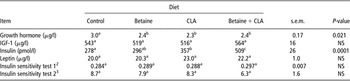
Metabolic hormone profile is shown in Table 3. Treatment × Time interactions were not significant for all variables.
Serum hormones of growing Iberian pigs fed diets supplemented or not with CLA (1%), betaine (0.5%) or betaine + CLA from 20 to 30 Kg BW (repeated measures over 20 h with feed offered at 0 and 5 h relative to sampling)Footnote 1

CLA = conjugated linoleic acid.
a,b,c Means within a row without a common superscript are different (P < 0.05).
1 n = 5 pigs/group. Least square means of 8 samples (0, 2, 4, 6, 8, 12, 16, 20 h after the morning meal). Treatment × Time interactions were not significant for all variables.
2 QUICKI = 1/[log(10) Fasting serum insulin, μU/ml + log(10) Fasting serum glucose, mg/dl].
3 HOMA = (Fasting serum insulin, μU/ml) × (Fasting serum glucose, mM)/22.5.
Pig serum IGF-1 and leptin were not affected (P > 0.10) by dietary supplementation with betaine, CLA or both additives.
Betaine supplementation decreased serum growth hormone concentration (P < 0.05; 20%) compared with Control pigs. When diets were supplemented with CLA, a decrease (P < 0.05; 23%) in growth hormone concentration and an increase in insulin concentration (P < 0.05; 28.8%) were found compared with Control pigs. Similarly, when both betaine and CLA were added to the diet, growth hormone levels decreased and insulin levels increased sharply compared with Control pigs (20% and 83%, respectively).
Insulin sensitivity assessed by insulin sensitivity tests 1 and 2 was not different between treatments.
Oral glucose tolerance test
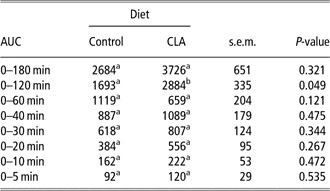
AUC were numerically higher for CLA pigs at all time intervals but only attained statistical significance at the 0 to 120 min interval (70%, P < 0.05; Table 4).
Area under the glucose curve (mmol/l and d) of 49 kg BW Iberian pigs fed Control or CLA diets and challenged with an oral glucose tolerance test (1 g/kg BW)Footnote 1

CLA = conjugated linoleic acid.
a,b Means within a row without a common superscript are different (P < 0.05).
1 n = 5 pigs/group.
Liver histology and fat content
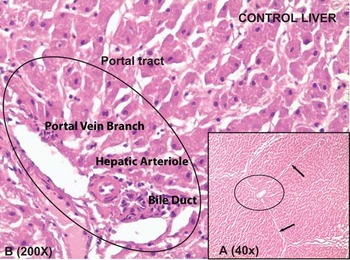
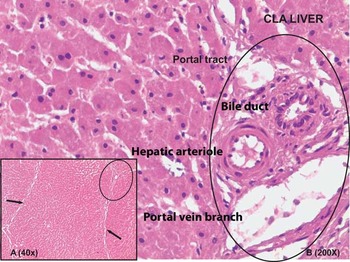
All livers showed lack of pathological changes, using light microscopy assessment. Representative histological sections of Control and CLA livers, respectively, are shown in Figures 1 and 2. At 40× magnification (Figures 1a and 2a), there was lack of widened conjunctive walls or fibrosis (arrows). At 200× magnification (Figures 1b and 2b), hepatocytes without vacuolization (no noticeable steatosis), inflammatory cells (lymphocytes or neutrophils), deposits or other pathological changes were observed. Nevertheless, we saw a widespread freezing artefact in samples of all treatments. Furthermore, the histopathological findings were supported by the lack of differences in fat content among treatments (147 to 158 mg/g DM; P > 0.10; Table 2).
Microphotograph of a histological section of liver of pigs fed the Control diet. The arrows show lack of widened conjunctive walls or fibrosis. The ovals mark a portal tract containing the bile duct, the hepatic arteriole and the portal vein branch.

Microphotograph of a histological section of the liver of pigs fed the conjugated linoleic acid (CLA) diet. The arrows show lack of widened conjunctive walls or fibrosis. The ovals mark a portal tract containing the bile duct, the hepatic arteriole and the portal vein branch.

Discussion
This study was designed to investigate possible mechanisms involved in the increased protein deposition and decreased fat content previously shown in the carcass of pigs fed diets supplemented with betaine and CLA (Ostrowska et al., Reference Ostrowska, Muralitharan, Cross, Baumann and Dunshea1999 and Reference Ostrowska, Suster, Muralitharan, Cross, Leury, Bauman and Dunshea2003; Fernández-Fígares et al., Reference Fernández-Fígares, Wray-Cahen, Steele, Campbell, Hall, Virtanen and Caperna2002 and Reference Fernández-Fígares, Conde-Aguilera, Nieto, Lachica and Aguilera2008; Mitchell et al., Reference Mitchell, Pursel, Elsasser, Mcmurtry and Bee2005). Serum metabolites and hormones that may indicate a modification in protein or energy metabolism were investigated in this study. As some deleterious effects have been reported when CLA was fed to laboratory animals, such as insulin resistance and hepatic steatosis (Tsuboyama-Kasaoka et al., Reference Tsuboyama-Kasaoka, Takahashi, Tanemura, Kim, Tange, Okuyama, Kasai, Ikemoto and Ezaki2000; Clément et al., Reference Clément, Poirier, Niot, Bocher, Guerre-Millo, Krief, Staels and Besnard2002), a glucose tolerance test was performed and liver morphology was studied to address these issues in a non-rodent model.
Effects on lipid metabolism
Possible mechanisms of decreased fat accretion include the inhibition of fat deposition from both preformed fatty acids (esterification) or glucose (de novo lipogenesis) and/or an increase in fat mobilization (lipolysis) in pigs fed dietary betaine or CLA.
The level of serum glucose, which is the primary carbon source of de novo lipogenesis, was monitored in this study. Isotope kinetics studies have shown that over 40% of whole body glucose pool can be used by adipose tissue for de novo lipogenesis in 80 kg pigs (Dunshea et al., Reference Dunshea, Harris, Bauman, Boyd and Bell1992). The uptake of glucose is dependent on insulin, and thus the level of this hormone was also examined. Reduced rates of glucose utilization for lipid synthesis could be a mechanism by which betaine or CLA reduce body fat. In this study, betaine or CLA had little effect on serum glucose. Our results would imply that the differences in fat deposition in pigs fed betaine + CLA (Fernández-Fígares et al., Reference Fernández-Fígares, Conde-Aguilera, Nieto, Lachica and Aguilera2008) could not be explained by dissimilar availability of glucose for lipogenesis. Similarly, CLA did not alter plasma glucose and insulin in growing (Ramsay et al., Reference Ramsay, Evock-Clover, Steele and Azain2001) and finishing pigs (Ostrowska et al., Reference Ostrowska, Cross, Muralitharan, Bauman and Dunshea2002) or lactating sows (Bontempo et al., Reference Bontempo, Sciannimanico, Pastorelli, Rossi, Rosi and Corino2004). Nevertheless, serum glucose concentration was decreased in finishing pigs (Huang et al., Reference Huang, Xu, Han and Lia2006) fed betaine-supplemented diets, the effect being ascribed to increased insulin levels. In our study, however, we encountered increased serum insulin in pigs fed CLA and betaine + CLA, with no change in serum glucose. Insulin stimulates lipogenesis (Kersten, Reference Kersten2001) and inhibits lipolysis (Bremer and Osmundsen, Reference Bremer and Osmundsen1984). Nevertheless, a trend to increased serum TG in the betaine + CLA pigs in this experiment together with a trend to decreased carcass fat content in betaine + CLA pigs (Fernández-Fígares et al., Reference Fernández-Fígares, Conde-Aguilera, Nieto, Lachica and Aguilera2008) would suggest that insulin sensitivity could be partly impaired at adipose tissue level, and part of the glucose destined for lipid synthesis could be redirected to other tissues. Interestingly, glycaemia was not affected, which suggests that glucose uptake was encouraged in other tissues (liver and muscle). Nevertheless, in vitro studies have shown that CLA decreased gluconeogenesis in primary culture of porcine hepatocytes (Conde-Aguilera et al., Reference Conde-Aguilera, Lachica, Nieto and Fernández-Fígares2011) with no change in glycogen synthesis and degradation.
Higher levels of circulating triacylglycerol in pigs fed CLA were found in this experiment. Likewise, others have also found increased plasma triacylglycerol in pigs fed CLA (Stangl et al., Reference Stangl, Muller and Kirchgessner1999; Ostrowska et al., Reference Ostrowska, Cross, Muralitharan, Bauman and Dunshea2002) or betaine (Martins et al., Reference Martins, Neves, Freitas and Tirapicos2010). An increase in serum triacylglycerol levels could be an indication of reduced activity of lipoprotein lipase, which is in line with decreased heparin-releasable lipoprotein lipase activity by CLA in 3T3-L1-cultured murine adipocytes (Park et al., Reference Park, Albright, Liu, Storkson, Cook and Pariza1997). The increase in serum TG levels observed when pigs were fed CLA and to a lesser extent betaine + CLA indicated that fat accretion could be reduced via decreased lipid synthesis from preformed fatty acids, which is in line with decreased carcass fat content of these pigs reported previously (Fernández-Fígares et al., Reference Fernández-Fígares, Conde-Aguilera, Nieto, Lachica and Aguilera2008). Nevertheless, Tischendorf et al. (Reference Tischendorf, Möckel, Schöne, Plonné and Jahreis2002) found no effect of CLA on plasma TG levels of finishing pigs. A reduced uptake of preformed fatty acids is indicated by the already-mentioned higher levels of circulating triacylglycerol in pigs fed diets containing CLA. Work with 3T3-L1 adipose cells supported the evidence that CLA enhanced lipolysis (Park et al., Reference Park, Albright, Liu, Storkson, Cook and Pariza1997). However, contrary to Ostrowska et al. (Reference Ostrowska, Cross, Muralitharan, Bauman and Dunshea2002), we have found no serum NEFA change in pigs fed CLA diets and similar results were found in lactating sows (Bontempo et al., Reference Bontempo, Sciannimanico, Pastorelli, Rossi, Rosi and Corino2004). In this study, betaine had no effect in serum NEFA and similar results have previously been reported (Matthews et al., Reference Matthews, Southern, Pontif, Higbie and Bidner1998; Øverland et al., Reference Øverland, Rørvik and Skrede1999). Furthermore, it is interesting to point out that whole body or hepatic fatty acid oxidation was not affected by betaine in growing pigs (Wray-Cahen et al., Reference Wray-Cahen, Fernández-Fígares, Virtanen, Steele and Caperna2004), suggesting that reduction in adipose accretion must be via a mechanism other than oxidation. Nevertheless, Huang et al. (Reference Huang, Xu, Han and Lia2006) reported increased NEFA but no change in TG of finishing pigs fed diets supplemented with betaine. Inconsistency may be in part because of different dietary nutrient composition.
Effects on protein metabolism
In the somatotrophic axis, growth hormones can act in tissues directly on the cells itself or indirectly through the action of locally and systemically produced IGF-1 (Brook et al., Reference Brook, Hindmarsh and Stanhope1988; Florini et al., Reference Florini, Ewton and Coolican1996). In our experiment, pigs fed betaine and (or) CLA had reduced serum growth hormone, with no change in IGF-1 levels, which agree with the findings of Bontempo et al. (Reference Bontempo, Sciannimanico, Pastorelli, Rossi, Rosi and Corino2004) in lactating sows fed CLA. By contrast, Li et al. (Reference Li, Seifert, Ney, Grahn, Grant, Allen and Watkins1999) found that CLA increases serum IGF-1 in rats, suggesting the hypothesis that CLA modulates body mass through mechanisms involving the IGF system. Nevertheless, decreased growth hormone levels in our experiment would contribute to an increase in lipogenic enzyme activities, as well as augmented adipocyte insulin sensitivity (Louveau and Gondret, Reference Louveau and Gondret2004). This is in contrast with increased protein deposition and decreased carcass fat content in Iberian pigs fed betaine + CLA diets (Fernández-Fígares et al., Reference Fernández-Fígares, Conde-Aguilera, Nieto, Lachica and Aguilera2008), and would indicate that the mechanism by which these metabolic modifiers altered nutrient partitioning is not via the somatotrophic axis in Iberian pigs.
Although insulin is the primary hormone responsible for maintenance of glucose homeostasis, it also has potent actions on protein metabolism. The increased protein anabolism in response to feeding in previously fasted animals has been postulated to be mediated by the transient increases in insulin and amino acid concentrations that follow a meal (Garlick and Grant, Reference Garlick and Grant1988). We have found increased serum insulin in pigs fed CLA and betaine + CLA diets compared with Control pigs. Hyperinsulinaemia in these pigs raises the question of a possible insulin resistance induced by CLA alone or in the presence of betaine, which will be addressed later.
Coma et al. (Reference Coma, Carrion and Zimmerman1995) reported that N retention and urea N concentration were reflective of each other such that urea N concentration is minimized as N retention is maximized. Our data indicated that betaine and betaine + CLA supplementation did significantly decrease serum urea concentration compared with Control pigs, suggesting dissimilar protein metabolism. Similar results were also reported in finishing pigs (Matthews et al., Reference Matthews, Southern, Pontif, Higbie and Bidner1998; Huang et al., Reference Huang, Xu, Han and Li2007) fed betaine. On the contrary, Martins et al. (Reference Martins, Neves, Freitas and Tirapicos2010) in Alentejano finishing pigs reported no effect of betaine on plasma urea. Matthews et al. (Reference Matthews, Southern, Pontif, Higbie and Bidner1998) suggested that the effects of betaine on protein status of pigs were dependent on the CP and energy content of the diet. Regarding CLA, supplementation of the diet for 8 days did not alter plasma urea of finishing pigs (Ostrowska et al., Reference Ostrowska, Cross, Muralitharan, Bauman and Dunshea2002), which is consistent with our results. Decreased serum urea in our research may suggest that betaine and betaine + CLA may improve N utilization in growing Iberian pigs fed diets supplemented with betaine or betaine + CLA. Although the responses to insulin on protein metabolism sharply decrease with age (Davis et al., Reference Davis, Suryawan, Orellana, Fiorotto and Burrin2010), it could be speculated that increased serum insulin could stimulate muscle protein synthesis and/or inhibit muscle proteolysis (Tesseraud et al., Reference Tesseraud, Métayer, Duchêne, Bigot, Grizard and Dupont2007) in pigs fed betaine + CLA diets, which would be in line with decreased serum urea and the increased carcass protein deposition, as previously reported (Fernández-Fígares et al., Reference Fernández-Fígares, Conde-Aguilera, Nieto, Lachica and Aguilera2008).
Adverse side effects
Insulinaemia, glycaemia, liver steatosis and morphology
Hepatic steatosis is closely associated with decreased sensitivity of the liver to insulin, which may lead to hyperglycaemia and hyperinsulinaemia.
The impact of dietary CLA on hepatic steatosis and insulin sensitivity is controversial because of differences in species, isomer responses and degree and sensitivity to changes in adiposity (Tsuboyama-Kasaoka et al., Reference Tsuboyama-Kasaoka, Miyazaki, Kasaoka and Ezaki2003; Nagao et al., Reference Nagao, Inoue, Wang, Shirouchi and Yanagita2005; Wang et al., Reference Wang, Nagao, Inoue, Ujino, Shimada, Nagao, Iwata, Kamegai, Yamauchi-Sato and Yanagita2006). In this study, we investigated the effects of dietary CLA and betaine in a highly adipogenic pig model.
It is usually considered that hyperinsulinaemia is reflective of insulin resistance. In our study, however, no differences in serum glucose were encountered among treatments, in spite of increased insulin levels in pigs fed CLA and betaine + CLA diets, and we did not see a change in insulin sensitivity calculated using insulin sensitivity tests 1 and 2. As the insulin sensitivity indices used are based on fasting glucose and insulin levels, it could be speculated that decreased insulin sensitivity in pigs fed CLA and betaine + CLA diets is postprandial. Moreover, liver fat was not affected by treatments in spite of increased serum insulin in pigs fed CLA and especially betaine + CLA. Interestingly, when pigs fed CLA diets were challenged with an oral glucose tolerance test, an increase in serum glucose was found compared with Control pigs, 2 h after the load.
No change in liver fat content or liver morphology assessed through optical microscopy was observed for any treatment. To our knowledge, this is the first report on the effects of CLA or betaine in liver morphology of pigs. In line with the lack of effect of CLA on liver fat content, TG content in primary culture of porcine hepatocytes increased in parallel with concentration of free fatty acids in the media, but CLA had no effect compared with linoleic acid (Conde-Aguilera et al., Reference Conde-Aguilera, Lachica, Nieto and Fernández-Fígares2011). In rats, there are conflicting results. Although rats fed 2% CLA diets for 2 weeks showed lipid accumulation in the liver as observed through electron microscopy (Yamasaki et al., Reference Yamasaki, Mansho, Mishima, Kimura, Sasaki, Kasai, Tachibana and Yamada2000a), dietary CLA fed at 1% prevented steatosis observed histologically in livers of rats fed high fructose diets (Kostogrys and Pisulewski, Reference Kostogrys and Pisulewski2010).
Although there is some evidence from mice and human studies that the CLA isomer trans-10, cis-12 may produce liver hypertrophy and insulin resistance via a redistribution of fat deposition that resembles lipodystrophy (Larsen et al., Reference Larsen, Toubro and Astrup2003), the CLA-induced changes in glucose tolerance and liver metabolism observed in the various animal studies are conflicting. For example, dietary CLA has been reported to decrease TG accumulation in the liver of Wistar rats (Purushotham et al., Reference Purushotham, Shrode, Wendel, Liu and Belury2007), but hyperinsulinaemia was observed in wild-type mice supplemented with CLA (Tsuboyama-Kasaoka et al., Reference Tsuboyama-Kasaoka, Takahashi, Tanemura, Kim, Tange, Okuyama, Kasai, Ikemoto and Ezaki2000).
In relation to betaine, there is a scarcity of information regarding its effect on liver lipids in non-rodent models. It has been reported (Barak et al., Reference Barak, Beckenhauer, Junnila and Tuma1993) that adding betaine as a methyl donor stimulates liver lipid mobilization in alcoholic fatty liver of rats, but we have been unable to show differences in liver fat content of pigs fed betaine diet compared with Control pigs, may be because lipogenesis in pig liver is negligible and also because of the fact that the growing pig does not mobilize fat from adipose tissue and would not be expected to accumulate fat in the liver.
The adipocyte-derived hormone leptin has a profound impact on steatosis and insulin sensitivity, and there seems to be a crosstalk between the leptin and the insulin signalling pathways at the levels of the insulin receptor substrate and phosphatidylinositol-3 kinase (Ceddia, Reference Ceddia2005).
Leptin has been implicated in feed intake regulation, reproductive and immune function (Barb et al., Reference Barb, Barrett, Kraeling and Rampacek1999). Because leptin is secreted mainly by adipocytes, circulating levels correlate directly with body mass index in humans (Ahima and Flier, Reference Ahima and Flier2000), with a positive correlation between circulating leptin levels and adiposity also reported in pigs (Barb et al., Reference Barb, Hausmann and Houseknecht2001). As CLA is reported to reduce body fat content (Ostrowska et al., Reference Ostrowska, Suster, Muralitharan, Cross, Leury, Bauman and Dunshea2003), a reduction in plasma leptin levels would be expected in CLA-supplemented animals (Kang and Pariza, Reference Kang and Pariza2002) unless there is central or peripheral leptin resistance. Leptin, by binding to its receptors located in skeletal muscle and fat cells promotes energy dissipation and prevents fatty acid accumulation in these tissues (Ceddia, Reference Ceddia2005). In contrast, under conditions of peripheral leptin resistance, the activation of pathways involved in fatty acid oxidation may be impaired, which would lead to intracellular accumulation of lipid intermediates and cause insulin resistance (Steinberg and Dyck, Reference Steinberg and Dyck2000). Serum leptin concentration in this experiment is much higher than in finishing Berkshire, Chester White, Duroc, Landrace, Poland China or Yorkshire pigs (Berg et al., Reference Berg, McFadin, Maddock, Goodwin, Baas and Keisler2003). We showed that Iberian pigs had higher plasma leptin concentration than Landrace gilts at 20 kg BW (Fernández-Fígares et al., Reference Fernández-Fígares, Lachica, Nieto, Rivera-Ferre and Aguilera2007); however, feed intake was not diminished, which suggests that they are leptin resistant. In this study, although some evidence of CLA-induced insulin resistance was detected (hyperinsulinaemia, increased serum glucose after glucose tolerance test), insulin resistance is not yet established as similar glucose levels, liver fat levels, and insulin sensitivity tests were found in CLA and Control pigs.
We have found no information in the literature on the effects of betaine on circulating leptin concentration in any experimental model. The effects of dietary CLA on serum leptin have not been extensively investigated in pigs. In our experiment, there was no effect of any treatment on serum leptin concentration. Dietary CLA reduced serum leptin levels in rats, mice and humans (Delany et al., Reference Delany, Blohm, Truett, Scimeca and West1999; Medina et al., Reference Medina, Horn, Keim, Havel, Benito, Kelley, Nelson and Erickson2000; Yamasaki et al., Reference Yamasaki, Mansho, Ogino, Kasai, Tachibana and Yamada2000b), whereas it was increased in lactating sows (Bontempo et al., Reference Bontempo, Sciannimanico, Pastorelli, Rossi, Rosi and Corino2004).
Serum lipids and arteriosclerosis
Although increased total cholesterol (Matthews et al., Reference Matthews, Southern, Higbie, Persica and Bidner2001; Martins et al., Reference Martins, Neves, Freitas and Tirapicos2010) and decreased HDL/total cholesterol (Martins et al., Reference Martins, Neves, Freitas and Tirapicos2010) have been reported in pigs fed betaine, other authors reported no betaine effect on cholesterol, plasma NEFA or TG (Matthews et al., Reference Matthews, Southern, Pontif, Higbie and Bidner1998; Øverland et al., Reference Øverland, Rørvik and Skrede1999). We found decreased HDL/total cholesterol in betaine pigs, but no significant effects in total cholesterol or fractions. However, in humans, Turpin (Reference Turpin1985) reported that adding betaine as a methyl donor reduced hyperlipidaemia.
Stangl et al. (Reference Stangl, Muller and Kirchgessner1999) found increased LDL-to-HDL ratio and a trend to augmented total and HDL cholesterol in CLA-supplemented pigs compared with Control pigs receiving sunflower oil. Nevertheless, Tischendorf et al. (Reference Tischendorf, Möckel, Schöne, Plonné and Jahreis2002) found no differences in TG or cholesterol fractions and concluded that blood lipid status of CLA fed pigs did not represent arteriosclerosis risk. Pigs fed betaine + CLA diets had diminished HDL/total cholesterol, increased LDL/HDL cholesterol and serum TG, which may be considered a risk for coronary heart disease (Kinosian et al., Reference Kinosian, Glick and Garland1994).
In conclusion, our observations show that betaine and CLA had an impact on protein and fat metabolism such that different hormones and biochemical parameters were affected. Decreased serum urea would indicate improved efficiency of protein utilization, and increased serum TG would suggest that fat is being mobilized. The use of betaine + CLA may worsen, from a human health point of view, the ratio between cholesterol fractions, which together with increased serum TG, may indicate a risk of atherogenesis. In addition, although CLA had a moderate effect on insulin sensitivity, no negative effects were found in liver histology for any treatment.
Acknowledgements
The authors thank Drs R. Barea and L. Lara for statistical advice and Dr C. García del Río for technical help. J. M. Rodríguez-López and L. González-Valero were supported by doctoral scholarships from the Spanish Ministry of Education (AP2006-01855) and Spanish Ministry of Science and Innovation (BES-2007-15633), respectively. This study was supported by grants from Ministry of Science and Technology AGL2009-08916 and CSIC, PIE200640I025.