Introduction
Nippotaenia mogurndae Yamaguti and Miyata, 1940, is a common nippotaeniid tapeworm found in the gastrointestinal tracts of the fish Odontobutis obscura and Perccottus glenii in Japan, China and Russia. Nippotaeniid tapeworms comprise a small group of eucestodes, and most species have a single powerful terminal sucker, anapolytic stobila, close-knit bilobed vitellarium and many interconnecting longitudinal excretory canals (Hine, Reference Hine1977; Sokolov et al., Reference Sokolov, Bel'kova and Maikova2018). To date, only six species have been placed in the family Nippotaeniidae and the monotypic order Nippotaeniidea (Hine, Reference Hine1977). These cestodes are mostly found from freshwater fish in China, Japan, New Zealand, Russia, Slovakia, Poland, and Ukraine (Hine, Reference Hine1977; Bray, Reference Bray, Khalil, Jones and Bray1994; Košuthová et al., Reference Košuthová, Koščo, Miklisová, Letková, Košuth and Manko2008; Mierzejewska et al., Reference Mierzejewska, Martyniak, Kakareko and Hliwa2010; Kvach et al., Reference Kvach, Drobiniak, Kutsokon and Hoch2013). However, it is difficult to identify and taxonomically classify these species using their limited and simple morphological characters. The six nippotaeniid cestodes were assigned into two genera, Nippotaenia (Yamaguti, 1939) and Amurotaenia (Achmerow, 1941); however, the validity of genus Amurotaenia is in doubt (Bray, Reference Bray, Khalil, Jones and Bray1994; Hoberg et al., Reference Hoberg, Mariaux, Justine, Brooks and Weekes1997; Waeschenbach et al., Reference Waeschenbach, Webster, Bray and Littlewood2007, Reference Waeschenbach, Webster and Littlewood2012; Caira et al., Reference Caira, Jensen, Waeschenbach, Olson and Littlewood2014). Based on phylogenetic analysis with 18S rRNA sequences, Sokolov et al. (Reference Sokolov, Bel'kova and Maikova2018) confirmed that the division of nippotaeniid cestodes into these two genera was improper.
Since N. mogurndae was first reported in Asia, it has spread through European waters with its fish hosts and has shown great adaptivity in colonized areas (Mierzejewska et al., Reference Mierzejewska, Martyniak, Kakareko and Hliwa2010). With increasing international fish trade, the transmission of invasive parasites along with fish hosts has drawn considerable attention (e.g. Košuthová et al., Reference Košuthová, Koščo, Miklisová, Letková, Košuth and Manko2008; Mierzejewska et al., Reference Mierzejewska, Martyniak, Kakareko and Hliwa2010). Mitochondrial DNA is a powerful marker that is used for species identification and phylogenetic analysis because it is maternally inherited and evolves rapidly (Xi et al., Reference Xi, Zhang, Li, Yang and Xie2018). In this study, the complete mitogenome of N. mogurndae was sequenced and annotated. The results presented herein will facilitate a better understanding of the evolution and taxonomy of nippotaeniideans.
Materials and methods
Specimen collection and DNA extraction
In September 2019, six Chinese sleepers (Perccottus glenii, Dybowski, 1877) caught from the Amur River (Heilongjiang River, Tongjiang, China) were purchased from the local fish market and immediately examined for parasites. The tapeworm N. mogurndae was found in the intestines of Chinese sleepers with high infective prevalence (100%; 6/6 fish) and intensity of 2–11. The tapeworms were rinsed with saline, fixed in 100% ethanol, and then identified using the method described by Sokolov et al. (Reference Sokolov, Bel'kova and Maikova2018). A Blood and Tissue DNA Mini Kit (Aidlab, China) was used to extract total genomic DNA and samples were immediately stored at −20°C until further analysis.
Polymerase chain reaction (PCR) and DNA sequencing
We amplified the whole mitogenome using primers (supplementary table S1) synthesized by Bio-Transduction Laboratory (Wuhan, China). PCR reactions were performed in a 50 μl reaction mixture, containing 33.5 μl double-distilled water, 5 μl 10 × LA Taq Buffer II (Mg2+ plus), 1 μl of each primer (10 μM), 0.5 μl LA Taq (Takara, China), 8 μl dNTP Mixture (2.5 mm each) and 60 ng DNA template. The procedure for amplification was as follows: initial denaturation at 95°C for 2 min, followed by 35 cycles of denaturation at 94°C for 30 s, annealing at 44°C–62°C (Tm of the primers used were listed in supplementary table S1) for 30 s, elongation at 72°C for 1 min/kb, and then final extension at 72°C for 10 min. PCR products were sequenced bidirectionally at Bio-Transduction Laboratory (Wuhan, China).
Sequence annotation and analyses
The amplified fragments were confirmed by Nucleotide Basic Local Alignment Search Tool (Altschul et al., Reference Altschul, Gish, Miller, Myers and Lipman1990), and mitochondrial genome sequences were assembled using DNAstar software (Burland, Reference Burland, Misener and Krawetz2000). The mitogenomic data of Mesocestoides vogae (LC102498) was used as a reference, and gene boundaries were determined with Multiple Alignment using Fast Fourier Transform (MAFFT) (Katoh & Standley, Reference Katoh and Standley2013) and Geneious (Kearse et al., Reference Kearse, Moir and Wilson2012). Mitogenome annotations and characterizations were conducted as previously described (Li et al., Reference Li, Zhang, Boyce, Xi, Zou, Wu, Li and Wang2017; Zhang et al., Reference Zhang, Zou, Wu, Li, Jakovlić, Zhang, Chen, Wang and Li2017a, Reference Zhang, Wang and Luob; Zou et al., Reference Zou, Jakovlić, Chen, Zhang, Zhang, Li and Wang2017). Protein-coding genes (PCGs) and non-coding regions (NCRs) were determined with Geneious by searching for open reading frames (using genetic code 9) and comparing nucleotide alignments with reference genomes. All transfer RNAs (tRNAs) were identified and confirmed using ARWEN software (Laslett & Canback, Reference Laslett and Canback2008) and the MITOS web server (Bernt et al., Reference Bernt, Donath, Jühling, Externbrink, Florentz, Fritzsch, Pütz, Middendorf and Stadler2013). Similarly, we used MITOS to search rrnL and rrnS with the reference genomes to determine their boundaries. The statistics tables and National Center for Biotechnology Information submission file was generated by PhyloSuite v1.2.2 (Zhang et al., Reference Zhang, Gao, Jakovlić, Zou, Zhang, Li and Wang2020). The tandem repeats (TRs) in non-coding regions were identified using the Tandem Repeats Finder (Benson, Reference Benson1999). The broken line graph of A + T content and scatter diagram of nucleotide skews were produced in ggplot2 (Wickham, Reference Wickham2009), and PhyloSuite was employed to make a nucleotide composition table and relative synonymous codon usage (RSCU) figures for PCGs.
Phylogeny and gene order
In addition to the newly sequenced mitogenome of N. mogurndae, 32 selected cestode mitochondrial DNA sequences retrieved from GenBank were used for phylogenetic analyses, including 30 complete mitogenome sequences (supplementary table S2). Two trematode species served as outgroups; namely, Dicrocoelium dendriticum (Rudolphi, 1819) (NC_025280) and Dicrocoelium chinensis (Tang & Tang, 1978) (NC_025279). PhyloSuite was used to extract PCG, rRNA and tRNA nucleotide sequences from GenBank files. PCGs were translated into amino acid sequences (with genetic code 9), aligned in batches with MAFFT using codon-alignment mode, and refined with MACES v2.03 (Ranwez et al., Reference Ranwez, Douzery, Cambon, Chantret and Delsuc2018). We aligned the RNA sequences using MAFFT's normal alignment mode. Ambiguously aligned fragments of all of the alignments were removed using Gblocks v0.91b (Talavera & Castresana, Reference Talavera and Castresana2007) with default settings. The aligned and trimmed PCGs and RNA sequences were concatenated using PhyloSuite. We conducted phylogenetic analyses simultaneously using maximum likelihood (ML) and Bayesian inference (BI). The optimal nucleotide substitution models were selected based on the lowest Bayesian information criterion scores in ModelFinder (Kalyaanamoorthy et al., Reference Kalyaanamoorthy, Minh, Wong, von Haeseler and Jermiin2017) (supplementary table S3). ML analysis was performed in IQ-TREE Web Server (Trifinopoulos et al., Reference Trifinopoulos, Nguyen, von Haeseler and Minh2016) using IQ-TREE v1.6.12. Branch support was estimated with 5000 bootstrap replicates. BI analysis was performed in MrBayes v3.2.7a (Ronquist et al., Reference Ronquist, Teslenko and van der Mark2012) on CIPRES Science Gateway (Miller et al., Reference Miller, Pfeiffer and Schwartz2010) with the default settings, and 5 × 10⁶ metropolis-coupled Markov chain Monte Carlo generations. MAFFT, MACES, Gblocks, and ModelFinder were used as plugins in PhyloSuite. The tree was annotated using iTOL web-based tool (Letunic & Bork, Reference Letunic and Bork2021).
Results and discussion
Genome organization and base composition
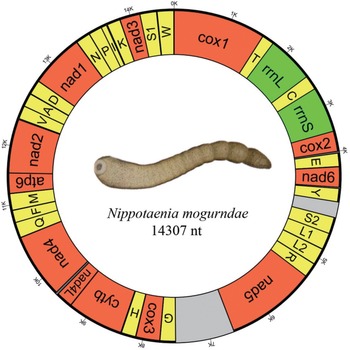
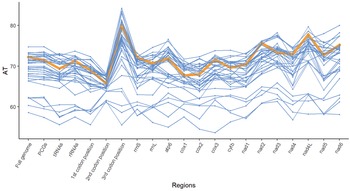
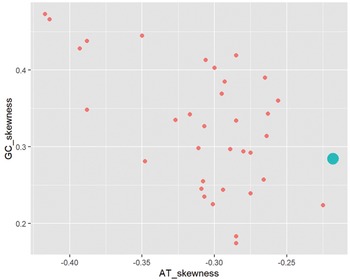
The mitochondrial genome of N. mogurndae is 14,307 base pairs (bp) in length (GenBank accession number: ON640728), and consists of 12 PCGs, 22 tRNA genes, two rRNA genes and two NCRs. The mitogenome also lacks the atp8 gene, similar to other platyhelminths (fig. 1), and all of the genes are transcribed along the same strand. Six overlapping regions and 23 intergenic regions were identified (table 1). The mitogenome of N. mogurndae shows a higher A + T content (72.2%) among the cestodes studied in this report (fig. 2), meanwhile it contains G-skew and T-skew, like those of other cestodes (fig. 3).
Organization of the complete mitochondrial genome of Nippotaenia mogurndae.

A+T content of complete genomes and different regions for the mitogenome of Nippotaenia mogurndae (red) and other cestodes.

Comparison of nucleotide skewness of the full genomes for the mitogenome of Nippotaenia mogurndae (green) and other cestodes.

Organization and length of genes in the mitochondrial genome of Nippotaenia mogurndae (Cestoda: Nippotaeniidae).

PCGs and codon usage
Coalesced PCGs are 10,113 bp in size, with 71.5% A + T content (supplementary table S2). A + T content of individual PCGs ranges from 66.9% (cox2) to 77.8% (nad4L) (supplementary table S4). GTG is identified as the initial codon for cox3, and ATG for the rest of the 12 PCGs. Among the terminal codons, six (cox1, nad4L, nad4, nad2, nad1 and nad3) are identified as TAG, and that of the remaining terminal codons five (nad6, nad5, cox3, cytb and atp6) as TAA, while that of cox2 is T (table 1).
The RSCU and codon family proportion of N. mogurndae is shown in supplementary fig. S1. The four most abundant codon families (Leu2, Phe, Ile and Val) are found to account for 41.99%. In all of the codon families, A + T-rich codons are more commonly seen as synonymous codons in contrast to the lower A + T content in N. mogurndae (supplementary fig. S1). Accordingly, the relatively high A + T content fits well with this tendency (supplementary table S2).
Transfer and ribosomal RNA genes
The two rRNAs, rrnL and rrnS, are 966 and 727 bp in size, with 70.7% and 72.1% A + T content, respectively (supplementary table S2). The mitogenome of N. mogurndae contains all 22 tRNAs, which range in size from 59 bp (trnR) to 67 bp (trnH and trnW), and have a combined total size of 1408 bp (table 1 and supplementary table S2). Most tRNAs have a conventional cloverleaf structure, but trnS1 and trnR lack dihydrouridine arms of tRNA which also were determined in caryophyllidean and anoplocephalidaen tapeworms (Guo, Reference Guo2017; Li et al., Reference Li, Zhang, Boyce, Xi, Zou, Wu, Li and Wang2017; Xi et al., Reference Xi, Zhang, Li, Yang and Xie2018).
Non-coding regions
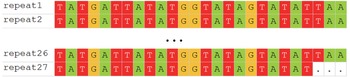
The NCR1 (220 bp) and NCR2 (817 bp), the two largest non-coding regions, are located between trnY and trnS2, nad5 and trnG, respectively. At similar positions, NCRs also have been found in other segmented tapeworms (e.g. von Nickisch-Rosenegk et al., Reference von Nickisch-Rosenegk, Brown and Boore2001). The A + T content in the two largest NCRs (81.8% and 83.1%) are higher than other regions in mitogenome (supplementary table S4). NCR2 contains 27 TRs. The first 26 repeat units are identical in nucleotide composition and size (26 bp), while the last one is truncated with 23 bp (fig. 4).
Tandem repeats in the second main non-coding region of Nippotaenia mogurndae.

Phylogeny and gene order
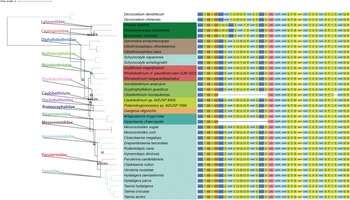
The phylogenetic topologies constructed with ML and BI show concordant branches, and high statistical support that are above 99 (bootstrap support values) or near 1.00 (Bayesian posterior probabilities) for most nodes. The complete mtDNA data set contributes significantly informative characters to the study of cestode evolution (Waeschenbach et al., Reference Waeschenbach, Webster and Littlewood2012). In this study, N. mogurndae clusters with the congener tapeworm Nippotaenia chaenogobii (JQ268550.1) and forms a monophyletic clade at the basal branch consisting of tetrafossate tapeworms from families Nippotaeniidae, Mesocestoididae, Hymenolepididae, Paruterinidae and Taeniidae (fig. 5). The Nippotaenia clade shows a close relationship with the Mesocestoididae, and this finding is also supported by the cytogenetic data reported by Bombarová et al. (Reference Bombarová, Špakulová and Oros2005).
Phylogenetic tree with gene order of cestodes species in nine orders inferred with 34 genes using maximum likelihood analyses. Bootstrap (BS)/Bayesian posterior probability (BPP) support values are shown above the nodes. Displayed sequences are BS <99 or BPP <1.

Gene order and arrangement in tapeworm mitogenome is conserved (Li et al., Reference Li, Zhang, Boyce, Xi, Zou, Wu, Li and Wang2017), and only four types of gene order are found among the 31 mtDNA data used in this study (fig. 5). The mtDNA of N. mogurndae showed consistent gene order with other segmented tapeworms.
Conclusion
In this study, we sequenced, annotated, and characterized the complete mitogenome of tapeworm N. mogurndae collected from Chinese sleeper P. glenii. Phylogenetic analysis based on mitogenomic data further confirmed that Nippotaenia is closely related to tetrafossate tapeworms, especially in the family Mesocestoididae.
Supplementary material
To view supplementary material for this article, please visit https://doi.org/10.1017/S0022149X22000530.
Financial support
This work was supported by the earmarked fund for China Agriculture Research System of MOF and MARA (CARS-45).
Conflicts of interest
The authors have no conflicts of interest to declare.
Ethical standards
The animal study was reviewed and approved by the protocols used on the experimental fish followed the guidelines of the Institutional Animal Care and Ethics Committee of Nanjing Agricultural University, Nanjing, China. [Permit number: SYXK (Su) 2011-0036].