The American Cancer Society estimates that 11.1 million Americans were living with cancer in 2005, and that 1.5 million new cases of cancer were diagnosed in 2009 (American Cancer Society, 2009). Because of the debilitating nature of advanced cancers and their treatment, many persons with advanced cancer require the assistance of an informal caregiver, defined as an unpaid individual who assists someone else who has functional impairment with activities of their daily living (Scott, Reference Scott2006). Over 22,000,000 people in the United States (with estimates running as high as 52,000,000) are involved in informal caregiving (Scott, Reference Scott2006), and a nationally representative survey of older people in the United States revealed that end-of-life caregivers provide an average of 43 hours of assistance per week (Wolff et al., Reference Wolff, Dy and Frick2007). Unfortunately, there is substantial evidence documenting deleterious caregiver physical and mental health effects, often referred to as caregiver burden. As people live longer with cancer, the negative effects of caregiver burden will only continue to grow.
A meta-analysis of 84 caregiver burden studies across all types of chronic disease showed that caregivers exhibit higher levels of stress and depression, lower subjective well-being, and worse physical health than non-caregiver controls (Pinquart & Sörenson, Reference Pinquart and Sörenson2003a). Caregiver burden has also been identified as an independent risk factor for mortality: controlling for demographics and co-morbid disease, caregivers were 63% more likely to die within a 4-year span than non-caregiver controls (Schulz & Beach, Reference Schulz and Beach1999). Although the negative effects of caregiving are most pronounced in caregivers of patients with dementia, informal caregivers of patients with cancer also report worse mental health (Ringdal et al., Reference Ringdal, Ringdal and Jordhøy2004; Braun et al., Reference Braun, Mikulincer and Rydall2007; Janda et al., Reference Janda, Seginga and Langbecker2007; Rhee et al., Reference Rhee, Yun and Park2008). In addition, caring for someone with a slow-developing cancer, such as colon or lung cancer, has been shown to increase 9-year mortality rates versus caregivers of patients with ‘quick’ cancers (Elwert & Christakis, Reference Elwert and Christakis2008). Even hospitalization for cancer may increase the risk of spouse mortality within 1 year (Christakis & Allison, Reference Christakis and Allison2006). The evidence seems clear that informal caregiving can exact a heavy toll.
Because of the significant effect of caregiving on health outcomes, various interventions to alleviate caregiver burden have been tested, but these have produced equivocal results (Harding & Higginson, Reference Harding and Higginson2003). A meta-analysis of 78 caregiver interventions across a wide array of chronic ailments found only marginal effects (0.14 < d < 0.41) (Sörenson et al., Reference Sörenson, Pinquart and Duberstein2002). A review of end-of-life palliative care studies concluded that the evidence for interventions improving outcomes for caregivers of patients with cancer was weak (Lorenz et al., Reference Lorenz, Lynn and Dy2008).
Psychoeducational interventions that teach caregivers about symptom management, self-care, and coordination of resources have been shown to improve caregivers' physical health, distress, and depression relative to controls, but these effects appeared short-lived as group differences disappeared shortly after the interventions ceased (McCorkle et al., Reference McCorkle, Robinson and Nuamah1998; Jepson et al., Reference Jepson, McCorkle and Adler1999). Caregiver interventions designed to improve problem-solving and coping skills have been shown to improve physical and social functioning (Toseland et al., Reference Toseland, Blanchard and McCallion1995). The benefits of both types of intervention, however, were most evident for those caregivers that entered the study with the highest impairment (Toseland et al., Reference Toseland, Blanchard and McCallion1995; Jepson et al., Reference Jepson, McCorkle and Adler1999). One exception was a problem-solving and coping skills intervention that successfully improved caregiver quality of life and reduced caregiver burden at 30 days post-intervention compared to both a usual care conditand an emotional support intervention (McMillan et al., Reference McMillan, Small and Weitzner2005). Unfortunately, this intervention failed to change the proposed mediators (e.g., problem-focused coping), leaving the mechanism behind this success unknown. In a disheartening statement, a review of interventions for caregivers of patients with cancer concluded that “no intervention can be recommended for nursing practice as an evidence-based strategy to reduce strain and burden in caregivers” (Honea et al., Reference Honea, Brintnall and Given2008)
One explanation for the ineffectiveness of earlier caregiver interventions is that these programs neglected the deteriorating health of caregivers' loved ones (Hebert et al., Reference Hebert, Arnold and Schulz2007). Cancer patients' physical health (e.g., functional impairment, experience of pain) and quality of life have been found to predict caregiver burden, distress, depression, and qality of life (Miaskowski et al., Reference Miaskowski, Kragness and Dibble1997; Beach et al., Reference Beach, Schulz and Yee2000; Fang et al., Reference Fang, Manne and Pape2001; Harding et al., Reference Harding, Higginson and Donaldson2003; Given et al., Reference Given, Wyatt and Given2004). A meta-analysis showed that among couples in which one partner had cancer, each partner's level of distress was significantly correlated (r = 0.29) and distress was not significantly different between partners (Hagedoorn et al., Reference Hagedoorn, Sanderman and Bolks2008). Additionally, a randomized controlled trial (RCT) of a caregiver intervention found that only a reduction in patient symptoms predicted decreases in caregiver depression (Kozachik et al., Reference Kozachik, Given and Given2001). It was argued, therefore, that caregiver interventions will not be effective if the patient is suffering, and that patient-directed interventions might help caregivers indirectly by improving patient outcomes (Hebert et al., Reference Hebert, Arnold and Schulz2007). However, previous palliative care interventions for patients with cancer have failed to affect caregiver outcomes despite demonstrating improvements in patients' quality of life (Clark et al., Reference Clark, Rummans and Sloan2006). For example, a RCT of a psychoeducational intervention produced marked reduction in patient depression and symptom severity in the intervention condition but a non-significant trend that caregivers in the intervention showed higher depression scores than controls (Kurtz et al., Reference Kurtz, Kurtz and Given2005). This finding indicates that certain interventions may inadvertently result in increased caregiver burden. Even a nursing intervention that increased longevity among patients with cancer only resulted in short-term alleviation of caregiver stress and depression (Giarelli et al., Reference Giarelli, Pisano and McCorkle2000).
The ENABLE II (Educate, Nurture, Advise Before Life Ends) palliative care intervention provided a prime opportunity to determine if an effective patient-directed intervention could alleviate caregiver burden. ENABLE II was designed to improve problem-solving skills, symptom management, and communication skills, as well as promote advance care planning (e.g., advanced directives and “do not resuscitate” orders) among patients with advanced cancer. Importantly, participants were recently diagnosed with cancer and the intervention occurred concurrently with cancer treatment, such as chemotherapy and radiation, in an effort to provide elements of palliative care to patients before death was imminent (Bakitas et al., Reference Bakitas, Lyons and Hegel2009a). In this RCT, the intervention proved effective in improving patients' quality of life, reducing symptom intensity, and lowering depressed mood compared to a usual care control condition in the 7 months following study enrollment (Bakitas et al., Reference Bakitas, Lyons and Hegel2009b). Although the intervention did not directly involve caregivers, we hypothesized that the intervention would improve caregiver outcomes indirectly through improvements in patient outcomes (Hebert et al., Reference Hebert, Arnold and Schulz2007).
METHOD
Sample
All procedures were approved by the Institutional Review Board of Dartmouth College. Patients in the parent study were recruited from an oncology clinic at a comprehensive cancer center in northern New England, affiliated outreach clinics, and an academically-affiliated Veterans' Affairs Medical Center. Recruitment extended from November 2003 to May 2007. Eligible patients were ≥18 years of age, had received a diagnosis of lung, breast, gastrointestinal, or genitourinary cancer within the past 12 weeks, and had a life expectancy of ~1 year. Patients were excluded if they were diagnosed with dementia/severe confusion, schizophrenia, bipolar disorder, or an active substance use disorder. Upon enrollment, patients were invited to identify someone close to them who was involved with their care (the caregiver) who could participate in the study. Patients were not excluded from the study if they failed to provide the name of a caregiver. Both patients and caregivers signed separate informed consents. Caregivers were asked to complete questionnaires on the same schedule as the patients, and caregivers of decedents were asked to participate in an interview to evaluate the quality of care patients received near the end of life.
Instruments
Caregiver Burden
Caregivers completed the Montgomery Borgatta Caregiver Burden Scale (Montgomery, Borgatta, & Borgatta, Reference Montgomery, Borgatta, Borgatta, Liu and Kendig2000). The 14-item measure contained three subscales: objective burden (α = 0.81, n = 192), or perceived infringement on tangible aspects of life (e.g., time available for recreational activities); stress burden (α = 0.76, n = 191), or the emotional impact of caregiving (e.g., perceived anxiety); and demand burden (α = 0.90, n = 184), or the caregiver's perceptions that the caregiving responsibilities are too demanding (e.g., unreasonable requests by the patient).
Quality of Care
The quality of care that patients received at end of life from their medical team was assessed using a revised version of the After Death Bereaved Family Member Interview (ADI) (Teno et al., Reference Teno, Clarridge and Casey2001). Caregivers were asked to complete this 67-item measure ~4–6 months following death of the patient. The scale measured perceptions of the quality of care that the patient received in eight domains: number of problems in unmet needs, coordination of care, emotional and spiritual support, shared decision making, match between care and preferences, problems with symptoms, support self-efficacy, and respectful treatment. Previous research has shown that close others' reports of patients' well-being and quality of care are reliable (McPherson & Addington-Hall, Reference McPherson and Addington-Hall2003).
Patient Quality of Life
Patients reported their quality of life by completing the Functional Assessment of Chronic Illness Therapy–Palliative Care (FACIT-Pal) (Brady & Cella, Reference Brady and Cella1999). This 46-item scale assessed the patient's physical, social, and emotional well-being at the end of life. Previous research demonstrated that the FACIT-Pal is reliable (α = 0.80, n = 189 in our sample) and has strong construct validity, being significantly related to symptom severity, depression, and longevity (Lyons et al., Reference Lyons, Bakitas and Hegel2009).
Physical Symptoms
Patients completed the Edmonton Symptom Assessment Scale (ESAS), a reliable (α = 0.80, n = 191 in our sample) and validated scale often used in palliative care research to measure severity of symptoms (Bruera et al., Reference Bruera, Kuehn and Miller1991; Bruera, Reference Bruera1996). This 10-item measure asked respondents to rate their intensity of pain, activity, nausea, depression, anxiety, drowsiness, appetite, shortness of breath, and sensation of well-being.
Depressed Mood
Patients completed the Center for Epidemiological Studies-Depression (CES-D) scale (Radloff, Reference Radloff1977). This 20-item scale asked respondents to rate the frequency of experiencing depressive symptoms. This scale is the most widely used measure of depressed mood in epidemiological studies, and extensive research has supported its reliability (α = 0.84, n = 185 in our sample) and validity (Plutchick & Conte, Reference Plutchick and Conte1989).
Procedure
Upon enrollment, patients were randomly assigned to either the intervention or usual care setting. In the intervention, specialized nurse educators conducted four weekly telephone sessions on topics of problem-solving skills, communicating with health care providers, managing symptoms, and advance care planning. Caregivers were invited to participate in these educational sessions but were not required to do so. After these sessions ended, nurses called patients at least monthly to provide support and further information. Patients in the usual care setting received standard care (oncology and/or palliative) provided at the cancer center. Caregivers and patients were asked to complete questionnaires at baseline (T0), 1 month after baseline (T1), and follow-up questionnaires were mailed every 3 months until the study ended (December 2007) or the patient died. If the patient died during the study, caregivers were also asked to complete the ADI. A detailed description of the intervention procedure is published elsewhere (Bakitas et al., Reference Bakitas, Lyons and Hegel2009a; Reference Bakitas, Lyons and Hegel2009b).
Statistical Analysis
Longitudinal caregiver burden data were analyzed using mixed effects modeling for repeated measures. For these analyses, we adopted a factorial design of Time (T0, T1, T2, T3), Condition (Intervention vs. Control), and Patient Gender (Male, Female) with an unstructured covariance matrix. The contribution of each independent variable was tested as a main effect and in interaction with the other independent variables for each of the three burden subscales. Following these analyses, we conducted a series of correlation analyses that related measures of caregiver burden to measures of patient well-being (FACIT-Pal, ESAS, and CES-D) and after-death reports by the caregiver of the quality of patient care. All analyses were conducted using SPSS version 17.0 (2008).
RESULTS
Demographics
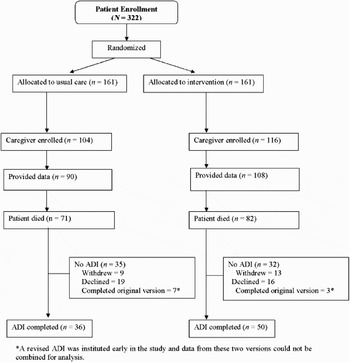
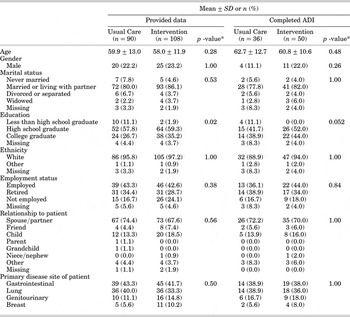
Two-hundred twenty participants from the parent study nominated a caregiver (68%). No caregiver declined enrollment, but only 198 (90%) provided any data (Figure 1). The demographic characteristics of caregivers in the intervention and control groups (N = 198) appear in Table 1. The majority of caregivers in the study were Caucasian (96%), female (77%), and the spouse or partner of the patient (71%). Caregivers of patients assigned to the intervention setting were more highly educated than caregivers of patients assigned to the usual care setting (p < 0.05). The demographic characteristics of the subset of caregivers who completed the ADI also appear in Table 1 (N = 86).
Caregiver enrollment diagram for caregiver burden measures and ADI.

Demographic characteristics of caregiver participants

*p-values from Fisher exact test for categorical variables and t-test for continuous variables.
Longitudinal Analyses of Caregiver Burden
There were no significant main effects or interactions for Time, Condition, or Patient Gender for any of the measures of caregiver burden (all ps > 0.05).
Caregiver Burden and Patient Well-Being
To further explore the relationship between patient status and caregiver burden, correlation analyses were conducted relating caregiver burden to patient's self-reported well-being. Listwise deletion of missing data was adopted so that all correlations would be based on the same participants (n = 118). Because follow-up measures at T2 and T3 suffered considerable attrition, results for these waves are not reported.
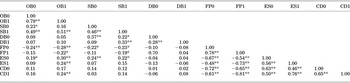
As seen in Table 2, measures of patient well-being were highly correlated both within and across measurement periods: quality of life (FACIT-Pal) was negatively correlated with symptom intensity (ESAS) and depressed mood (CES-D), whereas the latter two variables were positively correlated. In contrast, caregiver burden measures were less consistently and less highly correlated. Although objective burden was positively correlated with stress burden, it was not related to demand burden. In essence, caregivers who perceived objective sources of burden reported stress, but did not feel that the patient was inappropriately demanding. On the other hand, demand burden was positively related to stress burden: caregivers who perceived the patient was unduly demanding reported higher stress.
Correlation matrix of caregiver burden and patient quality of life, symptom intensity, and depressed mood

Listwise N=118.
*p < 0.05 (two-tailed); **p < 0.01 (two-tailed).
OB = Objective Burden, SB = Stress Burden, DB = Demand Burden, FP = FACIT-Pal, ES = ESAS, CD = CES-D.
0 = Time 0 (baseline); 1 = Time 1 (1 month follow-up).
With respect to relations between caregiver reports and patient reports, Table 2 shows that lower patient quality of life (FACIT-Pal) was related to higher caregiver reports of both objective burden and stress burden. Similarly, higher patient symptom intensity (ESAS) and depressed mood (CES-D) were related to higher caregiver reports of objective burden and stress burden, although in the case of depressed mood this relation was true only at T1. Demand burden was unrelated to patient reports of well-being. In general, then, caregivers reported more infringement on their lives and higher stress when the patient reported lower well-being, more intense symptoms, and greater depressed mood.
The same correlation analyses were conducted separately for male and female patients. These analyses showed similar patterns as those observed in Table 2, although because of the smaller number of observations in each category, statistical significance was diminished. Analyses that separated patients into those in the intervention and control settings showed similar, albeit less statistically significant patterns.
Caregiver Burden, Patient Well-Being, and Quality of Care
Each of the three measures of patient well-being (FACIT-Pal, ESAS, CES-D) and three subscales of caregiver burden at both T0 and T1 were correlated with eight measures of the quality of patients' end-of-life care, as reported by the caregiver after the patient's death. Because of missing data, pairwise deletion was adopted for all analyses. Out of 96 correlations, 5 achieved statistical significance. At T0, more problems in patient emotional and spiritual support were associated with decreased patient well-being, r(N = 37) = −0.49, p < 0.01, and decreased caregiver stress burden, r(N = 41) = −0.33, p < 0.05. In addition, more problems with symptoms at T0 were associated with decreased patient well-being, r(N = 35) = −0.45, p < 0.01. At T1, more problems with unmet patient needs were associated with increased stress burden, r(N = 74) = 0.24, p < 0.05, and more problems with respectful treatment of the patient were associated with increased demand burden, r(N = 73) = 0.23, p <.05.
DISCUSSION
Despite implementing an effective palliative care intervention for patients with advanced cancer (ENABLE II) (Bakitas et al., Reference Bakitas, Lyons and Hegel2009b), we found no evidence of a decrease in caregiver burden in the intervention condition compared to usual care. To further understand how patient status was related to caregiver burden, we found that patient quality of life (FACIT-Pal), symptom intensity (ESAS), and, to a lesser extent, depressed mood (CES-D), were positively related to objective burden and stress burden. As expected, caregivers expressed more tangible limitations and higher stress associated with caregiving when patients reported lower quality of life and more severe symptoms (Miaskowski et al., Reference Miaskowski, Kragness and Dibble1997; Beach et al., Reference Beach, Schulz and Yee2000; Fang et al., Reference Fang, Manne and Pape2001; Harding et al., Reference Harding, Higginson and Donaldson2003; Given et al., Reference Given, Wyatt and Given2004). Despite ENABLE II improving patient quality of life, symptom intensity, and depressed mood, these benefits did not appear to produce commensurate changes in any facet of caregiver burden. These findings are similar to other effective palliative care interventions for patients with cancer that failed to show improvements in caregiver outcomes (Giarelli et al., Reference Giarelli, Pisano and McCorkle2000; Kurtz et al., Reference Kurtz, Kurtz and Given2005; Clark et al., Reference Clark, Rummans and Sloan2006).
Given the dearth of significant findings in earlier caregiver interventions, these null results are not surprising, albeit disappointing. Such findings challenge the notion that interventions focused primarily on reducing patient suffering can improve caregiver outcomes (Hebert et al., Reference Hebert, Arnold and Schulz2007). These results suggest that the relation between patient status and caregiver burden is more complex than previously considered. First, it has been suggested that the association between patient status and caregiver burden is bidirectional (Nijboer et al., Reference Nijboer, Tempelaar and Sanderman1998; Fang et al., Reference Fang, Manne and Pape2001). Because many patients with cancer require daily assistance (Wolff et al., Reference Wolff, Dy and Frick2007) an overburdened caregiver will likely provide insufficient help to the patient due to their own limitations, leading to further decrements in patient quality of life. This decline may, in turn, increase caregiver burden (Nijboer et al., Reference Nijboer, Tempelaar and Sanderman1998). In addition, the majority of caregivers are patients' partners (Wolff et al., Reference Wolff, Dy and Frick2007), many of whom are experiencing their own physical limitations and medical problems prior to their partner's cancer diagnosis, which can exacerbate the ill effects of caregiving (Jepson et al., Reference Jepson, McCorkle and Adler1999; Giarelli et al., Reference Giarelli, Pisano and McCorkle2000). Second, because caregivers are often caring for end-of-life patients, they may fail to perceive the benefits of a patient-centered intervention. What researchers define as patient “improvements” are often compared to a control group, and at an individual level may actually be stabilization or a slower decline in health. Although interventions that produce these effects are important for patients, these differences may be lost on caregivers who cannot see patient status at the group level.
Further analyses involving caregivers' after-death reports of patients' care help explain factors in palliative care associated with caregiver burden. Patient's unmet needs at end of life were associated with higher caregiver stress burden and problems with respectful treatment toward the patient were associated with higher caregiver demand burden. These results suggest that practitioners' conduct toward patients may influence caregiver burden, and both results highlight areas that future palliative care interventions should address. Improvements in patient care may better serve both patients with cancer and their caregivers.
Another facet of caregiving that is often ignored in research is the perceived benefits of caregiving (Nijboer et al., Reference Nijboer, Tempelaar and Sanderman1998). In a national survey, end-of-life caregivers reported significant physical, emotional, and financial strains associated with caregiving, but >60% also indicated that caregiving is a rewarding experience (Wolff et al., Reference Wolff, Dy and Frick2007). In fact, increased help provided to one's spouse has been related to decreases in anxiety and depression (Beach et al., Reference Beach, Schulz and Yee2000). Additional research has shown that caregiver interventions can increase “uplifts” associated with caregiving (d = 0.15) (Sörenson et al., Reference Sörenson, Pinquart and Duberstein2002), and a meta-analysis of 228 studies showed that these “uplifts” are negatively associated with caregiver burden and depression (rs = −0.16 and −0.17, respectively) (Pinquart & Sörenson, Reference Pinquart and Sörenson2003b). These results suggest that by conceptualizing the health effects of caregiving as a bidimensional construct, rather than a unipolar scale ranging from “bad” to “worse,” researchers may better understand why multiple well-designed interventions have failed to affect caregiver burden and how to improve those processes in the future. Future research should measure both the negative and positive effects of caregiving, and interventions should simultaneously attempt to alleviate the bad while accentuating the good (Hudson et al., Reference Hudson, Aranda and Hayman-White2005).
Several limitations to our study must be noted. First, patients in the study were not required to provide the name of a caregiver. This recruitment procedure may have created a selection bias in which caregivers in the study were somehow different from those caregivers potentially omitted. Second, caregivers were provided the opportunity to be involved with patients' intervention sessions, but were not required to do so; therefore, the experience of caregivers in the intervention condition likely varied by their level of involvement. Third, the majority of caregivers were White females from rural New England, which calls into question the generalizability of these findings. Fourth, participant attrition limited our ability to study the effects of the intervention on caregiver outcomes past 4 months. Finally, caregivers' after-death reports in the current study focused solely on patients' quality of care, not on their own experiences. Although no significant effect of the intervention on caregiver burden was found, these caregivers may have shown faster improvements in mental health in the bereavement phase (Braun et al., Reference Braun, Mikulincer and Rydall2007).
The current study provides evidence that reducing caregiver burden requires more than just improving patient outcomes. Our results suggest that caregivers, along with patients, require specialized interventions to ease the physical and emotional strains that come with caregiving. In particular, future interventions should investigate treating caregivers and patients as a dyad whose health outcomes are inextricably linked. Such interventions will require well-designed RCTs to determine their feasibility and effectiveness in a palliative care setting. Future work should consider the pre-existing limitations of older caregivers (Jepson et al., Reference Jepson, McCorkle and Adler1999) and measure caregiver outcomes for longer durations in order to determine whether the intervention results in delayed positive effects (Kurtz et al., Reference Kurtz, Kurtz and Given2005). In addition, aside from the obvious patient benefits that result when the patient's needs are met and the patient is treated with respect, such care may mitigate undue burden for caregivers. Such steps should help develop evidence-based programs to improve the health of those helping others cope with cancer.
ACKNOWLEDGMENTS
This study was supported by National Cancer Institute grant R01 CA101704. We thank the study participants and oncology clinicians from the Section of Hematology/Oncology, outreach clinics, and VA Medical Center for their cooperation with the conduct of this study (all without payment). We also thank Ira Byock, M.D., Director, and the Palliative Care Team, Section of Palliative Medicine; Daphne Ellis, A.S., Julie Wolf, R.N., Luann E. Graves, B.S., M.T., C.C.R.P., and Linda Eickhoff, M.S., who provided recruitment, data collection, and data management as funded research coordinators; Kathleen Barnett, M.A., A.P.R.N. and Elizabeth McKinstry, M.S., R.N. who delivered the intervention; and Tor Tosteson, Sc.D., for consultation with statistical analyses.