For James Tyler (1940–2010)–beloved mentor and friend–
Io non sò, Donne mie, s'un si gran mostro
E' miracol d'Amore, ò s'egli e' vostro.
[I do not know, my ladies, if such a great thing / Is a miracle of love, or if it is your doing.]
Thus sang Cleopatra to the female members of her audience in March 1558, making explicit the connection between her appearance on the stage and the noblewomens' sponsorship, which metaphorically brought the Egyptian queen back to life. As patron, Maria d'Aragona, the Marchesa of Vasto (1503–68), had indeed ‘made this [performance] happen’ at her palazzo in Chiaia, Naples, with the assistance of members of her extended family, including a number of her female relatives. The appearance of the historical figure of Cleopatra was the centrepiece of the musico-theatrical part of the entertainment, an event sponsored by d'Aragona to honour the Duchess of Alba, Maria of Toledo, wife of the outgoing viceroy of Naples.Footnote 1 ‘Queen Cleopatra on her Ship’ was the third and most elaborate of four intermedi performed between the acts of a comedy – Alessandro Piccolomini's Alessandro – chosen by d'Aragona for the occasion. According to the descrizione, Cleopatra's ship drew up in front of ‘those ladies' – presumably Maria d'Aragona and the Duchess of Alba – and the renowned Neapolitan virtuosa Eufemia Jozola, cast as Cleopatra, directly addressed the women in the audience.Footnote 2
This moment in the intermedio has been given considerable musicological attention because of a phrase in the descrizione discussing Jozola's vocal style that appears to presage the earliest operas: ‘Cleopatra raised herself to her feet and delivered the stanzas in a manner half-way between singing and reciting’.Footnote 3 While I will look again at the significance of this description, in this article I want to see both Jozola and Cleopatra in a larger context, considering d'Aragona's entertainment – with ‘Queen Cleopatra on her Ship’ at the centre – in the context of the Marchioness's patronage within a female-dominated milieu. As we will see, the Cleopatra intermedio articulated the importance of establishing supportive relationships among noblewomen, reflecting d’Aragona's experience of female socio-cultural networks. Indeed, d'Aragona's status as widow (and as one who moved among an elite coterie of other widows) gave her the freedom to choose a female exemplum – Queen Cleopatra – that, as I will show, in other contexts and media proved highly problematic. This article thus contributes to a growing body of literature that demonstrates the close relationship between marital status and styles of patronage employed by noblewomen.Footnote 4 As d'Aragona's is one of the earliest female-sponsored musico-theatrical entertainments for which substantial documentation survives, it opens a window onto the kinds of social and artistic licence a noblewoman could take in the mid-Cinquecento, given favourable circumstances.
Sources and personnel
Information regarding d'Aragona's entertainment is contained in a number of sources. A 1577 anthology, Aeri racolti insieme con altri bellissimi aggionti di diversi dove si cantano Sonetti, Stanze, & Terze Rime, collected by the Neapolitan composer and organist Rocco Rodio, holds a skeletal version of the song that Cleopatra apparently sang from her ship. Only two of Cleopatra's ten stanze, written by the poet Luigi Tansillo, are included in this publication, and both stanze appear to be corrupt. The printed descrizione of the Neapolitan entertainment (now housed in the Vatican Library) is of central importance.Footnote 5 It is worth describing this source in some detail, as its significance has not previously been appreciated by musicologists, who appear to have known it only for its prose descriptions. Although titled ‘Stanze di Luigi Tansillo’, the publication includes both a prose description for each intermedio and Tansillo's stanzas that were sung or recited during the intermedi.Footnote 6 The title-page of the descrizione states that Tansillo's stanzas were ‘composed for the intermedi of the comedy recited in the house of the most illustrious and most excellent Signora Marchioness of Vasto to the delight of the most illustrious and most excellent Signora Duchess of Alba’.Footnote 7 The Neapolitan bookseller Marc'Antonio Passero organised the publication of the descrizione; it is possible that he also wrote the prose descriptions of the intermedi interspersed between Tansillo's stanze (and thus was eyewitness to the spectacle), although internal evidence in the publication could indicate that the descriptions were provided to him by another (unnamed) source.Footnote 8
At the opening of his address to the reader, Passero articulates d'Aragona's role as patron and initiator of the entertainment more explicitly, and hints at her motives:
Know, my very sweet reader, that the Signora Marchioness of Vasto – ornament not only of Italy but of [all] the world – desiring to give some pleasure to the Signora Duchess of Alba, offered her [the opportunity] to hear and see one of our [Neapolitan] comedies presented with its theatre, its stage, and its lights, and with all the circumstances used by the ancients and in use in this age.Footnote 9
In the descrizione itself we are told that
the set [apparato] and the comedy were the undertaking of the Signora Marchioness [of Vasto], both of which it appeared she organised, as they say of Virgil, through the art of necromancy: [so] that from the day the comedy was proposed to the day it was represented it did not take a month.Footnote 10
Despite some ambiguity surrounding the use of the word ‘apparato’ in this context – which could either mean ‘set/s' (and here one would assume the author refers to those of the intermedi) or more generically ‘prepared festivity’,Footnote 11 it seems reasonable to suggest that the Marchioness had overall responsibility for the intermedi – a point I take up below, and which is especially significant in light of the centrality of the Cleopatra intermedio. Indeed, given the Marchioness's temperament – she was nicknamed ‘la Draga’ (the dragon) because of the ferocity with which she exercised power over those around herFootnote 12 – it is probable that she took a very active role in preparations. She was also responsible for choosing and organising Piccolomini's comedy, Alessandro. As was often the case, the play was excluded from the descrizione because it was available elsewhere, and the descrizione does not discuss its dramatic content. However, given the importance of the play as the unifying thread in the entertainment, I will briefly discuss it here in order to foreground the way in which the comedy contributed to the female-centred trajectory of the entertainment as a whole.
Piccolomini's Alessandro was written in 1544 for members and guests of the Sienese Accademia degli Intronati, and was revived by d'Aragona for her 1558 Neapolitan entertainment. In the Sienese performance, the anticipated presence of noblewomen in the audience appears to have influenced the nature of the play's subject matter and led to the dominance of female characters.Footnote 13 The incorporation of cross-dressing provided further opportunities for female characters as it served, as Rita Belladonna has suggested, ‘the purpose of enlarging the heroine's sphere of action by transferring her into a previously inaccessible world of male adventure’.Footnote 14 In Alessandro, disguise also allows the heroine, Lucrezia, to express her same-sex passion for ‘Lampridia’ who is in fact a cross-dressed male character, Aloisio. In addition, Niccoletta, a bawd, enriches the Lucrezia–Lampridia plot when her call for sensual pleasure for women is addressed to Lampridia. Though Lampridia is ultimately revealed to be male, the sexual ambiguity that leads to the expression of same-sex passion between women is thought-provoking when considered in the context of the Neapolitan performance. It is, of course, highly unlikely that one could produce ‘hard’ evidence indicating homoerotic attraction between noblewomen in d’Aragona's circle, as it is in general during this period. However, that women (as well as men) might enjoy watching same-sex passion enacted within the confines of a theatrical context at this time is an issue addressed in a number of recent studies.Footnote 15 Maria d'Aragona's decision to feature a comedy foregrounding homoerotic overtones as the unifying thread of her entertainment speaks, at the very least, to her interest in women ‘playing’ with traditional boundaries. As will later become clear, the pleasure women derived from viewing other women – whether homoerotic overtones were present or not – is a central trope in the Cleopatra intermedio. For now, however, we will consider how Maria's interest in pushing boundaries in the theatrical sphere mirrored, to some degree, the contours of her own life, and was enabled by her status as a widow who had strong female role models and much familial support.
In order fully to appreciate how the Cleopatra intermedio resonated with d'Aragona's personal circumstances we need first to examine the intermedio's exceptional nature as compared with the other interludes, a process that in turn reveals just how much the various members of d'Aragona's circle were involved in the production of this particular piece. Cleopatra's scene is described in far more detail than the other intermedi in the descrizione. Her intermedio was the most elaborate of the four presented with regard to its set, props, costumes, the number of performers involved, and the incorporation of professional musicians. As such, it was probably the most time-consuming of the four intermedi to produce. Well-known musicians performed the four principal roles, and Cleopatra was the focus of the scene both aurally and visually, a point to which I will return. Before Cleopatra's ship appeared, ‘six of Cleopatra's ladies-in-waiting came with fragrances in their hands, perfuming the banks of the river’.Footnote 16 The ladies-in-waiting are not identified in the descrizione; however, the three daughters of Garzia of Toledo – Maria d'Aragona's grand nieces – are described as positioned atop one of the numerous marine monsters that surrounded Cleopatra's ship. The three sisters were ‘pretending to be the three Graces or, rather, represented them dutifully, because they indeed are so, and especially the first born’.Footnote 17 In addition, we learn of the behind-the-scenes involvement in this intermedio of d'Aragona's niece Signora Vittoria Colonna of Toledo, namesake of the renowned poet, who ‘spent a lot of effort so that [this scene] would turn out well’. According to the descrizione, Colonna was especially involved with the preparation of the richly decorated costumes in Egyptian style.Footnote 18 The intermedio thus seems to have been significant in terms of the involvement of a number of d'Aragona's female relatives.
Given the on- and off-stage involvement of women related to d'Aragona in this intermedio in particular, it is perhaps not surprising that d'Aragona chose a female singer for the central role of Cleopatra. More typically, of course, cross-dressed men or boys performed women's roles during the sixteenth century, the question of verisimilitude in terms of casting not usually being of concern; indeed in the first intermedio of the evening a young boy played the female character of Dawn. D'Aragona had a number of accomplished male singers at her disposal that she might have cast as Cleopatra (some named below); that she chose Eufemia Jozola reinforces the female-orientated nature of the intermedio. Jozola was renowned as a singer in Neapolitan and Roman circles, and was no doubt well known to the close-knit community that witnessed and participated in the performance. Numerous contemporaneous poets sang Jozola's praises including the Florentine Laura Battifera (1523–89) who describes the singer as ‘the pride of Naples'.Footnote 19 In his frequently cited Roman treatise of 1628, Vincenzo Giustiniani positions Jozola among four southern Italian singers who were foundational in the development of a new style of florid singing that only found its way into printed form later in the century.Footnote 20 Giustiniani's mention of Jozola some seventy years after her flourishing indicates her fame and suggests that her participation would not have gone unnoticed.Footnote 21
The descrizione also mentions the male musicians involved in Cleopatra's intermedio, including Scipione delle Palle (who played Proteus) and Giovanni Leonardo dell'Arpa (who played a servant of Mark Anthony).Footnote 22Descrizioni frequently omit the names of performers, focusing instead on the significance of particular historical or mythological roles, and on visual delights in general, so the descrizione is unusual (and valuable) in this regard. Despite the renown of both Palle and dell'Arpa – they were known for their performances in Naples as actors and singers, and dell'Arpa was a master player of the double harp – their function as musicians was subsidiary to that of Jozola.Footnote 23 We are not given specific information aside from their character designations, though we can assume that as musicians they probably accompanied Jozola's singing, and sang themselves in the apparently less noteworthy ensemble numbers.Footnote 24 Jozola was the only singer featured as a soloist in the entire entertainment.Footnote 25
Another unique feature of the Cleopatra intermedio is the fact that it was the only one in the set to draw on historical subject matter. The opening and closing intermedi were, respectively, ‘The Chariot of Dawn’ and ‘The Chariot of Night’. The principal performer in each of these intermedi was a young male noble, neither of whom appears to have been a close relative of the Marchioness. Dawn – a female deity – was recited by ‘a son of the Signor Count of Lauro, a boy of skill and memory, and of wonderful quickness'.Footnote 26 ‘Lelio Grisone, little nephew of the Pope, [and] a little older than him who played Dawn’, represented Night.Footnote 27 Unlike Jozola, neither of the two noble performers apparently sang their stanze, despite the use of the term ‘recitato’ in the descrizione.Footnote 28 Although ‘recitato’ does not preclude the possibility of a type of musical recitation, in the case of Jozola's performance the author is very careful to specify that she delivered the stanze in a manner ‘half-way between singing and reciting’, suggesting that the word ‘recitare’ is used for the other intermedi to specify speech rather than a style of singing. In the intermedio of the ‘savage men, centaurs, and bears' that followed Act II, ‘no sound but that of drums and trumpets was heard’.Footnote 29 There are neither stanze nor a prose description for this intermedio, suggesting, in conjunction with the specified instrumentation, that it was probably performed as a battle dance.
A less obvious distinction between ‘Cleopatra on her Ship’ and the two (other) intermedi with stanze concerns the nature of their texts and their function in relation to the entertainment as a whole. As the opening and closing numbers of the set, the interludes for Dawn and Night have an obvious thematic connection, marking the passage of time from the beginning to the end of Piccolomini's comedy.Footnote 30 ‘The Chariot of Dawn’ was a direct homage to the Duchess of Alba; the stanzas recited by Night, while initially addressed to the women of the audience, end by way of reference to the ‘beautiful women’ and ‘lords’ of the audience, thereby acknowledging the presence of men as well as women in the audience. The text declaimed by Cleopatra, on the other hand, is characterised by its singular focus on the female members of the audience, and frequent appeals to them as a group. It is this dimension of Cleopatra's stanze to which I will presently return.
While the descrizione has indicated Maria d'Aragona's authoritative role as patron and ultimate theatrical arbiter, it should be remembered that intermedi were multi-media events requiring the expertise and participation of a range of ‘actors' in order to bring them to fruition. In d'Aragona's entertainment, special responsibility was given to two younger male members of her immediate and extended family for the intermedi. Of the four intermedi presented, the ‘plots' and the production of ‘The Chariot of Dawn’ and ‘The Chariot of Night’ were assigned to d'Aragona's son Inico d'Avalos, while her nephew Garzia of Toledo was charged with creating ‘Cleopatra on her Ship’ and the intermedio involving the ‘savage men, centaurs and bears'.Footnote 31 As previously mentioned, Vittoria Colonna of Toledo, Maria's niece, was specifically engaged with the Cleopatra intermedio.
D'Aragona's team did not comprise only of family members, however, and there are hints that the role of professionals in an enterprise run by someone of d'Aragona's dragonish personality was not always easy. As we have seen, the Marchioness hired Luigi Tansillo (1510–68) – a poet whom she had intermittently sponsored over a period of some thirty years at the time of the entertainment's staging – to pen the stanze for Cleopatra's intermedio. But because audiences of court intermedi typically identified the protagonist with an entertainment's patron, d'Aragona and her representatives (for example Garzia of Toledo) would have at the very least vetted, if not substantially influenced, Tansillo's characterisation of Cleopatra. There is evidence to suggest that Tansillo may not have been entirely happy with the oversight he received during his work on the stanze. In the descrizione's dedication to Tansillo, Passero directs the following remarks to his friend:
I stirred myself to do this [publish the stanze] in order to restore both your reputation and your effort. Regarding your reputation, [I did this] because, even though you are not generous with your compositions to those that want them . . . nevertheless these Stanze are already in the hands of others, because those who have recited them have made copies for many people. And even though you would be happy if these [stanze] disappeared from the memory of men, not only from their eyes – because they are rhymes composed by you at the request of others, and almost as if you had improvised them so that they would only be useful at that time [during the performance] and everyone [present] could hear them – [but also] so that they would not circulate in the world and be preserved.Footnote 32
In part as justification for his initiative to print Tansillo's poetry without the poet's permission, Passero goes on to note that not only are Tansillo's stanze circulating, but they are circulating in corrupt versions.Footnote 33 Passero's dedication raises a number of issues regarding the status of authorship in relation to the ephemerality of sixteenth-century musico-theatrical performance, and seems to highlight tensions amongst the team producing the intermedi. Because Tansillo's stanze were commissioned for a specific occasion Passero suggests he would rather his work were forgotten, as the intervention of d'Aragona and others in the poet's creative process apparently compromised his authoritative and singular position as author. Tansillo, Passero implies, was of the opinion that the stanze should only be judged according to their utility within the specific performance context for which they were written. Passero's remarks on Tansillo's behalf speak to the very essence of the court intermedio. If intermedi involved ‘actors' with a range of skills, these skills needed to be put to use in a collaborative fashion, but ultimately intermedi could not take place without a patron's initiative, financial resources, artistic contacts, and so on. It was the sponsor – in this case, Maria d'Aragona – who guided both the entertainment's larger trajectory and more specific features of the entertainment that concerned her. Despite Tansillo's apparent annoyance that his compromised stanze were preserved, men of letters relied for their livelihood on the kinds of sponsorship that patrons such as d'Aragona could offer them. In turn, as we have seen, d’Aragona herself relied on a broader network of associations, particularly familial ones that provided a community and support for her own artistic endeavours.
The d'Aragona–Colonna circle
While the descrizione indicates the extent of familial and noble involvement in the 1558 entertainment, the particular significance of the Cleopatra intermedio in terms of gender politics can be illuminated by developing an understanding of the cultural, social, political and religious circles of which d'Aragona was part. Maria and her sister Giovanna d'Aragona (1502–77) were born and raised in the castle on the island of Ischia where their parents and other members of the Aragonese court took refuge when Naples fell to the French army.Footnote 34 In 1503, the year of Maria d'Aragona's birth, the widowed Costanza d'Avalos (1460–1541) assumed regency over the island, and in that same year d'Avalos took up arms against the French, leading an army of Italian and Aragonese soldiers when Ischia was subjected to a four-month siege.Footnote 35 Notwithstanding her military engagements, d'Avalos cultivated a vibrant and distinguished court at Ischia, gathering together a circle of men of letters that included poets such as Luigi Tansillo, Bernardo Tasso, Antonio Minturno and Jacopo Sannazaro for the discussion and reading of new literary works. (It was at Ischia that Maria d'Aragona first met these literary men, whom she herself would later patronise.) Significantly, d'Avalos joined forces with her niece, the poet Vittoria Colonna (1490–1547), to co-host and direct these salons.Footnote 36 While d'Avalos controlled the domestic, diplomatic, political and military affairs associated with courtly life, together these two women orchestrated the literary and cultural aspects of life in the castello.Footnote 37 It was within this matriarchal environment that d'Aragona was raised, witnessing women's social and political influence, with her own artistic proclivities nurtured within the context of the Colonna–d'Avalos literary salons. Colonna and d'Avalos were conscious of their relatively autonomous positions, and Colonna went on to assert her importance as a leader and role model for other women, especially after the death of her husband in 1525.Footnote 38 It is no coincidence that writers such as Bernardo Tasso depicted Ischia as an island governed by a female elite, not unlike the elite female guardians in Plato's Republic, a work no doubt known to the Ischia women (although it seems they did not know Christine de Pizan's Le Livre de la Cité des Dames [The Book of the City of Ladies] of 1405).Footnote 39
In 1523, d'Aragona married d'Avalos's grand nephew – also born on Ischia – the warrior-poet Alfonso d'Avalos, Marchese of Vasto (1502–46).Footnote 40 Like many of the noblemen in the d'Avalos–Colonna orbit, Alfonso was in the service of Charles V, and therefore frequently absent. Also, the marriage appears not to have been a happy one, although it was sustained in name until Alfonso's death in 1546. Following in the footsteps of d'Avalos and Colonna, d'Aragona remained a widow after Alfonso's death. D'Aragona's sister, Giovanna, on the other hand, chose to abandon her husband Ascanio Colonna well before his eventual demise in a Neapolitan prison. At various times, the d'Aragona sisters set up house together, maintaining close contact with Vittoria Colonna, and other like-minded noblewomen, including Giulia Gonzaga Colonna (1513–66). Described as something of a self-styled Amazon due to her independent nature and relative autonomy from men (she was widowed at the age of fifteen but retained the family's capital), Giulia Gonzaga, like d'Avalos, was apt to engage in dangerous escapades, which she embellished upon for popular consumption, thus promoting her abilities to escape (male) enemy combatants through daring equestrian exploits.Footnote 41
The group of women discussed here, that I have loosely described as the d'Aragona–Colonna circle – Maria d'Aragona, Giovanna d'Aragona, Vittoria Colonna and Giulia Gonzaga Colonna – were all related by marriage and it was the strength of the bonds created through their female-centred community that accounts, in part, for the degree of power and autonomy they were able – and chose – to exercise. Indeed, the model of female autonomy exemplified by the figure of Costanza d'Avalos that the younger women witnessed first hand on Ischia should not be underestimated.Footnote 42 This is not to suggest that they did not also rely on male relatives, or arrange dynastically favourable marriages for their own children; the d'Aragona sisters were particularly adept at the latter.Footnote 43 But following the model of d'Avalos's Ischia salon, this close-knit group of noblewomen led a series of salonsFootnote 44 that attracted leading literary and musical figures,Footnote 45 while they themselves remained relatively unhampered by the demands of matrimony or oversight by other male relatives.
Their shared status as widows (and what this actually meant in terms of social and financial autonomy) is important to understand because it sheds light on the ways in which these southern noblewomen could undertake creative and artistic endeavours – such as the 1558 intermedi – that were unavailable to other noblewomen. (The state of widowhood itself may have prompted d'Aragona's specific choice of the historical figure of Cleopatra for the central intermedio, a point to which I will return.) Widows were not a monolithic group, of course; considerations ranging from the more general – social class and age, for example – to more specific variables related to regional and familial associations intersected in ways that made each widow's situation somewhat distinctive, even among the d'Aragona–Colonna circle.
In some cases permanent widowhood was, in effect, imposed upon women as a way of preserving patrimony. Giulia Gonzaga Colonna's situation is a case in point. After the death of her husband, Giulia Gonzaga, then fifteen years of age, was willed sole heir of his estate and titles, but only on the condition that she remain a widow.Footnote 46 Such stipulations were designed to ensure that a late husband's financial assets stayed in the family.Footnote 47 It is more difficult to account for the seemingly audacious actions of Giovanna d'Aragona who, after the birth of her sixth child, left her husband with children in tow and retreated to the castello on Ischia. She refused the attempts of those who tried to reconcile her with her husband in much the same way that Vittoria Colonna resisted attempts by family members urging her to remarry after her husband's early death. Maria d'Aragona also chose not to remarry; she was forty-three years of age at the time of Alfonso's death, though not without suitors.Footnote 48 Although we do not know the exact details of these noblewomen's financial situations, what we know of their lives indicates that they were financially independent. P. Renée Baernstein has laid out some of the advantages of widowhood:
To describe the situation from the woman's point of view, widowhood, for the propertied, could be a window of opportunity; it was a crisis point, yes, but one that might with luck and enterprise be turned to the widow's advantage. If she had young children, she might remain head of a household of her own . . . She might live out her life on her own, or she might join together with like-minded women in an informal gathering or household. She might enter a convent, with or without taking religious vows.Footnote 49
Particular noblewomen could clearly make choices about whether to capitalise (or not) on the opportunities made possible through the state of widowhood. The various possibilities outlined by Baernstein, particularly those involving communal living, were in fact the options that were most appealing to the d'Aragona–Colonna noblewomen. As we have noted, the d'Aragona sisters set up house together on a number of occasions,Footnote 50 and both Giulia Gonzaga and Vittoria Colonna were attached to notable convents, not as professed nuns, but as lay widows.Footnote 51 Giulia Gonzaga, together with her sizable household, spent almost her entire widowhood in Naples living in a convent of Saint Clare nuns, assuming the role of the convent's treasurer, while Vittoria Colonna maintained a more mobile residency, travelling between convents (particularly in Rome and Viterbo) with some regularity. As Diana Robin notes: ‘Once settled in their convent lodgings, [Vittoria] Colonna and [Giulia] Gonzaga came, went, and received guests as they pleased’; ‘in return, they contributed generously to the daily upkeep of the establishment’.Footnote 52 The other advantage of the convent, particularly for these elite noblewomen, was that it provided an environment for a movable salon.
Aside from their shared status as widows, the d'Aragona–Colonna women were all deeply involved in what has been variously described as the religious reform or evangelist movement in Italy. Indeed, behavioural manuals had long touted the avoidance of second marriages for widows, who were then available (or free) to pursue religious or pious works. The four d'Aragona–Colonna women, along with their mentor Costanza d'Avalos, were among the first to join the spirituali movement led by the Spanish theologian Juan de Valdés upon his arrival in Naples in 1536, and they became his core group of supporters.Footnote 53 As Baernstein has suggested: ‘Through a life of piety, the widow might find a respectable stage on which to play, a congenial institution that offered financial and emotional support, and a suitable outlet for her energy and money.’Footnote 54 Further, association with a convent could assuage doubts about a widow's honour. Yet the support that the d'Aragona–Colonna women offered to radical theologians such as Valdés and Bernardino Ochino frequently placed them in direct opposition to papal authority. Their pro-Spanish interests, along with their promotion of the reform teachings of Valdés and Ochino, became especially risky with the ascent of Paul IV (Gian Pietro Carafa) in 1555, who virulently persecuted even those with only tangential connections to reform efforts. The books of Valdés and Ochino had already been banned as heresies six years prior to Carafa's investiture as pope. Thus, these women's beliefs and behaviour demonstrated independence of mind, spirit and action, placing them, at times, in life-threatening situations.Footnote 55 In short, the social, intellectual and spiritual circles that these noblewomen maintained fostered their own support networks, facilitating opportunities for creative endeavours such as d’Aragona's 1558 entertainment. They also set an example for the next generation of d'Aragona–Colonna women, some of whom were involved in or attended the 1558 performance. How Cleopatra, as the figure at the centre of this entertainment, played into its exemplary role is the question to which we will now turn.
Which Cleopatra?
As the subject of a musico-theatrical entertainment sponsored by one noblewoman for another, Cleopatra may seem a somewhat unusual choice: classical sources had transmitted a predominantly negative view of her, particularly with regard to sexual indiscretion. If one considers, for example, the entertainments sponsored by (widowed) female rulers such as Catherine de' Medici later in the sixteenth century, or Archduchess Maria Magdalena early in the next, one does not find Cleopatra.Footnote 56 Chastity and virginity were attributes commonly emphasised by female monarchs to legitimise their rule, but one could hardly associate these virtues with the figure of Cleopatra. One is also unlikely to find a Cleopatra among the personages that populate large-scale court intermedi produced during this period for royal weddings. Consider the many intermedi produced at the Florentine court: one can hardly imagine ‘Cleopatra on her Ship’ providing an appropriate resonance for a royal bride-to-be. Love – or for that matter lust – was not part of the social contract that governed the arrangement of noble marriages. And Cleopatra could hardly have represented an acquiescent royal bride or ‘vergine gentil’ (noble virgin) as the Florentine court would dub their new duchess, Christine of Lorraine, during the Medici wedding festivities of 1589.Footnote 57 With the risk of identification between a presumed virginal bride and a worldly Cleopatra, it is unlikely that the Egyptian queen would have been a personage of choice for public wedding celebrations intended to solidify dynastic alliances. Rather, if ‘suspect’ women were included in such entertainments their appearance was typically intended to function in a cautionary capacity, as the undesirable antithesis of the noble virgin.Footnote 58
Yet neither d'Aragona nor the other noblewomen in her circle were in a position that required carefully crafted official imagery to emphasise the virtue of chastity. Their well-known religious affiliations probably went some way towards ensuring there were no doubts in this regard. In any case, the 1558 performance was a private one, sponsored by d'Aragona for the pleasure of her friend the Duchess of Alba, not for the purpose of securing high-stakes political alliances. Perhaps for this reason, the figure of Cleopatra was cast in a positive light and female audience members were actively encouraged, as was typical for intermedi in general, to draw parallels between themselves and her. It is therefore important to understand how the historical figure of Cleopatra was posited, within these specific circumstances, as a positive role model for noblewomen.
The tendency to draw on an episode from the life of a well-known figure to exemplify a positive attribute – for example, Cleopatra's willingness to commit suicide with the asps rather than be paraded in Rome as Caesar Augustus's captiveFootnote 59 – speaks to broader issues regarding the treatment of exemplary pagan women, described by Mary Hamer in relation to the Egyptian queen as ‘the uses of Cleopatra’ (italics mine).Footnote 60 Written commentaries on Cleopatra probably known to d'Aragona and her circle – Plutarch's Lives and the various pre-1558 editions of Giuseppe Betussi's translation of Boccaccio's On Famous Women – portray her with few positive attributes. Boccaccio emphasises her lust and cruelty, although Plutarch's reading is somewhat more sympathetic.Footnote 61 In less well-known and non-literary sources, however, Cleopatra became a far more malleable and ambivalent figure, a feature that is characteristic of pagan exemplary women in general.Footnote 62 As Paola Tinagli has shown, visual representations of famous women were often more open to interpretation than written texts: a subject could carry very different meanings depending on its location or the function of the room in which it was placed, for example.Footnote 63 By the same token, the contexts of musico-theatrical performance changed the kinds of associations that spectators were expected to make between those on and those off the stage.
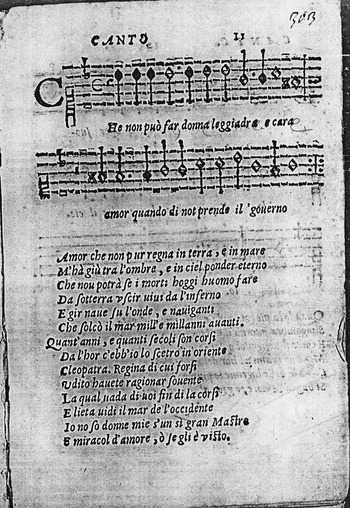
With this interpretative background in mind, we can now examine more closely the function and significance of the stanzas for Cleopatra's intermedio. Cleopatra's song as it appears in Rodio's 1577 anthology consists of just two musical phrases set to two versi; this musical formula was intended to be used for the remaining six versi in ottava rima of each stanza (see Fig. 1). Thus, for each stanza the music was sung four times, and the two musical phrases would then have provided a basis for the remaining nine stanzas in the 1558 performance. Both stanzas, as presented by Rodio, appear to be corrupt versions, obscuring the meaning that emerged in the context of the 1558 performance, in which Cleopatra specifically addresses her female audience and posits connections through gender and social standing between herself and her noblewomen spectator-auditors. For example, in Cleopatra's opening versi from the descrizione – which establish the song's central theme – the singer begins by deferring to and identifying with the ladies in the audience:
Che non puo far, Donne leggiadre et care,
Amor, quando di noi prende il governo,
[What is love not able to do, beautiful and sweet ladies / When it takes hold of us?]
‘Che non puo far, Donne leggiadre et care’, from Aeri racolti insieme con altri bellissimi aggionti di diversi dove si cantano Sonetti, Stanze, & Terze Rime, canto partbook, 11.

The sense of identification is almost completely lost in Rodio's version, which refers to a ‘donna’ (woman) rather than ‘women’ (see Fig. 1). The last pair of lines in the second stanza of Rodio's print also makes little sense either grammatically or contextually (see Fig. 1). As the versi in the descrizione make clear, the second stanza's concluding distich is yet another reference to the connection between Cleopatra and the ladies of the audience:
Io non sò, Donne mie, s'un si gran mostro
E' miracol d'Amore, ò s'egli e' vostro.
[I do not know, my ladies, if such a great thing / Is a miracle of love, or if it is your doing.]
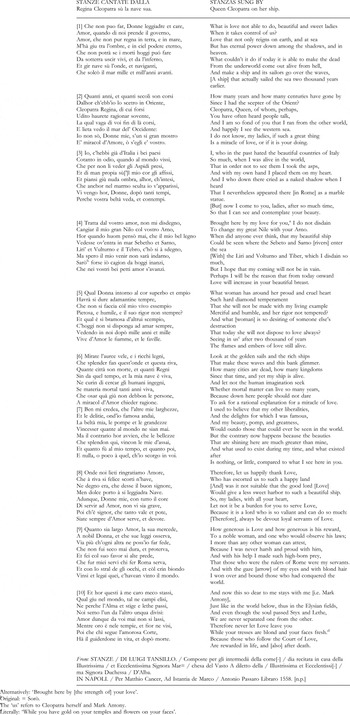
Implicit in the final phrase is a reference to the patronage of the female audience members; thus the translation in context could be more explicitly rendered as: ‘if it is you [who have made this happen]’, as I suggested at the opening of this essay. Thus Cleopatra establishes a relationship between her instantiation in this intermedio and her female audience members. Within this framework, the enduring love between Mark Antony and Cleopatra is also asserted, especially in stanzas five and ten (see the Appendix), but it is the connection between women, I argue, that provides the overarching backdrop for the intermedio. This connection was quite deliberately constructed by Tansillo (whether coerced or otherwise), and was rich in its resonances, particularly given the more usual ways of representing Cleopatra at this time.
It is of some note that the Neapolitan Cleopatra was not presented in, nor does she extensively embellish upon, either of the two contexts with which she was most closely identified in ‘famous women’ literature: her self-induced death with the asps or her infamous banquet with Mark Antony. The latter was an important (although negatively portrayed) episode in Boccaccio's narrative, transmitted primarily through Giuseppe Betussi's Italian translation, which d'Aragona undoubtedly knew.Footnote 64 At the banquet, Cleopatra boasts to Antony that ‘she could spend ten million sesterces on a single dinner . . . [even though] Antony thought this was impossible’, but she proceeded to do so by dissolving her pearl earring in a goblet of strong vinegar and drinking it.Footnote 65 The purpose of recounting this episode was typically to illustrate Cleopatra's insatiable appetite and the enjoyment she obtained from squandering great riches, at the same time as showing her as a clever and haughty woman who could outwit her lover.
Both Boccaccio and Plutarch write of Cleopatra's suicide, though Plutarch's reading is more extensive and (as already mentioned) sympathetic. According to Plutarch, Caesar Augustus admired Cleopatra's lofty spirit and ‘gave orders that her body should be buried with that of Antony in splendid and regal fashion’.Footnote 66 The idea of a woman whose love is stronger than death is an ancient one, and is a characteristic of other exemplary pagan women, such as Queen Artemisia. But the brief mention in Tansillo's stanze of the asps (Appendix, stanza three) alludes not to Cleopatra's undying love for Antony, but to her unwillingness to be brought back to Italy as Caesar Augustus's captive. In this stanza, the gesture speaks to Cleopatra's strength and self-determination – an erotic element is perhaps deflected by the reference to the asps at her heart, rather than breasts – and it is the opportunity to contemplate the beauty of the ladies in the audience that initiates Cleopatra's change of heart about dying. An unwillingness to be brought to Italy may also have spoken to the noblewomen's concerns about forced movement at the behest of men. The entertainment's honouree, the Duchess of Alba, whose husband had just concluded his term as viceroy of Naples, was confronting this very situation – a situation that d’Aragona herself would have understood well, having been ‘transplanted’ to Spanish-ruled Milan for a number of years when her husband became governor of the city.Footnote 67
Cleopatra's appearance on board ship appears to be loosely drawn from an episode in Plutarch's Lives, as well as another work that circulated in d'Aragona's orbit, Giulio Landi's 1551 play La vita di Cleopatra,Footnote 68 for which Anton Francesco Doni (known to musicologists especially for his Dialogo della musica) wrote the first dedication.Footnote 69 In Tansillo's stanzas the ship is the physical location where Cleopatra ‘took solace’ with Mark Antony, not to squander great riches but, presumably, to mourn their ultimate defeat by Caesar Augustus. Thus Tansillo establishes the ship as the context for their abiding and eternal love. From the outset, Tansillo's verses emphasise an elevated, unearthly, conception of a love that transcends death; as the first stanza indicates, it is the ‘eternal power’ of love that has enabled Cleopatra's reappearance (in the intermedio) 2,000 years after her death. In stanzas two to four (see the Appendix) Cleopatra is recuperated into a Western (and implicitly normative) context, and thus posited as a less threatening figure than she is in Boccaccio and Plutarch. In the second stanza an East–West dichotomy is implied, but upon Cleopatra's emergence from the underworld she herself ‘happily . . . saw the Western sea’. Her hatred of the ‘beautiful countries of Italy’ is superseded by her desire to see and be seen by the ladies of the audience, a theme that is encapsulated by the concluding couplets of the second and third stanzas: the ladies have ‘made [the performance] happen’ because they want to see Cleopatra and Cleopatra herself wishes to contemplate their beauty. Thus, in the interests of communing with the ladies of the audience, the Egyptian queen is willing to relinquish what was considered by many commentators to be one of her only virtues: her resistance to entering male-ruled, enemy territory. But she is willing to do so now not to be subjugated by a male captor, but to engage in the mutually satisfying act of being watched by and herself viewing the noblewomen in the audience.
The question of Cleopatra's potential subjugation to Caesar Augustus is still suggested by the resonances of the penultimate couplet of stanza three, but the context gives it very particular meaning:
Et piansi giùnuda ombra, alhor, ch'intesi,
Che anchor nel marmo sculta io v'apparissi,
[And I who down there [in the underworld] cried as a naked shadow when I heard / That I nevertheless appeared [in Rome] as a marble statue.]
The mention of Cleopatra's distress upon hearing that she indeed appeared in Rome, as a statue, is particularly interesting for the tensions it sets up between male and female appropriations of the Egyptian queen. Cleopatra's delight at her appearance before the women of the audience contrasts with her unhappiness at her co-option by Caesar Augustus, the latter sentiment not only referencing Cleopatra's representation in classical sources but also alluding to more recent events of which members of the d'Aragona–Colonna circle would have been aware. In several classical accounts, including, most notably, that of Plutarch, an effigy or image of Cleopatra was carried through the streets in Caesar Augustus's triumphal procession.Footnote 70 In other words, though Cleopatra herself avoided that humiliation through her suicide, Caesar Augustus symbolically claimed victory by parading her image instead. In the sixteenth century, Caesar Augustus's action was echoed when the so-called Belvedere Cleopatra, an ancient statue, was famously acquired late in the pontificate of Giuliano della Rovere who chose the papal name Julius II (r. 1503–13) in order to declare himself successor of the Julius Caesar (Gaius Julius Caesar).Footnote 71 Although Gaius Julius Caesar's grandnephew, Caesar Augustus, is remembered as the ruler who at least symbolically subjugated the real Cleopatra, it is assumed that Julius II inherited Gaius Julius Caesar's successors' conquests.Footnote 72 Thus, Hans Brunner interprets the Belvedere Cleopatra as a triumphal monument celebrating Pope Julius II as a second Julius Caesar. Further, Brunner and others have argued that the entire statue court at the Vatican represents the papacy's fulfilment of Rome's destiny.Footnote 73 No doubt d'Aragona and her coterie knew of the statue's existence, were aware of the lore surrounding it, and may have seen it first hand at the Vatican.Footnote 74
The statue was widely known in literary circles, and was the inspiration for a number of contemporary writers, including Baldassare Castiglione (1478–1539). Castiglione's poem, Cleopatra, is based on the relatively sympathetic, Plutarch-influenced line of commentary about Cleopatra – in contradistinction to Julius II's imperialist agenda – and there are notable similarities with Tansillo's stanze.Footnote 75 Among the poems inspired by the Belvedere Cleopatra, the most famous – those of Castiglione, Bernardino Baldi (1553–1617) and Agostino Favoriti (1624–82) – were engraved into the pilasters that framed the statue,Footnote 76 thereby seemingly allowing Cleopatra to speak for herself.Footnote 77 Reconsidering Tansillo's couplet with this background in mind only highlights the distinction between Cleopatra's enforced return to Rome (if only in the form of a statue) and her self-initiated return (within the context of d'Aragona's entertainment) for the purpose of communing with the ladies in the audience. The Neapolitan Cleopatra (embodied by the living, breathing, singing Jozola) is imagined within a context to which the ‘real’ Cleopatra never had access: a supportive and validating community of women.
Yet the traditional emphasis on Cleopatra as a powerful, autonomous woman with proven political ambition is by no means abandoned, as is demonstrated most strikingly by the penultimate stanza:
Et fei col suo favor si alte prede,
Che fur miei servi chi fer Roma serva,
Et con lo stral de gli occhi, et còl crin biondo
Vinsi et legai quei, c'havean vinto il mondo.
[And with his [Love's] help I made such high-born prey, / That those who were the rulers of Rome were my servants. And with the gaze of my eyes and with my blond hair / I won them over and bound those [Gaius Julius Caesar and Antony] who had conquered the world.]
The reference to Cleopatra's eyes and hair is clearly intended to suggest the power she wielded through her sexuality, although a Cleopatra imagined with blond hair is yet another trait that rehabilitates her into a Western context. Despite a brief reference to Cleopatra's beauty in stanza seven, Tansillo's verses do not dwell on her physical appearance, as was the case with many ‘readings' of Cleopatra. According to Plutarch, it was the force of her personality rather than her beauty (which he did not believe was exceptional) that accounted for Cleopatra's powerful allure, thus contributing to the apparent downfall of her male suitors. In the context of the intermedio, only Cleopatra (not her male suitor) demonstrated rhetorical eloquence; although she probably gestured to Mark Antony at the opening of the final stanza of her song, he himself remains mute.Footnote 78
Most significantly in a dramatic and musical portrayal, the presentation of a verbally eloquent Cleopatra resonated with the image of her perpetuated by Plutarch, by whom she is described as a great conversationalist:
[C]onverse with her had an irresistible charm, and her presence, combined with the persuasiveness of her discourse and the character which was somehow diffused about her behaviour towards others, had something stimulating about it. There was a sweetness also in the tones of her voice; and her tongue, like an instrument of many strings, she could readily turn to whatever language she pleased.Footnote 79
Aside from the musical connection here, Cleopatra was known to be able to speak more than seven languages. Plutarch emphasises her independence in this regard, noting that she did not need the assistance of other (presumably male) interpreters in order to converse in a variety of languages. It is implied that Cleopatra's ability to slip easily between languages is both a political and a military asset. An interesting parallel might be drawn here between d'Aragona's choice of Cleopatra, and her own leadership of literary and musical salons, not only as patron but as an active participant in a world dominated by male vocality. Further, the emphasis placed on Cleopatra's verbal eloquence could have been read as making a rather audacious statement about women's speech: performed for, and as a means of communing with her female audience, the reciprocity implicit in Cleopatra's declamation represented a model for converse by and among women. Indeed, as we have seen, the emphasis on women's relationships in the entertainment as a whole was heightened by d'Aragona's choice of Piccolomini's play, which not only highlighted converse among women, but also homoerotic attraction.
Rhetorical virtuosity: Eufemia Jozola as Queen Cleopatra
In light of Tansillo's reliance on a view of Cleopatra influenced by Plutarch, it seems fitting that the ‘action’ of the intermedio centred on her rhetorical prowess when, in the most oft-cited phrase from Passero's description, ‘Cleopatra raised herself to her feet and delivered the stanzas in a manner half-way between singing and reciting’. As I mentioned at the outset, this description of Cleopatra's singing style (as executed by Jozola), has been given considerable attention, most notably because it appears to presage the recitational style that characterised one form of monody later in the century – that associated with the earliest operas. Rodio's publication of Cleopatra's song supports this reading: the text setting is syllabic, there is a good deal of note repetition, and the range is narrow (Fig. 1).Footnote 80 In notation the style appears stilted and ‘square’, but the stanze would have been modified in performance to adhere more closely to the text's natural accentuations, heightening the relation to speech. That Jozola was an important exponent of this style has gained less attention, although John Walter Hill has touched on the issue, citing Vincenzo Giustiniani's ‘history’ of practitioners of Neapolitan and Roman singing styles, styles that ultimately made their way to northern Italy.Footnote 81 The descrizione from 1558 suggests another aspect of musical style that gives further indication of Cleopatra's (Jozola's) vocal dexterity:
Inside the ship [were] Cleopatra and Marco Antonio, and the ladies of Cleopatra and the servants of Marco Antonio, richly dressed in Egyptian style and dress, and Cleopatra as queen … Queen Cleopatra was Phomia [Eufemia Jozola], which in singing one is not able to compare to earthly things, but to the harmony of heaven … When the ship drew in front of those ladies, Cleopatra raised herself to her feet and delivered the stanzas written below, in a manner halfway between singing and reciting, [and] from time to time, singing tunefully [intonando] at the end of the lines, before the instruments began to play, which produced gracefulness and majesty.Footnote 82
While the recitational quality of Jozola's performance has, for obvious reasons, been a focus of past scholarship, the reference to Jozola's tuneful singing at the end of poetic lines has been overlooked.Footnote 83 The phrase ‘from time to time, singing tunefully at the end of the verses' suggests that Jozola also incorporated a more song-like or florid style at the end of some of the couplets (and at the end of each stanza), by way of contrast to the recitational style. Rodio's publication does not reflect the incorporation of this more tuneful style, which probably consisted of passaggi (passagework) improvised at the end of key phrases of Tansillo's text. It is unclear to what extent Jozola incorporated passaggi – the descrizione refers to versi, but the reference to her tuneful singing ‘before the instruments began to play’ suggests the inclusion of instrumental ritornelli between stanze. While ritornelli would clearly have occurred between each of the ten stanzas, with Jozola adding passaggi before the ritornelli began, it is also likely that she added passaggi at the end of selected couplets as well. The statement that she performed in this manner ‘from time to time’ is in keeping with the improvisational nature of her ornamentation, reflecting Jozola's discretion as to both when she might sing passaggi and the style of passages she chose to employ.
That Jozola was conversant with both recitational and ornamented singing styles is clearly evidenced by the 1558 descrizione; however, additional sources attest to Jozola's reputation in this regard. In the same year that d'Aragona's entertainment was staged, the Neapolitan poet Francesco Franchini published a Latin epigram that refers to ‘the famous Eufemia’ who ‘mixes learned poems with soft sounds'; he also writes of the ‘rivers of her liquid voice’.Footnote 84 Though Franchini is limited by poetry's strictures, and poetry is not always the most reliable guide to singing style, these two phrases are unusually specific regarding aspects of Jozola's style. First, his reference to the mixing of ‘learned poems with soft sounds' indicates that Jozola was versed in the art of singing elevated vernacular poetry, which typically would be accompanied by a chordally orientated stringed instrument (i.e. a ‘soft’ instrument). Franchini's reference to Jozola's ‘soft sounds' reflects the preference that women singing in camere (in rooms or chamber settings) during the early sixteenth century should set their volume at the level of the speaking voice. A lower, rather than high tessitura was also preferred, an aesthetic preference reflected in the restricted lower range of Cleopatra's song as represented in Rodio's print (Fig. 1), although as a virtuosa Jozola no doubt explored a far greater range with her passagework at the ends of phrases.Footnote 85 Vincenzo Giustiniani, who, we recall, lists Jozola along with three other (male) singers who rendered ‘a variety of passaggi that were new and gratifying to everybody's ears', confirms her fame as an innovator and a virtuosa.Footnote 86
The artistic intelligence that Jozola would have brought to bear on her performance of the role of Cleopatra as a whole is hinted at in another encomium for the singer. In his ‘L'Esercitio’ (which includes a discourse on music, among other subjects), Nicolò Tagliaferro connects Jozola's singing style with further attributes considered essential for singers who sang in camere: Footnote 87
One of these [singers] was Fumia [Eufemia Jozola], worthy of remembrance and of much praise for her manner of singing, [quality of] voice, disposition and grace, as well as presentation of the words, which is an aspect most necessary for those who like to sing in chambers.Footnote 88
In discussing Jozola's approach to the words, Tagliaferro is probably referring not only to text clarity, but to a range of techniques including dramatic rendering, expressive singing, and diction. One of the other key descriptors here is dispositione (disposition), which refers to the fundamental technique necessary for the performance of fluid, clear and rapid passagework. The clarity and fluidity of style implied by Franchini's phrase ‘liquid voice’ is thus tied to the attribute of dispositione. As Richard Wistreich and others have noted, ‘the precise singing of melismas (passaggi) and rhetorical ornaments (accenti)’ required ‘mastery of throat articulation, which in turn appears to be the technical essence of that elusive precondition of good singing: disposition’.Footnote 89 No less important was the attribute of gratia (grace) which assumed an innate understanding and command of good style and taste; that is, the singer's gratia relied on the ability to draw spontaneously from a vast technical ‘tool box’, so to speak, in such a way as to reflect ‘a precise understanding of the nature, function, place and social structure of the performance moment itself’ and of the singer's position within that dynamic.Footnote 90
Although the nuances of Jozola's 1558 performance cannot be completely recaptured – indeed it would be antithetical to the singular nature of her performance to attempt as much – it is interesting that she chose to employ both recitational and florid styles for her aria as Cleopatra. To be sure, the styles appear to be clearly delineated in terms of their placement within the song. However, what this dual usage appears to suggest is that there may have been a more fluid exchange between these styles – that is, within a given song – than has previously been suggested. There is still much research to be done regarding improvisational practices in the early to mid-sixteenth century, but the recent work of John Walter Hill has perhaps over-emphasised the dichotomous nature of the two styles. Certainly, as Hill suggests, both (distinct) styles could be rendered independently in performance from the same skeletal notation, but, following the lead of Donna Cardamone, he tends to bifurcate the actual performance traditions rather than allowing that the styles might be combined within the parameters of a single song.Footnote 91 Further evidence is needed in order to determine how frequently this stylistic ‘blending’ might have been practised, as it evidently was by Jozola in 1558.
In the context of this essay, however, the implications are clear: Cleopatra not only demonstrated her verbal prowess and intelligence through subtle and appropriate performance of the poetic text using a speech-like singing style; she also demonstrated the allure of virtuosity in the eloquent, tunefully oriented passaggi that represented the epitome of sophistication in southern Italian singing practice during the mid-century. As such, Jozola as Cleopatra was able to demonstrate within the course of a single song that her character was equipped to ‘speak’ in both the musical ‘languages' currently in vogue among virtuosi in southern Italy.
Women's vocality sustained: widowhood and the next generation
It is almost a truism of recent writing on Renaissance women that ‘prohibitions against women's self-display in public, as well as the prevalent notion that female [rhetorical] eloquence was synonymous with promiscuity, produced a highly contradictory set of pressures for women who traversed traditional (male-defined) boundaries'.Footnote 92 Yet the picture I have presented of the Neapolitan Cleopatra has emphasised her role in the empowerment of her female audience members; Maria d'Aragona – the woman behind the Egyptian queen – is therefore implicated in the display of female vocal eloquence. As noted earlier in this essay, the figure of Cleopatra would not have been suitable subject matter for either a male or female patron sponsoring a set of intermedi for a royal wedding, for example. As a noble widow with well-known religious affiliations, however, d'Aragona seems to have been immune to any linkage between the Egyptian queen's frequently emphasised sexual exploits and her own sexual life (or lack thereof).Footnote 93 Instead, in identifying with Cleopatra, d'Aragona tacitly emphasised her status as a woman of independent means, unhampered by the injunction of silence imposed by marriage. At the same time, she could endorse an overarching conception of love – articulated by Cleopatra in relation to both Mark Antony and her female audience members – as elevated and unearthly. For the widows in the audience this undoubtedly had a positive aspect: one could argue that this representation of Cleopatra indirectly provided a valorisation of spiritual love that might transcend death. After all, for the widows, the deaths of their own husbands did not diminish their (publicly touted) love, no matter what reasons they might have had for not remarrying.Footnote 94 Certainly they could honour the memory of each of their deceased husbands in words, but their actual lives were now such that they were no longer constrained by patriarchal matrimony. As Baernstein notes: ‘Social convention praised the widow who remained faithful to her dead spouse, rejecting remarriage and a return to the flesh’.Footnote 95
As a widow herself, the historical figure of Cleopatra had an obvious connection with the d'Aragona–Colonna noblewomen, and this may have been part of the reason she was chosen as an exemplar.Footnote 96 While the historical Cleopatra chose suicide, the Neapolitan Cleopatra advises the noblewomen in the audience to ‘always be devout loyal servants of Love’, a theme that pervades Tansillo's final three stanzas. The implication of such advice within the socio-political environment was not that these widowed noblewomen should acquiesce to suitors but, rather, that they should ‘follow the Court of Love’ by remaining faithful to their deceased husbands just as the Neapolitan Cleopatra remained devoted to Mark Antony (see especially the opening two couplets of the final stanza). Such an understanding would hardly have been unexpected: in Castiglione's poem Cleopatra also claims that the purpose of her statue is to ‘bestow eternal tears upon the dear ashes and shade of my beloved husband, as a pledge of love eternal’.Footnote 97 So, while these sentiments were an appropriate public response for a widow within a patriarchal society, they could also mask the potential advantages of widowhood that have been outlined throughout the course of this article. In the words of the final couplet of Cleopatra's stanze: by following the ‘Court of Love’, one will be ‘rewarded in life, and [also] after death’.Footnote 98
The 1558 descrizione ends with an address to the reader by the bookseller Passero. He characterises his address as an apparently off-the-cuff afterthought, and as such indicates that his list of those in attendance – which he restricts to the ladies in the audience – is less than complete. Of the four interludes performed at d'Aragona's palazzo, only that of Cleopatra warrants another mention by Passero in the afterword, in the context of his (truncated) list of important noblewomen. Passero concludes his list by stating that Cleopatra and Mark Antony ‘would not regret coming back from Egypt and from the netherworld for real, not just in fiction, all the way to Pisa to pay their respects [to the ladies]’.Footnote 99 Of the female spectators named by Passero, several are of the next generation of d'Aragona women: Maria d'Aragona's two nieces (that is, two of her sister Giovanna d'Aragona's daughters) – Lady Vittoria Colonna (di Toledo) and Lady Isabella d'Aragona – and one of d'Aragona's own daughters, Lady Antonia da Volo (d'Avalos). Not only do Passero's final comments reaffirm the centrality of ‘Cleopatra on her Ship’ in the evening's entertainment, but Cleopatra's self-initiated ascent from the underworld – ‘for real’, no less – is again defined by the Egyptian queen's desire to connect with the ladies in the audience. It seems especially fitting that d'Aragona's nieces and daughter should have been included in Passero's list, given the importance of intergenerational support that was characteristic of the d'Aragona–Colonna network. By giving her younger female relatives an opportunity to participate in and/or witness the entertainment, d'Aragona was providing them with the same kind of access, encouragement and support she herself had received as a young woman from her aunt Costanza d'Avalos and from Vittoria Colonna at the salons they hosted on the island of Ischia. Thus, in the context of the 1558 entertainment, Cleopatra's appearance served as a very ‘real’ conduit for maintaining converse, artistic engagement and creative endeavour among the d'Aragona–Colonna noblewomen. As such, Cleopatra also served to reaffirm the strong bonds between these noblewomen, bonds that had been cultivated for over a generation.

a Alternatively: ‘Brought here by [the strength of] your love’.
b Original: = Sorò.
c The ‘us’ refers to Cleopatra herself and Mark Antony.
d Literally: ‘While you have gold on your temples and flowers on your faces’.