Implications
This study suggests that growth rate in the suckling Iberian (IB) piglet is not limited by a shortage in milk nutrient supply but might rather be related to a very low efficiency in the use of milk protein and energy. In the young IB piglet, protein deposition is a costly process, presumably because of a high protein turnover rate, as found in later growth stages. The sharp decrease in milk conversion ratios detected during the last week of the study implies that a lactation period of more than 4 weeks is not to be recommended.
Introduction
Under similar commercial conditions, the growth rate of suckling Iberian (IB) piglets is lower than those observed for conventional or lean genotypes (Laguna Sanz, Reference Laguna Sanz1998). Growth rates as low as 165 and 200 g/day have been observed in the suckling IB piglet according to measurements at 21 and 42 days of age, respectively (Daza, Reference Daza2001). Creep feeding in combination with intermittent suckling (Gómez-Carballar et al., Reference Gómez-Carballar, Aguinaga, Nieto and Aguilera2009) has failed to result in heavier piglets at weaning or shortly after it. It is known that both the quantity of milk and its composition may limit the growth rate of the suckling piglet (Williams, Reference Williams1995). Some differences in the nutrient composition of sow's milk according to breed have been reported (Fahmy, Reference Fahmy1972; Zou et al., Reference Zou, McLaren and Hurley1992), and therefore it may be that the IB sow would not be able to support the same sort of growth rates in her suckling piglets as the values observed in conventional or lean genotypes, due to a shortage in the provision of nutrients to the litter. Nevertheless, the hypothesis that the IB piglet would have a low capacity for body weight (BW) gain due to limitations in the metabolic use of nutrients or a limited protein accretion capacity cannot be ignored. Few studies have been carried out to examine the efficiency of nutrient and energy use from sow's milk by the suckling piglet and no information at all seems to exist concerning the IB genotype. Although the available information suggests high levels of efficiency (Pluske and Dong, Reference Pluske and Dong1998), we cannot rule out differences among genotypes in the biological use of milk protein and energy by the piglet reared by its dam. Thus, within a wider programme aimed at improving litter growth before weaning, we undertook the present experiment to determine (i) the mean efficiency of conversion of IB sow's milk into piglet BW gain and (ii) to determine the relationship between milk protein and piglet body protein retention and between milk energy yield and body energy retention in the IB suckling piglet.
Material and methods
Animals
The procedures used in these experiments were approved by the Bioethics Committee of the Spanish National Research Council (CSIC). Sixteen third parity purebred IB sows of the Silvela strain were selected randomly at farrowing from the Montecastilla farm (Granada de Rio Tinto, Huelva, Spain). The experiment was conducted in two consecutive trials with eight sows per trial, the first trial from July to August 2006 and the second from October to November 2006. Within each trial, four sows were selected to evaluate their milk production, litter growth and nutrient balance measurements, and another four for milk sampling.
During gestation, all the sows were housed in an open air, fenced 5000 m2 space and were fed 1.8 kg/day until day 70 when the feed was progressively increased to 2.5 kg/day until farrowing. The gestation diet contained per kilogram, as fed, 12.13 MJ metabolizable energy (ME), 140 g CP and 5.5 g Lys. Water was freely available at all times.
One week before farrowing, the sows were housed individually in farrowing crates (1.90 × 0.60 m) within pens (2.40 × 1.60 m) in a ventilated room. The environmental temperature (ET) of the farrowing room was 27 ± 2°C in the first trial and 22 ± 2°C in the second one. The pens were equipped with a piglets’ surface (1.20 × 0.40 m), thermo-regulated at 33°C to 35°C during the first week of life and declining steadily to 25°C to 27°C by the end of the third week. In the week before farrowing, the sows were fed a commercial lactation feed (per kg, as-fed basis: 12.76 MJ ME, 144 g CP, 6.8 g Lys) at a level of 1% of BW. On the day of parturition, the sows were offered 1.5 kg of this diet. Thereafter, the daily feed allowance was increased by 0.6 kg to reach 4.5 kg/day on the fifth day of lactation, which was maintained from then onwards. Sow live weight just after farrowing was within the range of 130 to 140 kg. The sows and litters were provided with water ad libitum, but the litters had no access to either creep feed or sow feed. The light cycle was one of 24 h artificial daylight. In both trials, deliveries took place within a 2-day period. Shortly after birth, the piglets were administered 200 mg Fe-dextran complex (Imposil Forte®; Alstoe Ltd, York, UK) via i.m. injection, and on the day after farrowing, litter sizes were equalized by cross-fostering to six piglets.
Measurements
Milk composition
Within each trial, colostrum and milk samples were collected from four sows between approximately 10 and 35 h post partum and on days 5, 12, 19, 26 and 34 of lactation. After suckling, the piglets were separated from the dam. Two hours later, the sows were injected with 10 IU oxytocin and the milk was collected from all functional glands by hand milking before being stored in opaque plastic bottles at −20°C until analysis. The samples were allowed to thaw at room temperature and reconstituted by gentle agitation (Bibby Scientific, SBS30, Stone, UK) in warm water (37°C) to obtain a homogeneous mixture. An aliquot of milk was freeze-dried for analysis of total solids, ash and gross energy (GE), whereas total fat and CP (total N × 6.38) were determined in aliquots of thawed milk. All colostrum analyses were made in freeze-dried material.
Milk yield (MY)
Daily MY was determined, by the weigh-suckle-weigh technique (Speer and Cox, Reference Speer and Cox1984), on days 5, 12, 19, 26 and 34 of lactation. An electronic balance (Sartorius AG, Goettingen, Germany; readability 0.1/0.2/0.5 g; weighing capacity 8/16/34 kg) equipped with an integration system was used. Within each day of measurement, a total of eight determinations at 75-min intervals were made. The total amount of milk was extrapolated to a 24-h period. To estimate the individual milk intake, each piglet was weighed individually. Piglets were kept on a cold surface for a few minutes before suckling to encourage them to urinate and defecate. The milk intake (g) of each piglet was calculated as the difference between weight just before suckling (p′) and weight just after suckling (p) plus a correction term. This correction was made to avoid any underestimation of the milk consumed by the piglets, as it takes into account weight losses due to physical activity and evaporation during suckling. To estimate this correction term, complementary observations in piglets from the four nursing sows were made between days 1 and 34 as described by Klaver et al. (Reference Klaver, van Kempen, de Lange, Verstegen and Boer1981). As piglets are generally quite restless during suckling, only weight losses corresponding to high and medium activities were used to calculate the correction factor. Thus, it was estimated that during suckling the piglets lost 0.1271 g/kg BW0.75 × min−1, leading to a corrected milk intake of g = (p − p′) + 0.1271 × (p′/1000)0.75 × min suckling.
The first two nursings were discarded because, in comparison with subsequent suckling measurements, they resulted in lower milk intakes, probably due to insufficient adaptation of the piglets to the management imposed. Consequently, only the last six measurements were used to calculate daily milk production.
Calculation of nutrients and energy output
The total milk intake of each piglet and nutrient flow during the 34-day lactation period were calculated assuming that milk production changed linearly between successive measurements. For this purpose, within each trial, mean nutrient concentrations at each day of sampling and individual milk intakes were used to estimate the nutrient output of the corresponding week. The intake of colostrum throughout the first 2 days after farrowing was estimated on the basis of observations made on day 2 in a separate group of litters of six piglets each. For the period between farrowing and day 5 of lactation, the average colostrum composition was taken to calculate nutrient output during days 1 and 2 post partum and the composition of the milk on day 5 of lactation was taken for days 3 and 4.
Comparative slaughter measurements
The comparative slaughter procedure was used to determine nutrient and energy retention between birth and weaning. Within each litter, one piglet at birth and four out of the six nursing piglets on the morning of day 35 of life, all with a BW close to the litter average, were anaesthetized by i.p. administration of 40 mg/kg BW sodium pentobarbital (Sodium Pentothal®; Abbott Laboratories, Madrid, Spain) and subsequently bled. The blood and viscera, including the emptied gastrointestinal tract and eviscerated carcass (split into the carcass, and the head, feet and tail kept together), were weighed and kept at −20°C until analysis. To obtain a homogeneous blend of each component, the carcass, viscera and head, feet and tail were cut into small pieces and chopped separately, and subsamples were taken to be freeze-dried and minced for subsequent analysis. Samples were analysed for dry matter (DM), ash, CP (total N × 6.25) and GE. Body fat was calculated assuming an energy content of 23.8 and 39.8 kJ/g for protein and fat, respectively (Wenk et al., Reference Wenk, Colombani, van Milgen and Lemme2001). Within each trial, body composition data from the initial slaughter group were used to estimate the body composition of the other 16 piglets at birth. Average heat production (kJ/day) was calculated as the difference between daily ingested ME in milk during the entire nursing period and daily retained energy in the piglet body. The ME content of the sow's milk was estimated to be 0.97 × milk GE (Jentsch et al., Reference Jentsch, Beyer, Schiemann and Hoffmann1995). Energy and nutrient intakes were used to assess the efficiency of the use of milk energy and nutrients for protein and fat deposition in the piglet body.
Chemical analysis
All analyses in milk and piglet tissues were carried out in duplicate. Determination of the DM content and total ash was conducted by standard procedures (Association of Official Analytical Chemists (AOAC), 1990). Whenever a freeze-dried material was analysed, the DM determination was made in a ventilated oven on an aliquot sample by standard procedures to establish residual water content after freeze-drying and the corresponding analytical result expressed on a DM basis (Barea et al., Reference Barea, Nieto and Aguilera2007). GE was measured in an isoperibolic bomb calorimeter (PARR 1356, Biometa, IL, USA). Total N was determined by the Kjeldahl procedure (AOAC, 1990) using a freshly thawed sample of milk or freeze-dried samples of body components. Total fat in milk was determined by the Gerber method (AOAC, 1990). Lactose milk content was estimated by subtracting CP (total N × 6.38), fat and ash from the total solids content.
Statistical analyses
The data concerning MY and milk nutrient composition were analysed using a repeated measures two-way ANOVA randomized design with period of nursing and trial replicate as the main factors. As the differences between the two trials were quite small and the trial effect was seldom significant, the experimental data were re-arranged into a single trial and re-analysed with a repeated measures ANOVA using the MIXED procedure of SAS (Statistical Analysis Systems Institute (SAS), 2003). Statistical significance was assessed using Tukey's t-test. Data concerning the piglets’ body composition and nutrient use were analysed by one-way ANOVA with trial replicate as variation factor by the GLM procedure of SAS (SAS, 2003). Once again, trial effect proved not to be significant and the data were taken as belonging to one single trial. Results are expressed as least square means plus s.e.m. The level of significance was set at 5%.
Results
Milk production and composition
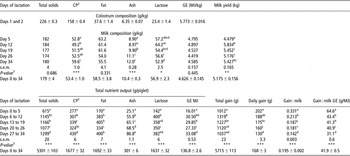
In both trials, the IB sows consumed their whole daily ration. The mean values for milk production and composition on the different days of measurement and sampling and of milk nutrient and energy output, calculated for the successive subperiods throughout the 34-day lactation period, appear in Table 1 together with the average composition of the colostrum samples obtained for days 1 and 2 of lactation. The average contents in the milk (g/kg) of total solids, CP, fat, ash and lactose were 179 ± 4, 53.4 ± 1.0, 58.5 ± 3.8, 10.4 ± 0.3 and 56.9 ± 2.3 g/kg, respectively. Mean GE was 4.626 ± 0.145 MJ/kg. Statistical analysis revealed that there was little effect of trial replicate on milk nutrient contents (data not shown), except for a higher ash content (10.8 v. 9.52 g/kg; P < 0.001) and a tendency for a higher CP content (54 v. 52 g/kg; P = 0.074) in the first replicate. The data set out in Table 1 show that as lactation advanced, a sharp increase in ash content took place (P < 0.001), whereas a sudden rise in CP concentration occurred at the end of the nursing period (P < 0.001). An average protein-to-energy ratio of 11.3 (10.0 to 13.1) g/MJ GE throughout lactation was obtained.
The effect of days of lactation on the composition and yield of Iberian sow's milk throughout a 34-day nursing periodFootnote 1

GE = gross energy.
1 Determined in eight sows and 48 piglets (four sows and 24 (6 × 4) piglets in each of two trials).
2 Total N × 6.38.
3 *P < 0.05; ** P < 0.01; ***P < 0.001. Within a column, means without a common superscript differ (P < 0.05).
Total MY was on average 5.175 ± 0.157 kg/day and tended to differ between the two trials (P = 0.090). Milk production (and consequently piglet milk intake (g/day)) attained a peak at day 12 and levelled off thereafter (P < 0.01). The total output of milk nutrients was seen to change in a highly significant way (P < 0.001), according to the lactation phase.
Over the 34-day lactation period, the piglets grew at an average rate of 168 ± 3 g/day. A steady decline in the rate of BW gain (from 202 to 130 g/day on average) was observed as lactation advanced (P < 0.001). As a result, there was a continuous decrease in the weight gain-to-milk ratio (G : M; P < 0.001). During the last week of lactation, milk conversion ratios were rather low. The gain-to-milk ratio and gain/MJ milk GE intake were on average 0.195 ± 0.002 and 41.9 ± 0.5, respectively. This indicates an average energy cost of 23.9 (1 : 41.9) kJ milk GE/g piglet gain. Assuming a coefficient of metabolizability of milk GE of 0.97, this would be equivalent to 23.2 kJ milk ME/g gain.
Body composition of piglets
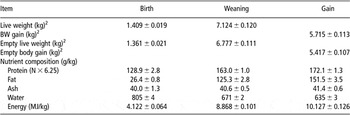
The mean whole-body chemical composition (g/kg) of piglets at birth and at weaning after 34 days of nursing appears in Table 2. The average empty BW at birth and at weaning were 1.361 and 6.777 kg, respectively. Between birth and weaning, the chemical composition of 1 kg gain was on average 172.1 ± 1.3 protein, 151.5 ± 3.5 fat and 635 ± 3 g water and 10.127 ± 0.126 MJ GE content.
Nutrient composition of the body and of BW gain of suckling Iberian piglets after a 34-day nursing periodFootnote 1

1 Calculated from 32 piglets (four piglets per litter (n=4) in each of two trials). Nutrient composition at birth was measured in one piglet per litter.
2 Determined in 48 piglets (six piglets per litter (n = 4) in each of two trials).
Nutrient and energy balance of the piglets
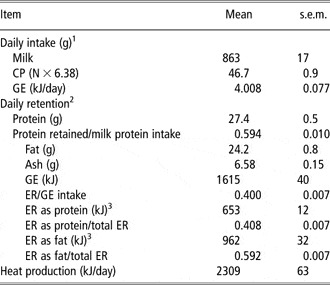
Table 3 shows the intake and retention of nutrients and energy from milk by the suckling piglets. The average intake of milk per piglet during the 34-day nursing period showed a tendency to be higher in trial 2 (832 v. 893 g/day; P = 0.066), implying small differences in piglet's daily protein (44.7 v. 48.7 g/day; P < 0.05) and energy supply (3866 v. 4150 kJ/day for GE; P = 0.066) between trial replicates (data not shown). A decline in the overall efficiency of use of milk protein was observed in trial 2 (0.619 v. 0.571; P < 0.05). On average, over the 34-day nursing period, 27.4 g protein (4.38 g N) were deposited daily in the piglets’ bodies. An increase in heat production was noticed in the piglets in trial 2 (2164 v. 2454 kJ/day; P < 0.05) because of their greater ME intakes (MEIs). The range of MEIs allowed us to establish linear and multiple regression equations with individual data (P < 0.001). MEI was related to total energy retained (ER) and MEI to ER as protein (ERp) and ER as fat (ERf) to predict maintenance requirements (MEm) and calculate net efficiencies in the use of ME for growth (kg) and partial efficiencies in the use of ME for protein (kp) and fat (kf) deposition:


Use of milk nutrients and energy by the suckling Iberian piglet throughout a 34-day nursing period

GE = gross energy; ER = energy retained.
1Determined in 48 piglets (six piglets per litter (n = 4) in each of two trials).
2Determined by the comparative slaughter approach in 32 piglets (four piglets per litter (n = 4) in each of two trials).
3Assuming an energy content of 23.8 and 39.8 kJ/g for protein and fat, respectively (Wenk et al., Reference Wenk, Colombani, van Milgen and Lemme2001).
Using equation (1), MEm can be calculated as 1158 kJ/day, equivalent to 404 kJ ME/kg BW0.75 (mean piglet BW = 2.864 kg), whereas kg was estimated as 1/1.71 = 0.584. Using equation (2), kp and kf can be calculated as 0.373 (1/2.67) and 0.696 (1/1.44), respectively.
Discussion
Methodological aspects regarding the estimation of milk nutrient output
In our experiment, milk samples were collected from eight additional sows to those used for MY measurements. This procedure allowed the collection of a great volume of milk (>100 ml) without disrupting the suckling pattern of the piglets involved in the nutrient balance measurements. Noblet and Etienne (Reference Noblet and Etienne1986, Reference Noblet and Etienne1987 and Reference Noblet and Etienne1989) collected milk samples from the nursing sow on the days following milk production measurements. Although corrections can be applied, this method may disrupt the normal access of piglets to the teats and reduces the volume of milk consumed and consequently BW gain.
Nutrient flow in the period from farrowing to day 5 of lactation was estimated assuming an average colostrum output. This estimate was based primarily on a number of colostrum intake determinations carried out on day 2 after birth in a separate trial, secondly on an analysis of the composition of individual samples of colostrum collected from different sows from 10 to 35-h post partum, and finally on the assumption that MY changed linearly between days 0 and 5 post partum. In this way, the intake of colostrum on day 1 was estimated as being 432.4 ± 11.8 g/piglet. This figure amounts to 18.01 ± 0.49 g/h, a flow similar to the 18.0 ± 1.1 g/h reported by Spinka et al. (Reference Spinka, Illman, Algers and Stetková1997) per teat on day 1 in Swedish Landrace × Yorkshire sows. Our estimation is equivalent to 308 g/kg piglet BW, a value 28% and 19% higher, respectively, than those of 240 and 260 g/kg average BW observed by Le Dividich and Noblet (Reference Le Dividich and Noblet1981) and Milon et al. (Reference Milon, Aumaitre, Le Dividich, Franz and Metzger1983). Although this estimation may imply some bias, the potential error was considered to be small as it concerns less than one-fifth of total lactation.
MY and composition
Current tendencies for the intensification of the productive cycle of the purebred IB pig have been widely adopted. They are compatible with a final fattening stage on acorn and pasture within the so-called traditional extensive systems of heavy pig production, which is widespread in some Mediterranean areas. Management intensification in particular is practised during the first stages of growth, including the suckling period. Weaning, performed around day 28, has replaced traditional practices. The average number of IB piglets born per litter has been registered as 7.4 (Laguna Sanz, Reference Laguna Sanz1998), based on statistical data obtained from IB pig farms over the past 50 years of the 20th century, in which routine controls of piglets’ weight were carried out at 21 days of age. Average individual BW was in the range of 4.29 to 4.55 kg. Growth rates as low as 165 and 200 g/day have been recorded in the suckling piglet at 21 and 42 days of age, respectively (Daza, Reference Daza2001). This low performance suggests either a shortage in the supply of milk nutrients to the suckling piglets or a poor conversion of milk nutrients to body constituents, resulting in lower growth rates than those reported for lean genotypes (Mackenzie and Revell, Reference Mackenzie and Revell1998).
MY and composition are key factors in determining piglet growth. MY has been related to litter and piglet size. Parity number and the stage of lactation are additional influencing factors (Agricultural Research Council, 1981). No available data exist in the literature concerning the yield and composition of IB sow's milk. The application of predictive equations from the literature results in biased estimations of MY and energy or nutrient outputs. For instance, Etienne et al. (Reference Etienne, Dourmad and Noblet1998) related milk production and GE and N outputs over 20 to 25 days of lactation with average daily BW gain and energy or N in piglet BW gain. From our experimental results, we calculate an average daily gain of 185 g/piglet for the same period of nursing, from which a daily intake of 698 g of milk, 5.49 g milk N and 3466 kJ of milk energy per piglet can be predicted. Nevertheless, the actual figures obtained through our experiment are 841 g, 6.74 g and 3959 kJ. The National Research Council (1998) uses a modification of the equation reported by Noblet and Etienne (Reference Noblet and Etienne1989) to estimate daily milk energy transferred to the litter, which underestimates the amount of milk produced daily by the IB sows by 12%. By contrast, the average MY of 6.25 kg/day over an 8-week nursing period (6.57 kg/day over 5 weeks of lactation) for conventional sows, adopted by the Agricultural Research Council (1981), based on data compiled by Elsley (Reference Elsley1971) from estimates of milk production reported in the literature, is well above the present values. Nevertheless, from this estimation, an intake of 821 g milk/piglet can be arrived at for an average litter of eight piglets, a figure comparable to our own observations.
Renaudeau et al. (Reference Renaudeau, Noblet and Dourmad2003) found that an increase in ET from 20°C to 28°C with a constant feed allowance did not alter milk production or composition in multiparous Large White × Landrace sows. Owing to the confounding effect of ET and trial replicate, we could not identify properly any effect of ET. Nevertheless, we did not observe any differences in MY between trials, and therefore we averaged out the data. A number of factors have been reported to affect milk production and composition (Darragh and Moughan, Reference Darragh and Moughan1998), but there are data to support the idea that the provision of milk nutrients to the piglet does not depend strictly upon the supply of dietary nutrients to the dam due to the mobilization of sow reserves (Klaver et al., Reference Klaver, van Kempen, de Lange, Verstegen and Boer1981; Clowes et al., Reference Clowes, Williams, Baracos, Pluske, Cegielski, Zak and Aherne1998; Pluske et al., Reference Pluske, Williams, Zak, Clowes, Cegielski and Aherne1998), a factor that declines as fat reserves are depleted (Noblet and Etienne, Reference Noblet and Etienne1986). The feeding regime throughout nursing in our study resulted in average daily weight losses in the range of 400 to 550 g/day and did not affect MY. Significant differences in the concentration of milk nutrients according to pig breed have been reported by Fahmy (Reference Fahmy1972), Zou et al. (Reference Zou, McLaren and Hurley1992) and Alston-Mills et al. (Reference Alston-Mills, Iverson and Thompson2000) among others. Our results on IB sow's milk composition are very close and, as lactation advanced, followed a similar pattern to those observed by Klobasa et al. (Reference Klobasa, Werhahn and Butler1987) in milk samples from German Landrace sows. Nevertheless, compared with Braude et al. (Reference Braude, Coates, Henry, Kon, Rowland, Thompson and Wolker1947), working with Large White sows, the present results show consistently lower concentrations for total solids, fat and protein and a higher lactose content. According to Liotta et al. (Reference Liotta, Madonia, Chiofalo, Margiotta, Riolo and Chiofalo2007), the milk from Nero Siciliano sows, a Mediterranean pig genotype like the IB breed, have greater concentrations of fat and energy than IB milk does.
Piglet performance
Very few experiments have been undertaken with piglets nursed by their dam, involving measurements of MY and milk composition at several stages of lactation, and therefore closely resembling what happens under practical conditions (Noblet and Etienne, Reference Noblet and Etienne1986 and Reference Noblet and Etienne1987; Jentsch et al., Reference Jentsch, Beyer, Schiemann and Hoffmann1995). Consequently, in this study, we give preference to those experiments conducted under similar management conditions.
In our trials, daily piglet BW gain measured weekly during the 34-day nursing period decreased from 202 to 130 g and the milk conversion ratio (g milk : g gain) increased from 3.02 (1 : 0.331) to 7.04 (1 : 0.142) as lactation progressed (Table 1). This performance pattern results from a fairly constant supply of nutrients from the milk and a steady and noticeable increase in total maintenance requirements as the piglets get heavier. IB piglets require more milk per gram BW gain than those in the study of Pluske et al. (Reference Pluske, Williams, Zak, Clowes, Cegielski and Aherne1998) (in the range of 3.8 to 4.2 g/g, depending upon the feeding level of the sows and the stage of lactation), the protein and energy milk content being similar in both studies. In the study of Noblet and Etienne (Reference Noblet and Etienne1986), the conversion ratios of milk and milk energy into piglet BW gain were on average 3.82 g/g and 18.3 kJ/g, respectively, which compare very favourably with those observed in our experiment (5.15 (1/0.195) and 23.9 kJ/g (1/41.9)). When the comparison is made for a 21-day lactation period, our experiment also results in a comparatively poorer efficiency in milk nutrient use (4.48 (1/0.223) and 21.0 kJ/g (1/47.6)).
Body composition of piglets
Compared with piglets from conventional breeds (Elliot and Lodge, Reference Elliot and Lodge1977; Noblet and Etienne, Reference Noblet and Etienne1986; Jentsch et al., Reference Jentsch, Beyer, Schiemann and Hoffmann1995), the composition of the IB piglets at birth shows increased protein, fat and ash content and consequently a greater concentration of total solids and energy density. Noticeably, the fat content doubles the values reported for lean breeds. This would be a key factor for the survival of the newborn IB piglet, particularly when delivery takes place in the open air. Comparisons of body composition at weaning and of BW gain may be biased due to differences in the length of nursing. Noblet and Etienne (Reference Noblet and Etienne1987) showed that the chemical composition of the weaned piglet was largely affected by the rate of growth, with protein and ash content correlating negatively with ADG, whereas DM, fat and energy content correlated positively. In their experiment, 141 mg protein, 197 mg fat, 28 mg ash, 410 mg DM and 12.384 kJ were deposited per gram increase in piglet BW gain. The values obtained for the chemical composition of the IB piglets at weaning support the observations of these authors and predict a comparatively lower growth rate. It should be mentioned that the average energy content of the IB piglet BW gain (10.127 MJ/kg) is close to the mean value of 10.1 MJ reported by Noblet and Etienne (Reference Noblet and Etienne1987) across breeds.
Nutrient and energy balance of piglets
With an average empty BW gain of 160 g/day, the daily nutrient and energy depositions between birth and weaning after 34 days of nursing were 27.4 g protein (4.38 g N), 22.7 g fat and 1615 kJ energy (Table 3). These deposition rates are slightly lower than those reported by Noblet and Etienne (Reference Noblet and Etienne1987) in Large White piglets weaned at only 22 days of age (4.78 g N and 28.7 g fat), which is in line with the slower average growth rate observed in the IB piglet after a similar period of nursing (185 v. 195 g/day). In contrast, our estimates are greater than the values obtained by Jentsch et al. (Reference Jentsch, Beyer, Schiemann and Hoffmann1995) in piglets from German Landrace sows weaned at 26 days. The overall efficiency of protein use from IB sow's milk is rather poor (0.619 and 0.571 in trials 1 and 2, respectively) compared with the ratios observed in suckling piglets from lean genotypes. Noblet and Etienne (Reference Noblet and Etienne1987) obtained a value as high as 0.88, whereas Jentsch et al. (Reference Jentsch, Beyer, Schiemann and Hoffmann1995) reported a ratio of 0.74.
GE from milk was retained in the body of the IB piglet with an overall efficiency of 0.4, a value once more lower than those reported by Noblet and Etienne (Reference Noblet and Etienne1987) and Jentsch et al. (Reference Jentsch, Beyer, Schiemann and Hoffmann1995) (0.547 and 0.435, respectively). The regression of MEI on energy deposition yielded a cost of 1.71 kJ/kJ ER in the body of piglets, that is, a net availability of ME from the milk of IB sows of 0.584, and a calculated MEm of 404 kJ/kg BW0.75. This value is lower than the 468 and 451 kJ/kg BW0.75 reported by Jentsch et al. (Reference Jentsch, Beyer, Schiemann and Hoffmann1995) for suckling and early-weaned piglets fed on cow's milk. It is also lower than the value of 445 kJ/kg BW0.75 published by Campbell and Dunkin (Reference Campbell and Dunkin1983) for early-weaned piglets given a protein-adequate diet based on skimmed milk powder. In growing IB pigs fed on an adequate supply of ideal protein, we obtained an estimate of 422 kJ/kg BW0.75/day for MEm and an identical value for kg (0.582; Nieto et al., Reference Nieto, Miranda, García and Aguilera2002). In the experiments of Jentsch et al. (Reference Jentsch, Beyer, Schiemann and Hoffmann1995), kg values were in the range of 0.70 to 0.72. Our estimates of kp (0.373) and kf (0.696), calculated using equation (2), suggest that in the suckling IB piglet, ME costs for protein accretion and fat deposition are 64 and 57 kJ/g, respectively. Although our kf value approaches those of 0.72 to 0.78 reported in the literature for early-weaned piglets (Close and Stanier, Reference Close and Stanier1980; Campbell and Dunkin, Reference Campbell and Dunkin1983; Gädeken et al., Reference Gädeken, Oslage and Böhme1985), our estimate for kp is far below the corresponding values of 0.74 to 0.83 found in these studies. The high energy cost of the protein deposited in the IB piglet explains, at least in part, the poor conversion ratio of milk energy into body energy retention. In IB pigs at different growth stages, we also obtained very low values for kp (0.303 and 0.218; Nieto et al., Reference Nieto, Miranda, García and Aguilera2002; Barea et al., Reference Barea, Nieto and Aguilera2007), which corroborates the idea that this pig breed requires considerably more energy per unit of protein deposited, presumably as a result of a comparatively greater protein turnover. Indeed, Rivera-Ferre et al. (Reference Rivera-Ferre, Aguilera and Nieto2005) found that growing IB pigs fed on a balanced protein-to-energy diet had higher muscle fractional protein synthesis rates than Landrace pigs, although muscle mass was smaller.
In conclusion, the present results suggest that the slow rate of growth of the suckling IB piglet can be explained not by a shortage in milk nutrient intake, but rather as a result of its limited capacity for protein accretion and the poor efficiency in use of milk protein and energy for body deposition. A nursing period of longer than 28 days is not recommended.
Acknowledgements
This study was supported by Junta de Andalucía grant AGR-395. M. A. Aguinaga received a grant from the Junta de Andalucía. We thank Ms Ana Navarro and Mr Francisco Funes for their skilful technical assistance and Sánchez Romero Carvajal Jabugo S. A. (Sevilla) for their helpful collaboration. We also thank A. L. Tate for revising our English text.