


Highlights
-
• Status epilepticus causes secondary brain injury, morbidity and mortality.
-
• Aggressive treatment is paramount and often requires multiple antiseizure medications.
-
• Cenobamate is a novel antiseizure medication, proven highly effective as an adjunct for patients with refractory focal epilepsy. Minimal evidence exists to support its use for the treatment of status epilepticus.
Introduction
Status epilepticus (SE) is a neurologic emergency defined as seizures that are prolonged or recur without the patient regaining their baseline level of consciousness. Reference Trinka, Cock and Hesdorffer1 Seizures trigger a pathophysiological cascade that includes internalization of gamma-aminobutyric acid (GABA) receptors, upregulation and activation of N-methyl-D-aspartic acid and α-amino-3-hydroxy-5-methyl-4-isoxazolepropionic acid receptors, glutamate release, calcium influx, intracellular inflammation, altered neuropeptide expression and genetic and epigenetic modifications. Reference Walker2 These cellular and molecular changes diminish the brain’s ability to terminate seizure activity, increasing the risk of progression to refractory SE (RSE) and super-refractory SE (SRSE). Reference Trinka and Leitinger3
Seizures are associated with significant metabolic consequences, characterized by reduced cerebral glucose, a shift toward anaerobic metabolism as indicated by elevated lactate/pyruvate ratios, cerebral hypoxia, increased mass effect and midline shift, elevated intracranial pressure and hippocampal atrophy. Reference Vespa, Tubi and Claassen4–Reference Vespa, Miller and McArthur7 This secondary brain injury may contribute to increased morbidity and mortality, although patient outcomes are also influenced by factors such as age, SE etiology, type, duration and refractoriness. Reference Trinka and Leitinger3,Reference Payne, Zhao and Frndova8
Consequently, timely and aggressive management of SE is paramount. Multiple guidelines outline standardized approaches to the treatment of SE, RSE and SRSE. Reference Glauser, Shinnar and Gloss9–Reference Brophy and Bell11 Robust evidence supports first-line benzodiazepine therapy Reference Treiman, Meyers and Walton12 and second-line treatment with phenytoin, valproic acid or levetiracetam; Reference Kapur, Elm and Chamberlain13 however, only 65% and 46% of patients respond to these first- and second-line treatments, respectively. Reference Treiman, Meyers and Walton12,Reference Kapur, Elm and Chamberlain13 Evidence for subsequent interventions such as additional antiseizure medications (ASMs) remains limited; Reference Glauser, Shinnar and Gloss9–Reference Brophy and Bell11 the choice of which may depend on patient characteristics, seizure semiology, underlying etiology, renal and hepatic function and concurrent medications and planned interventions. Reference Glauser, Shinnar and Gloss9–Reference Brophy and Bell11 When multiple ASMs are required, it may be beneficial to utilize agents with different mechanisms of action.
Cenobamate (CBM), a member of the carbamate drug class, is a novel ASM that inhibits voltage-gated sodium channels and acts as a positive allosteric modulator of GABAA receptors. At doses of 100–400 mg/day, CBM has been shown to achieve seizure freedom in 11%–36% of patients and to reduce seizure frequency by 50% or more in 50% of patients with refractory focal-onset seizures with or without secondary generalization. Reference Sperling, Abou-Khalil and Aboumatar14,Reference Lattanzi, Trinka and Zaccara15 In a recent systematic review, the pooled estimated relative risks for achieving at least 50%, 75% and 100% reduction in seizure frequency beyond 28 days of CBM compared to placebo in patients with refractory epilepsy were 2.18 (95% CI 1.67–2.85; p < 0.001), 2.25 (95% CI 1.57–3.24; p < 0.001) and 3.71 (95% CI 1.93–7.14; p < 0.001), respectively. Reference Lattanzi, Trinka and Zaccara15 The seizure freedom and control rate observed with CBM in clinical trials compares very favorably with the rates of individual and pooled clinical studies of other adjunctive ASMs in patients with refractory focal epilepsy, Reference Costa, Fareleira, Ascenção, Borges, Sampaio and Vaz-Carneiro16,Reference Irelli, Roberti and Borioni17 suggesting that CBM may be a viable therapeutic option for patients with SE. However, several factors may limit CBM’s utility in this context, including its enteral administration, potential drug interactions and the need for slow dose titration to mitigate the risk of Drug Reaction with Eosinophilia and Systemic Symptoms (DRESS), which was observed early in clinical development with rapid up-titration. To date, little is known about the efficacy and safety of CBM when used to manage patients with SE.
The aim of this systematic review was to summarize the evidence supporting the use of CBM for the management of patients with SE, RSE and SRSE, including dosage, administration, efficacy and safety.
Methods
This systematic review was conducted according to established methodological standards and reported in accordance with the Preferred Reporting Items for Systematic Reviews and Meta-Analyses (PRISMA) guidelines. Reference Page, McKenzie and Bossuyt18 The protocol was registered in PROSPERO (CRD420451106302). 19
Search strategy
In consultation with a health science librarian, a search strategy was developed (Appendix). Search terms included status epilepticus, cenobamate and all related MeSH terms combined with Boolean operators. The search was restricted to English-only publications with no publication date limitations. The search was executed on June 12, 2025, and included MEDLINE, EMBASE, CINAHL and Cochrane CENTRAL databases. Reference lists of all articles meeting inclusion criteria were manually searched to identify additional studies. References were exported and managed using Covidence. 20
Study selection
Two blinded reviewers (MM, AH) completed pilot screening of 25% of the available titles and abstracts to confirm 100% agreement of inclusion and exclusion with a senior reviewer (JAK). The remaining titles and abstracts were independently screened in duplicate by these two blinded reviewers to identify potentially relevant studies. Full-text articles were subsequently reviewed independently and in duplicate by four blinded reviewers (MM, AH, CB, IB) who applied the inclusion and exclusion criteria. Disagreements were resolved by a senior reviewer (NJ, JAK).
Studies were included if they were original research (case reports, case series, retrospective or prospective cohort or case-control studies, case series or interventional trials), including conference abstracts; involved adult patients (18 years of age or older) with or without known epilepsy, presenting with either SE, RSE or SRSE of any semiology (e.g., with or without prominent motor features, generalized or focal, etc.), resulted from any underlying etiology (except hypoxemic ischemic brain injury [HIBI]); and included participants who were treated with CBM (alone or in combination with other ASMs).
Studies were excluded if they were not original research, assessed only pediatric patients, did not utilize CBM or utilized it for an alternative indication (e.g., to treat refractory epilepsy) or did not assess the primary outcome of interest (i.e., seizure control). Studies including patients with SE solely due to HIBI were planned for exclusion, as this etiology is known to be highly refractory to treatment and associated with a disproportionately poor prognosis driven by its underlying pathophysiology. Reference Bencsik, Josephson and Soo21
Study quality and risk of bias assessment
Four blinded reviewers (MM, AH, CB and IB) independently assessed the quality of included studies, and disagreements were resolved by a senior reviewer (NJ or JAK). The Joanna Briggs Institute (JBI) Checklist for Case Reports was selected as the instrument for risk of bias assessment as all studies meeting the inclusion criteria were case reports or case series (Appendix). Reference Moola, Munn, Tufanaru, Aromataris and Munn22 The JBI Checklist asks eight questions relating to documentation of each patient’s demographics, clinical presentation, investigations, interventions, outcome and adverse events.
Data synthesis
All data from included articles were extracted independently and in duplicate by two reviewers (MM and AH) using a standard Microsoft Excel data form created by the study team. Disagreements were resolved by a senior reviewer (JAK). Extracted data included study details (year and country of publication, first author, study design and the total number of patients); patient demographics (age, sex, SE classification [SE, RSE, SRSE], seizure semiology [categorized when possible based on the International League Against Epilepsy [ILAE] Classification of Status Epilepticus] Reference Trinka, Cock and Hesdorffer1 and underlying etiology [in more granular detail than the ILAE Classification of Status Epilepticus categories: acute, remote, progressive, SE in defined electroclinical syndrome and unknown], presence or absence of pre-existing epilepsy, Status Epilepticus Severity Score [STESS] and Epidemiology-Based Mortality Score in SE [EMSE]); treatment details prior to or concurrently with the initiation of CBM (number and names of ASM, number and names of intravenous sedatives, other treatments including immunotherapy, antimicrobials, neurosurgery and the ketogenic diet); CBM details (time from onset of SE to CBM initiation, route of administration and dose); and outcome data (number of patients who obtained seizure control, adverse events, intensive care unit/hospital length of stay, mortality and functional outcomes if reported). See the appendix for a full list of extracted data and definitions.
For the purposes of data classification, the following definitions were used:
-
• SE defined as per the ILAE criteria as seizures that are prolonged (5 minutes for generalized and 10 minutes for focal) or repeated without a patient returning to their baseline level of consciousness Reference Trinka, Cock and Hesdorffer1 and an electrographic correlate as defined by the American Clinical Neurophysiology (ACNS) 2021 Critical Care Electroencephalography (EEG) Terminology. Reference Hirsch, Fong and Leitinger23
-
• Electrographic SE (sometimes referred to as nonconvulsive SE in studies) defined according to the ACNS criteria Reference Hirsch, Fong and Leitinger23 as 10 or more continuous minutes or a total duration of 20% or more of any 60-minute period of electrographic seizures meeting Salzburg criteria. Reference Leitinger, Beniczky and Rohracher24
-
• RSE defined as seizures that occur despite an adequate dose of benzodiazepines and another ASM. Reference Trinka and Leitinger3,Reference Hirsch, Gaspard, Baalen and van25
-
• SRSE defined as seizures that continue beyond 24 hours after initiation of an anesthetic agent. Reference Trinka and Leitinger3,Reference Hirsch, Gaspard, Baalen and van25
-
• Electroclinical seizure control defined as resolution of clinical signs or symptoms and cessation of ictal patterns on EEG within 14 days of the first administration of CBM. Electrographic seizure control was defined as cessation of ictal patterns on EEG within 14 days of the first administration of CBM.
○ Fourteen days was chosen considering the pharmacokinetics of CBM that can reach steady state after approximately 14 days in healthy controls. Reference Vernillet, Greene and Kamin26
Results
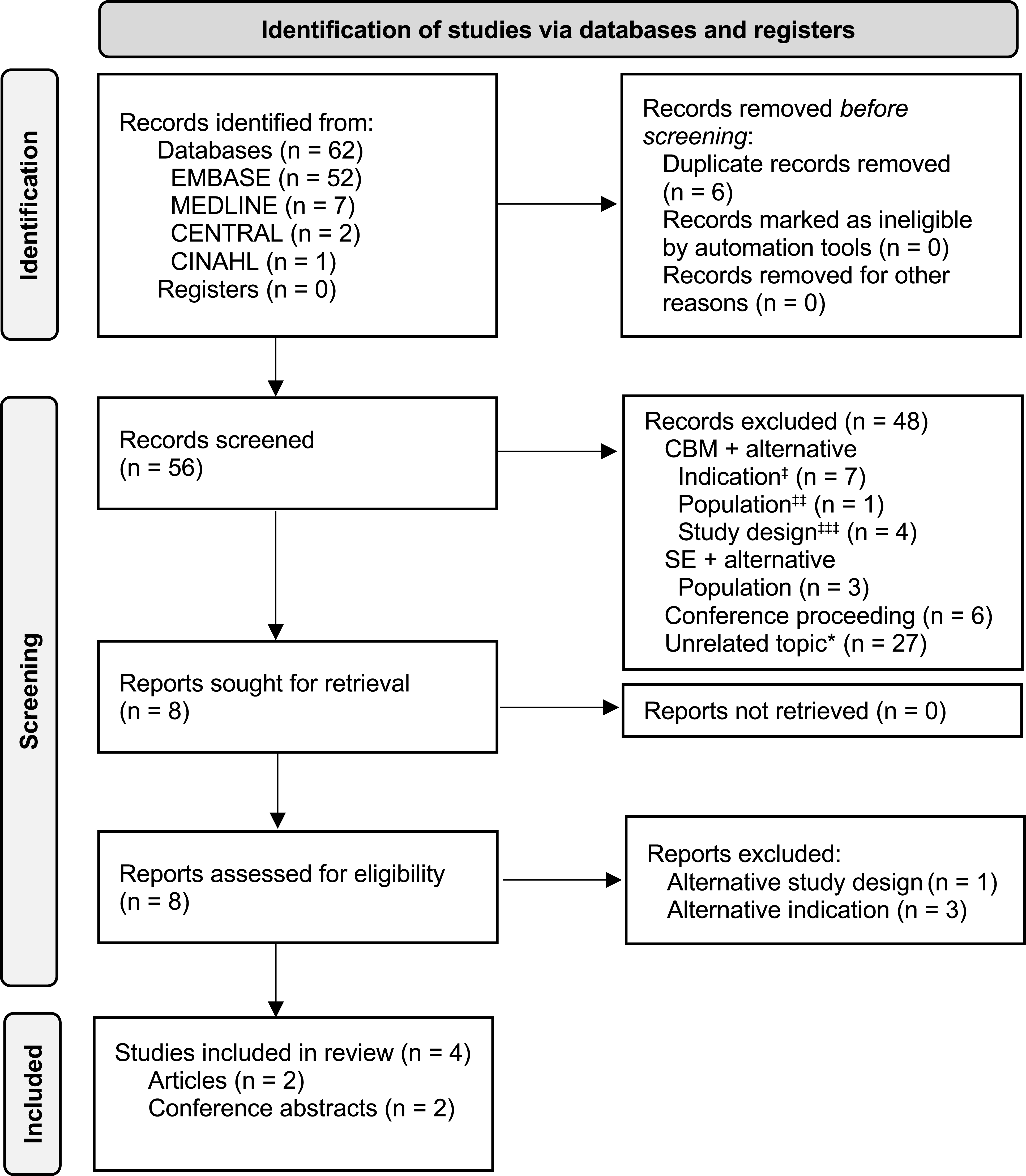
A total of 62 articles were identified during the search process. Six duplicate articles were removed. A total of 56 titles and abstracts were screened, and 48 were excluded. Full-text reviews of eight studies were completed. Three studies were excluded because CBM was used to treat refractory epilepsy and not SE (alternative indication). One study was excluded and categorized as an alternative study design because it was a retrospective cohort study of adult patients with SE designed to assess the association between the number of ASM used to control SE and outcomes with only 1 out of 184 patients treated with CBM. After applying inclusion and exclusion criteria, four studies remained including two conference abstracts and two full manuscripts (Figure 1).
PRISMA flow diagram.
‡CBM used for treating refractory epilepsy; ‡‡CBM used to treat status epilepticus, however, in pediatric patients only; ‡‡‡review article or animal study on CBM; *unrelated topic including articles focused only on epilepsy or other seizure treatments (e.g., surgery, levetiracetam, neurosteroids, etc.). CBM = cenobamate; SE = status epilepticus; PRISMA = Preferred Reporting Items for Systematic Reviews and Meta-Analyses.

Figure 1. Long description
A flow diagram outlining the number of articles retrieved from the literature search (62) with duplicates (6) removed leaving a total of 56 abstracts to screen, of which 48 were excluded. 8 Full text articles were reviewed and 4 excluded leaving 2 articles nd 2 conference abstracts to review.
Description of studies
After the Food and Drug Administration (FDA) and Health Canada approval of CBM for the treatment of refractory focal seizures in 2019 and 2023, respectively, the earliest report of the use of CBM for the management of SE was published in 2023 with subsequent publications as recent as 2025. Of the four studies included, three were case reports, Reference Falcicchio, Pellicciari and Graziani27–Reference Ang, Abu-Hashish, Malik, Noori and Singh29 and one was a case series including two patients. Reference Carlson, Molyneaux and Lee30 Overall, a total of five patients received CBM for SRSE.
Quality of studies
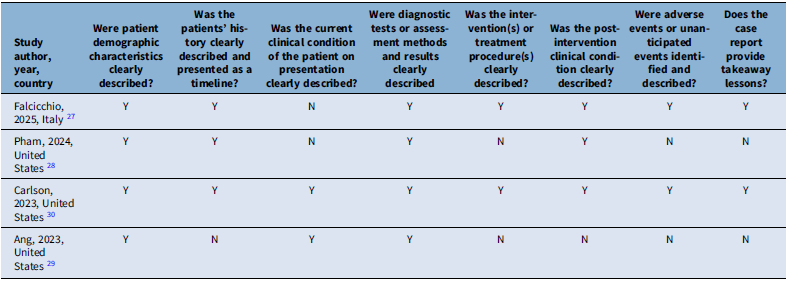
The JBI Critical Appraisal Checklist for the case reports and series is reported in Table 1. One study fulfilled all domains of the checklist. Reference Carlson, Molyneaux and Lee30 Two case reports did not clearly describe the patient’s clinical condition on presentation. Reference Falcicchio, Pellicciari and Graziani27,Reference Pham and Landeen28 A clear description of treatment interventions and adverse events was lacking in two case reports. Reference Pham and Landeen28,Reference Ang, Abu-Hashish, Malik, Noori and Singh29 Ang and colleagues did not describe the patient’s presentation as a timeline, nor the patient’s post-intervention clinical condition in sufficient detail. Reference Ang, Abu-Hashish, Malik, Noori and Singh29
JBI Critical Appraisal Checklist for case reports

Table 1. Long description
A table outlining the quality and risk of bias of included studies.
Y = yes; N = no.
Demographics
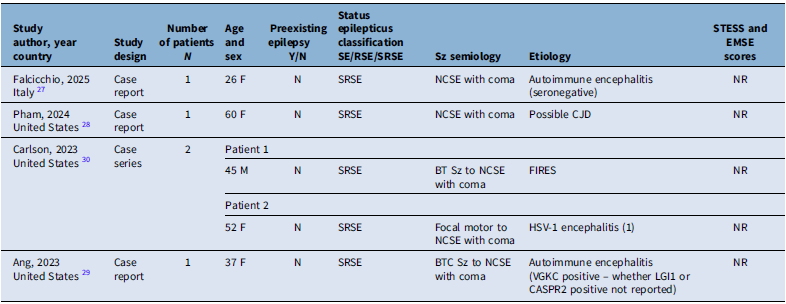
Four female and one male patient were included with an age range of 26–60 years. No patients had pre-existing epilepsy. All patients were suffering from SRSE. All patients had nonconvulsive SE (NCSE) with associated coma as per the ILAE SE semiology classification. Three patients initially presented with focal seizures with prominent motor symptoms prior to deteriorating to NCSE. Reference Ang, Abu-Hashish, Malik, Noori and Singh29,Reference Carlson, Molyneaux and Lee30 The underlying etiology for each patient’s SE included two cases of autoimmune encephalitis, Reference Falcicchio, Pellicciari and Graziani27,Reference Ang, Abu-Hashish, Malik, Noori and Singh29 one herpes simplex virus 1 (HSV-1) encephalitis, Reference Carlson, Molyneaux and Lee30 one febrile infection-related epilepsy syndrome (FIRES) of unclear etiology Reference Carlson, Molyneaux and Lee30 and one case of possible Creutzfeldt–Jakob disease. Reference Pham and Landeen28 STESS and EMSE were not reported by any study (Table 2).
Demographics

Table 2. Long description
A table outlining the demographics of patients in the included studies
BT = bilateral tonic; BTC = bilateral tonic clonic; CASPR2 = contactin-associated protein-like 2 molecule; CBM = cenobamate; CJD = Creutzfeld-Jakob disease; EMSE = Epidemiology-Based Mortality Score in Status Epilepticus; FIRES = Febrile Infection-Related Epilepsy Syndrome; HSV = herpes simplex virus; LGI1 = leucine-rich glioma-inactivated 1 protein; NCSE = nonconvulsive status epilepticus; N = no; NR = not reported; RSE = refractory status epilepticus; SE = status epilepticus; SRSE = super-refractory status epilepticus; STESS = Status Epilepticus Severity Score; Sz = seizure; VGKC = voltage-gated potassium channel antibody.
Treatment details
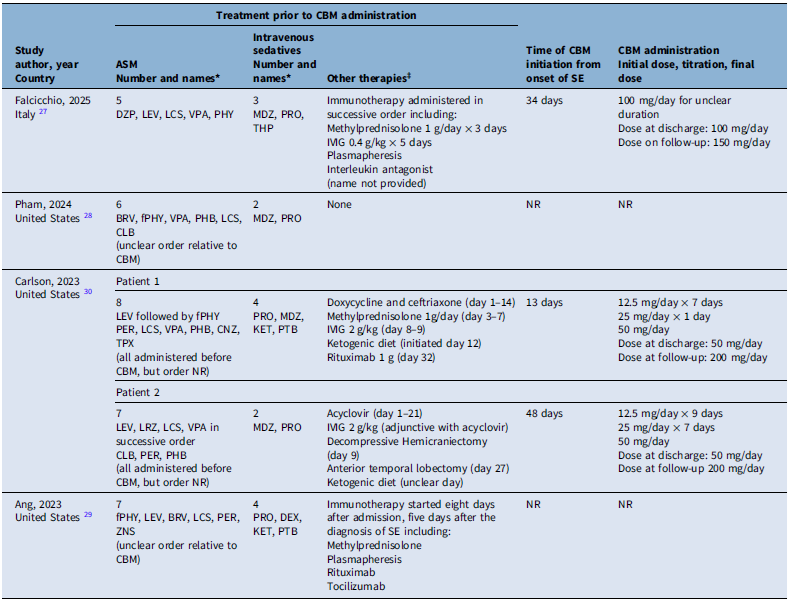
The number of ASMs that was utilized prior to the administration of CBM varied between five and eight with specific ASMs (Table 3). The exact dosing, order and timing of each ASM relative to CBM was not reported. The number of intravenous sedatives that was administered prior to CBM varied between two and four and included midazolam, propofol, ketamine, thiopental, pentobarbital and dexmedetomidine. The order, titration, maximum dosing and duration of intravenous sedatives were not reported. All but one patient received several other therapies that either preceded or coincided with CBM (Table 3). These included methylprednisolone (n = 3), Reference Falcicchio, Pellicciari and Graziani27,Reference Ang, Abu-Hashish, Malik, Noori and Singh29,Reference Carlson, Molyneaux and Lee30 intravenous immunoglobulin (IVIG) (n = 3), Reference Falcicchio, Pellicciari and Graziani27,Reference Carlson, Molyneaux and Lee30 plasmapheresis (n = 2), Reference Falcicchio, Pellicciari and Graziani27,Reference Ang, Abu-Hashish, Malik, Noori and Singh29 interleukin antagonists (n = 2), Reference Falcicchio, Pellicciari and Graziani27,Reference Ang, Abu-Hashish, Malik, Noori and Singh29 rituximab (n = 2), Reference Ang, Abu-Hashish, Malik, Noori and Singh29,Reference Carlson, Molyneaux and Lee30 ketogenic diet (n = 2), Reference Carlson, Molyneaux and Lee30 lesionectomy (n = 1), Reference Carlson, Molyneaux and Lee30 empiric antibiotics (n = 1) Reference Carlson, Molyneaux and Lee30 and antivirals (n = 1). Reference Carlson, Molyneaux and Lee30
Treatment details

Table 3. Long description
A table outlining the treatment each patient received including antiseizure medications, intravenous sedatives, other therapies and the time of cenobamate administration in addition to initial dose and titration.
ASM = antiseizure medication; CBM = cenobamate; IVIG = intravenous immunoglobulins; NR = not reported; SE = status epilepticus.
* Antiseizure medication abbreviations: BRV = brivaracetam; CLB = clobazam; CNZ = clonazepam; DZP = diazepam; fPHY = fosphenytoin; LCS = lacosamide; LEV = levetiracetam; LRZ = lorazepam; PER = perampanel; PHB = phenobarbital; PHY = phenytoin; TPX = topiramate; VPA = valproic acid; ZNS = zonisamide. Intravenous sedative abbreviations: DEX = dexmedetomidine; KET = ketamine; MDZ = midazolam; PRO = propofol; PTB = pentobarbital; THP = thiopental.
‡Dose and duration/timing indicated if available.
Falcicchio described a case of a patient with seronegative autoimmune encephalitis who was treated with successive immunotherapy including 1 g/day of methylprednisolone for three days, 2 g/kg of IVIG over five days, plasmapheresis (with no details provided regarding the volume exchanged, replacement fluid or total number of sessions) and an interleukin antagonist. Reference Falcicchio, Pellicciari and Graziani27 CBM was started on day 34 from the onset of SE after a perceived failure of the steroid, IVIG and plasmapheresis; however, the exact timeline was not provided. Administration of the interleukin antagonist was reported as successful in normalizing the EEG instead of the CBM. Carlson reported on a patient with FIRES who received 1 g/day of methylprednisolone (day 3–7), 2 g/kg of IVIG (day 8–9), initiation of the ketogenic diet (day 12), followed by initiation of CBM 12.5 mg/day (day 13) that was up-titrated to 50 mg/day (day 14–22) followed by seizure cessation on day 19. Reference Carlson, Molyneaux and Lee30 The case of autoimmune encephalitis reported by Ang received successive immunotherapy five days after the diagnosis of SE including methylprednisolone, plasmapheresis, rituximab and tocilizumab; however, the exact order and dosing of these agents relative to CBM was not reported. Reference Ang, Abu-Hashish, Malik, Noori and Singh29 The patient suffering from HSV-1 encephalitis, reported by Carlson, received a three-week course of acyclovir between day 1 and 21 in addition to 2 g/kg of IVIG, an anterior temporal lobectomy (day 27) and initiation of the ketogenic diet (unclear day) prior to initiation of CBM on day 48. Reference Carlson, Molyneaux and Lee30
The timing from the onset of SE to when CBM was administered was only reported for three patients and ranged from 13 to 48 days. Reference Falcicchio, Pellicciari and Graziani27,Reference Carlson, Molyneaux and Lee30 The dosing and titration of CBM was reported for three patients. Carlson reported on slow titration of enteral CBM starting at 12.5 mg/day up to 50 mg/day over 8–16 days, which was the final dose on discharge, but then later increased further to 200 mg/day at follow-up. Reference Carlson, Molyneaux and Lee30 Falcicchio started and maintained 100 mg/day at discharge but then later increased further to 150 mg/day at follow-up. Reference Falcicchio, Pellicciari and Graziani27
Outcomes
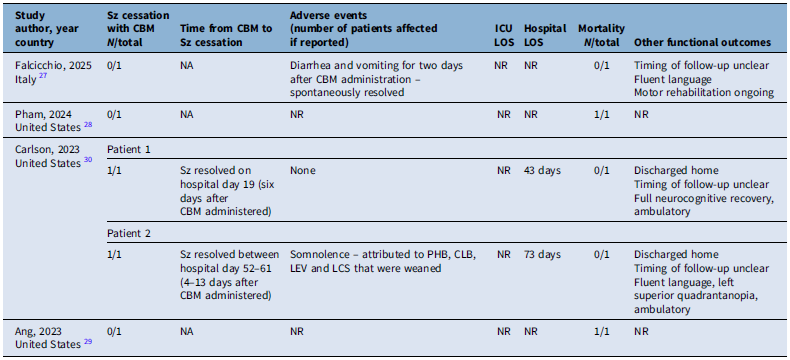
Outcome data were limited and reported in Table 4. Seizure cessation occurred in the two patients reported by Carlson. Reference Carlson, Molyneaux and Lee30 For one patient, seizures stopped 6 days after the initiation of CBM (which would have still been at 12.5 mg/day), while the other patient’s seizures stopped 4–13 days after the initiation of CBM (which would have been at 12.5–25 mg/day). Other interventions were concurrently ongoing.
Outcome data

Table 4. Long description
A table outlining the outcome data of patients in the included studies including if seizure cessation was obtained, time from cenobamate administration to seizure cessation, adverse events, intensive care unit and hospital length of stay, mortaity and other functional outcomes.
CBM = cenobamate; CLB = clobazam; ICU = intensive care unit; LCS = lacosamide; LEV = levetiracetam; LOS = length of stay; NA = not applicable; NR = not reported; PHB = phenobarbital; Sz = seizures.
Adverse events were not reported in the two conference abstracts. Reference Pham and Landeen28,Reference Ang, Abu-Hashish, Malik, Noori and Singh29 Carlson reported no side effects for one patient, while the other suffered somnolence, although this was attributed to other ASMs and not CBM. Reference Carlson, Molyneaux and Lee30 The patient described by Falcicchio experienced two days of diarrhea and vomiting immediately after CBM administration, which spontaneously resolved. Reference Falcicchio, Pellicciari and Graziani27
Other outcome data were sparse (Table 4). No study reported on intensive care unit length of stay. The two patients reported by Pham Reference Pham and Landeen28 and Ang Reference Ang, Abu-Hashish, Malik, Noori and Singh29 both died, while the three others were subsequently discharged. Carlson reported that the one patient with FIRES was discharged home on day 43 and, on subsequent follow-up, was ambulatory and had a full neurocognitive recovery. Reference Carlson, Molyneaux and Lee30 The patient with HSV encephalitis was discharged home on day 73 and, on subsequent follow-up, had only minor neurological deficits. Reference Carlson, Molyneaux and Lee30 The patient described by Falcicchio with autoimmune encephalitis underwent motor rehabilitation. Reference Falcicchio, Pellicciari and Graziani27
Discussion
CBM is a novel ASM with dual mechanisms that reduce neuronal excitability by enhancing inhibitory signaling. It enhances fast and slow inactivation of sodium channels and preferentially inhibits the persistent component of the sodium current over the transient component. It also acts as a positive allosteric modulator of GABAA receptors independently of the benzodiazepine binding site, potentiating both tonic and phasic inhibition produced by the receptor. Studies assessing the efficacy and safety of CBM for treating patients with refractory epilepsy compare very favorably with other adjunctive ASMs. Reference Sperling, Abou-Khalil and Aboumatar14–Reference Costa, Fareleira, Ascenção, Borges, Sampaio and Vaz-Carneiro16 However, Reference Lattanzi, Trinka and Zaccara15 evidence supporting the use of CBM for the management of patients with SE is limited. Reference Falcicchio, Pellicciari and Graziani27–Reference Carlson, Molyneaux and Lee30
We identified only five adult cases of SRSE treated with CBM. Reference Falcicchio, Pellicciari and Graziani27–Reference Carlson, Molyneaux and Lee30 While the observed response rate in SRSE (2/5, 40% seizure cessation) was comparable to seizure – freedom rates reported for CBM as an adjunct in refractory epilepsy (11%–36%), Reference Sperling, Abou-Khalil and Aboumatar14,Reference Lattanzi, Trinka and Zaccara15 this estimate is likely inflated due to the small number of SRSE cases. More importantly, concurrent medication regimens – including 5–8 ASMs, 2–4 intravenous sedatives and several other therapies – preclude definitive conclusions about CBM’s efficacy for SE because of confounding bias. Three of the five patients, including the two responders, had focal seizures, whereas the remaining two case reports did not provide sufficient detail about seizure semiology to determine whether seizures were generalized or focal. However, available evidence informing FDA and Health Canada approvals only supports CBM use for seizures that are focal in origin. Reference Lattanzi, Trinka and Zaccara15,Reference Singh31 The underlying remote etiologies of patients with refractory seizures who responded favorably to CBM in earlier epilepsy studies Reference Sperling, Abou-Khalil and Aboumatar14,Reference Lattanzi, Trinka and Zaccara15 were also different from the acute etiologies of the five patients with SRSE that included autoimmune, infectious and possible prion-related diseases. None of the reported patients with SRSE suffered from chronic epilepsy prior to their presentation. The impact of these etiologic differences on the efficacy of CBM remains unknown but is clinically important considering the underlying etiology of seizures influences treatment response and prognosis. Reference Trinka and Leitinger3,Reference Hirsch, Gaspard, Baalen and van25
Dosing regimens for CBM used as an adjunct for patients with refractory epilepsy have varied. Earlier studies started at a dose of 50 mg/day with weekly increments of 50 mg/day up to 200 mg/day, followed by two additional increments of 100 mg/day to reach 400 mg/day. Reference Chung, French and Kowalski32 Given concerns regarding DRESS, subsequent safety-focused regimens began at 12.5 mg/day with daily doses doubling every two weeks up to 50 mg/day and then increasing by 50 mg/day every two weeks to a maximum dose of 400 mg/day. Reference Sperling, Abou-Khalil and Aboumatar14,Reference Krauss, Klein and Brandt33 Dosing regimens for patients with SRSE in the included studies varied but were more aggressive upfront than the more conservative CBM titration from epilepsy studies. Two patients with SRSE received titrations of CBM from 12.5 mg/day up to 50 mg/day over 8–16 days, followed by further increases after discharge from the hospital to a maximum dose of 200 mg/d. Reference Carlson, Molyneaux and Lee30 Another patient was started immediately on 100 mg/day with no adverse events and a subsequent dose escalation to 150 mg/day after discharge. Reference Falcicchio, Pellicciari and Graziani27 Notably, no patient with SRSE received 400 mg/d – the dose associated with the greatest effect in epilepsy trials. Reference Lattanzi, Trinka and Zaccara15,Reference Singh31,Reference Nie and Hoy34 Considering the variability in dosing and titration across case reports, no definitive conclusions can be drawn regarding the optimal CBM dose or titration strategy for SE.
If CBM is selected as an ASM for the management of SE, its pharmacokinetic and pharmacodynamic properties must be carefully considered. Although CBM is available only for enteral administration, it is rapidly and extensively absorbed, reaches maximum plasma concentration within one to four hours after administration and has a bioavailability of at least 88%. The tablets can be crushed and administered as a suspension via a gastric tube with similar bioavailability. Reference Vashi, Laramy, Kamin, Ferrari and Hand35 Considering its long half-life of 50–60 hours, it takes approximately 14 days for CBM to reach steady state. Reference Vernillet, Greene and Kamin26 The pharmacokinetics of CBM are not linear, and dose increases result in a disproportionate increase in plasma levels, particularly at doses higher than 300 mg. Reference Singh31 As such, rapid dose adjustments of CBM, as is often done with other ASMs when managing SE, must be performed with caution. CBM is metabolized by multiple enzymes via glucuronidation and oxidation (CYP-2E1, 2A6, 2B6, 2C19 and 3A4/5). Phenytoin induces CYP3A4 and reduces the plasma concentrations of CBM by up to 28%. Reference Singh31 The drug itself also inhibits several enzymes including CYP2C19, which increases the plasma concentrations of phenytoin and phenobarbital by 70% and 34%, respectively. Reference Singh31 The active metabolite of clobazam, N-desmethylclobazam, is also catabolized by CYP2C19, and as such, CBM increases the plasma levels of this active metabolite. Through induction of CYP3A4, CBM causes a decline in the plasma concentration of lamotrigine, levetiracetam and carbamazepine up to 52%, 13% and 24%, respectively. Reference Singh31 Dose adjustments of these ASMs may be required if CBM is used as an adjunct for SE management. Reference Smith, Klein and Krauss36
CBM may cause several side effects that clinicians must be aware of. Two out of three patients in the included case reports suffered from adverse events including somnolence, Reference Carlson, Molyneaux and Lee30 diarrhea and vomiting. Reference Falcicchio, Pellicciari and Graziani27 Two cases did not report on adverse events. Reference Pham and Landeen28,Reference Ang, Abu-Hashish, Malik, Noori and Singh29 Studies assessing the use of adjunctive CBM for refractory epilepsy reported adverse events in 77% of patients, which were mostly rated as mild or moderate in severity. Twelve percent of patients required treatment discontinuation in clinical trials. Reference Lattanzi, Trinka and Zaccara15,Reference Nie and Hoy34 The most common reported side effects for CBM in clinical trials included somnolence (25%), dizziness (23%), fatigue (16%), imbalance/gait disturbance (14%) and headache (11%). Reference Lattanzi, Trinka and Zaccara15 Nausea was reported in 7%, diarrhea in 5% and vomiting in 4%, but these were not significantly different than with placebo. Reference Lattanzi, Trinka and Zaccara15 Early in clinical development, when initial treatment doses of 50–100 mg/day were used, four cases of DRESS including one fatality were reported. Reference Lattanzi, Trinka and Zaccara15,Reference Singh31,Reference Nie and Hoy34 However, subsequent studies utilizing a lower starting dose of 12.5 mg with biweekly titration as well as post-marketing reports have not reported any further cases of DRESS, only rashes that resolved upon discontinuation of CBM. Reference Strzelczyk, von and Hamer37 CBM also shortens the electrocardiogram QT interval in a dose-dependent manner and is contraindicated in patients with familial short QT syndrome, and caution is required if it is coadministered with other drugs known to reduce QT intervals. Reference Lattanzi, Trinka and Zaccara15 Studies suggest that many of the reported adverse events are more common in patients concomitantly treated with other sodium channel blockers. Reference Lattanzi, Trinka and Zaccara15
There are several limitations of this systematic review. First, the analysis relies solely on case reports and case series, as no cohort, case-control or interventional studies have been published to date, introducing significant publication bias and limiting conclusions regarding the efficacy and safety of CBM for SE. Additionally, confounding variables could not be excluded, given the concurrent initiation of multiple therapies. While we attempted to classify seizure cessation as objectively as possible considering the pharmacokinetics of CBM, many factors limit the ability to fully attribute seizure cessation to CBM. Most studies involved sequential and combined pharmacologic interventions with the number of preceding ASMs prior to CBM ranging from five to eight, in addition to other concurrent therapeutic interventions including immunotherapies, antivirals and the ketogenic diet. As such, we cannot exclude the possibility that seizure cessation reflects cumulative pharmacologic effects, delayed response to earlier interventions or synergistic drug interactions rather than a specific effect of CBM itself. Finally, the small number of patients available for analysis further limits conclusions regarding both efficacy and safety of CBM. Despite these limitations, this is the first systematic review to summarize the available literature, highlight its limitations and outline pragmatic considerations for clinicians considering CBM for SE management.
Conclusion
While CBM has robust evidence supporting its use as an adjunctive ASM for the management of refractory focal epilepsy, evidence for its use in SE remains limited, with only five cases reported to date. To define CBM’s efficacy and safety for SE, further evidence is needed, including larger observational studies with detailed documentation of concurrent therapies, CBM administration, side effects and efficacy, in addition to prospective interventional studies that explicitly evaluate CBM’s impact on patients suffering from SE.
Supplementary material
The supplementary material for this article can be found at https://doi.org/10.1017/cjn.2026.10651.
Data availability statement
Data are available upon request to the corresponding author.
Acknowledgments
The study team would like to acknowledge the assistance of Medical Librarian Xurong (Rachel) Zhao in creating and performing the literature search.
Author contributions
Moses Mo: contributed to title and abstract screening, full-text screening, risk of bias assessment, data extraction, revising the manuscript for intellectual content and approval of the final version of the manuscript. Anna Howard: Contributed to title and abstract screening, full-text screening, risk of bias assessment, data extraction, revising the manuscript for intellectual content and approval of the final version of the manuscript. Natalia Jaworska: Contributed to the design of the systematic review, full-text screening/resolution of disagreements, risk of bias assessment/resolution of disagreements, revising the manuscript for intellectual content and approval of the final version of the manuscript. Caralyn Bencsik: Contributed to the full-text screening, risk of bias assessment, revising the manuscript for intellectual content and approval of the final version of the manuscript. Ish Bains: Contributed to the full-text screening, risk of bias assessment, revising the manuscript for intellectual content and approval of the final version of the manuscript. Julie Anne Kromm: Contributed to the design of the systematic review, title/abstract screening, full-text screening/resolution of disagreements, risk of bias assessment/resolution of disagreements, data extraction, drafting and revising the manuscript for intellectual content and approval of the final version of the manuscript.
Funding statement
This work was not funded.
Competing interests
Moses Mo was financially supported by the University of Calgary, Department of Critical Care Medicine, Summer Studentship Scholarship. The remaining authors including Anna Howard, Caralyn Bencsik, Ish Bains, Natalia Jaworska and Julie Kromm have no conflicts of interest to disclose.
Ethical standards
As per institutional policy, this systematic review did not require ethics approval or patient consent.
Artificial intelligence statement
AI was used to remove duplicate articles after the search, but for no other part of this systematic review nor manuscript.


 Open access


Target article
Cenobamate for Status Epilepticus: A Systematic Review
Related commentaries (1)
Reviewer Comment on Mo et al. “Cenobamate for Status Epilepticus: A Systematic Review”