Introduction
Nasopharyngeal cancer (NPC) frequently occurs in South-East Asia.Reference Ferlay, Soerjomataram and Dikshit1 Due to the complex and delicate anatomy of the nasopharyngeal region, radiotherapy (RT) is the preferable treatment approach in NPC rather than surgery. RT alone is the standard treatment for early-stage, while concurrent chemoradiotherapy (CCRT) is the mainstay treatment for locoregionally advanced stage NPC.Reference Al-Sarraf, Leblanc and Giri2–Reference Lee, Sze and Au5
Intensity-modulated radiotherapy (IMRT) is the standard of care for locally advanced NPC. This sophisticated technique of RT utilises a computer-controlled device to deliver high precision radiation doses to the tumour targets while keeping a lower radiation dose to the adjacent normal tissues.Reference Eisbruch, Kim, Terrell, Marsh, Dawson and Ship6–Reference Nutting10 This leads to a lower rate of late toxicity, notably xerostomia.Reference Eisbruch, Kim, Terrell, Marsh, Dawson and Ship6 IMRT delivery methods commonly use the dynamic or step-and-shoot mode of multileaf collimators (DMLC or SMLC).Reference Alaei, Higgins, Weaver and Nguyen11 Both techniques are delivered with fixed gantry angles, but the difference is in the movement of the MLC leaves for delivery. Regarding the SMLC delivery method, MLC leaves are kept stationary when the beam is on. However, DMLC is delivered with the MLC leaves moving when the beam is on. The advantage of the SMLC method is a simple accelerator control system is needed and a lower complexity of planning and delivery.Reference Martens, De Gersem, De Neve and De Wagter12 However, DMLC is more time-efficient than SMLC, the time required for the treatment depends on the level of plan complexity.
Most IMRT techniques have been designed to treat targets smaller than the field size of the MLC.Reference Zeng, Heaton and Catton13 The SMLC technique can be problematic in treating the whole target in cases where the target is longer than 27 cm, the plan quality can be restricted due to the last pair of MLC being only 6.5 cm wide at the isocenter. In order to overcome the field size restrictions, Zeng et al. had developed a two-field technique to treat long volume targets. They used a split-field (SF) IMRT technique, which the treatment target volumes above the vocal cords were treated with an IMRT technique whereas the lower neck node regions were treated with a conventional low anterior neck field (LNF).Reference Dabaja, Salehpour and Rosen14 However, the SF-IMRT technique required more technical expertise to ensure accurate field border matching required to ensure adequate dose is given to the clinically involved lymph nodes that exist in the region of the match line. This has generated controversy among many who believed that an unnecessary dose of radiation is delivered to the normal non-diseased glottic larynx.Reference Amdur, Li, Liu, Hinerman and Mendenhall15
In our institute, step-and-shoot IMRT was developed to treat NPC since 2007 and SF-IMRT technique was investigated as pilot study to compare with extended-field (EF) IMRT technique with the goal ‘to introduce the SF-IMRT in our routine clinical practice’. The toxicities of SF-IMRT compared to EF-IMRT should be measured to evaluate the feasibility of SF-IMRT in clinical practice. With this purpose, a prospective study was performed to determine the differences in acute and late toxicities using SF or EF step-and-shoot IMRT in NPC patients with 60 months follow-up period.
Materials and Methods
Non-metastatic NPC patients who were planned to receive curative intent at our centre between January 2011 and October 2011 were enrolled in this study. The patients were randomly assigned to undergo either SF or EF step-and-shoot IMRT technique. This study was approved by the Institute Research Committee. Informed consent forms were provided to all patients before initiating the study. All enrolled NPC patients were stages I-IVB according to the 7th edition American Joint Committee on Cancer (AJCC) Staging.Reference Edge16 Blood tests were obtained to evaluate the bone marrow, renal and liver function. Imaging study of nasopharynx and cervical lymph nodes was performed by either computed tomography (CT) scan or magnetic resonance imaging (MRI). To detect the distant metastasis in our protocol; chest X-Ray, liver ultrasound and bone scan were performed.
All patients were immobilised with a thermoplastic head–neck–shoulder mask. The images were acquired on a CT unit (Astieon, Toshiba) by using a scan thickness of 3 mm with the intravenous contrast-enhanced simulation. A KonRad software version 2.2 (KonRad, Siemens, Germany) was used for IMRT treatment planning. Step-and-shoot IMRT was delivered using 6-MV Siemens Primus (Germany) linear accelerator.
-
1. EF step-and-shoot IMRT technique: Targets and organs at risk (OARs) were contoured on Oncentra MasterPlan (Nucletron, USA) and prescribed radiation dose according to Radiation Therapy Oncology Group (RTOG) guideline, Report No. 0225.Reference Lee, Harris and Garden17
The simultaneous integrated boost (SIB) was used in the IMRT field. The gross tumour and involved regional lymph nodes received a radiation dose of 70 Gy in 2.12 Gy/fraction. The intermediate-risk nodal area and the low-risk nodal area below the inferior border of cricoid cartilage received 59.4 Gy in 1.8 Gy/fraction and 54 Gy in 1.64 Gy/fraction, respectively. The entire treatment volume was treated with a step-and-shoot IMRT technique.
-
2. SF step-and-shoot IMRT technique: Targets and OARs above the inferior border of the cricoid cartilage were contoured, prescribed radiation dose and treated with SIB step-and-shoot IMRT technique according to RTOG 0225 guidelines. Low neck and supraclavicular fossa were treated with a single conventional LNF and received a total of 50 Gy in 25 fractions (2.0 Gy/fraction). However, all involved regional lymph nodes below the inferior border of cricoid cartilage received a total dose of 70 Gy (2.0 Gy/fraction). Regarding the junction of IMRT and LNF, the LNF was split into two fields. The first LNF, superior border was matched to the inferior 50% isodose line of the IMRT field and reduced the superior border with a 1 cm gap for the other LNF field.
Chemotherapy: Patients with stage II-IVB NPC received CCRT with cisplatin 100 mg/m2 on day 1, 22 and 43 followed by adjuvant chemotherapy every 28 days for three cycles with cisplatin 80 mg/m2 on day 1 and fluorouracil (FU) 1,000 mg/m2/day on days 1 through 4, as per Intergroup 0099 protocol.Reference Al-Sarraf, Leblanc and Giri2
Follow-up: Acute toxicities were assessed once a week using the National Cancer Institute Common Terminology Criteria for Adverse Events (NCI-CTCAE) version 4.03.18 Patients were evaluated for locoregional disease control, distant metastases, survival and late radiation toxicities every 3 months for the first 2 years, every 6 months between the 2nd and 5th year and then annually. Late radiation toxicities were assessed by the RTOG/EORTC late radiation morbidity scoring system.Reference Cox, Stetz and Pajak19 At every visit, a fiber-optic endoscopy was carried out by an otorhinolaryngologist. A post-treatment CT scan of the nasopharynx and the neck was performed within 6 months after treatment and annually thereafter.
Patients’ characteristics were presented as frequencies and percentages for categorical variables, and as medians and interquartile ranges (IQRs) for continuous variables. Mann–Whitney U test and Fisher’s exact test were used to compare the characteristics for categorical and continuous variables, respectively. The proportion of NPC patients who developed toxicities ≥ grade 2 between split-field and extended-field step-and-shoot IMRT techniques were analysed using Fisher’s exact test. The median time to the development of grade 2 acute toxicities was compared using the Mann–Whitney U test.
Overall survival (OS), progression-free survival (PFS), locoregional failure-free survival (LRFFS) and distant metastases-free survival (DMFS) were estimated using the Kaplan–Meier method. p-values < 0·05 were considered statistically significant, and all p-values reported in this article are two-sided values. All analyses were performed using Stata version 11 (StataCorp LP, College Station, TX, USA).
Results
Twenty-one NPC patients (12 male and 9 female) were enrolled in this study and randomly assigned to undergo SF (n = 11) and EF (n = 10) step-and-shoot IMRT techniques. Unfortunately, the study stopped enrolling more patients because our Primus machine came to the termination of its operating life.
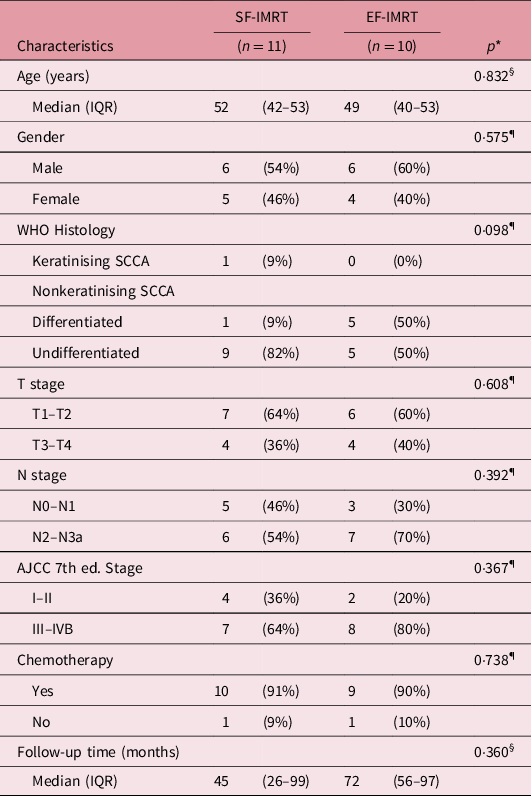
The patient and tumour characteristics are listed in Table 1. Both arms were comparable, including age, gender, staging and the World Health Organisation (WHO) classification. The most common histologic type in this study was undifferentiated carcinoma. One patient had WHO type 1; keratinizing squamous cell carcinoma. Two patients with stage I disease received only radiotherapy (RT) alone.
Patients and tumour characteristics

Tests: § Mann–Whitney U test; ¶ Fisher’s exact test
* p < 0·05 considered statistically significant.
Abbreviation: IQR, interquartile range.
The median follow-up time for all patients was 62 (IQR 39–97) months, while shorter in the SF-IMRT arm (45 months: IQR 26–99) than the EF-IMRT arm (72 months: IQR 56–97), respectively.
Treatment failures occurred in six patients (29%): two with locoregional recurrences, two with locoregional recurrences and distant metastasis and two with distant metastasis. Regional failures occurred in three patients (14%): two patients treated by SF-IMRT, more than 5 cm above the match line, and one patient treated by EF-IMRT. The 5-year LRFFS and DMFFS were 65% [95% confidence interval (CI): 40–82%; p = 0·1672] and 78% (95% CI: 52–91%; p = 0·2466) respectively. The 5-year OS was 80% (95% CI: 55–92%) without a statistically significant difference between the groups (p = 0·3154).
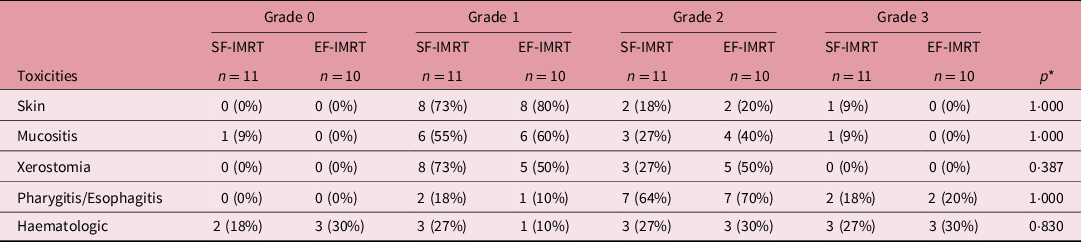
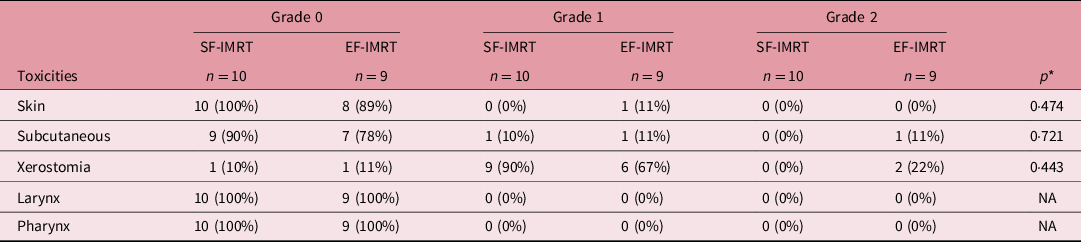
Toxicities: Tables 2 and 3 present the acute and late toxicities found in this study.
Acute toxicities

Tests: Fisher’s exact test.
* p < 0·05 considered statistically significant.
Late toxicities

Note: Late toxicities of one patient with SF IMRT and one with EF IMRT were not available.
Tests: Fisher’s exact test.
* p < 0·05 considered statistically significant.
Four patients (19%) needed nasogastric tube insertion during the RT period, two patients (18%) in SF-IMRT arm, and two patients (20%) with EF-IMRT arm (p = 1·000). After 2 months of RT completion, no patient needed nasogastric tube insertion.
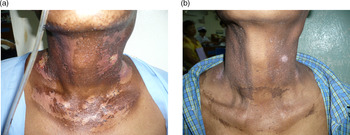
Grade 2 or more acute skin toxicity was observed in four patients (38%) in the SF-IMRT and three patients (30%) in the EF-IMRT (p = 1·000). Acute skin toxicity was usually mild. One patient (9%) with T2N3aM0 NPC in the SF-IMRT arm developed grade 3 acute skin toxicity (Figure 1), which was confluent moist desquamation at the right supraclavicular region during the 5th week of RT period and improved within 1 month after RT completion.
Photographs demonstrating grade 3 acute skin toxicity in a patient in the SF-IMRT arm. Photos are taken a) during the 5th week of the radiotherapy b) 1 month after radiotherapy completion.

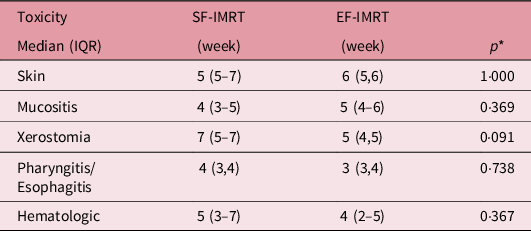
A grade 2 or more acute haematologic toxicity was found in six patients (55%) in the SF-IMRT versus six patients (60%) in the EF-IMRT (p = 0·830). No acute haematologic toxicity occurred in the two patients who received RT alone. Both of them had only grade 1 skin toxicity and xerostomia but developed grade 2 pharyngitis which completely recovered after RT completion. The median time from the beginning of treatment to the development of grade 2 or more acute toxicities was comparable between the two arms as shown in Table 4.
Median time to the occurrence of grade 2 or more acute toxicities

Tests: Mann–Whitney U test.
* p < 0·05 considered statistically significant.
Severe late toxicity was not found in both groups of patients. However, grade 2 late subcutaneous toxicity and grade 2 late xerostomia were found in one and two patients in the EF-IMRT group, respectively.
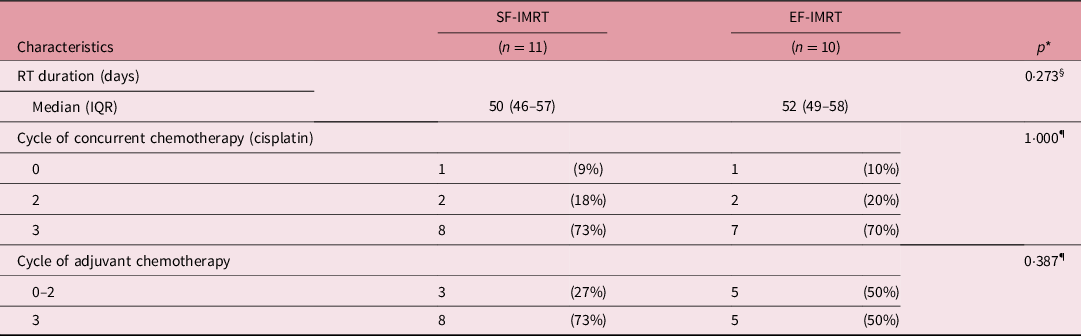
Treatment compliance is shown in Table 5: The median time required to complete RT was 51 (IQR 47–58) days, including holidays and weekends. The median time to complete RT was 50 (46–57) days with the SF-IMRT compared to 52 (49–58) days for the EF-IMRT (p = 0·273). Only one patient (9%) treating with the SF-IMRT required an interruption in his treatment of more than 7 days because of grade 3 acute toxicity compared with two patients (20%) treated with the EF-IMRT (p = 0·486).
Compliance of treatments

Tests: § Mann–Whitney U test; ¶ Fisher’s exact test.
* p < 0·05 considered statistically significant.
For compliance of chemotherapy, 19 patients with AJCC 7th ed. stage II or greater received two or more cycles of CCRT with cisplatin. Eight patients (73%) in the SF-IMRT arm received three cycles of adjuvant chemotherapy compared with five patients (50%) in the EF-IMRT arm (p = 0·387).
Discussion
This study is the first prospective study to compare acute and late toxicities between two different RT techniques (SF versus EF step-and-shoot IMRT) for NPC patients. From our results, all the survival outcomes (LRFFS, DMFFS, and OS) and toxicity profiles between both groups did not reach any statistically significance.
According to the study of Lee et al.,Reference Lee, Mechalakos, Puri and Hunt20 they compared the study between SF-IMRT and EF-IMRT in the six common primary cancer sites of the head and neck area. Target coverage and also the dose to the important surrounded OARs were comparable between these two IMRT techniques. Their study concluded that SF-IMRT is the preferred technique for treating NPC and oropharyngeal cancer with the benefit of lowering the dose to the larynx structure. They recommend that the EF-IMRT technique is suitable for cancer of the larynx, hypopharynx and also neck node unknown primary cancer with the larynx suspected as a primary site.
The SF-IMRT technique may increase the unpredictable dose at the match line from the junction area between a conventional LNF and IMRT field. It may consequently affect disease failure, though the EF-IMRT technique was used to avoid this concern.
With the same idea, a dosimetric study by Yu et al.Reference Yu, Chen, Leary, Shugard and Yom21 showed the better LNF coverage with acceptable thyroid and larynx sparing in the EF-IMRT arm compared to the SF-IMRT arm. They concluded that the EF-IMRT should be the standard treatment technique and the SF-IMRT is an alternative treatment for patients at very low risk for involvement of the LNF.
Moreover, a retrospective study by Turaka et al.Reference Turaka, Li and Nicolaou22 reported clinical outcomes of 91 patients with head and neck squamous cell carcinoma, who were treated with curative intent SF-IMRT versus EF-IMRT at Fox Chase Cancer Center. Thirty-seven patients (41%) were treated with the SF-IMRT. Forty-four patients (48%) had oropharyngeal cancer, 22 (24%) oral cavity cancer, 6 (7%) laryngeal cancer and 6 (7%) NPC. Postoperative RT was given to 29% of patients, whereas 71% were treated with definitive RT (19% RT alone and 52% CCRT). Most of the patients experienced grade 2 and 3 skin and mucosal toxicities, either treated with SF or EF-IMRT. In total, 3% of patients with SF-IMRT developed grade 4 toxicity. There were no other crucial grade 3 or 4 toxicities in both groups. Eighteen patients (33%) with EF-IMRT needed a percutaneous endoscopic gastrostomy (PEG) tube during treatment, compared to 11 patients (29%) in with SF-IMRT (p = 0·82). Failures occurred in 12 patients (13%). One patient treated with SF-IMRT had a regional failure located 4.5 cm above the match line (p = 0·04).
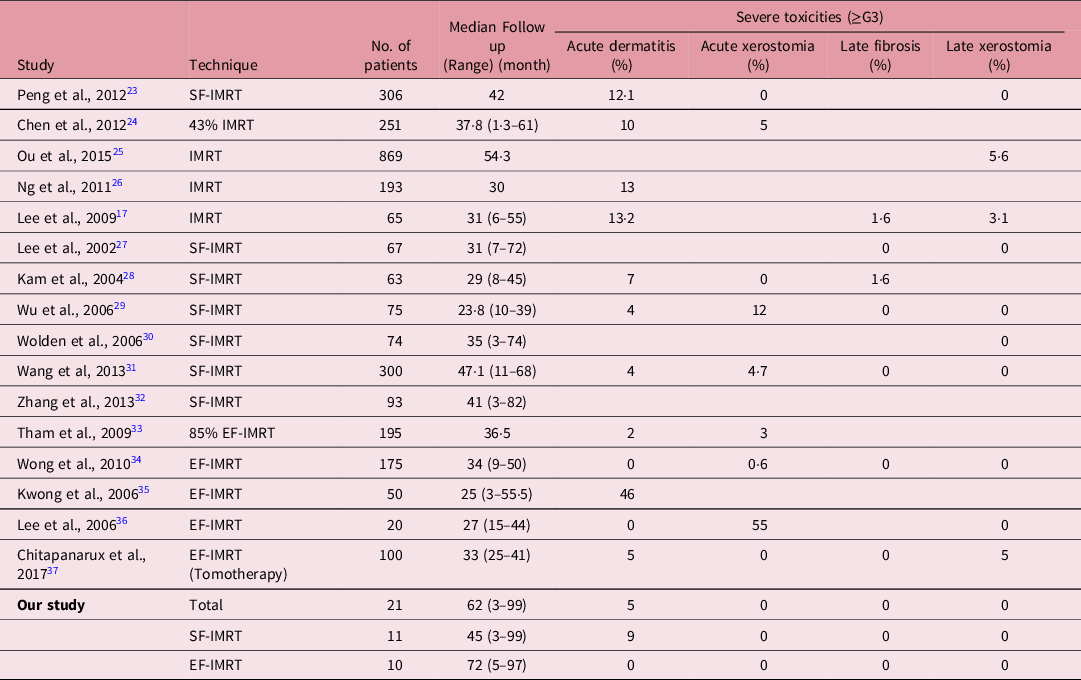
In comparison to other studies,Reference Lee, Harris and Garden17,Reference Peng, Wang and Yang23–Reference Ng, Lee and Hung26 our results found a lower incidence of severe acute dermatitis, mucosal toxicities, late fibrosis and late xerostomia (Table 6). There were no grade 4 toxicities in both groups. Only four patients (19%) in our study needed nasogastric tube insertion during the RT period.
Comparison of acute and late toxicities between both IMRT techniques studies

Although the problem of acute and late toxicities and regional recurrence at the IMRT/LNF match line in the SF-IMRT and the EF-IMRT were not different, we found one patient (9%) in the SF-IMRT developed severe acute skin toxicity, and none in the EF-IMRT. Severe grade 3 acute skin toxicity in the SF-IMRT affected compliance of the treatment (Figure 1). Two patients (20%) treated with SF-IMRT had regional failure more than 5 cm above the match line.
One distinct advantage of the EE-IMRT technique is that it can be delivered in one single dose painting plan, this avoids the tedious field matching (seamless radiation technique). Furthermore, the SF-IMRT technique presents challenges in field matching and planning and this requires additional workload for matching the inferior border of IMRT field and superior border of the lower neck field by conventional simulation. The small number of enrolled patients due to the treatment machine break down is the major limitation of this study. With these findings and circumstances, SF-IMRT could not replace EF-IMRT and EF-IMRT had been utilised in our routine practice since then.
Conclusion
It is concluded that both SF and EF step-and-shoot IMRT techniques for NPC patients are comparable in both acute and late toxicities. Although no difference in toxicity was observed, technical problems due to matching field management were the obstacles in utilisation of SF-IMRT in our routine practice.
Acknowledgements
None.
Financial Support
This research received grant from Faculty of Medicine, Chiang Mai University.
Conflicts of Interest
The authors have no conflicts of interest to declare.
Ethical Standards
The authors assert that all procedures contributing to this work comply with the ethical standards of the relevant national guidelines on human experimentation and with the Helsinki Declaration of 1975, as revised in 2008, and has been approved by the Institute Research Committee (Protocol Number RAD-2556-01983).