Introduction
Promotion of beef production in communal areas from indigenous and adaptable cattle breeds, such as the Nguni, has got the potential to increase off-take and reduce beef imports in South Africa where local meat supply cannot meet the demand for meat products. Assessment of meat production in the communal areas should include meat acceptability. Previous studies showed that there were no differences between beef from Nguni and Bonsmara steers in terms of their physical and histological meat quality characteristics (Muchenje et al., Reference Muchenje, Dzama, Chimonyo, Raats and Strydom2008a); while the Nguni had low tick loads and the Bonsmara had better carcass characteristics under natural grazing (Muchenje et al., Reference Muchenje, Dzama, Chimonyo, Raats and Strydom2008b), the Bonsmara steers were more stress-responsive at slaughter than the Nguni steers (Ndlovu et al., Reference Ndlovu, Chimonyo, Okoh and Muchenje2008). These studies however did not include sensory evaluation and its relationship with physical meat attributes.
The indigenous Nguni cattle breed of South Africa is small to medium sized, but adapted to harsh environments (Ndlovu et al., 2007; Muchenje et al., Reference Muchenje, Dzama, Chimonyo, Raats and Strydom2008a and Reference Muchenje, Dzama, Chimonyo, Raats and Strydom2008b). The Bonsmara competes favourably with European beef cattle while withstanding subtropical conditions, such as high temperatures, ticks and most tick-borne illnesses (Ndlovu et al., 2007; Muchenje et al., Reference Muchenje, Dzama, Chimonyo, Raats and Strydom2008a and Reference Muchenje, Dzama, Chimonyo, Raats and Strydom2008b). They are well muscled with high beef yield and quality. However, they are not as well adapted to harsh conditions as the Nguni breed. Although earlier work showed that most physical and histological meat quality characteristics (Muchenje et al., Reference Muchenje, Dzama, Chimonyo, Raats and Strydom2008a) and fatty acid profiles (Muchenje et al., 2007) of these breeds under natural grazing conditions did not differ significantly, there may be relationships between meat quality and its acceptability to the consumer. Since there may be relationships between some physical meat quality characteristics (Hoffman et al., Reference Hoffman, Kroucamp and Manley2007) and intramuscular fat (IMF) quantity and composition (Wood and Enser, Reference Wood and Enser1997) and sensory characteristics, the need for a sensory evaluation of beef from these two breeds under natural grazing is, therefore, not over-emphasized.
Components of the palatability of meat include tenderness, juiciness and flavour. Aroma, the impression that you form on the first bite of meat and the amount of connective tissue in meat are also important sensory characteristics (Hoffman et al., Reference Hoffman, Kroucamp and Manley2007). Of these attributes, consumers consider tenderness to be the most important factor influencing meat quality (Strydom et al., Reference Strydom, Naude, Smith, Scholtz and van Wyk2000). Relationships have been reported between physical meat quality characteristics and sensory characteristics, such as muscle fibre and overall tenderness (Hoffman et al., Reference Hoffman, Kroucamp and Manley2007); between quantity and composition of IMF and flavour (Melton, Reference Melton1990; Wood and Enser, Reference Wood and Enser1997; Calkins and Hodgen, Reference Calkins and Hodgen2007); and between treatments, sensory, instrumental and chemical descriptors (Spanier et al., Reference Spanier, Flores, McMillin and Bidner1997). However, flavour is a very complex attribute of meat palatability (Calkins and Hodgen, Reference Calkins and Hodgen2007). Juiciness also depends on the quantity and composition of fat in the meat (Melton, Reference Melton1990; Wood and Enser, Reference Wood and Enser1997). In addition, there have been reports of relationships between pH and several sensory characteristics (Calkins and Hodgen, Reference Calkins and Hodgen2007). The relationships between IMF, several physical meat quality characteristics and sensory characteristics are likely to depend on the condition of the animal.
Although Nguni beef had lower lightness (L* value) than Bonsmara beef in a previous study (Muchenje et al., Reference Muchenje, Dzama, Chimonyo, Raats and Strydom2008a), it is not clear whether the observed differences in the L* value among the breeds, though of little practical value (Muchenje et al., Reference Muchenje, Dzama, Chimonyo, Raats and Strydom2008a), could be reflected in the sensory testing of the beef. Furthermore, there is a need to establish whether there are any relationships between IMF and physical meat quality characteristics and sensory characteristics of beef. Studies on sensory characteristics of Nguni beef have been carried out on feedlot systems under commercial farming conditions (Strydom et al., Reference Strydom, Naude, Smith, Scholtz and van Wyk2000 and Reference Strydom, Naude, Smith, Kotze, Scholtz and van Wyk2001; Du Plessis and Hoffman, Reference Du Plessis and Hoffman2007). No information is available on the sensory characteristics and their relationships with IMF and physical characteristics of beef from Nguni cattle raised on natural pasture without dietary supplementation, as is practised in rural areas. There is, therefore, a need to evaluate sensory characteristics and their relationships with IMF and physical characteristics of beef from the Nguni cattle produced under conditions that mimic rural conditions and management systems.
The objective of the current study was to compare the sensory characteristics, together with their relationships with IMF and physical characteristics, of beef from Nguni v. that of beef from Bonsmara steers when raised on natural pasture. The null hypothesis tested was that, under natural grazing, sensory characteristics and their relationships with IMF and physical meat quality characteristics of beef from Nguni steers are similar to those of beef from the Bonsmara breeds.
Material and methods
Description of study site
The study was conducted at Honeydale Farm, University of Fort Hare. The farm is 520 m above the sea level and is located 32.8° latitude and 26.9° longitude. It is situated in the False Thornveld of the Eastern Cape, with an average annual rainfall of 480 mm. Most of the rainfall is during summer. The mean annual temperature of the farm is 18.7°C. The vegetation is composed of several trees, shrubs and grass species. Acacia karroo, Themeda triandra, Panicum maximum, Digitaria eriantha, Eragrostis spp, Cynodon dactylon and Pennisetum clandestinum are the dominant plant species. The topography of the area is generally flat with a few steep slopes.
Animal management, handling and slaughter procedure
Fifteen steers of the Bonsmara breed and 25 steers of the Nguni breed of similar age (around 205 days) were raised at Honeydale Farm, University of Fort Hare, till slaughter at 18 months of age. The details of how the animals were managed and slaughtered were as described by Muchenje et al. (Reference Muchenje, Dzama, Chimonyo, Raats and Strydom2008a). In brief, the animals rotationally grazed on natural pasture. The steers were never given any dietary supplementation. Monthly weights of all animals were recorded to monitor the growth of the steers. On the day prior to slaughter, the animals were weighed off-pasture and were kept overnight at the abattoir holding pens without food. Water was available at all times.
The average slaughter weights of the Nguni and the Bonsmara steers were 224 and 260 kg, respectively. The average daily gains were 201 and 231 g/day for the Nguni and Bonsmara steers, respectively. Animal slaughter and dressing were performed following usual commercial procedures at the East London Abattoir. The captive bolt method was used to stun the animals. Carcasses were electrically stimulated, using a voltage of 300 V, a frequency of 50 Hz, a current of 5 A in 40 to 45 s at a pulse of 12 per second, to control the effect of rapid chilling on cold shortening of muscles.
The m. longissimus thoracis et lumborum (LTL) of the left and right sides were sampled, a day after slaughter, from the 10th rib in the direction of the rump in the following order and amounts for meat quality and sensory characteristics of meat analyses:
(a) 300 mm thick, of the anterior side of the left LTL for 2-day-aged Warner Bratzler (WBSF2) and sensory tests,
(b) 300 mm thick, of the anterior side of the right LTL for 21-day-aged Warner Bratzler (WBSF21) and sensory tests,
(c) a 20 mm steak for myofibrillar fragment length measurement on 2-day-aged sample (MFL2),
(d) a 20 mm steak for myofibrillar fragment length measurement on 21-day-aged sample (MFL21),
(e) a 15 mm steak for drip loss determination in duplicate,
(f) a 20 mm steak, of the near posterior side of the left LTL for water-holding capacity (WHC) determination.
This amounted to approximately 2.5 kg meat sample per animal. All the meat quality analyses were done on the LTL.
Meat quality measurements
pH and drip loss measurement
A pH meter was used to measure ultimate pH (pHu) of the LTL 24 h post mortem. For drip loss measurement, two blocks of meat measuring 15 × 15 × 30 mm were sliced from the LTL steak so that the fibres ran across the longer axis of the sample. The samples were suspended on metal hooks in plastic sample bottles so that the sample did not touch the side of the bottle. The suspended samples were stored in a cool room at 2°C for 72 h and the drip loss calculated as the differences between the initial and final weight of the sample expressed as a percentage.
Myofibrillar fragment length determination
Two samples, each weighing approximately 50 g, of the LTL was sampled for myofibrillar fragment length (MFL) measurement, which indicates fragmentation due to post mortem proteolysis (determination of ageing rate over 21 days). The samples were vacuum-packed and aged for 2 and 21 days at 3°C, and were prepared for MFL. The MFL was determined by the method of Culler et al. (Reference Culler, Parrish, Smith and Cross1978) as modified by Heinze and Bruggemann (Reference Heinze and Bruggemann1994). The methods involved the extraction of the myofibres in the buffer solution at around 4°C to arrest any further proteolysis. Droplets of the extracted MFL solution were mounted on a slide, covered and viewed at a magnification of 40× under a microscope attached to the VIA. The MFL was determined as the average length of the first 50 myofibrills that were longer than five sarcomeres.
Warner Bratzler shear force determination
The sampled LTL to be used for shear force resistance were vacuum-packed and either frozen directly (for those aged for 2 days) or aged at 2°C for a further 19 days after processing (21 days in total) and frozen. Two days before preparation, three steaks measuring 30 mm thick were cut with a band saw, vacuum-packed and thawed over 24 h at 0°C to 4°C. The steaks were prepared according to an oven-broiling method using direct radiant heat (AMSA (American Meat Science Association), 1978). An electric oven (SAMMIC P8D-2. Azpeitia, Spain) was set on ‘broil’ 10 min prior to preparation at 260°C. Steaks were placed on an oven pan on a rack to allow meat juices to drain during cooking and placed in the pre-heated oven 90 mm below the heat source. The steaks were cooked to an internal temperature of 35°C recorded by direct probe, then turned and finished to 70°C. Raw and cooked weights were recorded.
Following cooking, the steaks were cooled down at room temperature for 5 h before shear force determination. Eight sub-samples measuring 2.5 mm core diameter were cored parallel to the grain of the meat, and sheared perpendicular to the fibre direction using a Warner Bratzler (WB) shear device mounted on a Universal Instron apparatus (cross-head speed = 400 mm/min, one shear in the centre of each core). The mean maximum load recorded for the eight cores represented the average of the peak force in Newtons (N) of each sample.
Water-holding capacity measurements
WHC was measured as the amount of water expressed from a minced meat sample (1 g) held under pressure (60 kg pressure) using the filter-paper press method developed by Grau and Hamm (Reference Grau and Hamm1957). WHC was calculated using the equation (WHC = 100% − [(outer circle area − inner circle area)/outer circle area] × 100%).
Intramuscular fat determination
Total lipid from muscle sample was quantitatively extracted, according to the method of Folch et al. (Reference Folch, Lees and Sloane-Stanley1957), using chloroform and methanol in a ratio of 2 : 1. An antioxidant, butylated hydroxytoluene was added at a concentration of 0.001% to the chloroform : methanol mixture. A rotary evaporator was used to dry the fat extracts under vacuum and the extracts were dried overnight in a vacuum oven at 50°C, using phosphorus pentoxide as moisture adsorbent. Total extractable IMF (marbling) was determined gravimetrically from the extracted fat and expressed as %fat (w/w) per 100 g tissue. The extracted fat was stored in a polytop (glass vial, with push-in top) under a blanket of nitrogen and frozen at −20°C, pending analyses.
Sensory evaluation
The meat samples were cooked as described for the Warner Bratzler shear force determination. Every steak was then trimmed of any external connective tissue, cut into approximately 2 × 2 × 2 cm samples, wrapped in coded aluminium foil and stored in warm pans at 60°C until tasting. Samples were put in plates and randomly allocated in individual booths under red lighting to mask the differences in meat colour. Each of the 10 panellists had wide experience in meat sensory evaluation. The panel performed training tests using the methods outlined in ISO 8586-1 (1993). From each plate the panellists evaluated six samples, corresponding to the two ageing times (2 and 21 days) in each of the two breeds. The panellist evaluated all samples once. Samples were presented in a different order to each panellist.
On an eight-point rating scale, assessments were made on beef aroma intensity, initial impression of juiciness (defined as the amount of fluid exuded on the cut surface when pressed between the thumb and the forefinger), first bite (defined as the impression that you form on the first bite) and sustained impression of juiciness (defined as the impression of juiciness that you form as you start chewing). The assessment criteria also included tenderness (defined as the opposite of the force required to bite through the sample with the molars), amount of connective tissue (defined as the chewiness of the meat), overall flavour intensity (defined as the combination of taste while chewing and swallowing – referring to the typical beef flavour) and atypical flavour intensity (this refers to a flavour that is present over and above typical beef flavour, such as livery, bloody, metallic, grassy, cooked vegetables). A score of 1 stood for extremely low aroma and flavour intensities, tough, dry, abundant connective tissue and no atypical flavour and 8 stood for extremely intense aroma and flavour intensities, very tender, very juicy, no connective tissue and extremely intense atypical flavour (ISO 8586-1, 1993).
Statistical analysis
The effects of breed on meat quality traits and IMF were analysed using generalized linear models procedures of SAS (2000). Data from the sensory panel tests were analysed by the PROC MIXED procedure of SAS (2000) considering the effects of panellist as random, breed and ageing as fixed effects. Interactions among the main factors were also fitted in the model. The significant differences between least-square group means were compared using the PDIFF test of SAS (2000), with a significance level of P < 0.05. Pearson’s correlation coefficients between physical meat quality traits, IMF and sensory characteristics within breeds were also determined (SAS, 2000).
Results
Intramuscular fat and physical meat quality characteristics
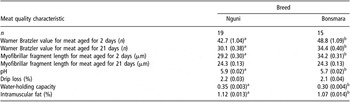
Table 1 shows that there were significant (P < 0.05) breed effects on most physical meat quality characteristics. Beef from the Nguni steers was more (P < 0.05) tender than the beef from the Bonsmara steers. Furthermore, the beef from the Nguni steers had higher (P < 0.05) pH level and higher (P < 0.05) WHC than the beef from the Bonsmara steers. Beef from the Nguni steers had higher (P < 0.05) IMF levels than the beef from the Bonsmara steers.
Least square means (s.e.) of meat quality characteristics and intramuscular fat of Nguni and Bonsmara steers

Means in the same row with different superscripts are significantly different at P < 0.05.
Sensory characteristics of beef from Nguni and Bonsmara steers
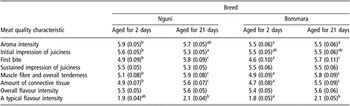
Table 2 shows that beef from Nguni steers had higher (P < 0.05) scores than beef from the Bonsmara in most sensory characteristics for beef aged for 2 days. There were no (P > 0.05) significant breed effects on the initial impression of juiciness and flavour. Ageing too did not (P > 0.05) have significant effects on aroma, sustained juiciness and overall flavour. Except for a significant (P < 0.05) breed by ageing interaction on the initial impression on juiciness, there were no (P > 0.05) significant interactions between ageing and breed on most sensory characteristics.
Least square means (s.e.) of sensory characteristics of beef from Nguni and Bonsmara steers aged for 2 and 21 days

Means in the same row with different superscripts are significantly different at P < 0.05.
Relationships among sensory characteristics of beef and physical meat quality attributes
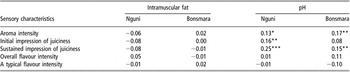
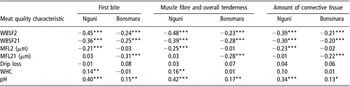
There were no (P > 0.05) significant correlations between IMF and sensory characteristics (Table 3). There were significant (P < 0.05) correlations between physical meat characteristics and sensory characteristics (Table 4). The MFL negatively correlated with beef tenderness attributes in Nguni (but not Bonsmara) when beef was aged for 2 days, but negatively correlated with the same attributes in Bonsmara (but not Nguni) when beef was aged for 21 days.
Correlation coefficients between intramuscular fat and pH, and juiciness, flavour and aroma of beef from Nguni and Bonsmara steers

NB: Significantly correlated at *P < 0.05, **P < 0.01, ***P < 0.001.
Correlation coefficients between pH, Warner-Bratzler shear force, myofibrillar fragment length, drip loss and water-holding capacity and first bite, muscle fibre and overall tenderness and connective tissue sensory characteristics of beef from Nguni and Bonsmara steers

WBSF2 = Warner Bratzler value for meat aged for 2 days; WBSF21 = Warner Bratzler value for meat aged for 21 days; MFL2 = myofibrillar fragment length for meat aged for 2 days; MFL21 = myofibrillar fragment length for meat aged for 21 days; WHC = water-holding capacity.
NB: Significantly correlated at *P < 0.05, **P < 0.01, ***P < 0.001.
Discussion
Intramuscular fat and physical meat quality characteristics
The results in this study contradict findings in earlier studies, where there were no breed effect on most physical and histological meat quality characteristics (Muchenje et al., Reference Muchenje, Dzama, Chimonyo, Raats and Strydom2008a) and IMF levels (Muchenje et al., 2007). Strydom et al. (Reference Strydom, Naude, Smith, Kotze, Scholtz and van Wyk2001) also reported no differences in WBSF values among Nguni and Bonsmara steers raised in a feedlot. Sañudo et al. (Reference Sañudo, Macie, Olleta, Villarroel, Panea and Alberti2004), however, reported that differences between breed types for most WBSF values were more pronounced at the lower carcass weight than at higher carcass weights. Meat tenderness is a function of the collagen content, heat stability and the myofibrillar structure of muscle, though these appear to be affected mainly by the rate of growth of the cattle rather than breed per se (Muir et al., Reference Muir, Wallace, Dobbie and Bown2000; Monsón et al., Reference Monsón, Sañudo and Sierra2005). Wheeler and Koohmaraie (Reference Wheeler and Koohmaraie1991) suggested that the myofibrillar component could be a more important factor than the connective tissue characteristics in influencing meat tenderness. Although there were (P < 0.05) breed effects on IMF, this might not have been biologically significant since the IMF levels in the current study were low. The steers used in the current study had low reserve fat, implying that the fat analyzed in the current study was mostly physiological – most likely the fat occurring in phospholipids in membranes. Biological significance is normally expressed in the reserve fat (Kazala et al., Reference Kazala, Lozeman, Mir, Laroche, Bailey and Weselake1999).
Relationships among sensory characteristics of beef and physical meat quality attributes
The results in this study are comparable with Strydom et al. (Reference Strydom, Naude, Smith, Kotze, Scholtz and van Wyk2001) in the strains of Nguni and Bonsmara that were raised in a feedlot and Du Plessis and Hoffman (Reference Du Plessis and Hoffman2007) in Nguni steers and Bonsmara crosses finished on natural pasture on a research station, although the scores in this study were lower than those reported by these authors. While breed differences (P < 0.0) were found in aroma in the current study, Strydom et al. (Reference Strydom, Naude, Smith, Kotze, Scholtz and van Wyk2001) did not find differences in aroma among the strains of Nguni and Bonsmara. Aroma scores in the beef from Nguni were higher (P < 0.05) than in the beef from the Bonsmara steers. There were no (P > 0.05) significant ageing effects on aroma.
As in the study by Strydom et al. (Reference Strydom, Naude, Smith, Kotze, Scholtz and van Wyk2001) on different strains of Nguni and Bonsmara, no (P > 0.05) breed differences were observed on overall flavour. This was despite the fact there were significant (P < 0.05) breed differences on the IMF of beef from the steers that were studied, although it may be argued that the low levels of IMF may not have been biologically significant. Flavour depends on the quantity and composition of fat in the meat (Melton, Reference Melton1990; Wood and Enser, Reference Wood and Enser1997; Calkins and Hodgen, Reference Calkins and Hodgen2007). Relationships between fat composition and flavour have also been observed for pork (Cameron et al., Reference Cameron, Enser, Nute, Whittington, Penman and Fisken2000) and in game meat (Hoffman et al., Reference Hoffman, Kroucamp and Manley2007), although flavour is a very complex attribute of meat palatability (Calkins and Hodgen, Reference Calkins and Hodgen2007). Unfortunately, fat composition was not determined in the current study. However, no (P > 0.05) significant correlation between IMF and flavour was found in the current study. This may be due to the low fat (<1.5%) levels of beef used.
There were no (P > 0.05) breed effects on atypical flavour. However, there were significant (P < 0.05) ageing effects on atypical flavour with beef aged for 21 days having higher (P < 0.05) scores (undesirable) than beef aged for 2 days. This is expected since off-flavours develop with ageing, especially at 21 days (Campo et al., Reference Campo, Sañudo, Panea, Alberti and Santolaria1999). Meat nitrogen-containing compounds can be formed by natural degradation occurring during ageing, and some of them have been reported to possess a variety of meat notes (Maga, Reference Maga1976), which can partially explain the increasing value of the odour. The rest of the overall odour could be due to many volatile compounds, which have been described as components of cooked meat (Farmer and Patterson, Reference Farmer and Patterson1991), although their influence on the perceived odour is not fully understood.
There were no (P > 0.05) breed effects on initial impression on juiciness while the Nguni beef aged for 2 days had higher (P < 0.05) initial impression on juiciness scores than the Nguni beef aged for 21 days. There were no (P > 0.05) ageing effects on sustained impression on juiciness. Strydom et al. (Reference Strydom, Naude, Smith, Kotze, Scholtz and van Wyk2001) reported higher juiciness scores on Nguni strains than on Bonsmara strains. As in this study (Table 3), Hoffman et al. (Reference Hoffman, Kroucamp and Manley2007) did not observe any correlation between IMF content and sustained juiciness ratings of the meat. The same authors suggested that the lack of correlation between IMF and sustained juiciness could have been due to the relatively low IMF content (<2%) of the springbok meat. This could have been the case in this study where the IMF content was low (1.07% for beef from the Bonsmara steers and 1.12% for beef from the Nguni steers).
The amount of connective tissue, muscle fibre and overall tenderness and impression on first bite scores were higher (P < 0.05) in beef from Nguni steers that were aged for 21 days and lowest (P < 0.05) in beef from Bonsmara steers that were aged for 2 days. Overall, beef from Nguni steers had higher (P < 0.05) rating for the amount of connective tissue, muscle fibre and overall tenderness and impression on first bite than beef from the Bonsmara steers in beef aged for 2 days while there were no differences in meat aged for 21 days. The absence of breed differences in beef aged for 21 days could be due to the fact that ageing of beef from both breeds was complete by day 21. Beef aged for 21 days had higher scores for the amount of connective tissue, muscle fibre and overall tenderness and impression on first bite than beef aged for 2 days in all the breeds. Strydom et al. (Reference Strydom, Naude, Smith, Kotze, Scholtz and van Wyk2001) found the Nguni strains to have higher tenderness and residual tissues scores than the Bonsmara strains. Hoffman et al. (Reference Hoffman, Kroucamp and Manley2007) reported an inverse correlation between mean shear force values and tenderness ratings of game meat, confirming a decrease in tenderness ratings with an increase in the shear force values of the meat. In the present study, beef from Nguni steers had lower (P < 0.05) WBSF and MFL values than beef from Bonsmara steers.
The finding that Nguni beef had higher (P < 0.05) scores for the amount of connective tissue, muscle fibre and overall tenderness and impression on first bite scores, therefore, agrees with the physical beef characteristics in this study. In addition, inverse relationships (P < 0.05) between WBSF and MFL values and tenderness ratings in all the two breeds were observed. There were, however, notable absence of such relationships between MFL values of beef aged for 2 days (MFL2) and tenderness and connective ratings in beef from Bonsmara, and between MFL for beef aged for 21 days (MFL21) and tenderness and connective tissue ratings in beef from Nguni steers. The reasons for the differences in relationships between the two breeds are not clear.
The presence of negative correlations between MFL and beef tenderness attributes in Nguni (but not Bonsmara) when beef were aged for 2 days, and the presence of negative correlations between MFL and the same attributes in Bonsmara (but not Nguni) when beef were aged for 21 days may be attributed to the different rates of proteolysis in beef from different breeds. Unfortunately, the rate of proteolysis was not determined in the current study.
There were no relationships between drip loss and any sensory characteristics while WHC only had a positive (P < 0.05) correlation coefficient with muscle fibre and overall tenderness and impression on first bite. The pH of beef was positively (P < 0.05) correlated to most sensory characteristics in beef from both the Nguni and Bonsmara steers. A positive correlation between pH and tenderness rating is expected since meat with higher pH is normally tender (Silva et al., Reference Silva, Patarata and Martins1999).
Although pH plays a role in the development of flavours in the Maillard reaction (Calkins and Hodgen, Reference Calkins and Hodgen2007), flavour did not (P > 0.05) significantly correlate with pH in the two breeds. The absence of a significant correlation coefficient between pH and flavour may be attributed to the narrow range (5.5 to 6.0) of pH of beef in this study.
Conclusions
Beef from Nguni steers had higher scores than the beef from Bonsmara steers for most sensory characteristics when meat was aged for 2 days while there were no breed differences in the sensory scores when beef was aged for 21 days. This implies that Nguni beef would be more preferable in South Africa where beef is consumed within 3 days of slaughter. It can also be concluded that while there were significant relationships between most physical meat quality and tenderness and connective tissue rating, no such relationship was observed between IMF and flavour, most probably due to low IMF levels in the studied beef. There is a need, therefore, to determine relationships between fat level and composition and the sensory characteristics of beef of steers of different body conditions.
Acknowledgements
This research was funded by the Kellogg Foundation (Project 388). The steers were slaughtered at the East London Abattoir. The meat samples were analysed at the Agricultural Research Council (ARC) Meat Industry Centre at Irene, Pretoria. Intramuscular fat (IMF) determination was performed at the University of Free State, Bloemfontein.