Introduction
Alzheimer’s disease (AD) is one of the most common causes of dementia which results in serious cognitive disability and slow destruction of neurons [Reference Kaushik, Kumar, Dwivedi, Bharadwaj, Kumar, Bharti, Kumar, Chaudhary and Mishra1]. It is generally associated with senile plaques and neurofibrillary tangles in the nervoussystem [Reference Austen, Frears and Davies2]. Amyloid-beta (Aβ) contributes to the formation of senile plaques, which has been reported to have various pathological effects on cell and organelle functions [Reference Beher, Wrigley, Owens and Shearman3]. Moreover, among various biomarkers such as Aβ1–42, phospho-tau-181, and total tau, Aβ-42 has been well established for the diagnosis of AD [Reference Marksteiner, Hinterhuber and Humpel4]. This neurodegenerative disorder is reported as one of the most progressive diseases that account for 60–75% of all the dementia cases. Recently, a study estimated that by 2050, the number of people with AD might reach 106.8 million [5]. Also, AD was documented as the most common form of dementia among neurodegenerative disorders and generally characterized by memory loss and cognitive dysfunction. With a rapidly increasing incidence, it demands immediate attention [Reference Goedert and Spillantini6]. In brief, it deteriorates the quality of life, decreases the life expectancy, and intensifies the physical disability. Although genetic factors are reported to be the most contributing factor, the principle mechanism behind AD is not still clear.
Recent studies have reported that the misfolded form of Aβ protein produces abnormal aggregates that escape the cellular quality control mechanisms. Such protein aggregates can cause a wide range of highly debilitating neurodegenerative disorders including AD. Clinicopathologic features of AD such as aggregation of insoluble senile plaques of Aβ peptides and neurofibrillary tangles have already been characterized [Reference Saido, Iwatsubo, Mann, Shimada, Ihara and Kawashima7]. Although pathology of AD has not been completely explored, it is suggested that proteolytic cleavage of amyloid precursor proteins (α, β, and γ-secretase) forms Aβ-42 aggregates in the brain, thus resulting in AD. Moreover, “amyloid cascade hypothesis” suggests that Aβ-42 initiated the pathological cascade of AD and presumed to play a significant role in AD [Reference Hardy and Higgins8]. Additionally, toxic species of Aβ-42 were established as soluble forms of small αβ oligomers [Reference Kayed, Head, Thompson, McIntire, Milton, Cotman and Glabe9]. The toxic mechanism of Aβ-42 is reported to be linked with the disruption of neuronal membrane composition following the formation of Aβ-42 channels [Reference Kawahara and Kuroda10]. Such channel formations lead to the disturbance of calcium homeostasis and other ions, promoting degenerative processes such as tau-phosphorylation and free radical formation [Reference Takashima, Noguchi, Sato, Hoshino and Imahori11, Reference Yatin, Aksenova, Aksenov, Markesbery, Aulick and Butterfield12]. Also, an increase in calcium ion concentration is shown to induce the secretion of Aβ-42 from amyloid precursor proteins [Reference Querfurth, Jiang, Geiger and Selkoe13]. Additionally, free radicals are reported to enhance membrane disruption, which further amplifies the unregulated calcium influx and finally leads to AD. Furthermore, as documented in different experiments and molecular dynamics simulation studies [Reference Capone, Jang, Kotler, Connelly, Teran Arce, Ramachandran, Kagan, Nussinov and Lal14, Reference Quist, Doudevski, Lin, Azimova, Ng, Frangione, Kagan, Ghiso and Lal15, Reference Bhatia, Lin and Lal16], formation of ion channels by Aβ-42 enhances the degenerative process of AD.
In modern scenarios, systems biology approach has been widely used to analyze the genomics and proteomics data and to investigate the interactions in various signaling and metabolic pathways. Also, synthetic biology or biological circuits, a component of electronics and biological sciences, have been used to shed light on biological networks linked to various diseases [Reference Lu, Jolly and Ben-Jacob17, Reference Jolly, Huang, Lu, Mani, Levine and Ben-Jacob18, Reference Kiel, Yus and Serrano19]. Biological circuits have been reported in various applications, including construction of sensor-based systems [Reference McMillen, Kopell, Hasty and Collins20], to investigate the up- and downregulation of biological signals [Reference Densmore and Hassoun21]. Moreover, biological circuits were proposed to be beneficial in the treatment of AD [Reference Khalil and Collins22]. Additionally, Boolean-based biological circuits were also reported as useful in the field of applied sciences [Reference Ozbudak, Thattai, Kurtser, Grossman and Van Oudenaarden23].
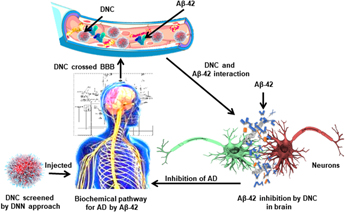
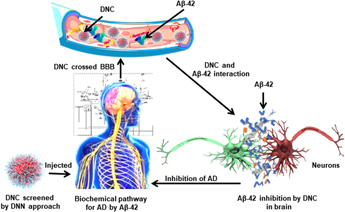
Recently, we have identified the small drug molecule wgx-50 as a potential inhibitor against Aβ-42 aggregates. We have also predicted the action mechanism of wgx-50 against Aβ peptides and Aβ channels [Reference Tang, Wang, Zhou, Xu, Li, Wang, Wei and Qiao24, Reference Hou, Gu and Wei25, Reference Fan, Gu, Wang, Pi, Zhang, Xu and Wei26]. In this study, we propose an algorithm to screen the potential inhibitors of Aβ-42 aggregates from the PubChem compounds library and check the synergistic effect of a potential drug with selected nanoparticles (NPs) such as gold NPs (AuNPs), manganese NPs (MnNPs), and superparamagnetic iron oxide NPs (SPIONs) against Aβ-42. We study these results using computational approaches and evaluate the synergistic effects of drug–nanoparticles complex (DNC) in the complete biochemical pathway of AD using synthetic biology approach, as shown in Fig. 1.
Schematic representation of drug–nanoparticles complex (DNC) generation by deep neural network (DNN) approach and its interactions with the Aβ-42 protein in the biochemical pathway of AD. The illustration represents the synergistic inhibition of Aβ-42 produced from the neurons by screened DNC in the biochemical pathway and hence demonstrated as potential treatment for the AD.

Results and discussion
Screening of inhibitors using deep neural network learning approach
We proposed an optimized deep neural network that operates directly on compounds’ structure. This approach allowed one to another point of structure for prediction, where inputs are chemical compounds along with their stereo-chemical properties. In this study, we usedPerl script to train and test our dataset that contained 27 million compounds of unique chemical features. We demonstrate the algorithm of proposed features in Sec. 1, which is more interpretable and has produced better predictive performance comparedwith the wet-lab data. After screening the entire PubChem compounds library, we concluded wgx-50 as the potential inhibitor against Aβ-42 protein and then further analyzed the screened drug with biocompatible NPs such as AuNPs, MnNPs, and SPIONs. We also compared our algorithm with other nature-inspired algorithms such as ant colony optimization and particle swarm optimization, but we found most significant results only with deep neural network analysis.
Section 1. Algorithm
Step 1: Input: Molecule with nanoparticles, radius (R), hidden weights (H1,…, Hn), output weights W1, …, Wn
Step 2: Initialize: Pattern vector f ← 0S
Step 3: or each atom in chemical compounds with nanoparticles
Step 4: r a ← g (a) atom features
Step 5: for L = 1 to n; for each layer of chemical compounds
Step 6: for each atom a in chemical compounds
Step 7: r1, …, r N = neighbors (a)
Step 8: v ← r a +  $\sum\limits_{i = 1}^N {{r_i}}$ Sum.
Step 9: ra ← σ(vH NL) smooth function.
Step 10: i ← softmax (r aW L) sparsify
Step 11: f ← f + i add to pattern
Step 12: Return: real-valued vector f
Molecular docking
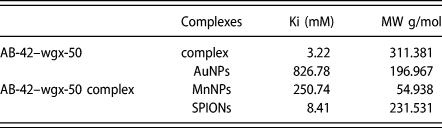
Aβ-42 was docked with wgx-50 and then wgx-50–Aβ-42 complex was docked with selected biocompatible NPs (AuNPs, MnNPs, and SPIONs). wgx-50–Aβ-42 complex showed potential binding affinity with 3.22 binding energy. Also, wgx-50–Aβ-42 complexed with NPs showed good binding affinity and recorded docking energies of 826.78 and 250.74 for AuNPs and MnNPs, respectively. However, wgx-50–Aβ-42 complex docked with SPIONs showed insufficient affinity (8.41) against wgx-50–Aβ-42 complex with AuNPs and MnNPs (Table I). Moreover, docking studies of SPIONs with wgx-50–Aβ-42 complex displayed pi-stacking interactions with active site residues by oxygen atoms (O1 and O2) and iron (Fe) atoms along with all the oxygen atoms (O1, O2, and O3). Interaction of wgx-50–Aβ-42 with AuNPs was also recorded to contribute to the stabilization of protein–metal interactions. Analysis of the drug molecule (wgx-50) as the standard control against drug–nanoparticles complex docked with Aβ-42 showed H-bond interaction and hydroxyl group (–OH) donor–acceptor bond on active site residues, respectively.
Molecular docking of wgx-50 with Aβ-42, and wgx-50–Aβ-42 complex with selected nanoparticles, i.e., AuNPs, MnNPs, and SPIONs, using modified script of atom types of AutoDock 4 (AD4), where Ki values depict log values.

The inhibitory constant (K i) value of Aβ-42 with wgx-50–AuNPs complex was recorded as 826.78 mM, and these results indicated that wgx-50–AuNPs complex has significant interactions with Aβ-42 protein in comparison with the other selected NPs. However, AuNPs showed good interaction or affinity with the carbon atoms of the protein, which may only alter the protein function.
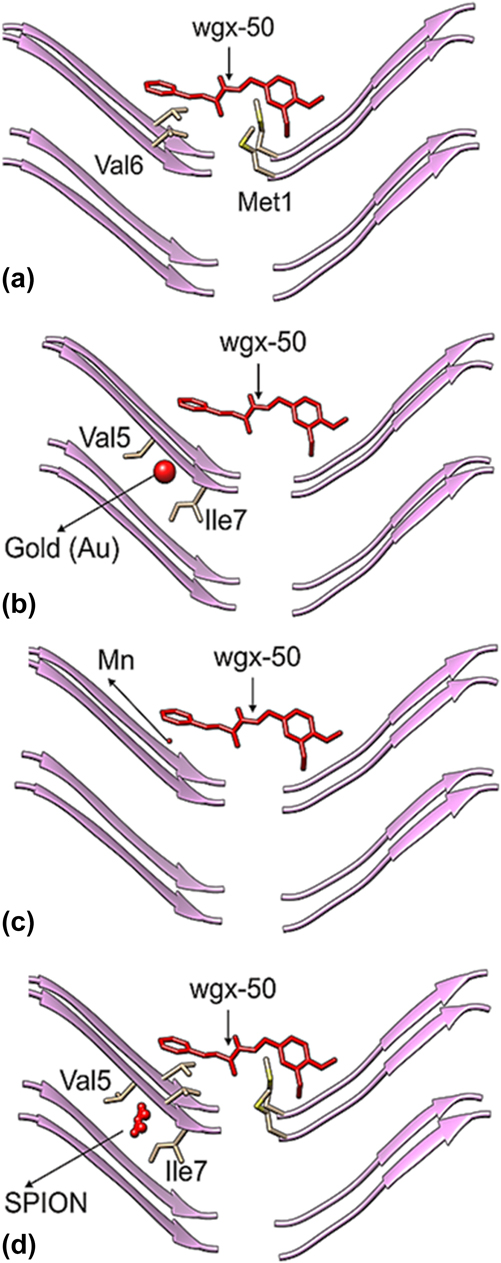
Docking energy recorded during the experiment showed that wgx-50 has formed stable complex with Aβ-42 and that among the selected NPs, SPIONs showed similar effect as wgx-50 molecules. Although AuNPs and MnNPs also showed similar effect as wgx-50 against Aβ-42, the effect was less in the case of SPIONs. To further validate the synergistic effect of drug–nanoparticles complex on Aβ-42 protein, we scrutinized the interaction between the entities at the molecular level (Fig. 2). It was observed that only wgx-50 showed potential binding with Aβ-42 and had made two contacts at Val6 and Met1 residues with Aβ-42 in the active region [Fig. 2(a)]. Also, wgx-50 complex with AuNPs [Fig. 2(b)] and SPIONs [Fig. 2(d)] showed similar way of contacts with Aβ-42 at Val5 and Ile7 residues, whereas MnNPs [Fig. 2(c)] showed no attraction with the residues of Aβ-42. These inspections at the molecular level suggested that AuNPs and SPIONs can be used as active nanoparticles along with wgx-50 to induce synergistic effects for the inhibition of Aβ-42 protein function in AD.
Docked complexes of Aβ-42 protein with (a) wgx-50, (b) wgx-50–AuNPs, (c) wgx-50–MnNPs, and (d) wgx-50–SPIONs. The wgx-50 and its complexes with all the selected NPs showed interaction with Aβ-42 except SPIONs.

Systems biology approach to predict dynamic changes in Alzheimer’s disease
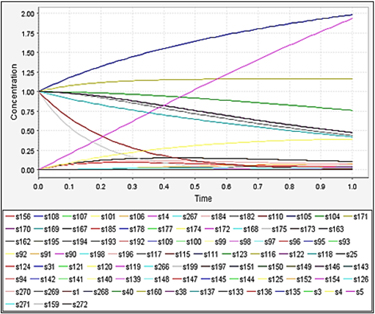
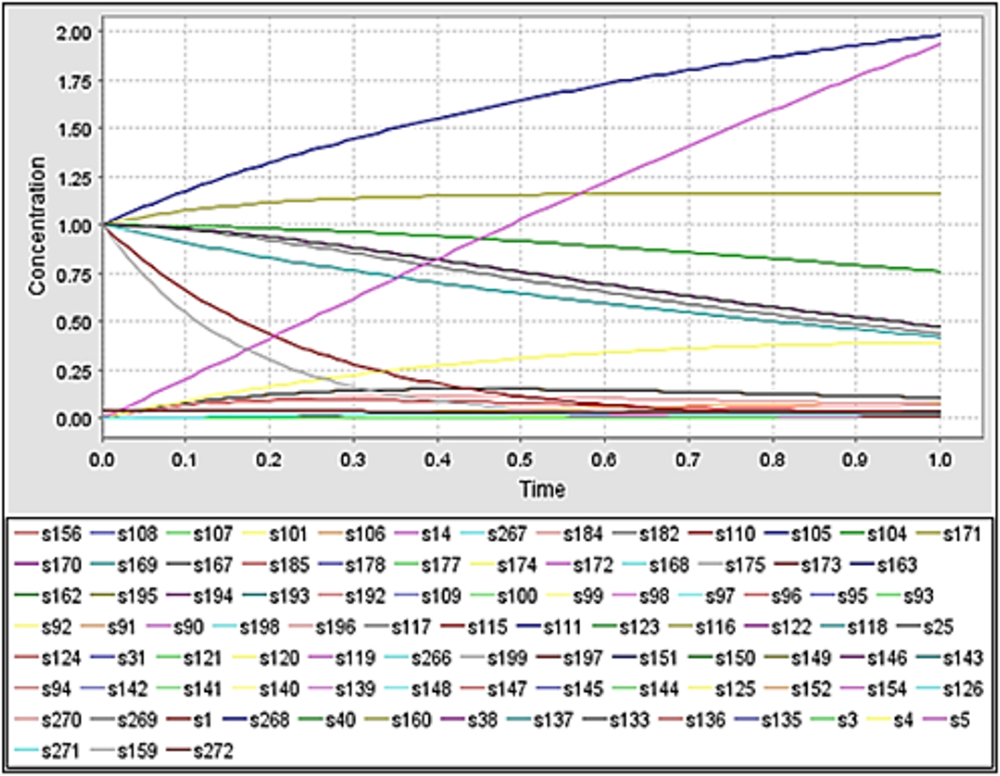
It has been well documented that the aggregates of Aβ, generated by the action of proteolytic enzymes (α, β, and γ-secretase) on the amyloid precursor proteins in the brain, play a significant role in AD. Herein, we designed the complete biochemical pathway of AD caused by Aβ-42 and studied the synergistic effects of screened wgx-50 complexed with AuNPs (Fig. S1) in comparison with wgx-50 alone (Fig. S2). The analysis of time course simulation (100s) using deep neural network approach for AD induced by Aβ-42 under the presence of wgx-50–AuNPs complex (Fig. 3) and wgx-50 alone (Fig. 4) reflected the inhibition of AD.
Time course simulation stands for all the interacting molecules in AD signaling cascade, where X-axis represents the time (second) and Y-axis indicates the concentration in µm. These simulations of AD induced by Aβ-42 and treated with wgx-50–AuNPs complex were produced using deep neural network approach based on virtual screening, where the initial concentration of wgx-50–AuNPs complex was assigned as 0.4 μM. After 100 s, all the interactions in the cell signaling cascade for AD mechanism were established.

Time course simulation stands for all the interacting molecules in AD signaling cascade, where X-axis represents the time (second) and Y-axis indicates the concentration in µm. These simulations of AD induced by Aβ-42 and treated with wgx-50 alone were produced using deep neural network approach based on virtual screening, where the initial concentration of wgx-50 was assigned as 0.4 μM. After 100 s, all the interactions in the cell signaling cascade for AD mechanism were established.

Systems biology reactions to validate potential drug–nanoparticles complex activity in entire systems
(i) Ordinary differential equations (ODEs) to model drug–nanoparticles complex concentration: An ordinary differential equation is an equation that involves some ordinary derivatives of a function:
 $${{{\rm{d}}x} / {{\rm{d}}t}}\left( t \right) = \cos \;t\quad ,$$
where function x(t) indicates that the antiderivative of cos t is sin t. Then x(t) must be sin t:
 $$x\left( t \right) = \sin \;t + C\quad ,$$
where C indicates arbitrary constant, whereas x(t) verifies and indeed and satisfies the following equation:
 $${{{\rm{d}}x} / {{\rm{d}}t}} = \cos \;t\quad .$$
Drug–nanoparticles complex injections can be modeled over time through ODEs of systems biology approach:
d([BBB])/dt = −ReactionFlux1,
d([BBB])/dt = ReactionFlux1 − ReactionFlux2,
d([BBB])/dt = ReactionFlux2 − ReactionFlux3,
d([BBB])/dt = ReactionFlux4 − ReactionFlux5 + ReactionFlux6 − ReactionFlux8 − ReactionFlux9,
d([BBB])/dt = ReactionFlux5 − ReactionFlux7,
d([BBB])/dt = 1/APP × (ReactionFlux16 − ReactionFlux17),
d([BBB])/dt = ReactionFlux10 − ReactionFlux11,
d([BBB])/dt = ReactionFlux11 − ReactionFlux12 − ReactionFlux13,
d([BBB])/dt = ReactionFlux12 − ReactionFlux14,
d([BBB Delay 1])/dt = 1/APP × (ReactionFlux15 − ReactionFlux18),
d([BBB Delay 2])/dt = 1/Aβ-42 × (ReactionFlux18 − ReactionFlux19),
d([Delayed Aβ-42 Signal])/dt = −alpha × ([Delayed Aβ-42 Signal] + ([Delayed Aβ-42 Signal Mode] == 0) × [Basal BBB] − ([Delayed Aβ-42 Signal Mode] ==1 ) × beta × ([Plasma Aβ-42 Conc] − [Basal Plasma Aβ-42 Conc])),
d([Plasma Aβ-42 Conc])/dt = [Plasma Aβ-42 Conc Rate].
Simulation studies of biochemical pathways
Systems biology is the study of biological components and simulation data predicting the biological behavior and identifying the processes or functions in a system. Concentration of wgx-50 (Fig. 3) and wgx-50–AuNPs complex (Fig. 4) was selected to be 0.4 μM based on the analysis of different concentrations using kinetic simulation. The mechanism of action of probable Aβ-42 inhibitors, and the effect of probable drug–nanoparticles complex on AD signaling network, can be used to predict the response of genes.
Time course simulation of AD pathway in presence of nano-drug were done at different concentrations, where colored peaks depict entities and concentrations. Y-axis represents the states and X-axis represents the time (second). The time course simulation studies were performed using different concentrations of both wgx-50–AuNPs complex (Fig. 3) and wgx-50 alone (Fig. 4), where the optimum concentration that inhibited AD was considered as 0.4 μM.
Biological circuit construction analysis against AD in the presence of a potential drug–NPs complex (wgx-50–AuNPs complex)
Synthetic biology gives an insight into the regulatory networks underlying various diseases. As reported in recent researches on cell behavior, molecular-based components can be used for the construction of complex circuits, which can be useful in designing synthetic circuits from digital-to-analog converters. Also, these circuits have a wide range of applications in construction of sensor systems simulations for biological systems to investigate gene and protein expression. It may be of relevance in medical and biological sciences, especially in drug discovery through exploration of mechanisms of target and ligand interactions. Engineering a trouble-free circuit built from side-to-side functional transmission of combinatorial libraries of a drug has been reported and can be helpful in curing hormonal diseases. Synthetic biology approach toggles two or three-way switch to control expansion and ability to analyze the circuit behavior. As mentioned earlier, the circuit switches “off” when the signal is “off,” and when signal is “on” the circuit becomes responsive in a log-linear fashion.
DNA computing is part of digital computing using DNA, biochemistry, and molecular biology as substitutes for silicon-based computer technologies. Synthetic biology was reported to include experiments and applications of DNA computing [Reference Kaushik and Sahi27]. However, theory on moletronic was initially introduced by Leonard Adleman [Reference Adleman28] and later proved with the use of DNA as a form of computation that was used to solve the seven-point Hamiltonian path problems [Reference Boneh, Dunworth, Lipton and Sgall29]. However, Mitsunori Ogihara and Animesh Ray proposed the evaluation of biological era using Boolean circuits [Reference Kari, Gloor and Yu30, Reference Ogihara and Ray31]. Recently, a DNA computer based on input and output module was capable of diagnosing the activity of cancerous cells and the effect of anticancerous drug release in the cell [Reference Benenson, Gil, Ben-Dor, Adar and Shapiro32].
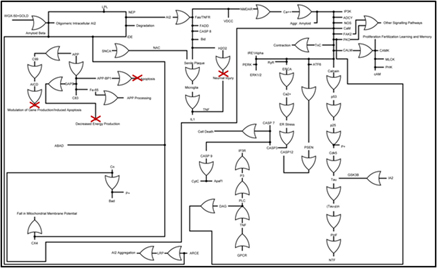
Hence, biological circuit can be constructed using Boolean algebra approach and may be further implemented through DNA computing approach, which can traverse the whole biological mechanism. Biological circuit implemented based on A, C, T, and G units thereby permits the organisms to sense and control the biological systems or up- or downregulation of the function. Here, we constructed the biological circuit for AD induced by Aβ-42 protein and treated with synergistic inhibition of screened wgx-50–AuNPs complex (Fig. 5). The designed biological circuit revealed the remarkable effect of wgx-50–AuNPs complex on signaling pathways of AD by suppressing the activity of Aβ-42 and hence preventing neural injury. The interaction of molecules in the AD pathway was analyzed in the form of logic GATE. In Fig. 5, lines represent the interactions and GATE represents the input and output of the molecules.
Biological circuit for biochemical pathway of AD. The designed circuit was generated for AD induced by Aβ-42, and the circuit was analyzed for the treatment of AD through synergistic impact of wgx-50–AuNPs complex as a screened potential inhibitor of Aβ-42.

Summary
Approximately 1.9 million deaths were reported in 2015 due to AD. To reduce the socio-economic burden of this disease, many important therapeutic biomarkers ranging from diagnosis to drug targets were identified and validated. Genetic risk, amyloid, tau, cholinergic hypothesis and many other important dimensions were reported to be the most frequent cause of this disorder. In this article, we proposed the deep neural network algorithm that has been employed to screened the potential inhibitors from chemical compounds library and new lead compounds against selected target were predicted against the amyloid beta protein as target based on molecular configuration such as size and shape. This approach evaluated the drug wgx-50 (compound) as potential inhibitor of Aβ-42 protein along with AuNP. Following, synergistic effect of drug wgx-50 + AuNP against Aβ-42 protein was evaluated and that showed significantly reduced the activity of the target protein. These results were further validated by computational approaches such system biology and synthetic biology. Additionally, the purposed biological circuits can be developed into sensor that can be advantageous to further study the extracellular as well as intracellular signals released for biological regulatory pathway for AD. This also opens a new avenue in the therapy of AD by employing synergistic inhibition of drug and nanoparticles such as AuNP.
Funding
This work is supported by the Key Research Area Grant 2016YFA0501703 from the Ministry of Science and Technology of China, State Key Laboratory on Microbial Metabolism, and Joint Research Funds for Medical and Engineering from Scientific Research at Shanghai Jiao Tong University.
Experimental procedure
Screening of Aβ-42 inhibitors using deep neural network approach
Several reports were published regarding using neural network approaches to predict novel and potential inhibitors for specific targets. The algorithm we propose in this study has been well established as a useful one in screening potential inhibitors based on their molecule arbitrary configurations such as size and shape. Although many machine learning approaches were proposed that can execute only inputs of fixed size, our deep neural network method operates directly on the dimensional feature vectors such as size, molecule arbitrary size, and shape as input data of the drug molecules along with NPs. Herein, we compute the molecular fingerprint vectors with differentiable neural networks whose input data represent the original molecules with NPs, whereas vertices and edges were marked for the individual atoms and bonds, respectively. The bottom layers of network were applied to each nodes and their neighborhood nodes (entities).
The proposed deep neural network algorithm was used for screening PubChem compounds library (http://pubchem.ncbi.nlm.nih.gov) [33]. Herein, we used 70/30 ratio of training and testing of dataset that contained 27 million compounds with unique chemical features for molecule arbitrary configurations such as size and shape. Generally, 70% of the available data are allocated for training and remaining 30% are equally partitioned and referred to as validation and test datasets. It should be ensured that the training dataset should include all possible patterns used for defining the problem and should extend to the edge of the modeling domain. We conformed to such important considerations and followed the above-mentioned 70/30 ratio. A total of 745 compounds were retrieved from the PubChem database, and after validation of the dataset, wgx-50 [(N-[2-(3,4-dimethoxyphenyl)ethyl]-3-phenylprop-2-enamide)] was selected as a potential inhibitor, when combined with NPs, against Aβ-42 protein.
Molecular modeling
Molecular docking was performed using AutoDockv4.4 [Reference Morris, Huey, Lindstrom, Sanner, Belew, Goodsell and Olson34] by preparing Aβ-42 as target and wgx-50 (N-[2-(3,4-dimethoxyphenyl)ethyl]-3-phenylprop-2-enamide) as ligand, with default parameters. Biocompatible NPs such as gold nanoparticles (AuNPs; CID23985), manganese nanoparticles (MnNPs; CID23930), and superparamagnetic iron oxide nanoparticles (SPIONs; CID16211978) were prepared by adding new AutoDock 4 (AD4) atom-type parameters in atom-type file. The docking grid shapes were placed at the center of the protein molecule, and output selections were collected based on default parameters using genetic and Lamarckian genetic algorithm.
Systems biology approach to predict dynamic changes in AD
To design and execute the biochemical pathway for AD induced by Aβ-42 in the presence of a screened potential drug with selected NPs, literature [Reference Kaushik, Bharadwaj, Kumar and Wei35] was collected for Aβ-42 interactions and then entire pathway was constructed using cell designer. In the designed pathway, nodes represent the entities, and edges signify the interactions between closely related nodes. In addition, time course simulations were also conducted with the screened drug at 0.4 μM concentration based on the information reported in the literature.
Evaluation of pharmacokinetic parameters of the screened drug–nanoparticles complex
To assess the pharmacokinetic parameters (in silico) of the potential screened drug–NPs complex, initially all the values for each molecule were assigned in terms of concentration. Then, Michaelis–Menten equation and mass action kinetics equation were applied for simulations, and entities such as proteins and genes involved in the AD interaction network in the presence of drug–nanoparticles complex were evaluated using GEPASI. Because kinetic simulation method has been well established in the estimation of the effective dose of test drug and because drugs generally follow the Michaelis–Menten first-order kinetics at therapeutic doses, the following equation can be used:
 $$V = {{{V_{\max }},\;S} \over {{K_{\rm{m}}} + S}}\quad ,$$
which can be transformed into the following form:
 $$C = {{{C_{\max }},D} \over {{K_{\rm{m}}} + D}}\quad ,$$
where C, A, C max, and D represent steady-state concentration, amount absorbed, maximum value for concentration C, and dose of drug–nanoparticles complex, respectively.
Biological circuit construction and analysis
Synthetic biology is a multidisciplinary field of bioinformatics, which is inclusive of electronics, genomics, and proteomics. It has recently gained relevance in medical and biological sciences, especially drug discovery through exploration of mechanisms of target and ligand interactions. Systems biology and synthetic biology impart accurate and robust approaches that have been incorporated into established practices. Synthetic biology approach has been applied in toggle two- or three-way switches to control the expansion and ability to analyze circuit behavior. The circuit switches “off” when the signal is “off,” and when signal is “on” the circuit becomes responsive in a log-linear fashion. In this study, biological circuit was constructed using Logisim [Reference Burch36], which is a well-known application for designing and simulating digital logic circuits. Also, the “combinational analysis” module allowed for conversion between circuits, truth tables, and Boolean expressions. Hence, the biological circuit thus designed depicted the interactions of screened potential drug–nanoparticles complex against Aβ-42 protein within the cell. In the biological circuit proposed for AD induced by Aβ-42, values were assigned in the binary form of 1 and 0.
Supplementary material
To view supplementary material for this article, please visit https://doi.org/10.1557/jmr.2018.452.
Authors contributions
Conceptualization: DQW, ACK
Data curation: ACK
Formal analysis: ACK
Funding acquisition: DQW
Investigation: DQW, ACK
Methodology: ACK
Project administration: DQW
Resources: ACK, DQW
Supervision: DQW
Validation: SB, DQW, ACK
Writing original draft: ACK, SB
Writing review draft: ACK, SB, DQW, AK, MJ, AA, AK, ZP.
Acknowledgments
The simulations in this work were supported by the Center for High Performance Computing, Shanghai Jiao Tong University.