

Over the last decades, metabolic diseases such as insulin resistance (IR), type-2 diabetes (T2D) and obesity have dramatically increased in both children and adults. Thus, worldwide prevalence of obesity has more than doubled between 1980 and 2014. 1 The pandemic of obesity and associated comorbidities may find part of its origin in the early postnatal life. Indeed, according to the Developmental Origins of Health and Disease, the fetal period and the first few months of postnatal life are a critical window for determining the flexibility of the system to cope with challenges in later life.Reference Hales and Barker 2 – Reference Nauta, Ben Amor, Knol, Garssen and van der Beek 4 Quality and quantity of early nutrition plays a crucial role since it can have a great influence on developing infants’ metabolism, impacting weight gain, adiposity and energy metabolism on the short and long term through physiological and behavioural pathways.Reference Thompson 5 Breast milk is recognized as the ideal nutrition for the full-term newborn. An exclusive breastfeeding for the first 6 months of life is therefore recommended by the World Health Organization. However, despite these recommendations, breastfeeding rates remain low. In 2013 in the United States, 81.1% of infants were breastfed at birth but only 22.3% were exclusively breastfed at the age of 6 months. 6 The same occurs in Europe, despite large disparities between countries, with breastfeeding rates beyond 4–6 months well below optimum levels.Reference Victora, Bahl and Barros 7 When breastfeeding is not possible or wanted, the only alternatives are infant formulas (IFs). Despite obvious improvements over the past 50 years, IFs remain perfectible to better approach the physiologic effects of breast milk. The objective of this review is to summarize differences between breastfed and formula-fed infants on long-term metabolic health, focusing on vaginal, term-born, healthy infants. It will then highlight the modifications that have already been made and that can further be made to IFs in order to better mimic the physiological effects of breast milk on both the short and long terms. Finally, it will attempt to approach the mechanisms, focusing on the ones involving gut microbiota, as it is known to be impacted by early nutrition and has a key role in regulating metabolism. For space reasons, the effects of early-life nutritional exposures on infections and immune diseases such as allergy and the interactions between gut microbiota and the immune system, recently published elsewhere,Reference Wang, Monaco and Donovan 8 , Reference Johnson and Ownby 9 will not be addressed in this review. Similarly, behavioural mechanisms, such as programming of food preferences and eating behaviour, will not be discussed, even though the early postnatal period is known to be essential for the establishment of odours and taste preferences and their maintenance in later life.Reference Dominguez 10 – Reference Mennella, Reiter and Daniels 13
Metabolic health benefits of breastfeeding compared with formula-feeding
Early nutrition is known to play a fundamental role in regulating body development and maturation of tissue functions with short- and long-term organ-specific and time of intervention-specific responses.Reference Koletzko, Brands and Grote 14 , Reference Gruszfeld and Socha 15 The first months of life are thus a critical time for preventing metabolic and cardiovascular disorders and obesity in later life. Infant growth trajectory and weight gain during the first year of life are one of the best predictors of obesity in later life, with an increase of 1 s.d. in weight z-score being associated with a two-fold higher obesity risk in childhood and a 23% higher obesity risk in adulthood.Reference Andersen, Holst, Michaelsen, Baker and Sorensen 16 , Reference Druet, Stettler and Sharp 17 More precisely, weight gain during the first 6 months of life is a better indicator of body composition in adolescence than weight gain from 6 months to 2 years of age.Reference Botton, Heude, Maccario, Ducimetiere and Charles 18 , Reference Chomtho, Wells and Williams 19 The early pattern of body fat is also indicative of later obesity: obese adults have often had an earlier adiposity rebound (at 3 years of age) than non-obese adults (at 6 years of age).Reference Rolland-Cachera, Deheeger, Maillot and Bellisle 20 Indeed, the early period of life is a sensitive period during which adipose tissue expands dramatically since the proliferative capacity of adipose precursor cells from subcutaneous adipose tissue is at its highest.Reference Ailhaud, Massiera and Weill 21 Therefore, numerous studies aiming at understanding the relationship between nutrition, growth in the first years of life and later risks for cardiometabolic disorders focussed on the comparison between breastfed and formula-fed infants.
Growth and body composition
Breastfed infants have a slower growth trajectory during the first months of life compared with formula-fed infants.Reference Dewey, Heinig, Nommsen, Peerson and Lonnerdal 22 – Reference Imai, Gunnarsdottir, Thorisdottir, Halldorsson and Thorsdottir 25 The advanced growth tempo, higher weight gain and earlier adiposity rebound of formula-fed children could lead to a higher obesity risk.Reference Rolland-Cachera, Deheeger, Maillot and Bellisle 20 , Reference Johnson, van Jaarsveld, Llewellyn, Cole and Wardle 23 , Reference Mihrshahi, Battistutta, Magarey and Daniels 26 – Reference Bell, Wagner, Feldman, Shypailo and Belfort 28 Indeed, formula-fed neonates would have a 22% higher risk of obesity in infancy compared with breastfed infants.Reference Arenz, Ruckerl, Koletzko and von Kries 29 Although the magnitude of breastfeeding protection may decrease over time, a 13% reduction in overweight and obesity has still been observed among adults.Reference Horta, Loret de Mola and Victora 30 An exclusive breastfeeding would be more efficient to prevent childhood obesity than mixed-feeding (breast milk and IFs), and mixed-feeding would be more efficient to prevent childhood obesity than exclusive formula-feeding.Reference Rossiter, Colapinto and Khan 31 Introducing an IF before 3 months may indeed increase odds of rapid growth in the first 6 years and is associated with higher mean body mass index (BMI) 20 years later.Reference Rzehak, Oddy and Mearin 27 However, the results of other clinical studies do not allow a clear conclusion on the relationship between an exclusive breastfeeding and a lower risk of childhood obesity.Reference Kramer, Matush and Vanilovich 32 – Reference Betoko, Charles and Hankard 35 The influence of non-investigated confounding factors such as the composition of human milk and its oligosaccharide content may explain the discrepancies between studies.Reference Uwaezuoke, Eneh and Ndu 36 As Beyerlein and von Kries already stated, it appears doubtful whether there will ever be a study that will have the appropriate methodology and the statistical power to conclude for or against a potential protective effect of breastfeeding against childhood overweight.Reference Beyerlein and von Kries 37
Metabolism/metabolic disorders
IR and T2D
Milk composition has a strong influence on metabolic programming. Weight gain between birth and 3 years of age predicted insulin sensitivity, BMI and waist circumference at the age 8 years.Reference Ong, Petry and Emmett 38 Formula-fed infants are at higher risk for IR and T2D in later life than the breastfed ones.Reference Horta, Loret de Mola and Victora 30 , Reference Owen, Martin, Whincup, Smith and Cook 39 , Reference Hui, Kwok and Nelson 40 Much higher urinary C-peptide concentrations (used as a measure of insulin secretion) were found in formula-fed infants compared with breastfed infantsReference Axelsson, Ivarsson and Raiha 41 as well as higher pre- and postprandial blood glucose levels.Reference Owen, Martin, Whincup, Smith and Cook 39 If higher glycaemia of formula-fed compared with breastfed infants no more persists in later life, differences in insulinaemia do continue. Breastfed infants have 3% lower insulin levels in later life (childhood and adulthood) compared with the formula-fed ones.Reference Owen, Martin, Whincup, Smith and Cook 39 At 8 years of age, overweight and obese infants formula-fed for 4 months or longer were more IR than the ones that were breastfed, and they compensated their lesser sensitivity by a higher insulin secretion.Reference Manco, Alterio and Bugianesi 42 These greater insulin levels in formula-fed infants may explain their greater deposition of subcutaneous adipose tissueReference Lucas, Sarson and Blackburn 43 and may be due to a faster increase in serum branched-chain amino acidsReference Newgard, An and Bain 44 as demonstrated in both animalReference O’Sullivan, He and McNiven 45 and humanReference Socha, Grote and Gruszfeld 46 – Reference Wang, Larson and Vasan 50 studies.
Cardiovascular risks factors
Early nutrition may also have an impact on cardiometabolic risk factors (dyslipidaemia and hypertension) and atherosclerosis in later life. Formula-fed infants could be at higher risk of atherosclerosis as a negative correlation has been found between inflammatory markers serum levels (serum monocyte chemoattractant protein-1 level and uric acid) and duration of breastfeeding.Reference Roszkowska, Taranta-Janusz, Tenderenda-Banasiuk and Wasilewska 51 Besides, observational studies suggested that formula-feeding could be associated with higher blood pressure levels in childhood compared with breastfeeding.Reference Wilson, Forsyth and Greene 52 , Reference Taittonen, Nuutinen, Turtinen and Uhari 53 A prospective study on Mexican children concluded that an exclusive and prolonged breastfeeding had a beneficial effect on later cardiometabolic health through lower total cholesterol, low-density lipoprotein (LDL) cholesterol and triglycerides levels at the age of 4.Reference Ramirez-Silva, Rivera and Trejo-Valdivia 54 Some studies demonstrated that these lower levels persisted even later in adulthood (from 17 to 64 years).Reference Owen, Whincup, Odoki, Gilg and Cook 55 Yet, earlier at 4 and 8 weeks of life, formula-fed infants had lower serum cholesterol, triglyceride and transaminase level (ALAT, ASAT, γGT) compared with breastfed infants.Reference Wu, Huang, Chen, Chen and Yang 56 The higher levels of cholesterol in breastfed infants before 1 year of age can be explained by the higher level of cholesterol in breast milk compared with IFs made with vegetable oils.Reference Owen, Whincup, Odoki, Gilg and Cook 55 The twist in cholesterol levels between formula-fed and breastfed infants may be due to a nutritional programming of cholesterol synthesis by early postnatal diet.Reference Owen, Whincup and Cook 57 In a pig model, the lower serum cholesterol concentration in formula-fed piglets compared with the breastfed ones was associated with an increase in mRNA encoding cholesterol 7 alpha-hydroxylase.Reference Ronis, Chen and Shankar 58 Despite the above studies, the long-term benefits of breastfeeding on preventing cardiovascular diseases remain controversialReference Horta, Loret de Mola and Victora 30 , Reference Izadi, Kelishadi and Qorbani 59 – Reference Martin, Ben-Shlomo and Gunnell 61 and further studies are required. Clearer results are mandatory to decipher whether reduced cholesterol level in early life has long-term deleterious consequences or not. A modest decrease in cholesterol level in adulthood could lead to a 5% reduction in coronary heart disease incidence.Reference Owen, Whincup and Cook 57
Improving IFs to approach the physiologic effects of breast milk
Breast milk remains the gold standard and the objective is therefore to improve the composition of IFs to better approach its physiologic effects. Breast milk has a unique composition that leads to specific metabolic and physiological responses.Reference Hamosh 62 Several factors have been suggested to explain the association between formula-feeding, growth, body composition and later risk of obesity and metabolic diseases. Differences in qualitative and quantitative intake in nutrients, hormones and milk bacteria may be involved. Since IF composition has greatly evolved and been improved over the last decades, cautiousness is needed when interpreting results from older cohorts.Reference Schack-Nielsen and Michaelsen 63
Macronutrients
Proteins
Cows’ milk proteins are the unique source of proteins in most IFs but have a lower quality compared with breast milk, partly because of differences in their amino acid contents. Over the last decades, the amount of protein per energy content has generally been higher in IFs than in human milk (0.9 g/100 ml in mature milk, 1.29–1.38 g/100 kcal)Reference Gidrewicz and Fenton 64 to meet infant’s protein and amino acid requirements.Reference Mace, Steenhout, Klassen and Donnet 65 Studies from the 1990s reported that formula-fed infants aged 3–12 months had 10–18% higher energy intakes and 55–80% higher protein supply per kg of body weight than breastfed infants.Reference Alexy, Kersting, Sichert-Hellert, Manz and Schoch 66 , Reference Heinig, Nommsen, Peerson, Lonnerdal and Dewey 67 A high protein intake in early infancy has been associated with an increased growth and higher later adiposity.Reference Escribano, Luque and Ferre 68 – Reference Voortman, Braun and Kiefte-de Jong 71 A high protein intake during the first year of life thus affected fat distribution in healthy children with an enhanced pre-peritoneal fat (a marker of visceral fat) but not subcutaneous fat tissue accumulation at the age 5 yearsReference Gruszfeld, Weber and Gradowska 70 and higher fat mass but not fat-free mass at the age 6 years.Reference Voortman, Braun and Kiefte-de Jong 71 According to the early protein hypothesis, the higher protein content in IFs could lead to increased circulating concentrations of insulin-releasing amino acids, stimulating the release of insulin and insulin-like growth factor I (IGF-1) and resulting in an accelerated growth, a faster weight gain and a greater adiposity.Reference Koletzko, Chourdakis and Grote 72 Formula-fed infants have higher levels of IGF-1 than breastfed infants at several ages and IGF-1 levels at 7–8 years of age was associated with the history of breastfeeding.Reference Savino, Fissore and Grassino 73 – Reference Martin, Holly and Smith 75 The early protein hypothesis was supported by a systematic literature review that assessed that a higher protein intake in infancy and early childhood was convincingly associated with increased growth and higher BMI in childhood, the first 2 years of life being likely most sensitive to high protein intake.Reference Hornell, Lagstrom, Lande and Thorsdottir 76 However, inconsistent evidence is available on the association beyond infancy and on later childhood overweight or obesity.Reference Patro-Golab, Zalewski and Kouwenhoven 77
An improvement of IFs has consisted in decreasing their protein content without altering the plasma amino acid profile. Two approaches has been considered: an increase in the proportion of α-lactalbuminReference Davis, Harris, Lien, Pramuk and Trabulsi 78 , Reference Sandstrom, Lonnerdal, Graverholt and Hernell 79 and, if necessary, the addition of free limiting amino acids.Reference Fazzolari-Nesci, Domianello, Sotera and Raiha 80 However, the addition of free amino acids in IFs may have long-term metabolic outcomes as they will be absorbed and oxidized more rapidly than protein-bound amino acids.Reference Menezes, Mucida and Cara 81
Infants fed a low-protein IF were lighter at the age 2 but had similar height than infants fed a high-protein IF,Reference Koletzko, von Kries and Closa 82 and their weight and BMI as well as their metabolism were closer to the ones of BF infants.Reference Koletzko, Beyer and Brands 83 At the age 6, their obesity risk was lowerReference Weber, Grote and Closa-Monasterolo 84 and at the age 14–16 years, it is expected to be 13% lower.Reference Koletzko, Beyer and Brands 83 Other factors than IGF-1 may also impact growth velocity since decreasing the IF protein content did not impact plasma IGF-1, insulin and C-peptide concentrations during the first year of life and body composition during the first 60 months of life but affected length and head circumference growth in a French randomized-controlled trial.Reference Putet, Labaune and Mace 85 Decreasing the protein content in IFs may also decrease the level of metabolic stressReference O’Sullivan, He and McNiven 45 by decreasing plasma levels of insulinogenic amino acids close to those induced by breast milk as well as urinary C-peptide level.Reference Axelsson, Ivarsson and Raiha 41
An ideal protein content of 1.8 g/100 kcal was therefore established for standard milk protein-based IFsReference Koletzko, von Kries and Closa 86 and protein content in IFs is now relatively close to the one found in breast milk.Reference Greer and Kleinman 87 Human milk also contains bioactive proteins such as lactoferrin (present at higher concentration in human milk compared with IFs),Reference Satue-Gracia, Frankel, Rangavajhyala and German 88 hormones and cytokines that may affect growth, body composition and metabolism in later life and explain differences observed between breastfed and formula-fed infants.Reference Fields, Schneider and Pavela 89 – Reference Badillo-Suarez, Rodriguez-Cruz and Nieves-Morales 92 The supplementation of IFs with bovine lactoferrin may help narrow the gap between breastfed and formula-fed infants.Reference Donovan 93 However, long-term and mechanistic studies are still missing.
Fat quality and structure
If in the early 20th century the fat matrix of IFs was made of cows’ milk fat and butterfat, today the fat matrix of most IFs is exclusively made of a blend of vegetable oils. The use of vegetable oils enabled to better mimic the human milk mono- and polyunsaturated fatty acid (PUFA) profilesReference Ailhaud, Massiera and Weill 21 but induced major differences in the fat globule and triglyceride structure. Regarding fatty acid profile, IFs usually contain more long-chain (LC) PUFAs of the ω-3 and ω-6 families due to their supplementation. If ω-3 LC-PUFAs have been associated with improved insulin sensitivity, reduced body weight gain and adiposity, and counteraction of dyslipidaemia in adult human and animal studies,Reference Flachs, Rossmeisl, Bryhn and Kopecky 94 data on nutritional programming by postnatal ω-3 LC-PUFAs are limited. In a male murine model, postnatal supplementation with ω-3 PUFAs reduced body fat deposition during adulthood and led to less hypertrophic adipocytes and healthier plasma lipid profile and glucose homoeostasis.Reference Oosting, Kegler and Boehm 95 Similar beneficial effects were observed with a low-ω-6-PUFA diet.Reference Oosting, Kegler, van de Heijning, Verkade and van der Beek 96 Both diets (high in ω-3 and low in ω-6) permanently affected the development of the central regulatory circuits controlling energy balance.Reference Schipper, Bouyer, Oosting, Simerly and van der Beek 97 The higher amount of ω-6 fatty acids in IFs than in breast milk may promote the adipose tissue development by enhancing the formation of pre-adipocytes,Reference Ailhaud, Massiera and Weill 21 and the arachidonic acid (ARA, ω-6) and its metabolites may directly be involved.Reference Ailhaud, Massiera and Weill 21 , Reference Massiera, Saint-Marc and Seydoux 98 However, a recent systematic review has concluded on the lack of evidence on consumption of LC-PUFA-supplemented IFs and later risk of obesity.Reference Patro-Golab, Zalewski and Kolodziej 99 Moreover, the supplementation of IFs with ARA and docosahexaenoic acid (DHA, ω-3) has proven to be efficient to lower blood pressure in children at the age 6 and potentially their cardiovascular risk in adulthood compared with their counterparts who had received a non-supplemented formula.Reference Forsyth, Willatts and Agostoni 100 A balanced ratio between ω-3 and ω-6 is essential,Reference Delplanque, Gibson, Koletzko, Lapillonne and Strandvik 101 , Reference Colombo, Jill Shaddy, Kerling, Gustafson and Carlson 102 however, the addition of DHA (20–50 mg/100 kcal) but not ARA is now mandatory in IFs for full-term healthy neonates, 103 which raises questions regarding the suitability and safety of these IFs.Reference Koletzko, Carlson and van Goudoever 104 – Reference Koletzko 106
Beyond fatty acid composition, the lipid matrix is also of great importance. Indeed, breast milk contains fat globules surrounded by a complex trilayer membrane called milk fat globule membrane (MFGM) rich in phospholipids (~30% of total lipid weight, mainly sphingomyelin, phosphatidylcholine and phosphatidylethanolamine), cholesterol and proteins (lipid:protein weight ratio of 1:1).Reference Hernell, Timby, Domellof and Lonnerdal 107 Due to homogenization and thermal treatments, the structure of fat in IFs is different in size of lipid droplets, interfacial composition and architecture, and fatty acid profile.Reference Lopez, Cauty and Guyomarc’h 108 , Reference Cilla, Diego Quintaes, Barbera and Alegria 109 Besides, IFs with a lipid matrix made only with vegetable oils do not contain MFGM. A clinical study displayed no effect of MFGM supplementation in IFs on growth and LDL:HDL ratio, but a higher plasma cholesterol trajectory from 2 to 6 months, that did not persist at 12 months of age.Reference Timby, Lonnerdal, Hernell and Domellof 110 In another study, providing an IF supplemented with cream and a bovine MFGM concentrate for 2 months normalized cholesterol and LDL concentrations to levels of breastfed infant.Reference Lukoyanova, Borovik and Bushueva 111 Animal studies can provide a better understanding of the importance of the structure and composition of fat matrix. In a murine model, male pups given an experimental formula with large lipid droplets coated with MFGM mimicking milk fat globules from 16 until 42 days of age displayed lower fat accumulation (by 30%) and lower fasting plasma leptin, resistin, glucose and lipid concentrations as adults compared with mice given a standard vegetable-fat-based formula.Reference Oosting, Kegler and Wopereis 112 Their adipocyte size was lower yet not their number and some key regulators of metabolic activity, such as PPARγ, were less expressed in their white adipose tissue reducing their susceptibility to obesity in later life.Reference Oosting, van Vlies and Kegler 113 Baars et al. Reference Baars, Oosting and Engels 114 recently demonstrated that both the large droplets and the MFGM coating were mandatory to induce such effects. A suggested mechanism would be a reduction in lipid storage capacity and a decline in lipogenesis in white adipose tissue. In infants, such an IF containing large, phospholipid-coated lipid droplets was found to support adequate growth in healthy Asian infants during the first 4 months of life compared with a standard IF.Reference Shek, Winokan and Abrahamse-Berkeveld 115
Besides, the supplementation of IFs with cholesterol by a direct addition of cholesterol or by replacing a fraction of vegetable oils by dairy lipids may have a beneficial effect on cholesterol level in adulthood. The addition of dairy lipids in IFs enabled a normal growth during the 4 months of feeding.Reference Gianni, Roggero, Baudry, Le Ruyet and Mosca 116 Supplementation in cholesterol (3.44 mmol/l v. 0.85 mmol/l in the regular cow’s milk protein-based formula) of IFs given to full-term healthy neonates did not modify plasma cholesterol concentrations at 4, 11 and 12 months of age. Both cholesterol-supplemented and not-supplemented formula-fed groups differed from the breastfed group at 4 months for plasma total cholesterol but not at 11 and 12 months.Reference Bayley, Alasmi and Thorkelson 117 In another study, differences were observed at 4 months but did not persist at 18 months.Reference Demmers, Jones and Wang 118 The lack of differences might be explained by the short-term follow-ups or by the bioavailability of the added cholesterol (unesterified in formula v. free and esterified in breast milk). The efficiency of cholesterol absorption may also be decreased by phytosterols present in IFs, competing in bile salt/lecithin micelles.Reference Ostlund and Lin 119 In order to resemble the animal/plant sterol ratio of human milk, plant sterols should be reduced.Reference Claumarchirant, Matencio, Sanchez-Siles, Alegria and Lagarda 120 Long-term human and animal studies are still needed to conclude on the outcomes of the addition of cholesterol in IFs.
Carbohydrates and oligosaccharides
Human milk v. formula-feeding
Lactose is the main carbohydrate source in both human milk and standard IFs and also the most stable of all macronutrients with a concentration of about 67–74.4 g/l (10.3–11.4 g/100 kcal) in human milk.Reference Ballard and Morrow 90 , Reference Nommsen, Lovelady, Heinig, Lonnerdal and Dewey 121 Animal studies have demonstrated adverse long-term effects of an increased intake of carbohydrate in early life. Indeed, the supply of a high-carbohydrate (polycose) formula to 4-day-old rat pups during the suckling period led to chronic hyperinsulinaemia and adult-onset obesity. These effects were mediated by numerous adaptations in 12-day-old rats targeting pancreatic islets, including the autonomic regulation of insulin secretion, the gut (increased GLP-1 levels) and possibly the hypothalamus. The phenotype was also spontaneously transmitted to the progeny.Reference Srinivasan, Laychock, Hill and Patel 122 Yet, carbohydrates levels in IFs do fit that of breast milk and such high-carbohydrate IFs are not available.
Human milk also contains a high quantity of oligosaccharides (third largest component after lactose and lipids, 5–20 g/l in mature milk) [human milk oligosaccharides (HMOs)], which are unconjugated glycans composed of five monosaccharide building blocks (d-glucose, d-galactose, N-acetylglucosamine, l-fucose and sialic acid derivative N-acetylneuraminic acid) associated under more than 200 distinct forms. The total amount and composition of HMOs are highly variable between women, depending on maternal genetic, lactation stages and environmental factors (such as geographic localization, diet and physical activity).Reference Bode 123 – Reference McGuire, Meehan and McGuire 127 Resistant to digestion, HMOs reach intact the distal small intestine and colon where they are fermented by the gut microbiota, sometimes in a strain-specific manner. For instance, Bifidobacterium infantis grows well on several HMOs, but most bifidobacterial species only metabolize the lacto-N-tetraose, one of the predominant HMOs.Reference Bode 123 – Reference Chichlowski, German, Lebrilla and Mills 126 , Reference Sela and Mills 128 Members of the genus Bacteroides are also known to consume specific HMOs.Reference Yu, Chen and Newburg 129 Different HMOs may therefore differently shape gut microbiota composition and activity through modulation of human milk microbiota.Reference Aakko, Kumar and Rautava 130 For instance, 2ʹ-fucosyllactose (2ʹFL) has been linked to a greater abundance of gut bifidobacteria and infants whose mothers are non-secretors would have a delayed establishment of bifidobacteria-laden microbiota,Reference Lewis, Totten and Smilowitz 131 with lasting consequences on the gut microbiota at 2–3 years of age.Reference Smith-Brown, Morrison, Krause and Davies 132 HMOs can be positively or negatively correlated with a number of bacteria in the stool of breastfed infants.Reference Wang, Li and Wu 133 In addition to their action on gut microbiota, HMOs may exert direct effects on intestinal epithelial cellsReference Holscher, Davis and Tappenden 134 – Reference Kuntz, Rudloff and Kunz 136 or potential systemic effects by reaching the circulation.Reference Ruhaak, Stroble, Underwood and Lebrilla 137 , Reference Goehring, Kennedy, Prieto and Buck 138 Therefore, either directly or indirectly, they can impact health on both the short and long terms. For instance, HMO diversity and evenness at 1 and 6 months of lactation were associated to the suckling infant’s weight and body composition (lean and fat mass). These preliminary results need to be corroborated by higher sample sizes and longer follow-up to elucidate the exact contribution of specific HMOs to infant development.Reference Alderete, Autran and Brekke 139
Prebiotics in IFs
Until recently, individual HMOs were not available at large-scale and therefore could not be added to IFs. Furthermore, the complex mixture of HMOs cannot be reproduced in IFs. The addition of prebiotics, substrates ‘selectively utilized by host micro-organisms conferring a health benefit’,Reference Gibson, Hutkins and Sanders 140 has been a first step to approach HMOs benefits in IFs. Studied prebiotics in IFs have mainly been a 9:1 mixture of short-chain galacto-oligosaccharides (scGOS) and long-chain fructo-oligosaccharides (lcFOS), or (used single or combined) GOS, FOS, acidic oligosaccharides, oligofructose, inulin, polydextrose or lactulose, with considerable variations in doses and duration of administration between clinical studies.Reference Braegger, Chmielewska and Decsi 141 If prebiotic supplementation has been associated with a slightly greater weight gain in a systematic review of randomized-controlled trials,Reference Rao, Srinivasjois and Patole 142 small sample sizes and the lack of statistical power and long-term follow-up complicate the interpretation of the effects of prebiotic-supplemented IFs. A routine use of prebiotic-supplemented IFs is therefore not legally recommended.Reference Braegger, Chmielewska and Decsi 141 Besides, prebiotics commonly added to IFs have much simpler structures than HMOs and cannot reproduce all their benefits, most of them being structure specific. For instance, prebiotics such as FOS and GOS are known to be broadly bifidogenic whereas HMOs are metabolized by a smaller array of bifidobacteria.Reference Chichlowski, German, Lebrilla and Mills 126 Short-chain fatty acids (SCFAs), such as acetate, propionate and butyrate, are a major product of gut microbiota fermentation. They are a source of metabolizable energy and they can be used as signalling molecules and involved in de novo lipid synthesis.Reference Canfora, Jocken and Blaak 143 SCFAs may have a beneficial role on weight gain and adiposity in infants.Reference Priyadarshini, Thomas and Reisetter 144 However, prebiotic supplementation does not seem to affect the biochemical parameters in the blood and urine samplesReference Closa-Monasterolo, Gispert-Llaurado and Luque 145 and different combination of prebiotics have demonstrated similar efficacy on gut microbiota compositionReference Veereman-Wauters, Staelens and Van de Broek 146 and on growth rate.Reference Ashley, Johnston and Harris 147 Long-term health outcomes of neonatal prebiotic supplementation in IFs have not been extensively described yet. A small explorative study on a specific population of hepatitis C virus-infected mothers demonstrated differences in gut microbiota composition at the age of 12 months between infants fed a scGOS/lcFOS-supplemented IF during the first 6 months of life compared with the placebo group.Reference Salvini, Riva and Salvatici 148
Other potential prebiotics are oligosaccharides present in the milk of farm animals such as cows and goats. Even if their oligosaccharide concentrations are 100–1000-fold lower than in human milk and less diverse,Reference Bode 123 they may represent an alternative source of prebiotics.Reference Simeoni, Berger and Junick 149 Individual HMOs like 2ʹFL and lacto-N-neotetraose (LNnT), which account for ~37% of total HMOs, are now commercially available and provide more promising opportunities for the development of IFs closer to breast milk.Reference Newburg, Ruiz-Palacios and Altaye 150 The supplementation with two HMOs (2ʹFL and LNnT) for 6 months did not induce differences in weight, length, BMI or corresponding z-scores through 12 months compared with a non-supplemented IF,Reference Puccio, Alliet and Cajozzo 151 but induced a faecal microbiota and metabolic signature closer to that of breastfed infants at 3 months of age.Reference Steenhout, Sperisen and Martin 152 No significant differences were further observed for weight, length or head circumference growth during a 4-month study period between infants fed IFs containing GOS and supplemented or not with 2ʹFL.Reference Marriage, Buck, Goehring, Oliver and Williams 153
If the smallest and most abundant HMOs are now available, the more complex ones are not. Besides, several questions remain regarding which HMO composition should be considered as ideal and therefore which HMOs should be added to IFs, their dosage and their short- and long-term health consequences.Reference Bode and Jantscher-Krenn 154
Probiotics and synbiotics
Formerly considered to be sterile, human milk has recently been recognized as a continuous source of viable commensal and potentially probiotic bacteria such as Staphylococcus, Streptococcus, Bifidobacterium and Lactobacillus.Reference Jost, Lacroix, Braegger and Chassard 125 If over 200 different bacterial species (from 50 different genera) have previously been identified in human milk,Reference Hunt, Foster and Forney 155 recent studies revealed a larger microbial diversity with over 200 different genera and 700 species.Reference Cabrera-Rubio, Collado and Laitinen 156 , Reference Murphy, Curley and O’Callaghan 157 The origin of bacteria present in breast milk is not fully elucidated but the current hypothesis is that bacteria from the maternal gut may be trapped by dendritic cells and spread to the mammary gland via the lymphatic and blood circulation,Reference Jost, Lacroix, Braegger and Chassard 125 although an additional retro-contamination of mammary gland by infant oral microbiota cannot be ruled out. Core milk microbiomes composed of genera present in most human milk samples have been identified with nine genera accounting for half of the microbial communityReference Hunt, Foster and Forney 155 or 12 genera accounting for more than 81 and 73% of the taxa identified before week 6 and at week 12 of lactation, respectively,Reference Murphy, Curley and O’Callaghan 157 with three genera shared between these two studies. Human milk microbiome is affected by external factors such as maternal nutrition, gestational age, health status and delivery mode, and also varies across lactation.Reference Jost, Lacroix, Braegger and Chassard 125 , Reference Bergmann, Rodriguez, Salminen and Szajewska 158 The daily ingestion of bacterial cells by an infant receiving 800 ml of breast milk would be up to 107–108.Reference Boix-Amoros, Collado and Mira 159 Therefore in a recent 12-month longitudinal study,Reference Pannaraj, Li and Cerini 160 it was estimated that breast milk accounted for almost one-third of total bacteria present in the gut of breastfed infants during the first month of life. Moreover, metagenome predictions indicated that breast milk harbours bacteria with prominent carbohydrate, amino acid and energy metabolism functions, suggesting a dual regulatory role of human milk bacteria as a continuous inoculum and on the physiological and metabolic development of neonates via their metabolites.
Introducing bacteria in IFs can be a clever way to better adjust IFs to breast milk. Such bacteria, called probiotics, are therefore added in IFs.
Probiotics
Probiotics are defined as ‘live micro-organisms that, when administered in adequate amounts, confer a health benefit on the host’. 161 , Reference Hill, Guarner and Reid 162 The most commonly probiotics used in infant nutrition are strains of Bifidobacterium (B. infantis, B. lactis, B. longum) and Lactobacillus (L. acidophilus, L. fermentum, L. reuteri, L. rhamnosus) isolated from the human gastrointestinal tract, human breast milk or dairy products.Reference Braegger, Chmielewska and Decsi 141 , Reference Davis, Wang and Donovan 163 The effects of probiotics such as the normalization of perturbed microbiota or the production of SCFAs are widespread among probiotics while particular changes in the microbial composition of the gut are specie- or even strain dependent.Reference Hill, Guarner and Reid 162 , Reference Davis, Wang and Donovan 163 Probiotics are usually administered alone or in 2–3 strain combination, far from the microbial diversity of human milk. The efficacy of specific probiotics has been demonstrated for the treatment of acute gastroenteritis and the prevention of necrotizing enterocolitis, antibiotic-associated diarrhoea and nosocomial diarrhoea in infants and children.Reference Szajewska 164 – Reference Szajewska, Canani and Guarino 166
The long-term effects of early probiotic consumption on growth have been investigated in a few studies 2–13 years after the intervention. No effect of supplementation with L. rhamnosus GG or L. fermentum CECT5716 in the first months of life was observed on growth and microbiota composition at 2,Reference Rinne, Kalliomaki, Salminen and Isolauri 167 3,Reference Maldonado-Lobon, Gil-Campos and Maldonado 168 5Reference Scalabrin, Harris, Johnston and Berseth 169 and 13 years.Reference Endo, Prtty, Kalliomki, Isolauri and Salminen 170 In contrast, an impact of maternal probiotic supplementation with L. rhamnosus GG was observed on children’s body weight development, with a lesser weight gain until 2–4 years, especially among children who later became overweight, resulting in a lower BMI until 7 years of age.Reference Luoto, Kalliomaki, Laitinen and Isolauri 171 However, there is no study investigating the effects of probiotic supplementation on metabolic syndrome progression in adulthood. In animal studies, early probiotic administration has been associated with the maintenance of eubiosis, intestinal tract maturation, and improved immunity and reduced pathogen infection.Reference Hashemi, Villa and Comelli 172
The ESPGHAN Committee on Nutrition concluded in 2011 that the administration of currently evaluated probiotic-supplemented formula to healthy infants did not raise safety concerns with regard to growth and adverse effects. However, because of high variability in responses, probably due to the small size and insufficient statistical power of studies, the different probiotic strains, doses, timing and duration of administration used, the lack of data on the long term after the cessation of the probiotic and the different methods used for microbiota analysis, the relevance of supplementation of IFs with probiotics remains unclear and the routine use of probiotic-supplemented IFs is not currently mandatory.Reference Braegger, Chmielewska and Decsi 141 , Reference Bergmann, Rodriguez, Salminen and Szajewska 158 , Reference Davis, Wang and Donovan 163
Synbiotics
Supplementation of IFs with prebiotics or probiotics alone does not fully mimic the complexity of human milk, which provides both, and has some limitations. Probiotics would transiently colonize the infant’s gutReference Petschow, Figueroa and Harris 173 (further studies are neededReference Yan, Liu and Cao 174 ) and prebiotics can only have an impact on bacteria that are already present in the gut. Therefore, beneficial synergistic effects may be expected from a combination of probiotics and prebiotics, called synbiotic, using prebiotics to selectively increase abundance of both endogenous beneficial bacteria and probiotics in the infant gut. However, due to the limited available data on synbiotics, the ESPGHAN Committee on Nutrition does not currently recommend the use of IFs supplemented with synbiotics even though the available data suggest that they are safe.Reference Braegger, Chmielewska and Decsi 141 Besides, the superiority of synbiotics over probiotics or prebiotics is not yet clearly established.Reference Mugambi, Musekiwa, Lombard, Young and Blaauw 175 The impact on microbial profile, particularly the bifidogenic effect, of synbiotic IFs containing L. reuteri and GOS/FOS, L. paracasei and GOS/FOS or B. animalis and bovine milk-derived oligosaccharides did not result in any differences in infant growth parameters during the first year of life compared with control IFs (without prebiotics and/or probiotics).Reference Simeoni, Berger and Junick 149 , Reference Lee le, Bharani and Biswas 176 , Reference Szajewska, Ruszczynski and Szymanski 177
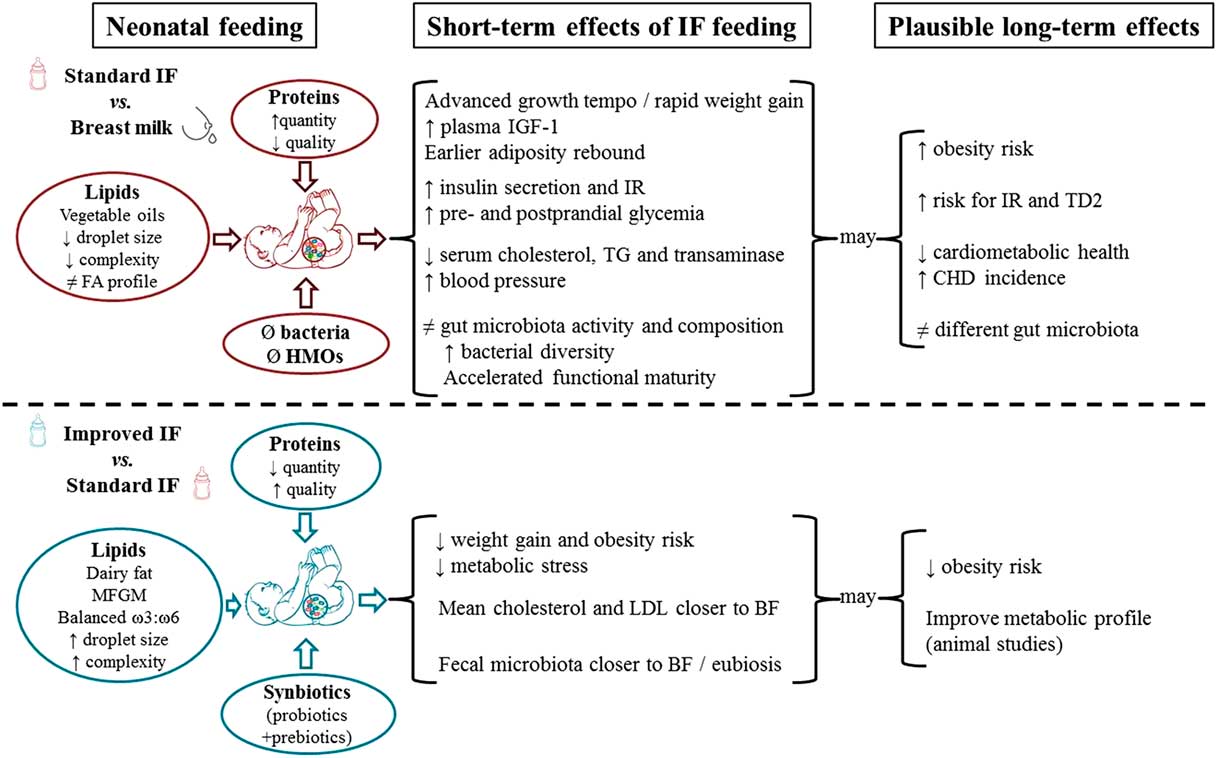
To conclude, even if some prebiotics and/or specific probiotic strains display promising results, more randomized-controlled clinical trials with longer follow-up are needed for the determination of tailored combinations and of their physiological and metabolic effects on the host (Fig. 1).
Short- and plausible long-term effects of neonatal feeding. BF, breastfed infants; CHD, coronary heart disease; FA, fatty acid; HMOs, human milk oligosaccharides; IF, infant formula; IGF-1, insulin-like growth factor-1; IR, insulin resistance; LDL, low-density lipoprotein; MFGM, milk fat globule membrane; TD2, type-2 diabetes; TG, triglycerides.

Effects of the IF composition on gut microbiota: a possible mechanistic link?
Early establishment of gut microbiota and differences between formula-fed and breastfed infants
Recent advances in sequencing technologies of the microbiota have questioned the sterile womb paradigm, suggesting a mother-to-child transfer of commensal bacteria in utero.Reference Perez-Munoz, Arrieta, Ramer-Tait and Walter 178 – Reference Funkhouser and Bordenstein 181 If there is currently no clear consensus regarding the prenatal life, it is well established that the first months of life are crucial for the establishment of the gut microbiota and host-microbiota symbiosis. Gut microbiota exerts several functions such as facilitating nutrient utilization, synthesizing amino acids and vitamins, educating the naïve immune system and programming the metabolic system in neonates.Reference Wang, Monaco and Donovan 8 , Reference Vyas and Ranganathan 182 , Reference van den Nieuwboer, Claassen, Morelli, Guarner and Brummer 183 It modulates infant growth and body compositionReference White, Bjornholt and Baird 184 – Reference Dogra, Sakwinska and Soh 187 and plays a crucial role in lifelong health. In mice, an early exposure to antibiotics during the suckling period was associated with an increased fat mass and a negative modulation of hepatic metabolism in adulthood though gut microbiota was only transiently altered.Reference Cox, Yamanishi and Sohn 188 Mainly consisting of facultative anaerobes and then obligate anaerobes within the 2 first weeks of life, gut microbiota slowly achieves a more complex structure and evolves towards an adult-like configuration throughout the first 3 years of life.Reference Yatsunenko, Rey and Manary 189 – Reference Rodriguez, Murphy and Stanton 191 Among the influencing factors of gut colonization, early nutrition plays a predominant role.Reference Wang, Monaco and Donovan 8 , Reference Marques, Wall and Ross 192 Formula-feeding has been associated with a less stable microbiota over time, different overall bacterial composition and higher bacterial richness and diversity (although controversial)Reference Wang, Li and Wu 133 compared with breastfeeding.Reference Azad, Konya and Maughan 193 – Reference Thompson, Monteagudo-Mera, Cadenas, Lampl and Azcarate-Peril 197 However, inconsistencies exist between studies on the impact of formula-feeding on gut microbiota composition and may be explained by several factors such as changes in IF composition over time and differences in oligosaccharides composition between breast milk and IFs.Reference Davis, Wang and Donovan 163 Early gut microbiota may influence later microbiotaReference Eggesbo, Moen and Peddada 198 , Reference Ding and Schloss 199 but the sustainability of early microbiota changes in later infancy and adulthood remains uncertain.Reference Salvini, Riva and Salvatici 148 , Reference Rinne, Kalliomaki, Salminen and Isolauri 167 In addition, alterations in the gut microbiota profile during the first months of life may precede overweight development.Reference Scheepers, Penders and Mbakwa 186 , Reference Luoto, Kalliomaki and Laitinen 200 – Reference Kalliomaki, Collado, Salminen and Isolauri 202 If the exact role of specific bacterial families or genera is not clear, a higher abundance of the genus Bifidobacterium has been observed during the first year of life in infants who remained normal weight at 7 years compared with children who became overweight.Reference Kalliomaki, Collado, Salminen and Isolauri 202 Infants not primarily breastfed had higher abundance of Bacteroidaceae Reference Pannaraj, Li and Cerini 160 and positive correlations were found between a higher abundance of Bacteroides spp. (in particular Bacteroides fragilis) and BMI at the age of 3 and 26 weeks but disappeared at ~2.5 years of age.Reference Vael, Verhulst, Nelen, Goossens and Desager 201 In overall, these data suggest that gut microbiota primocolonization is crucial and may affect infant growth trajectories. However, further investigations are needed to determine the time length of this early critical window and why early microbiota changes are not always observed in later life.
Beyond the taxonomic rank, it is necessary to investigate the infant gut microbiota in terms of functionality since bacteria belonging to different taxonomic groups may perform similar functions.Reference Pham, Lacroix, Braegger and Chassard 203 Formula-fed infants had an accelerated functional maturity compared with breastfed infants, characterized by enrichment in functions characteristic of the adult microbiome at 4 months, despite a small overall functional difference.Reference Backhed, Roswall and Peng 204 , Reference Bokulich, Chung and Battaglia 205 Formula-fed infants also had high stool levels of SCFAs such as propionate, butyrate, acetate, 5-amino-valerate and free amino acids at 3 and 6 months of age while breastfed infants had high concentrations of fucosylated oligosaccharides and lactic acid, as a result of a higher fermentation of HMOs.Reference Martin, Moco and Montoliu 206
Gut microbiota can be modulated by the macronutrient composition of IFs. A whey-predominant IF led to a faecal microbiota closer to that of breastfed infants at 2 months of age, compared with a casein-predominant IF.Reference Hascoet, Hubert and Rochat 207 Proteins, such as lactoferrin, may also function as prebiotics and impact gut microbiota composition.Reference Oda, Wakabayashi, Yamauchi and Abe 208 , Reference Mastromarino, Capobianco and Campagna 209 The structure of triglycerides could also affect gut microbiota. Indeed, a high β-palmitate formula was shown to increase Lactobacillus and Bifidobacteria counts in faecal stools of 6-week-old infants at abundances similar to breastfed infants, compared with infants receiving a low β-palmitate IF.Reference Yaron, Shachar and Abramas 210 A recent study in a germ-free mice model demonstrated that the fatty acid composition and phospholipid types may differently affect gut microbiota establishment.Reference Nejrup, Licht and Hellgren 211 The addition of MFGM alone did not lead to changes in gut microbiota composition in 28-day-old piglets compared with standard IFs but the addition of both dairy lipids and MFGM affected gut microbiota composition, with an increase in Proteobacteria and a decrease in Firmicutes phyla compared with piglets fed a standard vegetable-oil IF.Reference Le Huerou-Luron, Bouzerzour and Ferret-Bernard 212 These changes were similar to those observed at 3 months of age between breastfed infants and infants fed a vegetable-oil-based IF.Reference Donovan, Wang and Li 213
To conclude, relationships have been described between macronutrients and specific bacteria but further studies are needed to better understand them and evaluate their long-term impact on health.Reference Boix-Amoros, Collado and Mira 159
Mechanisms linking gut microbiota and long-term health
Several mechanisms have been proposed to connect gut microbiota to metabolic health. One mechanism relies on the property of gut microbiota to harvest energy in relation with the enrichment of genes coding enzymes that utilize non-digestible dietary carbohydrates to produce SCFAs. Indeed, breast milk butyrate was inversely associated with 12-month skinfolds and BMI, 3–12 month skinfold gain and weight gain in a prospective birth cohort. Associations were also found for acetate and formic acid and BMI and skinfolds at 3 months but not for adiposity at 12 months.Reference Prentice, Vervoort and Dingess 214 SCFAs are key mediators of the crosstalk between gut microbiota and host cells, able to act as signalling molecules by bonding to their receptors, expressed by different cell types such as enterocytes and intestinal enteroendocrine cells. SCFAs can bind to the free fatty acid receptor (FFAR) 2 and 3 (formerly known as G-protein coupled receptor (GPR) 43 and 41, respectively), the affinity for these receptors depending on the size of their aliphatic tail,Reference Layden, Angueira, Brodsky, Durai and Lowe 215 , Reference Kaji, Karaki and Kuwahara 216 and stimulate the release of enteroendocrine hormones such as glucagon-like peptide-1 (GLP-1) and peptide YY (PYY). For instance, propionate lowered hepatic glucose production in healthy rats in vivo,Reference Zadeh-Tahmasebi, Duca and Rasmussen 217 and prevented weight gain in overweigh adult humansReference Chambers, Viardot and Psichas 218 via the stimulation of the release of GLP-1 and PYY.Reference Tolhurst, Heffron and Lam 219 , Reference Psichas, Sleeth and Murphy 220 GLP-1 is an incretin exerting several functions, from increasing insulin and decreasing glucagon secretion and stimulating β-cell growth to decreasing appetite and food intake. GLP-1 secretion is not only stimulated by SCFAs but also by the digestion of macronutrients.Reference Everard and Cani 221 – Reference Wu, Rayner and Horowitz 224
Bacteria and their metabolites (SCFAs but also other signalling molecules) may also regulate the expression of key regulatory and functional genes such as those that are important for fat storage (adipocyte development and lipolysis) and oxidation, and gastrointestinal hormone production.Reference Delzenne, Neyrinck, Backhed and Cani 225 For instance, butyrate inhibited intestinal cholesterol biosynthesis in vitro, thus possibly lowering plasma cholesterol levelsReference Alvaro, Sola and Rosales 226 and improved insulin sensitivity in mice, through the promotion of energy expenditure and induction of mitochondrial function.Reference Gao, Yin and Zhang 227 SCFAs also regulate leptin secretion by adipocytes.Reference Zaibi, Stocker and O’Dowd 228 , Reference Xiong, Miyamoto and Shibata 229 SCFAs may therefore be mediators of the long-term effects exerted by early nutrition.
Host-microbiota interactions could also be mediated by other mechanisms. Diverse metabolites and signalling molecules produced by gut microbiota such as SCFAS and folate may directly or indirectly modify the epigenome and therefore regulate host genes and shape long-term phenotype.Reference Ye, Wu, Li and Li 230 , Reference Bhat and Kapila 231 There are three distinct epigenetic mechanisms: DNA methylation, histone modifications and non-coding microRNAs (miRNAs). Epigenome and microbiome would be interrelated and influenced by each other but their interaction in response to early-life environment remain unclear.Reference Majnik and Lane 232 , Reference Woo and Alenghat 233 SCFAs, such as butyrate and propionate are thought to modulate host cellular processes through inhibition of histone deacetylase activity and to alter the expression of specific genes.Reference Aoyama, Kotani and Usami 234 – Reference Sanderson 236 Interactions between gut microbiota composition and epigenetic regulation of genes have been demonstrated in obese and diabetic adult patients with a significant correlation between a higher BMI and lower methylation of FFAR3.Reference Remely, Aumueller and Merold 237 In a germ-free mice model, supplementation with SCFAs was sufficient to recapitulate chromatin modification states and transcriptional responses associated with colonization.Reference Krautkramer, Kreznar and Romano 238 Besides, a clear association has been demonstrated in pregnant women between a microbiome dominated by Firmicutes and blood DNA methylation patterns, associated with greater susceptibility to diseases such as cardiovascular disease and obesity.Reference Kumar, Lund and Laiho 239 Breastfeeding would contribute, via the modulation of gut microbiota composition, to the production of larger amounts of folate, inducing DNA methylation marks. On the contrary, the higher protein content of IFs may lead to a higher amount of protein reaching the colon and therefore to an enrichment in proteolytic bacteria, producing butyrate, at the expense of carbohydrate-fermenting bacteria, promoting histone acetylation, known to be a key factor of epigenetic regulation of cholesterol and lipid metabolism.Reference Mischke and Plosch 240 Other nutrients such as LC-PUFAs may also have an effect on epigenetic processes.Reference Brands, Demmelmair and Koletzko 241 , Reference Perfilyev, Dahlman and Gillberg 242 Thus, both the supplementation of IFs with probiotics and prebiotics and their composition in macronutrients may induce epigenetic modifications by impacting gut microbiota composition and metabolism.
Early life nutrition may also alter miRNA profiles and therefore gene expression since miRNA expression depends on gut microbiota community.Reference Bhat and Kapila 231 , Reference Singh, Shirdel and Waldron 243 , Reference Dalmasso, Nguyen and Yan 244 Human and bovine milks contain miRNAs and so do IFs but with much lower expression.Reference Weber, Baxter and Zhang 245 – Reference Izumi, Kosaka and Shimizu 248
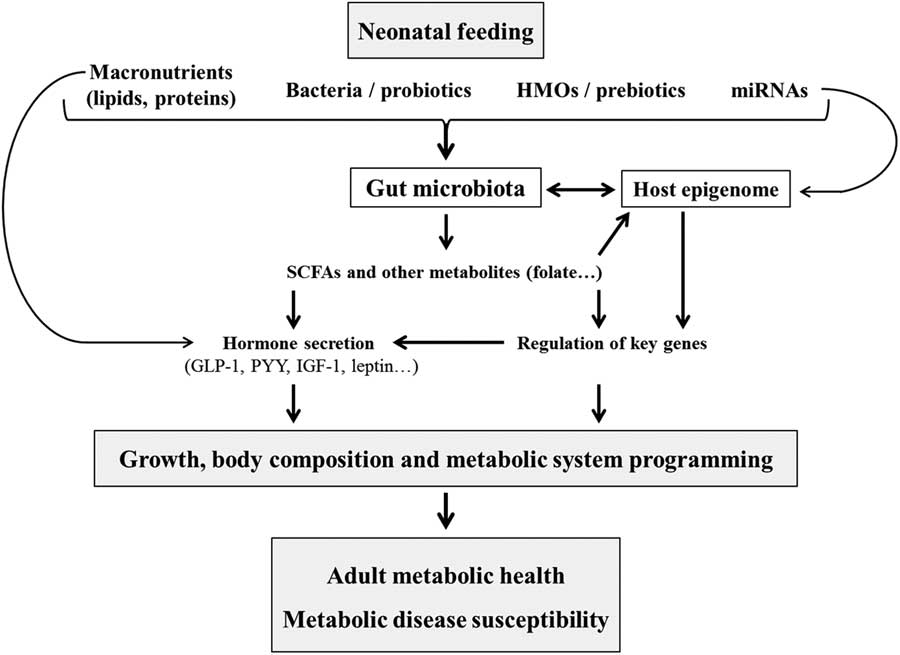
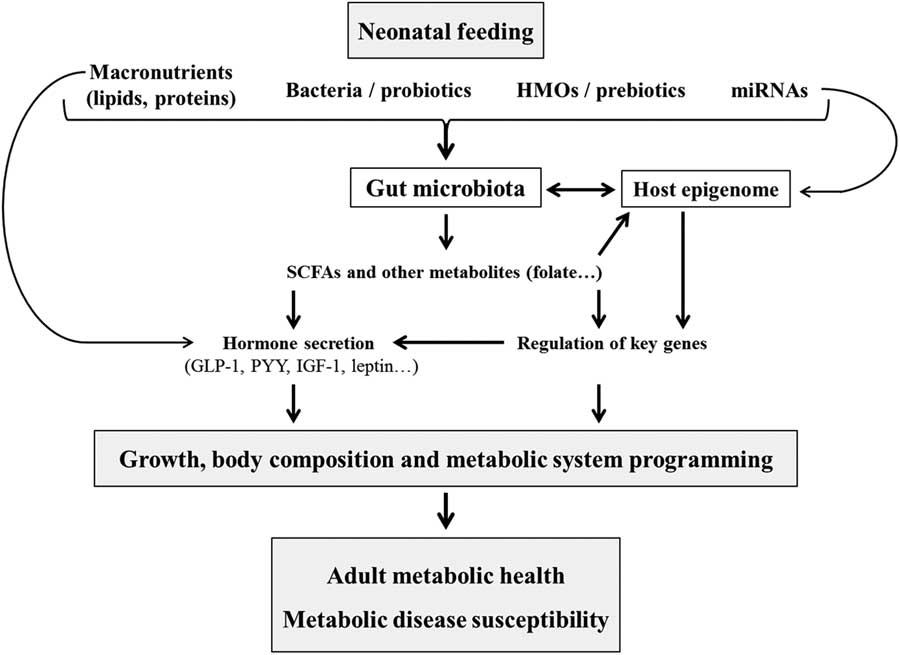
Targeting gut microbiota seems to be relevant to prevent metabolic diseases on the long term. Integrative approaches of metagenomic, epigenetic and metabolomic/lipidomic data are necessary to better understand their dynamic interactions with early-life environment and improve long-term health (Fig. 2).
Long-term metabolic health: the potential pathways involving gut microbiota. GLP-1, glucagon-like peptide-1; HMOs, human milk oligosaccharides; IGF-1, insulin-like growth factor-1; miRNAs, non-coding microRNAs; PYY, peptide YY; SCFAs, short-chain fatty acids.
Conclusion
Early nutrition plays a predominant role in health and well-being of the newborn and in later life by modulating its metabolism. Improving the functional effects of IFs to reduce the gap between breastfed and formula-fed infants is crucial and has been the topic of great research over the past years. Yet, numerous questions remain to be answered about which components should be added to IFs and in which quantity depending on their metabolic fate and outcomes. Indeed, when it comes to human milk composition and infant nutrition in general, there is no ‘one-size-fits-all construct’.Reference McGuire, Meehan and McGuire 127 Regarding metabolic health of infants, an improved IF would consist in modulating all macronutrients: proteins (to decrease the quantity but mostly improve their quality), lipids (to resemble the size, structure and composition of the fat globule by the addition of dairy lipids, cholesterol and MFGM, and also a balanced ω-3:ω-6 LC-PUFA ratio) and to supplement with prebiotics, probiotics or synbiotics. However, further studies are needed to improve IF composition and gain comprehension on how it may modulate the interplay between host metabolism and gut microbiome and exert long-term health benefits. Gut microbiota development plays a key role but due to its complexity, the underlying pathways impacting the infant biology remain largely unknown. Animals such as the non-human primate and the neonatal piglet, excellent preclinical models for the human infant,Reference Donovan 93 , Reference Roura, Koopmans and Lalles 249 proved to be useful to control and account for some confounding factors found in human studies and to investigate the mechanisms involved in the long-term effects of early nutrition. They allow for the screening of potential nutritional factors and the selection of the most promising ones. Yet there is still a need for a standardized model for infant growth and development. Besides, they remain models and additional well-designed longitudinal human studies are needed to investigate the effects of the IF composition on host metabolism beyond infancy.
Acknowledgements
The authors thank Dr Alain Dabadie for his careful reading of the manuscript and for his constructive remarks.
Financial Support
M.L. is employed by Lactalis R&D.
Conflicts of Interest
None.