INTRODUCTION
The major developments in cancer treatment strategies during recent years have markedly prolonged the life of cancer patients. Nonetheless, these developments have caused the formation of a cancer patient population who intensely experience many problems, including advanced-stage cancer, an ambiguous prognosis, and pain. Even though the lifetime of this population has been extended, a patient group has emerged whose functional adequacy and quality of life are decreasing with the course of the disease process (Glare, Reference Glare2005; Covinsky, Reference Covinsky, Goldman and Cook1994). Meier and colleagues complain about the insufficient quality of care services being provided for individuals with advanced-stage terminal disease and their families, and state that these patients experience uncontrollable pain and other symptoms, that unexpected personal needs arise during the care process, and that caregivers experience substantial difficulties and have a low level of satisfaction with the services being rendered (Meier, Reference Meier2008; Meier & Sieger, Reference Meier and Sieger2013).
Many healthcare environments—oncology departments included—measure such biomedical results as the duration of survival. However, patient and family satisfaction is very important in oncology clinics and is related to the development of information and mutual communication. Satisfaction is a subjective outcome and is an indicator of the quality of life of patients and their families (Lo et al., Reference Lo, Burman, Hales and Swami2009a ; Reference Lo, Burman, Rodin and Zimmermann2009b ).
Having an advanced-stage disease with an ambiguous prognosis affects not only the patient but family members as well. The literature contains studies which reveal that families experience both direct and indirect problems caused by cancer (Emanuel & Emanuel, Reference Emanuel and Emanuel2000; Babaoglu & Oz, Reference Babaoglu and Oz2003). The care of these patients is generally undertaken by families, and this responsibility causes disruption to the daily life of family members. It is known that family members give up their daily routines in this process and plan their whole day around the patient. Thus, this process causes a change or loss of role for family members, and consequently intrafamilial relations and the family structure are disrupted (Loke et al., Reference Loke, Liv and Szeto2003; Babaoglu & Oz, Reference Babaoglu and Oz2003; Goldstein et al., Reference Goldstein, Concato and Fried2004).
Family satisfaction is an important indicator of the quality of care. The family of a patient with advanced-stage cancer experiences a number of problems and difficulties according to the progression of the disease (Hwang et al., Reference Hwang, Chang and Alejandro2003). It is very important to meet all the needs of the family, including unexpected needs, during this process. Meeting those family needs and increasing their quality of life are among the targets of healthcare. Family satisfaction is affected by information about the treatment and prognosis of the disease, as well as communication and training, care support, and consistency (Ringdal, Reference Ringdal, Jordhoy and Kaasa2002). In addition, family satisfaction, quality of life, quality of death, accessibility, coordination and individualized care, symptom management, communication and training, emotional support, and assistance in decision making are closely related to the care of a patient with advanced-stage cancer (Dy, Reference Dy, Shugarman and Lorenz2008; Lo et al., Reference Lo, Burman, Hales and Swami2009a ,Reference Lo, Burman, Rodin and Zimmermann b ).
The care for a patient with advanced-stage cancer should be carried out by a multidisciplinary team consisting of a number of members, mainly a medical oncologist, an oncological nurse, and a psychiatrist. Each team member must maintain strong communications with family members during this challenging process. The long process of communication provides considerable data for the team regarding determination of family satisfaction. Since family satisfaction is also an indicator of quality of care, it is very important to determine the satisfaction levels of the family members of a patient with advanced-stage cancer, and to plan, apply, and evaluate the care according to the needs of the family (Steinhauser, Reference Steinhauser, Christakis and Clipp2001; Center for Bioethics, 2005). However, there is limited literature regarding the satisfaction levels of families specific to the care of patients with advanced-stage cancer in Turkey (Can et al., Reference Can, Akın and Aydıner2011).
In Turkey today it is not possible to receive palliative care from professionals with high levels of expertise, and such care has certainly not been integrated into our healthcare system. However, care is provided for palliative cancer patients at hospital-based oncology clinics, as well as in the internal diseases units and algology clinics of practices, research hospitals, and university hospitals, and new palliative care services are under construction. Our objective is to ensure that palliative care services are integrated into the healthcare system and provided within Turkey in the manner in which they are provided in developed countries, where the organization of health services is at a relatively advanced level, where economic resources are allocated efficiently, and where the human development index is high (Bingley & Clark, Reference Bingley and Clark2009; Wright et al., Reference Wright, Wood and Lynch2006; Ozcelik et al., Reference Ozcelik, Fadiloglu and Karabulut2010; EAPC Task Force, 2010).
There are no hospice care services within Turkey. Decisions on care for the dying patient are closely connected to family structure, religious values, and cultural values, and dying patients generally want to spend their remaining time at home. However, the insufficiency of home care services and the absence of reimbursement cause patients in this phase and their families many problems (Aksoy, Reference Aksoy and Song2003; Oguz et al., Reference Oguz, Miles and Buken2003). Health professionals, patients' families, and volunteers work in a highly self-sacrificing manner to mitigate the symptoms of patients in the last days of life. Hospice services are desperately needed for terminal patients. Many Turkish civil society organizations and health professionals support the establishment of hospices. However, the reality is that new national health policies and legal arrangements would be needed to establish hospices, far beyond individual efforts and well-intentioned thoughts. There are those in Turkey who have been working since the early 1990s to implement these actions, and it is encouraging that there has been some progress. However, there is no doubt of the need for more rapid development (Ozcelik et al., Reference Ozcelik, Fadiloglu and Karabulut2010).
Each nation is responsible for ensuring provision of palliative care services to those of its citizens in need of them. International institutions and scientific platforms should closely monitor national standards and patient results related to such services as palliative care. Our study, which evaluates palliative care activities in the field of oncology in Turkey, will hopefully contribute ideas relevant to the organization and provision of palliative care in our nation, as well as elsewhere. The main objective of our study was to determine the levels of satisfaction in families of patients with advanced-stage cancer.
METHODS
Design and Settings
This descriptive study, performed to determine the satisfaction levels of families of patients with advanced-stage cancer, was conducted in a palliative care and medical oncology clinic at a university hospital in the province of Izmir between April of 2011 and January of 2012. The study sample included a total of 145 family members who were responsible for the care of conscious patients aged 18 or older with advanced-stage cancer concomitant with metastases without visual and hearing problems. Study data involving the stages of the disease and the presence of metastases in patients were collected from patient files. The disease diagnoses were obtained by asking patients' relatives.
Measurements
Study data were obtained using the Patient Description Form and Family Satisfaction Scale (FAMCARE Scale) by means of face-to-face interviews. The Family Satisfaction Scale was developed by Kristjanson (Reference Kristjanson1993) in order to identify the satisfaction levels of family members caring for patients with advanced-stage cancer. This scale grades the level of family satisfaction between 1 and 5 thus: (1) very satisfied, (2) satisfied, (3) undecided, (4) unsatisfied, and (5) very unsatisfied. The Family Satisfaction Scale consists of 20 questions, and the component variables of the scale involve the dimensions of information giving, availability of care, physical care, and psychosocial care. To make the FAMCARE Scale easier to interpret, scores were converted to percentages, and scores between 0 and 100 were obtained. Low scores on the FAMCARE Scale and subscales indicated high levels of satisfaction with care and high scores indicated low levels of satisfaction (Can et al., Reference Can, Akın and Aydıner2011). The following SPSS command was used:
 $$\eqalign{\hbox{Item score} &= 100 - \displaystyle{{(\hbox{Item score} - {\hbox{Minimum item score})}} \over {{(\hbox{Maximum item score}} - {\hbox{Minimum item score})}}} \cr & \quad \times 100.}$$
 $${\hbox{Rescaled item}\ \# 1 = 100} - {[(({\rm Item} 1} - {1)/4)} \times {100}].$$
This scale was tested for validity and reliability in Turkish society, and Cronbach's alpha was determined to be equal to 0.80 (Can et al., Reference Can, Akın and Aydıner2011).
Study data were evaluated utilizing SPSS 15.00 software, while numbers, percentages, and Spearman correlation coefficients were employed. The significance level used was p < 0.05. The study was cleared by the ethics committee of the Ege University Faculty of Nursing, and permission was obtained from the university hospital and from patients' relatives.
RESULTS
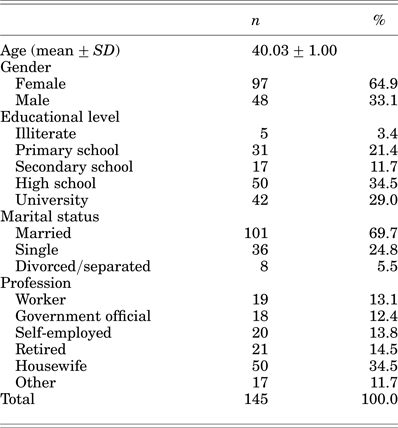
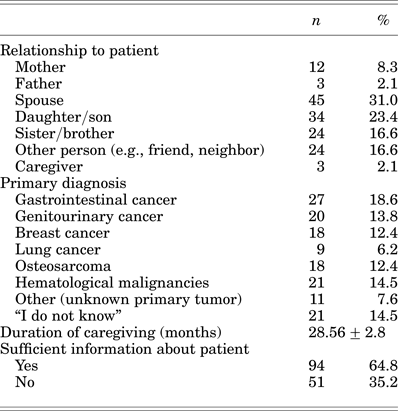
Some 67% of participating family members were women, and 33% men, while 70% were married, 35% were high school graduates, and 34.5% were housewives. Some 45% of participants were the partner of the patient, 65% lived with the patient, and 80% provided patient care on their own (see Table 1). Considering the distribution of patients according to the course of their disease and examining their diagnoses, it was determined that 18.6% had systemic gastrointestinal cancer and 75% had been diagnosed for at least 36 months (Table 2).
Family members' demographic characteristics

Distribution of factors related to patients' illness and family members (n = 145)

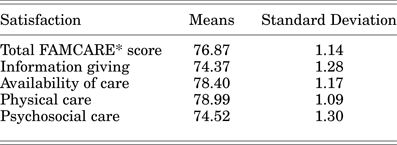
When the distribution of participant satisfaction level was considered, the average total family satisfaction scale score was found to be 76.87 ± 1.14, and the score averages for the component variables were as follows: information giving 74.37 ± 1.28, availability of care 78.40 ± 1.17, physical care 78.99 ± 1.09, and psychosocial care 74.52 ± 1.30 (Table 3).
Family members' satisfaction scores (FAMCARE Scale scores) (n = 145)

*Average scores on the FAMCARE scale were rescaled to vary between 0 and 100 so that low scale values indicate low satisfaction with care and high ones indicate high satisfaction.
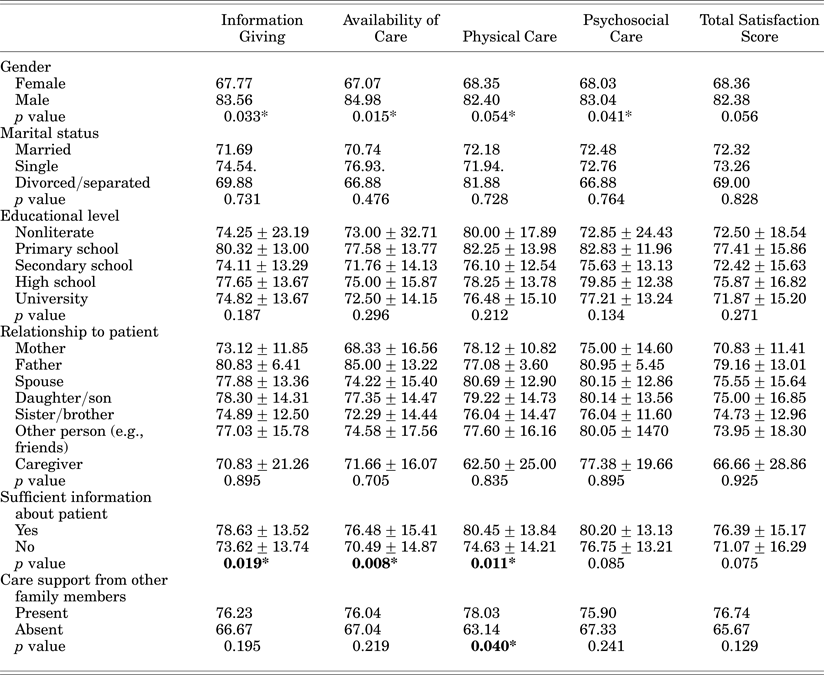
We also determined that the distribution of factors affecting patient and family member satisfaction levels were affected by such variables as gender, occupation, the presence of someone supporting the care, and the possession of sufficient information about the patient (p < 0.05). On the other hand, we found that family member satisfaction levels were not affected by age, marital status, educational status, degree of kinship, the patient's tumor site, nor length of diagnosis (p > 0.05) (Table 4).
Means ± SD of categorical demographic and medical variables on family member satisfaction scores (n = 145)

*p ≤ 0.05.
DISCUSSION
This study provides information about the levels of satisfaction with the healthcare services in family members who are responsible for the care of patients with advanced-stage cancer and the factors affecting that satisfaction. Our hope was to contribute to the limited literature on this subject.
Satisfaction levels were found to be high for the components of total satisfaction: information giving, availability of care, physical care, and psychosocial care of family members. Similarly, Can and colleagues determined that family members were satisfied with the healthcare services provided at one hospital (Can et al., Reference Can, Akın and Aydıner2011). Ringdal and colleagues (Reference Ringdal, Jordhoy and Kaasa2002) conducted a study to determine the satisfaction levels of family members of patients with advanced-stage cancer and found that levels were high for families in a palliative care environment. Hwang et al. (Reference Hwang, Chang and Alejandro2003) set out to determine the satisfaction levels of family members caring for patients with advanced-stage cancer in a hematology oncology clinic and found that total caregiver satisfaction levels were high (Hwang et al., Reference Hwang, Chang and Alejandro2003).
Our research group received immediate consultation and follow-up from the palliative care team, true to the principle of multidisciplinary care. Based on the consultation process and in accordance with patients' requirements, team members engendered cooperation and care coordination with other team members, who represented the broad spectrum of palliative care. As is evident from our results, family member satisfaction levels could be increased through private clinics and such interventions as palliative care services that involved services specific to patients with advanced-stage cancer and their families. We also found a relationship between family member satisfaction levels and gender, occupation, the presence of someone supporting the care, and possession of sufficient information about the patient.
Ringdal and coworkers found a significant relation between family member satisfaction levels and gender, as well as a higher satisfaction level in males, a result similar to our own (Ringdal et al., Reference Ringdal, Jordhoy and Kaasa2002). Can and colleagues (Reference Can, Akın and Aydıner2011) also found a significant relationship between family member satisfaction levels and gender. This could be explained by the difference between females and males with regard to how they react to events: women are generally more able to express their complaints and dissatisfactions, while men seem to be more reticent. This result could also be explained by gender differences related to accepted roles and social expectations. This subject needs to be explored in greater detail both sociologically and psychologically.
In the process of caring for patients with advanced-stage cancer, family members may have needs related to patient comfort and care, information, support, and efficient communications (Osse et al., Reference Osse, Vernooij-Dassen and Schade2006). Some studies have asserted that family members cannot receive a sufficient amount of this support while receiving routine clinical care. In fact, other studies have found that routine care increases care burden and decreases family member satisfaction (Jasnma et al., Reference Jasnma, Schure and Jong2005; Johansson & Danielson, Reference Johansson and Danielson2007; Northouse et al., Reference Northouse, Katapodi and Song2010). In our study, we found a significant relationship between the receipt of care support and family member satisfaction. This reveals how important it is for family members to receive social support during the care process. The literature contains a number of studies asserting that social support positively affects caregiving and enables family members to cope with problems efficiently (Tan, Reference Tan and Karabulutlu2005; Northouse et al., Reference Northouse, Katapodi and Song2010; Pehlivan et al., Reference Pehlivan, Ovayolu and Ovayolu2012). It must be remembered that healthcare professionals working with family members who are caring for patients with advanced-stage cancer should provide effective support and that it is necessary to be sensitive to the needs of family members during intensive clinical work.
Family members often demand sufficient information on the care of patients with advanced cancer. In our study, we determined a significant relationship between receiving sufficient information and family member satisfaction. Ringdal and colleagues, in a study of family members providing support for patients with advanced-stage cancer (Ringdal et al., Reference Ringdal, Jordhoy and Kaasa2002), found that family satisfaction could be increased through efficient delivery of information. At this point, it should be remembered that information that is efficient and sufficient can only be delivered through fair, explicit, and safe communication from a healthcare professional. Further, healthcare professionals often perceive communication with patients who have advanced-stage cancer and their families as a stressful and annoying responsibility. The literature is replete with examples of healthcare professionals who form technical and shallow relationships in this process, often not knowing how to talk with patients and families, keeping silent and avoiding certain things, having difficulty in establishing deeper communication involving social and personal dimensions, and displaying such behavior as decreasing the number of visits to a patient's room. This type of behavior, which can go unnoticed by the health professional, makes a patient with an untreatable life-threatening illness feel abandoned, as they are dying and think they are being ignored by the doctors and other healthcare professionals taking care of them (Center for Bioethics, 2005; Hancock et al., Reference Hancock, Clayton and Parker2007; Kavas, Reference Kavas2008). Sensitive, humanistic, and fair contact made with patients and families during this process is the primary target in the care of patients with advanced-stage cancer. In turn, healthcare professionals apparently also need sensitivity and efficiency to effect this kind of contact (Hofmann et al., Reference Hofmann, Wenger and Davis1997; Hancock et al., Reference Hancock, Clayton and Parker2007; Kavas, Reference Kavas2008).
CONCLUSION AND IMPLICATIONS
The satisfaction of family members who are responsible for the care of patients with advanced-stage cancer is a crucial component of the quality of care. Family member satisfaction levels must be considered, and the factors affecting satisfaction must be known to those providing healthcare services. We conducted our study to draw attention to this subject, one that is often ignored in the context of the busy world of clinical work.
We have determined that the satisfaction levels of family members responsible for the care of patients with advanced-stage cancer are affected by gender and delivery of sufficient and effective information, as well as by receiving supportive care from other persons.
DISCLOSURES AND ACKNOWLEDGMENTS
This study was not supported by other organizations and companies. The authors have no conflicts of interest to disclose. The authors wish to thank the research team members for their administrative assistance.