Introduction
Honey and bee products have a very rich history of use in traditional medicine in humans but recently, various products like beeswax, pollen, RJ, venom and propolis, have attained more research focus. The raw materials, crude extracts and purified active compounds in bee products have revealed interesting bioactivities such as anti-inflammatory, antimicrobial and antioxidant activity (Ramadan and Al-Ghamdi, Reference RAMADAN and AL-GHAMDI2012; Premratanachai and Chanchao, Reference PREMRATANACHAI and CHANCHAO2014).
Royal jelly is a milky substance that is secreted and produced by the worker bees to feed the queen and larvae. RJ is derived from pollen by the bees hypopharyngeal glands (Jalali et al., Reference JALALI, NAJAFI, HOSSEINCHI and SEDIGHNIA2015). The larvae that develop into queens require eating royal jelly in large quantities. The RJ generally contains proteins (27-41%), lipids (8-19%), free amino acid (0.6-1.5%), sugars (~30%), enzymes, minerals, vitamins, sterols, acetylcholine and a hormone-rich substance (Kamakura et al., Reference KAMAKURA, MITANI, FUKUDA and FUKUSHIMA2001; Suzuki et al., Reference SUZUKI, ISOHAMA, MARUYAMA, YAMADA, NARITA, OHTA, ARAKI, MIYATA and MISHIMA2008). It contains compounds known as ‘major royal jelly proteins’ (MRJPs) that constitute 90% of the total protein (Santos et al., Reference SANTOS, DOS SANTOS, MENDES, DE SOUZA, MALASPINA and PALMA2005). The predominant amino acids (AA) in RJ include lysine, proline, ß-alanine, aspartate, glutamic acid phenylalanine, serine, lysine, cysteine and arginine (Boselli et al., Reference BOSELLI, CABONI, SABATINI, MARCAZZAN and LERCKER2003). Major carbohydrates in RJ are mainly glucose, fructose, and sucrose; while maltose, melibiose, trehalose, ribose and erlose are also present in traces (Sabatini et al., Reference SABATINI, MARCAZZAN, CABONI, BOGDANOV and ALMEIDA-MURADIAN2009). Lipids (80% and 90%) are mainly free fatty acids, while the rest include neutral lipids, sterols and hydrocarbons (Kodai et al., Reference KODAI, UMEBAYASHI, NAKATANI, ISHIYAMA and NODA2007). Almost all major the vitamins and minerals are present in royal jelly (Sabatini et al., Reference SABATINI, MARCAZZAN, CABONI, BOGDANOV and ALMEIDA-MURADIAN2009; Abd-Allah, Reference ABD-ALLAH2010), and it has an abundance of nucleic acids i.e. DNA and RNA (Justin et al., Reference JUSTIN, MIZRAHI and LENSKY1996).
It has been demonstrated in many experiments that RJ possesses potential bioactivities including anticancer (Townsend et al., Reference TOWNSEND, MORGAN, TOLNAI, HAZLETT, MORTON and SHUEL1960), anti-allergic (Okamoto et al., Reference OKAMOTO, TANIGUCHI, KUNIKATA, KOHNO, IWAKI, IKEDA and KURIMOTO2003), anti-inflammatory (Kohno et al., Reference KOHNO, OKAMOTO, SANO, ARAI, IWAKI, IKEDA and KURIMOTO2004), antihypertensive, (Tokunaga et al., Reference TOKUNAGA, SUZUKI, YOSHIDA, MARUYAMA, FUTAMURA, ARAKI and MISHIMA2004) antioxidant (Nagai and Inoue et al., 2006; Nakajima et al., Reference NAKAJIMA, TSURUMA, SHIMAZAWA, MISHIMA and HARA2009), antibacterial (Tseng et al., Reference TSENG, HUANG, HUANG, TZEN, CHOU and PENG2011) as well as growth promoting and anti-hypercholesterolemic (Nagai and Inoue, Reference NAGAI and INOUE2004) effects as shown in Figure 1. Royal jelly is an extremely potent antioxidant where it acts as a free radical scavenger (Jalali et al., Reference JALALI, NAJAFI, HOSSEINCHI and SEDIGHNIA2015) via its substantial level of polyphenolic compounds (Viuda-Martos et al., Reference VIUDA-MARTOS, RUIZ-NAVAJAS, FERNANDEZ-LOPEZ and PEREZ-ALVAREZ2008). It contains a specific unsaturated acid hydroxy-2-decenoic acid (HDA), that is only naturally occurring in royal jelly (Seven et al., Reference SEVEN, ŞIMŞEK, GOKÇE, SEVEN, ARSLAN and YILMAZ2014). This compound possesses a number of potential physiological effects including, antimicrobial (Barnuţiu et al., Reference BARNUŢIU, MĂRGHITAŞ, DEZMIREAN, MIHAI and BOBIŞ2011) and immune modulation. (Pavel et al., Reference PAVEL, MĂRGHITAŞ, BOBIŞ, DEZMIREAN, ŞAPCALIU, RADOI and MĂDAŞ2011). Oral consumption of RJ improves metabolism of lipids and lipoproteins, ultimately reducing levels of bad cholesterol in animal studies (Guo et al., Reference GUO, SAIGA, SATO, MIYAZAWA, SHIBATA, TAKAHATA and MORIMATSU2007). Keeping in mind the potent bioactivities of RJ, it could have potential applications in animal health. This review summarises the beneficial uses and health benefits of RJ as an alternative to either in-feed antibiotics or as a supplement that can be used for poultry.
The pharmacological activities of Royal Jelly.

Chemical and nutritional composition
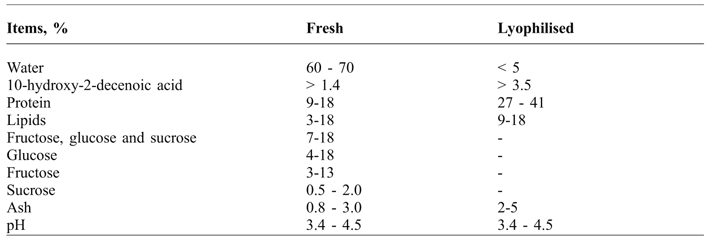
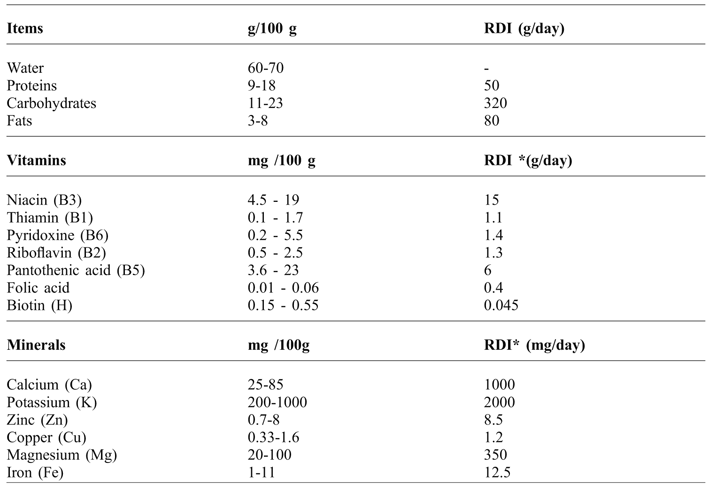
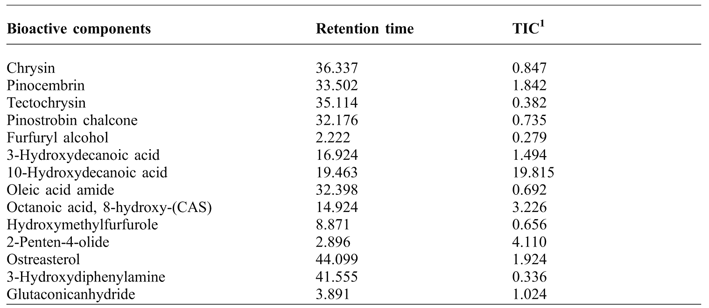
Royal jelly is a thick substance with a density of 1.1 g/ml and has a partial solubility in water. Its appearance is whitish to yellow in colour. Its odour is sour and pungent, with sour/sweet taste (Takenaka et al., Reference TAKENAKA, YATSUNAMI and ECHIGO1986). Major components found in RJ are presented in Tables 1, 2 and 3.
Typical composition of royal jelly.

Adopted from (Sabatini et al., Reference SABATINI, MARCAZZAN, CABONI, BOGDANOV and ALMEIDA-MURADIAN2009).
The nutritional components of royal jelly.

As per German Nutrition Society (Serra Bonvehi and Escola Jorda Reference SERRA BONVEHI and ESCOLA JORDA1991; Sabatini et al., Reference SABATINI, MARCAZZAN, CABONI, BOGDANOV and ALMEIDA-MURADIAN2009). RDI- recommended dietary intake.
Chemical composition (flavonoids, organic compounds, fatty acids and others) of royal jelly assessed by GC-MS (Seven et al., Reference SEVEN, ŞIMŞEK, GOKÇE, SEVEN, ARSLAN and YILMAZ2014).

TIC: The ion current generated depends on the characteristics of the compound concerned and is not a true quantitation.
antimicrobial activity
RJ shows strongest antibacterial activity compared to other bee products, like propolis and venom (Enfeksiyonu and Arı, 2014). It inhibits both Gram-negative and Gram-positive bacteria, but Gram-positive are more sensitive (Bílikova et al., Reference BÍLIKOVA, HUANG, LIN, ŠIMUTH and PENG2015). The antibacterial activity is considered due to its 10-hydroxy-2-decenoic acid (10-HDA) content (Serra Bonvehi and Escola Jorda, Reference SERRA BONVEHI and ESCOLA JORDA1991). Water-soluble fractions of RJ (peptides and proteins) have a strong bactericidal activity against Gram-positive and fungi (Vezeteu et al., Reference VEZETEU, BOBIŞ, MORITZ and BUTTSTEDT2017). Potent bactericidal activity against Gram-positive bacteria including Streptococcus, Lactobacillus helveticus, Clostridium, Leuconostoc, Staphylococcus, and Corynebacterium spp. has been demonstrated in an in vitro study but had no effect against Gram-negative bacteria (Fujiwara et al., Reference FUJIWARA, IMAI, FUJIWARA, YAESHIMA, KAWASHIMA and KOBAYASHI1990). The major acidic contents of royal jelly (10-DHA) have promising antimicrobial activity against several fungi and bacteria which included Escherichia coli, Micrococcus pyogenes, and Neurospora sitophila (Blum et al., Reference BLUM, NOVAK and TABER1959; Stocker, Reference STOCKER2003). These properties can ameliorate issues of antibiotic resistance against Pseudomonas aeruginosa which is increasingly encountered (Gunaldi et al., Reference GUNALDI, DAGLIOGLU, TUGCU, KIZILYILDIRIM, POSTALCI, OFLUOGLU and KOKSAL2014). Moreover, it is reported that RJ, positively decreased viral load when supplemented at a concentration of 100 μg/ml (Hashemipour et al., Reference HASHEMIPOUR, TAVAKOLINEGHAD, ARABZADEH, IRANMANESH and NASSAB2014).
antioxidant activity
It has been reported that RJ collected after 24 hours of larval transfer possesses the strongest anti-oxidant action (Jalali et al., Reference JALALI, NAJAFI, HOSSEINCHI and SEDIGHNIA2015) which have been observed in extensive in vitro studies conducted on yeast and plants (Jamnik et al., Reference JAMNIK, GORANOVIČ and RASPOR2007) and in animal studies (Kanbur et al., Reference KANBUR, ERASLAN, BEYAZ, SILICI, LIMAN, ALTıNORDULU and ATASEVER2009). Inhibition of lipid peroxidation (LPO) has been observed along with protection of tissue DNA against oxidative damage. The reduction in serum and kidney levels of oxidative stress markers (8-hydroxy-2-deoxyguanosine) reported can lead to an average increase in life expectancy (Abdel-Hafez et al., Reference ABDEL-HAFEZ, RIFAAI and ABDELZAHER2017).
anti-inflammatory activity
RJ has strong anti-inflammatory properties due to its free radical scavenging ability and anti-oxidative effects (Aslan and Aksoy, Reference ASLAN and AKSOY2015) indicating its potential for use against skin disorders. This strong anti-inflammatory response decreases exudation, leading to the accelerated healing and new tissue formation. Hence it could be helpful for shortening of time required for healing of damaged skin (Fuji et al., Reference FUJI, KOBAYASHI and KUBOYAMA1990).
immune-modulating activity
The immune boosting effects of RJ are due to apalbumin1 (Majtan et al., Reference MAJTAN, KOVÁČOVÁ, BÍLIKOVÁ and ŠIMÚTH2006) WHICH has immuno-inhibitory anti-allergic effects (Okamoto et al., Reference OKAMOTO, TANIGUCHI, KUNIKATA, KOHNO, IWAKI, IKEDA and KURIMOTO2003). Increases in haematopoiesis and serum antibodies (α-1 and α-2 globulins) have been observed after intake of RJ (Krylov and Sokolskii, Reference KRYLOV and SOKOLSKII2000). RJ can induce the production of immune cells (T-lymphocytes) to fight against pathogens and inflammatory agents owing to its 10-HAD contents (Siavash et al., Reference SIAVASH, SHOKRI, HAGHIGHI, MOHAMMADI, SHAHTALEBI and FARAJZADEHGAN2011). RJ contains a substantial quantity of gamma globulins, amino acids, hormones, fatty acids (unsaturated), enzymes and anti-oxidants (e.g. vitamin E and A) that support immunity (Pavel et al., Reference PAVEL, MĂRGHITAŞ, BOBIŞ, DEZMIREAN, ŞAPCALIU, RADOI and MĂDAŞ2011). Recently, modulation of immune responses from T-cell and dendritic cell cultures has been observed by 10 HDA and 3-10-dihydroxydecanoic acid extracted from RJ. This response was in a dose depended manner by stimulating T-cell proliferation at lower concentration but inhibiting it at higher concentrations by reducing production of IL-2 while increasing IL-10 (Vucevic et al., Reference VUCEVIC, MELLIOU, VASILIJIC, GASIC, IVANOVSKI, CHINOU and COLIC2007).
cardiovascular disease
Royal jelly can lower levels of bad (e.g. low-density lipoprotein cholesterol) while increasing levels of good cholesterol (high density lipoproteins). It can reduce plasma fibrinogen and thrombosis (Table 3). These abilities are responsible for the cardio-protective effects revealed in feeding experiments (Krylov and Sokolskii, Reference KRYLOV and SOKOLSKII2000) manifested as anti-hypertensive and vasodilative properties (Chen et al., Reference CHEN, LIU, WAN, LAI and SHEN2017). Hence, RJ may be useful to combat obesity and metabolic disorders (Yoneshiro et al., Reference YONESHIRO, KAEDE, NAGAYA, AOYAMA, SAITO, OKAMATSU-OGURA, KIMURA and TERAO2017).
Performance and health in broilers
RJ is rich in energy, protein and vitamins (Vit. B complex), especially in pantothenic acid which plays an important role in the immune system (Abd-Allah, Reference ABD-ALLAH2010). Since ancient times, RJ has been considered an important product from honey bees frequently used in medicine. Use of RJ in broiler diets has been reported to cause a significant increase in body weight and immunity levels (Osman and Elgadir, Reference OSMAN and ELGADIR2015). Supplementation with Chinese-sourced RJ may alleviate the detrimental impact of high stocking density in broiler chickens, as feeding trials showed it improved performance, behaviour and blood indices under these conditions (Mahmoud, Reference MAHMOUD2016). Moreover, it has shown a positive effect on antibody production (Kurkure et al., Reference KURKURE, KOGNOLE, PAWAR, GANORKAR, BHANDARKAR, INGLE and KALOREY2000; Mufarrej and El-Sarag, Reference MUFARREJ and EL-SARAG1997). RJ fed at a dose of 500 mg/kg in feed increased final body weight in broilers (Seven et al., Reference SEVEN, ARSLAN, OZCELIK, SIMSEK and SEVEN2016). In increasing early chick growth, Ahangari et al. (Reference AHANGARI, HASHEMI, AKHLAGHI, ATASHI, ESMAILI, GHORBANI, MASTANI, AZADEGAN and DAVOODI2013) showed that in ovo injection of RJ at 7 days incubation exerted a beneficial effect on growth performance in the starter phase. These results supported the theory that in ovo injection of RJ could be an effective method to improve daily old body weight as well as the development of internal organs in newly hatched chicks (Moghaddam et al., Reference MOGHADDAM, BORJI and KOMAZANI2014). Injection of RJ in broiler chickens increased the heterophil count and decreased the number of lymphocytes when compared to a control group (Jafari et al., Reference JAFARI, HASHEMI and AKHLAGHI2013). The fatty acids, organic compounds and flavonoids in RJ have been shown to enhance the growth rate of quail resulting in improved body weight, feed intake and feed conversion ratio. However, the application of RJ in the poultry industry as a broiler immunostimulant and to enhance growth for farming purposes requires further validation (Steel and Torrie, Reference STEEL and TORRIE1980), regarding doses, for example.
Performance and health in layer birds
Royal jelly is a safe natural product that stimulates the immune system as revealed by in-vitro studies by expressing an elevated antibody response against natural killer (NK)-cells (www.deeplyeal.com). It is rich in energy, protein and vitamins, especially pantothenic acid which plays an important role in the immune system (Abd-Allah, Reference ABD-ALLAH2010). White Leghorn cockerels, where RJ was fed for 28 days, has an increase in circulating lymphocytes and leucocytes and a decrease in serum globulin concentrations (Kurkure et al., Reference KURKURE, KOGNOLE, PAWAR, GANORKAR, BHANDARKAR, INGLE and KALOREY2000). Feeding RJ to layers gave a significant increase in body weight, egg production and immunity parameters (Osman and Elgadir, Reference OSMAN and ELGADIR2015). Supplementation of RJ (100 mg/kg feed) increased body weight, lymphoid organ weight and antibody titre in laying Japanese quails. These results may be attributed to the immunostimulant and antimicrobial activity of RJ products (Babaei et al., Reference BABAEI, RAHIMI, TORSHIZI, TAHMASEBI and MIRAN2016). Seven et al. (Reference SEVEN, ARSLAN, OZCELIK, SIMSEK and SEVEN2016) stated that the feed consumption of RJ supplemented poultry was significantly (P<0.05) increased in comparison with a control group. In laying hens, there was no significant effect of different feeding levels of RJ on eggshell weight and thickness (Seven et al., Reference SEVEN, ARSLAN, OZCELIK, SIMSEK and SEVEN2016). The higher yolk and albumen indices in RJ- treated groups were consistent with other findings (Arpášová et al., Reference ARPÁŠOVÁ, HAŠČÍK, PISTOVÁ, MELLEN, GÁLIK and FIK2016). Feed supplementation with RJ at 10 and 15 ppm increased egg weight and production along with an improvement of hen body weight (Bonomi et al., Reference BONOMI, BONOMI, FORMAGGIONI and QUARANTELLI2000). Total leukocyte and erythrocyte counts in a diet containing 200 mg/kg were significantly higher than in birds fed a diet contained 100 mg/kg or the unsupplemented control group. However, the heterophil/lymphocyte ratio and heterophil percentages were reduced in RJ-fed groups. In addition, the use of RJ improved egg quality criteria and some blood haematological parameters. Haugh units, yolk index and albumen height in RJ groups were significantly greater than those recorded in the control (El-Tarabany, Reference EL-TARABANY2017).
Conclusions
Royal jelly is widely marketed as a dietary feed additive, due to its health benefits and biological properties such as antimicrobial, anti-inflammatory, antihypertensive, antioxidant, and antitumor as well as growth promoting and anti-hypercholesterolemic activities. RJ has potent bactericidal properties due to its acidic contents. Moreover, RJ is an extremely efficient antioxidant and has noticeable free radical scavenging properties. Due to its antimicrobial and immune modulating properties, it could be a promising feed supplement in poultry nutrition, especially for organic chicken production where natural products must be used. Potential supplementation of RJ as an alternative feed additive to replace antibiotic growth promoters offers an opportunity to maximise profit from safe, welfare friendly and high-quality chicken production. However, further studies are required to elucidate the optimum inclusion rate of RJ in commercial poultry diets.
Acknowledgements
This work was supported by the grants from the Major National Scientific Research Projects (2015CB943102) and the National Nature Science Foundation of China (31572365) and Key Sci-tech innovation team of Shaanxi province (2017KCT-24).
Declaration of interest
The authors declare that there is no competing financial interest.