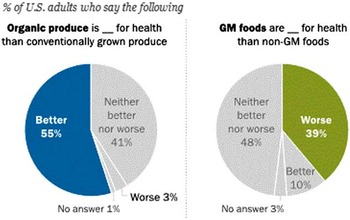
What you believe depends on who you are, not what you know. In December 2016, The Pew Research Center released a reportFootnote 1 depicting Americans sharply divided regarding the foods they buy. Pew polled a nationally representative sample of 1480 United States adults during the summer of 2016, which found that approximately 39% of American adults believe genetically modified (GM) foods to be less healthy than non-GM foods. With regard to organic foods, approximately 55% of the sample polled believed organic foods to be healthier than those grown using conventional farming methods. While participants who identified themselves as Democrats showcased slightly higher attitudes towards increased health benefits in consuming organic foods, party affiliation as an indicator proved weak.Footnote 2 The author of the study notes “…how we feel about the food we buy, eat and feed to our families appears to defy the usual demographic signifiers”. When it comes to GM and organic food, the divide is between consumers and scientists, not the divide so often evident in American domestic politics.
The public perceptions depicted in Figure 1 that organic foods are “healthier” have no basis in science.Footnote 3 Classification of foods as “organic” is a certification that a product has met the standards set by the US Department of Agriculture (USDA) for marketing purposes as defined by USDA’s National Organic Program (NOP). Organic food differs from conventionally-produced food in the way it is grown or produced, not in relation to its nutritional value or the characteristics of the final product.Footnote 4 The USDA makes no claims that organically produced food is safer or more nutritious than conventionally produced food, or that it has been produced in a more sustainable manner. Additionally, it is the US Food and Drug Administration (FDA), not the USDA, that regulates use of the term “healthy”. Such a classification means that the product meets certain criteria that limit the amounts of fat, saturated fat, cholesterol, and sodium, and require specific minimum amounts of vitamins, minerals, or other beneficial nutrients in the final product.Footnote 5
(Colour online) Most Americans see health benefits in organics, a sizable minority sees health risks in GM foods. Note: Beliefs about effects of genetically modified (GM) foods includes those who lean toward each response. Source: Survey conducted 10 May–6 June 2016. “The New Food Fights: U.S. Public Divides Over Food Science”

Perceptions that GM foods are less healthy than conventionally-produced foods have persisted despite robust evidence to the contrary. Most recently, a 2016 report from the National Academies of Sciences, Engineering and Medicine presented scientific consensus on the safety of GM foods.Footnote 6 The recent Pew report, however, shows that most Americans perceive considerable disagreement in the scientific community. Only a minority of Americans (14%) says that almost all or more than half (28%) of scientists agree that GM foods are safe to eat.
Despite a global governance system that has steadily improved regulation of food safety, public perceptions polls like the recent Pew survey illustrate a skeptical public that increasingly demands less risk associated with the foods they consume. Salient food scandals (e.g., salmonella in eggs, food fraud) amplified through conventional and social media outlets have perpetuated the perception that those charged with guaranteeing public safety (e.g., regulators, scientists) fell short of fulfilling their duties. While some key actors in the food system (e.g., industry, regulatory agencies) have been trying to convince the public that the world’s food supply system has never been better controlled, others have been raising questions about the current food system (e.g., Chipotle).
As science and technology progress, the food system benefits from more sophisticated and precise analytical methods and equipment. Advances in genetic engineering, and in particular recent breakthroughs in new breeding techniques (e.g., CRISPR), present numerous opportunities for further benefits to the food system and potentially improved outcomes in human health and the environment. However, these benefits may never by fully realised if the public refuses to accept them. As the Pew report notes:
… people with a deep concern about the issue of GM foods are particularly skeptical of information from food industry leaders about the health effects of GM foods and see more industry influence on science research findings than do other Americans.Footnote 7
In an ideal world the public want elected policy makers and regulators to act on their behalf and protect them from food risks. Measures include setting adequate safety standards and ensuring they are properly implemented throughout the food chain. However, salient food safety scares have undermined confidence in food regulators, and the public has turned to other sources for food information. The Pew report has shown that only 19% of US adults believe that scientists understand the potential adverse effects of GM foods “very well”, despite the generally wide consensus throughout the scientific community on the safety of GM organisms both to humans and the environment.Footnote 8
The study also adduces that Americans are increasingly distrustful of institutions attempting to influence their consumption behaviours. Approximately 72% of participants reported that the “core ideas about how to eat healthy are pretty well-understood”, which suggests that many US adults are ignoring nutritional information contrary to their existing core beliefs. Pundits have linked this phenomenon to a broader trend in skepticism towards science communicators (e.g., media, government).
Many proponents of GM foods find public opposition to such products inconsistent with the broad public support for biotechnology in the health sector. “Prospect theory”,Footnote 9 however, provides a lens for understanding these seemingly different views. In fact, according to prospect theory both positions make perfect sense. People are risk taking when it comes to loss avoidance, such as when one is sick and a drug may make one better. However, most consumers view food as perfectly safe. As a result, the introduction of GM food offers little gain to an otherwise acceptable position. Prospect theory tells us that consumers will be risk averse in such situations, which is what we find with GM foods.
In addition, cognitive behavioural scientists have been able to explain disengagement with contradictory information through “cognitive dissonance”. Cognitive dissonance explains why people are motivated to reduce or avoid psychological inconsistencies, or new information that is at odds with existing beliefs. We know that changes in attitudes can lead to changes in behaviour, but dissonance theory also explains how the pressure to feel consistent will often lead people to bring their beliefs in line with their behaviour.Footnote 10
Increased information and access to that information has resulted in more stakeholders and self-proclaimed experts participating in debates around food safety. These stakeholders include consumer groups, industry and environmental organisations, all with separate agendas. In a multi-stakeholder environment, there is the risk of one actor attempting to discredit another to reduce public trust in the opponent and gain public trust for him/herself. These efforts can prove futile, as people have a tendency to embrace information that supports their beliefs and to reject information that contradicts them. This well-documented phenomenon, referred to as “confirmation bias”,Footnote 11 has been replicated through various experiments.
However, researchers Hugo Mercier and Dan Sperber in their recent book, The Enigma of Reason,Footnote 12 assert that the term “myside bias” better encompasses the nature of the heuristic. They assert that incredulity to new and inconsistent information is not random, but there is a tendency to remain to true to one’s original viewpoint or position or “myside.” The authors demonstrated that presenting the participant’s position as an opposing perspective could result in significant criticism of the position, but only when participants did not recognise the presentation of the position as their own. These findings suggest that humans have the ability to recognise and engage with information that is not in line with their existing beliefs, but this rational processing is trumped by the evolutionary need to stay true to one’s identity,Footnote 13 and to win the argument to survive.
Cognitive scientists Steven Sloman and Philip Fernbach further support the evolutionary reasoning for human irrationality through their research on the “illusion of explanatory depth”.Footnote 14 Demonstrations of poor human calibration on personal knowledge and understanding have persisted through multiple experiments. More worrying is the demonstrated relationship between less knowledge and more polarised positions on topics ranging from military interventions to healthcare policies. These findings illustrate the challenge communicators and policymakers face in addressing deeply imbedded and persisting positions on organic and GM foods illustrated in the recent Pew report.
Researchers are working to better understand the value-based factors (e.g., religion, culture, ethics) that lead to false scientific values. Additional research on value-based factors for human decision-making is needed, as is further understanding on the relationship between individuals and those charged with decision-making on their behalf. Research indicates that improving upon a sense of shared values between individuals and policymakers could potentially build trust and improve cooperation in policy outcomes.Footnote 15 Public trust will be vital in ensuring the success of bringing GM food products to market produced through new breeding techniques (e.g., white-button mushroom). While establishing and/or building trust is notoriously difficult, it will be imperative as new information on novel technologies is presented to the public.