1. Introduction
Insurance companies are faced with the task to set up an adequate reserve for outstanding claims. As reserves regularly make up a huge position on the liabilities side of a balance sheet of an insurance company there is a high interest not to overestimate them. Likewise, the reserve needs to be high enough to settle all future claims. Hence, neither overestimation nor underestimation of the reserve is preferable.
In the literature there are various purely computational and stochastic loss-reserving methods in non-life insurance (see e.g. Kaas et al., Reference Kaas, Goovaerts, Dhaene and Denuit2008, chapter 10; Wüthrich & Merz, Reference Wüthrich and Merz2008). A popular technique which also comprises a priori information is given by the Bornhuetter–Ferguson (BF) method (Bornhuetter & Ferguson, Reference Bornhuetter and Ferguson1972, see also Mack, Reference Mack2000). For example, the a priori information can originate from market statistics, expert opinions or the experience of similar portfolios. The BF method asks for a crisp specification of both the estimation of the ultimate claims as well as of the payout pattern. Occasionally, the estimation of the ultimate claims and/or the payout pattern underlie subjective judgements of the reserving actuary. An indication of the estimated ultimate claims by an interval in which they range could also be thinkable. By doing so, vagueness is added to the model.
A possibility to handle such vague information is given by the methodology of fuzzy sets as presented by Zadeh (Reference Zadeh1965). Vague information or quantities can appear in different situations in claims reserving. If an actuary likes to model that not exactly 75% but ~75% of the claims in a payout pattern are settled fuzzy sets can be an appropriate means.
The main goal of this paper is to consider both a priori information and vague information. Accordingly, we enhance the classical BF method with fuzzy methods. For this purpose, we choose triangular fuzzy numbers (TFNs) (e.g. Dubois & Prade, Reference Dubois and Prade1978, Reference Dubois and Prade1979) as they are easy to handle arithmetically and still can map a large part of the actuary’s intuition about the uncertainty.
Originally, Heberle & Thomas (Reference Heberle and Thomas2014) introduced a comparable approach in the setting of the chain ladder (CL) method. There, they model the development factors as TFNs and make an attempt to quantify the uncertainty. The CL method is popular due to its simplicity, but in contrast to the BF method it cannot utilise a priori information. However, we also aim to contrast results of both the fuzzy Bornhuetter–Ferguson (FBF) and the fuzzy chain ladder (FCL) method in a numerical example. It appears that the FBF method in contrast to the FCL method can lead to results in which the vagueness of the predicted reserves is considerably lower. Therefore, the method gives the actuary a better intuition about the predicted reserves.
Within the last years the theory of fuzzy sets has found its way into actuarial science (for a survey see Shapiro, Reference Shapiro2004). Nevertheless, there exist only few utilisations in claims reserving and – to our knowledge – no comparable approaches. Most of the articles in this field make use of fuzzy regression (FR) instead. As one of the first publications de Andrés Sánchez & Terceño Gómez (Reference de Andrés Sánchez and Terceno Gomez2003) apply the FR technique by Tanaka & Ishibuchi (Reference Tanaka and Ishibuchi1992) to the London chain method in order to obtain incurred but not reported reserves. De Andrés Sánchez (Reference de Andrés Sánchez2006) utilises an FR method by Ishibuchi & Nii (Reference Ishibuchi and Nii2001) to yield a fuzzy version of the claims-reserving scheme as given in Sherman (Reference Sherman1984). The work of de Andrés Sánchez (Reference de Andrés Sánchez2007) merges FR and Taylor’s geometric separation method. De Andrés Sánchez (Reference de Andrés Sánchez2012) consolidates FR and Kremer’s two ways of ANOVA model. A hybrid fuzzy least squares regression technique as proposed by Chang (Reference Chang2001) is applied to geometric separation method in Başer & Apaydin (Reference Baser and Apaydin2010).
Heberle & Thomas (Reference Heberle and Thomas2014) make use of TFNs and apply them to the CL claims-reserving method. They model the development factors as TFNs and make an attempt to quantify the uncertainty. The CL method is popular due to its simplicity, but in contrast to the BF method it cannot utilise a priori information.
The structure of the paper is as follows. In the next section, the classical BF and CL methods are introduced. In section 3, a short introduction in fuzzy numbers and their arithmetic is provided. The fuzzy extended version of the classical BF model, namely the FBF model, is presented in section 4. In section 5, we derive claims reserves within the FBF model and in section 6 the model uncertainty is discussed. The article ends with an example in section 7 and a conclusion in section 8.
2. BF and CL method
For both claims-reserving methods presented in sections 2.1 and 2.2 we assume that the data are given in a claims development triangle.
In the progress of this paper we will denote by C
i,j
cumulative claims made in relative accident year i∈{0, … , I} and relative development year j∈{0, … , J}. At calendar year I we have the set of observations
 $${\cal D}_{I} =\{ C_{{i,j}} \!\mid\!i{\plus}j\leq I\} $$
.
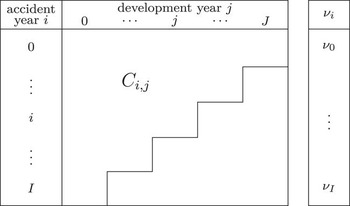
Figure 1 shows the specifications introduced above. The observations given at time t=I are shown in the upper left part of the triangle, whereas the lower right part needs to be predicted. The right part in Figure 1 represents the a priori information needed in the BF model. It can derive from expert knowledge, market statistics, organisational data, etc. and represents a priori estimators for the ultimate claims, i.e. the last column of the development triangle. For simplicity’s sake we assume that the data are given in a triangle, i.e. I=J, and that claims are settled after J years, i.e. there are no more claims payments after J years. However, the model also holds true for development trapezoids, i.e. I>J.
Left: development triangle at time t=I with observable cumulative claims C i,j in the upper left part; right: ν i is only needed in the Bornhuetter–Ferguson model and is used as a priori information for the ultimate claims. This a priori information is for example given by expert knowledge.

2.1. BF method
Although the BF method was initially introduced as a purely computational method, it can be set in a stochastic framework (e.g. Mack, Reference Mack2000; Verrall, Reference Verrall2004). It can be stated in the following way (Wüthrich & Merz, Reference Wüthrich and Merz2008: 21).
Model Assumptions 2.1 (BF method) We assume for cumulative claims C i,j :
-
∙ Cumulative claims C i,j of different accident years i are independent.
-
∙ There exist parameters ν 0, … , ν I >0 and a pattern γ 0, … , γ J >0 with γ J =1 such that for all i∈{0, … , I}, j∈{0, … , J−1} and k∈{1, … , J−j} we have
 $$\:E[C_{{i,0}} ]=\gamma _{0} \nu _{i} $$
 $$\:E[C_{{i,j{\plus}k}} \!\mid\!C_{{i,0}} ,\,\ldots\!,C_{{i,j}} ]=C_{{i,j}} {\plus}\left( {\gamma _{{j{\plus}k}} {\minus}\gamma _{j} } \right)\nu _{i} $$
The sequence (γ j ) j∈{0, … , J} describes the claims development pattern. With Model Assumptions 2.1 we yield
 $$\:{\rm E}[C_{{i,j}} ]=\gamma _{j} \nu _{i} \quad \quad {\rm and}\quad \quad {\rm E}[C_{{i,J}} ]=\nu _{i} $$
Under Model Assumptions 2.1 a predictor for the ultimate claims C i,J is given by
 $$\widehat{{C_{{i,J}} }}^{{{\rm BF}}} =C_{{i,I{\minus}i}} {\plus}\left( {1{\minus}\hat{\gamma }_{{I{\minus}i}} } \right)\hat{\nu }_{i} \quad \quad {\rm for}\,{\rm all}\,i\in 1,\,\ldots\!,I$$
In equation (2.4),
 $$\hat{\gamma }_{{I{\minus}i}} $$
is an estimator for γ
I−i
and
 $$\hat{\nu }_{i} $$
is an a priori estimator for the expected ultimate claim E[C
i,J
]. In practice,
 $$\hat{\nu }_{i} $$
often derives from external information.
2.2. CL method
Among the most popular claims-reserving methods is the CL method due to its simplicity and nonetheless often good results. Initially, it was introduced as computational technique but it can be put into a probabilistic framework as proposed by Mack (Reference Mack1993).
Model Assumptions 2.2 (Distribution-free CL method) We assume for cumulative claims C i,j :
-
∙ Cumulative claims C i,j of different accident years i are independent.
-
∙ There exist parameters f 0, … , f J−1>0 and variance parameters
 $$\sigma _{0}^{2} ,\,\ldots\!,\sigma _{{J{\minus}1}}^{2} \gt 0$$
such that

 $$\:E\left[ {C_{{i,j{\plus}1}} \!\mid\!C_{{i,j}} } \right]=f_{j} C_{{i,j}} $$
 $${\rm Var}(C_{{i,j{\plus}1}} \!\mid\!C_{{i,j}} )=\sigma _{j}^{2} C_{{i,j}} $$
holds true for all i∈{0, … , I} and j∈{1, … , J}.
The parameters f j are usually estimated by so-called CL estimators:
 $$\hat{f}_{j} ={{\mathop{\sum}\limits_{i\,=\,0}^{I{\minus}j{\minus}1} {C_{{i,j{\plus}1}} } } \over {\mathop{\sum}\limits_{i\,=\,0}^{I{\minus}j{\minus}1} {C_{{i,j}} } }},\quad j=0,\,\ldots\!,\,J{\minus}1$$
With the help of the CL estimators predictions of the ultimate claims
 $$\hat{C}_{{i,J}} \,(i=1,\,\ldots\!, \,I)$$
can be derived.
A comparison of the BF and CL methods is conducted in Wüthrich & Merz (Reference Wüthrich and Merz2008: 22 sqq.). We yield that a prediction of the ultimate claim in the BF method is given by
 $$\widehat{{C_{{i,J}} }}^{{{\rm BF}}} =C_{{i,I{\minus}i}} {\plus}\left( {1{\minus}\hat{\gamma }_{{I{\minus}i}}^{{{\rm CL}}} } \right)\hat{\nu }_{i} $$
where
 $$\hat{\gamma }_{j}^{{{\rm CL}}} =\hat{\gamma }_{j} =\prod\limits_{k=j}^{J{\minus}1} {\hat{f}_{k}^{{{\minus}1}} } $$
3. Fuzzy Numbers and Fuzzy Arithmetic
A possibility to model vague information is given by the theory of fuzzy sets (Zadeh, Reference Zadeh1965). In the following we will model the a priori information as fuzzy numbers which are a special case of fuzzy sets. As we only consider fuzzy sets over real numbers
 $${\Bbb R}$$
we restrict the definition to this case (Zadeh, Reference Zadeh1965).
Definition 3.1
(Fuzzy set) A fuzzy set
 $$\tilde{A}$$
over
 $${\Bbb R}$$
is defined as
 $$\tilde{A}=\{ (x,\mu _{{\tilde{A}}} (x))\!\mid\!x\in {\Bbb R}\} } $$
where the membership function
 $$\mu _{{\tilde{A}}} $$
is given by
 $$\mu _{{\tilde{A}}} :{\Bbb R}\to[0,1]$$
.
Remark 3.2 The membership function does not model probabilities as in probability theory but explains to what extent an element belongs to the fuzzy set
 $$\tilde{A}$$
.
In the following section, we are only dealing with TFNs which possess a triangular-shaped membership function. Their advantage lies in the fact that arithmetical operations are easy to conduct. Moreover, they can be interpreted intuitively due to the simple structure of the membership function. Therefore, we choose TFNs in our model, even though it is not limited to the case and can be also modelled with fuzzy numbers with a differently shaped membership function. (For an introduction into the concept of L-R fuzzy numbers to which the TFNs belong see e.g. Dubois & Prade (Reference Dubois and Prade1980: 53 sqq.), for a definition of a TFN we refer to Hanss (Reference Hanss2005: 46).)
Definition 3.3
(TFNs) A TFN is a fuzzy set over
 $${\Bbb R}$$
with membership function
 $$\mu _{{\tilde{A}}} $$
given by
 $$\mu _{{\tilde{A}}} (x)=\left\{ {\matrix{ {{{x{\minus}a{\plus}l_{a} } \over {l_{a} }}} \hfill & {{\rm if}\,a{\minus}l_{a} \leq x\lt a , l_{a} \gt 0} \hfill \cr {{{a{\plus}r_{a} {\minus}x} \over {r_{a} }}} \hfill & {{\rm if}\,a\lt x\leq a{\plus}r_{a} , r_{a} \gt 0} \hfill \cr 1 \hfill & {{\rm if}\,x=a} \hfill \cr 0 \hfill & {{\rm otherwise}} \hfill \cr } } \right.$$
for all
 $$a\in {\Bbb R}$$
and l
a
, r
a
≥0.
Remarks 3.4
-
∙ To simplify notation we will identify a TFN as given in Definition 3.3 with
$$\tilde{a}=(a,l_{a} ,r_{a} )$$
. Then, we speak of a as the mode and l
a
and r
a
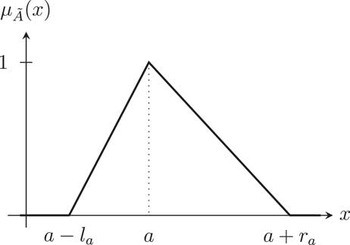
as the left and right spread of the TFN, respectively. An example is illustrated in Figure 2. The depicted TFN can be interpreted as “approximately a”. -
∙ A real (crisp) number
$$a\in {\Bbb R}$$
can be represented as
$$\tilde{a}=(a,0,0)$$
. -
∙ A TFN
$$\tilde{a}=(a,l_{a} ,r_{a} )$$
is said to be non-negative if and only if a−l
a
≥0 and positive if and only if a−l
a
>0.


An example of the triangular fuzzy number
 $$\tilde{a}=(a,l_{a} ,r_{a} )$$
.

In the following Definition 3.5, we will introduce some basic arithmetic operations for TFNs (Hanss, Reference Hanss2005: 55 sqq.).
Definition 3.5
(Fuzzy arithmetic) Let
 $$\tilde{a}=(a,l_{a} ,r_{a} )$$
and
 $$\tilde{b}=(b,l_{b} ,r_{b} )$$
be positive TFNs. Then the sum, difference, multiplication and inverse are defined in the following way:
 $$\tilde{a}\,\oplus\,\tilde{b}=(a,l_{a} ,r_{a} )\,\oplus\,(b,l_{b} ,r_{b} )=(a{\plus}b,l_{a} {\plus}l_{b} ,r_{a} {\plus}r_{b} )$$
 $$\tilde{a}\,\ominus\,\tilde{b}=(a,l_{a} ,r_{a} )\,\ominus\,(b,l_{b} ,r_{b} )=(a{\minus}b,l_{a} {\plus}r_{b} ,r_{a} {\plus}l_{b} )$$
 $$\tilde{a}\,\otimes\,\tilde{b}=(a,l_{a} ,r_{a} )\,\otimes\,(b,l_{b} ,r_{b} )=(ab,al_{b} {\plus}bl_{a} {\minus}l_{a} l_{b} ,ar_{b} {\plus}br_{a} {\plus}r_{a} r_{b} )$$
 $$\tilde{a}^{{{\minus}1}} =\left( {{1 \over a},{{r_{a} } \over {a(a{\plus}r_{a} )}},{{l_{a} } \over {a(a{\minus}l_{a} )}}} \right)$$
Remarks 3.6
-
∙ Definition 3.5 is restricted to positive TFNs as we are only dealing with cumulative claims which are assumed to be only positive.
-
∙ An exact membership function for the product of two TFNs can be derived with the help of Zadeh’s extension principle which has been introduced in Zadeh (1975 Reference Zadeha , 1975 Reference Zadehb , 1975 Reference Zadehc ). When deriving the membership function using the L-R representation of TFNs the operation is not necessarily closed due to the quadratic term (Dubois & Prade, Reference Dubois and Prade1980: 55; Hanss, Reference Hanss2005: 57). Therefore, we use the definition defined above.
-
∙ Wagenknecht et al. (Reference Wagenknecht, Hampel and Schneider2001) derive upper and lower bounds for the exact multiplication of two TFNs. The lower bound is given by
$$(\tilde{a}\,\otimes\,\tilde{b})^{{{\rm lower}}} =(ab,al_{b} {\plus}bl_{a} {\minus}l_{a} l_{b} ,ar_{b} {\plus}br_{a} )$$
and the upper bound is given by
$$(\tilde{a}\,\otimes\,\tilde{b})^{{{\rm upper}}} =(ab,al_{b} {\plus}bl_{a} ,ar_{b} {\plus}br_{a} {\plus}r_{a} r_{b} )$$
. The choice of the approximation defined in (3.5) is conservative. In this context, conservative means that the resulting reserves are (slightly) overestimated.Wagenknecht et al. (Reference Wagenknecht, Hampel and Schneider2001) also derive upper and lower bounds for the exact inverse of a TFN which are given by
$$(\tilde{a}^{{{\minus}1}} )^{{{\rm lower}}} =\left( {{1 \over a},{{r_{a} } \over {a(a{\plus}r_{a} )}},{{l_{a} } \over {a^{2} }}} \right)$$
and
$$(\tilde{a}^{{{\minus}1}} )^{{{\rm upper}}} =\left( {{1 \over a},{{r_{a} } \over {a^{2} }},{{l_{a} } \over {a(a{\minus}l_{a} )}}} \right)$$
. The choice of the approximation in (3.6) leads to more conservative predictions in our context as well. -
∙ Hanss (Reference Hanss2005: 55 sqq.) discusses both the tangent as well as the secant approximation. As described there we choose the secant approximation for the use with TFNs. In most literature only the tangent approximation is discussed for the inverse, but for TFNs the secant approximation often performs much better (Hanss, Reference Hanss2005: 61).
-
∙ Examples of the fuzzy arithmetic given in Definition 3.5 are shown in Heberle & Thomas (Reference Heberle and Thomas2014).


The aim of this paper is to derive a fuzzy version of the BF claims-reserving method. Thus, the goal is to deduce a prediction for the claims reserve. An actuary cannot set up a “fuzzy” reserve as it is a figure in the balance sheet of an insurance company. Figures in the balance sheet are crisp numbers so that we need to make use of a defuzzification method. The concept of an expected value of an FN is applied which was introduced by de Campos Ibáñez & González Muñoz (Reference de Campos Ibáñez and González Muñoz1989) and was also considered, e.g. by de Andrés Sánchez (Reference de Andrés Sánchez2007). We will speak of a an expected value of a TFN as it has been denoted by this term in the literature (de Andrés Sánchez, Reference de Andrés Sánchez2006, Reference de Andrés Sánchez2007). We use the expression in the knowledge that it is generally associated with random variables.
Definition 3.7
(Expected value of a TFN) (a) Let
 $$\tilde{a}=(a,l_{a} ,r_{a} )$$
be a TFN and 0≤β≤1. The expected value of the TFN
 $$\tilde{a}$$
(denoted by
 $$\:E_{\beta } (\tilde{a})$$
) is given by
 $$\:E_{\beta } (\tilde{a})=a{\minus}{{1{\minus}\beta } \over 2}l_{a} {\plus}{\beta \over 2}r_{a} $$
(b)
 $$\:E_{\beta } (\tilde{a}\!\mid\! \cdot )$$
denotes the expected value given a prior information. If the prior information is given by a set of TFNs
 $$\{ \tilde{b},\tilde{c},\,\ldots\!\} $$
, the TFNs shall be considered as crisp, i.e. {(b,0,0), (c,0,0), …}.
Remarks 3.8
-
∙ The reserving method we will introduce in section 4 yields TFNs. The concept of an expected value of a TFN does not only offer a means to defuzzify the resulting reserve but the parameter β provides the opportunity to assess the considered data. We refer to the parameter β as “decision-maker risk parameter”. For higher values of β more weight is put on the right spread. That is, higher values of the parameter β are chosen if the actuary thinks the a priori information (which is often expert knowledge and therefore subjective) does not fit well to the considered claims development triangle.
-
∙ In the following we will model claims reserves as TFNs such that a choice of β≥0.5 for a symmetric TFN, i.e. for a TFN with spreads of equal length, leads to a uncertainty-averse manner of reserving. For a symmetric TFN representing the reserve one would expect the crisp reserve to be the mode, whereas a parameter of β≥0.5 leads to a reserve greater than the mode.
-
∙ The notation of a conditional expected value is introduced in Definition 3.7. It is assumed that there is no more uncertainty in the sense of fuzziness about the given information.
We also need a measurement for the uncertainty of an FN since we like to measure the goodness of our ultimate claims predictions. As in this paper TFNs are consulted to predict the ultimate claims we need a comparable measure to the mean square error of prediction (MSEP) in the classical model as derived in Alai & Wüthrich (Reference Alai, Merz and Wüthrich2009). We use a measure of uncertainty proposed by Pal & Bezdek (Reference Pal and Bezdek1994).
Definition 3.9
(Uncertainty of a TFN) (a) Let
 $$\tilde{a}=(a,l_{a} ,r_{a} )$$
be a TFN. The uncertainty of a TFN
 $$\tilde{a}$$
(denoted by
 $${\rm Unc}(\tilde{a})$$
) is defined as
 $${\rm Unc}(\tilde{a})={1 \over 2}(l_{a} {\plus}r_{a} )$$
(b)
 $${\rm Unc}(\tilde{a}\!\mid\! \cdot )$$
denotes the uncertainty of a TFN
 $$\tilde{a}$$
given a prior information. If the prior information is given by a set of TFNs
 $$\{ \tilde{b},\tilde{c},\,\ldots\!\} $$
, the TFNs shall be considered as crisp, i.e. {(b,0,0), (c,0,0), …}.
Remarks 3.10
-
∙ As defined, the uncertainty of a TFN
$$\tilde{a}=(a,l_{a} ,r_{a} )$$
is independent of the mode a and depends only on the support of
$$\tilde{a}$$
where the support is the subset of the real numbers in which the membership function takes on positive values, i.e. here the interval (a−l
a
, a+r
a
) (Dubois & Prade, Reference Dubois and Prade1980: 10). -
∙ The uncertainty of a TFN
$$\tilde{a}$$
is defined as the area between the x-axis and the membership function
$$\mu _{{\tilde{a}}} $$
. In fact, it is the area between the membership function and the x-axis. Greater values of the uncertainty
$${\rm Unc}(\tilde{a})$$
of a TFN
$$\tilde{a}$$
derive from larger areas between the membership function and the x-axis. Analogously, the smaller the area the less uncertain the TFN is. -
∙ The definition of the uncertainty is motivated by example 3 in Pal & Bezdek (Reference Pal and Bezdek1994) applied to the TFNs given in Definition 3.3.
-
∙ The conditional uncertainty is motivated in analogy to the conditional expected value that there is no more uncertainty about known information in a fuzzy sense.


4. The FBF Method
In this paper, we extend the classical BF method to a FBF method. This is done by the use of fuzzy numbers, i.e. we assume that the a priori information ν
i
(i=0, … , I) as well as the parameters γ
j
(j=0, … , J) are TFNs. Therefore, we denote these by
 $$\tilde{\nu }_{i} =(\nu _{i} ,l_{{\nu _{i} }} ,r_{{\nu _{i} }} )$$
and
 $$\tilde{\gamma }_{j} =(\gamma _{j} ,l_{{\gamma _{j} }} ,r_{{\gamma _{j} }} )$$
, respectively. Our goal is to derive predictors for the ultimate claims
 $$\tilde{C}_{{i,J}} \,(i=1,\,\ldots\!,I)$$
, for the claims reserves for single accident years
 $$\tilde{R}_{i} \,(i=1,\,\ldots\!,I)$$
as well as for aggregated accident years
 $$\tilde{R}$$
and for the uncertainty of the predicted ultimate claims for single accident years
 $${\rm Unc}\left( {\left. {\hat{\tilde{C}}_{{i,J}} } \right| {\cal D}_{I} } \right)$$
(i=1, … , I) and for aggregated accident years
 $${\rm Unc}\left( {\mathop{\,\oplus\,}\limits_{{i=1}}^{I} \left. {\hat{\tilde{C}}_{{i,J}} } \right| {\cal D}_{I} } \right)$$
.
As a clarification, the FBF method introduced in this section models fuzziness and not randomness in a stochastic sense. As the a priori information often derives from subjective knowledge in the form of expert knowledge fuzziness is also present in models of claims reserving.
We make the following model assumptions.
Model Assumptions 4.1 (FBF model)
-
∙ There exist positive TFNs
$$\tilde{\nu }_{i} \,(i=0,\,\ldots\!,I)$$
and also positive TFNs
$$\tilde{\gamma }_{j} \,(j=0,\,\ldots\!,J)$$
such that


 $$\tilde{C}_{{i,0}} =\tilde{\gamma }_{0} \,\otimes\,\tilde{\nu }_{i} $$
 $$\tilde{C}_{{i,j{\plus}k}} =\tilde{C}_{{i,j}} \,\oplus\,(\tilde{\gamma }_{{j{\plus}k}} \,\ominus\,\tilde{\gamma }_{j} )\,\otimes\,\tilde{\nu }_{i} $$
holds true for all i=0, … , I, j=0, … , J−1 and k=J−j.
-
∙ The sums of incremental claims
$$\mathop{\,\oplus\,}\limits_{{i=0}}^{{I{\minus}j{\minus}1}} \tilde{X}_{{i,j{\plus}1}} $$
with
$$\tilde{X}_{{i,j{\plus}1}} =\tilde{C}_{{i,j{\plus}1}} \,\ominus\,\tilde{C}_{{i,j}} $$
for all j∈{0, … , J−1} are non-negative.


Remarks 4.2
-
∙ Since every real number
$$a\in {\Bbb R}$$
can also be denoted as a TFN
$$\tilde{a}=(a,0,0)$$
, observable cumulative claims (i+j≤I) can be written as
$$\tilde{C}_{{i,j}} =(C_{{i,j}} ,0,0)$$
. -
∙ As in our fuzzy model the uncertainty is always included in the fuzzy numbers and there is no need for an error term in equations (4.1) and (4.2).
-
∙ The sum of incremental claims is assumed to be non-negative due to the choice of the following Estimator 4.3. Hence, individual incremental claims can be negative so that adjustments of the reserves in both directions (e.g. additional reserve or regress) are possible.


Since the a priori information
 $$\tilde{\nu }_{i} \,(i=0,\,\ldots\!,I)$$
has to be given in advance by
 $$\hat{\tilde{\nu }}_{i} $$
, we only need an estimator for the parameters
 $$\tilde{\gamma }_{j} \,(j=0,\,\ldots\!,J)$$
with
 $$\tilde{\gamma }_{J} =1$$
. With these estimators we are able to predict the ultimate claims
 $$\tilde{C}_{{i,J}} \,(i=1,\,\ldots\!,I)$$
by
 $$\hat{\tilde{C}}_{{i,J}} =C_{{i,I{\minus}i}} \,\oplus\,\left( {\hat{\tilde{\gamma }}_{J} \,\ominus\,\hat{\tilde{\gamma }}_{{I{\minus}i}} } \right)\,\otimes\,\hat{\tilde{\nu }}_{i} $$
Since the parameters in the payout pattern are assumed to be TFNs we need estimators for the mode as well as the left and right spreads. An actuary will choose TFNs with wider spreads if the available data is vague. Comparably, he or she will opt for narrower width in the opposite situation.
In practice some actuaries tend to modify the estimated parameters in the payout pattern due to subjective judgement. With the help of the FCL estimators we choose Estimator 4.3 as motivated by equation (2.9). Hence, estimators for the mode and both spreads are given in (4.4). Here, the choice of the estimators does not normally lead to symmetric spreads. In our model the sum of incremental claims are assumed to be non-negative (cf. Model Assumptions 4.1) for technical reasons of the choice of the FCL estimators (cf. (4.7)).
Estimator 4.3
(FBF estimator for the TFNs
 $$\tilde{\gamma }_{j} $$
) The TFNs
 $$\tilde{\gamma }_{j} =\left( {\gamma _{j} ,l_{{\gamma _{j} }} ,r_{{\gamma _{j} }} } \right)$$
(j=0, … , J) introduced in Model Assumptions 4.1 are estimated by
 $$\hat{\tilde{\gamma }}_{j} =\left( {\hat{\gamma }_{j} ,\hat{l}_{{\hat{\gamma }_{j} }} ,\hat{r}_{{\hat{\gamma }_{j} }} } \right)$$
with
 $$\hat{\tilde{\gamma }}_{j} =\mathop{\,\otimes\,}\limits_{{k\,=\,j}}^{{J{\minus}1}} \hat{\tilde{f}}_{k}^{{{\minus}1}} $$
for j=0, … , J−1 and
 $$\hat{\tilde{\gamma }}_{J} =(1,0,0)$$
Thereby,
 $$\hat{\tilde{f}}_{k} =\left( {\hat{f}_{k} ,\hat{l}_{{\hat{f}_{k} }} ,\hat{r}_{{\hat{f}_{k} }} } \right)$$
is an estimator for the FCL factor
 $$\tilde{f}_{k} =\left( {f_{k} ,l_{{f_{k} }} ,r_{{f_{k} }} } \right)$$
(k=0, … , J−1) and is given by
 $$\hat{f}_{k} ={{\mathop{\sum}\limits_{i\,=\,0}^{I{\minus}k{\minus}1} {C_{{i,k{\plus}1}} } } \over {\mathop{\sum}\limits_{i\,=\,0}^{I{\minus}k{\minus}1} {C_{{i,k}} } }}$$
and
 $$\hat{l}_{{\hat{f}_{k} }} =\hat{r}_{{\hat{f}_{k} }} ={{\mathop{\sum}\limits_{i\,=\,0}^{I{\minus}k{\minus}1} {X_{{i,k{\plus}1}} } } \over {\mathop{\sum}\limits_{i\,=\,0}^{I{\minus}k{\minus}1} {C_{{i,k}} } }}$$
where X i,k+1=C i,k+1−C i,k for i=0, … , I and k=0, … , J−1.
Remarks 4.4
-
∙ FCL factors are being used for the estimation of
$$\tilde{\gamma }_{j} \,(j=0,\,\ldots\!,\,J{\minus}1)$$
. For more details on the FCL factors
$$\tilde{f}_{k} =\left( {f_{k} ,l_{{f_{k} }} ,r_{{f_{k} }} } \right)\,(k=0,\,\ldots\!,\,J{\minus}1)$$
we refer to Heberle & Thomas (Reference Heberle and Thomas2014). In this method, a priori information about the ultimate claims can also be considered. -
∙ For a stronger analogy to the stochastic models (CL or BF) fuzzy random variables should be used. Then, fuzziness as well as stochastic randomness can be modelled.
-
∙ Although the FCL estimates
$$\hat{\tilde{f}}_{k} $$
are symmetric, i.e.
$$\hat{l}_{{\hat{f}_{k} }} =\hat{r}_{{\hat{f}_{k} }} $$
holds true for all k=0, … , J−1, the FBF estimates
$$\hat{\tilde{\gamma }}_{j} $$
in general are not (except for
$$\hat{\tilde{\gamma }}_{J} =(1,0,0)$$
). -
∙ The choice of Estimator 4.3 is motivated by the classical BF pattern estimates (Wüthrich & Merz, Reference Wüthrich and Merz2008: 23). It needs to be kept in mind that fuzzy set theory models vagueness, whereas stochastic models consider stochastic randomness. Hence, there are situations in which the estimator for the variance parameter yields 0, whereas the spreads are still not equal to 0.
-
∙ Similarly, to the FCL model the total spread of
$$\hat{\tilde{\gamma }}_{j} $$
given by
$$\hat{l}_{{\hat{\gamma }_{j} }} {\plus}\hat{r}_{{\hat{\gamma }_{j} }} $$
can also be interpreted as “uncertainty” of the FN
$$\tilde{\gamma }_{j} $$
. -
∙ The FCL estimators
$$\hat{\tilde{f}}_{k} \,(k=0,\,\ldots\!,\,J{\minus}1)$$
are bounded below to 1 (see Remarks 2.6 in Heberle & Thomas, Reference Heberle and Thomas2014). In our FBF model this is obviously not the case for
$$\hat{\tilde{\gamma }}_{j} $$
and also not necessary, but it can easily be shown that the left border
$$\hat{\gamma }_{j} {\minus}\hat{l}_{{\hat{\gamma }_{j} }} \,(j=0,\,\ldots\!,\,J)$$
is not smaller than 0. -
∙ In the FCL model (see Remarks 2.6 in Heberle & Thomas, Reference Heberle and Thomas2014) the expected values
$$\:E_{{0.5}} (\hat{\tilde{f}}_{j} )$$
for j=0, … , J−1 equal the classical CL estimators as the FCL estimators are defined as symmetric TFNs where the mode is given by the classical CL estimators. Here, we do not yield an equivalent result for
$$\hat{\tilde{\gamma }}_{j} $$
as the fuzzy product and fuzzy inverse (cf. equations (3.5) and (3.6)) do not maintain the symmetric structure of the FCL estimators
$$\hat{\tilde{f}}_{j} $$
.


5. Claims Reserves
In equation (4.3), a predictor for the cumulative claims for accident years i=1, … , I is given. This one is used to derive a predictor for the claims reserves for single accident years. The claims reserves
 $$\tilde{R}_{i} \,(i=1,\,\ldots\!,\,I)$$
for single accident years are given by
 $$\tilde{R}_{i} =\tilde{C}_{{i,J}} \,\ominus\,\tilde{C}_{{i,I{\minus}i}} $$
where
 $$\tilde{C}_{{i,I{\minus}i}} $$
is observable, i.e.
 $$\tilde{C}_{{i,I{\minus}i}} =(C_{{i,I{\minus}i}} ,0,0)$$
. Since, at time t=I only the observations
 $${\cal D}_{I} $$
are available, the ultimate claims
 $$\tilde{C}_{{i,J}} \,(i=1,\,\ldots\!,\,I)$$
are unobservable and, therefore, the claims reserves for single accident years have to be predicted. When replacing the magnitudes in equation (5.1) by their estimates we yield a predictor for the claims reserves, i.e.
 $$\hat{\tilde{R}}_{i} =\hat{\tilde{C}}_{{i,J}} \,\ominus\,\tilde{C}_{{i,I{\minus}i}} ,\quad i=1,\,\ldots\!,\,I$$
Given the observations
 $${\cal D}_{I} $$
the ultimate claims
 $$\hat{\tilde{C}}_{{i,J}} $$
for accident year i=1, … , I can be written as (cf. equation (4.3))
 $$\hat{\tilde{C}}_{{i,J}} =C_{{i,I{\minus}i}} \,\oplus\,\left( {1\,\ominus\,\hat{\tilde{\gamma }}_{{I{\minus}i}} } \right)\,\otimes\,\hat{\tilde{\nu }}_{i} $$
Therefore, we can identify the predictor given in equation (5.2) in the following way:
 $$\hat{\tilde{R}}_{i} =\left( {1\,\ominus\,\hat{\tilde{\gamma }}_{{I{\minus}i}} } \right)\,\otimes\,\hat{\tilde{\nu }}_{i} $$
The aggregated claims reserve
 $$\tilde{R}$$
given by
 $$\tilde{R}=\mathop{\,\oplus\,}\limits_{{i=1}}^{I} \tilde{R}_{i} $$
can be estimated by
 $$\hat{\tilde{R}}=\mathop{\,\oplus\,}\limits_{{i=1}}^{I} \hat{\tilde{R}}_{i} =\mathop{\,\oplus\,}\limits_{{i=1}}^{I} \left( {1\,\ominus\,\hat{\tilde{\gamma }}_{{I{\minus}i}} } \right)\,\otimes\,\hat{\tilde{\nu }}_{i} $$
6. Prediction Uncertainty
6.1. Single accident years
In order to get a feeling for the accuracy of the prediction a measure needs to be introduced. In classical reserving methods this is often done with the MSEP. Here, we use a similar approach as in Heberle & Thomas (Reference Heberle and Thomas2014) which makes use of Definition 3.9 such that we yield an estimator for the ultimate claim uncertainty as given in Estimator 6.1.
Estimator 6.1
(Ultimate claim uncertainty) Given the observations
 $${\cal D}_{I} $$
, the uncertainty of the ultimate claim
 $$\hat{\tilde{C}}_{{i,J}} $$
for accident year i=1, … , I is given by
 $${\rm Unc}\left( {\left. {\hat{\tilde{C}}_{{i,J}} } \right| {\cal D}_{I} } \right)={1 \over 2}\left[ {\left( {1{\minus}\hat{\gamma }_{{I{\minus}i}} } \right)\left( {\hat{l}_{{\hat{\nu }_{i} }} {\plus}\hat{r}_{{\hat{\nu }_{i} }} } \right){\plus}\left( {\hat{l}_{{\hat{\gamma }_{{I{\minus}i}} }} {\plus}\hat{r}_{{\hat{\gamma }_{{I{\minus}i}} }} } \right)\hat{\nu }_{i} {\plus}\hat{l}_{{\hat{\gamma }_{{I{\minus}i}} }} \hat{r}_{{\hat{\nu }_{i} }} {\minus}\hat{r}_{{\hat{\gamma }_{{I{\minus}i}} }} \hat{l}_{{\hat{\nu }_{i} }} } \right]$$
Proof: Given the observations
 $${\cal D}_{I} $$
the predicted ultimate claims
 $$\hat{\tilde{C}}_{{i,J}} $$
for accident year i∈{1, … , I} are given by
 $$\eqalignno{ \hat{\tilde{C}}_{{i,J}} & =\tilde{C}_{{i,I{\minus}i}} \,\oplus\,\left( {1\,\ominus\,\hat{\tilde{\gamma }}_{{I{\minus}i}} } \right)\,\otimes\,\hat{\tilde{\nu }}_{i} \cr & =\left( {C_{{i,I{\minus}i}} ,0,0} \right)\,\oplus\,\left( {1\,\ominus\,\left( {\hat{\gamma }_{{I{\minus}i}} ,\hat{l}_{{\hat{\gamma }_{{I{\minus}i}} }} ,\hat{r}_{{\hat{\gamma }_{{I{\minus}i}} }} } \right)} \right)\,\otimes\,\left( {\hat{\nu }_{i} ,\hat{l}_{{\hat{\nu }_{i} }} ,\hat{r}_{{\hat{\nu }_{i} }} } \right) \cr & = \Big(C_{{i,I{\minus}i}} {\plus}\left( {1{\minus}\hat{\gamma }_{{I{\minus}i}} } \right)\hat{\nu }_{i} , \cr & \quad \quad \left( {1{\minus}\hat{\gamma }_{{I{\minus}i}} } \right)\hat{l}_{{\hat{\nu }_{i} }} {\plus}\hat{r}_{{\hat{\gamma }_{{I{\minus}i}} }} \hat{\nu }_{i} {\minus}\hat{r}_{{\hat{\gamma }_{{I{\minus}i}} }} \hat{l}_{{\hat{\nu }_{i} }} , \cr & \quad \quad \quad \left( {1{\minus}\hat{\gamma }_{{I{\minus}i}} } \right)\hat{r}_{{\hat{\nu }_{i} }} {\plus}\hat{l}_{{\hat{\gamma }_{{I{\minus}i}} }} \hat{\nu }_{i} {\plus}\hat{l}_{{\hat{\gamma }_{{I{\minus}i}} }} \hat{r}_{{\hat{\nu }_{i} }} \Big)} $$
Then, the uncertainty
 $${\rm Unc}\left( {\left. {\hat{\tilde{C}}_{{i,J}} } \right| {\cal D}_{I} } \right)$$
is given by Definition 3.9 applied to equation (6.2).□
6.2. Aggregated accident years
Since we are not only interested in the prediction uncertainty of single accident years we also derive an estimator for the uncertainty of the aggregated ultimate claim
 $\mathop{\,\oplus\,}\limits_{{i=1}}^{I} \hat{\tilde{C}}_{{i,J}} $
given the observations
 $${\cal D}_{I} $$
. As the aggregated ultimate claim is just the sum of the individual ultimate claims, i.e.
 $$\eqalignno{ \mathop{\,\oplus\,}\limits_{{i=1}}^{I} \hat{\tilde{C}}_{{i,J}} & =\mathop{\,\oplus\,}\limits_{{i=1}}^{I} \left[ {C_{{i,I{\minus}i}} \,\oplus\,\left( {1\,\ominus\,\hat{\tilde{\gamma }}_{{I{\minus}i}} } \right)\,\otimes\,\hat{\tilde{\nu }}_{i} } \right] \cr & =\mathop{\,\oplus\,}\limits_{{i=1}}^{I} \Big(C_{{i,I{\minus}i}} {\plus}\left( {1{\minus}\hat{\gamma }_{{I{\minus}i}} } \right)\hat{\nu }_{i} , \cr & \quad \quad \left( {1{\minus}\hat{\gamma }_{{I{\minus}i}} } \right)\hat{l}_{{\hat{\nu }_{i} }} {\plus}\hat{r}_{{\hat{\gamma }_{{I{\minus}i}} }} \hat{\nu }_{i} {\minus}\hat{r}_{{\hat{\gamma }_{{I{\minus}i}} }} \hat{l}_{{\hat{\nu }_{i} }} , \cr & \quad \quad \quad \left( {1{\minus}\hat{\gamma }_{{I{\minus}i}} } \right)\hat{r}_{{\hat{\nu }_{i} }} {\plus}\hat{l}_{{\hat{\gamma }_{{I{\minus}i}} }} \hat{\nu }_{i} {\plus}\hat{l}_{{\hat{\gamma }_{{I{\minus}i}} }} \hat{r}_{{\hat{\nu }_{i} }} \Big) $$
 $$\cr & =\mathop{\,\oplus\,}\limits_{{i=1}}^{I} \Big(C_{{i,I{\minus}i}} {\plus}\left( {1{\minus}\hat{\gamma }_{{I{\minus}i}} } \right)\hat{\nu }_{i} , \cr & \quad \quad \left( {1{\minus}\hat{\gamma }_{{I{\minus}i}} } \right)\hat{l}_{{\hat{\nu }_{i} }} {\plus}\hat{r}_{{\hat{\gamma }_{{I{\minus}i}} }} \hat{\nu }_{i} {\minus}\hat{r}_{{\hat{\gamma }_{{I{\minus}i}} }} \hat{l}_{{\hat{\nu }_{i} }} , \cr & \quad \quad \quad \left( {1{\minus}\hat{\gamma }_{{I{\minus}i}} } \right)\hat{r}_{{\hat{\nu }_{i} }} {\plus}\hat{l}_{{\hat{\gamma }_{{I{\minus}i}} }} \hat{\nu }_{i} {\plus}\hat{l}_{{\hat{\gamma }_{{I{\minus}i}} }} \hat{r}_{{\hat{\nu }_{i} }} \Big) $$
the estimator of the uncertainty of the aggregated ultimate claims is straightforward.
Estimator 6.2
(Uncertainty of the aggregated ultimate claims) Given the observations
 $${\cal D}_{I} $$
, the uncertainty of the aggregated ultimate claims
 $$\mathop{\,\oplus\,}\limits_{{i=1}}^{I} \hat{\tilde{C}}_{{i,J}} $$
is given by
 $${\rm Unc}\left( {\left. {\mathop{\,\oplus\,}\limits_{{i=1}}^{I} \hat{\tilde{C}}_{{i,J}} } \right| {\cal D}_{I} } \right)=\mathop{\sum}\limits_{i=1}^I {{\rm Unc}\left( {\left. {\hat{\tilde{C}}_{{i,J}} } \right| {\cal D}_{I} } \right)} $$
Proof: Based on equation (6.4), we yield with Definition 3.9 and Estimator 6.1
 $$\eqalignno{ {\rm Unc}\left( {\left. {\mathop{\,\oplus\,}\limits_{{i=1}}^{I} \hat{\tilde{C}}_{{i,J}} } \right| {\cal D}_{I} } \right) & ={\rm Unc}\left( {\mathop{\,\oplus\,}\limits_{{i=1}}^{I} \Big( {C_{{i,I{\minus}i}} {\plus}\left( {1{\minus}\hat{\gamma }_{{I{\minus}i}} } \right)\hat{\nu }_{i} ,} \right.} \right. \cr & \quad \quad \left( {1{\minus}\hat{\gamma }_{{I{\minus}i}} } \right)\hat{l}_{{\hat{\nu }_{i} }} {\plus}\hat{r}_{{\hat{\gamma }_{{I{\minus}i}} }} \hat{\nu }_{i} {\minus}\hat{r}_{{\hat{\gamma }_{{I{\minus}i}} }} \hat{l}_{{\hat{\nu }_{i} }} , \cr & \left. {\left. {\quad \quad \quad \left( {1{\minus}\hat{\gamma }_{{I{\minus}i}} } \right)\hat{r}_{{\hat{\nu }_{i} }} {\plus}\hat{l}_{{\hat{\gamma }_{{I{\minus}i}} }} \hat{\nu }_{i} {\plus}\hat{l}_{{\hat{\gamma }_{{I{\minus}i}} }} \hat{r}_{{\hat{\nu }_{i} }} } \right)} \right) \cr & ={\rm Unc}\left( {\mathop{\sum}\limits_{i=1}^I {\left( {C_{{i,I{\minus}i}} {\plus}\left( {1{\minus}\hat{\gamma }_{{I{\minus}i}} } \right)\hat{\nu }_{i} } \right)} } \right., \cr & \quad \quad \mathop{\sum}\limits_{i=1}^I {\left( {\left( {1{\minus}\hat{\gamma }_{{I{\minus}i}} } \right)\hat{l}_{{\hat{\nu }_{i} }} {\plus}\hat{r}_{{\hat{\gamma }_{{I{\minus}i}} }} \hat{\nu }_{i} {\minus}\hat{r}_{{\hat{\gamma }_{{I{\minus}i}} }} \hat{l}_{{\hat{\nu }_{i} }} } \right),} \cr & \quad \quad \quad \left. {\mathop{\sum}\limits_{i=1}^I {\left( {\left( {1{\minus}\hat{\gamma }_{{I{\minus}i}} } \right)\hat{r}_{{\hat{\nu }_{i} }} {\plus}\hat{l}_{{\hat{\gamma }_{{I{\minus}i}} }} \hat{\nu }_{i} {\plus}\hat{l}_{{\hat{\gamma }_{{I{\minus}i}} }} \hat{r}_{{\hat{\nu }_{i} }} } \right)} } \right) \cr & =\mathop{\sum}\limits_{i=1}^I {{1 \over 2}\left( {\left( {1{\minus}\hat{\gamma }_{{I{\minus}i}} } \right)\left( {\hat{l}_{{\hat{\nu }_{i} }} {\plus}\hat{r}_{{\hat{\nu }_{i} }} } \right){\plus}\left( {\hat{l}_{{\hat{\gamma }_{{I{\minus}i}} }} {\plus}\hat{r}_{{\hat{\gamma }_{{I{\minus}i}} }} } \right)\hat{\nu }_{i} } \right.} \cr & \left. {\quad \quad {\plus}\hat{l}_{{\hat{\gamma }_{{I{\minus}i}} }} \hat{r}_{{\hat{\nu }_{i} }} {\minus}\hat{r}_{{\hat{\gamma }_{{I{\minus}i}} }} \hat{l}_{{\hat{\nu }_{i} }} } \right) \cr & =\mathop{\sum}\limits_{i=1}^I {{\rm Unc}\left( {\left. {\hat{\tilde{C}}_{{i,J}} } \right| {\cal D}_{I} } \right)} $$
□
Remark 6.3 In comparison to the MSEP for aggregated accident years in classical reserving methods there are no covariance terms in equation (6.5). In fact, the uncertainties of different accident years cannot offset each other. One possibility to model dependencies as well would be to change over to the theory of fuzzy random variables.Footnote 1
7. Example
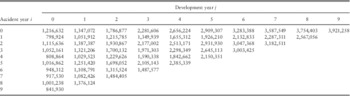
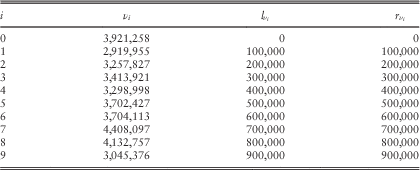
For our example we apply the paid run-off triangle and as a priori information we use the last observed diagonal in the incurred run-off triangle both given in Dahms (Reference Dahms2008). We like to keep in mind that the example presented in Dahms (Reference Dahms2008) considers randomness, whereas fuzziness is addressed here. Consequently, the results cannot be compared without difficulty. Since we are dealing with fuzzy a priori information we assume that the values are not sharp but only approximate values. By doing so, vagueness is added to the a priori information. The paid run-off triangle is given in Table 1 and the a priori information is shown in Table 2.
Observed cumulative claims payments C i,j .

Given a priori information
 $$\tilde{\nu }_{i} =\left( {\nu _{i} ,l_{{\nu _{i} }} ,r_{{\nu _{i} }} } \right)$$
.
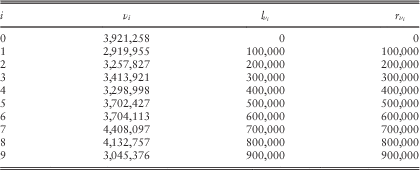
The a priori information usually originates from expert knowledge and the spreads need to be chosen by the actuary. On the one hand, vagueness rises the more values for a given accident year need to be predicted (Model Assumptions 4.1 and Estimator 4.3), on the other hand large absolute values can accommodate a higher vagueness. The actuary will choose the spreads under these considerations. The left and right spreads in Table 2 are increasing for later accident years i∈{1, … , 9}. This is only an example of how membership functions could be assigned. For i=0 there is no spread as no cumulative claims need to be predicted.
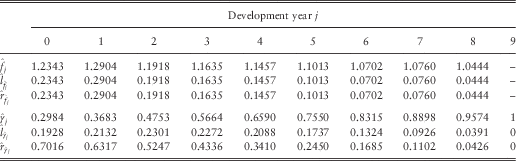
In Table 3, the estimated FCL factors
 $$\hat{\tilde{f}}_{j} =\left( {\hat{f}_{j} ,\hat{l}_{{\hat{f}_{j} }} ,\hat{r}_{{\hat{f}_{j} }} } \right)$$
(j=0, … , J−1) as well as the estimated parameters of the FBF method
 $$\hat{\tilde{\gamma }}_{j} =\left( {\hat{\gamma }_{j} ,\hat{l}_{{\hat{\gamma }_{j} }} ,\hat{r}_{{\hat{\gamma }_{j} }} } \right)$$
(j=0, … , J) are given computed with Estimator 4.3 and the estimator for the FCL factors are given in Heberle & Thomas (Reference Heberle and Thomas2014). Both are written down in three lines; the first line refers to the mode and in the second and third one the left and right spread, respectively, are given.
Estimated fuzzy chain ladder
 $$\left( {\hat{\tilde{f}}_{j} } \right)$$
and fuzzy Bornhuetter–Ferguson
 $$\left( {\hat{\tilde{\gamma }}_{j} } \right)$$
factors for j=0, … , J−1.
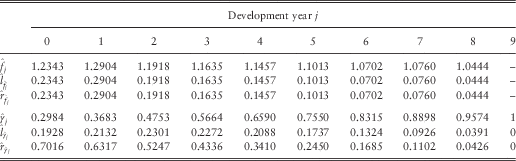
Note: The estimated fuzzy parameter in the payout pattern for j=J is given by
 $$\hat{\tilde{\gamma }}_{J} =(1,0,0)$$
.
With the help of the estimated parameters
 $$\hat{\tilde{\gamma }}_{j} \,(j=0,\,\ldots\!,\,J{\minus}1)$$
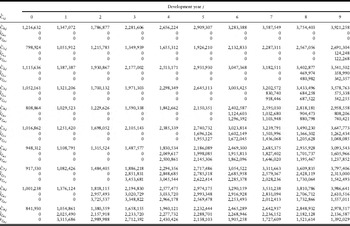
we are able to fill up the observed development triangle given in Table 1 using equation (4.2). The filled development triangle is shown in Table 4.
Filled run-off triangle with observed cumulative claims C
i,j
(i+j≤I) and predicted cumulative claims
 $$\hat{\tilde{C}}_{{i,j}} \,(i{\plus}j\gt I)$$
.

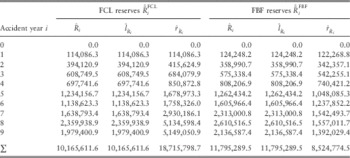
The predicted FBF reserves
 $$\hat{\tilde{R}}_{i}^{{{\rm FBF}}} \,(i=0,\,\ldots\!,\,I)$$
as well as the aggregated FBF reserve
 $$\hat{\tilde{R}}^{{{\rm FBF}}} $$
are presented in Table 5 and compared with the corresponding FCL reserves
 $$\hat{\tilde{R}}_{i}^{{{\rm FCL}}} \,(i=0,\,\ldots\!,\,I)$$
and
 $$\hat{\tilde{R}}^{{{\rm FCL}}} $$
. In the first column the mode of the fuzzy reserve is given and in the second and third column the left and right spread, respectively, are written down. The support of the fuzzy reserves ranges from
 $$\hat{R}_{i} {\minus}\hat{l}_{{\hat{R}_{i} }} $$
to
 $$\hat{R}_{i} {\plus}\hat{r}_{{\hat{R}_{i} }} $$
. Thus, the reserve can take on very small values down to 0 but only with a very small grade of membership since the slope of the membership function is small. The mode and the left spread of the FBF reserve are a bit higher (except for accident years 2 and 3). However, the right spreads of the FBF reserves are much smaller, especially for later accident years i∈{0, … , I}. This is due to the underlying arithmetic operations: in contrast to the FBF method we yield the FCL reserve by various fuzzy multiplications. This is analogous to the classical case in which we can fill up the development triangle by successively multiplying the last observation with the CL factors in the CL method, whereas for the BF method there are less multiplications. The considered fuzzy multiplications in our example lead to larger spreads for the FCL reserves.
Predicted fuzzy chain ladder (FCL) and fuzzy Bornhuetter–Ferguson (FBF) reserves for individual accident years i∈{0, … , I} and for aggregated accident years.

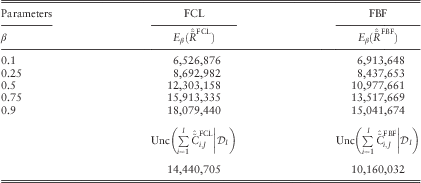
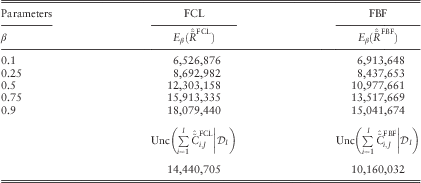
The expected aggregated reserve
 $$\:E_{\beta } \left( {\hat{\tilde{R}}} \right)$$
for different choices of the “decision-maker risk parameter” β as well as the prediction uncertainty
 $${\rm Unc}\left( {\left. {\mathop{\,\oplus\,}\limits_{{i=0}}^{I} \hat{\tilde{C}}_{{i,J}} } \right| {\cal D}_{I} } \right)$$
for aggregated accident years are presented in Table 6. As expected, the expected aggregated reserve is higher, the larger the parameter β. The expected aggregated reserve for the FCL model exceeds the FBF reserve for nearly all choices of the parameter β. This is due to the fact that the expected value puts more weight on the right spread, the higher β. Hence, the FCL model leads to more pessimistic predictions for this example.
Expected reserves and uncertainties for different choices of the “decision-maker risk parameter” β∈[0, 1].
Note: FCL, fuzzy chain ladder; FBF, fuzzy Bornhuetter–Ferguson.
Obviously, the uncertainty is lower for the FBF method since the total spread of the aggregated reserve is narrower. Hence, the FBF method leads to more stable results in this example.
8. Conclusion
Fuzzy set theory offers instruments to model uncertainty. The a priori estimators in a classical BF method can originate from market statistics, expert knowledge, etc. Thus, they might be associated with uncertainty. The presented FBF method offers an approach to model this uncertainty as well as uncertainties with the payout pattern. Therefore, we have followed a similar approach as in Heberle & Thomas (Reference Heberle and Thomas2014). Wider spreads of the a priori information stand for more uncertain information.
The FCL method also provides an opportunity to model uncertainty in a claims-reserving context. However, if a priori information for the ultimate claims is available, it makes sense to incorporate this. It can be handled by the introduced FBF method. A characteristic of the FCL model is that the prediction uncertainty of the reserves rises rapidly for later accident years. This can be avoided here due to the used arithmetic operations. The FBF method applies more fuzzy sums and less fuzzy multiplications. Therefore, as can be seen in the presented example in section 7, the FBF method can result in more stable predictions. However, compared with the FCL method the parameters in the FBF method are not symmetric.
The uncertainty is modelled in this paper with TFNs. Of course, the choice is not limited to this case, but the uncertainty can also be modelled with FNs with a completely different shaped membership function as e.g. Gaussian or exponential membership functions. Situations are thinkable in which these functions are more suitable. Nonetheless, the computational effort is higher so that in this method the benefits of the easily interpretable TFNs are utilised.
Moreover, in current situations the quantification of the claims development result is of crucial importance. So far it is to our knowledge not considered in a fuzzy context and can be of great interest for further research.
Acknowledgements
We thank the two anonymous referees for their valuable feedback and suggestions.