Why do the outcomes of newly formed party systems vary so much? Some new party systems are either in permanent disequilbria (such as Russia and various African party systems) or face reversal after periods of limited stability (for example, the Weimar Republic, the French IV Republic, Bulgaria, Lithuania, Poland, Bolivia, Ecuador, Brazil). Others institutionalize but do so either very slowly (as in Estonia, nineteenth-century and early twentieth-century Europe, the Czech Republic) or with surprising speed (like post-war Germany, Hungary or the Czech Republic).Footnote 1 What systematic factors explain such a wide range of party system formation outcomes? The literature has advanced few systematic theoretical propositions that can help us understand it.Footnote 2 Institutions, historical legacies, political education and social cleavages have variously been identified in the literature as the key explanatory variables. This line of research has produced important insights, but they have been limited by two factors. First, the literature often looks at these factors independently of each other and therefore neglects their important interaction effects. Secondly, it has done little to integrate systematic, cross-national factors with the historical contingencies and temporal dynamics that are frequently emphasized in more historical studies.
To address these theoretical deficiencies, this article advances a path dependent (PD) explanation. PD explanations have gained currency because they promote the understanding of the reason why small causes occasionally have unexpectedly large consequences over time, and why, as a result, we can observe very different and, often, inefficient equilibria in phenomena like economic markets, social policies or states.Footnote 3
Empirically, the article explains the rapid formation of the moderate, durable, two-and-half party in post-war Germany. By the standards of most fragmented transitional party systems, the German case is deviant. It challenges existing theories, as well as permitting a preliminary test of alternatives to PD explanations. At first sight, Germany’s rapid and linear party-system institutionalization strongly suggests that systematic, large-scale causal factors, like institutions or cleavages (as favoured by most existing explanations) were the primary causal variables. On closer analysis, however, it was various small-scale, unsystematic factors and their interaction with institutions, and to a lesser extent cleavages, which were of primary importance in the German case. The small-scale historical factors include the party licences awarded by a handful of mid-level Allied military administrators between 1946 and 1949, the skilful co-optation of a few politicians and the formation of a few minor electoral coalitions. It is this interaction between small-scale historical factors and larger-scale institutions or cleavages that rests at the heart of PD explanations. Closely analysing such interactions is very labour intensive: it requires extensive contextual knowledge as well as conversance with different theoretical literatures – and this might thus explain why it is rarely done. Selecting Germany as a case reduces these costs somewhat because it is an empirical gold-mine. It provides data for virtually every conceivable variable, and does so across time, sub-national levels and individual parties. It offers within-case variation that is sufficient to test heretofore untested theoretical claims, trace poorly understood causal mechanisms and follow historical dynamics.Footnote 4
The article is organized in four sections. First, it reviews how three strands in the literature on party system formation – historical, market/institutional and elite explanations – can be easily re-specified to fit the key and often quite generic causal mechanisms identified by the PD literature. Secondly, it specifies the historical and early advantages they created for the first parties to form. Thirdly, it analyses the various reproduction mechanisms and whether or not they reinforced the early movers’ initial advantages. Fourthly, it addresses the vexing issue of how to generalize from findings derived from a single case and a theory emphasizing historical contingencies.
Critical junctures and reinforcement mechanisms
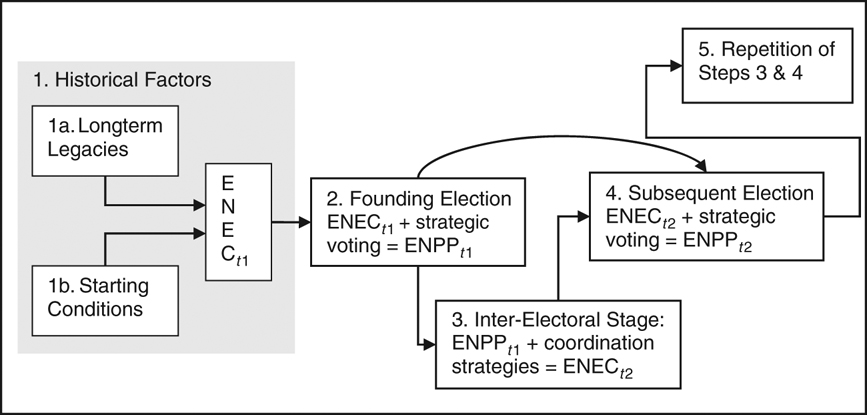
The central claim of PD is that the sequence in which several events happen does matter. A small event occurring early can have large consequences because subsequent events may reinforce some of the earlier event’s characteristics. In doing so, alternative courses of action become less probable and the initial event increasingly shapes subsequent developments. PD thus narrows the choice set through time.Footnote 5 What narrows the choice sets are so-called increasing returns or reinforcement mechanisms through which each sequence of events imparts particular skills, reputational gains, learning effects and organizational advantages which make exit from the current path increasingly costly and, hence, less likely.Footnote 6 In emphasizing learning, availability of information and co-ordination effects, PD arguments point to very similar processes discussed in the party literature even though this literature has not drawn on PD arguments. If we merge the specific mechanisms that the party literature identifies as shaping the formation of party systems with the broader categories of path dependency, the result is the analytical framework outlined in Figure 1.
Elements of party system formation Note: ENEC: Effective number of electoral contestants; ENPP: Effective number of parliamentary parties.
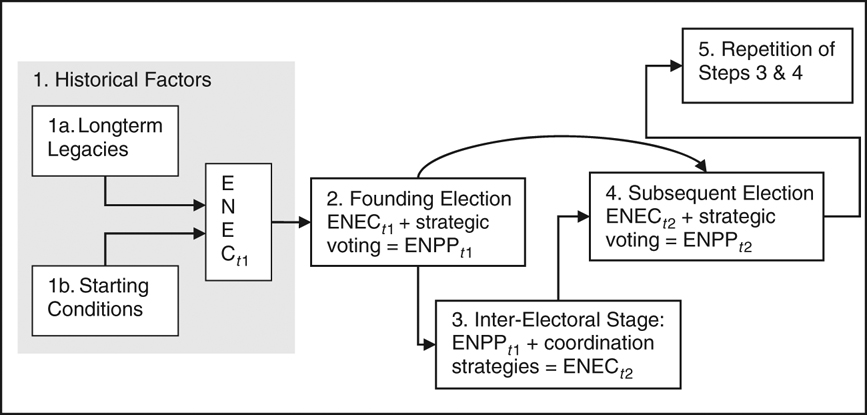
Party systems are complex and literature consequently uses many different variables to measure their evolution. Party fragmentation – that is the number of parties and their respective electoral strength (measured as the effective number of electoral parties, ENEP) or parliamentary strength (measured as the effective number of parliamentary parties, ENPP) – is the most widely used measure of party system institutionalization and, hence, the one that I use.Footnote 7 The literature uses fragmentation to infer when a party system reaches a stable equilibrium point. According to Gary Cox, such a point corresponds to a set of market-clearing expectations where ‘the number of types of candidates that voters are willing to vote for turns out to equal the number and types of candidates that are willing and able to stand for elections’.Footnote 8 Equilibria form centrally around mutual expectations that voters and politicians have of each other, and they are reached when neither politicians nor voters have any incentive to change their behaviour.
The boxes in Figure 1 illustrate three principal factors – history, electoral markets, and elite co-ordination strategies – forming and co-ordinating the expectations of actors and, thereby, determining different equilibrium outcomes. Historical explanations of party system formation focus on boxes 1a and 1b; they are crucial for understanding what the PD literature calls ‘critical junctures’, that is, the starting points of a potentially new path. Electoral market explanations focus on boxes 2 and 4; they concentrate on electoral competition and its institutional incentives as key mechanisms for generating information and co-ordination effects and, thereby, reinforcing starting conditions defined by historical factors. Finally, box 3 draws attention to elite co-ordination strategies which amplify or mitigate prior electoral market outcomes. The iteration of elections and co-ordination strategies, thus, constitute the key mechanisms for analysing increasing returns.
It is important to emphasize that electoral markets differ a great deal in the institutional incentives created for competition and also that co-ordination strategies encompass a wide range. These differences matter a great deal because they determine whether and to what degree increasing return mechanisms are at work, and, hence, make it less likely for path dependency to be viewed as a form of historical inevitability. The party literature does not relate these three factors directly to path dependency. Instead, it usually focuses on one of three factors while ignoring the other two. It treats them as constant causes rather then being part of a causal sequence with distinct temporal dynamics. The challenge, therefore, is to show how these three factors interact and thereby help understanding of whether history’s returns are increasing or diminishing.
Historical Factors
The very idea of a ‘path’ implies a starting moment during which the actors’ choice set is constrained to varying degrees. Historical factors are key to understanding how constrained actors’ choices are and how genuinely novel a new path is. The effects of these historical factors can be conceptualized in terms of the effective number of electoral contestants (ENEC) participating in the founding election. In a brand new party system, voters have very little ex ante information about parties’ winning chances. As they cannot readily differentiate effective parties from those that are not, the effective number of electoral contestants will be much higher in founding than subsequent elections. Historical factors directly determine how much ex ante information voters have about parties’ winning chances and, therefore, how many of them will be effective contestants. Long-term, historical legacies (like cleavages or prior regime types) generate important information about actors’ potential electoral strength, resource endowments and political expertise.Footnote 9 If historical legacies are important, then the candidates for ENEC will be fewer and the starting moment less of a tabula rasa or, as the PD literature puts it, less of a critical juncture. In such situations, more short-term, more contingent starting conditions play an important role. The list of starting conditions is almost endless, but those the party literature mentions most frequently are the type of democratic transition, timing and sequencing of founding elections, and prominence of external actors.Footnote 10 Such factors generate information about the effectiveness of contestants in the founding election. Such information will be far more uncertain and volatile than that produced by historical legacies and as such has a weaker constraining effect on how many contestants will be effective in the founding election. In short, when historical legacies are negligible and starting conditions are important, we get the sort of critical junctures from which new paths branch off.
Institutions
Institutions and the competition they structure are a crucial reinforcement mechanism as they generate new information about parties’ winning chances, create learning effects (i.e. how institutions work, imparting organizational skills, electioneering), co-ordinate voter expectations and amplify first-mover advantages (i.e. incumbents avail themselves of public resources or gain reputational advantages among voters). Institutions first determine how the ENEC participating in the founding election are translated into an effective number of parliamentary parties. In subsequent elections, institutions also influence how the ENPP are reproduced in each electoral cycle.
The increasing returns that institutions produce for each party are contingent on the incentives that political institutions create for strategic voting. The stronger such incentives are, the more electoral competition accentuates the advantages of first-mover and larger parties as voters bandwagon around them and vice versa. First-past-the-post-electoral systems, high electoral thresholds, presidentialism or unitary government create formidable obstacles for small or late-formed parties to win seats or cabinet portfolios and, thus, create incentives for voters to abandon such parties. Proportional representation, low or no electoral thresholds, parliamentarism and federalism, in turn, mitigate the incentives for strategic voting and thus will weaken increasing returns that the front-runners of founding elections gain. In short, institutions produce increasing returns of varying magnitudes; the specific magnitude is the combined effect of the initial effectiveness of a party as an electoral contestant and the subsequent incentives for strategic voting. While institutions are a crucial and the most widely studied reproduction mechanism, they are by no means the only one.
Co-ordination Strategies
Various elite strategies constitute another important but far less studied reproduction mechanism. Politicians certainly are constrained by starting conditions and initial election outcomes, but they are also capable of responding and reshaping these very same conditions. Jack Bielasiak observed that ‘the development of party structures is driven by election outcomes, and by parliamentary gamesmanship between elections. Elections and parliamentary activities … act as screening devices that elevate some political contenders to prominent roles and marginalize other party formations.’Footnote 11 Gary Cox loosely labelled these forms of inter-electoral gamesmanship, ‘co-ordination strategies’ to emphasize that the effective number of parliamentary parties produced by one election does not automatically constitute the starting point for the next election. In short, politicians have the capacity to reshape party systems between elections.Footnote 12 Co-ordination strategies capitalize on the fact that the political value of individual votes is not given, but can be enhanced or diminished through co-ordination moves taking place between elections. They play an important but underappreciated role in inducing equilibiria, and therefore require slightly more attention than the other two.
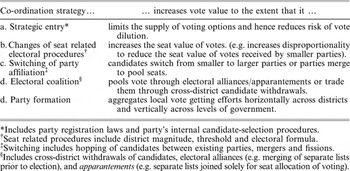
Table 1 lists the co-ordination strategies identified in the literature (even though they are not always labelled as such), and summarizes how they enhance the value of votes in the sense of increasing their seat-winning capacity. They include aggregating votes across districts through forming national parties,Footnote 13 pooling or trading votes through inter-party electoral coalitions,Footnote 14 limiting the entry of new competitors to avoid diluting existing votes,Footnote 15 changing the rules that determine how votes will be counted when translated into seats,Footnote 16 or changing the value of votes after the election when individual politicians switch their party affiliations.Footnote 17
Co-ordination Strategies and Value of Votes

*Includes party registration laws and party’s internal candidate-selection procedures.
†Seat related procedures include district magnitude, threshold and electoral formula.
‡Switching includes hopping of candidates between existing parties, mergers and fissions.
§Includes cross-district withdrawals of candidates, electoral alliances (e.g. merging of separate lists prior to election), and apparantements (e.g. separate lists joined solely for seat allocation of voting).
Why Do Co-ordination Strategies Matter?
The party system literature, especially in its institutional garb, assumes that electoral markets are efficient and thereby pre-determine what sorts of co-ordination strategies are chosen. It employs a tacit functional logic in which co-ordination strategies are the mechanisms of an invisible natural selection process. According to this functional logic, politicians decide to merge, change institutions, withdraw, switch or form temporary coalitions in response to either prior or anticipated election outcomes. And they will do so until the party system reaches a stable equilibrium. The party literature thus treats co-ordination strategies as accelerators producing increasing returns; they amplify market outcomes even as they are predetermined by market outcomes – thus lacking any independent causal impact on the formation of party systems.
This functional logic overlooks two important points. First, actors choose co-ordination strategies in response to election outcomes and institutional constraints. Institutions affect the ability of politicians to change electoral rules, switch parties or form coalitions and thus interact directly with election outcomes. And as institutions vary across countries, so the potential accelerator effect of co-ordination strategies’ will vary. Secondly, co-ordination strategies serve as brakes on market outcomes. Parties often use co-ordination strategies to shelter themselves from strategic voting. Small parties, for example, form electoral coalitions or use their parliamentary swing votes to make electoral rules more proportional. In short, co-ordination strategies are influenced, but by no means pre-determined, by electoral-market outcomes; therefore, they are not part of some functional, natural selection process. They have to be analysed as distinct causal mechanisms shaping party systems; they can alter the number of parties or their electoral prospects to the point where the effective number of electoral parties (ENEP) that voters face in subsequent elections has little in common with ENPPt1 produced by the preceding election. Co-ordination strategies generate information about parties’ strength or create focal points around which voters’ expectations can converge. Cox notes that there are ‘many instrumentally rational agents in elections – candidates, activists, contributors – all of them may respond in ways that overwhelm or accentuate the strategic responses of voters.’Footnote 18
Co-ordination strategies are key to the better understanding of temporal dynamics. Their accelerator effect provides a detailed account of how positive feedback mechanisms might work in the formation of party systems and, thereby, how small causes could have big, long-term consequences. Conversely, their braking effect can account for why some party systems reach a stable equilibrium more slowly than others, or never at all. Co-ordination strategies thus are a key for understanding the temporal dynamics of transitional party systems.
Co-ordination strategies especially matter in transitional party systems where electioneering strategies – the vote-winning strategies most central in established party systems – are often limited in their effectiveness. Electioneering strategies include formulating policies, building personal reputations, manipulating issue dimensions, advertising or improving voter turnout.Footnote 19 At the most basic level, they involve communicating with voters either to change their party affiliation or, for those already affiliated, to assure their turnout. However, such communication is effective only if voters have formed preferences and get to choose among a stable set of parties offering clear policy alternatives. The relative absence of such conditions in many transitional party systems means that voters cannot evaluate electoral alternatives and parties cannot effectively solicit electoral support. As a result, politicians in transitional democracies rely just as much on co-ordination strategies as they do on electioneering strategies.
Historical factors
A founding election does not take place in a historical vacuum, as it is shaped by long-term historical legacies and short-term starting conditions. Such prior factors affect the effective number of electoral contestants participating in the founding election as they convey information about a party’s potential voting base, resources and, hence, winning prospects.Footnote 20 Moreover, long-term historical legacies potentially determine to what extent a starting point does or does not constitute a genuine critical juncture from which a new path branches off. It is to this latter issue that I turn first.
Long-term Historical Legacies
Long-term, large-scale, historical legacies pre-date a critical juncture and, depending on their importance, diminish that juncture’s degree of indeterminacy.Footnote 21 The key for path dependent arguments is the degree to which historical legacies narrow the actors’ choice set and diminish the influence of contingent factors; the more they do, the less it makes sense to talk about a critical juncture or a new path like a tabula rasa. There is no systematic way to ascertain the degree of indeterminacy at the outset of a new path. One option is to see how much emphasis historians place on long-term legacies as opposed to short-term starting conditions and the resulting continuity and discontinuity at a particular point in time. What makes historians credible on this is that they think very seriously about the degree of (dis-)continuity across time.
The issue of a tabula rasa and, hence, genuinely critical juncture is particularly relevant for re-democratizing countries like post-war Germany where the existence of a prior party system potentially constrains subsequent ones. Prior to 1949, Germany experienced seventy years of electoral politics during which a party system with clear regional, religious and above all class lines had evolved.Footnote 22 German historians debate extensively how much of these prior structures survived after 1945. They conclude that historical legacies most directly affect the left. The leaders of the SPD and KPD (see Appendix 2 for list of abbreviations and explanation of the names of German political parties) returned from exile, re-established their organizations and mobilized voters around the same class issues that had dominated Weimar politics. The KPD, however, quickly lost much of its credibility after its sister party in the Soviet zone banned all other parties.
For the rest of the party system, historians discern much less historical continuity. Little of the centre and centre-right’s inter-war party infrastructure survived the Great Depression, twelve years of Nazi rule and six years of war. Weimar’s liberal and conservative parties were fragmented, plagued by defections and unsuccessful in transforming themselves from unorganized parties of notable people into modern mass parties.Footnote 23 Very few of their members stayed in politics after 1945; only 8.6 per cent of the CDU/CSU deputies and 13.4 per cent of the FDP deputies served in the Weimar Reichstag. This compares with 22.9 per cent for SPD deputies and 26.6 per cent for KPD legislators.Footnote 24 In addition to having to recruit new political leaders, centre and centre-right parties had to form new party organizations, formulate programmes capable of bridging old regional, religious and class divides, integrate 12 million German refugees and pre-empt the resurgence of Nazi-successor parties.Footnote 25 As a result, ‘organizations that once had linked the parties to specific cultures had vanished … The result was a breakdown of the rigid system of regional, denominational, ideological and class cleavages that had characterized German society and the old party system.’Footnote 26 In emphasizing discontinuities, historians imply a sufficient degree of indeterminacy in 1945 to consider this moment in time as a critical juncture for the centre-right. For this key segment of the party system, the post-war development was unconstrained by pre-1945 historical legacies.
Starting Condition: Party Licensing
The Allies involved themselves very selectively in Germany’s return to democracy except when it came to licensing new parties.Footnote 27 Party licensing plays a particularly important role in transitional party systems where voters have insufficient information about parties’ winning chances. As a result, ‘the number of entrants is not limited by anticipation of strategic voting [and thus] everyone has an ex ante equal chance of suffering (or benefiting) from it.’Footnote 28 Through party licensing, the Allies decisively changed these odds and had a profound impact because it restricted the supply of contesting parties and gave the licensed parties a tremendous early mover advantage. I analyse first the proximate effects of party licensing by looking at how its varied application across the French, British and US occupation zones affected the ENEP going into the 1949 election. I then assess the licensing’s more distal effects on parties’ organizational institutionalization by following the affiliation choices of electoral candidates after 1949.
Licensing’s Proximate Effects
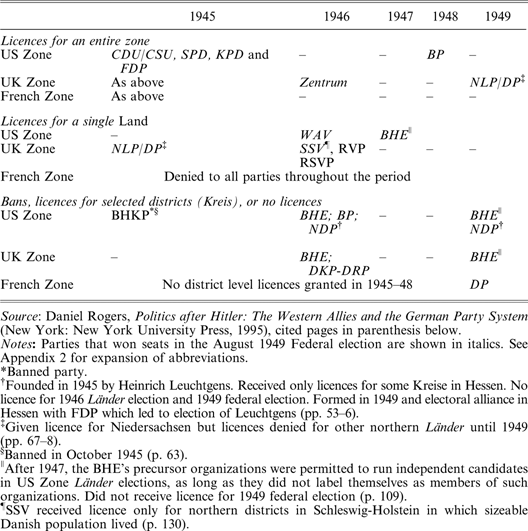
The Allies had no licensing policy for the whole of Germany and so the licensing varied across the British, French and US occupation zones. The licensing practices ranged from giving parties a licence for an entire zone, a single Land within a zone, or for a few electoral districts within a particular Land. Parties also were denied licences or even banned outright. Table 2 summarizes these various licensing practices by showing the year in which a party received a licence (columns) and how its licence varied across the three zones (rows).
Party Licensing by Allied Zone
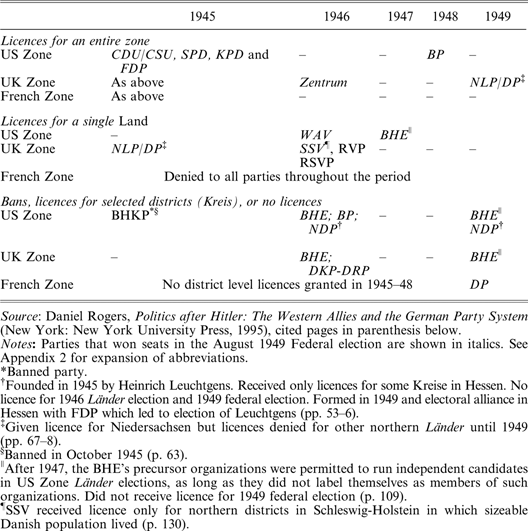
Source: Daniel Rogers, Politics after Hitler: The Western Allies and the German Party System (New York: New York University Press, 1995), cited pages in parenthesis below.
Notes : Parties that won seats in the August 1949 Federal election are shown in italics. See Appendix 2 for expansion of abbreviations.
*Banned party.
†Founded in 1945 by Heinrich Leuchtgens. Received only licences for some Kreise in Hessen. No licence for 1946 Länder election and 1949 federal election. Formed in 1949 and electoral alliance in Hessen with FDP which led to election of Leuchtgens (pp. 53–6).
‡Given licence for Niedersachsen but licences denied for other northern Länder until 1949 (pp. 67–8).
§Banned in October 1945 (p. 63).
∥After 1947, the BHE’s precursor organizations were permitted to run independent candidates in US Zone Länder elections, as long as they did not label themselves as members of such organizations. Did not receive licence for 1949 federal election (p. 109).
¶SSV received licence only for northern districts in Schleswig-Holstein in which sizeable Danish population lived (p. 130).
Of sixteen parties, only four – the CDU/CSU, SPD, FDP and KPD – received licences in all three zones thus enabling them to operate as national parties. Of the twelve partially licensed parties, three (the BP, Zentrum and NSLP/DP) were granted licences in only one zone and five (WAV, BHE, SSV, RVP, RSFP) were licensed in only a single Land. Three more parties (BHKP, NDP, DKP-DRP) received even more limited licences or were banned. Clearly, the French had the most restrictive licensing, restricting it to the four large parties and denying all other requests.Footnote 29 The American and British occupation authorities were more liberal in their licensing. They tried to balance their desire to assist the CDU/CSU, SPD and FDP with their concern that silencing important social groups would unduly radicalize them or drive them underground. Strikingly enough, party licences were only denied to the right-of-centre parties.
Party licensing dramatically reduced the ENEC heading into the founding election, leading the CDU/CSU, SPD, FDP and KPD winning 77.8 per cent of the votes. It did so in three ways. First, the four fully licensed parties were the most successful in linking their organizations across levels of government and districts, making them the only genuinely national parties. They contested virtually every single member district (SMD) in 1949 and fielded lists in all eleven multi-member districts (MMDs). The other parties participated in far fewer electoral contests; the RSFP fielded lists in five Länder, the DP and the DKP-DRP in four, Zentrum in three, BP and WAV in one. Secondly, the fully licensed parties participated in all the fourteen Länder elections held before 1949. By contrast, the partially licensed parties ran in no more than two Länder elections. This extensive participation in Länder elections gave the fully licensed an important reputational advantage going into the 1949 election. Thirdly, the fully licensed parties attracted more experienced and, presumably, also more skilled politicians. In the first Bundestag, 18.4 per cent of CDU/CSU deputies sat in one of the previous Länder assemblies, 20.1 per cent of SPD deputies, and 17.6 per cent of FDP deputies. Of the partly licensed parties, only the DP had any pre-1949 legislative experience (27.8 per cent).Footnote 30
Two additional observations underscore the immediate causal link between party licensing and strategic voting. First, the variations in party licensing across the three occupation zones directly impacted the ENEP. Licensing in the French zone was far more restrictive than in the US and British zone. And so, the ENEP in the Länder election taking place in the French zone was low at 2.8 compared to the 3.8 in the British zone and 3.8 ENEP in the US zone. Secondly, the Allies actually preferred to have voters’ kill small parties through strategic defections rather than having to ban outright. Rogers observed that the Allies’ original intent was to limit ‘parties geographically [and] thereby manage them quietly into harmlessness’ rather than to ban them outright.Footnote 31
Licensing’s Distal Effects
How significant were the first mover advantages of the fully licensed parties over time and how durable were the increasing returns they produced? Theoretically, we would expect the fully licensed parties to expand their vote share, recruit the most experienced politicians and attract most of the financial contributions. Of these three potential increasing returns, we have sufficient information to assess only the first two.
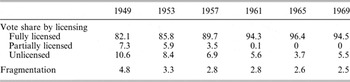
Table 3 demonstrates how the early mover advantage of the fully licensed parties translated into overwhelming electoral advantages in the 1949 election and how these advantages persisted and compounded over time. The fully licensed parties increased their vote share from 1949 to 1969 by 12.4 percentage points and their seat share (not shown in Table 3) by 15 points to the point of winning every single seat after 1961. Moreover, the decline in the ENEP from 4.8 in 1949 to 2.5 in 1969 underscores that the votes cast for fully licensed parties also became more and more concentrated around the SPD, CDU/CSU and, to a lesser extent, the FDP.
Vote Share by Licensing Status and Party Fragmentation

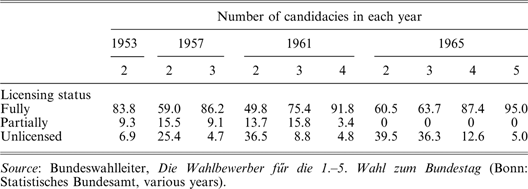
Table 4 looks at the increasing returns that licensing produced for parties’ efforts in recruiting experienced politicians. I use the number of repeat candidacies as a proxy for political experience. I focus on experience of candidates, rather than candidate shares, because a party’s demand for candidates, unlike voters, is more limited by the number of candidates a party can nominate. Thus, just looking at parties’ candidate share would not be particularly informative as fully licensed parties certainly would have attracted far more candidates if they had had room to nominate them. Focusing on experienced candidates mitigates this problem as the focus now is on how licensing affected the quality – rather than quantity – of candidates that a party managed to recruit.
Number of Candidacies by Licensing Status (in Percentages)
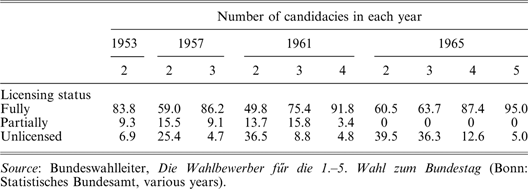
Source: Bundeswahlleiter, Die Wahlbewerber fűr die 1.–5. Wahl zum Bundestag (Bonn: Statistisches Bundesamt, various years).
The figures in Table 4 clearly show that the more experienced a candidate was, the more likely he/she would run for one of the fully licensed parties. If we average the percentages, then the fully licensed parties recruited 63 per cent of all candidates who had run twice, 75 per cent of candidates who had run three times and 90 per cent of candidates who had run four times. Experienced politicians thus just jumped on the bandwagon of fully licensed parties just as much as voters did. Such parties offered them both greater career stability and advancement opportunities than the other parties. The experience of politicians, in turn, led to the greater professionalization and hence greater electoral effectiveness of fully licensed parties.Footnote 32
If party licensing indeed had distal effects, what role did institutions and co-ordination strategies play in reproducing the early mover advantages over time? Answering this question is crucial both for theoretical and empirical reasons. Theoretically, path dependent arguments that do not specify the positive feedback mechanisms commit the post hoc, propter hoc fallacy of assuming that because A happened before B, A must have caused B. Empirically, party licensing is insufficient to explain some important developments in the post-war Germany party development. The founding election in 1949 – the first one held without party licensing – witnessed an increased in the ENEP from 3.4 to 4.8 when compared with the previous fourteen state elections held between 1946 and 1948. This increase suggests that alternative paths were possible during the first two electoral cycles. Newly formed or previously only partially licensed parties won 17.9 per cent of the votes in 1949 and 14.3 per cent in 1953. These parties also were very successful in recruiting electoral candidates, increasing their share from 35.2 per cent in 1949 to 43.2 per cent in 1953 and 51.5 per cent in 1957. Many of the new or now fully nationalized parties (DP, SSV, BP and WAV) had strong regional support. After 1949, the German party system was two tiered; it was vertically fragmented along national fault lines defined by the four fully licensed parties and horizontally divided across the regional identities represented by either partially licensed parties or new entrants. There were few indications that this second, regional tier would disappear as quickly as it did. There was little reason to suspect that these parties would not persist and maybe even expand their electoral appeal. Germany could have gone the way of post-communist Bulgaria or Lithuania, where the early mover advantages did not increase over time and where, consequently, fragmentation increased rather than decreased with time. Such disequilibrium outcomes are to be expected since starting conditions, like party licensing, affect strategic voting through the information they provide voters. And such information is a perishable good that is unlikely to produce increasing returns if it is not updated and renewed. This gets us to the role institutions and co-ordination strategies play.
Institutional factors
Maurice Duverger memorably likened institutions to accelerators and brakes because they had the capacity to accentuate or neutralize the political consequences of non-institutional factors (which he called the ‘engine of politics’).Footnote 33 From more recent work, we know that the accelerator effect of institutions is the direct result of the incentives they create for strategic voting. Institutions vary significantly in how accurately they translate votes into seats and, as such, create different risks for how likely a vote will count or be wasted. The greater such risks, the more likely voters will support established parties with good winning chances. Applied to transitional party systems, this means that institutions creating incentives for strategic voting will favour parties with an early mover advantage and in so doing they will positively reinforce these advantages.Footnote 34
If we apply this theoretical insight to Germany, we have to conclude that its various institutions created weak incentives for strategic voting and thus contributed little to accentuate the early advantages of the fully licensed parties. The Bonn Constitution reaffirmed Germany’s longstanding federal structure in which Länder governments and elections create important opportunities for regional parties to build local power bases. It also removed Weimar’s directly elected presidency, thus removing a single national and non-divisible prize which induced strategic voting.Footnote 35 Finally, the personalized form of proportional representation created weak incentives for strategic voting. The SMD elections had no effect on the distribution of seats and thus did not influence strategic voting.Footnote 36 Neither did the MMD lists because of their large district magnitude (ranging from five to 109 seats). The 5 per cent electoral threshold was the institution that most directly induced strategic voting. Yet, if we take a comparative perspective, we see that electoral systems with a comparable electoral threshold support on average 4.7 ENEP which is 2.5 ENEP more than in Germany in 1969.Footnote 37 So, German voters did cast strategic votes but it seems that the incentives to cast them were not institutional in origin.
This contention is further substantiated by the evidence in Table 5 which looks at how closely levels of strategic voting co-vary with levels of fragmentation. It operationalizes strategic voting as the vote share cast for parties that failed to win seats; the smaller the percentage of such wasted votes, the higher the level of strategic voting.Footnote 38 In Table 5, we see fragmentation declining and waste vote shares (i.e. strategic voting) remaining unchanged for the first three elections. This disjuncture suggests that voters defected until 1961 at higher rates from small, seat-winning and hence ‘risky parties’ (thereby reducing fragmentation without affecting wasted vote shares) than from even smaller, seatless and hence ‘hopeless parties’ (thereby leaving wasted vote shares unaffected).Footnote 39 It also implies that voters for risky parties used different information than voters for hopeless parties. Institutional explanations cannot account for such informational differences since they assume that electoral markets provide uniform information for all parties and that all voters learn the same lessons from that information. To explain such differences requires that we look beyond institutions to co-ordination strategies as another source of information that influenced strategic voting.
Formation of Post-War German Party System

*MMD vote shares of all parties failing to win seats.
Co-ordination strategies
Just like institutions, co-ordination strategies cover a wide range, with some functioning as accelerators of prior election outcomes and others as brakes. Generally, winners in prior elections will use co-ordination strategies that further enhance their temporary electoral advantages or even make them more permanent, while losers in elections will try to mitigate the consequences of their losses. Co-ordination strategies thus have the ability to alter the ENEC significantly between two elections. In post-war Germany, co-ordination strategies were used most frequently by fully licensed parties to accentuate their early mover advantages. These parties employed four such strategies: strategic entry, electoral engineering, party switching and formation of electoral alliances. Together, these four strategies each played an important role in understanding the increasing returns that the fully licensed parties garnered from their early mover advantages.
Strategic Entry
Strategies to co-ordinate the entries of new candidates or parties affect strategic voting as it shapes pre-electoral expectations about the entrants’ electoral viability. Parties employ three entry strategies. First, they control the supply of candidates through recruitment regulations for internal party candidates. Such regulations seek to prevent vote splitting among similarly minded voters by offering them a single, party-endorsed candidate.Footnote 40 Secondly, party registration laws restrict the supply of parties if they have formidable signature or membership requirements. Such requirements increase entry costs and thus limit the number of new electoral entrants.Footnote 41 Thirdly, party laws in many post-authoritarian democracies contain democratic litmus tests which permit parties or individual politicians to be banned.Footnote 42 The more restrictive such litmus tests are and the more discretion elected politicians, as opposed to less partisan constitutional courts, have in enforcing them, the more likely they will constrain the entry of new parties. How do such party laws differ from the aforementioned party licensing? While both seek to control the number of entrants, they differ in who does the controlling and for how long. The Allies were committed to licensing parties for only a limited time and had no direct partisan interests. Party licensing thus was an individual, highly contingent event and as such constitutes a historical factor rather than a co-ordination strategy.Footnote 43
Of these three entry strategies, only party bans were used in Germany. The Allies’ de-Nazifization programme barred all medium to high ranking Nazi officials from running for public office,Footnote 44 while the Constitutional Court could ban extremist or anti-democratic parties. The Court did so twice, banning the neo-Nazi SRP in 1952 and the KPD in 1956. These bans did not affect strategic voting since the two parties were electorally unviable well before they were banned.Footnote 45 The SRP gained considerable public attention by winning 11 per cent of the votes in 1951 Niedersachsen state election and 7 per cent in the 1951 Bremen state election. Despite these two regional successes, the party had limited support in other states. It won only 1.7 per cent of all votes cast in the 1949–52 state elections, before it was banned from running in a federal election.Footnote 46 Similarly, the KPD won only 2.2 per cent of votes in the 1953 federal election and 2.8 per cent of the votes during the 1953–56 Länder elections, thus failing to cross either electoral threshold. Clearly, voters, rather than party bans, contributed to the two parties’ demise.
Electoral Engineering
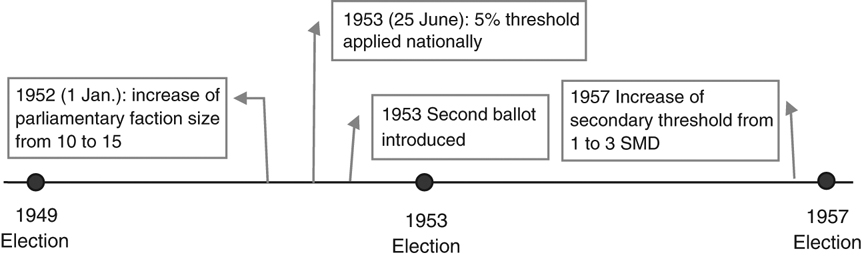
Changing electoral procedures is a common co-ordination strategy that political actors use to either improve their winning chances or to reduce their prospective losses. German politicians resorted to electoral engineering four times (see Figure 2).Footnote 47 Only the raising in 1953 of the electoral threshold from state to national level affected strategic voting while the other three strategies were of relatively minor significance.
Institutional engineering
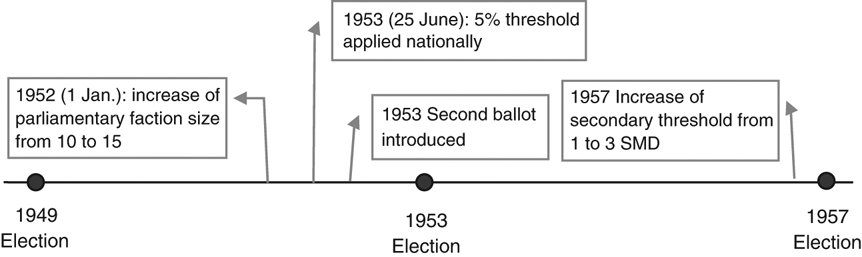
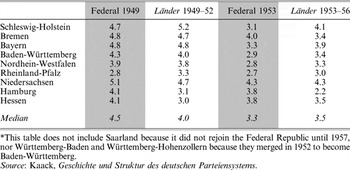
Changing the electoral threshold. Institutional effects are best observed at the district level where voters assess parties’ winning chances. Table 6 thus reports ENEP for district/state level of the federal elections preceding and following the raising of the electoral threshold in 1952. It also adds fragmentation of Länder elections preceding and following the 1953 election which employed (just like the 1949 federal election) the 5 per cent state-level threshold. In comparing Länder and district-level federal election returns, I can compare the effects of two types of thresholds over thirty-six elections rather than just two federal ones. I use the ENEP because it reflects strategic voting more accurately than ENPP.
ENEP in Länder Elections and Federal Electoral DistrictsFootnote *

* This table does not include Saarland because it did not rejoin the Federal Republic until 1957, nor Württemberg-Baden and Württemberg-Hohenzollern because they merged in 1952 to become Baden-Württemberg. Source: Kaack, Geschichte und Struktur des deutschen Parteiensystems.
The 1953 threshold had a noticeable impact on strategic voting by contributing to a drop in the median party fragmentation of 1.2 parties compared with the 1949 election, and 0.7 drop when compared to average fragmentation for the 1949–52 state elections. These median drops also are very consistent across individual districts; all nine districts in 1953 had lower fragmentation levels than in the 1949 and seven districts in 1953 had lower levels than in the preceding state elections. Minor parties (others than the CDU/CSU, SPD or FDP) were most adversely affected by the new electoral threshold. In 1953, they lost 11.3 per cent of the votes they had won in the 1949 and 10.2 per cent of the votes they had received in the preceding state elections. Having regional strongholds, these minor parties had no difficulties crossing the state-level thresholds. Their national support, however, was below or sufficiently close to the new 5 per cent threshold to explain the defection of many of their voters in 1953.
In the 1953 election, fragmentation declined in all but two districts (Hamburg and Hessen) when compared to the preceding state elections. These two exceptions reflected electoral alliances in the preceding state elections. In Hamburg, the CDU and FDP formed an anti-socialist alliance – the Vaterstädtischen Bund Hamburg (VBH) – to compete more effectively against the dominant SPD; in Hessen, the highly nationalist FDP state party merged with the right-wing BHE by inviting its candidates to run on its electoral list.Footnote 48 These alliances artificially lowered fragmentation and when they were not renewed in the 1953 federal election, fragmentation increased. Overall then, it was a change in elite behaviour, rather than strategic voting, which accounts for these two anomalies.
The state-level fragmentation following the 1953 federal election (last column) further demonstrates the effects of the new, electoral threshold. It increased by 0.2 parties, compared to 1953, but dropped by 0.5 parties when compared with the 1949–52 state elections. Voters responded to the lower threshold in the post-1953 state elections by returning to smaller parties but clearly not at the same rate as during the previous round of state elections. It can be surmised that a small percentage of voters, who defected from small parties in 1953, returned to those parties once the incentives for strategic voting weakened in the state elections.
Other procedural changes. Compared to changing the electoral threshold, the introduction of the second ballot, change in the secondary electoral threshold, and change in the size requirement for parliamentary caucuses each had only a minor consequence. The original electoral law granted parties seats that won a single district but failed to cross the 5 per cent threshold. In 1957, this secondary threshold was increased from one to three SMD.Footnote 49 The increase was inconsequential since small parties, facing strategic voting, never were competitive in SMD districts. If we simulate the 1953 election with the 1957 three SMD threshold, the ENPP would have dropped from 2.79 to 2.7, preventing only the Zentrum from making it into the Bundestag.
Starting in 1953, voters were allowed to cast two ballots: a district vote used in winner-take-all district races and a party vote applied to the state-wide party lists. The two votes permit ticket splitting and create the false impression that parties could make votes count more if they co-ordinated their ticket splitting. The first ballot only determines how many SMD, as opposed to list seats, a party wins; it has no bearing on its overall seat share which is exclusively based on the second ballot. The first ballot, in other words, merely adds a personalizing element, permitting voters to express a personal preference for individual candidates. So, given the centrality of the second vote for a party’s overall seat share, any additional SMD seats won through ticket splitting are inconsequential. This fact is frequently lost on voters and politicians alike, who persist in believing that ticket splitting somehow affects the overall seat distribution among parties.Footnote 50
There were instances, though, when ticket splitting actually mattered as in both 1953 and 1957. In those two elections, the CDU withdrew candidates in a handful of safe SMD and instructed its voters to cast their ballots for one of their coalition partners (either DP, Zentrum or FDP). The objective of such strategic withdrawals was to award these parties SMD seats so that they could clear the secondary, less formidable, electoral threshold. The double ballot made such strategic withdrawals less costly for the CDU because its voters could still cast their decisive, second-list vote for their party, thus assuring that ticket splitting would not reduce its seat share.Footnote 51 Not surprisingly, the number of strategic withdrawals increased from thirty-one in 1949 to seventy-seven in 1953 before dropping, largely because of the CDU’s absorption of many small parties, to twenty in 1957. The more general impact such strategic withdrawals had on party fragmentation is discussed in this article’s final section.Footnote 52
Finally, in 1951, the SPD and CDU/CSU co-operated to raise the number of deputies required to form a parliamentary faction from eleven to fifteen. Their goal was to make committee work more efficient by excluding smaller parties. The rule change contributed to the loss of the KPD’s committee assignments. It would have meant the same for the nine Zentrum and thirteen BP deputies had they not joined together in the newly formed FU. Similarly, the seven WAV deputies retained their committee assignments by joining the DP.Footnote 53 These party switches had no significant overall effect, reducing the ENPP from 4.01 to 3.98.
Party Switching
Rational choice scholars treat political parties as memberless and infrastructure-free coalitions of office seekers who continuously re-evaluate the costs and benefits of their membership.Footnote 54 In doing so, they underscore the idea that politicians may switch their party affiliations and thereby alter a party system between elections. Such switching usually is accompanied by well-publicized personality disputes or factional squabbles from which voters can infer parties’ changing electoral prospects. The amount and type of switching have a distinct impact on strategic voting; the more switching pools seats of parties, the more likely voters will upgrade those parties’ winning chances and vice versa.
Frequency and types of switching. Table 7 shows the frequency and the nature of German party switchers. The first row indicates that switching was a temporary phenomenon – with the number of switchers declining rapidly and disappearing altogether after 1961. The second row identifies switchers according to the size of their party of origin; it shows that switchers originating from minor parties account for the most switches. This is hardly surprising given the fact that the small parties’ precarious existence made them unattractive to both existing members contemplating defection and prospective joiners from other parties. By contrast, the major parties experienced much lower levels of switching because they provided more secure career paths for their members. Deputies who left one of the three big parties almost always did so because of policy rather than career considerations. Such policy considerations led in 1956 to the defection of sixteen FDP deputies who formed the short-lived FVP before joining the DP.Footnote 55 These sixteen defectors also explain the lower percentage of minor-party switchers during the 1953–57 electoral cycle.
Post-War German Party Switching

Source: Schindler, Datenhandbuch, pp. 237–54; Kaack, ‘Fraktions- und Parteiwechsler’.
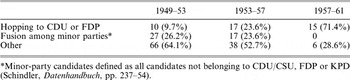
What then were the re-affiliation preferences of minor-party defectors? The answer to this question is key for understanding how switching affected the consolidation of the German party system. German deputies had different switching options (such as hopping between existing parties, fusions and fissions) and could re-affiliate to parties of very different sizes and ideological orientations. Among the possible choices, Table 8 highlights the two which pooled seats the most and, thus, were most likely to produce increasing returns. These choices for minor-party deputies were between switching to one of the CDU/CSU, SPD or FDP, or merging with other minor-party candidates. Row 3 aggregates the remaining switching strategies under ‘Others’. This category includes fissions, hopping from major to minor parties or lateral hopping among small parties or even large parties. Such strategies would dilute seat concentration, reduce parties’ electoral viability and thus lead to decreasing returns. Table 8 reports individual switches rather than individual switchers; it therefore reflects multiple switches of deputies who changed their party affiliations several times during a legislative period.
Types of Party Switches

*Minor-party candidates defined as all candidates not belonging to CDU/CSU, FDP or KPD (Schindler, Datenhandbuch, pp. 237–54).
Switching and strategic voting. Table 8 highlights three broad switching patterns. The first two produced very short-term decreasing returns by delaying the de-fragmentation. The third one, however, severely undermined smaller parties, thereby reinforcing the early mover advantages of fully licensed parties.
First, the switching strategies which dilute seats and produced decreasing returns were almost exclusively confined to the first parliamentary term. The sixty-six switches recorded in 1949–53 were motivated either by ideological sorting or circumventing not being licensed. Policy motivated switching was common right after the 1949 election. Prior to the election, many deputies joined parties that had not yet settled on a party programme. As parties clarified their programme during the election, initial joiners switched to ideologically more compatible parties. Other switchers belonged to refugee organizations that were denied party licences. They got around this obstacle by running either as independents or as guests of the WAV. No longer requiring a licence after the 1949 elections, these guest candidates formed their own parliamentary faction, the GB/BHE.Footnote 56 After 1953, switches in the ‘Other’ category dropped noticeably; thirty of the thirty-eight switches in 1953–57 were the result of the FDP’s 1956 schism.
Secondly, fusion related switches, which declined rapidly by 1957, helped smaller parties to counter strategic voting by pooling their voters and resources. This was the primary motivation for the BP and Zentrum to form the FU in 1951, the WAV’s fusion with the DP the same year, and the FVP’s merger with the DP in 1957. All these mergers were marriages of convenience and their principle goal was to convince voters that the fused parties had enough electoral support to cross the 5 per cent electoral threshold. These mergers did not succeed in stemming strategic defections and thus had a temporary negative feedback effect.
Thirdly, the CDU/CSU, and to a lesser extent the FDP, attracted a steady number of switchers throughout the 1950s while suffering few defections themselves. The deputies switching to the CDU/CSU did so as small groups rather than as individuals. Their re-affiliations produced important increasing returns but these returns owed more to who the switchers were than to their numbers. In terms of numbers, the switchers to the CDU/CSU and FDP had a limited impact. Switchers added 1.5 per cent to the CDU’s parliamentary size in the first legislature (for a total of 36 per cent of seats), 2.0 per cent in the second (51.9 per cent) and 2.4 per cent in the third (56.7 per cent).Footnote 57 Such switchers did not alter the overall fragmentation since they were too infrequent to offset fissions and switches from larger to smaller parties.Footnote 58
However, the switchers contributed directly to the electoral decline of the parties from which they exited. The CDU/CSU accepted five of the twelve BP deputies in 1952, nine of the twenty-seven GB/BHE deputies in 1955 and eleven out of seventeen DP deputies in 1960. These party switches received significant media attention and thus further undermined public confidence in the electoral viability of the switchers’ old parties. Moreover, these parties’ winning prospects were further diminished by the fact that most switchers were senior party members with considerable public reputations, extensive contacts with interest groups and much political experience. Losing these assets undermined the electioneering effectiveness of the switchers’ old parties.
The switches to the CDU/CSU all followed a similar pattern. They usually began with an internal crisis in the switchers’ old party. The trigger for such a crisis was either a disappointing election result or concern about losing the party’s identity by co-operating too closely with the CDU/CSU. In response to such a crisis, a majority faction usually responded by advocating the departure from the CDU/CSU-led federal coalition government, joining a state-level coalition government with the SPD or seeking a merger with another minor party. The goal of these proposals was greater ideological differentiation from the CDU/CSU to win back disgruntled voters; or, in the case of mergers, to pool votes, and thereby reduce strategic voting. After these proposals were tabled, a minority faction usually opposed them. The members of these factions, generally senior party members, were unwilling to give up committee assignments, cabinet posts or, in the case of mergers, safe positions on the electoral lists that such breaks with the CDU/CSU or mergers would have entailed. After losing these factional disputes, the members of the minority factions switched to the CDU/CSU.Footnote 59 Their decision was made all the easier by the CDU/CSU’s promise to grant switchers the same seniority and offices they had in their old party. This welcoming gesture was part of Adenauer’s divide-and-rule strategy, which sought to weaken minor parties by strategically poaching some of their leaders.Footnote 60 He thought that such a strategy required fewer concessions and lower political costs than an outright fusion with minor parties would have done.
Electoral Coalitions
The formation of electoral coalitions offers politicians an important instrument for making votes count more effectively by temporarily ‘reallocating votes to produce a more efficient translation of votes into seats’.Footnote 61 Electoral coalitions can take three forms; apparantements (for example, separate lists joined solely for seat allocation after voting); electoral alliances (for example, merging separate lists prior to voting) or co-ordination of candidate withdrawals across districts.Footnote 62 The vote pooling effect of such coalitions certainly reduces defection of strategic voters but the resulting voter co-ordination does not necessarily reduce the number of parties in a lasting fashion. Electoral coalitions usually are temporary arrangements, involving small parties that try to rescue each other from losing their seats by pooling their votes.Footnote 63 As such, they mostly have a braking effect on the consolidation of transitional party systems. The reason for this is that electoral coalitions make it more difficult for voters to assess parties’ winning chances and, thus, impede strategic voting.Footnote 64 In Germany, the fragmenting effect of electoral coalitions was minimal. If we simulate the ENPP without parties rescued by the CDU/CSU, then in 1953 fragmentation would have been 0.2 parties lower and 0.06 parties lower in 1957. Electoral coalitions thus had no significant impact on strategic voting.
A closer analysis of electoral coalitions confirms this aggregate finding. Of the three coalition arrangements, German politicians used only electoral alliances and candidate withdrawals. And of those two only the latter had any effect on party system formation.
Electoral alliances. Electoral alliances did not produce any increasing returns because they involved tiny parties and only occurred in the 1949 election. They were piggy-back arrangements whereby unlicensed parties entered parliament. The unlicensed party would actively campaign for its allied party in return for a few safe list positions. Three such piggy-back alliances materialized in 1949. The FDP in Hessen offered the NDP a few list positions in return for its electoral support. This alliance boosted the FDP’s vote share in Hessen to 28 per cent, much higher than in other states. It led to the election of the NDP’s party chairman Heinrich Leuchtgens, who, after the election, immediately left the FDP and founded the DRP.Footnote 65 In Niedersachsen, the DKP-DRP formed an electoral alliance with the Gemeinschaft unabhängiger Deutscher whose two leaders were elected.Footnote 66 And in Bavaria, the WAV formed a joint list with a large refugee organization, helping the latter to elect six candidates.Footnote 67 All these alliances were temporary as the piggy-backing candidates left their host party immediately after the election. The overall effect of the alliances was minimal; they were individual events leading to the election of nine candidates who otherwise would not have made it into the Bundestag.
Strategic candidate withdrawals. Strategic withdrawals across SMDs constituted a second and more important form of electoral coalition formation that was attractive to small and large parties alike. To the former, they provided an opportunity to clear the electoral threshold while, for the latter, they offered the possibility of rescuing small but crucial coalition partners.Footnote 68 What made strategic withdrawals feasible was Germany’s secondary electoral threshold which permitted parties to win seats if they won one and, after 1957, three SMDs. The secondary threshold was particularly attractive to smaller parties because they could win seats even if they failed to cross the primary 5 per cent threshold. Smaller parties, however, stood little chance of winning SMD contests without larger parties withdrawing their candidates and instructing their voters to support the candidate of the small, allied party.
Table 9 looks at the number of strategic withdrawals and differentiates among those involving withdrawals between the CDU/CSU and small parties and withdrawals among small parties, not involving the CDU/CSU. Every party withdrawing a single candidate was counted as one withdrawal. To fully understand Table 9 requires that we combine raw figures with background information. Such an analysis reveals three effects that strategic withdrawals had on the formation of the German party systems.
Strategic Withdrawals

Sources: Schindler, Datenhandbuch, pp. 107–10, Kitzinger, German Electoral Politics, pp. 40–2.
First, some of the strategic withdrawals were utterly inconsequential, producing neither increasing nor decreasing returns. Strategic withdrawals among minor parties never succeeded in circumventing the primary 5 per cent threshold by crossing the secondary SMD threshold. So, they did not manage to reduce the strategic voting that propelled their electoral decline. The same can be said for the strategic withdrawals engineered by the CDU/CSU in 1949. The CDU/CSU, together with other parties, successfully supported in Northern Germany an independent candidate against the Danish minority party, the SSV. It also co-ordinated candidate withdrawals with the FDP, but these were inconsequential because the FDP easily crossed the 5 per cent threshold.Footnote 69
Secondly, most withdrawals were rescue missions led by the CDU/CSU, which marginally and temporarily delayed de-fragmentation. They involved right of centre parties that were too small to cross the 5 per cent threshold but large enough to be attractive as a potential coalition partner.Footnote 70 The CDU/CSU used strategic withdrawals very selectively, offering it only to parties it wanted to include in its post-electoral coalition.Footnote 71 This strategy proved highly effective. In 1957, it permitted the Zentrum and the DP to win, respectively, three and fifteen seats, even though they both failed to cross the 5 per cent threshold. In 1957, it helped the DP once again to win seventeen seats. In 1953, these rescued seats added a 4 per cent seat share to the CDU/CSU’s (for a total of 45.1 per cent) and, in 1957, a 3.3 per cent seat share (50.7 per cent). The disappearance of strategic withdrawals after 1957, in turn, is explained by the CDU/CSU’s lack of interest in rescuing parties whose electoral strength had all but evaporated.
Thirdly, CDU/CSU’s rescue of smaller parties over the medium term produced increasing returns because it was a preliminary step to co-opting their most prominent leaders and subverting their long-term organizational viability.Footnote 72 Fourthly, strategic withdrawals had some broader positive reinforcement effects by indirectly increasing political stability. They helped the CDU/CSU form stable parliamentary majorities in 1953 and to a lesser degree in 1957 and also moderated electoral competition. They prevented the DP, Zentrum and other parties hoping to be rescued by the CDU/CSU from outflanking it on the right by mobilizing nationalist, regionalists or otherwise extremist constituencies.Footnote 73
Path dependency, generalizability and theory formation
A research design focused on a single case – Germany – and advancing a PD explanation endogenizing historical contingencies invites reflections on whether its findings and implications can be generalized for the development of the theory.
Generalizability of the German Case
The key feature setting the post-war German party system apart from most other transitional party systems was the speed of its formation. How much, then, can the historical factors, co-ordination strategies and institutions that contributed to this quick consolidation be generalized?
Historical factors had a twofold effect on Germany’s rapid institutionalization. Historical legacies reduced the ENEC on the left while being inconsequential for centre-right parties. This limited role of long-term historical legacies, in turn, was overshadowed by the importance of short-term historical factors like party licensing which structured the starting conditions. Generalizing from these historical factors to other transitional party systems is not easy. At first sight, the historical factors of the German case differ significantly from those of most post-communist cases. Most notably, the post-communist party systems had far higher ENEC going into the founding election. The reasons for this difference vary but generally have to do with the weaker influence of historical cleavages, the sudden implosion of communism and the resulting ‘actorless transitions’ and the absence of Allied-like transition monitors.Footnote 74 In short, post-war Germany was less novel than many other transitional party systems and thus more likely to produce increasing returns.
The greater historical continuity of the post-war German system raises two questions: first, is it simply an outlier with uniquely favourable historical conditions – and hence non-generalizable – to produce path dependencies? Secondly, does the seeming uniqueness of its historical factors indicate shortcomings in their conceptualization that would prevent large n comparisons and, hence, generalizations about their increasing returns? Hypothetically, it is possible to subsume historical particularities under broader classificatory schemes and then systematically test what kind of historical factors do or do not produce increasing returns.Footnote 75 Practically, however, I think that generalizations derived from such covariational testing have to be interpreted with caution. Historical factors are numerous, and frequently also singular.Footnote 76 For example, I could only find one other case where parties were licensed (i.e. Brazil) leading into a founding election and it failed to generate increasing returns.Footnote 77 Concept formation can accommodate great empirical diversity only by stretching the concept and thereby eventually diminishing the validity of any eventual measurement.Footnote 78 Other historical factors, like corruption or clientelism, are less singular but they defy easy quantification.Footnote 79
Compared to historical factors, institutions played a more limited role in the rapid institutionalization of Germany’s party system. The absence of a presidential system and federalism deprived Germany of the single, national, non-divisible prize that is capable of inducing strategic voting. The 1949, state-level, 5 per cent electoral threshold arguably was the most consequential institutional factor. Its observed effects in the German case already have been extensively generalized in the literature on electoral systems. This literature offers clear theoretical grounding and readily quantifiable variables, whose effects remain constant across time and space and only vary according to their measured attributes (i.e. incentives for strategic voting).Footnote 80 However, the endogeneity problem plaguing institutions complicates the generalizability of their consequences. Institutions might reflect prior cleavage structures or be changed as the political balance of power changes. In each of these cases, their effects would be a spurious reflection of prior, non-institutional factors.Footnote 81 As is shown in Appendix 1, it is possible to control for such endogeneity by assuming that institutions have genuinely independent causes rather than being the effect of prior factors.Footnote 82 Such controls, however, require extensive contextual knowledge and thus make data gathering and development of valid quantitative measures very costly.
Finally, co-ordination strategies also mattered in increasing the initial, potentially perishable informational returns that historical factors created for the fully licensed parties. We saw that the fully licensed parties were the primary actors using them to solidify their early mover advantages. They did so by using party registration laws to restrict new entrants, increasing the electoral threshold, enticing leaders of smaller parties to switch and offering smaller parties electoral alliances. Overall then, Germany is useful for generalizing about the positive feedback effects of co-ordination strategies as they are clearly anchored in individual actors, have well understood causal mechanisms and are invariant across time and space. However, such generalizations should take into account potential obstacles. Germany is less useful for studying negative feedback mechanisms of co-ordination strategies since we observed only some minor ones (i.e. mergers of minor parties). The absence of such decreasing returns is to be expected in a party system forming as rapidly as the German one but it becomes a problem when studying party systems that institutionalize more slowly or not at all. Generally, the PD literature has paid little attention to negative feedback mechanisms. In the party system literature, the concluding chapter in Cox’s Making Votes Count takes a few preliminary steps in that direction. Finally, the difficulties of gathering quantitative data for Germany’s co-ordination strategies suggest very high costs for gathering more cross-national data. For example, collecting data on candidates’ changing party affiliations through time or archive-like research of the internal party politics of electoral alliances are very time consuming.
Generalizability and Path Dependency
From what I said so far, generalizing from the German case and about path dependency seems possible, albeit not without some important ‘ifs and buts’. What are the implications of these caveats for the larger issue of theory development and the epistemological status of PD explanations? To conclude my analysis, I sketch out three competing answers to this meta-theoretical question.
First, some scholars see caveats as inevitable, but temporary, features of the early stages in the development of a theory. They subscribe to the idea of a scientifically maturing thesis and claim that the ‘ifs and buts’ are temporary methodological problems which subsequent research will diminish and perhaps eventually fully resolve. This methodological perspective ontologically treats transitional party systems as established ones with some temporary deficiencies. As my earlier remarks indicate, the prospects of such scientific maturation are better for institutions and co-ordination strategies than for historical factors. Also, the idea of scientific maturation runs into problems explaining the disequilibrium of party systems whose deficiencies are medium or longer-term, rather than temporary, features.
Secondly, other scholars are less sanguine about objections and see them as evidence for fundamental flaws in the existing research paradigm. More specifically, there is a view that the objections to PD explanations are harbingers of a Kuhnian-like scientific revolution in which the theoretical assumptions rooted in mechanical, Newtonian epistemology will need to be replaced by one rooted in chaos theory.Footnote 83 This scientific revolution argument certainly is provocative but, in the end, I think, it overshoots its target. Its methodological claims ontologically treat established and stable party systems as temporary aberrations of transitional and constantly changing systems. And in doing so, it ignores the fact that most transitional party systems eventually reach an equilibrium in which non-PD explanations work quite well.
Thirdly, and here I finally come to the end, scholars who have studied broader democratization closely argue, apparently very compellingly, for a theoretical differentiation between equilibrium and non-equilibrium situations. These scholars point out that it is easier to generalize about equilibrium phenomena, such as established party systems, than it is about non-equilibrium ones. Adam Przeworski and Fernando Limongi, for example, show that affluence makes democracies more stable but that the level of economic development (i.e. affluence) does not affect the probability of non-democratic regimes becoming democratic.Footnote 84 In other words, they simply support Dankwart Rustow’s earlier point that the factors that bring about democracies are different from those that maintain their eventual equilibrium.Footnote 85 If we accept this differentiation, then PD explanations might be most appropriate for studying the genesis of the phenomenon and large n, covariational analysis might be best suited for explaining fully formed party systems. I can only speculate why such theoretical differentiation is difficult to accept for the first two perspectives. One factor might be a misguided envy of physics, which leads scholars to view political reality like a mechanism in which recurring, constant causes produce the same outcomes irrespective of time and place and where historical contingencies are treated as irrelevant background noise. Such envy is all the more misplaced since students of the natural ‘sciences’ like medicine, geology or meteorology use different theoretical approaches from physicists and are unfazed by the occasional limitations of their generalizations.Footnote 86 Ultimately, I think that theoretical differentiation, suggested by scholars of democratization, provides a more sensible position than the excessive optimism behind the scientific maturation position or excessive gloom (or maybe excessive long-term optimism) of the scientific revolution argument.
Appendix 1
Institutional explanations raise the question of whether institutions are genuinely independent causes or merely the effect of the prior factors (i.e. party system, cleavages) determining their choice.Footnote 87 Checking for spuriousness of institutional effects is difficult as it requires very detailed and hard to come by information about the motivation and information of the actors choosing the institutions.Footnote 88 Kathleen Bawn, for example, attributes the original adoption of the 1949 electoral system to the knowledge that parties had about their respective electoral strength. She argues that parties derived that knowledge from the 1946–48 state-level election, and their seat shares in the 1949 Parliamentary Council which selected the electoral system.Footnote 89 Her account implies that the prior party system causes the electoral system, thus making institutional effects spurious.
Erhard Lange’s far less theoretical but more detailed 883-page book provides a different and, in my estimation, more convincing account. He also emphasizes the parties’ seat maximization as an important factor shaping their institutional preferences.Footnote 90 However, he cites additional factors and gives them far more weight. First, parties were not the only decision makers as the Allies and state governments also participated in the decision-making process. And these additional actors were interested in goals other than seat maximization.Footnote 91 Secondly, concerns about avoiding the extreme fragmentation and party ossification of the Weimar era played an important role for all the parties. Thirdly, the information parties derived from the 1946–48 state-level election was very unreliable for a number of reasons. Politicians did not know whether the Soviet zone would become part of the new Germany, nor did they have information where the 12 million refugees would settle and for whom they would vote. Simulations run by parties proved inconclusive as the same electoral system favouring a party in one state would harm it in another.Footnote 92 Many refugees did not meet residence requirements to register to vote. As a result, only 59.3 per cent of eligible voters actually registered and of those on average 74.3 per cent voted in state elections prior to 1949.Footnote 93
In the light of this evidence, it is difficult to argue conclusively that the post-1949 electoral system was the result of the pre-1949 party system. So whatever effect the 1949 electoral system had can reasonably be attributed to institutional factors rather than to some antecedent non-institutional ones.
Appendix 2: ABBREVIATIONS OF GERMAN POLITICAL PARTIES